
Finding Local Insurance CE Classes: A Complete Guide
Insurance CE classes near me are essential for property and casualty agents who need to maintain their licenses. For quick reference:
| Quick Ways to Find Local CE Classes | Resources |
|---|---|
| State Insurance Department Websites | GA DOI, AL DOI, MS DOI official provider lists |
| Industry Association Directories | PIA Southern Alliance education calendar |
| Online Provider Portals | Sircon, NAIC State-Based Systems |
| Google Maps Search | “Insurance CE classes” + your zip code |
| Phone Directories | Call (601) 359-3582 (MS), (334) 269-3550 (AL), or (404) 656-2100 (GA) |
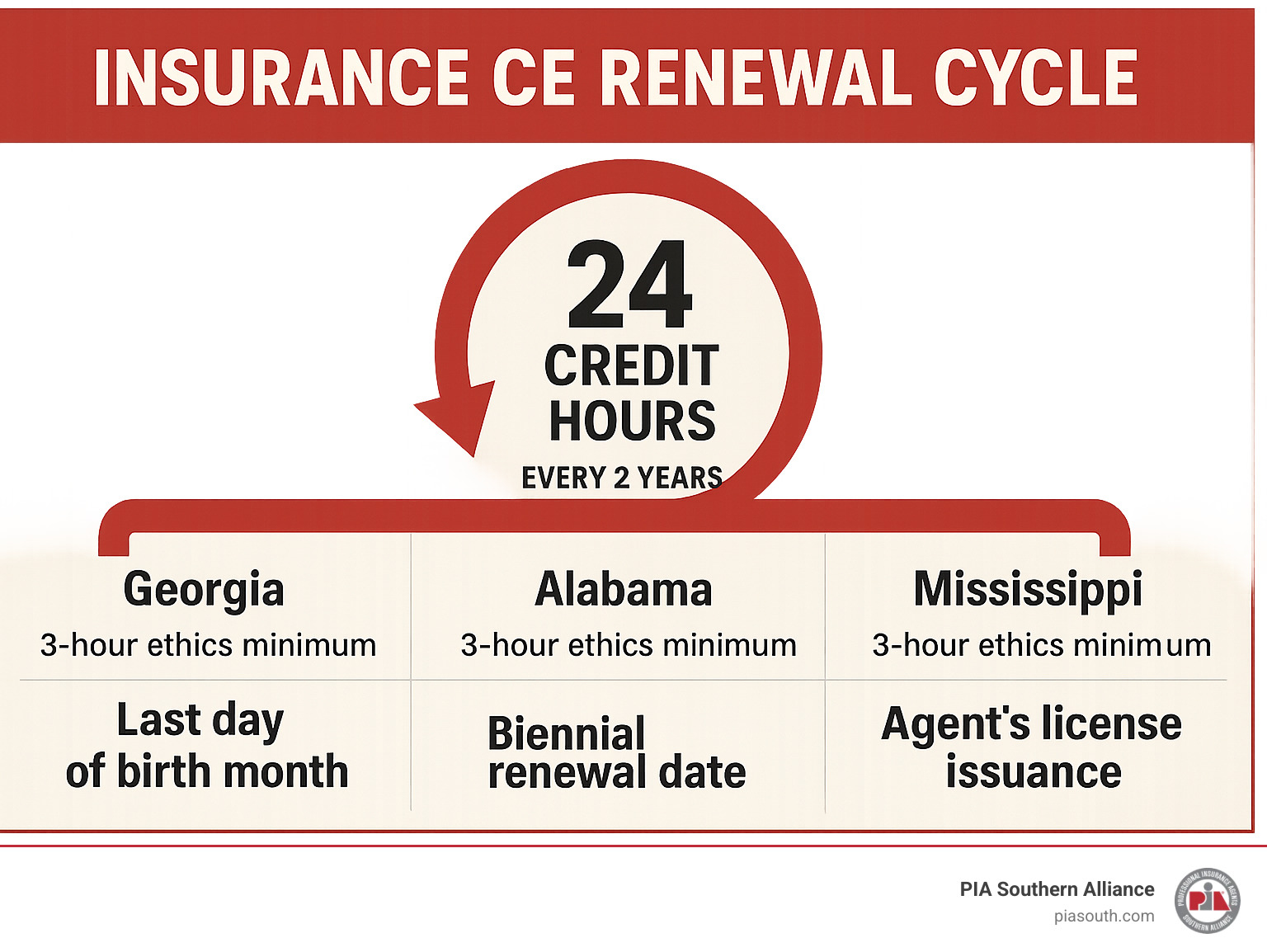
As a licensed insurance professional in Georgia, Alabama, or Mississippi, you know the drill: every two years, you need to complete your continuing education requirements to keep your license active. Most states require 24 hours of CE credits per renewal period, with at least 3 hours in ethics-specific content. Finding convenient insurance CE classes near me can be challenging, especially when balancing client meetings, policy renewals, and running your agency.
I’m with the PIA Southern Alliance, where we specialize in helping independent agents throughout Georgia, Alabama, and Mississippi find and complete their required CE credits efficiently. Our organization has helped thousands of property and casualty agents locate insurance CE classes near me that fit their schedules and specific licensing requirements.
Common Insurance CE classes near me vocab:
- Commercial insurance agent training
- Cross-selling insurance techniques
- ethics course for insurance agents
Why Continuing Education Is Non-Negotiable
Let’s be honest—nobody wakes up in the morning excited about completing insurance CE requirements. But behind those mandatory hours lies something truly valuable for every property and casualty agent in the Southeast.
Continuing education isn’t just paperwork and hoops to jump through. It’s the backbone of what makes you a professional rather than just someone who sells insurance policies. For agents across Georgia, Alabama, and Mississippi, staying current with changing regulations isn’t optional—it’s essential for both protecting your clients and growing your business.
As the Alabama Department of Insurance bluntly puts it: “Continuing Education is required to maintain the eligibility to receive a renewal license unless exempt.” Pretty straightforward, right? This requirement exists across our three southern states because informed agents mean protected consumers.
I recently spoke with a veteran Georgia agent who shared: “At first I viewed CE as a necessary evil, but now I strategically choose courses that help me solve real client problems. Last year’s flood insurance CE course helped me save three commercial clients from significant coverage gaps.” That’s the difference between viewing CE as a burden versus an opportunity.
State CE Basics for Georgia, Alabama & Mississippi
Each state has its own specific requirements that must be followed to the letter. Here’s the breakdown of what you need to know:
| State | Total Hours Required | Ethics Minimum | Renewal Cycle | Carry-Over Allowed? |
|---|---|---|---|---|
| Georgia | 24 hours | 3 hours | Biennial | Yes, up to 12 hours (general only) |
| Alabama | 24 hours | 3 hours | Biennial | No |
| Mississippi | 24 hours (19-24 months licensed); 12 hours (13-18 months licensed) | 3 hours | Biennial | Limited |
In Georgia, you’ll need 24 hours every two years with at least 3 focused on ethics. The Georgia Office of Commissioner of Insurance tracks your credits through your personal biennial compliance period ending on your license expiration date. One nice perk? Georgia allows you to carry over up to 12 general credit hours to your next renewal period.
Alabama keeps it simple with 24 hours of approved CE per biennial period, including 3 ethics hours. But be careful with your planning—Alabama does not allow excess hours to carry over. Once your renewal period ends, any extra credits simply vanish.
Mississippi takes a slightly different approach with a tiered system based on your licensing tenure. If you’ve been licensed for 13-18 months, you need 12 hours of CE. For those licensed 19-24 months, the requirement jumps to 24 hours, always including those critical 3 hours of ethics.
Special Rules for Flood, Annuity & LTC Training
Beyond your standard CE requirements, certain specialty products demand additional training:
Flood Insurance Training is mandatory for property and casualty agents selling through the National Flood Insurance Program. You’ll need a specialized 3-hour NFIP course—typically a one-time requirement, except in Mississippi where it’s required for participation in the NFIP Agent Leads Referral Program.
Annuity Training might seem like it’s just for life insurance folks, but P&C agents who cross-sell these products need to comply too. Georgia, Alabama, and Mississippi have all adopted versions of the NAIC’s revised Suitability in Annuity Transactions Model Regulation. This means a one-time 4-hour course plus product-specific training for each annuity you sell.
Long-Term Care Insurance requires an initial training (usually 8 hours) followed by ongoing education (typically 4 hours every two years). This matters particularly for P&C agents offering comprehensive financial protection packages.
The stakes for non-compliance are serious. One Mississippi agent learned this lesson the hard way: “I didn’t realize my flood insurance training had expired until a client filed a claim. The resulting compliance investigation nearly cost me my license.”
Potential penalties include license suspension or revocation, monetary fines, commission reimbursements, and even E&O claims. That’s why finding convenient Insurance CE classes near me becomes so important—it’s not just about checking boxes, it’s about protecting your livelihood and your clients.
When you approach CE strategically, you transform a regulatory requirement into a competitive advantage that helps you better serve your community while keeping your license in good standing.
How to Calculate Your Required Credit Hours
Figuring out exactly how many CE hours you need isn’t just about hitting a number—it’s about strategically maintaining your professional credentials while minimizing stress. Let’s break this down into something manageable.
Your license anniversary date is your North Star in this process. This date typically determines your CE compliance period, so mark it on your calendar (maybe with a reminder 90 days before!). I’ve seen too many agents scramble at the last minute because they lost track of their timeline.
The type of license you hold matters tremendously. If you’re like many of our readers who maintain multiple lines of authority, you’ll need to track requirements for each. Remember though, completed courses often count toward multiple lines simultaneously—a real time-saver!
Ethics requirements deserve special attention. All three states—Georgia, Alabama, and Mississippi—require at least 3 hours of ethics training each renewal period. I always recommend knocking these out early in your cycle, since they’re non-negotiable regardless of other credits you’ve earned.
For those of you with specialized offerings like flood insurance or annuities, don’t forget your additional training requirements. These don’t replace your standard CE—they’re extra, and forgetting them can cause serious compliance headaches.
New agents often get a welcome break. In Alabama, for instance, if you’ve been licensed less than 12 months when your first renewal comes around, you’re exempt from CE requirements for that first cycle—but you must actively claim this exemption during renewal through NIPR.
Mississippi takes a more graduated approach, with requirements scaling based on how long you’ve held your license: 12 hours for those licensed 13–18 months, and the full 24 hours (including 3 ethics hours) for those licensed 19–24 months.
Teaching can be a hidden opportunity here. If you enjoy sharing knowledge, consider becoming an instructor. In Alabama, teaching an approved CE course earns you the same credits as taking it—a great way to earn while you learn!
Can Extra Credits Roll Over to Next Term?
The rollover question is where our three states really diverge, and getting this wrong can mean wasted time and money.
In Georgia, you’ve got a nice advantage: up to 12 excess CE hours can carry forward to your next period. Here’s the catch though—they always transfer as general hours, not specialty-specific. So if you complete 30 hours this period, you’ll only need to complete 12 more (plus your ethics) next time around. That’s a significant time-saver!
Alabama takes a much stricter approach. As the Alabama Department of Insurance bluntly puts it: “Excess credit hours earned cannot be carried over to the next reporting period; they are lost.” I’ve had agents tell me how painful it was to complete 30+ hours in one period, only to start from zero the next cycle.
Mississippi falls somewhere in between, with limited carryover provisions that vary based on individual circumstances. Your best bet is to contact the Mississippi Insurance Department directly for clarity on your specific situation.
Here’s a planning tip I share with all my agents: If your state allows carryover, still complete your ethics hours early in each new period rather than relying on carryover credits. Ethics must be fresh each compliance period regardless of your total hours.
What Happens If You Miss the Deadline?
Missing your CE deadline is something I strongly urge you to avoid. The consequences can derail your business in ways that far outweigh whatever time you might save by procrastinating.
The most immediate impact is a license lapse. Once your deadline passes without meeting requirements, your license becomes inactive immediately. This isn’t just a technical status—it legally prevents you from selling, soliciting, or negotiating insurance. Imagine explaining to clients why you can’t help them during this period!
Late fees add financial injury to professional insult. Reinstating a lapsed license typically involves substantial fees beyond your normal renewal costs. I’ve seen these range from $50 to several hundred dollars depending on the state and how long you’ve been non-compliant.
The reinstatement process itself can be time-consuming and stressful. You’ll need to complete all missing CE requirements plus follow specific procedures that may include submitting a reinstatement application, paying those additional fees, and potentially retaking licensing exams if your lapse exceeds certain timeframes.
Perhaps most concerning is the increased CE audit risk. Reinstated licenses often trigger automatic CE audits, where you’ll need to provide documentation for all claimed credits. Without proper record-keeping, this can become a nightmare.
A Georgia agent recently shared this cautionary tale with me: “I missed my deadline by just three days. Not only did I pay $250 in late fees, but I couldn’t write new business for two weeks while my reinstatement was processing. One missed commercial opportunity cost me thousands in commissions.”
The bottom line? A little planning now saves enormous headaches later. Set reminders, track your progress, and give yourself a buffer before deadlines. Your future self will thank you!
Finding “Insurance CE Classes Near Me”

Let’s face it—finding convenient CE classes shouldn’t feel like filing a complex claim. When you’re juggling client meetings and policy renewals, the last thing you need is to spend hours hunting down approved courses. I’ve helped hundreds of agents streamline this process, and I’m happy to share the insider tricks to finding quality insurance CE classes near me.
Using State-Approved Provider Tools to Locate Local Options
Each of our three southern states offers reliable tools to find legitimate, approved courses—you just need to know where to look.
In Georgia, the Office of Insurance and Safety Fire Commissioner maintains a searchable database that’s actually quite user-friendly. Head to their website and look under the Licensing section for “Approved Courses & Providers.” You can filter by classroom settings and your specific zip code to find nearby options.
Alabama keeps things simple by partnering with the NAIC for their CE lookup tool. As one Montgomery agent told me, “I was surprised how many classroom options popped up within 15 miles when I filtered correctly.” The tool lets you narrow results by delivery method and location, making it easy to find insurance CE classes near me without endless scrolling.
Mississippi agents should bookmark the Sircon portal system. After logging in, select “Continuing Education Transcript Inquiry” and enter your license information. The system not only shows your current transcript but offers a robust search for upcoming approved courses.
For agents licensed in multiple states, the NAIC State Based Systems (SBS) provides a unified portal for Continuing Education for Insurance Agents. This saves significant time compared to checking each state individually.
When using these official tools, remember to select “Classroom” or “Seminar” for delivery method and enter your zip code with a reasonable radius. Property & Casualty agents should specifically filter by license type to avoid sitting through irrelevant life insurance content.
“Insurance CE Classes Near Me” on the Web: Search Hacks
Beyond the official channels, a few smart search strategies can uncover local options you might otherwise miss.
Google Maps Strategy: This is my personal favorite trick. Type “insurance CE classes” plus your city name directly into Google Maps. This visual approach reveals training facilities you might drive past every day without realizing they offer regular CE programs. One Biloxi agent finded a training center just three blocks from his office this way!
Distance filtering is your friend, especially if you’re in a rural area. Most search engines allow specific “within X miles” parameters. Urban agents in Atlanta or Birmingham might find plenty within 5-10 miles, while those in smaller communities might need to expand to 50 miles.
Don’t overlook the power of reviews. When several local options appear, check what other agents are saying. Look specifically for comments about the relevance to property and casualty topics—there’s nothing worse than sitting through a class that barely touches your daily work realities.
Setting up Google Alerts for specific course topics plus your location (like “commercial property insurance CE Atlanta”) can be a game-changer. This proactive approach means new classes come to you rather than requiring constant checking.
Many CE providers also allow you to register for zip code notifications when in-person classes are scheduled nearby. As one Alabama agent shared, “I set up email alerts with three different providers for classes within 30 miles of Montgomery. Now I get notified about local options before they fill up, which has been a game-changer for planning my CE.”
The Online CE Classes for Insurance Agents page offers additional options if you’re finding limited local classroom availability or need more flexible scheduling. Sometimes the best “near me” option is actually right at your desk!
Finding insurance CE classes near me doesn’t have to be complicated. With these tools and a bit of planning, you can turn this necessary requirement into an opportunity for genuine professional growth—ideally with a minimal commute.
Classroom, Webinar, or Self-Study? Picking the Best Format

Let’s face it—we all learn differently. Some of us thrive in a classroom surrounded by colleagues, while others prefer the comfort of our home office at midnight. When it comes to knocking out those required CE hours, choosing the right format can make the difference between genuinely learning something useful and just checking a box.
“I used to dread CE days,” confesses a veteran agent from Birmingham. “Then I finded webinars that fit my schedule, and it’s been a game-changer for my business and sanity.”
In-Person Learning Benefits for Property & Casualty Pros
There’s something irreplaceable about being in the same room with other insurance professionals who understand your daily challenges. For P&C agents especially, classroom learning offers distinct advantages that online formats simply can’t match.
Networking Opportunities aren’t just about collecting business cards—they’re about building relationships that can transform your business. A Georgia agent recently shared, “I met three commercial lines specialists at a CE class who now send me all their personal lines overflow. That single day of CE has generated over $20,000 in commissions this year.”
The peer discussion element of in-person classes brings policy language to life. When an instructor presents a complex business interruption scenario, hearing how the agent across the table would handle it provides practical insights no textbook can offer. These conversations often continue during breaks, creating impromptu mastermind sessions that tackle real-world challenges.
Many agents appreciate that classroom formats typically use attendance monitoring rather than final exams. “Test anxiety is real, even for successful adults,” notes an instructor in Mississippi. “In-person classes let you demonstrate your engagement through participation instead of memorization.”
The focused learning environment removes the temptations of email notifications, client calls, and office interruptions. “I actually remember what I learned in classroom CE,” admits a Mississippi agent with a laugh. “The online courses I click through are forgotten by the next day.”
Perhaps most valuable for Southern agents is the regional expertise that local instructors bring. When a Biloxi-based teacher discusses Gulf Coast windstorm coverage or a Georgia instructor addresses the state’s specific commercial property endorsements, the content becomes immediately applicable to your book of business.
When Online CE Makes More Sense
While classroom learning has its charm, digital options have revolutionized continuing education access. Online CE Classes for Insurance Agents shine in several key situations.
24/7 accessibility means your continuing education can fit around your life, not the other way around. “Tuesday at 9 AM is prime selling time for me,” explains an Atlanta-based commercial agent. “Being able to complete my ethics requirement at 10 PM after my kids are in bed is invaluable.”
For rural agents in places like southern Georgia or northern Mississippi, online options eliminate long drives. “The nearest in-person class is 90 minutes away,” shares an agent from a small town. “That’s three hours of driving for a three-hour class—hardly efficient.”
When facing an imminent renewal deadline, online self-study becomes a lifesaver. One procrastinating agent confessed, “I finished 12 hours of CE the weekend before my deadline—something impossible with scheduled classes. Not my proudest moment, but it saved my license!”
The automated reporting feature of most online providers means your completion is transmitted to state regulators within 1-2 business days. This quick turnaround can be crucial when you’re cutting it close to renewal time.
From a practical standpoint, digital options offer cost efficiency that’s hard to ignore. Beyond the typically lower registration fees, you’ll save on gas, parking, meals out, and—most importantly—time away from serving clients.
For those seeking a middle ground, Insurance Continuing Education Webinars offer an appealing hybrid. You get the scheduling convenience of online learning with much of the interactivity of live instruction. You can ask questions in real-time, participate in polls, and even network through chat functions—all while wearing your comfortable pants.
“I was skeptical about webinars at first,” admits a veteran agent from Montgomery. “But the quality has improved dramatically. Now I can see the instructor’s screen, ask questions, and even break into discussion groups with other participants. It’s almost like being there, minus the mediocre coffee.”
Whether you prefer the energy of a classroom, the convenience of self-study, or the balanced approach of webinars, the key is choosing a format that keeps you engaged enough to actually learn something useful for your clients. After all, that’s what continuing education is really about—becoming a better agent, not just maintaining a license.
Registering, Reporting, and Staying Compliant
You’ve found the perfect insurance CE classes near me – now what? Let’s walk through how to register and make sure those hard-earned credits actually count toward your license renewal.
Most CE courses cost between $15-$50 per credit hour, but here’s a money-saving tip: look for package deals. Many providers offer complete 24-hour packages (ethics included) for just $69-$99. For the cost-conscious agent, that’s like getting your entire biennial requirement for the price of a nice dinner!
Before pulling out your credit card, though, take a moment to verify the provider’s state approval status. Every legitimate CE provider has a unique identification number in state databases, and each course has specific approval codes. I’ve heard too many horror stories of agents completing courses only to find they weren’t approved in their state – talk about wasted time and money!
Step-by-Step Registration Guide
Registering for insurance CE classes near me is straightforward when you know the process:
Start by browsing the course catalog and selecting topics relevant to your practice. If you specialize in commercial property or general liability, focus on courses that will actually benefit your day-to-day work rather than just checking a box.
Always double-check that the course is approved for your specific state and license type. The Georgia approval code won’t help you if you need Alabama credits!
Once you’ve selected your courses, complete the checkout process – most providers accept major credit cards and sometimes agency checks. After payment, you’ll receive a confirmation email with all the details you need: course access information for online classes or location and parking details for in-person sessions.
Don’t forget to add webinar times or classroom dates to your calendar right away. I can’t tell you how many agents have paid for courses they ended up missing because they forgot to block the time.
For classroom courses, arrive 15-30 minutes early for check-in. State regulations require precise attendance tracking, and most in-person classes require a photo ID matching your license name. Nothing’s worse than driving across town only to be turned away because you forgot your driver’s license!
How Your Credits Get to the State
The magic of modern technology means you rarely need to worry about mailing certificates anymore. Here’s how your completed credits reach state regulators:
Most state-approved providers report course completions electronically within 10 days, though many do so within 24-48 hours. Georgia, Alabama, and Mississippi all use electronic reporting systems (Sircon or NAIC SBS) that automatically update your transcript once the provider submits your completion data.
Always verify your CE transcript through your state’s online portal before your renewal date. As the Alabama Department of Insurance wisely advises, “You can view and print your CE transcript via the NAIC License Manager link before renewing your license.” This simple step has saved countless agents from last-minute panic.
If completed credits don’t appear on your transcript, don’t immediately blame the state. Contact the provider first – they can provide a completion certificate and confirmation of submission. If the provider confirms reporting but credits still don’t appear, then it’s time to contact your state insurance department.
Even after successful renewal, keep all CE completion certificates for at least five years. State departments conduct random CE audits, and you’ll be grateful to have that documentation when the auditor calls.
For the budget-minded agent (and who isn’t these days?), Free Insurance CE Webinars occasionally become available through industry partners and associations. These can substantially reduce your compliance costs while still delivering quality education. At PIA Southern Alliance, we regularly update our members about these opportunities to help independent agents manage their educational expenses.
Staying compliant doesn’t have to be complicated or expensive when you understand the process and plan ahead. Your license is the foundation of your insurance career – protecting it with proper CE compliance is simply good business.
Frequently Asked Questions about Insurance CE Classes Near Me
How often must I renew my insurance license in GA, AL, or MS?
All three states operate on a biennial (two-year) renewal cycle. In Georgia and Alabama, your renewal deadline aligns with your original license issue date. Mississippi bases renewal timing on your license’s effective date, with requirements adjusted based on how long you’ve held your license.
I’ve heard some clever approaches from experienced agents about tracking these important dates. One property and casualty agent in Alabama shared, “I track my renewal date in three places—my digital calendar with alerts 90, 60, and 30 days out, a paper calendar in my office, and through my agency management system. Triple redundancy prevents any surprises.” This might seem excessive, but when your livelihood depends on maintaining an active license, it’s better to be over-prepared!
Can I take an online course approved in another state for local credit?
Generally, no. Each state has its own approval process for CE courses and providers. This is one of the most common misconceptions I hear from agents who are licensed in multiple states.
There are some exceptions worth noting:
- Many providers obtain multi-state approvals for their courses, meaning the same course content is independently approved in Georgia, Alabama, and Mississippi
- Some states have reciprocity agreements for non-resident licensees
- Certain national designations (like CPCU) may receive automatic credit in some jurisdictions
The golden rule here is verification. Always check a course’s approval status in your specific state before enrolling. As the Mississippi Insurance Department notes, you should “use the Sircon portal to look up approved CE providers and courses” to ensure compliance. Nothing’s worse than completing hours that don’t count toward your requirement!
Are there CE waivers for veterans or long-time agents?
Limited exemptions exist in our three southern states, but they’re not as generous as they once were. Let’s break it down by state:
Georgia: Georgia offers limited exemptions for certain license types and specific situations. For the most current information on your particular circumstances, it’s best to contact the Georgia Office of Insurance directly.
Alabama: Alabama provides a helpful exemption for new licensees: “Individuals licensed for less than 12 months at the time of their first renewal are exempt but must claim it during renewal via NIPR.” This gives new agents a bit of breathing room during their first year in business.
Mississippi: Mississippi has a graduated system based on license tenure. Those licensed less than 12 months are generally exempt from their first renewal’s CE requirements. Agents licensed 13-18 months need 12 hours, while those licensed 19-24 months need the full 24 hours including ethics.
If you’re a military veteran, you may qualify for exam fee reimbursements through the Department of Veterans Affairs, but this applies to initial licensing rather than ongoing CE requirements. As the Mississippi Insurance Department explains, “The Department of Veterans Affairs can reimburse veterans for taking an insurance licensing exam” by completing VA Form 22-0803.
One important note for seasoned agents: the days of “grandfather clauses” are largely gone. Even if you’ve been selling property and casualty insurance since before computers existed, you’ll still need to complete your CE requirements. The industry changes too rapidly to allow for experience-based exemptions in most cases.
Staying current with your education isn’t just about checking a box—it’s about providing the best possible service to your clients in an changing insurance landscape.
Conclusion

Finding insurance CE classes near me doesn’t need to feel like a last-minute treasure hunt. With the right approach, continuing education transforms from a dreaded requirement into a valuable opportunity to sharpen your professional edge.
Think about the last time you completed your CE hours with days to spare. Feels good, doesn’t it? That peace of mind is available to every agent who takes a strategic approach to their education requirements.
The path to stress-free compliance starts with understanding your specific state requirements. Whether you’re in the peach orchards of Georgia, the rolling hills of Alabama, or the Mississippi delta, knowing your exact hour requirements and deadlines is step one in your CE success plan.
Format flexibility is your friend. Some days, nothing beats the energy of an in-person classroom where you can swap war stories with fellow agents. Other times, a midnight webinar after the kids are asleep might be your only option. Both paths lead to compliance—choose what works for your life.
One Mississippi agent told us: “I used to dread CE season until I started planning my courses six months ahead. Now I actually look forward to the classes as a break from selling, and I’ve picked up commercial coverage insights that have helped me win new business.”
Smart agents also recognize the importance of verification. After completing any course, take those extra five minutes to check your state transcript online. This simple habit has saved countless agents from renewal panic when credits mysteriously fail to appear.
Documentation is your safety net. Even in our digital age, keeping those completion certificates for five years provides peace of mind that’s worth the minimal storage space they require. One folder in your filing cabinet might save you hours of stress during a random state audit.
At PIA Southern Alliance, we understand the unique challenges facing independent agents across Georgia, Alabama, and Mississippi. Our organization is built around supporting your success—not just in meeting minimum requirements, but in truly expanding your professional capabilities through relevant, practical education.
The best agents don’t just complete CE—they leverage it to become better risk advisors. They select courses strategically, focusing on emerging risks and coverage innovations that can directly benefit their clients. This approach transforms regulatory compliance into competitive advantage.
Ready to get ahead of your CE requirements? Visit our education calendar to find upcoming opportunities designed specifically for property and casualty professionals in your region.
Your license represents your livelihood—and your CE credits protect that license. With thoughtful planning and the resources we’ve shared, you can ensure your professional knowledge stays as current as your credentials.