
For insurance professionals seeking a competitive edge, certified insurance counselor online courses offer an accessible, effective path to the prestigious CIC designation. These courses help sharpen your skills in planning, claims handling, and customer service across crucial areas like agency management, commercial property, and personal lines. With numerous online options, professionals in Georgia, Alabama, and Mississippi can dig into specialized learning modules without disrupting their busy schedules.
Key Benefits of CIC Online Courses:
- Flexibility: Self-paced learning that fits your timetable.
- Comprehensive Coverage: Five essential courses covering different aspects of insurance.
- Career Advancement: Improved expertise leads to more opportunities.
I’m Scott Hansard, an advocate for empowering independent agents in the insurance industry. Through years of supporting agencies in Georgia and beyond, I can assure you that investing in certified insurance counselor online courses can dramatically boost your agency’s strategies and client relationships.
Easy certified insurance counselor online courses word list:
– cic insurance designation online courses
– how does an insurance agent get the cic designation
– insurance certification programs
Understanding the CIC Designation
The Certified Insurance Counselor (CIC) designation is a highly respected professional credential in the insurance industry. It signifies a comprehensive understanding of complex insurance topics and demonstrates a commitment to excellence. This credential is particularly valuable for those working in insurance agencies across Georgia, Alabama, and Mississippi, where the demand for knowledgeable professionals is high.
Why Pursue a CIC Designation?
Professional Credential: The CIC designation is more than just letters after your name. It’s a mark of expertise that distinguishes you from your peers. It shows that you have a deep understanding of key areas in the insurance field, from agency management to commercial property.
Insurance Agency Advantage: For agency owners and producers, having a CIC designation within your team can significantly improve your agency’s credibility and client trust. It signals to clients that your agency is committed to providing informed and reliable advice.
Comprehensive Knowledge: Achieving the CIC designation requires completing five rigorous courses. These courses cover crucial areas like commercial casualty, personal lines, and life & health, providing a well-rounded education. This comprehensive knowledge equips insurance professionals to tackle a wide range of challenges and deliver exceptional service.
The journey to earning a CIC designation involves dedication and strategic learning. By understanding its value, insurance professionals can position themselves as industry leaders, ready to meet any challenge with confidence and skill.
In the next section, we will explore the various certified insurance counselor online courses available, focusing on how these flexible learning options can help you earn this esteemed designation while balancing your professional commitments.
Certified Insurance Counselor Online Courses
Earning the Certified Insurance Counselor (CIC) designation is a significant milestone for insurance professionals. Fortunately, there are certified insurance counselor online courses that make this goal more accessible than ever. These courses offer self-paced, flexible learning custom to fit around your busy schedule.
Self-Paced Learning
The beauty of self-paced courses is their flexibility. You can learn at your own speed, making it easier to juggle work, family, and other commitments. These courses are designed to let you dive deep into insurance topics, such as commercial property and casualty, whenever it suits you best.
Study Anywhere, Anytime: With online training, you can access materials on any device. Whether you’re at home in Georgia, at the office in Alabama, or traveling in Mississippi, your coursework is just a click away.
Structured Yet Flexible: While the courses are flexible, they are also well-structured. You have a clear path to follow, ensuring you cover all necessary content to prepare for the CIC exams.
Online Training
Online training is not just about reading materials. It’s an interactive experience that can include videos, quizzes, and discussion forums to improve your understanding.
Engaging Content: Expect to find engaging content that makes complex insurance topics easier to grasp. This interactive approach helps reinforce your learning and keeps you motivated.
Expert Guidance: Many courses offer access to instructors who are experts in the field. They can provide insights and answer questions, helping you gain a deeper understanding of the material.
Flexible Learning
Flexibility is key for many professionals seeking the CIC designation. Online courses allow you to fit your studies into your life, not the other way around.
Adapt to Your Schedule: You can pause and resume your studies as needed. This adaptability means you can focus on learning when you’re most alert and ready to absorb information.
Meet Professional Goals: By choosing online, self-paced courses, you position yourself to meet your professional goals without sacrificing your personal time.
In the next section, we’ll dig into how to earn your CIC designation, including the courses you need to complete and the exams you’ll need to pass to achieve this respected credential.
How to Earn Your CIC Designation
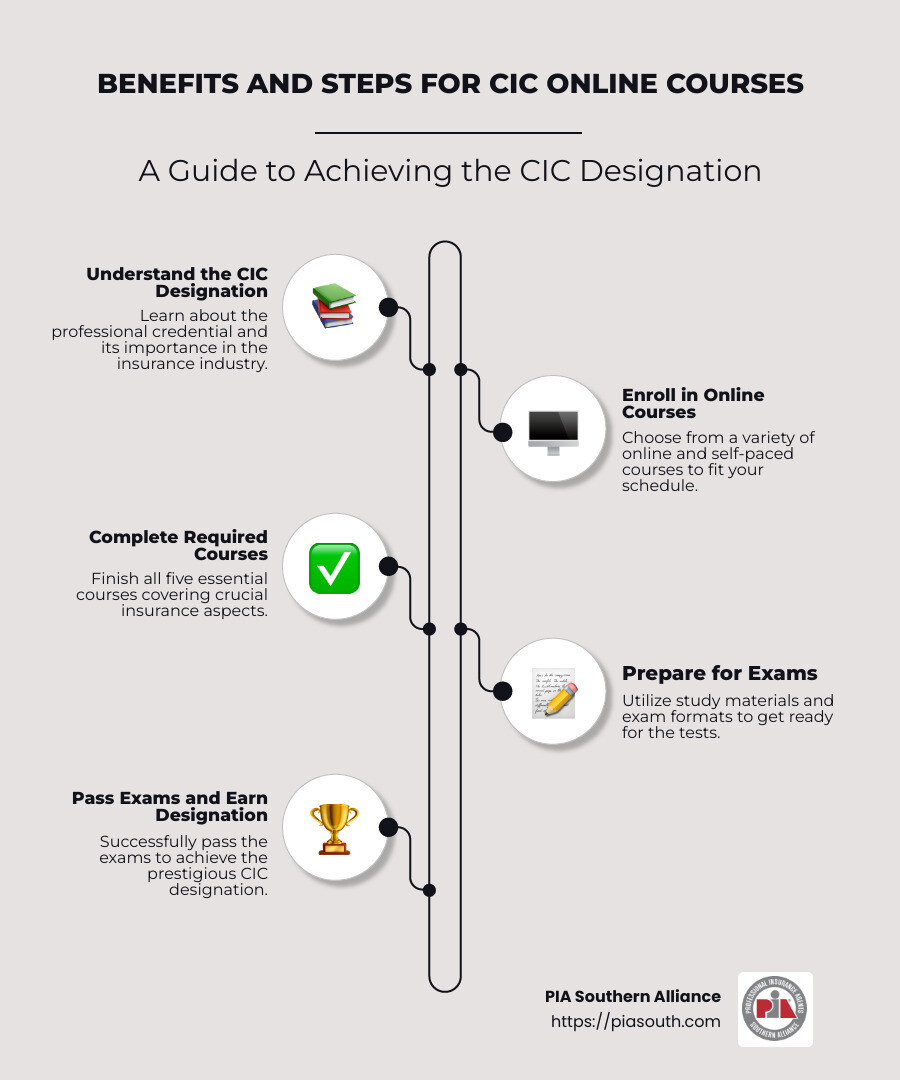
Earning the CIC designation involves a structured yet flexible path. You’ll need to complete five courses and pass their corresponding exams. Here’s how you can achieve this professional milestone:
Five Courses to Master
To earn your CIC designation, you must complete five out of seven available courses. Each course focuses on a different aspect of the insurance industry, providing a comprehensive understanding of the field. The courses include:
- Agency Management
- Commercial Casualty
- Commercial Property
- Personal Lines
- Life & Health
- Insurance Company Operations
- Commercial Multiline
Note: You can choose any five courses that align with your career goals. This flexibility allows you to tailor your learning experience to your interests and needs.
Exam Requirements and Passing Criteria
Each course concludes with an exam that you must pass to earn credit toward your CIC designation. Here’s what you need to know about the exams:
Exam Format: Most exams consist of essay-style questions. You will need to showcase both your factual knowledge and your ability to apply it in real-world scenarios.
Scoring: To pass, you must achieve at least 70% on each exam. This means scoring 140 out of 200 possible points.
Attempts: Candidates typically have two opportunities to pass each exam, providing a safety net if you don’t succeed on your first try.
Proctored Exams: All exams require a proctor to ensure the integrity of the testing process. This means you’ll need to plan ahead to schedule your exam time and secure a proctor.
Flexible Completion Timeline
You have five years from the date you pass your first exam to complete all five courses. This extended timeline allows you to balance your studies with your professional and personal responsibilities.
Choosing Your Path
You also have the option to substitute one of the CIC courses with a CRM (Certified Risk Manager) or CPRM (Certified Personal Risk Manager) course. This choice can broaden your expertise and open additional career opportunities.
By completing these courses and passing the exams, you not only earn a respected credential but also gain in-depth knowledge that will improve your professional capabilities.
In the next section, we’ll explore how to effectively prepare for the CIC exams, ensuring you have the best chance of success.
Preparing for the CIC Exams
Getting ready for the CIC exams might seem daunting, but with the right strategies and resources, you can set yourself up for success. Let’s break down the key elements of preparation: study materials, exam format, and preparation tips.
Study Materials
To ace the CIC exams, you’ll need to dive into comprehensive study materials. These resources are designed to give you a full grasp of the complex insurance topics you’ll encounter.
Executive Summaries: These provide concise overviews of each course, highlighting core concepts and crucial details.
Self-Study Guides: Custom for each course, these guides help you focus on essential topics and practice applying what you’ve learned.
Practice Quizzes: Regular self-assessment through quizzes can reinforce your knowledge and identify areas needing more focus.
Tip: Use flashcards to memorize key terms and concepts. This method is particularly effective for retaining information.
Exam Format
Understanding the exam format is crucial to tackling it effectively. Here’s what you need to know:
Essay-Style Questions: Each exam includes essay questions, requiring you to explain concepts clearly and apply them to practical scenarios.
Point System: Exams are scored out of 200 points, with a passing score of 140 points (70%).
Time Management: You have two hours to complete each exam. Practice managing your time to ensure you can thoughtfully answer each question.
Preparation Tips
Preparation is key to passing the CIC exams. Here are some tried-and-true strategies:
Start Early: Begin studying several weeks before your exam date. This gives you ample time to absorb the material and revisit challenging topics.
Form Study Groups: Collaborate with peers to discuss difficult concepts and share insights. This can deepen your understanding and keep you motivated.
Simulate Exam Conditions: Practice answering essay questions under timed conditions. This will help you get comfortable with the format and improve your time management skills.
Focus on Instructor Emphasis: Pay attention to the topics your instructors highlight during courses. These are likely to be important on the exams.
By following these preparation tips and using the right study materials, you’ll be well-equipped to tackle the CIC exams with confidence. Consistent study habits and a clear understanding of the exam format are your best allies in earning your certification.
In the next section, we’ll address some frequently asked questions about the CIC designation, helping you steer your path to becoming a Certified Insurance Counselor.
Frequently Asked Questions about CIC
How do I become an insurance counselor?
To become a Certified Insurance Counselor (CIC), you’ll need to complete a series of steps designed to ensure you have the necessary expertise and skills. Here’s how it works:
Enroll in CIC Courses: Start by enrolling in the five required CIC courses. These courses cover key areas like Agency Management, Commercial Casualty, Commercial Property, Personal Lines, and Life & Health. You can choose to take these courses online for flexibility.
Pass the Exams: After completing each course, you’ll take an exam. These exams are essay-style, and you’ll need to score at least 70% to pass. You have five years to complete all five exams, so pace yourself.
Earn the Designation: Once you’ve passed all five exams, you’ll earn your CIC designation, marking you as an expert in the insurance field.
Is the CIC designation worth it?
Absolutely! The CIC designation is highly respected in the insurance industry. Here’s why it’s worth pursuing:
Professional Expertise: Completing the CIC program demonstrates a deep understanding of complex insurance topics. This expertise makes you a valuable asset to any insurance agency or company.
Career Opportunities: With the CIC designation, you stand out in the job market. It opens doors to advanced roles, higher salaries, and the potential to start your own agency.
Increased Earning Potential: CIC designees often earn more than their non-certified peers. This is because clients and employers value the knowledge and credibility that comes with the designation.
What are the continuing education requirements for CIC?
Maintaining your CIC designation requires ongoing education. Here’s what you need to do:
Annual Courses: CIC designees must complete at least one approved course each year. This could be one of the CIC institutes, a James K. Ruble Seminar, or other recognized programs.
Certification Maintenance: Keeping your certification current ensures you stay up-to-date with industry trends and continue to offer top-notch advice to clients.
By fulfilling these continuing education requirements, you’ll maintain your status as a trusted and knowledgeable insurance professional. This commitment to learning not only benefits your career but also improves your ability to serve your clients effectively.
In the next section, we’ll explore how the PIA Southern Alliance can support your journey with valuable educational resources and strategic insights.
Conclusion
At PIA Southern Alliance, we are committed to empowering insurance professionals in Georgia, Alabama, and Mississippi with the tools they need to excel. Our focus is on providing educational resources and development programs that improve your skills and boost your career.
Strategic decision-making is key to success in the insurance industry. Our courses and webinars are designed to improve your ability to make informed choices, especially in areas like commercial property insurance. By honing your cross-selling abilities, you can increase your agency’s profitability and better serve your clients.
We offer a range of self-paced courses that fit your schedule, allowing you to earn the prestigious Certified Insurance Counselor (CIC) designation at your own pace. This flexibility ensures you can balance your professional and personal commitments while advancing your career.
Our commitment to your success doesn’t stop at education. We also advocate for independent insurance agencies, ensuring you have the support you need to thrive in a competitive market. Whether you’re looking to improve your agency’s strategic planning or develop effective talent acquisition strategies, we have the resources to guide you.
Ready to take your insurance career to the next level? Explore our professional designations and educational programs today and let PIA Southern Alliance be your partner in building a successful agency.