
A client calls at 4:30 p.m. They need a certificate before a contract can be signed. The contract administrator has marked up the request with extra wording, broader status, and dates that don't match the policy. Your CSR wants to help. Your producer wants to keep the account happy. Your carrier expects the certificate to reflect the policy exactly. That tension is where ACORD forms stop being paperwork and start becoming an agency liability issue.
For independent agencies, especially those growing fast, the question usually isn't just what is an ACORD form. Instead, the question is whether your team understands what an ACORD form can do, what it cannot do, and how one rushed certificate request can turn into an E&O problem. The forms themselves are familiar. The risk comes from shortcuts, assumptions, and trying to satisfy third parties with wording the policy doesn't support.
Table of Contents
- The Daily Reality of ACORD Forms in Your Agency
- What Are ACORD Forms and Why Do They Matter
- Common ACORD Forms Every Agency Uses
- How to Complete ACORD Forms Correctly
- E&O Risks and Compliance Best Practices
- Streamlining Your Agency's ACORD Workflow
The Daily Reality of ACORD Forms in Your Agency
A new account lands in your office. The insured is ready to start work, but the project owner won't release them until a certificate arrives. Then the email comes in with familiar language: show additional insured status, confirm waiver wording, note special terms, and send it today.
That request sounds routine until the policy file says something else. The endorsement hasn't been issued. The effective date is later than the contract requires. The client insists the job can't wait. If your staff treats the ACORD 25 as a favor instead of a legal communication, the agency can end up owning a problem it didn't create.
Why these requests create pressure
Independent agencies sit between competing expectations:
- The client wants speed. They often see the certificate as the final hurdle to getting paid or starting work.
- The certificate holder wants certainty. They may ask for language that reads like coverage confirmation, contract interpretation, or legal advice.
- The carrier wants accuracy. The form must reflect the actual policy and endorsements, not the deal the client hopes they bought.
When agencies lose discipline here, trouble starts. A rushed certificate can misstate a date, list unsupported status, or imply rights the policy doesn't grant. None of those errors feel dramatic when the form is emailed. They become dramatic later, when a claim, audit, lender review, or contract dispute exposes the mismatch.
Practical rule: If a certificate request makes you compare the contract to the policy, slow down. That's usually where E&O exposure begins.
New agencies sometimes assume ACORD forms are basic admin work. Experienced agencies know better. Certificate handling is a front-line compliance function, and the people issuing forms need the same caution they'd use with endorsements, applications, and coverage discussions.
What Are ACORD Forms and Why Do They Matter
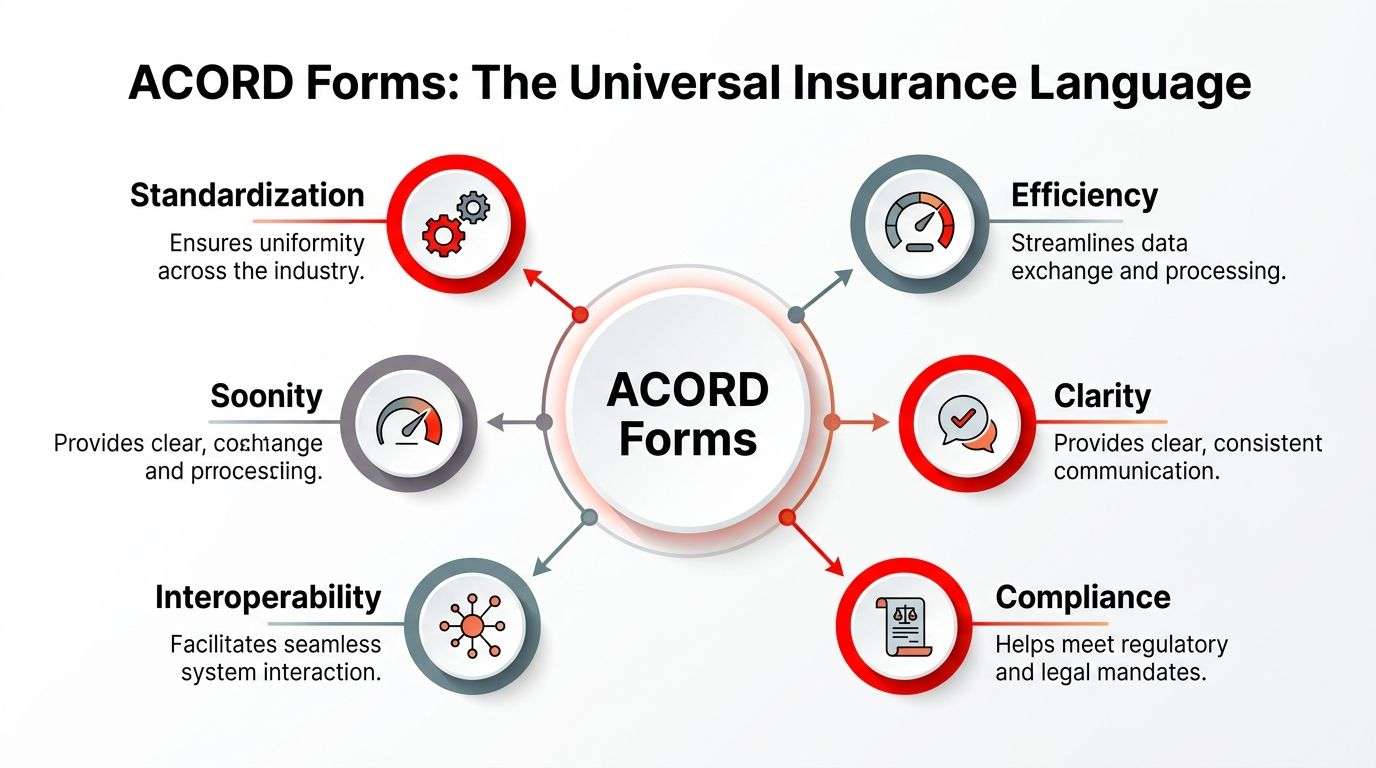
ACORD forms are standardized insurance documents used across the industry so carriers, agents, brokers, and other parties can exchange information in a consistent format. ACORD is a non-profit organization founded in the 1970s that replaced inconsistent company-specific forms with standardized documents. Today, it maintains a library of over 1,200 standardized transaction types for global insurance data exchange, according to ACORD background information on Wikipedia.
The industry's universal translator
The easiest way to understand what is an ACORD form is to think of it as a universal translator for insurance operations. Without standard forms, every carrier and broker would rely on proprietary layouts and field names. That would force agency staff to relearn document structure every time they moved between markets or lines of business.
Standardization solves several daily problems at once:
| Function | Why it matters to agencies |
|---|---|
| Consistent layout | Staff know where to find key information quickly |
| Shared data language | Carriers receive information in a predictable format |
| Lower error risk | Standard fields reduce improvisation and missing details |
| Operational continuity | Multi-carrier submissions become manageable |
That standardization matters most in busy commercial shops. A producer can gather information once, your service team can process it consistently, and the receiving underwriter or certificate holder sees a familiar structure. When the form itself is predictable, mistakes are easier to spot.
Why agencies depend on them
Some forms support submissions. Others provide evidence of insurance. Others help verify property or liability coverage for third parties. The common thread is that they let different parties work from the same template instead of negotiating document structure every time.
Agencies don't rely on ACORD forms because they're glamorous. They rely on them because standardization reduces confusion when speed and accuracy both matter.
That matters for compliance, too. A standard form helps your team separate what belongs on the document from what doesn't. That's one reason ACORD forms are so important in E&O prevention. They create boundaries. When staff stay inside those boundaries, the agency is in a stronger position. When staff start customizing language outside the form's purpose, the protective value of standardization disappears fast.
Common ACORD Forms Every Agency Uses
In most independent agencies, a small group of ACORD forms shows up constantly. New staff need to know what each one is for, who relies on it, and where agencies get into trouble by treating one form like another.
ACORD 25 and third-party proof of liability coverage
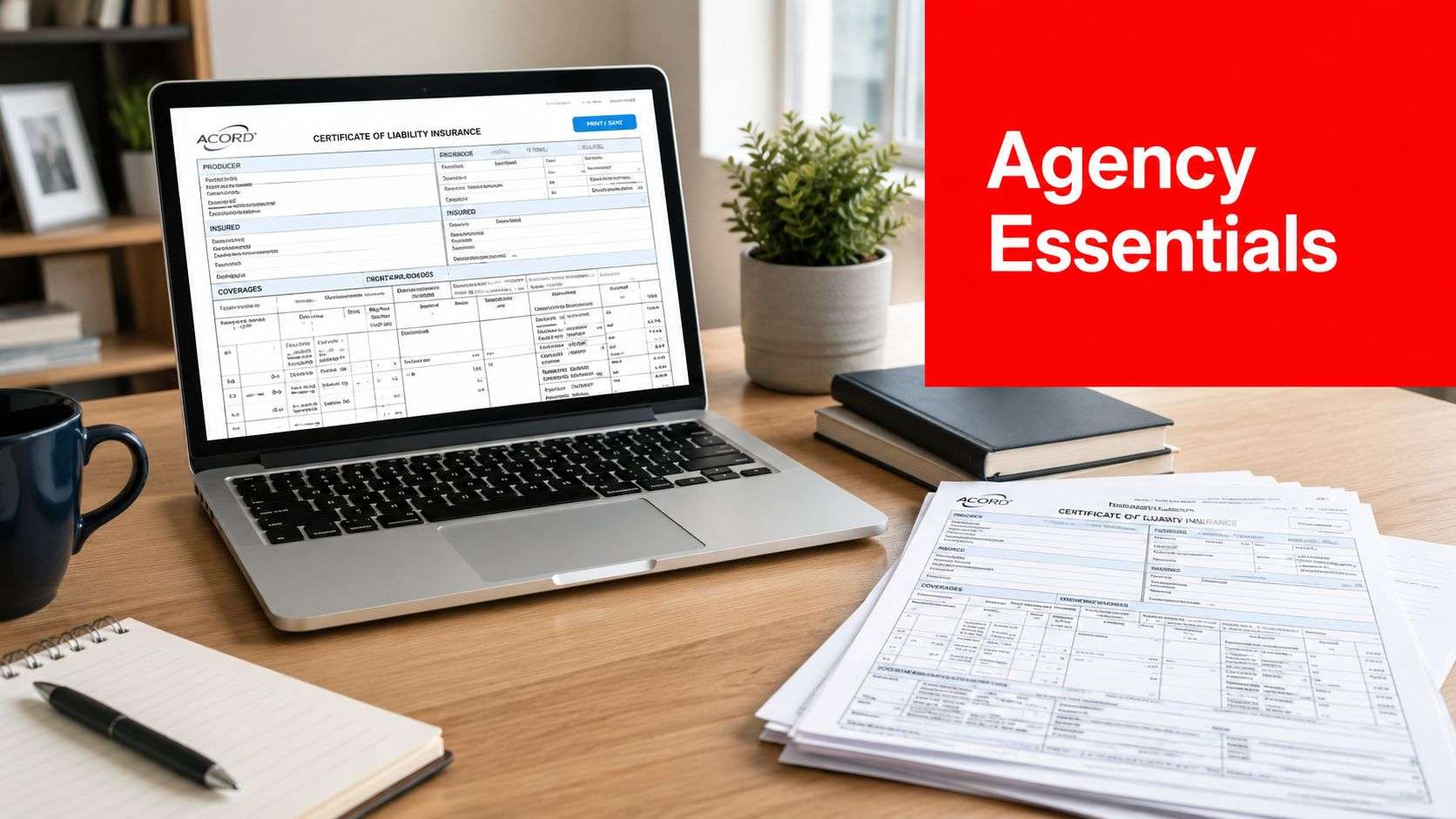
The ACORD 25 Certificate of Liability Insurance is the form agencies issue when a third party needs evidence that liability coverage exists. It summarizes key policy elements such as coverage types, policy numbers, limits, and effective and expiration dates, but it does not amend or expand the policy terms, as explained in Insureon's overview of the ACORD 25.
This is the form that creates the most day-to-day agency pressure because certificate holders often treat it as if it grants rights. It doesn't. It reflects coverage already in force.
Use it when:
- A client signs a contract and must show liability coverage to an owner, landlord, or vendor
- A third party needs quick verification rather than a full policy copy
- The request fits the policy as written and any referenced status is supported by endorsement
If your team fields certificate requests often, it helps to keep a clear process for ACORD insurance claims phone number and form-related resources so staff know where to find the right support information without improvising.
ACORD 27 and evidence of property insurance
The ACORD 27 serves a similar role for property coverage. Lenders and other interested parties often ask for it when they need evidence that property insurance exists. Its value is practical: everyone reviewing it sees the same layout, with the same categories in the same places.
For agencies, the main lesson is to avoid substituting one proof form for another. Liability evidence and property evidence aren't interchangeable, even if the request sounds informal over the phone. Misusing the form creates confusion at exactly the moment a third party wants certainty.
ACORD 125 and the start of a commercial submission
The ACORD 125, commonly known as the Commercial Insurance Application, is the foundational document for commercial underwriting. It gives underwriters the applicant details they need to evaluate risk, coverage needs, business operations, and prior loss information, according to Regure's explanation of ACORD 125 and standardized data exchange.
For agencies, this form does two jobs at once. It starts the submission process, and it forces discipline in data gathering. If the legal entity name, operations, prior coverage, or loss history are incomplete here, every downstream form and coverage discussion gets weaker.
The practical difference between them
These forms often pass through the same hands, but they do different work.
- ACORD 125 starts the underwriting conversation.
- ACORD 25 proves liability coverage to a third party.
- ACORD 27 proves property coverage to a third party.
That distinction matters. An application is where you build the account correctly. A certificate is where you communicate what exists. Agencies create avoidable risk when they blur those roles and start using a certificate to fill gaps that should have been addressed by underwriting, endorsements, or policy review.
How to Complete ACORD Forms Correctly
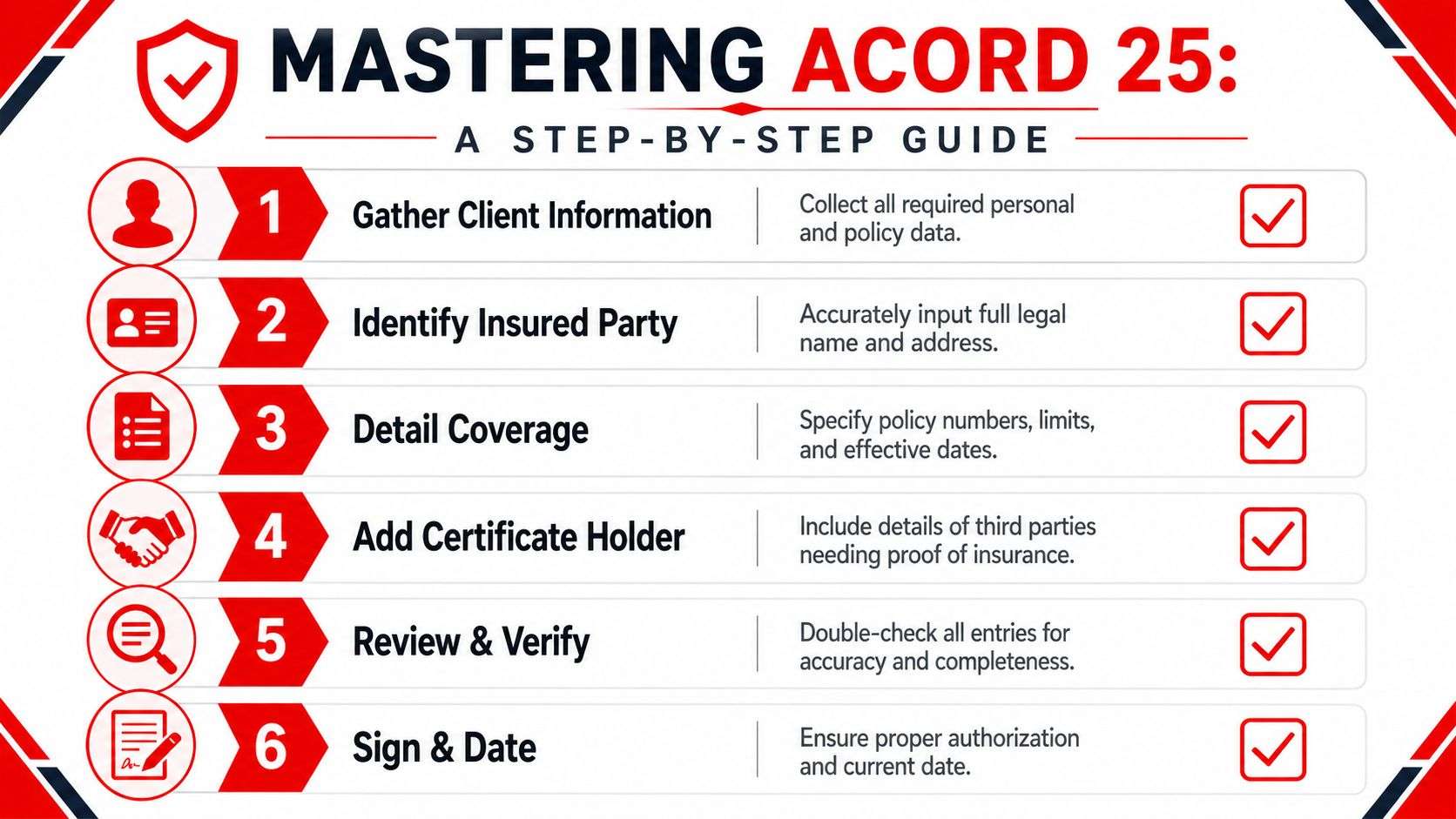
Accuracy on an ACORD form starts before anyone types into a field. The form should mirror the policy, not the requestor's wish list, the producer's memory, or the insured's summary of what they think was purchased.
Match the policy before you touch the form
On an ACORD 25, the most important fields are usually the ones staff assume are simple. They aren't.
Start with a clean verification process:
- Confirm the named insured exactly as shown on the policy. Trade names, nicknames, and partial entity names cause problems.
- Verify the producer information. The issuing office should be clear and current.
- Pull policy numbers directly from the declarations or carrier-issued record. Never rely on an older certificate as your source.
- Check effective and expiration dates. Rushed requests commonly go wrong here.
- Match limits to the policy. Don't round, shorten, or paraphrase.
A disciplined reviewer also checks whether the certificate holder is asking for something outside the policy. Additional insured status, waiver wording, and special notice language should only appear if the policy and endorsements support them.
The certificate should be the last step in confirming coverage, not the first step in promising it.
Use the designated sections and nothing else
The structure of the form matters. Regulatory and operational mandates strictly prohibit modifying the standard ACORD layout. Insurers may add company-specific information in designated areas, but changing the form's structure defeats the standardization that makes it reliable, as noted in Kolena's guide to ACORD form rules and layout limits.
That means your staff shouldn't improvise with custom boxes, altered labels, or rewritten sections to satisfy a demanding contract reviewer. If special information belongs anywhere, it belongs in the form's designated description area and only when the underlying policy supports it.
A simple control helps here. Keep one approved certificate procedure that includes:
- A policy-first review before issuing any evidence form
- A second review for unusual requests such as manuscript wording or contract-specific demands
- A current-form check so staff aren't pulling outdated versions from old folders
- A standard training reference for certificate of insurance templates and certificate handling guidance
What doesn't work is allowing every CSR or producer to develop their own certificate style. That's how agencies end up with inconsistent wording, undocumented exceptions, and forms that say more than the policy does.
E&O Risks and Compliance Best Practices
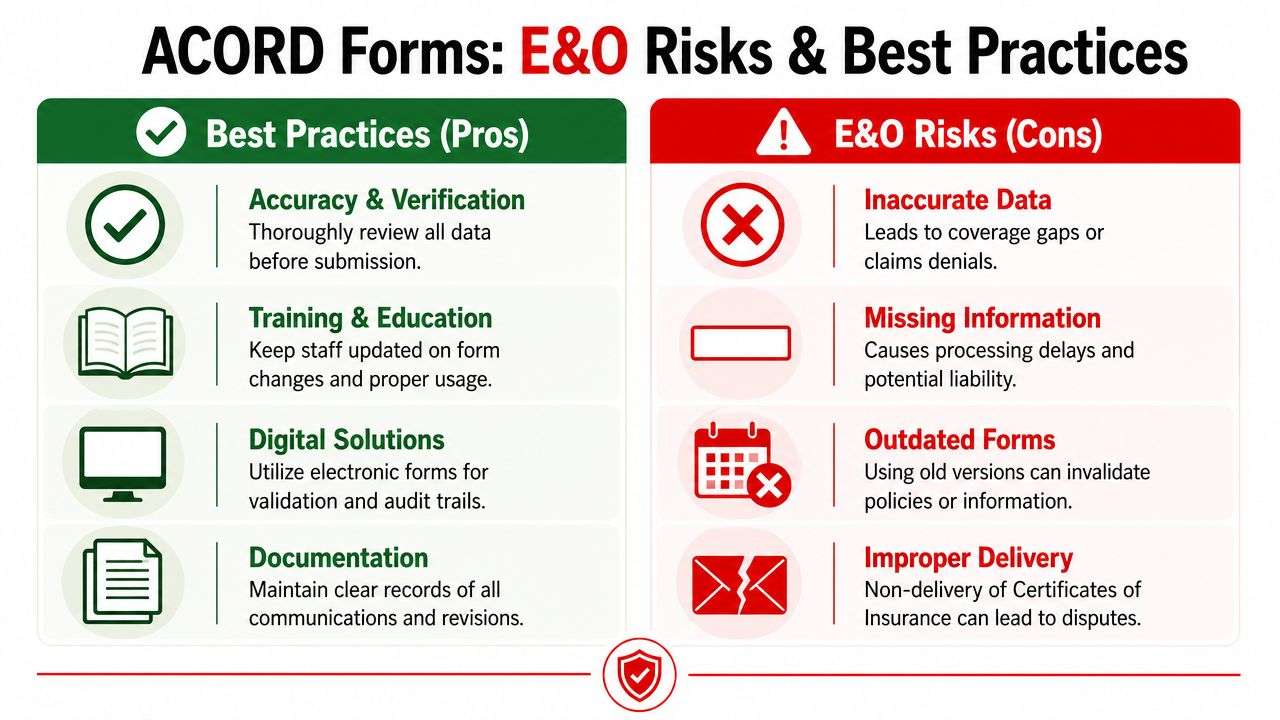
The biggest ACORD risk in independent agencies isn't ignorance of the form name. It's the false comfort that certificates are simple. They aren't. They are often the document a third party relies on when deciding whether to release a contract, fund a loan, or allow work to begin.
The most dangerous misunderstanding
A critical compliance problem arises when people treat an ACORD form as if it were the insurance itself. It isn't. The form is standardized evidence that coverage exists, not the policy. That misunderstanding creates serious exposure around forged certificates, expired coverage, and unsupported assumptions about rights or status, as described in Insly's glossary entry on ACORD forms and compliance gaps.
For agency staff, that misconception creates several traps:
- Clients think the certificate grants coverage. They may assume a job can proceed because the form was issued.
- Certificate holders read beyond the document. They may treat the certificate as confirmation of contract compliance in full.
- Staff feel pressure to satisfy everyone. That pressure leads to shortcuts, verbal assurances, or wording the policy doesn't support.
When a claim happens, nobody cares that the request felt routine on a busy afternoon. They care whether the agency issued an accurate document and documented what was requested, what was denied, and why.
What disciplined agencies do differently
Agencies with strong certificate controls tend to share the same habits.
- They restrict issuance authority. Not everyone should be able to create or alter certificates.
- They document every unusual request. If a third party asks for language the policy doesn't support, the file should reflect the request and the response.
- They train staff to say no clearly. A polite refusal is safer than a misleading accommodation.
- They escalate contract-driven requests. If wording sounds legal, contractual, or interpretive, a senior reviewer should handle it.
A useful way to think about this is through the broader lens of compliance operations. Teams that document, review, and standardize decisions usually handle certificate risk better than teams that rely on memory and individual judgment. This overview of regulatory compliance risk management from Logical Commander is helpful because it reinforces the operational side of controlling preventable errors.
Agency stance: The certificate cannot change the policy. If the policy doesn't support the request, the answer is no until the coverage is actually endorsed.
When agencies need stronger protection around these exposures, it's worth reviewing Errors and Omissions insurance company options and E&O guidance as part of a broader risk-management process. E&O coverage matters, but it should backstop a disciplined workflow, not replace one.
Streamlining Your Agency's ACORD Workflow
The best ACORD process is the one your staff can follow under pressure. It has clear authority, predictable review points, and a simple rule: no certificate goes out unless it matches the policy file.
Build a workflow your staff can actually follow
Start with one source of truth inside the agency. Client data, policy details, prior certificates, and endorsement status should live in the same operating record so staff aren't hunting through inboxes. Pre-fill where appropriate, but require a human review before anything is released to a third party.
Then assign complexity, not just volume. Routine certificate requests can follow a standard path. Requests involving contract language, lender conditions, or unusual status should move to a designated reviewer. That keeps speed for ordinary work without letting high-risk requests slip through the same lane.
A practical workflow usually includes:
- A standard intake step so the agency captures the exact request in writing
- A coverage verification step against current policy records
- A review threshold for any request involving special wording
- A delivery log showing when the form was sent and to whom
- Periodic staff refreshers so old habits don't become accepted practice
Operationally, agencies often improve this process by reducing repetitive manual handling and standardizing recurring tasks. For teams thinking about process discipline more broadly, this primer on automating daily activities offers a useful framework for building repeatable internal workflows without turning service into guesswork.
Good ACORD handling protects more than compliance. It protects client relationships, carrier trust, and your staff from being cornered into promises they can't support.
Independent agencies across Georgia, Alabama, and Mississippi don't have to figure this out alone. PIA Southern Alliance supports agencies with education, compliance-focused resources, E&O solutions, and practical guidance that helps owners, producers, and service teams build stronger operations. If you want a better handle on certificate risk, workflow discipline, and agency best practices, PIASA is a strong place to start.