
Choosing the right errors and omissions insurance companies is far more than just another line item in your agency's budget. It's one of the most foundational decisions you'll make, a choice that directly protects the future of your business. The best partner isn't simply a policy provider; they are a strategic ally who genuinely understands the specific risks independent agents like us face every day—from simple clerical errors to complex, emerging cyber threats.
This guide is built from years of experience to help agency owners in Georgia, Alabama, and Mississippi look beyond the price tag and find that truly essential partner.
Why Your E&O Insurance Company Is Your Most Critical Partner

For an independent agency, your Errors and Omissions (E&O) policy is the ultimate backstop. It’s your last line of defense against claims that could otherwise bankrupt your business and shatter the client trust you've spent years building. Think about it: a single allegation of negligence, whether it has merit or not, can easily trigger tens of thousands of dollars in legal fees before a verdict is even reached.
But if you’re only viewing E&O coverage as a defensive shield, you're missing a huge opportunity. The relationship you have with your E&O insurance company should be a true strategic partnership focused on proactive risk management. The right carrier does so much more than just pay claims. They provide the resources, expertise, and guidance you need to stop those claims from ever happening in the first place.
Beyond the Policy Document
A top-tier E&O partner understands the unique operational pressures we face as independent agents. They get that a simple mistake—like forgetting to add an additional insured or misinterpreting a coverage detail—can spiral into a devastating lawsuit. Their value extends far beyond the contractual language of the policy itself.
- Financial Stability: This is non-negotiable. Your carrier’s ability to pay claims is everything. A high A.M. Best rating is a clear signal of the financial strength needed to weather industry storms and honor their obligations to you.
- Industry Specialization: You want a specialist insurer that lives and breathes insurance agencies. Their claims adjusters and legal teams will understand the nuances of agency operations, leading to fairer and far more efficient resolutions when a claim does arise.
- Risk Management Resources: The best errors and omissions insurance companies offer a library of best practice guides, compliance checklists, and educational materials designed specifically to reduce your agency's exposure.
The core function of E&O coverage is to defend against malpractice claims, but its true value lies in the partnership. A carrier that helps you implement better internal controls and stay ahead of emerging risks is an invaluable asset for long-term growth and stability.
For agency owners here in the Southeast—especially in Georgia, Alabama, and Mississippi—the stakes feel even higher. Our legal environment demands more than a generic, one-size-fits-all policy. You need a partner who understands regional regulations and provides coverage tailored to local challenges. This is precisely where endorsed programs, like those offered through PIA Southern Alliance, deliver immense value. We vet carriers and structure policies specifically for the risks you face every day.
You can learn more about how professional liability coverage protects against malpractice claims in our detailed guide.
Key Criteria for Vetting E&O Insurance Companies
When you’re shopping for E&O, it’s easy to get tunnel vision and focus on the price tag. But choosing the right partner is about long-term stability, not short-term savings. A truly solid E&O program is built on the carrier's financial strength, deep expertise, and the actual words in the policy. The first and most important step is shifting your mindset from cost to value—that’s how you build a real defense for your agency.
Your evaluation has to start with the carrier’s financial health. An A.M. Best rating is the industry’s go-to benchmark for an insurer's stability and, most importantly, their ability to pay claims. For something as critical as E&O coverage—which protects the very existence of your agency—you should only be looking at carriers rated "A" (Excellent) or higher. This is non-negotiable. It’s your assurance that your partner has the capital to stand with you through a catastrophic loss or a drawn-out legal fight.
A strong financial rating is just the table stakes, though. How a carrier handles claims is just as critical, especially their specific experience in the insurance agency world.
Assessing Claims Handling and Industry Specialization
A generalist insurer might dangle an attractive premium, but they often don't get the nuances of an agency's day-to-day operations. When a claim pops up because of a certificate of insurance mistake or a failure to place the right coverage, you want an adjuster who has seen it all before, not one who is learning on your claim. Specialist carriers have claims pros who live and breathe agency E&O.
This specialization gives you a few major advantages:
- Fairer Evaluations: They know the standard of care for an independent agent and can more accurately size up liability.
- Efficient Resolutions: Their experience cuts through the noise, leading to faster and more effective claim closures.
- Better Legal Counsel: They have a roster of law firms that specialize in defending insurance agents, which is a massive leg up in any litigation.
A carrier’s claims philosophy really shows you who they are. You want to find companies known for partnership and fairness, not an adversarial culture that treats every claim with suspicion from the get-go.
Scrutinizing Critical Policy Language
The real meat of an E&O policy is in the fine print. These are the clauses that can either save you or sink you when a crisis hits. A lower premium often means you're giving up stronger policy language. You absolutely have to dig deeper than the declarations page and understand the mechanics of the coverage you're buying.
A policy's definition of a "wrongful act" is the absolute foundation of your coverage. A broad definition that includes any actual or alleged negligent act, error, or omission in the rendering of professional services is what you want. It provides the most robust protection for all the different things your agency does.
One of the biggest distinctions you'll find is between "duty to defend" and "reimbursement" policies. A duty to defend policy means the insurer steps in immediately, appointing and paying for a lawyer on your behalf as soon as a covered claim is filed. On the flip side, a reimbursement policy makes you hire and pay for your own defense first, then hope to get reimbursed later. That can create a serious cash flow nightmare for any agency.
Another crucial piece is prior acts coverage. This is what covers claims that come from work you did before your current policy started. To avoid terrifying coverage gaps, your new policy’s retroactive date must line up perfectly with the date from your old policy. This ensures you have a continuous blanket of coverage for all your past work. Without it, your agency is completely exposed to claims from previous years. As the E&O market tightens and claims keep climbing, maintaining this continuity is more critical than ever. You can see more on these trends and how they tie into 'cost of correction' coverage in a recent 2025 Financial Institutions Market Survey.
Comparing E&O Insurance Carrier Types
Choosing among the different errors and omissions insurance companies isn’t just about picking a brand name; it's about finding a business model that truly aligns with your agency's unique risks and how you operate day-to-day. The reality is, not all E&O carriers are built the same, and these differences are what separate a policy that just checks a box from one that actually saves your business.
Generally, E&O providers fall into one of three buckets: National Standard Carriers, Specialty Agency-Focused Insurers, and Surplus Lines Markets. Each one has a completely different approach to coverage, pricing, and, most importantly, how they handle claims.
National Standard Carriers
You know these names. They're the big, national players who write all sorts of commercial insurance. Their E&O products are usually one small part of a massive portfolio, making it easy to bundle with your other business policies. It’s convenient, no doubt.
But that convenience can come at a price. Their policy forms are often generic, designed for a broad audience, and might miss the specific nuances that independent insurance agents face. When a claim happens, it might be handled by a generalist adjuster who doesn't live and breathe agency E&O, potentially overlooking critical details of your defense.
Specialty Agency-Focused Insurers
These carriers are the polar opposite. They eat, sleep, and breathe agency E&O. It's all they do. This intense focus, from underwriting to claims, is their entire value proposition.
Because of this specialization, their policy forms are often crafted specifically to cover common agency exposures, like mistakes on a certificate of insurance or fallout from a carrier going insolvent. Their claims teams are true experts who understand an agent's standard of care inside and out, which can lead to a much fairer and more informed claims process. For agencies dealing with complex risks or high-value clients, paying a little more for this expertise is a no-brainer.
One of the biggest differentiators you'll see is in risk management. Specialty carriers often give you agency procedure manuals, E&O checklists, and even CE credits. Why? Because when they help you reduce your risk, it reduces their own. This creates a real partnership that goes far beyond just a premium payment.
Surplus Lines Markets
So, what happens when an agency doesn't fit the neat boxes of standard or specialty carriers? Maybe there's a tough claims history, a focus on high-risk industries, or an unusual business structure. This is where the Surplus Lines Market becomes an essential lifeline. These carriers have more regulatory flexibility, allowing them to insure risks that admitted carriers won't touch.
While this flexibility is a lifesaver for getting hard-to-place coverage, it’s not without its own set of trade-offs. Surplus lines policies might offer fewer consumer protections, and the policy language can be much more restrictive. It’s absolutely critical to work with a broker who knows this market well and can scrutinize the policy to make sure you're adequately protected.
This decision tree gives you a quick visual guide to the key questions you should be asking when vetting any E&O carrier.
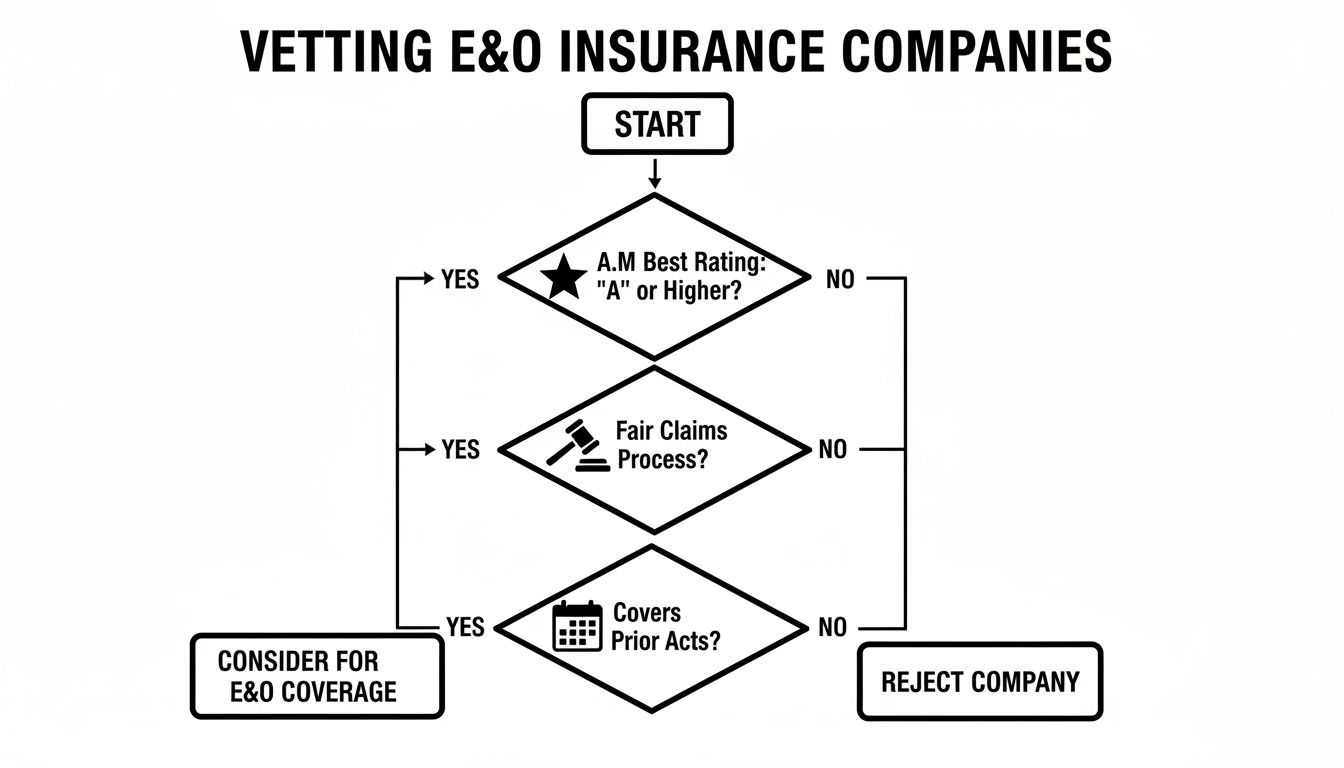
As the flowchart shows, some things are non-negotiable. No matter the carrier type, you need solid financial strength, fair claims handling, and continuous prior acts coverage. Don't compromise on the fundamentals.
Side-by-Side Carrier Comparison
Let's break these differences down even further. The table below puts these three carrier types head-to-head on the features that have a real, tangible impact on your agency’s bottom line and ability to withstand a lawsuit.
Comparing E&O Carrier Types for Independent Agencies
| Feature/Attribute | National Standard Carrier | Specialty Agency-Focused Insurer | Surplus Lines Market |
|---|---|---|---|
| Primary Focus | Broad commercial lines, including E&O. | Exclusively on insurance agency professional liability. | Hard-to-place or non-standard agency risks. |
| Policy Forms | Standardized, may require endorsements for specific agency needs. | Highly customized forms built specifically for agency risks. | Often restrictive and manuscripted for the specific risk. |
| Claims Handling | Handled by general commercial liability adjusters. | Managed by dedicated agency E&O claims specialists. | Varies widely; may be handled by a Third-Party Administrator (TPA). |
| Defense Costs | Can be either inside or outside policy limits; must be verified. | Typically offered as Defense Outside the Limits, preserving your full coverage amount. | Almost always Defense Inside the Limits, eroding your coverage. |
| Insolvency Coverage | Generally included, covering E&O claims arising from placing policies with an insolvent carrier. | A standard and robust feature, recognizing this as a key agency risk. | Often excluded or offered with a sublimit; a significant potential gap. |
| Risk Management | Limited to general business resources. | Extensive, agency-specific resources are a core part of the offering. | Minimal to non-existent risk management support. |
These aren't just minor details; they can make or break your agency in a claim. Take Defense Costs Inside the Limits, a common feature in the surplus lines market. A long, drawn-out lawsuit could eat up your entire policy limit on legal fees alone, leaving nothing to pay for a settlement or judgment. It’s a detail that's easy to miss but underscores why you have to look beyond the premium when comparing errors and omissions insurance companies. Your agency's future depends on it.
How Underwriters Really Look at Your Agency's Risk Profile
Getting the best terms from top errors and omissions insurance companies isn't about just filling out an application. It starts way before that. It’s about understanding how an underwriter sees your agency. Think of them as risk detectives, piecing together a puzzle to figure out how likely you are to have a claim.
This isn't some secret formula; it's a methodical look at specific risk indicators inside your agency. Once you know what they’re looking for, you can start shoring up your weak spots and making your agency a much more appealing risk. That puts you in the driver's seat during negotiations, instead of just taking whatever quote they slide across the table.
Right now, the global market dynamics are actually on your side. New carriers and more capacity are creating a softer market for buyers. The Management and Professional Liability insurance market is getting more competitive on pricing. Globally, premium changes have been pretty flat, and that trend is expected to continue, opening up some great opportunities for well-run agencies. You can dig into these 2025 management and professional liability market outlooks to see how you can use this to your advantage.
What’s in Your Book of Business?
The first thing an underwriter will dig into is your book of business. They want a clear picture of the risks you write and the industries you focus on. An agency that mainly handles standard personal lines like auto and home is a completely different animal than one specializing in tough commercial accounts like construction, trucking, or healthcare.
- Personal vs. Commercial Mix: If your book is heavy on complex commercial lines, especially those with big liability exposures, that’s a red flag for potentially severe E&O claims.
- Industry Specialization: Focusing on a high-risk niche can drive up your premium. Underwriters see specialization in areas like contractors or bars as having more complex coverage needs and, therefore, a higher chance for mistakes.
- Carrier Relationships: They’ll also check the financial stability of the carriers you place business with. If you're sending a lot of business to lower-rated or non-admitted carriers, they see that as an added layer of risk.
An underwriter’s job is to predict volatility. An agency with 90% personal lines is a steady, low-severity risk. Compare that to an agency where 50% of its revenue comes from contractors' liability in a sue-happy state, and you can see why the underwriter's pen gets a little heavier.
Your Internal Controls and Procedures
It’s not just what you write, but how you write it. Your agency's internal controls are a direct reflection of your professionalism and how serious you are about preventing mistakes. Underwriters need to see hard evidence of solid, documented procedures that every single person on your team follows, every single time.
Underwriters view robust internal controls as the single most effective loss prevention tool an agency can have. The presence of checklists, standardized workflows, and a formal procedures manual demonstrates a proactive risk management culture, which often translates directly into better E&O pricing.
When thinking about how underwriters size you up, getting the details right on key documents is non-negotiable. A clean, accurate application gives them an immediate snapshot of your professionalism. For example, properly mastering the ACORD 125 form shows a commitment to detail that underwriters absolutely value.
Here are the key controls they’re looking for:
- Use of Exposure Checklists: Do you use them for all new and renewal business? It shows you have a process to make sure all exposures are identified and discussed with the client.
- Documentation Standards: Is there a clear, agency-wide rule for documenting every client conversation, coverage decision, and change request in your management system?
- Peer Review Process: Do you have a second set of eyes review complex quotes or new business policies before they go out the door?
Showing you have these controls in place proves your agency is a well-managed risk. It makes you the kind of partner every E&O carrier wants to have on their books.
Closing Common Coverage Gaps with Endorsed Solutions

Let's be honest: standard, off-the-shelf E&O policies are rarely built with the independent agent in mind. They often fail to address the specific, high-stakes risks we face every day. These generic forms can leave you dangerously exposed, with gaping holes in areas like cyber liability or exclusions for services that are central to your agency’s operations.
Relying on a one-size-fits-all policy is a gamble. This is where an endorsed program from an association like PIA Southern Alliance makes a real, tangible difference. We don’t just accept a standard contract. Our programs are engineered from the ground up to close the very gaps that leave agencies in Georgia, Alabama, and Mississippi vulnerable. We partner with select errors and omissions insurance companies to build policy forms that directly address regional challenges and common claim scenarios.
Tailored Policies for Regional Realities
An agency in rural Alabama has a completely different set of regulatory hurdles and client expectations than one in metro Atlanta. Endorsed solutions get this. They integrate policy language reflecting local legal precedents and business realities, going far beyond simple geography to provide truly relevant protection.
For instance, a standard policy might have a painfully narrow definition of "professional services," potentially leaving out the consulting or risk management advice you provide. Our endorsed programs fight for broader language that covers the full scope of what a modern independent agent actually does, ensuring your core activities are protected when a claim hits.
The real power of an endorsed program lies in its ability to leverage the collective experience of hundreds of member agencies. By analyzing regional claims data, we can identify emerging risks and proactively negotiate policy enhancements that benefit everyone, turning shared knowledge into stronger individual protection.
Another common weak point involves new threats. Think about the rise of artificial intelligence in agency operations. Some insurers are now slapping broad AI exclusions on policies that could deny coverage for anything from a chatbot's bad advice to a claim stemming from an AI-powered underwriting tool. An endorsed program gives us a seat at the negotiating table to push for clarity and fight against overly broad exclusions that don't reflect an agency's actual risk profile.
More Than Just an Insurance Contract
Smart risk management is a combination of two things: strong insurance and even smarter business practices. The best errors and omissions insurance companies understand this, but an association partnership is what brings it to life. The benefits we provide at PIA Southern Alliance work hand-in-hand with the insurance policy, creating a comprehensive shield around your agency.
This integrated approach delivers a powerful one-two punch against potential claims:
- Specialized Risk Management Resources: Members get access to agency procedure manuals, E&O self-assessments, and best-practice guides. This isn't generic business advice; it’s built specifically to help independent agents reduce their liability.
- Targeted Continuing Education: Our CE courses and webinars drill down on loss prevention and E&O hot topics. This training keeps your entire team sharp on compliance and helps them avoid the common mistakes that turn into lawsuits.
This dual focus shifts the dynamic from a simple transaction to a genuine partnership. Your E&O coverage becomes an active risk management tool, not just a reactive safety net. Instead of just crossing your fingers and hoping a claim never happens, you're equipped with the resources and knowledge to actively prevent it.
You can see for yourself how this integrated solution provides a stronger defense for your agency by exploring the details of our endorsed Professional Agents E&O programs.
Your Top E&O Insurance Questions, Answered
When you're shopping for errors and omissions insurance companies, a few critical questions always come up. These aren't just details; the answers can make or break your agency's financial future. Getting this right means survival. Let's walk through the most common questions agency owners ask, so you can get clarity before signing on the dotted line.
What Is Tail Coverage and When Does My Agency Need It?
Think of tail coverage as a safety net for your past work. Officially called an Extended Reporting Period (ERP), it's an add-on you buy when your "claims-made" E&O policy is about to end. A standard claims-made policy is tricky—it only covers claims that are both made and reported while the policy is active.
That leaves a massive potential gap. Tail coverage extends your deadline for reporting claims that stem from work you did while the policy was still in force. You absolutely need it in three specific situations: when you sell your agency, when you retire, or if you ever switch from a claims-made policy to an "occurrence" form. If you skip tail coverage, all your past work is left wide open to future lawsuits.
How Do Defense Costs Affect My Agency?
This is one of the most important financial levers in your entire E&O policy: "Defense Inside the Limits" versus "Defense Outside the Limits." This single clause dictates how your legal fees are handled and can dramatically change how much protection you really have.
Defense Inside the Limits means every dollar spent on lawyers, court costs, and expert witnesses gets subtracted from your policy's liability limit. If you have a $1 million limit and legal bills reach $250,000, you've only got $750,000 left for a settlement or judgment.
Defense Outside the Limits means the insurance company pays for your legal defense in addition to your full policy limit. That same $1 million in coverage stays completely intact, no matter how high the legal bills climb.
For any independent agency, "Outside the Limits" is always the better choice. A messy claim can easily burn through six figures in legal fees, and the last thing you want is for your defense to eat up the very protection you bought to pay potential damages.
"A duty to defend policy with defense costs outside the limits provides the strongest financial backstop for an agency. It ensures that a protracted legal battle doesn't bankrupt your coverage before a settlement is even on the table."
Can I Switch E&O Insurance Companies Without Creating Gaps?
Yes, but you have to be meticulous to avoid leaving your agency exposed. When you move between errors and omissions insurance companies, the most crucial piece of the puzzle is maintaining your "prior acts" coverage. Your new policy absolutely must have a retroactive date that matches or precedes the date on your old policy.
This retroactive date is the line in the sand; it tells the new policy how far back in time it will look to cover your work. If your old policy went back to June 1, 2010, your new policy needs to have that same date or an earlier one. If a new carrier resets that date to the day your new policy starts, you've just created a huge gap, leaving years of your hard work completely uninsured.
To make the switch safely, start shopping for a new carrier 90-120 days before your renewal. Don't just compare premium quotes—get the actual policy forms and compare them side-by-side. Most importantly, get written confirmation of the retroactive date before you even think about canceling your existing coverage. A little diligence here can prevent a seamless transition from turning into a catastrophic mistake.
At PIA Southern Alliance, we help our members work through these complex decisions every single day. Our endorsed E&O programs are built with features like "defense outside the limits" and we provide resources to help you manage policy transitions without creating those dangerous coverage gaps.