
You're probably dealing with some version of this right now. Referrals still matter, but they're less predictable than they used to be. Your producers know they need a steadier flow of inbound opportunities. Your website may look fine, but it isn't clear whether it's helping you write business. Someone is pitching SEO, someone else is pitching paid ads, and every proposal sounds polished until you ask a simple question: how will this turn into bound policies in Georgia, Alabama, or Mississippi?
That's where many independent agencies get stuck. The problem usually isn't effort. It's translation. Generic marketing advice rarely accounts for carrier appetite, regional underwriting quirks, compliance review, or the practical limits of a lean agency team. A campaign can look busy on paper and still create poor leads, regulatory headaches, or reporting that tells you everything except what you need to know.
A good marketing partner can help. The wrong one can waste budget, create E&O exposure, and leave you with little more than a stack of dashboards and a weaker balance sheet. This guide is written for independent agencies in the Southeast that need a more grounded way to evaluate insurance marketing agencies, measure ROI, and decide whether to outsource or build internally.
Table of Contents
- Introduction Navigating the Modern Marketing Landscape
- What Exactly Is an Insurance Marketing Agency
- Core Services and Common Pricing Models
- Critical Compliance and E&O Considerations
- How to Choose the Right Partner A Vetting Checklist
- Measuring Success KPIs and Reporting That Matter
- In-House Marketing Strategies An Alternative Path
- Conclusion Building Your Agency's Future
Introduction Navigating the Modern Marketing Landscape
Independent agencies don't lack options. They usually have too many. Search ads, local SEO, website rebuilds, email campaigns, social media, automation, lead vendors, reputation management. Every channel promises growth, and very few proposals explain the operational trade-offs that come with them.
That matters more in the Southeast than many national firms realize. A campaign for a personal lines agency in Atlanta won't look the same as one for a mixed book in coastal Alabama or a rural Mississippi operation with long-standing carrier relationships. Your market, service territory, staffing model, and book mix shape what marketing should do. They also shape what marketing should avoid.
The practical question isn't whether to market. It's how to market without wasting time, overspending, or creating compliance problems your service team has to clean up later.
A strong marketing plan for an independent agency should support three outcomes at the same time: growth, defensibility, and clarity.
Growth means more qualified opportunities. Defensibility means your messaging, data handling, and outreach methods hold up under scrutiny. Clarity means you can explain which efforts are producing quotes, binds, renewals, and cross-sell opportunities.
If you're evaluating insurance marketing agencies, start there. Don't buy activity. Buy a system that helps your agency make better decisions.
What Exactly Is an Insurance Marketing Agency
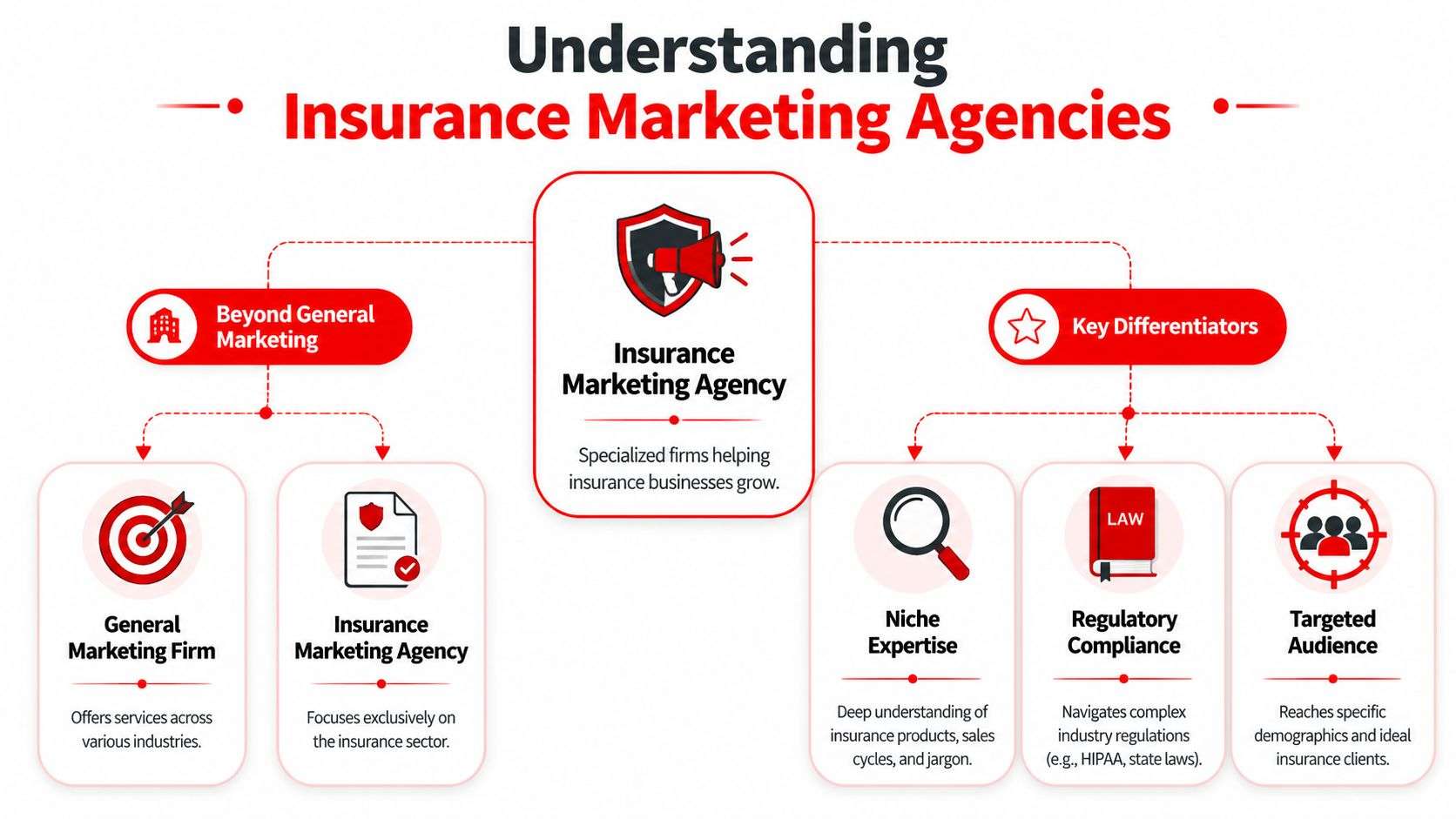
A general marketing firm can build ads, redesign a website, or write blog posts. That doesn't make it the right fit for an independent insurance agency. The difference is similar to the gap between a general contractor and a specialist trade. Both work on buildings. Only one knows where a small mistake is likely to create a much bigger problem later.
An insurance marketing agency is a firm that focuses on helping insurance businesses attract, convert, and retain clients. The specialization matters because insurance isn't a simple retail sale. Products differ, sales cycles vary, and your marketing often intersects with regulation, underwriting realities, and system integrations inside the agency.
Why specialization changes the outcome
A specialist usually understands the difference between marketing a personal auto quote, a bundled home package, a commercial account, or a life policy review. Those aren't just different landing pages. They involve different buyer questions, different follow-up timing, and different handoffs from marketing to producer to account management.
A generalist often sees “insurance” as one category. A specialist should know it isn't.
There's also a technology layer. The insurance sector is changing quickly, and approximately 90% of insurers are investing in AI technologies, while the global market for AI in insurance is projected to grow from $13.45 billion in 2026 to $154.39 billion by 2034, according to insurance AI market projections and adoption data. For an agency owner, that doesn't mean chasing every new feature. It means choosing partners who understand how automation, segmentation, and reporting fit into insurance operations rather than treating them like generic marketing add-ons.
The three pillars that separate specialists from generalists
Industry expertise
Insurance buyers ask product-specific questions. Agencies need messaging that reflects how coverage decisions happen. A strong specialist can write for homeowners, auto, small commercial, or life discussions without sounding vague or inaccurate.
They should also understand lead quality accurately. High lead volume means nothing if the account doesn't fit your carriers, territory, or appetite.
Compliance awareness
Marketing language can create exposure when it overpromises, omits material details, or uses outreach methods your agency can't defend. A specialist should build review steps into the process. They should expect compliance questions. They should never act surprised when you ask who approved copy, disclaimers, forms, or campaign audiences.
Operational fit
An agency's marketing doesn't stop at the click. It has to connect with intake, quoting, follow-up, remarketing, renewals, and cross-sell workflows. If the firm can't work around the way your agency processes business, the campaign will break in the handoff.
Practical rule: If a marketing firm talks only about traffic and creative, but not intake workflow, account ownership, and compliance review, they're not ready for independent agency work.
Core Services and Common Pricing Models
Most insurance marketing agencies group their work into a few clear buckets. That's useful, because it helps you match spending to business goals instead of buying a grab bag of tactics.
For independent agencies, marketing budgets are usually constrained by economics, not ambition. According to insurance agency marketing budget benchmarks, independent agencies typically allocate 5% to 10% of annual revenue to marketing, while newer agencies often spend 10% to 15%. For an established agency with $1 million to $2 million in annual revenue, that works out to roughly $50,000 to $200,000 per year, with spending often distributed across lead generation, brand building, technology, and content.
Service categories that matter most
Lead generation
Most agencies identify this as their starting point, and for understandable reasons. Lead generation aims to create quote opportunities now, not someday.
That bucket often includes:
- Search visibility work that helps your agency appear when prospects look for coverage locally
- Paid campaigns designed to capture high-intent shoppers
- Landing pages built around one line of business, one offer, or one local market
- Call tracking and form routing so inquiries reach the right person quickly
A website is often the center of that effort. Agencies evaluating page structure, conversion flow, and intake friction may find useful ideas in this guide to lead generation website design for SMBs, especially if the current site looks professional but doesn't convert well.
Brand building
Brand work sounds softer, but it's not optional. In insurance, buyers want signs of credibility before they request a quote. That includes your site, local reputation, messaging consistency, educational content, and visible proof that a real agency stands behind the offer.
Brand building often includes:
- Website redesign or refresh
- Content creation focused on common client questions
- Local presence work such as directory consistency and review generation
- Messaging development for niche programs, community positioning, or agency differentiation
Client retention and cross-sell
This is the most underused category in many independent agencies. Good marketing doesn't stop after the first bind. It supports renewals, remarketing, referral prompts, and additional policy conversations.
Common retention services include:
- Email automation tied to renewal timing or client milestones
- Cross-sell campaigns based on policy type
- Re-engagement sequences for dormant prospects or former clients
- Audience segmentation so messaging matches the client's actual needs
How agencies usually charge
Pricing models shape expectations. Before you sign anything, understand what behavior the pricing model encourages.
| Model | Best For | Pros | Cons |
|---|---|---|---|
| Monthly retainer | Agencies that need ongoing execution and strategy | Predictable budgeting, continuous optimization, easier accountability over time | Can drift into routine activity if scope isn't tied to outcomes |
| Project-based fee | Website rebuilds, audits, setup work, or one-time campaigns | Clear scope, defined deliverables, easier to compare bids | Often stops before optimization starts |
| Performance-based partnership | Agencies focused on tightly defined acquisition goals | Incentives can align around results | Definitions matter, and poor lead standards can distort what “performance” means |
The practical trade-off
Retainers work best when the agency already knows what it needs and wants steady execution. Projects work when the problem is specific, like fixing a site or building a reporting foundation. Performance deals sound attractive, but they require very clear definitions of a qualified lead, ownership of ad accounts, and agreement on what happens after the lead reaches your office.
If those details aren't nailed down, the pricing model won't save you.
Critical Compliance and E&O Considerations
Marketing risk usually shows up after the campaign launches. The ad copy looked fine. The landing page was live. The text campaign generated responses. Then someone asks who approved the wording, whether consent was documented, or why the form collected more information than the agency needed.
That's where vendor oversight turns into an E&O issue.
A third-party marketer can create exposure for your agency if they publish misleading language, mishandle leads, or run outreach tactics your staff can't document or defend. If your agency wants a useful refresher on how liability can arise from professional services, this overview of professional liability insurance for agencies is worth reviewing alongside any marketing vendor contract.
Where marketing creates agency risk
Messaging that overpromises
Insurance advertising has to stay inside the lines. Trouble starts when a campaign implies guaranteed savings, broad coverage certainty, or an outcome that depends on underwriting. Even if the agency didn't draft the copy, the agency can still own the consequences.
Outreach without controls
Automated calls, texts, and email sequences can create problems fast when consent records are weak or audience lists are poorly maintained. A vendor may think in terms of volume. Your agency has to think in terms of proof.
Data collection that exceeds necessity
Lead forms often ask for more than they should. That creates extra handling obligations for your team and increases the consequences of any process failure. Agencies should collect what they need to start the conversation, not every possible detail up front.
If a vendor wants broad control over messaging, audiences, and data intake, but resists documented approval workflows, that's a contract problem before it becomes a compliance problem.
Contract protections worth insisting on
A short contract is not the same thing as a safe contract. At minimum, your agreement should deal with responsibility, access, and approvals in plain language.
Use a checklist like this during review:
- Approval rights: State that the agency must approve ad copy, landing pages, forms, and automated outreach before launch.
- Account ownership: Keep ownership of websites, analytics, ad accounts, creative files, and audience data with the agency.
- Indemnification language: Require the vendor to stand behind its work where appropriate under the agreement.
- Insurance requirements: Ask for proof that the vendor carries its own liability coverage.
- Data handling terms: Spell out what information the vendor may collect, store, share, or retain.
- Compliance cooperation: Require prompt response if your agency or a regulator questions a campaign.
Oversight that actually works
You don't need to micromanage every ad variation. You do need a review process. That usually means one agency decision-maker, one documented sign-off path, one source of truth for approved language, and periodic checks on live campaigns.
The easiest time to prevent a bad campaign is before launch. The second easiest time is during the first review cycle. After that, cleanup gets expensive.
How to Choose the Right Partner A Vetting Checklist
A Southeast agency usually realizes it hired the wrong marketing partner after the first few months. Leads come in from counties the agency does not serve. Campaigns push lines the agency cannot place well with current carriers. Reporting looks polished, but no one can explain which submissions were worth a producer's time. By then, the agency has already spent money, burned staff hours, and created cleanup work.
That is why partner selection needs to be operational, not cosmetic. Independent agencies in Georgia, Alabama, and Mississippi have to account for regional carrier appetite, local competition, licensing boundaries, and service capacity. A firm that sells a generic insurance package at the national level can still be a poor fit for a Main Street agency trying to grow without creating compliance or E&O exposure.
Questions that expose fit quickly
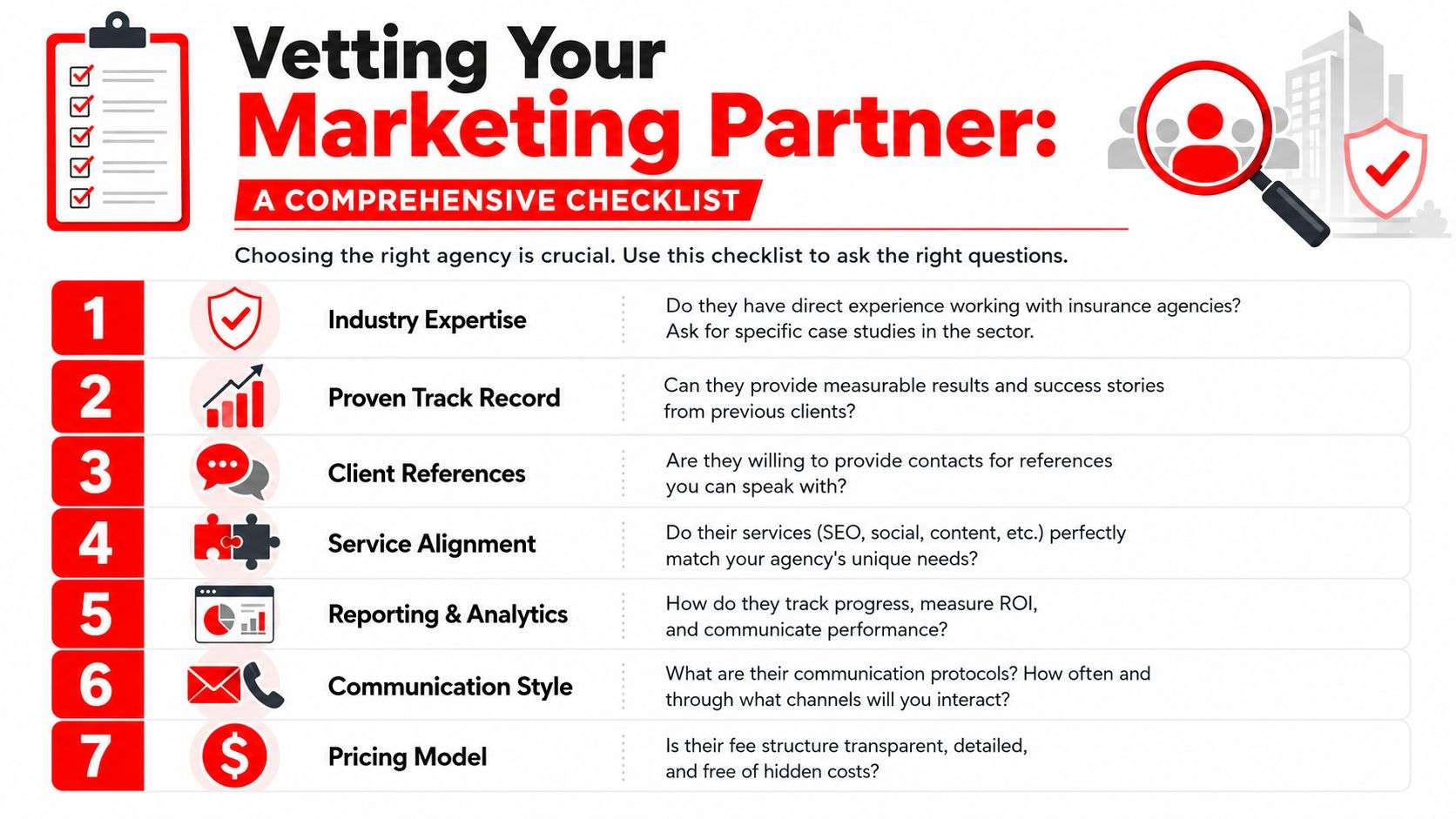
Start with experience, but press for specifics. “We work with insurance” is not an answer. Ask what lines they have marketed, whether they understand the difference between independent agency distribution and direct-to-consumer campaigns, and how they adjust strategy for rural versus metro parts of the Southeast.
Use questions like these:
- Line of business fit: Have you handled personal lines, commercial lines, life, or employee benefits?
- Agency model: Have your clients been independent agencies, not just carriers or financial firms?
- Regional understanding: How would you approach growth differently in Georgia, Alabama, and Mississippi?
- Carrier reality: How do you build campaigns around what an agency can write well today?
The best agencies answer with examples, constraints, and trade-offs. Weak firms default to broad terms like brand awareness, engagement, and visibility.
Operations matter just as much as creative. If a marketing firm cannot explain how a lead moves from ad click to quote request to producer follow-up, it does not understand agency economics. A partner should be able to discuss intake, assignment, response times, and how marketing data connects back to your book.
That conversation usually reveals whether they understand the role of an agency management system in independent insurance operations. The point is not software trivia. The point is whether they know that marketing only creates value when it feeds the agency's real workflow.
What to ask for before you sign
Good vetting goes past credentials. Ask the firm to show you how it works.
- A sample 90-day plan: What gets built first, what gets delayed, and why
- A sample report: Preferably redacted, with enough detail to show how they review lead quality
- A campaign example for one line you sell: Home, small commercial, contractors, life, or another core line
- A list of required inputs from your agency: Staff time, approvals, call handling, market appetite, budget
- A clear point of accountability: Who owns strategy, execution, and communication on their side
Trade-offs become apparent. A firm may be strong on paid search but weak on local content. Another may build a solid website but have little discipline around lead handling. Those are manageable issues if they are identified early. They become expensive when discovered after launch.
Red flags that should slow the process down
Some warning signs are obvious. Others sound reasonable until you test them.
Watch for:
- Guaranteed lead volume or ranking promises: Insurance demand, geography, appetite, and competition all affect results
- No questions about your carrier mix: A firm that ignores placement reality will send the wrong prospects
- Little interest in service capacity: Ten extra leads a week can hurt an agency that cannot answer phones or follow up fast
- Bundled tactics with no priority order: Agencies rarely need every channel at once
- Reporting focused on traffic and clicks only: Activity is not the same as quoted, bound, and retained business
- Vague answers about local targeting: County, city, and service radius decisions matter in the Southeast
A useful comparison exists outside insurance. Even in unrelated niches, buyers still need to test whether the agency understands the business model, audience, and commercial goal. That is why articles about specialized work, including managing social media for bedding companies, can still reinforce a smart buying principle. Industry context usually matters more than polished deliverables.
Field test: Ask the agency to outline a campaign for one of your actual lines of business using your current carrier appetite, service area, and staffing limits. If the answer stays generic, keep looking.
A simple RFP structure for independent agencies
A short request for proposal can save a lot of wasted meetings. It gives every firm the same facts and makes comparison easier.
Include:
- Agency profile: States served, office locations, lines of business, staffing, and growth goals
- Current marketing position: Website condition, referral mix, paid activity, email use, and local search presence
- Operational limits: Review process, service radius, call handling, quoting capacity, and market appetite
- Requested scope: Lead generation, website updates, content, retention campaigns, or a phased engagement
- Success criteria: What outcomes matter to your agency, not just what tasks the vendor plans to complete
- Access and ownership expectations: Confirm that the agency keeps access to accounts, audiences, and creative assets
- Pricing format: Separate setup work, monthly fees, media spend, and optional projects
Keep it plain. The goal is clarity, not paperwork. The right partner will usually welcome a tighter vetting process because it reduces bad-fit engagements on both sides.
Measuring Success KPIs and Reporting That Matter
A monthly marketing report should help an agency owner answer three questions fast. Did we get the right opportunities. Did those opportunities turn into written business. Did the return justify the cost.
For independent agencies in Georgia, Alabama, and Mississippi, that standard matters because marketing performance is tied to staffing limits, carrier appetite, and local compliance review. A campaign can produce plenty of activity and still create problems if the office cannot quote it promptly, the risks fall outside current markets, or the messaging creates avoidable cleanup.
Metrics that deserve your attention
Start with economics tied to revenue, not surface activity. Website visits, click-through rates, and social engagement can explain what happened at the top of the funnel, but they do not tell you whether marketing is producing profitable accounts.
A better scorecard tracks cost per qualified lead, cost per quote, cost per bound policy, and premium written by source. Agencies with strong retention may also want to watch 90-day retention by channel, especially if one source produces price shoppers who cancel early or create heavy service work.
That last point gets missed often.
A lead source that looks cheap on paper can become expensive once the agency accounts for remarketing time, low close rates, endorsement volume, and rewrite risk. In the Southeast, that trade-off shows up clearly in personal lines and small commercial. Volume alone is not the win. Fit is.
Track the full path from inquiry to policy
A form fill is only the start. A useful report follows the lead through the same stages your office uses every day:
- Lead received
- Lead contacted
- Qualified for appetite
- Quote issued
- Policy bound
- Retention review or cross-sell opportunity created
That extra qualification step matters for independent agencies. If marketing sends in risks your carriers do not want, the campaign may look healthy in a dashboard while your producers lose time on business they cannot place. Reporting should expose that early.
What a useful monthly report should include
Keep the report simple enough that the owner, producer, and service manager can all use it.
Look for:
- Spend by channel
- Lead volume by source
- Qualification rate by source
- Quote rate and bind rate
- Premium written and estimated commission by source
- Response time and contact rate
- Lead quality notes from the agency team
- Problems that blocked conversion, such as call routing issues, form errors, missed follow-up, or appetite mismatch
For many agencies, the best reporting change is not more software. It is cleaner handoff between marketing and operations. If the producer marks why a lead did not move forward, patterns show up fast. Wrong county. Wrong line. Limits too low. No market. Slow callback. Those details improve ROI because they tell you what to change.
Avoid reports that hide behind activity
Some agencies get a polished dashboard every month and still cannot tell which campaigns helped the agency grow. That usually means the reporting stopped at clicks, calls, and impressions.
Ask for reporting that connects marketing to agency outcomes. Which source produced accounts your carriers wanted. Which source generated the best close rate. Which campaigns created service-heavy, low-commission business. Which efforts supported retention, referrals, or cross-sell opportunities.
That is the level of reporting that supports decisions.
If you want a practical benchmark for what good local execution looks like before you judge the numbers, review these insurance agency marketing ideas for local growth. The tactics matter less than whether your reporting shows what each one produced.
A good agency partner should be able to sit down with your management team and explain, in plain language, what to keep, what to cut, and what to fix inside the office. If they cannot connect spend to quotes, binds, retention, and revenue quality, the report is decoration.
In-House Marketing Strategies An Alternative Path
Not every agency should hire outside help right away. Some need to get the basics in order first. That's not a disadvantage. In many cases, the foundational work you do internally will make any future agency relationship stronger and cheaper because the easy problems are already fixed.

Start local and make it easy to contact you
For many independent agencies, the first win is local discoverability. Make sure your business information is consistent everywhere your prospects might find you. Your service areas, phone number, hours, and core lines of business should match across your site and local profiles.
Then fix the contact path. A local visitor shouldn't have to hunt for a quote request form, office number, or producer contact. If your office handles different lines differently, route that clearly.
Agencies wanting a practical starting point can review these insurance agency marketing ideas for local growth and outreach. The useful part isn't complexity. It's consistency.
Build content from real client questions
You don't need a giant content calendar. You need answers to the questions your staff hears every week.
That usually means short, plain-English pieces on topics like:
- What information to gather before requesting a quote
- When to review homeowners coverage
- How bundling works in practical terms
- What changes should trigger a policy conversation
- What business owners should have ready before discussing coverage
This works because good insurance content reduces friction. It helps prospects self-identify. It also gives producers something useful to send instead of rewriting the same explanation repeatedly.
Use email for retention and cross-sell, not just announcements
Many agencies underuse their existing book. That's a missed opportunity. For independent agencies, average policies per client sit at 1.6, and agencies using marketing automation tied to life events or policy expirations can move that ratio toward 2.0 or higher. The point isn't to chase a number blindly. It's to recognize that the cleanest growth often comes from clients who already trust the agency.
A simple internal email strategy can include:
- Renewal reminders with a prompt to review changes in household or business operations
- Coverage checkup emails tied to seasonal risks or life events
- Single-topic cross-sell notes based on what the client already carries
- Referral requests sent after positive service interactions
PIA Southern Alliance also offers factual support in this area through digital marketing services that include local SEO and email campaign support for independent agencies in Georgia, Alabama, and Mississippi.
Keep social media useful and local
Independent agencies don't need to post constantly. They need to post things their community recognizes as relevant. That means local event participation, staff introductions, storm preparedness reminders, claims prep checklists, community sponsorships, and short educational posts.
What usually doesn't work is constant hard selling. Social media is better as a trust channel than a direct quote machine for most agencies.
Small agencies usually grow faster from disciplined basics than from scattered experimentation.
Conclusion Building Your Agency's Future
Choosing among insurance marketing agencies isn't really about finding the flashiest proposal. It's about finding a partner, process, or internal plan that fits how your agency writes business, serves clients, and manages risk in the Southeast.
The practical standard is simple. Marketing should produce qualified opportunities, support retention, respect compliance boundaries, and give you reporting you can use to make decisions. If it can't do those things, it's overhead dressed up as strategy.
Some agencies are ready for outside support. Others should tighten local visibility, content, email follow-up, and reporting discipline first. Either path can work if you stay focused on economics, ownership of your assets, and clear accountability.
For independent agencies in Georgia, Alabama, and Mississippi, that discipline matters even more because regional nuance affects every stage of the process, from targeting to underwriting fit to compliance review.
PIA Southern Alliance gives independent agencies across Georgia, Alabama, and Mississippi access to the education, operational guidance, and practical resources needed to make smarter growth decisions. If you want support that aligns marketing, compliance, and agency performance, explore what PIA Southern Alliance offers for member agencies.