

Real-Time Customer Feedback Systems Transforming Insurance Automation for Independent Agents
Real-time customer feedback systems capture immediate signals from policyholders and prospects to inform rapid decision-making, automate workflows, and improve service outcomes for independent insurance agents. This article explains how these systems work, why they matter for insurance automation, and how independent agencies can operationalize feedback loops to reduce manual tasks, boost retention, and personalize service. Readers will learn definitions, channel options, analytics and workflow patterns, and concrete implementation guidance tailored to small and mid-sized agencies across Georgia, Alabama, and Mississippi. The guide also examines CyberCommand as an exemplar real-time feedback and automation platform and provides practical steps, checklists, and anonymized regional case snapshots to illustrate measurable outcomes. Throughout, the focus stays on actionable advice—how to collect signals, translate them into decision triggers, measure impact with KPIs, and scale feedback-driven automation without overwhelming staff or compromising data governance.
What Is Real-Time Customer Feedback and Why Does It Matter in Insurance Automation?
Real-time customer feedback is the continuous capture of customer responses, behavior signals, and sentiment as interactions occur, enabling immediate analysis and automated responses that improve service speed and relevance. The mechanism relies on lightweight capture channels (widgets, chatbots, SMS, IVR) feeding analytics engines that detect intent, sentiment, or transaction status and trigger downstream workflows such as claims triage or renewal outreach. The specific benefit for insurance automation is a shortened feedback loop: issues are surfaced and handled proactively, which reduces churn risk and accelerates resolution. Understanding these core mechanics sets the stage for practical implementation choices about which channels to prioritize and how to integrate analytics with existing agency systems. The next sections unpack the direct customer experience improvements and the channel architecture agencies should evaluate.
How Does Real-Time Feedback Improve Customer Experience in Insurance?
Real-time feedback improves customer experience by enabling faster problem detection, more relevant personalized outreach, and dynamic prioritization of service tasks based on urgency and sentiment. When a policyholder reports dissatisfaction via a short survey or chatbot, the feedback system can escalate that case to a priority queue, alert a claims specialist, or trigger an automated empathy-based message while routing the issue for human follow-up. These mechanisms translate into concrete CX improvements such as faster first response times, higher post-interaction satisfaction scores, and lower churn among at-risk customers. Agencies can measure impact using KPIs like average response time, CSAT, NPS, and first-contact resolution rate to validate improvements. That measurement focus leads naturally to selecting capture channels that align with typical customer touchpoints and expected metrics for each interaction type.
What Types of Real-Time Feedback Systems Are Used in Insurance Agencies?
Insurance agencies deploy a range of real-time feedback systems, from embedded web widgets and in-app micro-surveys to AI chatbots, SMS alerts, and IVR prompts, each fitting different customer journeys and complexity levels.
In-app surveys and embedded widgets are lightweight and excellent for post-quote or post-service ratings; chatbots capture intent and basic details while providing immediate answers; SMS is high-read-rate for urgent outreach; and IVR remains useful for voice-first customer segments. Each channel has trade-offs in reach, depth of insight, and implementation complexity: widgets and SMS are quick to deploy, while conversational AI and IVR require more configuration and testing. Assessing channel mix against customer preferences and technical readiness helps agencies choose an optimal combination that balances immediacy, coverage, and resource demands.
How Does CyberCommand Leverage Real-Time Feedback to Automate Insurance Processes?
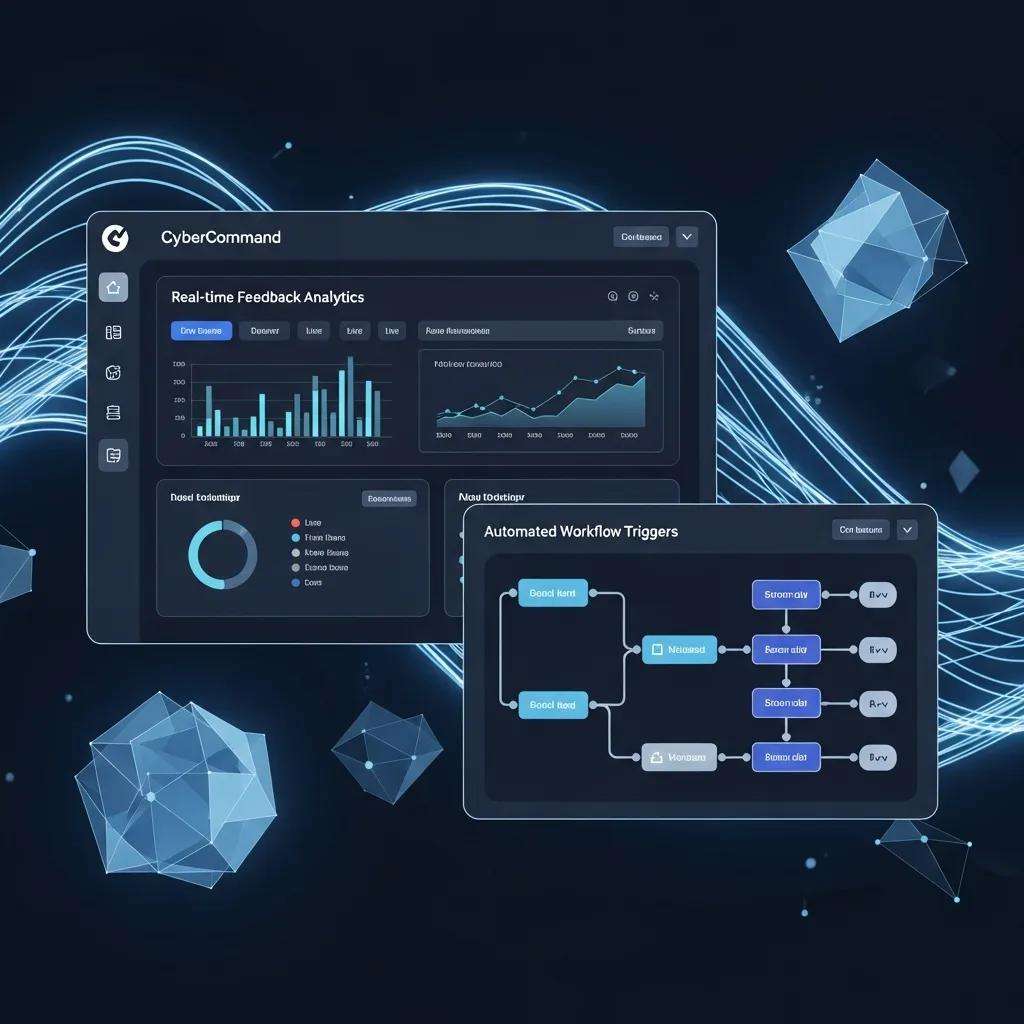
CyberCommand captures feedback signals across channels, applies real-time analysis to detect intent and sentiment, and triggers workflow automations that reduce manual steps across quoting, claims, renewals, and cross-sell opportunities. The system maps incoming events to policy and contact records through AMS/CRM connectors, evaluates priority via configurable rules, and initiates actions—notifications, task creation, or automated messaging—without human intervention when appropriate. This design reduces friction, shortens resolution cycles, and preserves case context across systems so agents focus on high-value interactions. The following subsections break down the platform’s core features and how integration patterns typically look for independent agencies.
What Are the Key Features of CyberCommand for Insurance Automation?
CyberCommand’s core capabilities center on three functional pillars: real-time collection, analytic decisioning, and automated workflow orchestration, each mapped to practical outcomes. The real-time collection layer uses omnichannel inputs—widgets, chatbots, SMS, and IVR—to ensure no touchpoint is blind, while the decisioning engine applies sentiment analysis and rule-based scoring to categorize urgency and opportunity. Workflow orchestration converts analyzed signals into concrete actions such as auto-generated tasks, renewal nudges, or claims escalation, and includes auditing and reporting dashboards to track outcomes. These features combine to reduce routine manual work, improve prioritization, and deliver measurable service improvements that independent agents can operationalize with minimal disruption.
Before presenting the feature EAV table, here is a short list that summarizes how these features translate into outcomes for agencies.
- Immediate triage: Real-time signals move urgent cases to the top of the queue.
- Automated outreach: Triggered messages handle routine confirmations and renewals.
- Intelligence-driven assignment: Sentiment and intent score guide assignment to the right agent.
| Feature (CyberCommand) | What it Does | Example Operational Outcome |
|---|---|---|
| Omnichannel Capture | Collects input from chat, SMS, widget, IVR | 95%+ coverage of customer touchpoints; faster detection of issues |
| Real-Time Sentiment Analysis | Scores mood and intent from text/voice inputs | Escalates negative sentiment to priority workflows within minutes |
| Workflow Trigger Engine | Maps signals to automated tasks and messages | Auto-creates renewal tasks and sends follow-up emails reducing manual steps |
| AMS/CRM Connectors | Syncs events with agency systems via API/webhooks | Maintains unified contact and policy context, reducing duplicate work |
This table clarifies how discrete CyberCommand features map to operational benefits that independent agents can measure. The next subsection explains how those capabilities integrate with existing agency systems and what to check before integration.
How Does CyberCommand Integrate with Existing Agency Management Systems?
CyberCommand integrates with Agency Management Systems and CRMs using standard API connectors, webhooks, and middleware adapters to ensure event-level synchronization without manual reconciliation. Integration patterns include near-real-time sync for critical events (claims exceptions, NPS drops) and scheduled batch updates for lower-priority metrics, with field-mapping templates to align customer identifiers and policy numbers. Key integration readiness items are mapping unique identifiers, confirming field-level access, and validating webhook security and retry logic so events are never lost. Typical pitfalls include mismatched contact IDs and insufficient error-handling that lead to orphaned tasks; addressing these requires a short discovery phase to align data models. Once connectors are validated, agencies can safely route feedback-derived actions into their AMS workflows with confidence that context and audit trails remain intact.
What Are the Benefits of Insurance Automation for Independent Agents Using Real-Time Feedback?
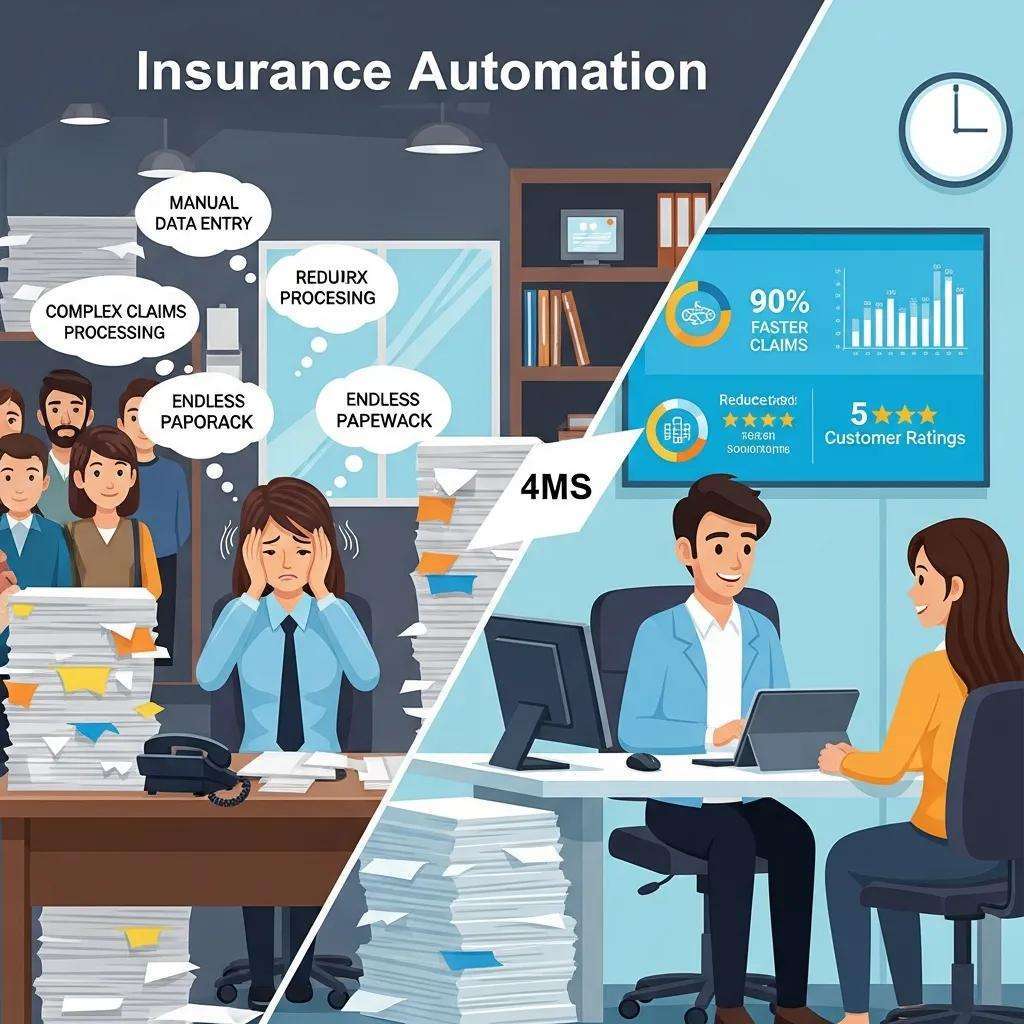
Insurance automation informed by real-time feedback delivers measurable benefits in efficiency, client retention, revenue generation, and service quality by converting momentary signals into prioritized actions. The mechanism is straightforward: continuous capture → analytic scoring → automated or assisted response → tracked outcome. For independent agents, these benefits compound because process automation substitutes repetitive work across renewals, claims triage, and follow-ups, freeing limited staff to focus on complex advisory tasks. The following EAV table compares primary benefits with how they work and example metrics agents should track to validate impact.
| Benefit | Mechanism | Example Metric (what to track) |
|---|---|---|
| Increased Efficiency | Automate routine tasks like renewals and follow-ups | Hours saved per week; tasks automated per agent |
| Higher Retention | Real-time churn signals trigger retention offers | Policy retention rate change; reduction in churn % |
| Improved NPS/CSAT | Priority handling of negative feedback improves satisfaction | NPS lift; CSAT average post-intervention |
| Revenue Uplift | Feedback identifies cross-sell opportunities | Cross-sell conversion rate; additional premium per customer |
These benefit mappings show how mechanisms translate into concrete KPIs independent agents can use to monitor success. The next subsections drill down into specific efficiency gains and personalization outcomes with practical examples.
How Does Automation Increase Agent Efficiency and Reduce Manual Tasks?
Automation reduces manual work by taking over repeatable touchpoints—renewal reminders, basic policy updates, and initial claim intake—so agents spend less time on administrative tasks and more on advisory work. For example, an automated renewal workflow can send reminder messages, create a follow-up task when a message is unopened, and populate AMS fields when a client accepts an online offer, cutting manual entry. Agents measure efficiency via hours saved, tasks closed without agent intervention, and average handling time reductions; these KPIs help justify scaling automation. Implementing automation requires clear mapping of which tasks to automate first and monitoring to ensure quality control, which leads to better staff allocation and more strategic client engagement.
In What Ways Does Real-Time Feedback Enhance Personalized Customer Engagement?
Real-time feedback enables personalization by supplying immediate context—recent claims, expressed pain points, or service ratings—that informs tailored messaging and offers at the moment of highest relevance. When feedback indicates interest in bundling or dissatisfaction with coverage, a triggered workflow can propose a personalized review appointment or present a curated cross-sell offer via preferred channel. Personalization tracked against engagement and conversion metrics demonstrates the value of timely relevance; agents should monitor conversion rates on triggered offers and retention among clients who received personalized touchpoints. Building these journeys requires rules that translate signal types into offer templates, and continuous A/B testing to refine messaging and delivery timing for stronger results.
How Can Independent Insurance Agents Implement CyberCommand Successfully?
Successful implementation follows a staged approach: define objectives and KPIs, pilot with narrow scope, validate integration and data flows, train staff, then scale with governance and measurement controls. Start by selecting one high-impact workflow—such as renewal reminders or claims triage—for a 30–60 day pilot to prove value with measurable KPIs. During onboarding, map the data model, ensure secure API access, and set up rule logic for signal scoring and escalation. Training should emphasize new role responsibilities and how automation augments rather than replaces human tasks, and governance must cover privacy, retention, and audit trails. The following numbered checklist provides a practical step-by-step plan agencies can follow when starting with CyberCommand.
- Define goals and KPIs: Choose 2–3 primary metrics like response time and renewal conversion.
- Pilot a single workflow: Implement automation for renewals or claims intake with a small customer cohort.
- Map integrations: Align identifiers, fields, and webhook behaviors with your AMS/CRM.
- Train staff: Run role-based sessions and create troubleshooting playbooks.
- Measure and iterate: Review KPIs weekly, refine rules, and expand scope once successful.
This implementation checklist ensures agencies focus on early wins and measured scaling, and the next paragraph highlights common best practices and pitfalls to avoid during integration.
What Are the Best Practices for Integrating CyberCommand into Your Agency?
Best practices begin with careful scoping: limit the pilot to a single workflow and a defined customer segment to reduce complexity and set clear success criteria. Define ownership and roles—who will monitor alerts, who handles escalations, and who manages rule updates—to prevent ambiguity when automation triggers actions. Maintain data hygiene by standardizing contact identifiers and cleaning duplicate records before integration so that feedback maps to the correct policy contexts. Use staged rollout and clear rollback plans so any misconfigurations can be reversed quickly. Finally, plan for continual monitoring and a cadence of review to refine scoring thresholds and message templates, ensuring sustained improvement and staff confidence in the automation platform.
What Challenges Might Agents Face and How Can They Be Overcome?
Agents commonly face three challenge types: technical integration friction, data quality issues, and staff resistance to new workflows; each requires a targeted mitigation strategy. Integration friction is best addressed by a short discovery and field-mapping phase that documents identifiers, required access, and error handling. Data quality problems demand deduplication and consistent identifier practices before connecting systems, plus monitoring for mismatches post-launch. Staff resistance is mitigated through role-based training, emphasizing time savings and clearer escalation rules, and by involving frontline staff in pilot design so they feel ownership. These mitigations, combined with governance controls and incremental rollout, reduce risk and accelerate successful adoption.
What Are Real Success Stories of CyberCommand Transforming Insurance Automation?
Independent agencies leveraging real-time feedback through CyberCommand have seen measurable improvements across response time, customer satisfaction, and renewal outcomes—especially when pilots focused on high-volume workflows like claims intake and renewals. The regional context—markets in Georgia, Alabama, and Mississippi—benefits from tailored workflows that account for local customer preferences and regulatory nuances, resulting in operational improvements that align with small-agency constraints. Below is a standardized case EAV table presenting anonymized snapshots from regional implementations to illustrate typical problem-to-impact transitions agencies can expect.
| Agency (Region) | Problem Addressed | Measured Improvement |
|---|---|---|
| An independent GA agency | Slow claims intake and delayed follow-up | 40% reduction in average initial response time |
| Small AL brokerage | Low renewal engagement | 15% increase in renewal conversion after triggered outreach |
| Community MS agency | Missed cross-sell signals | 10% uplift in cross-sell conversion from feedback-triggered offers |
These anonymized examples demonstrate typical outcomes rather than guaranteeing results; measurement methods included before/after comparisons over a 90-day pilot window and tracking of defined KPIs. The next subsections dive into regional benefits and how agencies measured improvements in operational metrics and customer satisfaction.
How Have Independent Agents in Georgia, Alabama, and Mississippi Benefited?
Regional agencies benefited by tailoring capture channels and workflows to local customer preferences—SMS and phone follow-ups in rural segments, and web widgets for digitally engaged clients—yielding faster responses and more relevant outreach. Agencies with tight staffing used automated triage to route complex claims to specialists while allowing general inquiries to be resolved via automated confirmation messages, producing better resource allocation. Local regulatory considerations were respected by designing consent capture and data retention rules aligned with agency policies, which preserved compliance while enabling real-time operations. These adaptations allowed agencies to maintain personal service while scaling responsiveness through automation.
What Measurable Improvements Have Agencies Seen in Efficiency and Customer Satisfaction?
Agencies measured improvements by comparing baseline KPIs to post-implementation results across common indicators like response time, CSAT, and conversion rates, using standardized measurement windows to ensure comparability. Typical improvements in pilots included faster initial response times, higher post-interaction satisfaction scores, and improved renewal conversions when triggered personalized outreach was applied. Measurement methods combined automated logging of event timestamps with survey responses for CSAT and tracked conversion funnels for offers initiated via feedback triggers. Agencies that maintained disciplined measurement—clear baselines, consistent windows, and control cohorts—were able to attribute performance gains to the feedback-driven automation with higher confidence.
What Are the Latest Trends in Insurance Automation and Real-Time Customer Feedback for 2025?
In 2025, insurance automation and real-time feedback converge around AI-driven personalization, tighter real-time data sharing across systems, and omnichannel expectations that blur the line between digital and human service. AI models increasingly power intent detection, sentiment scoring, and predictive nudges that anticipate churn or cross-sell opportunities before a customer articulates interest. The infrastructure trend emphasizes low-latency data pipelines and secure connectors that allow event-level synchronization across AMS, CRM, and feedback platforms. Customer expectations continue to evolve toward instant, context-rich interactions, prompting agencies to design feedback loops that are seamless and privacy-aware. The following list summarizes dominant trends agencies should prioritize.
- AI-powered personalization: Automates relevant offers and actions based on immediate signals.
- Real-time data pipelines: Ensure event-level synchronization between feedback systems and agency platforms.
- Omnichannel CX: Customers expect consistent experiences across web, mobile, SMS, and voice.
These trends influence practical decisions about platform selection, integration investment, and governance practices; next, the subsections unpack AI use-cases and the customer expectations shaping these developments.
How Is AI Driving Hyper-Personalization and Automation in Insurance?
AI accelerates hyper-personalization by converting sparse signals—short survey answers or chat snippets—into rich profiles that inform tailored offers, prioritized service, and predictive interventions like churn prevention. Models predict propensity to purchase add-ons, likely claim severity, or risk of attrition by combining feedback sentiment with policy and behavioral data, enabling earlier and more relevant outreach. Governance remains critical: models require validation to avoid bias, and agencies must document decision logic for auditability and compliance. When deployed responsibly, AI reduces manual triage, surfaces high-value opportunities, and empowers agents with concise, data-backed recommendations that enhance both efficiency and client outcomes.
AI-Powered Personalization: Real-Time Data for Insurance Customer Experience
Conversely, machine learning, deep learning, and big data analytics use in AI-driven systems enables behavioral, demographic, and environmental data to be assessed in real-time. Such insights can empower the insurers to develop offers of policies much more precise and relevant in terms of coverage and price. Customer interactions are also changing into real time connections, predictive suggestions, and responsive communication techniques by AI. Personalization has been applied in health, auto, and property insurance that has resulted in customer
What Customer Expectations Are Shaping Insurance Automation Today?
Customers now expect rapid, contextual responses and continuity across channels—what they share in chat should inform follow-up calls and emails seamlessly—so agencies must design automation that preserves conversation history and context. They also expect transparency and control over communications, making explicit consent capture and clear opt-out mechanisms essential. Speed, personalization, and channel preference are the three operational pillars customers judge most critically, and agencies that align automation workflows to these expectations see stronger engagement. Meeting these expectations requires both technical connectors and thoughtful rule design that respects customer context and choice.
AI Agents Revolutionizing Insurance: Efficiency, Personalization, and Customer Engagement
From risk assessment and claims processing to customer engagement and regulatory compliance, AI agents are driving efficiency, accuracy, and personalization across the value chain. It examines how AI agents leverage diverse data sources and advanced reasoning capabilities to achieve a new era of risk understanding, moving beyond prediction to causal inference and scenario generation. Furthermore, the chapter discusses the automation of claims processing, showcasing AI’s role in streamlining operations, from First Notice of Loss (FNOL) to fraud detection and payment processing. It also explores how AI-powered customer engagement is enhancing personalization, availability, and support, creating seamless and tailored experiences.
What Are the Most Common Questions About Real-Time Feedback and Insurance Automation?
Independent agents routinely ask how immediate feedback delivers tangible benefits, which channels to prioritize, and what governance is necessary to scale automation safely. Concise, direct answers help agents assess suitability and next steps without wading through vendor marketing. Below are tightly focused Q&A-style responses that address common PAA-style queries, optimized for quick reference and to help drive implementation decisions.
What Are the Top Benefits of Real-Time Customer Feedback for Insurance Agencies?
Real-time feedback delivers several high-value benefits that improve operational and commercial outcomes for agencies, and these benefits can be tracked with measurable KPIs.
- Reduced response times: Immediate signals enable rapid triage and faster first responses which improve satisfaction.
- Improved retention: Early detection of dissatisfaction leads to proactive retention interventions.
- Personalized engagement: Timely context allows tailored offers and service that increase conversion and loyalty.
These benefits translate into measurable KPIs—response time reductions, retention rate improvements, and conversion lifts—that agencies can use to justify investment and scale.
How Does Automation Transform Customer Service in Insurance?
Automation transforms customer service by moving agencies from reactive, manual operations to proactive, signal-driven workflows that prioritize high-value interactions and automate repetitive tasks. Automated triage routes issues based on urgency and sentiment, while triggered messaging handles confirmations and routine follow-ups to free agents for complex advisory work. This transformation improves capacity, shortens resolution cycles, and raises average service quality by ensuring timely, consistent actions. Measuring the transformation involves tracking task automation rates, average handling time, and customer satisfaction before and after deployment to quantify benefits.
Automation in Insurance: Modernizing Policy and Claims with Real-Time Systems
This technical article examines the transformative role of automation in modernizing insurance policy and claims management systems. It traces the evolution from batch-based legacy infrastructure to real-time microservices at State Farm, where the Data Access Service project handles over 50 million annual transactions. The transformation replaced monolithic Struts and DB2 systems with Spring Boot services and cloud-native architecture, achieving 98% success in automated renewals while reducing response times by 40%. Key technical innovations include optimized caching strategies, parallelized data access, and intelligent health checks maintaining 99.99% uptime. These improvements delivered tangible business benefits: accelerated claims processing, reduced manual interventions, enhanced customer satisfaction, and more reliable policy renewals. Beyond operational efficiency, these advancements contribute to broader societal trust in financial services by enabling faster emergency
How Does CyberCommand Provide a Competitive Advantage to Independent Insurance Agents?
CyberCommand provides a competitive advantage by enabling data-driven decision workflows, faster response times, and more personalized engagement that differentiate independent agents in crowded markets. The platform’s analytics surface patterns and micro-segments that agents can act on—such as groups with high cross-sell propensity or neighborhoods with elevated claim activity—allowing tailored campaigns and staffing decisions. By automating routine touchpoints and preserving human focus for advisory interactions, CyberCommand helps agencies operate at greater scale without sacrificing the personal service that distinguishes independents. The following subsections describe how its analytics support decisions and how it helps meet modern customer expectations.
In What Ways Does CyberCommand Support Data-Driven Decision Making?
CyberCommand’s dashboards and trend reports aggregate feedback signals, policy context, and interaction history to reveal actionable insights like rising dissatisfaction segments or product interest clusters. Decisioning workflows translate these insights into tactical actions—adjusting outreach cadence, reallocating staff to high-need queues, or launching targeted offers—so analytics directly inform operational choices. Common dashboards include sentiment trend lines, trigger conversion funnels, and agent workload snapshots that make trade-offs visible at a glance. When used in weekly decision review cycles, these reports enable continuous optimization and strategic investments that improve retention and conversion outcomes.
How Does CyberCommand Help Agencies Meet Modern Customer Expectations?
CyberCommand helps agencies match modern expectations for speed, personalization, and omnichannel experience by routing feedback into immediate, context-aware actions and by preserving interaction history across channels. Its omnichannel capture ensures customers can use their preferred touchpoint while agents receive a unified view; personalized templates and decision rules tailor messaging based on signal type and policy context. The result is faster, more relevant interactions that feel consistent whether a customer uses chat, phone, or email. Agencies that operationalize these capabilities can differentiate on service responsiveness and relevance, building stronger loyalty in competitive local markets.