
Open uping the Power of Premium Financing
What is life insurance premium financing? It’s a strategy where a third-party lender pays the premiums on a large life insurance policy, allowing the insured to obtain coverage without liquidating valuable assets. This approach is primarily used by high-net-worth individuals with significant assets but limited liquid cash.
“Premium financing gives families with illiquid estates the ability to acquire large amounts of needed liquidity at death. By only paying annual interest on the loan, the out-of-pocket cost is less than paying properly funded permanent policies.”
Life Insurance Premium Financing at a Glance:
| Key Component | Description |
|---|---|
| Definition | Borrowing funds from a third party to pay life insurance premiums |
| Typical Clients | High-net-worth individuals (net worth $5M+), ages 29-75 |
| Primary Benefit | Preserves capital for other investments while securing coverage |
| Structure | Policy often held in irrevocable trust with loan collateralized by policy |
| Collateral | Policy cash value plus additional assets as needed |
| Interest Rates | Typically 1-year LIBOR/SOFR + 180 basis points (2.5%-6%) |
Life insurance premium financing works similarly to a mortgage on a house. Instead of paying the full premium upfront, you borrow the funds and pay only the interest, allowing your assets to continue growing elsewhere. This creates potential for positive arbitrage – when the policy’s internal return exceeds the loan interest cost.
The strategy is particularly valuable for business owners, real estate investors, and others with substantial but illiquid assets who need significant life insurance coverage but prefer not to liquidate their investments.
At PIA Southern Alliance, we’ve helped independent agencies across Georgia, Alabama, and Mississippi understand complex financial strategies like life insurance premium financing to better serve their high-net-worth clients and expand their service offerings.
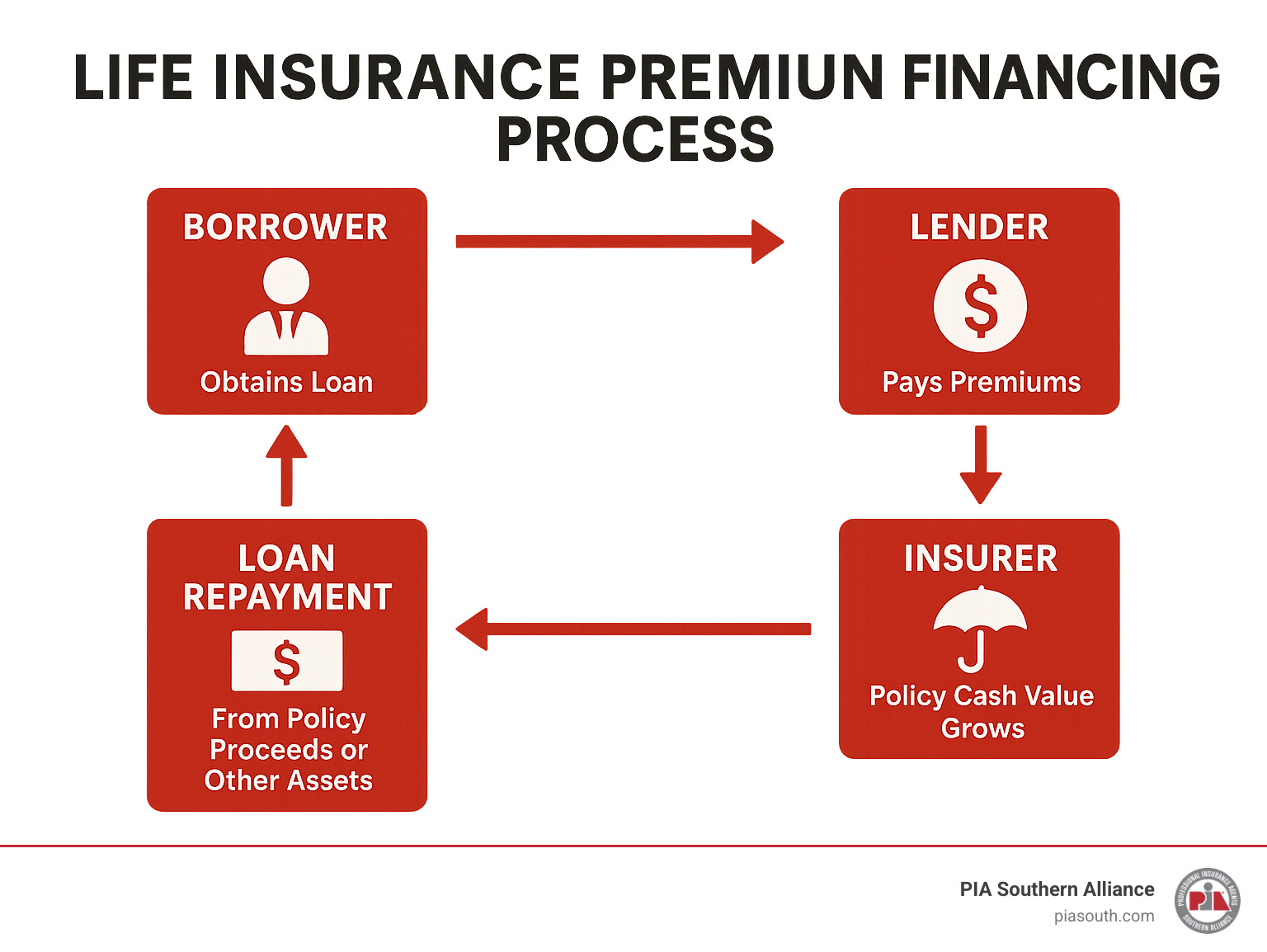
What is life insurance premium financing terms to know:
– can an insurance agency finance a premium
– insurance premium funding interest rates
– insurance premium funding loan
What Is Life Insurance Premium Financing?
Life insurance premium financing is a sophisticated borrowing strategy that lets wealthy individuals and businesses get large life insurance policies without tying up their own money. At its heart, it’s about using “other people’s money” – a third-party lender provides the funds to pay those hefty insurance premiums, and the policy itself serves as the main collateral for the loan.
It’s worth noting that this approach has become incredibly popular – about 72% of high-net-worth individuals choose to premium finance their universal life insurance policies rather than paying premiums directly. This shows just how mainstream this strategy has become for affluent clients looking for smarter ways to handle large insurance costs.

The beauty of what is life insurance premium financing lies in its leverage and interest-rate arbitrage. Instead of writing big checks for premiums, the insured borrows the premium amount and typically just pays the annual interest on that loan. This clever arrangement means your client’s existing assets stay invested elsewhere, potentially earning returns that beat the loan’s interest cost.
As industry expert Daniel Zigman explains: “Many of our clients consider financing their life insurance premiums in order to reduce the gift tax implications of contributing assets to a trust.”
Why the term “what is life insurance premium financing” matters to P-C agents
For property-casualty agents across Georgia, Alabama, and Mississippi, understanding life insurance premium financing opens doors to valuable cross-selling opportunities. Many of your existing commercial clients—especially business owners with substantial real estate holdings or other assets that aren’t easily converted to cash—could be perfect candidates for this strategy.
Our Southeastern markets offer unique premium financing opportunities. Georgia’s thriving business community, Alabama’s robust manufacturing sector, and Mississippi’s agricultural enterprises all include business owners who might benefit tremendously from securing large life insurance policies without disrupting their business capital.
When you can confidently discuss premium financing options with clients, you transform from “just an insurance salesperson” into a comprehensive risk management advisor. This knowledge expansion is exactly what we at PIA Southern Alliance strive to help you achieve – improving your cross-selling abilities and making you a more strategic partner to your high-value clients.
How Does Insurance Premium Financing Work?
The mechanics of premium financing might sound complex, but the concept is surprisingly straightforward. Think of it as a strategic partnership between several parties to fund a life insurance policy without tying up your capital.
Here’s what happens: a third-party lender provides a loan to pay the premiums on a permanent life insurance policy—typically an indexed universal life or whole life policy. For tax efficiency, the policy is often owned by an Irrevocable Life Insurance Trust (ILIT), keeping the death benefit safely outside the insured’s taxable estate.
The real beauty of this arrangement? The loan is secured primarily by the policy’s cash surrender value. While additional collateral is needed in the early years (before the policy builds significant cash value), the insured or trust typically pays only the annual interest on the loan—substantially less than paying the full premium out-of-pocket.
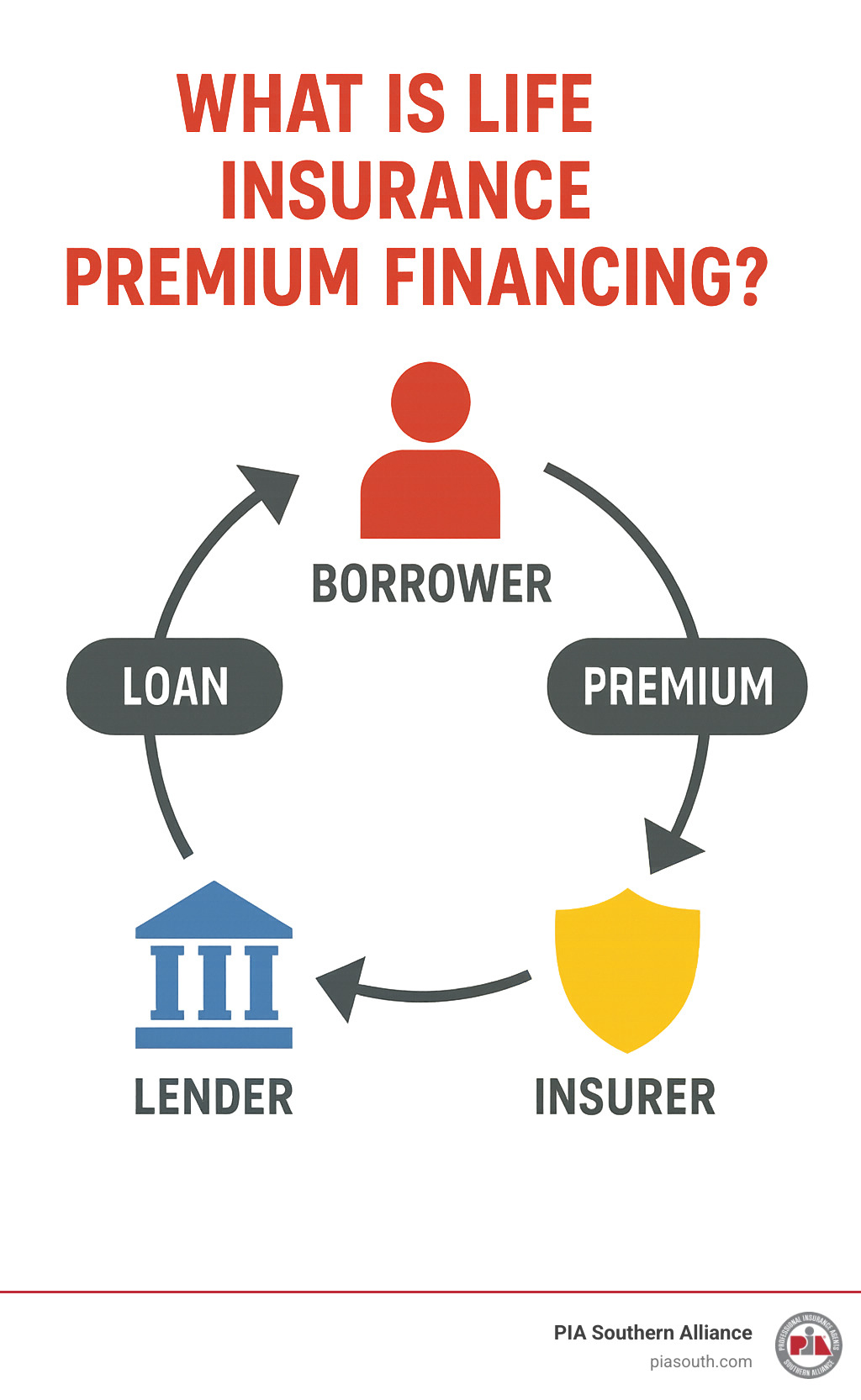
Most premium finance loans are linked to 1-year LIBOR (now being replaced by SOFR) plus a competitive spread of around 180 basis points. This typically results in borrowing rates between 2.5% and 6%, depending on current market conditions.
Want to dive deeper into the mechanics? You can find more info about how it works on our dedicated page.
Parties & Structures in a Typical Arrangement
A premium financing arrangement brings together five key players, each with an important role to play:
The Insured is the individual whose life is covered by the policy. They need to qualify medically for the insurance and typically must have a net worth of at least $5 million to make this strategy worthwhile.
The Trustee often enters the picture because the policy is frequently owned by an ILIT rather than directly by the insured. This trustee manages the trust, handles premium payments, and takes care of administrative tasks.
The Lender might be a commercial bank, private bank, or specialty finance company that focuses on premium financing. They provide the funds for the premiums and establish the loan terms.
The Carrier is the insurance company issuing the policy. It’s worth noting that not all carriers’ products work well for premium financing—policies need strong cash value accumulation features to be suitable.
The Guarantor (often the insured themselves) backs the loan, especially during those early years when additional collateral is required.
The structure can be custom to the insured’s specific goals—some arrangements focus primarily on estate planning, while others are designed for business succession or wealth accumulation strategies.
The Keyword in Action: what is life insurance premium financing step-by-step
Let’s break down what is life insurance premium financing into a real-world process:
The journey begins with loan origination. The client qualifies for a substantial life insurance policy, and the lender approves financing based on the client’s financial situation and creditworthiness. Loan documents are signed, including collateral agreements, and initial collateral is posted—typically a combination of the policy itself and other assets.
Next comes the premium payment phase. The lender sends funds directly to the insurance carrier, the policy is issued with a collateral assignment to the lender, and the policy begins building cash value.
The servicing stage is ongoing. The client pays annual interest on the loan (or in some cases, allows it to accrue), collateral is reviewed yearly and adjusted as needed, and policy performance is monitored to ensure it’s meeting projections.
Finally, there’s the exit strategy. Eventually, the loan will be repaid through one of several options: the policy death benefit upon the insured’s passing, policy cash value through withdrawals or loans, external assets through sale of a business or other liquidity event, or refinancing with another lender or with policy loans.
To put this in perspective, consider a real case from our files: a 45-year-old real estate entrepreneur in Georgia needed a $5 million policy. Instead of paying the $325,000 annual premium out-of-pocket for seven years, he financed the premiums. His first-year loan interest was only $13,000, allowing him to keep his capital working hard in his real estate ventures.
This practical approach to funding life insurance makes perfect sense for many business owners and high-net-worth individuals across Georgia, Alabama, and Mississippi who understand the value of keeping their capital deployed in higher-returning investments.
Is Premium Financing the Right Fit?
Not everyone should consider premium financing for their life insurance needs. This strategy works best for a specific type of client with particular financial characteristics that make it advantageous.
The ideal candidate for what is life insurance premium financing typically has:
- Net Worth: $5 million or more
- Age Range: Between 29 and 75 years old
- Insurance Need: Requiring substantial coverage, usually $5 million+
- Asset Profile: What we often call “asset-rich but cash-poor” – folks with considerable wealth tied up in illiquid investments
- Credit Worthiness: Strong credit history and stable financial situation
- Long-term Outlook: Planning horizon of at least 10 years
I’ve seen premium financing work wonders for business owners across Georgia, Alabama, and Mississippi who have significant company value but struggle with day-to-day liquidity. Real estate investors with capital tied up in properties are also perfect candidates. The strategy particularly shines for wealthy families working on efficient estate planning solutions and individuals expecting future liquidity events, like selling a business.
As one advisor I know likes to say: “Ultra-high-net-worth clients are comfortable with secured debt and may prefer financing over liquidating high-return assets.” They understand leverage and how to make it work in their favor.
Insurance Premium Funding Loan
Benefits You Can Leverage
When premium financing fits, it offers some compelling advantages that can make a real difference for the right clients.
First, it provides estate liquidity – giving your heirs cash at death to handle estate taxes without forcing them to sell off the family business or cherished real estate holdings. This alone brings tremendous peace of mind to many families.
The tax efficiency aspect is particularly attractive. By funding only loan interest rather than full premiums to an ILIT, you can significantly reduce gift tax exposure – a clever strategy for wealth transfer.
Capital retention might be my favorite benefit to discuss with clients. Why pull money out of investments earning 8-10% to fund premiums when you can borrow at 4-5%? This allows clients to keep their money working harder elsewhere.
The ability to secure a larger death benefit than might otherwise be affordable out-of-pocket opens doors for comprehensive estate planning. I’ve seen clients obtain policies two or three times larger than they initially thought possible.
Then there’s the opportunity cost savings – preventing the liquidation of assets that might trigger capital gains taxes or lose significant appreciation potential. This hidden benefit often gets overlooked but can be substantial.

I remember working with a family business owner in Mississippi who used premium financing to secure a $25 million policy. Instead of paying approximately $2,100 per month for the premium, he paid only the interest while keeping his capital invested in his growing business. When he eventually passed away, the policy provided the liquidity his family needed to pay estate taxes without having to sell the family business. That’s the real-world impact this strategy can have.
Risks & Downsides to Stress-Test
Let’s be honest – what is life insurance premium financing isn’t without significant risks. Any reputable advisor should thoroughly stress-test these concerns before recommending this approach.
Interest rate volatility tops the list of concerns. If rates climb significantly, the cost of borrowing could exceed the policy’s returns, creating what we call a “negative arbitrage” situation. As James Holtzman, CFP, wisely cautions: “Most of the time a premium finance loan will have a variable interest rate. When [interest rates] rise, it could really eat into the advantages you were trying to accomplish in the first place.”
Collateral calls can catch clients off guard. If the policy underperforms or interest rates increase, the lender might require additional collateral, potentially straining your client’s liquidity just when they least expect it.
The risk of negative arbitrage deserves special attention. There’s simply no guarantee that the policy’s returns will outpace the loan’s interest cost, especially during volatile economic times. We’ve seen this happen in recent years when interest rates climbed faster than anyone predicted.
Refinancing risk often gets overlooked in the initial excitement. When the loan term ends (typically after 5-10 years), there’s no guarantee the lender will renew or that another lender will step in with favorable terms.
Finally, policy underperformance can derail even the best-laid plans. If the policy doesn’t perform as illustrated, the cash value might not grow sufficiently to serve as adequate collateral or provide a viable exit strategy.
To help clients steer these waters safely, I always recommend:
– Running multiple stress tests under various interest rate and policy performance scenarios
– Developing a clear exit strategy beyond simply relying on the death benefit
– Working with advisors experienced in the complexities of premium financing
– Considering fixed-rate options or interest rate caps to limit volatility
Latest research on premium-financing risks
Designing a Successful Premium-Finance Strategy
Creating a premium financing strategy isn’t one-size-fits-all—it’s more like tailoring a custom suit for your client’s financial profile. The right design balances their goals, risk tolerance, and long-term needs.
Let’s start with a fundamental choice: variable or fixed interest rates. Variable rates typically offer lower initial costs but come with uncertainty—like Georgia weather in spring! Fixed rates, while generally higher, provide the comfort of predictability. Most premium finance loans track benchmark rates such as SOFR (which replaced LIBOR) plus a spread around 180 basis points.
“The interest rate structure is just the foundation,” explains one premium finance specialist. “What you build on top of it matters just as much.”
Another key decision is whether clients should pay interest annually or let it accrue. Paying annually keeps the loan balance in check but requires regular cash flow. Accruing interest preserves current cash flow but grows the loan balance—a tradeoff that depends on your client’s liquidity situation.
The crown jewel of any premium financing arrangement is the exit strategy. Without a clear path to eventually repay the loan, the entire structure could collapse. Smart exit strategies include:
Policy cash value growth can eventually provide enough value to repay the loan, either partially or fully.
Grantor Retained Annuity Trusts (GRATs) can generate income specifically earmarked for loan repayment.
Policy loans can replace third-party financing once sufficient cash value accumulates, effectively “refinancing” the debt internally.
Death benefit proceeds can repay the loan, with remaining funds going to beneficiaries.
Refinancing with another lender might secure more favorable terms as markets change.
Every solid plan includes stress testing. This means running “what if” scenarios with higher interest rates, lower policy returns, and longer loan periods—think of it as financial storm-proofing for your Mississippi and Alabama clients.
Insurance Premium Funding Interest Rates
Collateral Requirements & Management
Collateral is the security blanket that lenders need to sleep well at night. They typically require 100% collateralization—meaning the collateral value must match or exceed the loan balance.
In the early years, your client’s policy cash surrender value serves as the foundation, but it’s rarely enough on its own. Additional collateral often includes:
Cash or cash equivalents offer simplicity and liquidity that lenders love.
Marketable securities work well but face “haircuts”—lenders might value a $100,000 stock portfolio at only $70,000-$80,000 for collateral purposes.
Letters of credit provide strong security but come with their own costs and requirements.
Existing insurance policies with established cash value can supplement newer policies.
“Most private banks will allow you to borrow between 80% and 90% loan to value of the day one cash surrender value of your life policy,” notes a premium finance specialist.
Collateral requirements aren’t set in stone—they’re typically reviewed annually, with adjustments based on loan balance changes, policy performance, and shifts in other asset values. Many savvy advisors recommend policies with high-early-cash-value riders specifically designed to minimize additional collateral requirements in those crucial early years.
Choosing a Lender & Monitoring Market Conditions
Finding the right lending partner is like choosing the right fishing spot in Alabama’s Gulf Coast—location matters, but so does knowing what you’re fishing for.
Two main categories of lenders dominate the premium financing landscape:
Banks (traditional, private, and commercial) offer premium financing alongside their broader lending services. They often provide competitive rates, especially for existing clients, but come with stricter underwriting requirements and less flexibility. They typically expect substantial banking relationships beyond just the premium finance loan.
Specialty Finance Companies focus specifically on life insurance premium financing. They bring greater flexibility in terms and collateral requirements, deeper understanding of insurance products, and often more accommodation for credit or collateral challenges. The tradeoff? Usually higher interest rates than banks.

When helping your Georgia, Alabama, or Mississippi clients select a lender, consider their interest rate structure, loan term length, renewal provisions, collateral calculations, experience with premium financing, and overall financial stability.
Market conditions can shift like sand dunes on the Gulf shores. Rising interest rates increase borrowing costs, while declining policy crediting rates can hamper performance. Successful advisors keep a close eye on interest rate trends, carrier financial strength ratings, policy performance versus illustrations, and regulatory changes.
Regular reviews aren’t just good practice—they’re essential. A strategy that works brilliantly today might need adjustments tomorrow as economic winds shift. For property-casualty agents looking to expand their offerings, understanding these nuances creates valuable opportunities to serve clients more comprehensively.
At PIA Southern Alliance, we’ve seen how property-casualty agents across our three-state region have leveraged this knowledge to become more well-rounded risk management advisors. The premium financing conversation often opens doors to deeper client relationships and referrals that benefit both your life and property-casualty business.
Compliance, Tax & Estate Planning Essentials
Navigating the compliance waters of premium financing feels a bit like sailing through a storm – challenging but manageable with the right crew. This is especially true for independent agents working across Georgia, Alabama, and Mississippi, where state regulations add another layer to consider.
When it comes to taxes, premium financing creates some interesting opportunities and potential pitfalls. Gift tax considerations stand front and center for many clients. When a policy is held in an Irrevocable Life Insurance Trust (ILIT), premium payments are typically considered gifts to the trust. The beauty of premium financing is that it can significantly reduce gift tax exposure – your client only needs to gift the loan interest amount rather than the full premium. That’s a substantial difference when dealing with large policies!
Estate tax planning represents another major advantage. When properly structured, the death benefit of a policy owned by an ILIT remains outside the insured’s taxable estate. This creates a powerful tool: liquidity for paying estate taxes without actually increasing the estate’s value. It’s like creating money out of thin air (legally, of course!).
Be careful about income tax implications, though. Policy loans and withdrawals can create unexpected tax consequences, particularly if the policy becomes a Modified Endowment Contract (MEC). This happens when too much premium is paid into a policy too quickly relative to the death benefit – and the tax consequences can be significant.
The insurable interest doctrine varies across Georgia, Alabama, and Mississippi, so local knowledge matters. This doctrine requires that the policy owner has a legitimate interest in the insured’s life beyond simply profiting from their death. Violating these state-specific rules can potentially make a policy unenforceable – not a conversation you want to have with beneficiaries!
Another important development to watch is the transition from LIBOR to SOFR as the benchmark interest rate. Existing premium financing arrangements may need adjustments, and new ones will likely use SOFR as their reference rate. This shift affects how loan interest is calculated and can impact the long-term economics of the arrangement.
I can’t stress enough how important independent legal counsel is when implementing premium financing. As one specialist puts it: “Have an attorney or specialized premium finance platform review all transaction documentation.” This isn’t an area for DIY approaches or cutting corners.
Scientific research on capital gains taxes
Coordinating Your Advisory Team
Premium financing truly takes a village – or at least a well-coordinated team of professionals working in harmony. Here’s who should be at the table:
Your property-casualty agent often serves as the quarterback, identifying opportunities and coordinating the overall strategy. In Georgia, Alabama, and Mississippi, P-C agents who understand premium financing can deliver tremendous value to high-net-worth clients and differentiate themselves in competitive markets.
An experienced estate attorney handles the critical legal infrastructure – drafting the ILIT, ensuring compliance with state laws, and addressing the broader estate planning implications. The attorney’s expertise helps avoid costly mistakes that could undermine the entire strategy.
A knowledgeable CPA provides essential tax guidance both during setup and ongoing operation. Tax laws change, and having someone monitoring these changes as they relate to your premium financing arrangement is invaluable.
A specialized premium finance consultant brings technical expertise in designing these arrangements, including policy selection, lender relationships, and exit strategies. They’ve seen what works and what doesn’t across many cases.
Your client’s financial advisor helps integrate premium financing into their comprehensive financial plan, ensuring it aligns with other investments and goals.
Ideally, these professionals should have experience with premium financing and collaborate effectively. A risk management graduate often excels at coordinating this team, bringing both insurance knowledge and financial acumen to the table.
Regular team reviews aren’t optional – they’re essential to ensure the strategy adapts to changing conditions and remains aligned with your client’s evolving needs. The best premium financing arrangements receive ongoing attention and adjustments, not just at inception.
Frequently Asked Questions about Life Insurance Premium Financing
How much collateral will I need each year?
One of the most common questions we hear from clients across Georgia, Alabama, and Mississippi relates to collateral requirements. The truth is, collateral typically follows a predictable pattern – increasing in the early years when your loan balance grows faster than the policy’s cash value, then gradually decreasing as the cash value catches up.
Most lenders require your arrangement to be 100% collateralized at all times. In the first few years, you’ll likely need to pledge additional assets beyond just the policy itself. Think of it as similar to how a mortgage works when you first buy a home – you need a down payment until you build equity.
The specific amount varies based on several factors: the type of policy you choose, how well it performs, your loan’s interest rate, whether you’re paying or accruing interest, and if your policy includes special riders like high early cash value. Your lender’s requirements also play a significant role.
In a typical scenario, you might need additional collateral equal to 60-80% of the loan balance during the first few years. The good news? This requirement usually declines to zero somewhere between years 8-12 as your policy’s cash value grows and eventually exceeds the loan balance.
What happens if interest rates spike?
Let’s address the elephant in the room – interest rate risk. This is a legitimate concern, especially in today’s economic climate. If rates increase significantly, your premium financing arrangement can be affected in several important ways:
Higher loan costs become an immediate concern with variable-rate loans. Those increased payments can chip away at the economic benefits that made premium financing attractive in the first place.
Collateral requirements often increase when rates rise, as lenders seek additional security for their loans in a higher-rate environment.
Negative arbitrage becomes a real risk if loan rates exceed what your policy is earning, potentially flipping the mathematical advantage that underlies the entire strategy.
The good news is you’re not powerless against rate increases. Many clients in the Southeast work with their advisors to negotiate interest rate caps or secure fixed-rate loans, even at a slightly higher initial cost. Building stress-testing into your plan that assumes higher rates is also prudent.
As one experienced advisor working with clients in Alabama put it: “A properly structured financing should still make sense even if borrowing costs rise to 9%, as long as policy values grow accordingly.” The key is planning for this possibility from the beginning.
Can I exit before death without lapsing the policy?
Absolutely! Contrary to what some might believe, premium financing isn’t a “til death do us part” arrangement. Several practical exit strategies allow you to gracefully disengage while keeping your valuable coverage intact:
Once your policy’s cash value reaches sufficient levels (typically after 8-12 years), you can use it to repay part or all of your loan. Many clients in Georgia’s thriving business communities find this becomes a viable option as their policies mature.
You can also use external assets – perhaps from a business sale or other liquidity event – to repay the loan while maintaining the policy with no outstanding debt.
Converting to policy loans is another popular approach among Mississippi and Alabama business owners. This strategy replaces the third-party loan with loans against the policy itself, which typically offer more flexible repayment terms.
Some clients consider selling the policy in the life settlement market, potentially generating enough proceeds to repay the loan with money left over.
For those with substantial estates, a Grantor Retained Annuity Trust (GRAT) can be established to generate income specifically earmarked for loan repayment.
The most important thing to remember is that your exit strategy should be thoughtfully planned from day one. Your team of advisors, including your property-casualty agent who likely introduced you to this concept, should regularly review your arrangement to ensure it remains aligned with your evolving financial situation.
Conclusion
Life insurance premium financing represents a sophisticated financial strategy that can deliver substantial benefits for the right clients. By strategically leveraging borrowed funds to pay premiums, high-net-worth individuals and business owners can secure necessary coverage while keeping their capital working elsewhere.
However, this approach isn’t without its complexities. Like any powerful financial tool, premium financing requires thoughtful consideration, careful planning, and vigilant management. The success of any premium financing arrangement hinges on proactively addressing key factors: interest rate movements, policy performance metrics, evolving collateral requirements, and well-defined exit strategies.
For property-casualty agents serving clients across Georgia, Alabama, and Mississippi, developing expertise in premium financing creates valuable opportunities to deepen client relationships. When you can confidently discuss this strategy alongside your traditional P-C offerings, you position yourself as a more comprehensive risk management advisor rather than just another insurance salesperson. This knowledge expansion gives you a meaningful edge in an increasingly competitive marketplace.
A well-structured premium financing strategy should include:
- A carefully selected policy design aligned with the client’s goals
- A lender whose terms and approach match the client’s needs
- Comprehensive stress-testing under various economic scenarios
- Multiple clearly defined exit strategies
- Regular reviews and adjustments as conditions change
Premium financing isn’t a one-size-fits-all solution. It works best for clients with specific financial profiles – typically those with substantial net worth but limited liquidity, ongoing investment opportunities that outpace borrowing costs, and a long-term planning horizon.
The most successful arrangements involve collaboration among specialized professionals. When P-C agents partner with estate attorneys, CPAs, and premium finance specialists, they create a powerful team that can steer the complexities while maximizing the strategy’s benefits.
At PIA Southern Alliance, we’re dedicated to helping independent agencies across Georgia, Alabama, and Mississippi develop these valuable cross-selling skills. By providing educational resources on sophisticated strategies like premium financing, we empower our member agencies to better serve their high-net-worth clients while expanding their service offerings beyond traditional P-C products.
More info about professional-agent funding resources
When properly executed, premium financing can be a game-changer for the right clients – a strategy that neatly addresses their insurance needs while optimizing their overall financial picture. For the property-casualty agent who understands its nuances, it represents both a valuable client solution and a powerful practice-building tool.