
Think of an independent insurance agent as your personal guide in the often-confusing world of insurance. Instead of working for a single insurance company, they represent you. Their job is to tap into a network of multiple insurance carriers to find the perfect mix of price, coverage, and service that fits your life, not the other way around. This freedom empowers them to give you unbiased advice and real choices.
Your Guide to Independent Insurance Agents

Here’s a simple analogy: imagine the insurance market is a giant department store with hundreds of different brands on the shelves. A captive agent, who works exclusively for one company like State Farm or Allstate, can only sell you products from their single brand. They're locked in.
An independent agent, however, has the freedom to walk through every aisle and compare all the options for you.
Their value really boils down to three core commitments:
- Unbiased Choice: They have no incentive to push one company's policy over another. Their only goal is finding the right fit for you, period.
- Expert Advice: They're masters at translating complicated insurance jargon into plain English, making sure you actually understand what you're buying and why it’s so important.
- Client Advocacy: If the unexpected happens and you need to file a claim, they are in your corner. They work for you—not the insurance company—to help you navigate the entire process.
This unique setup means that most independent agents are entrepreneurs and local business owners. They build their careers on creating lasting relationships and earning trust, one client at a time. To truly get the picture, it's helpful to see where they fit into the broader insurance agents industry.
The Growing Influence of Independent Agents
The independent agency channel isn't just a small niche; it's a major force in the insurance market. The global insurance brokers and agents market, where independents are the stars of the show, grew to an incredible $436.16 billion in 2023. And it’s not slowing down, with projections showing it could hit $612.71 billion by 2028.
North America is the heart of this movement, accounting for 45.7% of the market, or $199.4 billion. This is the epicenter for agencies that are built on delivering personal service and real expertise. You can dive deeper into these trends over at ResearchAndMarkets.com.
In this guide, we’ll break down the key differences between agent types, show you the real-world benefits for you as a consumer, and explain how organizations like PIA Southern Alliance champion these entrepreneurs. For those in our region, getting a feel for the landscape of independent insurance agencies in Georgia can offer some great local perspective. Our aim is to give you a clear, complete picture of how this model works and why it just might be the smartest way to protect what matters most.
Understanding The Independent vs Captive Agent

To really understand what an independent insurance agent is, it helps to look at them alongside their counterpart: the captive agent. This isn't just industry jargon; it's a core difference in how they're structured, which directly impacts the advice and options you get as a client. The whole distinction boils down to loyalty and choice.
A captive agent works for, or is exclusively contracted with, a single insurance company. You know the big names—think State Farm, Allstate, or Farmers Insurance. These agents are tied to their brand and can only offer the products that one company sells.
While that model can work for some, it naturally limits your choices. If that specific company's rates are too high for your situation or their coverage just isn't the right fit, the captive agent’s hands are tied. Their toolbox only has one set of tools, no matter what the job calls for.
The Independent Advantage Unlocked
An independent agent, on the other hand, is a business owner. They aren't tied to any single carrier. Instead, they build relationships and secure appointments with multiple insurance companies, completely flipping the script.
Their loyalty isn't to a corporate brand; it's to you, their client. When you come to them for a policy, they can shop the entire market on your behalf, gathering quotes and comparing coverage from a whole lineup of different carriers. It’s like getting multiple second opinions without having to do any of the legwork yourself.
This freedom is what allows them to hunt down competitive pricing and put together a plan that truly fits your unique needs, whether it's for your family or your business.
For the consumer, this difference is everything. An independent agent’s primary duty is to match you with the best possible coverage solution available from a wide marketplace, not to sell you a predetermined product from a single company.
This key distinction is why so many people prefer the flexibility and client-first approach of the independent model. To see these differences laid out clearly, this quick comparison is a great place to start.
Independent Agent vs Captive Agent A Quick Comparison
This table highlights the key operational and philosophical differences between independent and captive insurance agents, clarifying how their business models impact your experience.
| Feature | Independent Agent | Captive Agent |
|---|---|---|
| Carrier Representation | Represents multiple insurance companies | Represents a single insurance company |
| Product Offerings | A wide variety of policies and options | Limited to one company's product line |
| Primary Loyalty | To the client | To the insurance company they represent |
| Business Structure | Typically owns their agency as an entrepreneur | Works for or is contracted by one carrier |
| Approach to Quoting | Compares quotes from several carriers | Provides a single quote from their company |
| Client Relationship | Long-term advisor focused on finding the best fit as needs change | Representative of a specific brand's offerings |
As you can see, the independent model is built around providing choice and acting as a long-term advocate for the client.
How Independent Agents Benefit You
It’s one thing to know the difference between agent types, but it's another thing entirely to see how that difference actually helps you. When you partner with an independent insurance agent, you get three core advantages that directly impact your wallet, your peace of mind, and your family's security.
These benefits—customized choice, unbiased expert guidance, and true advocacy—are the pillars of the independent model. They're what set this experience apart.
Customized Choice and Competitive Pricing
The most immediate benefit is having a world of options. An independent agent isn't stuck with one company's product list. Instead, they have access to a whole marketplace of carriers, which lets them shop around to find coverage that’s the right fit for your unique situation.
This means they can hunt down more competitive prices and build policies that cover specific risks a single carrier might not handle well.
Imagine you're a family in Georgia adding a teen driver to your auto policy—a change that can really sting your budget. A captive agent can only give you one price from their company, take it or leave it. An independent agent, on the other hand, can compare quotes from five or six different carriers, finding one that specializes in insuring families with new drivers and potentially saving you hundreds of dollars.
The same goes for business owners. A small business in a flood-prone area of Mississippi needs a very specific kind of protection. An independent agent taps into their network to find a carrier with the right commercial flood endorsements, making sure the business is properly covered without you paying for a bunch of extras you don't need.
At its core, the power of choice gives you leverage. An independent agent uses their market access to create competition for your business, driving better terms and pricing directly to you.
This dynamic is a huge reason why the independent channel is so strong. Independent insurance agents hold a commanding 61.5% market share of all property and casualty (P&C) insurance written in the U.S. in 2024. This includes capturing 39% of personal lines premiums, a number that has been climbing as more people look for personalized service.
Unbiased Guidance from a Trusted Advisor
Beyond just pulling quotes, an independent agent is your personal translator and advisor. Let's be honest, insurance policies are packed with complex jargon, exclusions, and endorsements that are confusing for anyone outside the industry.
Your agent’s job is to cut through all that noise. They explain what your policy actually covers in plain English so you can make decisions you feel good about. Since their loyalty is to you—not a single company—their advice is unbiased and focused completely on your best interests. This is a key reason many people trust independent agencies over big-box carriers.
Your Advocate When It Matters Most
This might be the most important role an independent agent plays: they are your advocate, especially when you have to file a claim. This is the moment of truth in any insurance relationship.
When something goes wrong—a car wreck, a house fire, or a liability issue at your business—your first call is to your agent. They walk you through the claims process, handle the back-and-forth with the insurance company for you, and work to make sure you get a fair and prompt settlement.
They are in your corner, fighting for you every step of the way.
A Day in the Life of an Independent Agent
To really get what an independent insurance agent does, it helps to walk a mile in their shoes. Let's imagine a real-world scenario with a small business owner in Alabama who needs a solid Business Owner's Policy (BOP). This story pulls back the curtain on the agent's process, showing you their value from the first handshake to long-term support.
The day kicks off with a client consultation, not a sales pitch. The agent sits down with the business owner to learn the ins and outs of their operation. They dig deep with probing questions to uncover what makes this business unique: What kind of inventory are you carrying? Do you have employees driving company vehicles? What keeps you up at night when you think about liability? This initial discovery is everything; it’s about diagnosing the risks before even thinking about a solution.
From Assessment to Action
Armed with a deep understanding of the business, the agent doesn't just grab a single quote off the shelf. Instead, they tap into their network of insurance carriers, shopping the policy across multiple companies. This is where the magic happens. Each carrier has its own sweet spot; one might be fantastic for liability coverage for retailers, while another offers better pricing on property risks.
The agent then meticulously compares the quotes, looking way beyond the premium to dissect the fine print. This is where their expertise truly shines. They translate the dense, confusing policy language into a clear, side-by-side comparison, presenting the business owner with two or three excellent options. They walk through the pros and cons of each, empowering their client to make a smart, informed decision without feeling buried in jargon.
This core process—moving from choice to expert guidance and finally to client advocacy—is what it's all about.
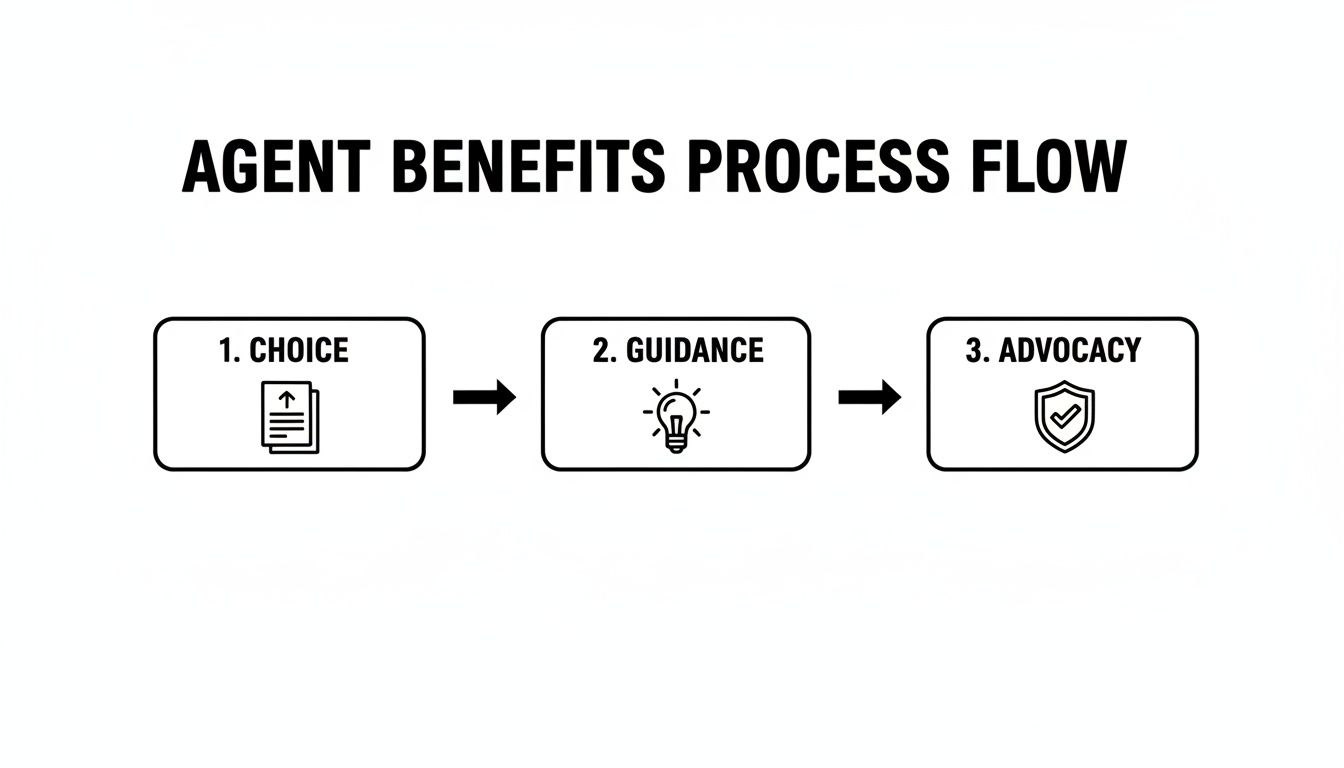
This workflow perfectly illustrates how an independent agent acts as a filter, turning a sea of market options into tailored, understandable solutions for their client.
A Partner for the Long Haul
Once the client picks the best policy for their needs, the agent binds the coverage and handles all the paperwork to get the protection locked in. But their job doesn’t end there—it’s really just the beginning. They become the client's single point of contact for anything and everything that comes next.
Key Takeaway: An independent agent’s role goes far beyond the initial sale. They are long-term risk advisors who manage policy renewals, help adjust coverage as the business grows, and, most importantly, serve as the client's first call and staunchest advocate during a claim.
This relationship-first model is what's fueling incredible growth in the independent channel. Agents are carving out niches in specialized markets, contributing to a global insurance brokerage market that's projected to hit $125.36 billion in 2025. Even more impressive, this sector is expected to soar to $282.45 billion by 2034, with North America leading the charge. You can dig into more data on these trends with the Insurance Information Institute.
At the end of the day, an independent agent's value is built on trust and sustained service, making them indispensable partners for people and businesses alike.
The Entrepreneurial Journey of an Independent Agent
Every independent insurance agent is more than just a trusted advisor—they're an entrepreneur at heart. They are small business owners, building an agency from the ground up that serves as a cornerstone for their local community. Make no mistake, this journey is demanding. It takes a unique blend of risk expertise, business savvy, and a whole lot of grit.
The first major hurdle is laying the foundation, which means securing appointments with top-rated insurance carriers. You can think of these appointments as distribution agreements; without them, an agent simply has no products to sell. For a brand new agent, earning the trust of established carriers is a critical—and often humbling—first step.
At the same time, they're navigating a complex web of state licensing and compliance rules. Each state has its own set of requirements, and staying in good standing isn't a one-time task. It's an ongoing commitment that requires constant attention.
Navigating the Operational Maze
Once the legal paperwork and market access are sorted, the real work of running a business kicks in. The day-to-day operational challenges are significant, and smart solutions are needed to keep the agency humming.
Here are a few of the non-negotiables:
- Robust E&O Insurance: Errors and Omissions (E&O) coverage is absolutely essential. It protects the agency from liability if a mistake is made, making it one of the most important policies an agent will ever buy for their own business.
- Efficient Agency Management Systems (AMS): An AMS is the central nervous system of any modern agency. This software is where you manage client information, track policies, and automate workflows, freeing you up to focus on service instead of drowning in paperwork.
- Ongoing Education: The insurance world never stands still. New risks, new products, and new regulations are always emerging. Continuous learning isn't just a good idea; it's a matter of survival and a prerequisite for giving competent advice.
The life of an independent agent is a constant balancing act. You're simultaneously a salesperson, a risk manager, a compliance officer, and a CEO—all while building lasting relationships with your clients.
This entrepreneurial path is brimming with opportunity, but it also comes with immense pressure. That’s why connecting with peers is so valuable. For agents on this journey, organizations like the EO Entrepreneurs Organization can provide incredible leadership guidance and a supportive network.
These operational demands are precisely why support networks are so crucial. Organizations like PIA Southern Alliance offer the critical infrastructure—from E&O programs to technology solutions—that empowers these entrepreneurs to succeed. By providing essential tools and resources, they help agents not just survive, but truly thrive. You can learn more about how agents continue their education through dedicated independent insurance agent training.
Why Support Networks Are Essential for Agents
The word "independent" is perfect for describing an agent's freedom to choose products for their clients, but it can be a little misleading when it comes to running the business itself. The truth is, no agent truly succeeds on their own. While they are absolutely entrepreneurs, the best ones operate within a supportive ecosystem designed to help them compete and thrive.
Professional associations are the backbone of this system. They act as a force multiplier, giving solo agents and smaller agencies the collective power and resources of a much larger organization. This support directly tackles the biggest operational headaches, turning what could be a weakness into a real strength.
From Independence to Interdependence
Think about it this way: an agent’s number one job is to serve their clients. Every minute they spend wrestling with administrative tasks, researching compliance changes, or trying to get a foot in the door with a new carrier is a minute they’re not spending building relationships and solving problems. A strong support network does the heavy lifting behind the scenes.
For agents in Georgia, Alabama, and Mississippi, organizations like PIA Southern Alliance offer a critical competitive edge by providing the foundational resources that matter most:
- Expanded Market Access: Getting appointments with top-tier carriers is one of the toughest hurdles for new or small agencies. Associations open doors to exclusive markets and programs that would otherwise be completely out of reach.
- Essential E&O Coverage: Having solid Errors & Omissions insurance isn't just a good idea—it's non-negotiable. Endorsed partner programs offer trusted, industry-specific E&O solutions that provide a critical safety net for any agency.
- Powerful Legislative Advocacy: A single agent doesn't have the time or clout to track every legislative shift that could upend their business. A dedicated association becomes their unified voice, fighting for the interests of the independent channel in the halls of government.
An agent's independence is secured by their interdependence. By joining forces through a professional association, they gain the tools, voice, and expertise needed to deliver the superior service and choice their clients expect.
This collaborative model is what props up the entire independent agency channel. It ensures agents have access to top-notch education, operational help through vetted partners, and a community of peers to lean on. At the end of the day, this framework frees them up to focus on what they do best: being a trusted advisor for the people and businesses in their communities.
You’ve Got Questions, We’ve Got Answers
Still have a few things you’re wondering about? You're not the only one. Here are some of the most common questions people ask when they’re first learning about independent insurance agents.
Does It Cost More to Use an Independent Insurance Agent?
Nope, it almost never costs you more. Independent agents get paid a commission from the insurance carriers they work with, not directly from you.
Because they can shop your policy across a bunch of different companies, they often find you better coverage at a better price than you could find on your own. This setup keeps their advice centered on what’s best for you, not what’s best for one specific company.
Is an Insurance Broker the Same as an Independent Agent?
The terms get thrown around interchangeably, and from a consumer's point of view, their jobs are practically identical. Both represent multiple insurance carriers and work to find the best policy for their clients.
If you want to get technical about it, an agent legally represents the insurance company, while a broker legally represents you, the client. In the real world, though, both are committed to finding you the right fit.
At the end of the day, both independent agents and brokers give you choices and expert guidance. They act as your advocate in the complicated world of insurance, and their main goal is to look out for your best interests.
How Do I Find a Reputable Independent Agent Near Me?
Finding a trusted local agent is a lot easier than you might think. A great place to start is a professional association directory, which lists agents who have been vetted and are held to high ethical standards.
You can also just ask around. Get referrals from friends, family, or other local business owners who’ve had a good experience with their agent.
Ready to connect with a thriving network of professionals and get the tools you need to succeed? PIA Southern Alliance provides the resources, advocacy, and community that empower independent agents across Georgia, Alabama, and Mississippi. Learn more and join us today.