
Think of an independent insurance agency as your personal shopper for insurance policies. Instead of being limited to one brand, they bring you multiple options from various carriers. It's the difference between shopping at a versatile marketplace versus a single brand's storefront.
The Independent Insurance Agency Model Explained

So, what’s really at the heart of an independent insurance agency? It’s a business model built entirely on choice and client advocacy. This stands in stark contrast to captive agents, who are employees of a single insurance company—think household names like State Farm or Allstate. Independent agents, on the other hand, are true business owners who partner with a whole roster of different carriers.
This structure completely changes the dynamic of the agent-client relationship. An independent agent’s primary loyalty isn't to a single company; it's to you, the client. Their job is to understand your specific needs, then go out into the market to find the policy that best fits your budget and protects what you value most.
The Power of Choice
The biggest advantage is having a wide selection right at your fingertips. A captive agent can only sell you the products their parent company offers, which may or may not be the best or most affordable fit for your unique situation.
An independent agent, however, can pull quotes and compare coverage details from several different companies at once. This is a game-changer, especially when life happens and your needs evolve. If a carrier suddenly hikes your rates at renewal or stops offering the coverage you need, an independent agent can simply shop your policy with their other partners to find a better home for it. A captive agent is stuck.
An independent agent isn't just a salesperson for one brand; they are a risk management advisor for their client. Their goal is to find the right solution, period—regardless of which company provides it.
Your Advocate and Advisor
This model naturally fosters a long-term, advisory relationship. Because they aren’t beholden to one company's agenda, independent agents can provide genuinely unbiased guidance. Their success is built on client satisfaction and retention, not on hitting some corporate sales quota.
This dynamic empowers you with:
- More Options: Access a broad marketplace of insurance products, ensuring you get competitive pricing and the right coverage.
- Unbiased Advice: Receive objective recommendations tailored to your best interests, not a company mandate.
- A Single Point of Contact: You get one trusted advisor for all your insurance needs, even if your policies are with different companies.
To make it even clearer, here’s a quick look at how the two models stack up side-by-side.
Independent Agent vs Captive Agent At a Glance
The table below breaks down the key distinctions between these two approaches. It's a simple way to see where the core differences lie in terms of who they work for and what they can offer.
| Feature | Independent Agent | Captive Agent |
|---|---|---|
| Carrier Access | Represents multiple insurance companies. | Represents a single insurance company. |
| Client Loyalty | Advocates for the client's best interests. | Loyalty is primarily to the employer insurance company. |
| Product Choice | Offers a wide variety of policies and prices. | Limited to the products of one carrier. |
| Flexibility | Can easily move clients to new carriers if needed. | Cannot offer alternatives outside their own company. |
Ultimately, the choice comes down to what you value most: the perceived stability of a single big brand or the flexibility and personalized advocacy of an independent advisor. For many, having a dedicated expert who shops the market on their behalf is an invaluable advantage.
How Independent Agencies Empower Their Clients

The real magic of an independent agency happens when life gets messy. A captive agent can sell you a product, but an independent agent builds you a strategy. They piece together the best coverage from across the market to create a protective shield that actually fits your life.
This is where the relationship moves beyond a simple transaction and becomes a genuine partnership.
Think about a growing family juggling several major life events at once. They just launched a consulting business from their home office, their oldest kid is now a licensed driver, and they bought a small boat for weekend trips. Almost overnight, their insurance needs went from simple to seriously complex.
A captive agent, tied to just one company, would likely hit a wall here. Maybe their company has great home insurance but charges a fortune for teen drivers. Or perhaps they don't even offer the specialized liability coverage needed for a home business, let alone a separate policy for the boat. The family is stuck trying to fit into a box that’s suddenly way too small.
Crafting a Custom Protection Plan
This is precisely where an independent agent thrives. Instead of being stuck with one set of tools, they act as your personal insurance shopper, pulling the best options from multiple carriers to solve each specific problem. They aren't just selling policies; they're solving a complex puzzle on your behalf.
For the family in our example, an independent agent’s game plan might look something like this:
- Home & Business: They place the homeowner's policy with Carrier A, a company known for its excellent and affordable endorsement for home-based businesses. Both the house and the new venture are covered.
- Teen Driver: They find that Carrier B offers the most competitive rates and best coverage options for families with new drivers, avoiding that massive premium spike everyone dreads.
- Recreational Boat: They secure a standalone boat policy from Carrier C, a company that specializes in marine insurance and offers far better protection for the vessel than the other carriers could.
The result? A seamless, comprehensive plan that’s more effective and often more affordable. The family gets a single expert to manage everything, even though their protection comes from three different, specialized companies. This is the power of choice.
The Long-Term Advisory Relationship
This approach builds a level of trust that a single-carrier agent just can't match. The client knows their agent is working for them, not for a sales quota from one company. It completely transforms the dynamic from a one-off sale into a long-term advisory partnership.
The core promise of an independent insurance agency is advocacy. Their mission is to navigate the market on your behalf, ensuring your protection evolves perfectly in step with your life.
This client-first mentality is a huge reason why so many people trust independent agencies over big-box carriers. An independent agent becomes a key member of your financial team—someone who will re-shop your policies if rates climb, help you through the claims process, and proactively check in as your life changes.
You get a single point of contact for all your insurance questions, saving you the headache of dealing with different call centers and corporate red tape. And when you need to file a claim, they’re in your corner, acting as your advocate with the carrier. That level of personal service and market freedom is the ultimate advantage for any person, family, or business looking for true peace of mind.
The Business of Independence: How Agencies Operate
Behind every successful independent insurance agency is a powerful and resilient business engine. If you're an entrepreneur wondering how these agencies not only survive but thrive, getting a handle on their operational structure is key. It’s a model built on strategic partnerships, client retention, and creating long-term value.
At its core, the business of an independent agency is about managing relationships—with both clients and a diverse portfolio of insurance carriers. This dual focus is what fuels its success and stability.
Primary Revenue Streams
An independent agency’s financial health is driven by a few key income sources. Unlike a traditional retail business that relies on a one-time sale, an agency builds a sustainable book of business that generates recurring revenue for years to come.
The most significant source of income is commissions. When you sell a new policy, the insurance carrier pays you a percentage of the premium. But this isn't a one-and-done deal. The agency continues to earn a commission each time that policy renews, rewarding you for keeping clients happy and well-served.
Key Takeaway: The annuity-style nature of renewal commissions is the cornerstone of the independent agency model. It creates a predictable and stable revenue base that grows year after year.
Another critical revenue stream is profit-sharing, sometimes called contingent income. Carriers reward agencies that provide them with a profitable block of business—meaning the policies you bring in result in fewer claims than expected. This performance-based bonus is a powerful incentive for agencies to write high-quality, low-risk policies, perfectly aligning their goals with their carrier partners.
The Operational Pillars of Success
Beyond bringing in revenue, a successful agency owner has to manage several core operational components. Think of these as the pillars that support your day-to-day functions and long-term growth, making sure the business runs smoothly and efficiently.
Three of the most important pillars are:
- Carrier Appointments: An agency is only as strong as its carrier partners. Securing and maintaining appointments—which are the contractual agreements to sell a carrier's products—is a top priority. A diverse mix of strong carriers allows you to serve a wide range of client needs, making you the go-to expert.
- Cash Flow Management: Just like any other business, managing your finances is absolutely essential. Agency owners have to balance commission income with operational expenses like payroll, rent, marketing, and technology to ensure profitability and sustained growth.
- Technology Integration: Modern agencies lean heavily on technology. An Agency Management System (AMS) is the central nervous system, housing all your client data, policy information, and communication records. When looking for tools to boost efficiency and client interaction, independent insurance agencies might explore using AI chatbots for insurance agents to provide instant support.
A Resilient and Dominant Business Model
The independent agency model has proven its durability, especially in the property and casualty (P&C) sector. This resilience is a major reason why so many entrepreneurs are drawn to it. The model's structure fosters deep client relationships and market adaptability that single-carrier operations simply can't match.
The numbers back this up. Independent insurance agencies are a powerhouse in the P&C insurance landscape, commanding a dominant 61.5% market share of all P&C insurance written in the U.S. This dominance is even more pronounced in commercial lines, where agencies write an incredible 87.2% of premiums. You can dig into more data on the independent channel's market performance from the Big 'I' Market Share Report.
This commanding market presence isn't an accident. It's the direct result of a business model that prioritizes choice, expert advice, and client advocacy. For agency owners, this translates into a sustainable framework for building a profitable, enduring enterprise that serves its community for generations.
Your Roadmap to Starting an Agency
So, you’re ready to make the leap from insurance professional to entrepreneur. It’s an exciting move, but it can feel overwhelming. Let's break down the journey into a clear roadmap, cutting through the jargon to show you exactly what it takes to build a successful agency from the ground up.
The very first step isn’t finding an office or hiring staff; it’s hammering out a solid business plan. Think of this document as your strategic guide. It forces you to get serious about your target market, financial projections, and marketing strategy, creating a firm foundation for everything that comes next.
This is a good look at the core engine of an independent agency—how it runs, what powers it, and where the money comes from.
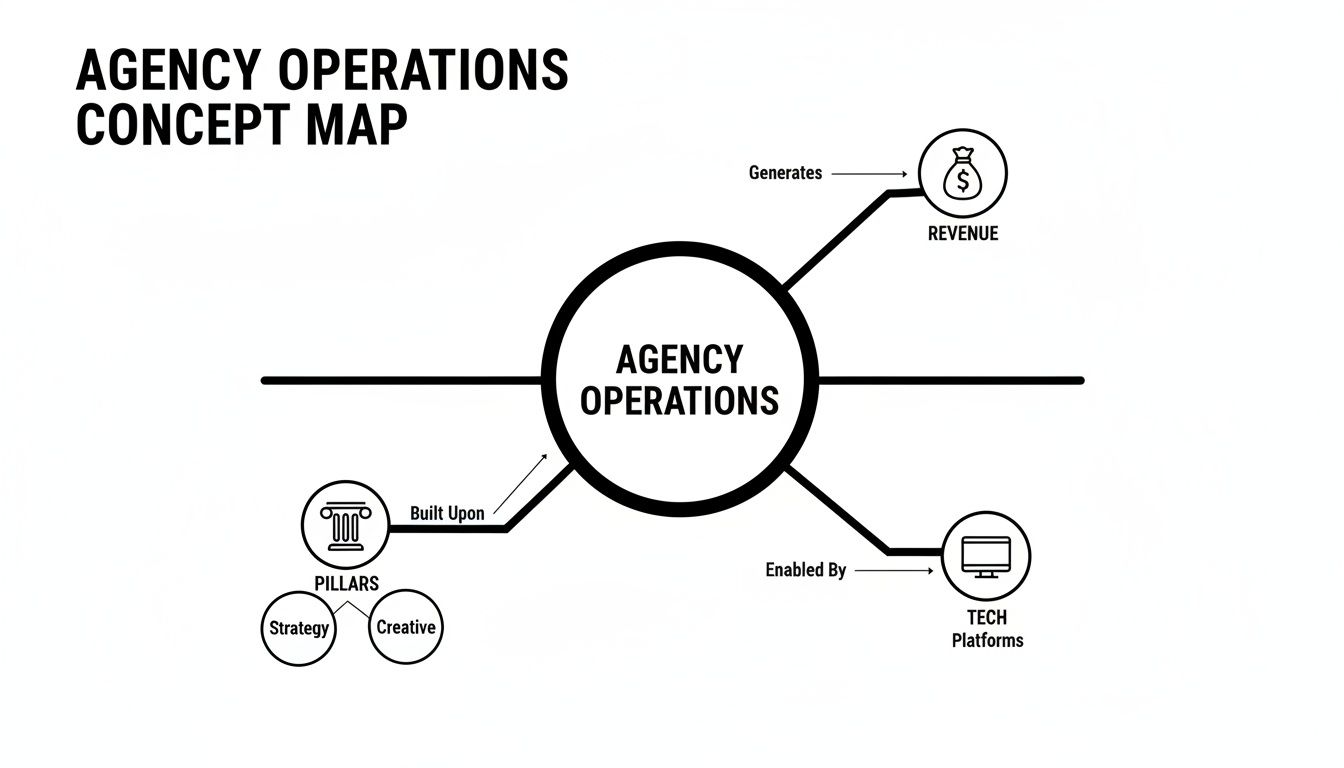
As you can see, a healthy agency is a balancing act. It’s about blending smart operations with the right technology to keep revenue flowing and the business growing.
Laying the Legal and Protective Groundwork
With your business plan in hand, it's time to make things official. One of your first big decisions is choosing a legal structure. This choice has a major impact on your personal liability and how you’re taxed. Many new agency owners go with a Limited Liability Company (LLC) or an S-Corporation (S-Corp) to create a protective barrier between their personal assets and the business.
Next up: getting the right licenses. You’ll need to secure state insurance licenses for every line of business you plan to sell, like Property & Casualty or Life & Health. These are non-negotiable legal requirements to operate in states like Georgia, Alabama, and Mississippi.
Once the legal and licensing boxes are checked, you need to get your own protection in place. That means securing Errors & Omissions (E&O) insurance. Honestly, this might be the single most important policy you buy for your agency.
E&O insurance is your professional safety net. It’s what protects your agency from financial ruin if a client sues you for a mistake or alleged negligence. For a new agency, this coverage is an absolute must-have.
Think of it as malpractice insurance for insurance agents. Without it, one disgruntled client could jeopardize your entire business and even your personal finances. It’s the foundational layer of protection you can’t afford to skip.
Overcoming the Carrier Appointment Hurdle
Alright, now for what is often the biggest headache for new agencies: securing carrier appointments. Insurance carriers can be picky about who they partner with. They usually prefer established agencies with a proven track record, which creates a classic catch-22 for a startup. How do you get access to markets when you’re just getting started?
This is exactly where agency networks and alliances become a game-changer.
Joining an organization like PIA Southern Alliance gives you instant credibility. More importantly, it provides immediate access to a whole portfolio of top-rated insurance carriers. Instead of spending months—or years—trying to build dozens of individual relationships from scratch, you can tap into the collective strength and established partnerships of the alliance. This lets you start quoting and binding policies almost right away.
For those just starting out, investing in comprehensive independent insurance agency training can also give you the skills and confidence to navigate these early challenges like a pro.
To give you a clearer picture, here’s a checklist that breaks down the major milestones you'll need to hit.
Agency Startup Checklist Key Milestones
This table outlines the critical phases and actions needed to get your agency off the ground, turning your vision into a reality.
| Phase | Key Action | Primary Goal |
|---|---|---|
| Phase 1: Foundation | Develop a comprehensive business plan. | To define your niche, set financial goals, and create a strategic roadmap for success. |
| Phase 2: Legal & Licensing | Choose a legal structure (LLC, S-Corp) and secure state insurance licenses. | To establish the business as a legal entity and ensure full compliance with state regulations. |
| Phase 3: Protection | Purchase Errors & Omissions (E&O) insurance. | To protect your agency and personal assets from professional liability lawsuits. |
| Phase 4: Market Access | Secure carrier appointments, often through an agency network or alliance. | To gain the ability to quote and sell policies from a diverse range of insurance carriers. |
| Phase 5: Operations | Set up an agency management system (AMS), accounting, and marketing tools. | To build the operational infrastructure needed to manage clients, policies, and growth efficiently. |
Following this path—building a smart plan, getting your legal and protective framework in place, and strategically partnering to gain market access—is the key. It’s how you navigate the complexities of launching your own agency with confidence and set yourself up for the long haul.
Strategies for Agency Growth and Profitability
Once your agency is up and running, the game changes. You shift from focusing on setup to focusing on scale. This is where smart, intentional growth separates the agencies that thrive from those that just get by. Let's dive into the proven strategies for building a profitable, resilient business by focusing on the right metrics, people, and tools.
Success starts with knowing what to measure. Sure, you can track total revenue, but the top-performing agencies dig much deeper. They live and breathe their Key Performance Indicators (KPIs), which act like a dashboard for the business, showing exactly where things are going right and where a course correction is needed.
Identifying Your Core Growth Metrics
To really steer your agency in the right direction, you have to move past guesswork and let the data do the talking. Instead of getting buried in dozens of data points, concentrate on a handful of powerful KPIs that have a real impact on your bottom line.
A few essential metrics to keep your eye on include:
- Organic Growth Rate: This is the purest sign of your agency's health. It measures growth from new sales and increased premiums on existing accounts, stripping out any growth from acquisitions. It tells you how effective your sales and service efforts truly are.
- EBITDA Margins: This one sounds technical, but it’s crucial. Earnings Before Interest, Taxes, Depreciation, and Amortization (EBITDA) margin shows you how much cash your core business operations are generating. It’s a key indicator of your operational profitability.
- Revenue Per Employee: A simple but powerful metric. It helps you gauge the efficiency of your team. As you bring on more people, you want to see this number steadily climb.
The good news? The independent agency channel is incredibly healthy. Recent data shows that the top 'Best Practices' agencies hit a record 10.7% organic growth rate, even in a tough market. This growth, mostly from personal P&C and group benefits, helped them maintain strong EBITDA margins at 26.1%. These are the benchmarks to aim for.
Investing in Your Most Valuable Asset: Your Team
Technology is a fantastic tool, but your people are your real competitive advantage. Investing in their development through continuing education (CE) isn't just about checking a box for state licensing—it's a direct investment in your agency's future. A well-trained team is more confident, more competent, and far better equipped to advise clients on complex risks.
A knowledgeable producer who can clearly explain the nuances of a complex policy will not only close more business but will also build the deep-seated trust that leads to long-term client retention and valuable referrals.
When you commit to professional development, you keep your team's skills sharp and ensure they're up-to-date on ever-changing regulations. It also does wonders for morale. When your staff feels valued and sees a clear path for growth, they're much more motivated to help the agency succeed.
Leveraging Technology to Streamline and Scale
In today's world, technology is the engine that drives efficiency. It frees up your producers to do what they do best: build relationships and sell insurance. By automating repetitive tasks and streamlining your workflows, you can slash the administrative burden and unlock some serious growth potential. The right tech stack empowers your team to work smarter, not harder.
Here are a few essential tools to consider:
- Customer Relationship Management (CRM): A good CRM is non-negotiable. It helps you manage your sales pipeline, track every client interaction, and automate marketing, ensuring no lead ever falls through the cracks.
- Marketing Automation: Imagine staying top-of-mind with prospects and clients without lifting a finger. Tools that automate email campaigns, social media posts, and follow-ups make it happen.
- Efficient Payment Processing: Offering secure, digital payment options like credit cards and ACH transfers is no longer a "nice-to-have." It improves your cash flow and delivers the modern, convenient experience clients expect.
As you build your agency's presence online, don't overlook the power of search. Exploring dedicated strategies like effective SEO for financial services can be a fantastic way to generate a steady stream of qualified leads.
By putting these growth strategies into action, you're not just running a business—you're building a more profitable and resilient independent agency. If you want to dive even deeper, check out our guide on other powerful insurance agency growth strategies.
Why Partnering with PIA Southern Alliance Is a Game Changer

Launching and growing an independent insurance agency is an incredible journey, but let's be honest—it’s filled with hurdles. From securing carrier appointments to just keeping up with regulatory changes, the to-do list never seems to end.
The good news? You absolutely don’t have to go it alone. Joining an association like PIA Southern Alliance gives you the community, the tools, and the strategic backup to turn those challenges into major growth opportunities. Think of an alliance as your agency's force multiplier, connecting your ambition with the resources you need to make it happen.
Your Solution for Core Agency Needs
From day one, every new agency runs into the same critical roadblocks. You need Errors & Omissions (E&O) coverage to protect yourself—it’s non-negotiable. And you need access to top-tier insurance carriers, because without them, you have nothing to sell. PIA Southern Alliance gives you direct solutions for both.
Through our endorsed E&O programs, members get access to high-quality, competitively priced coverage that carriers require and your agency needs for protection. This one benefit alone knocks down one of the biggest walls for new agents.
Joining an alliance isn't just about getting benefits; it's about gaining a strategic partner. It provides the collective strength and credibility you need to compete and thrive from the moment you open your doors.
On top of that, our established relationships with carriers give your agency instant market access. Instead of spending months knocking on doors and trying to build a carrier portfolio from scratch, you can tap into the power of the alliance to start writing business with trusted names right away. That’s a massive head start for any independent agency.
A Partnership for Long-Term Growth
Getting started is one thing, but building a profitable agency for the long haul is another. PIA Southern Alliance is committed to the health of your business for years to come. We’ve built a rich ecosystem of resources that address the real, ongoing needs of a modern agency, making sure you can adapt and grow no matter what the market throws at you.
Our support is designed to empower every part of your operation:
- Continuing Education: Stay compliant and keep your team sharp with a huge range of CE courses and professional development programs.
- Legislative Advocacy: We are your unified voice in Georgia, Alabama, and Mississippi, fighting to protect the interests of the independent agency channel from harmful legislation.
- Networking Opportunities: Connect with other agency owners, carrier reps, and industry experts at our events. It's the best way to share what works and build relationships that matter.
- Vetted Vendor Partners: Get access to trusted partners for essential services like premium financing and secure payment processing, often at preferred rates only available to members.
When you join PIA Southern Alliance, you’re investing in a support structure that grows right alongside you. It’s the kind of game-changing partnership that gives you the education, advocacy, and community you need to build a resilient and successful agency.
Your Questions, Answered
Stepping into the world of independent insurance can feel like a big move, and naturally, you’ve got questions. We hear these all the time from agents just like you. Here are some straightforward answers to the most common things people ask.
How Do Independent Insurance Agencies Make Money?
It mainly comes down to two things: commissions and contingent income.
First, for every policy you sell—and every time it renews—the insurance carrier pays your agency a commission. This is a set percentage of the premium and forms the backbone of your agency's revenue.
The second piece is what's often called profit-sharing or contingent income. Think of this as a bonus. Carriers reward agencies that bring them a solid, profitable book of business that sticks around and grows. It’s a powerful incentive that aligns your success with the carrier’s.
Is It Hard to Get Carrier Appointments as a New Agency?
Honestly, yes, it can be. Landing direct appointments with the big, A-rated carriers is one of the toughest hurdles for a new agency. They want to see a proven track record of profitable growth before they’ll open their doors, which is a classic chicken-and-egg problem for newcomers.
This is exactly why so many new agencies join a network or an association like PIA Southern Alliance. Membership can unlock immediate access to top-tier carriers and markets that would otherwise be out of reach, putting you on a level playing field from day one.
What Is the Biggest Advantage of Being an Independent Agent?
Without a doubt, it’s the power of choice. You’re not locked into one company's products. You work for your client, period. Not the carrier.
This freedom transforms you from a salesperson into a genuine advisor. You have the ability to shop the market, comparing options from multiple carriers to find the absolute best fit for your client’s needs and budget. That client-first approach is how you build unshakable trust and keep clients for life.
What Support Does an Alliance Like PIA Southern Alliance Offer?
An alliance is your support system—the partner you need to not just survive, but thrive. One of the most critical things we provide is access to top-notch, competitively priced Errors & Omissions (E&O) insurance, which is non-negotiable for running an agency.
But it goes way beyond that. We also offer continuing education to keep your licenses current, networking events to connect with peers and carrier reps, and access to a whole suite of endorsed partners for everything from payment processing to premium financing. We’re in your corner, dedicated to helping you succeed.
Ready to build your agency with a powerful partner in your corner? Join the PIA Southern Alliance and gain the tools, market access, and support you need to thrive. Learn more about becoming a member today.