
A state insurance license is the single most important document for any professional selling, soliciting, or negotiating insurance. It’s the official, state-sanctioned green light that says you've met the bar for ethics, education, and competence. Think of it as a critical layer of protection for the public.
The Foundation of Your Insurance Career
Building an independent insurance agency is an exciting journey, but it all starts with one non-negotiable step: getting your state insurance license. This isn't just about shuffling paperwork. It’s your legal authority to advise clients and sell policies, a crucial shield that protects both your customers and your agency from serious legal and financial trouble.
For agents setting up shop in Georgia, Alabama, and Mississippi, getting this process right from the start is the key to building a business that lasts.
This guide is your roadmap. We'll walk through every stage, from the initial pre-licensing classes all the way to your first renewal, making the whole thing a lot less intimidating. We’ll also dig into why this license is the bedrock of any successful agency and how it builds the trust you need with clients.
Getting and keeping your license isn't just a box-ticking exercise for compliance. It’s a real commitment to professionalism. It tells clients and carriers alike that you’re a serious, knowledgeable, and trustworthy advisor in a pretty complex industry.
Why Your License Is More Than Just a Certificate
Your license is the key that unlocks everything else—it gets you access to carriers, opens up markets, and gives you the power to build a resilient, profitable agency. Without it, you are legally barred from earning a single dollar in commission or even talking about specific policy details with a potential client.
- It’s Your Legal Authority: The license grants you the legal right to do business in your state’s regulated insurance market. Simple as that.
- It Builds Client Confidence: A valid license is a signal of trust. It shows you’re committed to professional standards, making clients feel much more comfortable putting their financial security in your hands.
- It Unlocks Carrier Partnerships: Insurance carriers won't even talk to an unlicensed agent. You absolutely cannot represent their products without this credential.
- It Protects Your Agency from Risk: Operating without a license is a huge gamble. It exposes your agency to severe penalties, including massive fines and even legal action.
Organizations like PIA Southern Alliance exist to give you the resources to handle the regulatory side of the business. At the end of the day, your license is the fundamental asset that fuels your growth, ensuring every piece of advice you offer is backed by certified expertise and legal standing.
Navigating the Path to Your Insurance License
Getting your state insurance license is a clear, multi-stage process. I've guided countless new agents through it, and while it requires focus, it's absolutely manageable. The path starts with required education, moves on to the state exam, and finishes with your official application and background check. Think of it as building a foundation—get each step right, and you'll have a smooth start to your career.
First up is your pre-licensing education. This isn't just a good idea; it's a legal must-have in most states, including Georgia, Alabama, and Mississippi. These courses give you the core knowledge—insurance principles, state laws, and ethics—that you'll need not just to pass the exam, but to be a responsible agent for your clients.
You'll typically need to complete 20 to 40 hours of coursework for each line of authority you want, like Property & Casualty or Life & Health. Picking the right course provider is a big deal. You need a state-approved vendor, but you also want one that fits your learning style and schedule. If you're going the online route, checking out some online course tips can really help you stay on track and get the most out of your studies.
Gearing Up for the State Exam
Once you've got that pre-licensing certificate, it's time to face the state exam. For many, this is the most nerve-wracking part of the whole process. First-time pass rates in states like Georgia and Alabama often sit around 55-65%, which shows you just how important solid preparation is. But don't let that number intimidate you. With the right approach, you can be in the group that passes on the first try.
My best advice? Live and breathe practice exams. They do more than just test your knowledge; they get you comfortable with the test format and timing, which cuts down on exam-day anxiety. More importantly, they show you exactly where you're weak. Don't just memorize answers—dig in and understand the why behind them, especially for state-specific rules, as those are always hot-button topics on the test.
When the day comes, get there early, have your ID ready, and breathe. Read every question twice. They’re often worded to catch you off guard, so take your time to understand what's really being asked.
This whole process isn't just about passing a test. It's about earning the authority to operate and building the trust you need for a long, successful career in this industry.
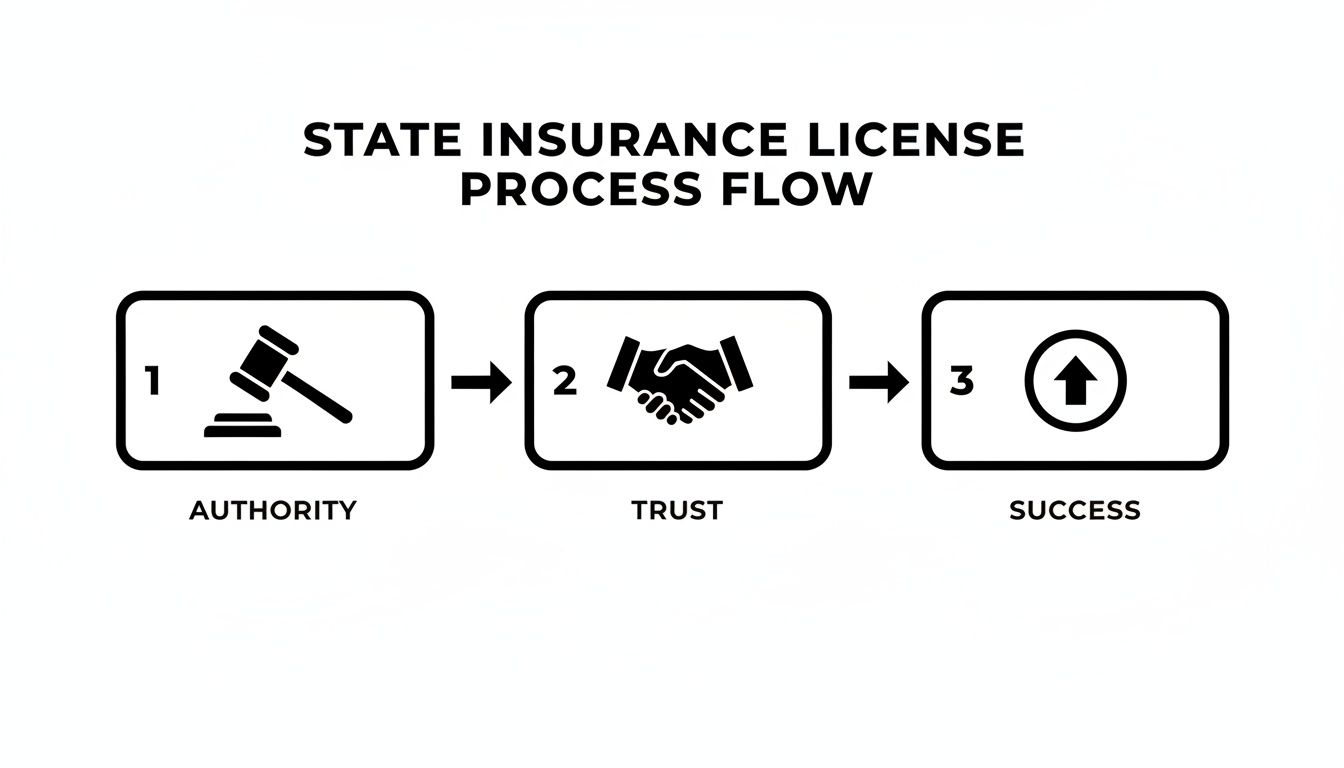
This visual breaks down how each piece of the licensing journey—from education to the exam to the final application—builds on the last, establishing you as a credible, trustworthy professional.
Submitting Your License Application
You passed! Don't celebrate for too long, though—it’s time to get your official license application submitted. States have deadlines. In many places, you only have one year from your exam pass date to apply, so don't put this off.
The easiest and most common way to do this is through the National Insurance Producer Registry (NIPR). NIPR is the central clearinghouse for producer licensing in almost every state. You’ll set up an account, walk through the uniform application, and pay your state fees right there.
Be painstakingly honest and accurate on your application. I’ve seen applications get delayed for weeks over simple mistakes or omissions, especially when it comes to background questions. When in doubt, disclose.
The application will dig into your personal history, asking about any criminal background or past regulatory issues. The state will run a thorough background check, and they are always more concerned with a failure to disclose than with the original issue itself.
The Final Steps: Fingerprints and Background Checks
Your last major task before the state reviews everything is getting fingerprinted for your criminal background check. It's a non-negotiable step that verifies your identity and gives the Department of Insurance a full picture.
You’ll need to find a state-approved vendor to handle the digital fingerprinting. They'll capture your prints and send them directly to the state and FBI.
To keep things moving smoothly:
- Book Your Appointment ASAP: Schedule your fingerprinting right after you submit your license application. This is often the step that holds things up.
- Bring the Right ID: You'll need a government-issued photo ID and any specific registration number or form the state provided during your application.
- Know What They're Looking For: The state is mainly concerned with financial crimes (fraud, theft) or felonies that suggest you could be a risk to the public.
To make this journey as straightforward as possible, we’ve put together a simple checklist to help you track your progress from start to finish.
Licensing Application Checklist
| Phase | Action Item | Key Resource/Tip |
|---|---|---|
| Education | Complete a state-approved pre-licensing course (20-40 hours per line). | Choose a provider with flexible formats (online/in-person) that fit your schedule. |
| Exam | Schedule and pass your state licensing exam. | Use practice exams heavily. Focus on understanding concepts, not just memorizing. |
| Application | Submit your license application via the National Insurance Producer Registry (NIPR). | Don't delay! Apply within your state's deadline (often one year post-exam). |
| Background | Schedule and complete your fingerprinting appointment with an approved vendor. | Book this immediately after submitting your NIPR application to avoid delays. |
| Approval | Wait for the state Department of Insurance to review and approve your license. | Monitor your email and NIPR account for status updates or requests for more info. |
Following these steps in order will help you avoid common pitfalls and get your license issued without any unnecessary headaches.
The entire journey, from starting your course to getting that license in hand, can take several weeks. By being diligent and prepared for each step, you can get through the process efficiently and start your insurance career on the right foot. For more detailed guides tailored to our region, we have additional licensing information to help you get everything right.
Turning Your New License into a Business
Passing the state insurance exam and finally seeing your name in the Department of Insurance database is a fantastic feeling. But that license number, on its own, is just potential. To turn it into a real, revenue-generating business, you have to get appointed by insurance carriers.
This is the step that legally authorizes you to represent a carrier and sell its products.
Think of an appointment as a formal agreement between you (the producer) and an insurance company. It’s the contract that establishes a direct legal relationship, allowing you to solicit applications and bind coverage on their behalf. Without an appointment, you can’t legally sell a carrier's policies—no matter how many licenses you hold.
Securing Your First Carrier Appointments
Getting appointed is the bridge between being licensed and actually being in business. As an independent agent, you’ll need appointments with multiple carriers to offer your clients the best choices. This process usually kicks off once a carrier sees you as a valuable partner to distribute their products.
The appointment process generally involves a few key steps:
- Submitting an Application: You'll hand over your license information, background details, and sometimes a business plan to the carrier.
- Background Verification: The insurer will double-check that your license is active and in good standing with the DOI.
- Signing a Contract: Once you get the green light, you’ll sign a producer agreement that spells out commissions, responsibilities, and your binding authority.
This can take anywhere from a few days to several weeks, all depending on the carrier's internal process. For brand-new agents, this can feel like a slow crawl. Joining an agency network or alliance like PIA Southern Alliance can be a game-changer, as these groups have established relationships and streamlined appointment processes with key carriers.
Expanding Your Reach with Non-Resident Licenses
Your resident state license is your home base, but your business doesn't have to stop at the state line. Many successful agents in Georgia, Alabama, and Mississippi serve clients who move or own property in neighboring states. To do this legally, you need a non-resident license in each state where you want to do business.
This is where the power of reciprocity comes in. Thanks to agreements between most states, you won’t have to go through the whole pre-licensing and exam nightmare all over again. As long as you have an active resident license in good standing, applying for a non-resident license is usually a simple administrative task.
The entire process is managed through the National Insurance Producer Registry (NIPR). You just submit a uniform application, pay the state's non-resident licensing fee, and the system verifies your home state license. In most cases, the non-resident license is issued incredibly fast—sometimes almost instantly.
Expanding into multiple states is a smart growth strategy, but it brings new compliance headaches. Each non-resident license has its own renewal dates and continuing education rules, which you absolutely must track to avoid a lapse in your authority to operate.
Industry data shows a clear trend toward multi-state operations, especially in the Southeast. The U.S. insurance sector has about 1.5 million licensed professionals, and with agencies facing talent shortages, the ability to work across borders is a huge competitive advantage. It's estimated that 40% of Southern agents hold licenses in more than one state, a practice made easier by the NAIC's Uniform Application. You can find more insights about these industry workforce trends and how they're impacting agencies.
Strategies for Multi-State Growth
For an independent agent, holding non-resident licenses is a strategic asset. It lets you build a regional book of business and follow your clients wherever life takes them. For example, an agent in Columbus, Georgia, can easily get an Alabama non-resident license to serve clients right across the river in Phenix City.
Here are a few practical tips for managing your multi-state licensing:
- Prioritize Contiguous States: Start by getting licensed in states that border your own. That’s where business is most likely to spill over naturally.
- Use a License Management Tool: As you add more licenses, a simple spreadsheet or dedicated software is a lifesaver for tracking renewal dates and CE deadlines for each state.
- Understand State-Specific CE: While your home state's CE often covers other states, some have unique requirements, like specific courses on flood or ethics. Always double-check.
By pairing solid carrier appointments with a smart non-resident licensing strategy, you transform your state insurance license from a piece of paper into a powerful engine for growing your business.
Maintaining Your License for Long-Term Success
Getting your state insurance license is a huge milestone, but it's really just the starting line. Think of it as a commitment to lifelong learning, not a one-and-done achievement. Your license isn't a "set it and forget it" credential; it needs regular maintenance to stay active and keep you on top of industry changes, new regulations, and ethical standards.
Staying on top of your license renewal is just part of being a professional. It shows clients you're dedicated and protects your agency from some pretty severe penalties. We're talking hefty fines or even license suspension if things fall through the cracks.
The World of Continuing Education
The biggest piece of the maintenance puzzle is Continuing Education (CE). CE is the ongoing training that keeps your skills sharp and your knowledge up-to-date, long after you’ve aced that initial exam. States require it to make sure licensed pros can handle the ever-changing complexities of the insurance world.
For agents in Georgia, Alabama, and Mississippi, the requirements are pretty consistent. You’ll generally need to complete 24 hours of state-approved CE every two years. This is the baseline for keeping your license in good standing.
But it’s not just about hitting a magic number of hours. States get specific about what kind of hours you need.
- Ethics Training: It’s standard for at least three of those 24 hours to be dedicated to ethics. This really highlights how much the industry values consumer protection and professional integrity.
- Line-Specific Topics: Depending on which licenses you hold, you might also need credits in specialized areas, like flood insurance or annuity suitability training.
Many states refer to these requirements as Continuing Professional Education (CPE) credits. If you're curious about the broader context, Understanding what is CPE Credit provides a good overview of how this works across different regulated professions.
Finding Quality CE and Staying on Track
With a sea of CE providers out there, finding quality courses that your state actually approves can feel a little daunting. It's critical to pick vendors recognized by your state’s Department of Insurance. If you use an unapproved provider, all that time and money you spent will be for nothing—the state simply won't accept the credits.
Your CE renewal period is not something to leave until the last minute. I've seen agents scramble in the final weeks, paying premium prices for last-minute courses and risking a license lapse over simple procrastination. Set calendar reminders one year, six months, and three months before your deadline.
Professional organizations like PIA Southern Alliance are a huge help when it comes to navigating these requirements. You can learn more about how we support our members by checking out our resources on continuing education for insurance agents.
The License Renewal Process
Completing your CE hours is directly tied to renewing your license. The renewal itself is usually a straightforward online process, often done through the NIPR portal. The trick is to get it done on time.
Most states will send a renewal notice 60 to 90 days before your license is set to expire. That’s your signal to double-check that all your CE credits are finished and have been reported to the state. Once your CE is on file, you can go ahead and submit your renewal application and pay the fee.
What Happens If You Miss the Deadline
Look, life happens and deadlines sometimes get missed. If you fail to renew your insurance license on time, it will lapse. That means you are no longer legally allowed to sell insurance or earn commissions. Period.
Most states offer a reinstatement period, which can be up to a year after the expiration date. During this grace period, you can usually get your license back by:
- Completing all the required CE.
- Paying the standard renewal fee.
- Paying an additional late fee or penalty.
Letting that reinstatement window close is a huge mistake. If you miss it, you'll almost certainly have to start the entire licensing process over from scratch. That means pre-licensing classes, studying, and passing the state exam all over again. It's a costly, time-consuming headache that's completely avoidable with a bit of planning.
State-Specific Licensing Insights
While the big picture of getting an insurance license looks pretty similar nationwide, the devil is always in the details—and those details are written at the state level. The specific rules in your home state dictate everything from your initial coursework to your long-term compliance plan.
For independent agents in Georgia, Alabama, and Mississippi, understanding these differences isn't just helpful. It’s absolutely essential for operating legally and efficiently. An agent in Atlanta might face a different pre-licensing hour requirement than a peer in Birmingham, and their continuing education could vary just enough to trip them up. These small distinctions can have a major impact on your career timeline.
Georgia Licensing Deep Dive
Georgia is known for its detailed requirements for new insurance producers. The state mandates specific pre-licensing education hours that change depending on the line of authority you're after, ensuring you have a solid foundation before you even think about sitting for the exam.
To sell Property & Casualty (P&C) insurance, you must complete 40 hours of approved pre-licensing coursework. The same 40-hour rule applies if you're pursuing a license for Life, Accident & Sickness. If you plan on getting licensed in both, you’ll need to complete the full 40 hours for each one separately.
Once you’re licensed, the learning doesn't stop. Georgia requires 24 hours of Continuing Education (CE) every two years to keep your license active, with 3 of those hours dedicated specifically to ethics. It's a structure designed to keep you sharp and ethically grounded. You can manage your license and find approved courses through the official Georgia Office of Insurance and Safety Fire Commissioner website.
Alabama Licensing Requirements
Alabama’s approach is a bit different, offering a little more flexibility in pre-licensing education. The state requires 20 hours of pre-licensing coursework for each major line of authority, like P&C or Life & Health. This lower hourly requirement can sometimes let new agents get to the exam phase a bit faster.
Don't let that fool you, though. The state exam, administered by the University of Alabama, is known to be tough, so solid preparation is still the name of the game. The continuing education mandates in Alabama mirror Georgia's very closely: agents must complete 24 hours of CE every two years, including 3 hours in ethics. This consistency across the region really helps agents who might be considering holding non-resident licenses.
For all official forms, applications, and regulatory updates, the Alabama Department of Insurance is your go-to resource.
Mississippi Licensing Essentials
Mississippi lands right between its neighbors when it comes to pre-licensing. To get your state insurance license, you'll need to complete 20 hours of study for each line of authority before you’re eligible to sit for the state exam.
The CE requirements in Mississippi are also right in line with the regional standard, mandating 24 hours every two years with a 3-hour ethics component. One unique point to note is Mississippi’s specific rule for P&C agents: you must complete a 3-hour course on flood insurance as part of your total CE hours. This directly reflects the state's geographic risks and the critical need for agents to be experts in this type of coverage.
The Mississippi Insurance Department provides all the information producers need, from initial applications to renewal procedures.
Remember, the National Insurance Producer Registry (NIPR) is the central hub for most transactions, including applications and renewals for all three states. Getting comfortable with the NIPR portal is a non-negotiable for any modern agent.
To help you see how these requirements stack up side-by-side, we've put together a quick comparison table.
GA vs. AL vs. MS Licensing Requirements at a Glance
| Requirement | Georgia | Alabama | Mississippi |
|---|---|---|---|
| Pre-Licensing (P&C) | 40 Hours | 20 Hours | 20 Hours |
| Pre-Licensing (Life & Health) | 40 Hours | 20 Hours | 20 Hours |
| Continuing Education (Total) | 24 Hours every 2 years | 24 Hours every 2 years | 24 Hours every 2 years |
| CE Ethics Requirement | 3 Hours | 3 Hours | 3 Hours |
| State-Specific CE | None | None | 3 Hours of Flood Insurance (for P&C) |
This table makes it clear: while the CE hours are mostly consistent, the upfront pre-licensing work and special state-focused topics are where you'll find the biggest differences.
The economic engine behind state insurance licensing is massive. It's what helps foster a trillion-dollar industry. Licensed independent agents generate hundreds of billions in U.S. P&C premiums and hold a huge portion of the commercial lines market share. Southeastern states are a big part of that, with licensing fees generating millions annually for state regulators to fund crucial oversight.
Since the NAIC unified the producer database, license tracking has been a game-changer in preventing fraudulent claims through better verification. Compliance creates real ROI; agencies with fully licensed staff consistently report higher client retention and sales growth. These benefits are amplified by organizations like PIA Southern Alliance, which provide scholarships and networking to support members. For PIASA members, this means accessing markets and best practices that empower their agencies to build profitable, community-focused businesses through ethical, licensed excellence. You can get more great insights on the industry's financial outlook from Deloitte's detailed analysis.
For a deeper dive into these requirements and how they compare, you may be interested in our guide that further breaks down state insurance education requirements explained. By understanding these state-specific rules, agents across the PIA Southern Alliance region can ensure flawless compliance and build a strong, sustainable business.
Common Questions About State Insurance Licensing
Getting your state insurance license can feel like a maze, and it’s totally normal to have questions pop up. Whether you're just cracking open your pre-licensing textbook or you're a seasoned agent looking to expand your reach, you need clear answers. Let's tackle some of the most common questions I hear from agents.
How Long Does the Entire Licensing Process Take?
This is probably the number one question I get, and the honest answer is: it depends. But for most people, a realistic timeline to get your state insurance license is somewhere between three and six weeks. That window covers everything from starting your studies to getting your license number in hand.
Here's how that usually breaks down:
- Pre-Licensing Coursework: You can knock this out in one to two weeks, especially if you dive into a focused online program.
- The Exam: Factoring in study time and waiting for an open slot at the testing center, this part usually takes another week or two.
- State Paperwork: Once you pass the test and get your application and fingerprints submitted, the state typically takes another one to two weeks to process everything and issue your license.
Want a pro tip to speed things up? Schedule your state exam the day you start your pre-licensing course. It lights a fire under you, gives you a hard deadline, and cuts out the dead time waiting for an exam slot after you've finished studying.
What Is the Difference Between a Resident and Non-Resident License?
Getting this right is crucial for any agent with ambitions to grow. Your resident license is your home base credential. It’s issued by the state where you actually live and plan to do most of your business. To get it, you have to go through the whole nine yards: that state's pre-licensing course, its official exam, and a full background check.
A non-resident license is your ticket to sell insurance in other states. This is where reciprocity is a beautiful thing. Because states have agreements with each other, you almost never have to take another exam.
The process is mostly administrative. You just apply for the non-resident license through NIPR, pay the fee, and the new state confirms your resident license is active and in good standing. It's a must-have for agents who have clients moving across state lines or with property in different places.
For example, an agent based in Georgia can easily get a non-resident license for Alabama to help a client who lives just over the border. No need to start from scratch.
What Happens If I Let My Insurance License Expire?
Letting your license expire can bring your business to a screeching halt. You can't legally sell, solicit, or even discuss insurance policies—or get paid commissions—with an inactive license. This isn't something you want to mess around with.
Most states give you a little grace period, usually 30 to 90 days after the expiration date, where you can renew by paying a late fee. But if you miss that window, your license is officially expired.
Trying to reinstate a fully expired license is a massive headache. Many states make you start the entire process all over again—we're talking new pre-licensing courses, re-taking the state exam, and submitting a brand-new application. It's so much easier (and cheaper) to just track your renewal date and get your Continuing Education (CE) credits done ahead of time.
Can I Hold Licenses for Different Lines of Authority?
Absolutely, and it's a smart move if you want to be the go-to resource for your clients. Lots of pros hold multiple licenses so they can offer a full suite of products and advice. Each line of authority—like Property & Casualty, Life & Health, or Personal Lines—is its own separate credential.
If you want to add a new line to your existing license, you'll generally need to:
- Take the specific pre-licensing course for that new line.
- Pass the separate state exam for it.
- Apply to have the new line added to your license.
The good news is that your CE requirements usually consolidate once you're licensed for multiple lines. While some states might have specific credit requirements for certain products (like annuities or flood insurance), the total number of hours you need typically covers all of your licenses. This makes you way more valuable to your clients and opens up new income streams for your agency.
Navigating the complexities of getting and maintaining your state insurance license is easier when you have a partner dedicated to your success. PIA Southern Alliance provides the resources, education, and support independent agents in Georgia, Alabama, and Mississippi need to thrive. Discover how membership can benefit your agency at https://piasouth.com.