
So, you're thinking about starting your own independent insurance agency. It's a fantastic goal, and more achievable now than ever, especially in the thriving markets of Georgia, Alabama, and Mississippi. But ambition alone won't get you there. What you need is a clear, practical roadmap to turn that dream into a profitable reality.
This guide is that roadmap. We're cutting through the noise to give you a region-specific playbook, built from real-world experience.
Forget the old, dusty business models. A successful modern agency is built on a blend of smart technology, solid carrier relationships, and a relentless focus on the client. It’s a journey, and we’ve broken it down into three core phases you’ll navigate: Foundation, Operations, and Growth. Each stage has its own set of challenges, but with the right strategy, you'll be ready for them.
Charting Your Course From Day One
You wouldn't start a road trip without a map, and launching an agency is no different. You need a bird's-eye view of the entire journey before you even think about applying for your first license. Understanding the major milestones ahead is critical.
This simple roadmap breaks the process down into the foundational, operational, and growth stages you'll move through.
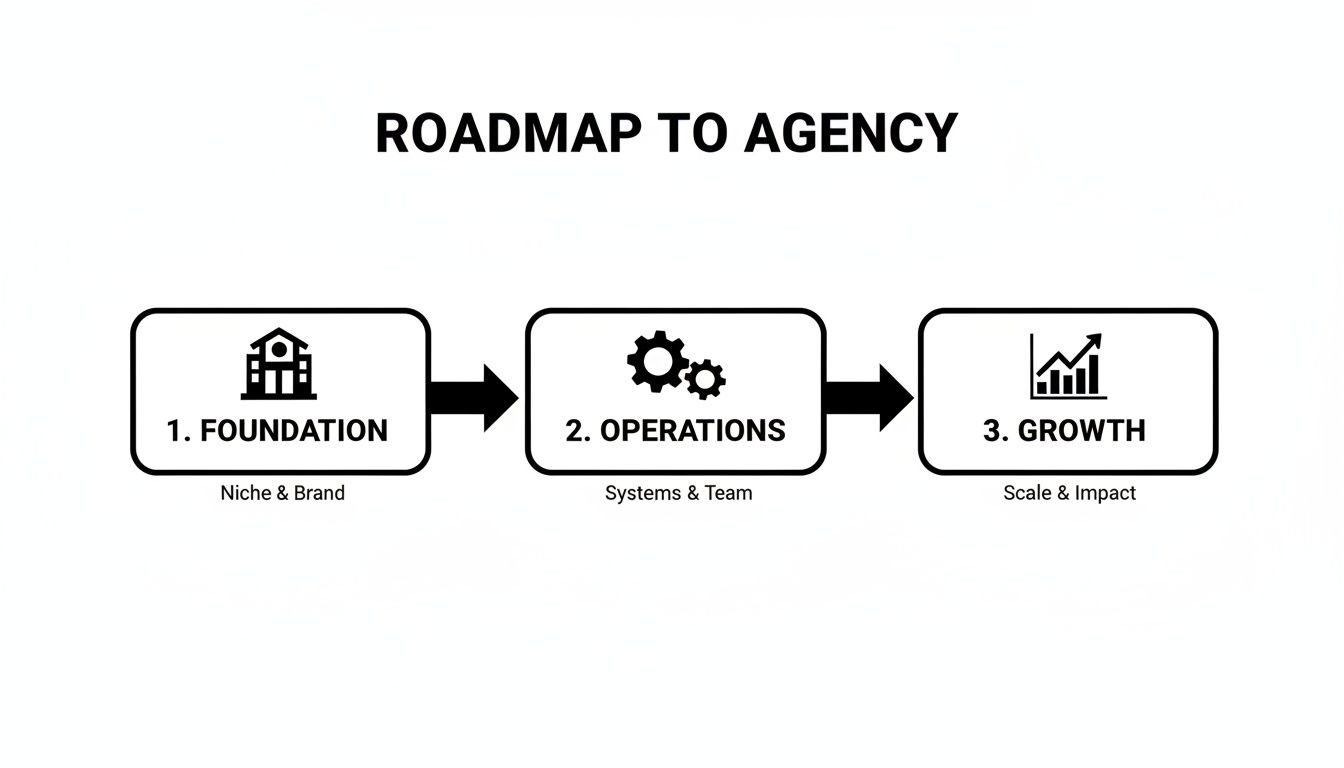
Think of it as a process, not a single event. It all starts with building a strong base and then methodically moving toward expansion.
Seizing the Market Opportunity
Your timing couldn't be better. The U.S. insurance industry is seeing massive growth, with the market projected to hit a staggering $8,876.92 billion by 2026. Digging deeper, Property & Casualty (P&C) premiums—the bread and butter for many independent agents—are set to grow by about 3% in 2026. For entrepreneurs in the South, this is a clear signal of opportunity. You can explore more market growth statistics and see what they mean for agents like you.
The most successful new agencies don't just sell insurance; they build a business. This means focusing as much on your business plan, operational efficiency, and market access strategy as you do on sales.
A clear, step-by-step approach keeps you from getting lost in the weeds and helps you make the big strategic decisions that matter.
To give you a quick overview of what's involved, this table breaks down the key milestones. Think of it as your high-level checklist for the entire launch process.
Key Milestones for Launching Your Agency
| Milestone | Key Objective | PIA Southern Alliance Support |
|---|---|---|
| Foundation | Build your legal structure, secure licensing, and get E&O insurance. | Discounts on E&O coverage and expert compliance guidance. |
| Operations | Choose your agency management system and set up daily workflows. | Access to top-tier technology and operational best practices. |
| Growth | Secure carrier appointments and build your client acquisition plan. | Direct market access programs and marketing resources. |
Each of these milestones represents a critical building block for your agency's success. With the right plan and support, you can tackle each one with confidence.
In this guide, we're going to walk through the core pillars of that plan:
- Foundation: We’ll cover structuring your business, getting your licenses, and securing that all-important E&O coverage.
- Operations: This is all about choosing the right technology and setting up efficient workflows that let you focus on what you do best.
- Growth: We'll dive into building strong carrier partnerships and executing a smart client acquisition strategy to get your first customers in the door.
Building Your Legal and Financial Foundation
Before you ever think about selling your first policy, you need to pour a solid foundation for your business. This is the stage where a lot of new agency owners get tripped up, but getting your legal and financial house in order from day one isn't just a suggestion—it's non-negotiable. Think of it less like paperwork and more like building a resilient business that can handle the bumps in the road and grab opportunities when they appear.

Your first big decision is choosing a business entity. You could technically operate as a sole proprietor, but that offers zero liability protection, putting your personal assets on the line. Most savvy agency owners choose a more formal structure to protect themselves.
Choosing Your Business Structure
The legal entity you choose will have major tax and liability implications for years to come, so it’s a decision that deserves real thought. We always recommend a chat with a legal or tax pro, but here’s a quick rundown of your main options to get you started.
- Limited Liability Company (LLC): This is the go-to for most new agencies, and for good reason. An LLC creates a crucial shield of personal liability protection, keeping your business debts separate from your personal assets. They are relatively easy to set up and give you flexibility in how you’re taxed.
- S Corporation (S-Corp): An S-Corp can unlock some nice tax advantages, especially when it comes to self-employment taxes. The trade-off? It comes with stricter administrative rules, like running payroll and holding formal board meetings, which can be a heavy lift for a brand-new agency.
For most startups, the LLC hits the sweet spot between protection and simplicity. You can always make the S-Corp tax election later on as your agency grows and revenue becomes more predictable.
Navigating State Licensing and Compliance
With your business entity registered, the next hurdle is licensing. This is where it gets detailed. Each state—Georgia, Alabama, and Mississippi—has its own playbook for licensing both you as an individual producer and your agency as a business. Making a mistake here can cause serious delays.
You'll need to lock down your individual resident producer license first. This usually means completing pre-licensing courses, passing the state exam, and clearing a background check. Only after you’re personally licensed can you even start the application for your agency’s license.
Remember, your agency is a distinct legal entity that must be licensed separately from you, the owner. This agency license is what allows your business to legally operate and earn commissions in the state.
This dual-licensing requirement is a common trip-up for new owners. Be ready to manage two application tracks at the same time—one for you, and one for your business.
Securing Your Financial Footing
Once the legal framework is solid, it's time to shift your focus to the financial must-haves. The absolute first step here is getting your Errors & Omissions (E&O) coverage. No reputable carrier will even talk to you about an appointment without proof of adequate E&O insurance. It’s your single most important protection against claims of negligence or failing to do your job right.
PIA Southern Alliance members get access to exclusive E&O programs, often at a major discount, which is a huge leg up when your startup cash is tight. To get a better handle on your budget, you can also check out our detailed breakdown of common insurance agency startup costs.
Finally, you need to think about your operational finances. As you build your independent insurance agency, setting up your HR and payroll systems correctly is a critical piece of the puzzle. For some expert guidance on this, take a look at this guide on setting up payroll for your small business. Getting this right from the beginning will save you from massive compliance headaches down the road.
Designing Your Modern Agency Operations
Now that your legal and financial house is in order, it’s time to build the engine that will actually run your agency. A modern agency’s success isn't just about sales chops; it's built on a backbone of smart, efficient operational systems. This is the fun part, where you move from planning the business to building the machine that will scale with you from client one to client one hundred.
The heart of this machine is your Agency Management System (AMS). Think of it as the central nervous system for your entire operation. It's where you’ll manage client info, track policies, handle commissions, and automate communications. Skimping here is a classic rookie mistake that will cost you dearly in lost time and opportunities down the road.
Choosing Your Agency Management System
Picking an AMS feels like a massive decision because, frankly, it is. This one piece of software will dictate your daily workflows, so you have to choose wisely. The market is packed with options, from simple, budget-friendly platforms to complex systems built for national enterprises.
For a brand-new agency, the trick is to find a balance between what you need today and where you want to be tomorrow. Don't pay for a bunch of features you won't touch for years, but make sure the system has room to grow with your book of business.
When you’re weighing your options, keep these key factors in mind:
- Scalability: Can it handle a growing roster of clients, policies, and maybe even a new team member without the price jumping into the stratosphere?
- Ease of Use: A complicated system means a steep learning curve, and that slows you down right when you need to be moving fast. Look for an intuitive interface.
- Core Functionality: At a bare minimum, it must handle client data, policy management, commission tracking, and basic reporting. No exceptions.
- Carrier Integration: How well does it play with the carriers you plan to represent? Smooth data flow is a huge time-saver.
Your AMS isn't just a database; it's a productivity tool. The right system automates the soul-crushing admin tasks, freeing you up to focus on what actually makes you money: selling and servicing clients.
A great starting point is to demo at least three different systems. This lets you get a real feel for how each one works and whether its flow matches how you envision running your business. Don't get distracted by flashy bells and whistles; focus on how the core functions will make your daily grind easier.
Building Your Essential Workflows
Beyond the AMS, you’ll need a few other systems to create a smooth operational flow. These are the tools that handle the money, protect your data, and keep you compliant. Getting these right is non-negotiable when you start an insurance agency.
Payment Processing: In today's world, clients expect easy payment options. Your agency has to be ready to securely accept both credit/debit card payments and ACH (bank draft) transactions. Look for a payment processor that integrates directly with your AMS to make accounting a breeze and cut down on manual data entry.
Data Security and Protection: As an insurance agent, you are a steward of incredibly sensitive client information. Protecting this data isn't just good practice; it’s a legal and ethical requirement. This goes way beyond just having a strong password. You need to implement multi-factor authentication on all systems, use secure email, and have a clear data backup and recovery plan in place from day one.
The Role of AI in Modern Agency Operations
Technology is no longer just about being efficient; it’s about gaining a real competitive edge. The insurance industry is seeing a massive shift, and artificial intelligence is quickly becoming a key tool for agencies that want to get ahead.
AI advancements are already making a huge impact, reducing claims processing times by up to 40% and automating tedious underwriting submission reviews. Agencies that start using AI-powered tools for claims, underwriting, and client interactions can dramatically cut their operational costs and speed up service delivery.
For a new agency, this might sound a little futuristic, but practical applications are already here and accessible. AI can help with:
- Automated Quoting: Some tools can pre-fill data and quickly generate quotes from multiple carriers.
- Customer Service Bots: Simple chatbots can handle common client questions 24/7, like "What's my policy number?" freeing you up for more complex issues.
- Marketing Automation: AI can help you segment your client list and send targeted, personalized marketing messages that actually resonate.
You don’t need to become a tech guru overnight. The key is to build a tech stack that is flexible enough to incorporate these tools as you grow. By laying this operational groundwork now, you're not just launching an agency; you're building a business designed for the future. For more guidance on this, check out our guide on insurance agency digital transformation.
How to Secure Carrier Appointments and Market Access
Alright, let's talk about what is often the single biggest hurdle you'll face when starting your agency: getting carrier appointments. You can have the perfect business plan, all your licenses in order, and a top-notch office setup, but without carriers, you have nothing to sell. This is where the rubber truly meets the road.
Many new agents mistakenly think it's a numbers game—that if they just knock on enough doors, someone will say yes. But carriers aren't just looking for a production firehose. They’re looking for a stable, professional, and profitable long-term partner.

To get those coveted appointments, you need a smart, strategic approach. You have to convince a carrier that giving a direct appointment to your unproven agency is a sound investment, not a gamble. This means building a compelling case that goes way beyond a simple request for access.
Thinking Like a Carrier
To get a 'yes,' you first need to get inside the head of a carrier's market manager. From their point of view, every new agency appointment is a risk. They are pouring resources, training, and support into your business, and they need to see a very clear path to getting a return on that investment.
Here’s what they are really looking for when you pitch them:
- Your Business Plan: They want proof you've done the hard work. A well-researched business plan shows you understand your target market, have a realistic production forecast, and know exactly how you're going to grow.
- Niche Expertise: Are you a generalist trying to write every policy that walks in the door? Or do you have a specific focus? Carriers love agencies that dominate a particular market, whether that's commercial trucking in Alabama, coastal properties in Mississippi, or high-net-worth clients in the Atlanta suburbs.
- Technological Proficiency: A modern agency runs on technology. Show them you have a solid AMS in place, a plan for digital marketing, and efficient workflows. This signals you're built for the future and can service policies without being a drain on their resources.
A carrier appointment isn't just a transaction; it's the beginning of a partnership. Frame your pitch around how you will be a valuable, low-maintenance, and profitable partner for them over the long haul.
Your presentation needs to be buttoned-up and professional. Treat it like the most important job interview of your life. Have your E&O declaration page, your polished business plan, and your marketing strategy printed and ready to go.
The Direct Appointment vs. Market Access Dilemma
In a perfect world, you'd launch your agency with direct appointments from every A-rated carrier on your wish list. But the reality for a new agency is a lot tougher. Most premier carriers have strict production volume requirements—often demanding $250,000 to $500,000 in written premium—before they'll even talk to you about a direct contract.
This creates the classic chicken-and-egg problem: you can't hit those premium targets without appointments, but you can't get the appointments without having the premium history. This is exactly where market access providers and agency alliances become absolutely essential.
Joining an organization like PIA Southern Alliance can be the key that unlocks these otherwise inaccessible markets. Here’s a simple breakdown of how it works:
- Shared Access: The alliance holds the master contract—the direct appointment with the carrier.
- Sub-Appointments: As a member, you get access to that carrier's products through the alliance's appointment.
- Building Your Book: You can start writing business immediately, building your book and proving your value to carriers under the alliance's umbrella.
This model lets you start selling for top-tier carriers from day one, completely bypassing those daunting initial premium requirements. It's the single most effective strategy to get your agency off the ground and start generating revenue right away.
Navigating an Era of Consolidation
There are also powerful market forces at play that you need to understand. Broker consolidation is a huge trend, with massive national firms buying up smaller agencies at a blistering pace. For example, major brokers like Alliant Insurance Services have acquired 16 agencies in 2025 alone.
This might sound intimidating, but it actually creates a massive opportunity for new, truly independent players. By staying autonomous, you can offer the kind of personalized service and local expertise that the big consolidators often lose sight of. You can find more insights on these top insurance industry trends on Markel.com.
This market dynamic makes your story even more compelling. When you approach carriers—whether directly or through an alliance—pitch your independence as your greatest strength. Highlight your ability to build deep community roots and provide a level of client care that a national call center simply can't replicate. That differentiation is your secret weapon.
Acquiring Your First Clients
Alright, you’ve done the heavy lifting. Your agency is structured, licensed, and you've got carrier appointments lined up. Now comes the moment of truth: winning business. This is where your dream of starting an insurance agency stops being a plan and starts generating real revenue.
Forget the generic marketing fluff. Let’s get into the high-impact, low-cost strategies that actually work for new independent agencies in Georgia, Alabama, and Mississippi.
Your first clients are so much more than just policies. They're the bedrock of your reputation and, if you play your cards right, your most powerful referral engine. The goal isn't just to get anyone in the door. It's to attract the right people who will stick with you, trust your advice, and tell everyone they know about the great new agent they found.
Defining Your Ideal Client Profile
Before you spend a single dime on marketing, you have to know exactly who you're trying to reach. The single biggest mistake I see new agents make is trying to be everything to everyone. It's a recipe for burnout and mediocre results.
Instead, find a profitable niche you can serve better than anyone else. This laser focus makes your marketing targeted, personal, and a whole lot more effective.
Are you a wizard with contractor's liability? Do you have a deep understanding of the unique insurance needs of coastal property owners in Mississippi? Maybe your passion is helping young families in the Atlanta suburbs lock in their first life insurance policies.
- Geographic Focus: Zero in on specific towns, counties, or even neighborhoods. If you have deep local knowledge, use it. Become the go-to agent for that area.
- Industry Niche: Concentrate on a particular business type, like local restaurants, auto repair shops, or main street retailers. You'll quickly become the expert they turn to.
- Demographic Targeting: Pinpoint a group you understand inside and out, whether it's new homeowners, high-net-worth individuals, or retirees.
Having this clear profile is your compass. It guides every single marketing decision you make, from the words on your website to the local events you attend.
Building Your Online Foundation
In this day and age, your digital presence is your storefront. Even if 90% of your business comes from handshakes and local connections, I guarantee nearly every one of those people will look you up online before they call. A professional, trustworthy online presence isn't optional.
Your website doesn’t need to be fancy, but it absolutely must be polished and focused on the client. It should clearly and quickly answer: who you are, what you do, and who you help. Most importantly, make it dead simple for a visitor to request a quote or get in touch with you.
Your brand voice is your key differentiator. Emphasize your local expertise and personalized service. This isn't just a marketing tactic; it's the core reason a client will choose you over a faceless national competitor.
Beyond the website, claim and complete your Google Business Profile. It's a free and incredibly powerful tool that helps you show up in local searches and on Google Maps. As soon as you get your first few happy clients, gently encourage them to leave a review. Positive social proof is marketing gold.
For a deeper dive into this, check out our guide on insurance agency lead generation.
Tapping Into Your Local Network
As a new independent agent, your greatest asset is your connection to your community. It’s almost a certainty that your first batch of clients will come from people who already know, like, and trust you. This is where you lean hard into your local advantage.
Start with Your Natural Market: Make a list. I mean it—sit down and list out everyone you know. Family, friends, former coworkers, neighbors, your dentist, you name it. Reach out to them personally. This isn't a hard sales pitch; you're simply announcing your new venture and positioning yourself as a resource.
Get Involved Locally: Join the Chamber of Commerce, a civic club like Rotary or Kiwanis, or a local business networking group. But don't just be a name on a roster. Get involved. Sponsor a little league team, volunteer at a community festival, or serve on a committee. Visibility builds credibility, and credibility builds trust.
To avoid the "feast-or-famine" cycle that sinks so many new businesses, it's critical to establish a consistent process for how to find clients and build a predictable pipeline. This means turning these networking activities into a repeatable system that brings in leads.
Ultimately, the goal is to turn these initial relationships into a sustainable source of new business. When you deliver exceptional, personalized service to your first clients, you're not just closing a deal—you're creating an army of advocates. A strong referral from a trusted friend is the most effective and affordable marketing you will ever have.
Your Questions Answered: Getting Real About Starting an Agency
Even with a rock-solid business plan, you're going to have questions. It's only natural. This is where we tackle the common, real-world concerns that pop up right before you take the leap, moving beyond the business plan to the nitty-gritty details.
Let’s dig into the practical side of things—startup costs, how long this really takes, and who you should bring on board first.

How Much Does It Really Cost to Start an Insurance Agency?
This is the big one, but don't worry—the answer isn't a million dollars. While costs certainly vary depending on your business model and where you set up shop, you can get a surprisingly solid start with a modest investment if you're smart about it.
Your main expenses will fall into a few key buckets:
- Licensing and Legal Fees: You’ll need to budget for state exam fees, licensing applications for both you and the agency itself, and business registration. This typically runs somewhere between $500 to $1,500.
- Tech and Software: Your Agency Management System (AMS) is the biggest line item here. The initial setup and first-year subscriptions can range from $1,500 to $5,000, plus you'll have smaller costs for a professional website and email.
- Errors & Omissions (E&O) Insurance: This is absolutely non-negotiable. Plan for an initial down payment between $500 and $2,000, which will depend on your experience and the coverage limits you choose.
- Office and Overhead: If you’re starting from a home office, your overhead is minimal. But if you decide to rent a small office space, you’ll need to factor in rent, utilities, and some basic furniture.
For a solo agent bootstrapping from a home office, a realistic budget is often in the $5,000 to $10,000 range. This gets you licensed, insured, and fully operational with all the essentials.
Remember, this initial outlay is just to get the doors open. You’ll also want a separate cash reserve to keep things running while you build your book of business. Having three to six months of both personal and business expenses set aside is a smart move that will let you breathe easier as those first commission checks start rolling in.
What’s a Realistic Timeline From Idea to First Client?
Patience is more than a virtue here; it’s a necessity, especially when you’re dealing with state regulators. The journey from the moment you decide to launch to when you write your first policy isn't an overnight sprint. Thinking about it in phases helps manage expectations and prevent burnout.
Here’s a practical look at the timeline:
- The Foundation (1-2 Months): This is all about planning. You'll be finalizing your business plan, forming your legal entity, and knocking out your pre-licensing education.
- Licensing and Compliance (1-3 Months): This phase is the biggest variable. It involves passing your state exam, submitting your producer application, and then applying for the agency license. State processing times can vary quite a bit.
- Setting Up Operations (1 Month): While waiting on licenses, you can get productive. This is the time to secure your E&O coverage, choose and set up your AMS, and get your website live.
- Getting Carrier Access (1-2 Months): This happens at the same time you're setting up operations. You'll either be applying to an alliance like PIA Southern Alliance for market access or pitching carriers directly.
A reasonable estimate is four to six months from start to finish. If you stay organized and on top of your paperwork, you can definitely hit the shorter end of that window. The most common hold-ups are almost always delays in state licensing or carrier appointments.
Who Should Be My First Hire?
When you first hang your shingle, your "team" is probably just going to be you. That’s perfectly fine. But thinking about your first hire from day one will help you build processes that you can easily hand off later.
Here's a tip from experience: your first hire should almost never be another salesperson.
Your primary job as the owner is to do the one thing no one else can do: sell insurance and build relationships. Everything else is secondary.
That means your first hire should be someone who frees you up to do more of that. A licensed Customer Service Representative (CSR) is usually the perfect fit. A great CSR can handle policy changes, field client billing questions, process renewals, and manage the administrative tasks that will quickly overwhelm a new agency owner.
By offloading service work, you effectively multiply yourself. You create the capacity for real growth without ever sacrificing the quality of your client experience.
Navigating the complexities of launching a new agency is a challenge, but you don't have to go it alone. The PIA Southern Alliance provides the essential support, market access, and resources new agencies in Georgia, Alabama, and Mississippi need to build a strong foundation and thrive.
Discover how a PIA Southern Alliance membership can accelerate your agency's success.