
Effective sales training in insurance isn't just about teaching agents to sell policies. It's the whole strategic process of giving them the skills, knowledge, and frankly, the confidence they need to be successful. We're moving way beyond basic product details here. It's about consultative selling, generating real leads, and staying compliant—all things that directly pump up an agency's growth, keep good agents around, and boost profitability. This isn't a one-time thing; it's a constant system of getting better.
Why Modern Sales Training Is Non-Negotiable
In a market this competitive, just hoping your new agents will figure it out is a recipe for disaster. Let’s be real: unprepared agents don't just underperform, they often walk away. This constant churn creates a painful cycle of recruiting, onboarding, and watching opportunities disappear, which can absolutely cripple an agency's momentum. A structured sales training program isn’t a luxury anymore—it’s a core business driver for any agency that wants to grow sustainably.
The numbers tell a pretty stark story. Solid sales training in insurance dramatically cuts down on agent attrition and cranks up revenue. Some data shows that a staggering 67% of new agents leave within three years, mostly because they felt unprepared. For an agency, that’s a huge drain on recruitment costs and lost potential. On the flip side, strong training programs can deliver up to a 20% revenue increase. That's a game-changer for independent agencies fighting for every client. You can explore more data on the impact of insurance sales training to see for yourself.
Conducting A Realistic Needs Assessment
Before you can build a killer training program, you have to get an honest look at where your team stands today. A needs assessment isn't about pointing fingers; it’s about finding the specific skill and knowledge gaps that are holding your agency back from hitting its goals. Think of it as the blueprint for your entire training strategy.
Start by asking some tough questions:
- Where are we losing sales? Dig into your pipeline. Are agents struggling with that first prospecting call, fumbling objections, or failing to close the deal?
- What are our biggest E&O risks? Are you seeing common documentation mistakes or compliance misunderstandings that better training could fix?
- Which products are collecting dust? If sales are low for a specific line, like commercial umbrella or cyber liability, it might be a knowledge gap, not a lack of demand.
- What are clients telling us? Client surveys or online reviews can be brutally honest. Do they see your agents as trusted advisors, or just people who spit out a price?
The whole point of a needs assessment is to replace your assumptions with actual data. Instead of just thinking, "Our team needs to be better at sales," you can get specific: "Our junior producers need focused training on how to pivot from a simple homeowner's quote to a real multi-policy discussion."
From Gaps To Goals
Once you’ve identified the weak spots, you can turn them into clear, actionable training objectives. This is where you connect the dots between your assessment and your curriculum, making sure every single training module has a purpose.
For example:
Identified Gap: New agents have a hard time explaining the value of higher liability limits on an auto policy. They just point to the price.
Training Goal: We need to develop a role-playing module that focuses on communicating risk. Let's use real-world claim scenarios to help them justify coverage recommendations.
Identified Gap: Our agency has a really low cross-sell rate between personal and commercial lines. We're leaving money on the table.
Training Goal: Let's create a workshop on spotting cross-sell triggers during client reviews and mastering the language to make that transition feel natural, not pushy.
This methodical approach transforms your sales training insurance initiative from a generic expense into a targeted investment. By clearly defining what needs fixing, you set the stage for a curriculum that doesn't just inform but actively builds the skills your team needs to drive measurable results and protect your agency's future.
Before we dive into the specific topics your curriculum should cover, let's look at the foundational pillars that make up a modern, effective program. A well-rounded training plan doesn't just focus on one area; it builds a comprehensive skill set that prepares agents for the realities of the market.
Core Components Of A Modern Insurance Sales Training Program
| Training Pillar | Key Focus Areas | Why It Matters For Your Agency |
|---|---|---|
| Product & Coverage Mastery | Deep dives into policy forms (ISO, proprietary), coverage triggers, exclusions, and endorsements for key lines like commercial auto, BOP, and EPLI. | Agents can't sell what they don't understand. This builds the confidence to make accurate recommendations and avoid costly E&O mistakes. |
| Consultative Selling Skills | Needs analysis techniques, active listening, asking high-value questions, and framing insurance as a risk management solution, not a commodity. | Moves your team from "price quoters" to "trusted advisors." This is how you build loyalty, increase retention, and win against direct writers. |
| Prospecting & Lead Generation | Strategies for niche marketing, leveraging COIs (Centers of Influence), social selling on platforms like LinkedIn, and effective cold outreach. | A healthy pipeline is the lifeblood of your agency. This ensures your producers aren't just waiting for the phone to ring. |
| Sales Process & Pipeline Management | Understanding the agency's defined sales stages, using the CRM effectively, forecasting, and mastering the follow-up process. | Creates consistency and accountability. It allows you to accurately measure performance and identify where deals are stalling. |
| Compliance & E&O Risk Mitigation | Proper documentation, avoiding "advice" that creates liability, understanding state-specific regulations (GA, AL, MS), and ethics. | Protects the agency's bottom line. One uncovered E&O claim can wipe out years of profit. This is non-negotiable. |
These pillars form the essential framework for any training program, whether you're onboarding a brand-new producer or upskilling a veteran agent. By ensuring your curriculum addresses each of these areas, you create a holistic learning experience that drives both individual and agency-wide success.
Designing A Curriculum That Actually Sells
A generic training program delivers generic results. If you want your agency to truly thrive, you need a curriculum that speaks directly to the challenges your producers face every single day. This means ditching the one-size-fits-all approach and building a strategic plan around four essential pillars—transforming agents from policy quoters into indispensable risk advisors.
A great curriculum always starts with a clear, structured game plan. This process ensures you're evaluating your team's current skills, pinpointing specific knowledge gaps, and then building training modules that actually move the needle.
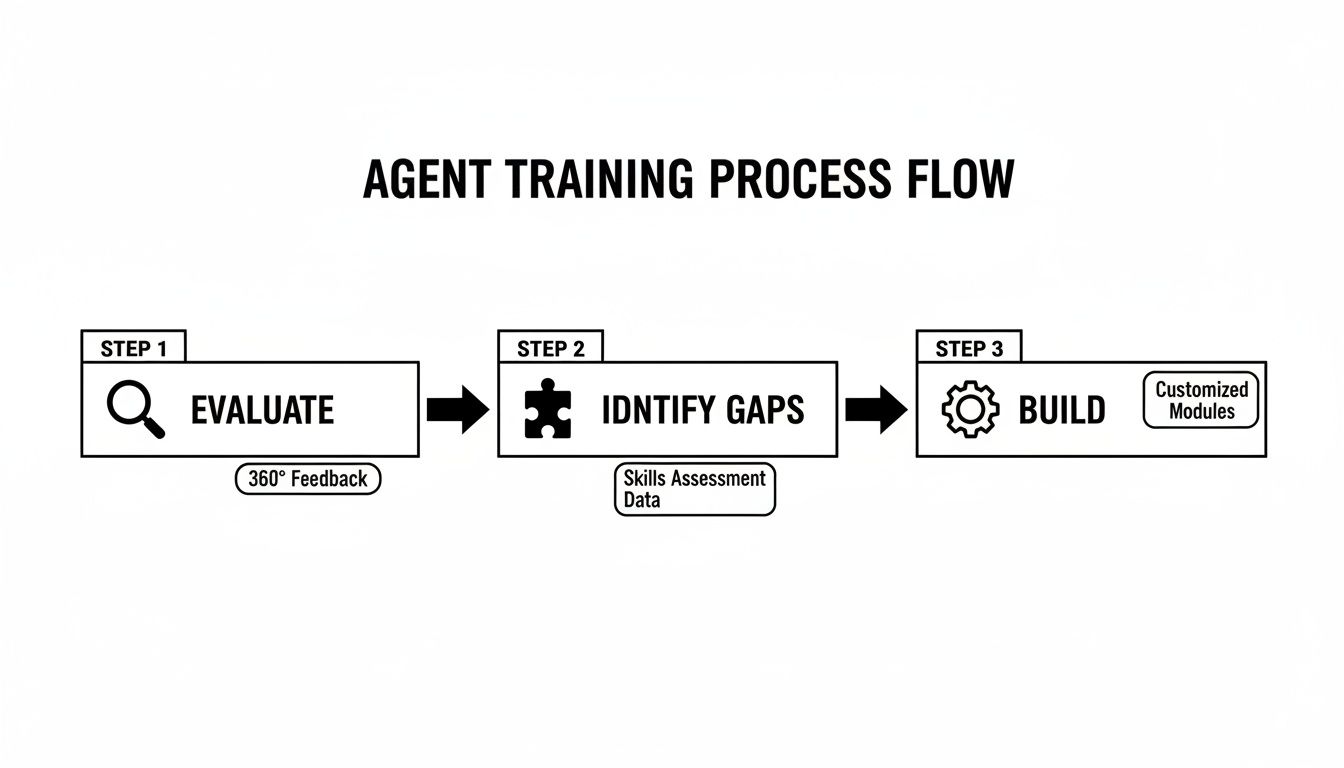
This simple flow highlights a critical point: without solid evaluation and gap identification, your training efforts will be scattered and lack any real impact. Let’s dig into the core content areas this process should help you build.
Mastering Product And Carrier Knowledge
True product mastery goes way beyond memorizing coverage limits. Top-performing agents understand the why behind the coverage. They can clearly explain how a specific endorsement, like Equipment Breakdown on a BOP, saves a small business owner from a catastrophic loss when their HVAC system dies unexpectedly.
Your curriculum has to empower agents to think like underwriters. That means training them on:
- Carrier Appetite: Which industries does a specific carrier actually want to write? Training should make it crystal clear that while Carrier A is a fantastic fit for contractors, Carrier B has far better programs for restaurants in Georgia.
- Positioning Endorsements: Teach agents to frame endorsements not as pricey add-ons, but as essential solutions. An EPLI endorsement isn't just another line item; it's the shield against a devastating employee lawsuit.
- Competitive Analysis: Get your team comfortable explaining the differences between your proposal and a competitor's, focusing on the dangerous coverage gaps, not just the price.
A producer who can tell a client, "The other quote is missing business income from dependent properties, which puts your entire supply chain at risk," is a true advisor. An agent who only talks about the premium is just another salesperson.
Modern Prospecting And Lead Generation
Let's be honest—the days of relying on a phone book and a dialer are long gone. An effective sales training program has to include modern strategies for building and nurturing a healthy pipeline. This isn't about theory; it's about providing practical, step-by-step guidance.
Focus on techniques your team can put into action immediately:
- Social Selling: Train agents on how to actually use LinkedIn to find ideal clients in specific niches, share content that provides real value, and build a relationship before ever asking for a meeting.
- Referral Systems: Stop just hoping for referrals and start building a system. Give your team scripts and simple workflows for asking for introductions from happy clients, Centers of Influence like CPAs in Alabama, and even their carrier reps.
- Niche Marketing: Show producers how to become the go-to expert in a specific industry, like craft breweries in Mississippi, by joining local associations and speaking at industry events.
A modern sales curriculum should also show your team how to use smart tools, like a lead generation chatbot, to make their sales process more efficient and boost conversion rates.
Consultative Selling And Client Advisory
This is where your agency creates real distance from the competition. Consultative selling is the art of shifting the conversation from "How much does it cost?" to "What are the biggest risks your family or business is facing?" It's all about diagnosing before you prescribe.
Your training needs to include a heavy dose of role-playing on real-world scenarios, like:
- Walking a new commercial prospect through a thorough risk analysis.
- Handling the "your price is too high" objection by pivoting to value.
- Guiding a client through a tough claim to prove your agency is their advocate.
This skill is absolutely critical for uncovering hidden needs. When you teach agents to ask better, more insightful questions, you naturally create opportunities to talk about other lines of coverage. We've got more practical advice on this in our guide covering cross-selling insurance techniques to skyrocket your sales.
Compliance And E&O Risk Mitigation
Every single sale carries potential risk. Strong sales training insurance integrates compliance and Errors & Omissions (E&O) prevention directly into the sales process. It becomes a natural part of the workflow, not some annoying afterthought. This protects your client, and it protects your agency.
This module is completely non-negotiable and has to cover:
- Documentation Standards: Drill down on the critical importance of documenting every client conversation, every recommendation, and every declined coverage in your agency management system. No exceptions.
- Avoiding "Advice" Traps: Teach agents the fine line between explaining coverage options and giving legal or financial advice that could create massive liability.
- State-Specific Regulations: Make sure the team is up-to-date on the unique compliance rules for Georgia, Alabama, and Mississippi, including regulations around policy delivery and client communication.
By embedding these four pillars into your curriculum, you're building a comprehensive program that produces confident, knowledgeable, and compliant producers. This foundational content is the perfect launchpad for choosing the right delivery methods to bring it all to life.
Choosing Delivery Methods That Engage Your Team
Crafting the perfect curriculum is only half the battle. How you actually deliver that training is what makes it stick.
Let's be honest, if your sales training feels like a long, drawn-out lecture, your team will tune out before the first coffee break. The real key is to build a dynamic learning environment by mixing different formats that work for different people and different agency needs.

This isn't just about personal preference; it's about getting results. A blended model lets you balance immersive, hands-on practice with the flexibility and efficiency of virtual learning. It’s a powerful approach that fits the reality of modern agency life, where some of your producers are in the office and others might be working remotely across Georgia, Alabama, or Mississippi.
Live Workshops Versus Virtual Classrooms
The choice between in-person and virtual training really comes down to your specific goals for a particular session. Neither is automatically better—they just serve different purposes.
Immersive In-Person Workshops: Nothing beats getting everyone in the same room for building team camaraderie and practicing complex interpersonal skills. Use these live sessions for high-stakes topics like advanced negotiation tactics or your annual sales kickoff. That face-to-face interaction allows for subtle feedback and helps build a stronger agency culture.
Flexible Virtual Training: For your remote agents or for topics that are more about information transfer, virtual instructor-led training (VILT) is a fantastic option. It’s perfect for rolling out updates on carrier appetite or introducing a new feature in your agency management system. The trick is to keep these sessions highly interactive with polls, Q&As, and breakout rooms to keep everyone plugged in.
The growth in this space is impossible to ignore. The insurance sales enablement market was valued at USD 2.8 billion in 2024 and is projected to skyrocket to USD 8.7 billion by 2033. This surge is fueled by digital tools and increasingly complex policies—making blended training the new standard for managing costs while ensuring deep understanding. You can see more details on the growth of insurance sales enablement tools on marketintelo.com.
The Power Of Realistic Role-Playing
If I could point to the single most effective tool for bridging the gap between knowing something and being able to do it under pressure, it's role-playing. This is where theoretical sales techniques become muscle memory.
For it to really work, though, the scenarios have to be painfully realistic.
Forget generic scripts. The best role-playing scenarios are pulled directly from your team’s recent experiences. Was there a difficult claim conversation last week? A big deal lost over a pricing objection? Turn those real-life challenges into training opportunities.
Start building a library of scenarios that are specific to your agency.
Handling Tough Objections: An agent plays a small business owner in Alabama who says, "Your competitor's BOP quote is $500 cheaper. Why should I pay more?" The other agent has to pivot from price to the value of a key coverage exclusion in that cheaper policy.
Presenting a Multi-Policy Quote: Simulate a meeting with a new homeowner in Georgia. The agent's goal isn't just to sell the home policy but to successfully introduce the need for an auto policy and a personal umbrella by asking smart questions about their family's lifestyle and risks.
Navigating a Difficult Client Conversation: One producer acts as a long-time client whose renewal premium for their commercial auto fleet has jumped by 20%. The other has to explain the hard market conditions, reinforce the agency's value, and retain the business without just remarketing everything.
Bite-Sized Learning For The Busy Producer
Not all training needs to be a day-long event. Microlearning is all about delivering focused, bite-sized content that agents can consume in just 5-10 minutes. This format is perfect for reinforcing key concepts and providing knowledge right when it's needed.
It's an ideal way to supplement your core program and ensure learning continues without pulling producers out of the field for hours at a time.
Think about creating short video tutorials, quick-reference PDFs, or brief online quizzes on specific topics. For example, a three-minute video on "How to Document a Declined Coverage in our AMS" is far more effective than burying that one instruction in a two-hour session.
These small, consistent touches are also a great way to meet ongoing education needs, like those we cover in our resources for online insurance CE courses. By blending these different methods, you create a complete training ecosystem that supports your team where they are, ensuring skills are not just learned but consistently applied.
Building A Culture Of Coaching And Improvement
A single day of training, no matter how engaging, rarely creates lasting change. I’ve seen it happen time and time again. The real growth, the kind that sticks, happens when learning is reinforced consistently. It has to transform from a one-time event into an everyday habit.
Embedding a culture of continuous coaching and mentorship is the single most powerful way to make sure your investment in sales training pays dividends long after the initial sessions are over. This isn't just about temporary instruction; it's about permanent improvement.

This shift from one-off workshops to ongoing skill reinforcement isn’t just a gut feeling—it reflects where the market is heading. The global sales training market is on track to hit USD 16.91 billion by 2032, and sales skills training holds the largest chunk of that at 27.4%. What does that tell us? That core abilities like consultative selling and relationship-building are best sharpened through daily practice and coaching, not just isolated classes. You can explore more on the sales training market growth on coherentmarketinsights.com.
Structuring Productive Coaching Sessions
Let’s be clear: effective coaching isn't about micromanagement. It’s a structured partnership aimed at building skills and confidence. The goal is always constructive feedback that builds people up, never criticism that tears them down. You have to move away from those vague "how are things going?" check-ins and start having focused, data-driven conversations.
A solid one-on-one session can follow a simple, repeatable framework:
- Review Key Metrics: Start with the numbers. Look at the producer's pipeline—quote-to-bind ratios, cross-sell rates, new business premium. Let the data guide the conversation.
- Discuss Recent Wins: Ask the agent to walk you through a recent successful sale. What went right? What specific technique made the difference? Celebrating wins is just as important as analyzing losses.
- Analyze a Challenge: Talk through a deal that was lost or is stuck in the pipeline. This isn't about placing blame. It’s about working together to find a different approach for next time.
- Set One Actionable Goal: End the session by agreeing on one specific skill to work on before the next meeting. Maybe it's asking more open-ended questions during discovery calls or practicing a new closing technique.
A coaching culture thrives on consistency. Schedule these one-on-one sessions weekly or bi-weekly. When you make them a non-negotiable part of your routine, it sends a clear message to your team: their development is a top agency priority.
Conducting Effective Call And Quote Reviews
Some of the most practical coaching opportunities come from reviewing actual sales interactions, whether it's listening to a recorded call or looking over a recently presented quote. This is where you connect the concepts from a training session to the real world.
The goal isn't to play "gotcha" and catch people making mistakes. It's about identifying those small adjustments that can produce big results. For example, during a review, you might notice a producer immediately jumps to price when a prospect raises a budget concern. That's a perfect coaching moment to role-play how to pivot back to the value of the coverage and the real-world risks of being underinsured.
Fostering Peer-To-Peer Learning
Don't forget that your top producers are one of your most valuable—and often underused—training assets. Creating a system for peer-to-peer learning can elevate the entire team while building a stronger, more collaborative culture. It also takes some pressure off agency leaders to be the sole source of wisdom.
Here are a few simple strategies I’ve seen work wonders:
- "Win of the Week" Huddles: Kick off your weekly sales meeting by having a different producer share a recent success story. They should explain the client's situation, the objection they overcame, and the exact strategy they used to win the business.
- Shadowing Opportunities: Pair a newer agent with a seasoned producer for a day. The simple act of observing how a top performer navigates client conversations, manages their time, and handles difficult questions can be incredibly insightful.
- Joint Work on Complex Accounts: When a large or complicated commercial account comes in, assign a junior and a senior producer to tackle it together. This hands-on collaboration is one of the most powerful forms of mentorship you can facilitate.
When you build these coaching and feedback loops directly into your agency's daily operations, you transform your sales training insurance program. It stops being a series of events and becomes a sustainable system for continuous growth. And that kind of culture is what turns good producers into great ones.
How To Measure Your Training ROI
Putting your team through training is a big investment. You deserve to know if it's actually paying off. So, how can you be sure the time, money, and focus you pour into a sales training insurance program are delivering real, tangible results?
The secret is to look past the fluffy "vanity metrics" and zero in on the key performance indicators (KPIs) that directly fatten your agency's bottom line.
Moving Beyond Simple Completion Rates
Forget about just tracking who finished the online modules. Sure, completion rates are nice to know, but they don't tell you if your producers are any better at their jobs. Real measurement means connecting the training directly to the sales behaviors and outcomes that drive revenue and protect your agency.
To get a true picture of your program's impact, you need to pull specific, quantifiable data from before and after the training. This baseline data is your anchor; without it, you're just guessing at the results.
Pull reports on your key sales metrics for the three to six months leading up to the training. Then, track those exact same metrics for the three to six months right after. The comparison will paint a clear, data-driven picture of the change.
Here are the numbers that really matter:
- Quote-to-Bind Ratio: Is your team closing a higher percentage of the quotes they issue? This is a direct measure of improved sales and closing skills.
- Average Premium Per Policy: Are producers successfully selling on value and placing more comprehensive coverage? This should lead to larger policies.
- Cross-Sell and Upsell Rates: Is that consultative selling training sticking? You should see a solid uptick in clients holding multiple policies.
- Client Retention Rate: Well-advised clients who feel cared for stick around. Better advisory skills learned in training should absolutely boost your retention figures.
- Errors & Omissions (E&O) Incident Reduction: Good training on compliance and documentation should mean fewer mistakes and a cleaner E&O record.
When you focus on these numbers, the conversation shifts from, "I think the training helped," to "After the training, our agency's quote-to-bind ratio jumped by 12%." We've put together a deeper dive into the specific insurance agency performance metrics you should be tracking that can help you get started.
Calculating The Financial Return
Once you have your before-and-after data, you can run a pretty straightforward ROI calculation to justify the spend. While a ton of complex formulas exist, a simple approach often tells you everything you need to know. Getting a handle on the financial impact is crucial, and a great resource on this topic offers a practical guide to measure training ROI for your business.
A simplified framework looks like this:
- Calculate the Net Program Gain: Add up the total increase in revenue or profit that you can directly attribute to your tracked KPIs. For example, if your cross-selling training led to $50,000 in new premium, that’s your starting point.
- Determine the Total Program Cost: Tally up all the expenses—the trainer’s fee, course materials, your team's time away from selling, and any travel.
- Use the ROI Formula: (Net Program Gain – Total Program Cost) / Total Program Cost. Multiply that result by 100 to get your ROI percentage.
A positive ROI confirms the program's financial value, making it much easier to justify future training budgets. It shifts training from an expense line item to a strategic investment in growth.
Gathering Qualitative Feedback For a Complete Picture
Numbers tell a huge part of the story, but not all of it. The best measurement strategies also include gathering qualitative feedback to understand the how and why behind the data. This human element gives you priceless context.
Don't skip these crucial steps:
- Producer Surveys: Use anonymous surveys to ask producers which skills they feel more confident in now. Ask them point-blank which parts of the program were most—and least—effective.
- Manager Observations: Have your sales managers and agency leaders report on observable changes in behavior. Are producers handling objections more smoothly on calls? Are their client presentations more polished and confident?
- Client Feedback: This one is indirect but incredibly powerful. Are you seeing a spike in positive online reviews? Are clients mentioning your team's expertise or thoroughness in their feedback?
This blend of hard data and real-world feedback gives you a 360-degree view of your training program's success. It not only proves the value of your investment but also gives you the critical insights needed to refine and improve your next training initiative. This is how you create a true cycle of continuous improvement for your agency.
Common Questions About Insurance Sales Training
When you're building a new sales training program from the ground up, a lot of the same questions and hurdles pop up for agency owners. It's totally normal to wonder where to start, what to focus on first, and how to get the most bang for your buck.
Let's dig into some of the questions I hear most often and get you some clear, straightforward answers.
How Often Should We Conduct Sales Training?
Here’s the thing: effective training isn't a one-and-done workshop. It’s a rhythm you build into your agency's culture. Think of it as an ongoing process, not a single event.
The best approach I've seen is to build a solid onboarding process for every new hire. From there, you should hold weekly or bi-weekly team huddles that laser-focus on one specific skill—like handling a common objection or perfecting a cross-sell pitch.
For the bigger topics, like a deep dive into consultative selling or a new carrier's appetite, quarterly intensive workshops are fantastic. Then, you can reserve annual training sessions for big-picture strategic planning and rolling out major agency initiatives.
The real magic isn't in a single, perfect training day. It's in the consistency and ongoing reinforcement through daily coaching and regular, focused sessions. This is what transforms learning into lasting habits and measurable results.
What Is The Biggest Mistake Agencies Make?
Hands down, the most common—and most expensive—mistake I see is focusing 100% on product knowledge while completely ignoring actual sales skills.
It doesn't matter if an agent can recite every policy form and exclusion from memory. If they can't build rapport, handle a price objection, or simply ask for the business with confidence, they're going to fail. It's that simple.
A truly successful program has to balance three pillars:
- Deep Product Knowledge: They need to know the policies inside and out, no question.
- Proven Sales Techniques: This is the "how"—how to connect, listen, and guide clients to a smart decision.
- Efficient Internal Processes: They have to master your agency's tech stack and workflows to be effective.
If you neglect any one of these, you're kneecapping your ROI and setting your producers up for a world of frustration. The goal is to create well-rounded advisors, not just walking encyclopedias of insurance facts.
Can A Small Agency Afford A Comprehensive Program?
Absolutely. A powerful training program is about being resourceful and strategic, not throwing a ton of money at the problem. I've seen countless small to mid-sized agencies across Georgia, Alabama, and Mississippi build outstanding programs on a shoestring budget.
The key is to get creative and tap into the resources that are probably already right under your nose.
- Carrier Resources: Your key carrier partners want you to sell their products. Lean on the free training they offer. They have a vested interest in your team's success.
- Association Offerings: Organizations like the PIA Southern Alliance are a goldmine. They provide access to webinars, educational materials, and networking events that deliver incredible value.
- Peer Mentoring: This one is huge. Set up a simple mentoring program where your top-performing veterans guide the newer agents. This is often the most impactful training you can offer, and it costs you nothing but a little bit of time.
At the end of the day, the real cost isn't in providing quality training. It's the high turnover, missed sales, and stagnant growth that come directly from not preparing your team to win.
At PIA Southern Alliance, we are dedicated to providing independent agencies across Georgia, Alabama, and Mississippi with the resources, training, and support they need to succeed. From continuing education to E&O coverage and market access, we're here to help you build a more profitable and resilient agency. Explore the benefits of membership today.
Discover how PIA Southern Alliance can support your agency's growth