
For independent agents, finding a standalone umbrella policy that doesn't disrupt existing client relationships is a real game-changer. The RLI umbrella insurance product is that exact solution. It provides a crucial layer of liability protection without forcing you to rewrite a client's underlying home and auto policies.
Think of it as a universal safety net that sits on top of their existing coverage, ready to catch a catastrophic claim no matter who their primary carrier is.
Why RLI Is Your Agency's Best Umbrella Solution

We live in an increasingly litigious world. For your clients in Georgia, Alabama, and Mississippi, standard liability limits just aren't enough anymore. A single severe auto accident or an incident on their property can easily trigger a lawsuit that blows past the coverage on their primary policies. This is where an RLI personal umbrella becomes an indispensable tool in your agency's arsenal.
The biggest advantage of an RLI umbrella policy is its standalone nature. Unlike many carriers that demand you bundle home, auto, and umbrella coverage, RLI lets your clients keep their current insurers. This strategic flexibility is a massive win for you.
- Protect Client Relationships: You can add essential liability protection without having to disturb a client's long-standing, preferred home and auto policies. No more awkward conversations about moving carriers they're perfectly happy with.
- Access a Broader Market: This allows you to offer coverage to clients insured with direct writers or carriers that don't even offer umbrella policies or have incredibly strict underwriting rules.
- Close Gaps Efficiently: You can quickly and easily place a high-quality umbrella policy right over their existing coverage, securing your client’s financial future against a devastating lawsuit.
A Financially Sound Partner
Beyond its smart product design, RLI offers the kind of peace of mind that only comes from partnering with a financially rock-solid carrier. This stability isn't just a talking point; it's a core part of the value you're delivering. Your clients need to know that their insurer can actually pay when a multi-million-dollar claim comes due.
RLI Corp has a long, proven history of underwriting profitability and financial strength. For example, in 2023, RLI reported net premiums earned of $1.61 billion while achieving an impressive combined ratio of 83.6%—blowing the industry average out of the water. You can see the full financial picture in RLI's annual report filings.
That kind of performance demonstrates a disciplined approach that ensures RLI will be there for your clients when it matters most.
Understanding Core Features and Policy Limits
Think of an RLI umbrella insurance policy less like another line item on a client's account and more like a carefully engineered financial backstop. To really show its value, you need to get comfortable with the core components and limits that make it such a smart choice for so many clients.
The policy limits themselves are pretty straightforward, usually available in chunks from $1 million to $5 million. This is where your expertise as an agent really shines. Guide your clients to think beyond their current net worth. A major lawsuit can target future earnings, too, which makes a simple net worth calculation a dangerously incomplete picture of their total exposure.
Built-In Protections Your Clients Need
Beyond just the big liability number, RLI packs in several powerful, built-in features that tackle modern-day risks. One of the most important is worldwide coverage. If your client rents a car on vacation in Italy and causes an accident, their RLI policy can step in where their standard US auto policy almost certainly won't.
Another game-changer is coverage for personal injury liability. Don't confuse this with bodily injury—this is about protecting against claims like:
- Libel: Defamation in writing.
- Slander: Spoken defamation.
- False Arrest or Imprisonment: Unlawfully detaining someone.
We live in an age where a nasty online review or a heated social media debate can easily escalate into a lawsuit. This kind of protection has gone from a "nice-to-have" to a "must-have." Since many standard homeowners policies leave this out entirely, the RLI umbrella fills a huge and growing gap in coverage.
For a quick overview of what makes this policy so valuable, here’s a simple breakdown of its standout features.
RLI Personal Umbrella Key Feature Breakdown
This table provides a quick-reference summary of the most important policy features and available options for RLI's standalone personal umbrella insurance.
| Feature | Description | Benefit for the Agent |
|---|---|---|
| Standalone Policy | The umbrella can be written without the underlying home/auto policies being with the same carrier. | Offers incredible flexibility to place coverage for clients regardless of their primary carrier. |
| Policy Limits | Available in increments from $1 million to $5 million. | Allows you to right-size coverage based on a client's specific net worth and risk profile. |
| Worldwide Coverage | Provides liability protection for incidents that occur anywhere in the world. | A major selling point for clients who travel internationally, filling a common gap in domestic policies. |
| Personal Injury Liability | Includes coverage for claims like libel, slander, and false arrest. | Addresses modern risks from social media and online interactions that are often excluded elsewhere. |
| UM/UIM Endorsement | Optional Uninsured/Underinsured Motorist coverage can be added. | A powerful cross-sell opportunity that protects your client from financially irresponsible drivers. |
| Admitted Carrier | RLI is an admitted carrier in all 50 states. | Provides clients with the security and protection of state guaranty funds. |
| Financial Strength | Holds an A+ 'Superior' rating from A.M. Best. | Instills confidence that RLI has the financial stability to pay out on even the largest claims. |
Having these key points at your fingertips makes it much easier to articulate the policy's value during client conversations.
The Critical UM/UIM Endorsement
While the base policy is fantastic on its own, there's one optional add-on that you absolutely have to discuss with every single client: Uninsured/Underinsured Motorist (UM/UIM) coverage. This endorsement sits on top of their underlying auto policy, giving them an extra layer of liability protection if they get hurt by a driver who has little or no insurance.
Picture this: your client is seriously injured by an at-fault driver who only carries the state minimum liability limits. The client’s medical bills and lost wages could blow past that driver's policy in a heartbeat. The RLI UM/UIM endorsement would then kick in to cover that shortfall, shielding their own assets from being wiped out by someone else's carelessness.
This isn't just a good selling point; it's a critical piece of financial protection.
On top of that, RLI’s rock-solid financial stability means they can actually handle these catastrophic claims. The company boasts an A+ 'Superior' rating from A.M. Best and offers its standalone policies in all 50 states on an admitted basis. This gives your clients the freedom to add this crucial protection without having to move their existing home and auto policies—a massive advantage for you. You can learn more about RLI's established financial performance to see for yourself.
Navigating RLI Eligibility and Underwriting
Getting an RLI umbrella insurance policy placed all comes down to a solid grasp of their underwriting appetite. When you know who qualifies—and just as importantly, who doesn't—you can manage client expectations, avoid wasting time on bad submissions, and protect your own agency from E&O headaches.
Think of it as having the answers to the test before you even start.
The whole foundation of RLI's eligibility starts with the client's primary policies. RLI needs to see certain minimum liability limits in place before they’ll even consider adding their umbrella on top. While the specifics can shift, here’s a common baseline you can count on:
- Auto Liability: At least $250,000 per person / $500,000 per accident for bodily injury and $100,000 for property damage (a standard 250/500/100 split).
- Homeowners Liability: A minimum of $300,000 in personal liability coverage.
These underlying limits are the first line of defense. They ensure the primary carrier is on the hook for most claims long before the RLI umbrella ever gets triggered.
Pre-Qualifying Common Client Profiles
One of the biggest reasons agents love RLI is their willingness to look at risks other carriers run from. This flexibility is a game-changer, letting you find solutions for a much wider slice of your book of business. For instance, RLI is known for being more reasonable about households with youthful drivers or even someone with a single, minor driving violation on their record.
Got a client with a swimming pool or a trampoline? Those "attractive nuisances" are often insurable with RLI, as long as they’re properly fenced, secured, and disclosed upfront. This broader appetite is a massive competitive advantage for your agency. But don't mistake flexibility for a free-for-all; RLI definitely has its hard lines.
Be ready to walk away from applicants with certain aggressive dog breeds, undisclosed home-based businesses that have people coming and going, or major driving offenses like a recent DUI. Knowing these non-starters from the get-go saves everyone a ton of time and frustration.
This handy flowchart shows how RLI’s core coverages are designed to stack, starting with the base liability and expanding to worldwide protection and optional UM/UIM.
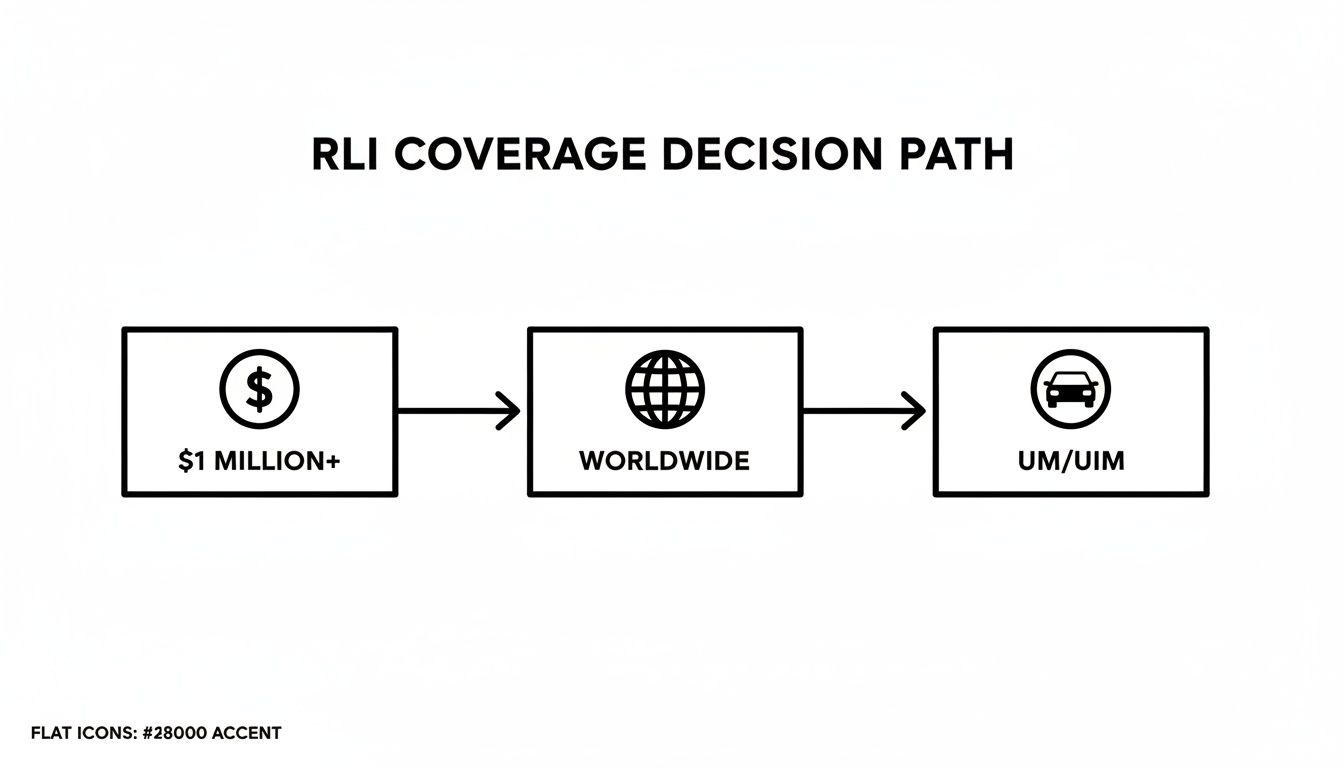
It’s a clear picture of how the policy is built to provide comprehensive, layered protection for all kinds of client needs.
This smart, disciplined underwriting is exactly what has fueled RLI's impressive growth. Over the last five years, their net premiums earned grew at a 13.3% annualized rate, helping build a surplus of $1.85 billion. For an agent, that kind of financial strength is incredibly reassuring. You can see RLI's financial stability for yourself in their public filings.
Because you’re accessing these policies through pre-approved systems, you’re only binding risks that fit the guidelines. That automatically minimizes your E&O exposure, which is a huge win.
When you master these guidelines, you stop being just a salesperson and become a true risk advisor. If you're looking to sharpen these skills even further, you might find our guide on improving your commercial insurance underwriting training helpful.
Making Quoting and Binding a Breeze
One of the best things about working with an RLI umbrella insurance policy is just how fast you can get things done. For a busy independent agent, time is money. Efficiency isn't just a goal; it's the engine that powers your agency’s growth. RLI’s online portal is built from the ground up to take you from a fresh quote to a bound policy in minutes, not hours or days.
This platform transforms what could be a headache into a simple, repeatable workflow. It gives your producers and CSRs the confidence to punch in client info, review the numbers, and issue coverage without skipping a beat. The whole thing is designed to be intuitive, which means less time fumbling with data entry and more time actually advising your clients.
From Quote to Issued Policy
Getting started is a piece of cake. The process kicks off with the basics—client names, addresses, and the details from their underlying auto and home policies. The platform is smart enough to handle the kind of common situations that might trip up other systems, like clients with multiple cars, several properties, or even a youthful driver in the home.
Once all the necessary information is in, the online portal serves up an instant, bindable quote. There are no hidden steps. The entire workflow is transparent, showing you exactly how things like different policy limits or optional endorsements will move the needle on the final premium. This clarity is huge when you're trying to explain coverage options to your client on the fly.
This is a peek at the clean, user-friendly interface agents see right when they start the process.

As you can see, it's designed for speed. You can get a quote quickly without getting lost in a maze of confusing menus.
The real magic here is speed to market. While other carriers might kick a quote to manual underwriting for a review that takes days, the RLI system gives you an immediate decision for eligible clients. That means you can secure coverage for your client during a single phone call or meeting.
This kind of efficiency is more than just a nice-to-have. It directly impacts your agency’s bottom line by freeing up your team to place more policies each week. When you lean into modern workflows like this, you can really boost your agency's productivity. To dig deeper into this, check out our guide on essential insurance agency workflow automation tools.
Ultimately, when you can quote and bind premium protection this fast, you’re not just saving time—you’re gaining a serious competitive edge and delivering a far better experience for your clients.
Proven Sales Strategies to Sell More Umbrella Policies

Knowing the nuts and bolts of an RLI umbrella insurance policy is one thing. Actually turning that knowledge into a conversation that clicks with your clients? That's where the real skill comes in.
The best time to bring up an umbrella isn't out of the blue. It’s during a natural touchpoint, like an annual review or a new business call. Frame it as a core piece of their financial safety net, not just another policy to buy.
And please, ditch the abstract liability jargon. A story about a teenage driver causing a multi-car pileup or a guest slipping at a backyard BBQ is far more powerful than just reciting policy limits. These real-world scenarios make a vague threat feel real and urgent—something a client will want to do something about today.
Identifying Your Best Prospects
Your best umbrella prospects are already in your book of business. You just need to know who you’re looking for. When you can proactively spot clients with bigger risks, you’re not selling a policy; you’re offering a solution before they even realize they have a problem. That’s how you become a trusted advisor.
Start by running a report for clients who have these common risk factors:
- Households with teen drivers: Let’s be honest, young drivers are a leading cause of major accidents.
- Property owners with pools or trampolines: These are what the industry calls "attractive nuisances" for a reason—they're magnets for liability claims.
- Clients with significant assets: High-net-worth individuals are often seen as deep pockets in a lawsuit.
- Anyone with a public profile: Think social media influencers, local business owners, or community leaders. They face a higher risk of libel and slander claims.
"A client’s financial exposure doesn't stop at their net worth. A lawsuit can target future earnings, retirement funds, and college savings. An umbrella policy is the most cost-effective way to build a firewall around their entire financial life."
For your agency, partnering with RLI through PIA-endorsed channels is a huge win. It gives you the ability to offer clients nationwide coverage, an optional $1 million UM/UIM endorsement, and direct online quoting that helps your team close deals fast.
Identifying Prime RLI Umbrella Prospects In Your Book
Spotting the right clients for an umbrella policy is easier than you think. This simple checklist can help you and your CSRs pinpoint the highest-need clients already in your agency management system.
| Client Risk Profile | Why They Need an Umbrella | Conversation Starter |
|---|---|---|
| Has teen drivers | Young drivers dramatically increase auto liability exposure. | "Now that your son is driving, let's look at what happens if a serious accident exceeds your auto limits." |
| Owns a pool/trampoline | These are high-risk "attractive nuisances" for guest injuries. | "Your new pool looks amazing! Let's make sure you're protected from the liability that comes with it." |
| High net worth/income | Seen as a lawsuit target with significant assets at stake. | "With your financial success, it’s critical we build a liability shield around your assets and future earnings." |
| Owns rental properties | Landlord liability is a major and often underestimated risk. | "Let's review the liability on your rental properties and discuss how an umbrella can protect your personal assets." |
| Serves on a non-profit board | Directors & Officers (D&O) liability can extend to personal assets. | "Your work on the community board is great. Are you aware of the personal liability risks involved?" |
By proactively identifying these risks, you shift from simply selling a policy to providing essential, personalized advice that protects your clients' futures.
Mastering the Cross-Sell Conversation
Once you’ve identified a perfect candidate, the conversation is simple. You can pivot naturally from a standard review to a discussion about their total exposure.
For example, after reviewing their auto policy, you could say, “Okay, your auto liability is set. Now, let’s talk about protecting you from a claim that goes above those limits.” This makes the umbrella feel like the next logical step in a complete plan. For more ideas, check out our guide on effective cross-selling insurance techniques.
To make sure no lead falls through the cracks, consider using a specialized Insurance Answering Service. It ensures every call gets a professional, timely response, even when your team is swamped. It’s a simple way to turn every single inquiry into a genuine opportunity.
Managing Compliance and Client Claims
Protecting your own agency is just as important as protecting your clients. When you're placing an RLI umbrella insurance policy, solid compliance habits are your best defense against a future Errors & Omissions (E&O) claim. The single most important practice you can adopt is to document every single offer of umbrella coverage.
This documentation is critical even when—and especially when—a client turns you down. A simple, time-stamped note in your agency management system or a signed waiver form creates a crystal-clear record. It proves you did your job, identified the client’s liability gap, and recommended the right solution.
Should that client later face a catastrophic lawsuit that blows past their primary limits, this record becomes your shield. It shows you provided sound advice and the client made an informed choice to reject the extra protection, which can completely dismantle a potential E&O claim against your agency.
This isn't just about covering your tail; it reinforces your role as a diligent, professional risk advisor.
Navigating the RLI Claims Process
When a client has a potential claim that looks like it could breach their underlying policy limits, your role shifts from advisor to trusted guide. RLI’s reputation for fair and efficient claims handling is a huge asset here, but knowing the process yourself helps you manage client expectations and keep things calm.
The process itself is pretty straightforward:
- Immediate Notification: The moment you're aware of an incident that could reasonably involve the umbrella, get RLI in the loop. Early communication is key, even if you’re not 100% sure the primary limits will be exhausted.
- Information Gathering: You’ll help your client pull together the necessary documents for the RLI claims adjuster. Think police reports, letters from the primary carrier, and any legal notices they've received.
- Monitoring and Support: The RLI adjuster will take the lead from there, but you remain a vital point of contact. You're there to provide your client with updates, answer questions, and offer reassurance.
Partnering with a financially solid carrier like RLI is never more important than during a major claim. RLI's remarkable 28 straight years of combined ratios below 100% isn't just a number; it's proof of disciplined underwriting and an ironclad ability to pay claims. They've consistently beaten industry averages by 12 points over the last decade. This proven stability means that when your clients need their coverage most, the money is there. You can get a deeper look at RLI’s strong financial performance in their public filings.
Got Questions About RLI Umbrella Policies? We've Got Answers.
Even when you feel like you have a great handle on RLI's umbrella insurance, specific client situations always pop up that make you pause. This section tackles some of the most frequent questions we hear from agents, giving you quick, clear answers so you can advise your clients with total confidence.
Having these answers in your back pocket not only makes you look like the expert you are but also helps get policies placed faster.
Can I Get an RLI Umbrella for a Client with a DUI?
This is a big one. Generally, RLI is pretty strict when it comes to major driving violations. If your client has a recent DUI or DWI, or a stack of moving violations from the last three to five years, they're probably not going to be eligible.
It's absolutely critical to be upfront about the client’s full driving history during the quoting process. For most applicants, a clean driving record is a non-negotiable, and getting the facts straight from the beginning prevents major coverage headaches down the road.
What Happens if a Client’s Underlying Policy Cancels?
The RLI policy is built on the foundation of the client's primary auto and home policies. It absolutely requires those minimum underlying liability limits to be in place without any gaps. If a primary policy cancels and isn't immediately replaced, the umbrella likely won't respond to a claim.
This is a crucial conversation to have with your client.
The responsibility to keep those underlying policies active rests squarely on the client's shoulders. A best practice for agents is to document this conversation. It's a simple step that helps manage your agency's E&O exposure and ensures the client knows what they need to do to keep their RLI umbrella intact.
Does RLI Cover Liability for Rental Properties?
Yes, in many cases it can. RLI’s personal umbrella can often extend liability coverage to a limited number of rental properties, like one-to-four family homes that the insured owns. You just have to disclose these properties accurately on the application.
Keep in mind they might be subject to different underwriting rules or a premium surcharge. But for liability on commercial properties or a big portfolio of rentals? That's outside the scope of a personal umbrella and would need a separate commercial liability policy.
At PIA Southern Alliance, our goal is to give you the resources and market access you need to protect your clients effectively. Explore our membership benefits and see how we support independent agents like you.