
What a Property and Casualty Underwriter Does Behind the Scenes
A property and casualty underwriter is the risk assessment expert who evaluates insurance applications and determines whether to approve coverage, at what price, and under what terms. These professionals are the backbone of the insurance industry, making critical decisions that protect both insurers and policyholders.
Key responsibilities include:
- Risk Assessment – Analyzing property details, financial statements, and loss history
- Premium Pricing – Setting appropriate rates based on risk factors and company guidelines
- Policy Terms – Determining coverage limits, deductibles, and special conditions
- Collaboration – Working with agents, brokers, and field inspectors
- Compliance – Ensuring applications meet legal and regulatory requirements
Property and casualty underwriters held about 123,300 jobs in 2021, with a median annual wage of $76,390. While employment is projected to decline 4% through 2031 due to automation, approximately 8,400 openings are expected each year as workers transfer to other roles or retire.
The role requires balancing automated software recommendations with human judgment for complex policies. Underwriters must become experts in political, legal, demographic, economic, environmental, and competitive factors in their territory to make sound decisions.
Property and casualty underwriter terms to know:
– chartered property casualty underwriter designation
– property casualty insurance classes
What Does a Property and Casualty Underwriter Do?
Think of a property and casualty underwriter as the insurance industry’s detective and mathematician rolled into one. They dig into applications, crunch numbers, and decide who gets coverage and at what price.
Core Functions
Risk evaluation is the heart of the job. Underwriters study everything from a building’s construction materials to a business owner’s safety record. Routine submissions flow through automation tools, but complex policies still need human judgment.
Premium setting blends art and science. Using actuarial data, loss ratios, and predictive models, underwriters ask: “How likely is a claim and how much could it cost?”
Technology speeds the process: catastrophe models gauge natural-disaster exposure, and big-data analytics reveal patterns software alone can’t interpret. Experienced underwriters treat these outputs as a starting point, not the final word.
| Property Underwriting | Casualty Underwriting |
|---|---|
| Focuses on physical assets (buildings, contents) | Focuses on liability exposures |
| Evaluates construction type, location, fire protection | Assesses business operations, safety programs |
| Considers natural-catastrophe exposure | Reviews professional liability risks |
| Uses property valuation methods | Analyzes claims frequency and severity trends |
| Requires knowledge of building codes | Needs understanding of legal liability |
Day-to-Day Responsibilities
A typical morning starts with application screening. Simple auto policies may be approved automatically, while a manufacturing plant or coastal hotel will demand deeper analysis.
Underwriters spend much of the day on data analytics, reviewing loss histories, or conducting site inspections to spot hazards a form can’t capture—think aging wiring or a leaning tree.
When ready to bind coverage, they draft reports that summarize findings, set terms, and explain any special conditions.
Catastrophe modeling is especially important in Georgia, Alabama, and Mississippi where hurricanes, tornadoes, and severe storms drive major losses.
Property vs. Casualty—Key Differences
Property underwriters concentrate on the physical asset: construction quality, sprinkler systems, and replacement cost.
Casualty underwriters focus on liability: slip-and-fall exposures, product defects, or professional errors. Because lawsuits can be unpredictable, casualty work often involves deeper legal analysis.
Despite their different lenses, both roles require sharp analytics, solid communication, and a willingness to balance software recommendations against real-world judgment.
Skills, Education & Credentials to Become a Property and Casualty Underwriter
Breaking into underwriting might seem daunting at first, but the path to becoming a successful property and casualty underwriter is clearer than you might think. Let’s walk through what it really takes to build a rewarding career in this essential insurance role.
The foundation starts with education – specifically, a bachelor’s degree in risk management. This field of study aligns most closely with what you’ll actually do as an underwriter. Risk management programs teach you the fundamentals of identifying, analyzing, and managing various types of risks that businesses and individuals face every day.
The most successful underwriters share some key traits that make them stand out. Analytical thinking tops the list – you’ll need to sift through complex data and spot patterns that others might miss. Attention to detail comes in a close second because one overlooked item in an application could mean the difference between a profitable policy and a costly claim.
Don’t underestimate the importance of communication skills either. You’ll spend significant time explaining your underwriting decisions to agents, brokers, and sometimes directly to clients. Being able to translate complex risk assessments into clear, understandable language is invaluable.
Problem-solving abilities and technology proficiency round out the essential skill set. Modern underwriting relies heavily on specialized software and data analysis tools, so comfort with technology isn’t optional – it’s required.

Recommended Education Pathways
While a risk management degree provides the most direct route to becoming a property and casualty underwriter, it’s not the only path that works. Degrees in finance, business, or economics also prepare you well for this career.
The journey typically unfolds in stages. After completing your bachelor’s degree, look for internship opportunities with insurance companies or agencies. These experiences give you real-world exposure to underwriting processes and help you understand how the insurance industry actually operates.
Many insurance companies offer structured trainee programs specifically designed for new graduates. These programs usually last 18 to 24 months and provide comprehensive training in company procedures, underwriting guidelines, and industry best practices.
Mentorship plays a huge role in developing successful underwriters. Being paired with an experienced professional who can guide you through complex decisions and share practical insights makes the learning curve much more manageable.
The reality is that becoming proficient as a property and casualty underwriter takes time. Most professionals need two to three years of training and experience before they feel truly confident in their decision-making abilities.
Valuable Certifications (CPCU & More) for Property and Casualty Underwriters
Professional certifications can dramatically boost your earning potential and open doors to senior positions. The Chartered Property Casualty Underwriter (CPCU) designation stands head and shoulders above all other credentials in the insurance industry.
The CPCU designation isn’t just another certificate to hang on your wall. Industry decision-makers rate it as the most valuable credential by a margin of three to one compared to the next best option. That’s the kind of recognition that translates directly into career opportunities and higher salaries.
Earning your CPCU requires dedication. You’ll complete eight comprehensive courses covering risk management, insurance operations, business law, and finance. The program also includes a required ethics course because maintaining high professional standards is fundamental to the underwriting profession.
The financial investment is significant – expect to spend around $6,000 or more for the complete program. However, this investment typically pays for itself through salary increases and advancement opportunities. The Chartered Property Casualty Underwriter Designation provides detailed information about requirements and benefits.
Beyond the knowledge you’ll gain, the CPCU opens doors to a professional network of over 18,000 members in more than 130 chapters worldwide. This network becomes invaluable for career guidance, job opportunities, and staying current with industry trends.
Other certifications worth considering include the Associate in Commercial Underwriting (AU) for those focusing on commercial lines, and the Associate in Personal Insurance (API) for personal lines specialists.
For comprehensive information about available certifications, check out Designations by The Institutes. And to support your ongoing professional development, explore our Property Casualty Insurance Classes designed specifically for insurance professionals in our region.
Career Path, Salary & Job Outlook in GA, AL, MS
The career landscape for property and casualty underwriters across Georgia, Alabama, and Mississippi remains promising, even as automation reshapes routine tasks.
Salary Snapshot
Nationally, the median annual wage is $76,390. In our region, entry-level roles start around $47,000, while experienced professionals can top $120,000, especially in metro hubs such as Atlanta, Birmingham, and Jackson.
Employment Outlook
Automation is expected to trim about 4% of underwriting positions nationwide through 2031, yet roughly 8,400 openings should appear each year as veterans retire or move into new roles. Routine personal-lines work is most affected; complex commercial risks still rely on human expertise.
Underwriters who build specialties—cyber, climate, or highly protected risks—often command higher pay and greater job security.
Entry-Level to Senior Tracks
Most start as an Assistant Underwriter, mastering guidelines and software. Progression typically follows:
- Underwriter I – handles routine accounts with limited authority
- Underwriter II / III – tackles higher limits and mentors juniors
- Senior Underwriter – crafts strategy for key segments
- Leadership or Specialist – manage teams, develop products, or serve as Field Underwriters who combine technical reviews with client visits
Earning the CPCU designation and demonstrating leadership skills are proven accelerators along this track.
Technology’s Role
Artificial intelligence, predictive models, and aerial imagery now perform much of the data gathering. That frees human underwriters to interpret results, negotiate terms, and refine guidelines—work that is both engaging and irreplaceable.
How Underwriters Collaborate with Agents, Brokers & Clients
The magic of insurance happens when property and casualty underwriters work hand-in-hand with agents and brokers. This partnership creates a seamless experience for clients while ensuring everyone understands the risks involved.
Think of it like a well-choreographed dance. Underwriters bring the technical expertise to assess risk, while agents provide the client relationship skills and market knowledge. When both sides understand their roles, the result is better coverage for clients and stronger business relationships all around.
Clear communication about risk appetite forms the foundation of this partnership. When underwriters help agents understand exactly what types of risks their company wants to write, agents can focus their efforts more effectively. This saves time for everyone and leads to better submission quality.
For most personal lines policies like homeowners insurance, underwriters work behind the scenes while agents handle all client communication. But when it comes to complex commercial accounts, underwriters might join client meetings to explain technical coverage details or discuss risk management strategies.
Application guidance represents another crucial collaboration area. Experienced underwriters know exactly what information they need to make good decisions. When they share this knowledge with agents upfront, it prevents the frustrating back-and-forth of incomplete submissions.
The negotiation process showcases collaboration at its best. Agents understand their client’s needs and budget constraints, while underwriters know company guidelines and risk tolerances. Working together, they can often structure coverage that satisfies everyone involved.
Risk Assessment Process Step-By-Step
Walking through the risk assessment process helps agents understand what happens after they submit an application. This behind-the-scenes look at how a property and casualty underwriter evaluates risks can improve submission quality and set realistic client expectations.
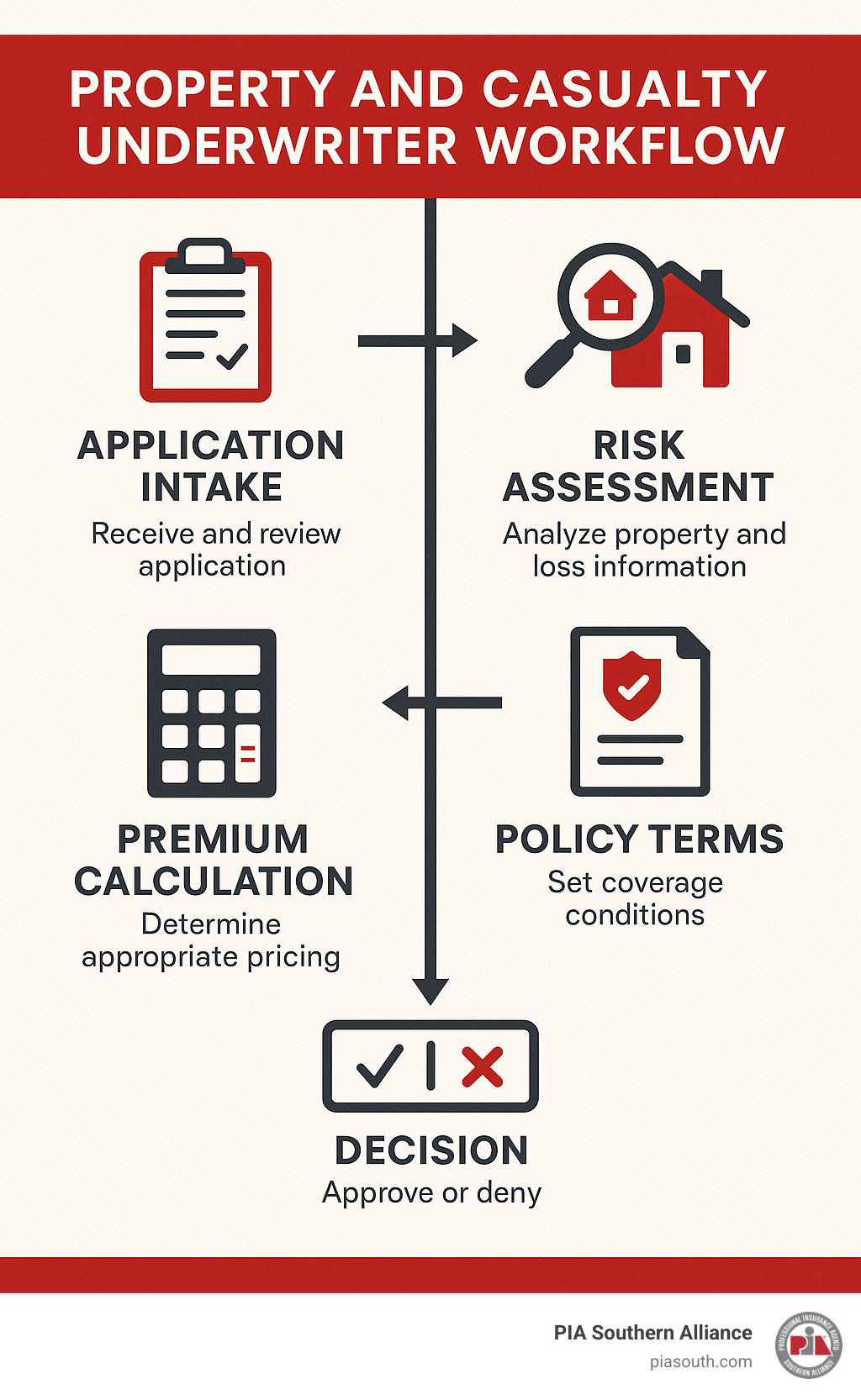
Application intake starts the moment an underwriter receives a new submission. They’re looking for completeness first – missing information creates delays that frustrate everyone. Smart underwriters develop checklists to quickly identify what’s missing and communicate needs back to agents promptly.
The financial analysis phase digs deeper into the applicant’s stability. Credit reports reveal payment patterns, while financial statements show business health for commercial accounts. This isn’t about being nosy – it’s about ensuring the applicant can afford the premiums and represents a sustainable business relationship.
Loss history evaluation tells the story of past claims. Underwriters look for patterns, not just totals. A single large loss might be less concerning than multiple small claims that suggest ongoing problems. They compare the applicant’s experience to industry benchmarks to put the numbers in context.
Inspection reports provide the eyes-on-the-ground perspective that applications can’t capture. Field underwriters visit properties to assess construction quality, safety features, and any unique risks that need special attention.
The pricing and terms determination phase brings everything together. Modern underwriters use sophisticated software, but they must know when human judgment should override automated recommendations. Complex commercial risks especially require this analytical thinking.
Main Challenges & Solutions for Today’s Property and Casualty Underwriter
Today’s property and casualty underwriters steer a landscape that would seem foreign to their predecessors. The challenges are real, but so are the opportunities for those who adapt and grow with the industry.
Climate risk tops the list of modern challenges. Weather patterns that held steady for decades are shifting, making traditional risk models less reliable. Underwriters in Georgia, Alabama, and Mississippi see this with changing hurricane patterns and severe weather frequency.
The solution isn’t to panic, but to accept better tools and data. Advanced catastrophe modeling helps underwriters understand these evolving risks more precisely. Continuing education in climate science and risk assessment keeps professionals ahead of the curve.
Cyber liability exposure creeps into traditional property and casualty policies in unexpected ways. A cyber attack might trigger business interruption coverage, or a data breach could create general liability claims. Underwriters must understand these connections even when writing seemingly traditional coverages.
Regulatory changes create another layer of complexity. What’s acceptable in Georgia might not work in Alabama or Mississippi. Staying current with three different regulatory environments requires systematic attention to industry publications and professional development.
Balancing automation with human judgment might be the trickiest challenge of all. Software handles routine decisions efficiently, but underwriters must recognize when a situation needs human insight. The art lies in knowing when to trust the technology and when to dig deeper.
The most successful underwriters view technology as a powerful tool that frees them to focus on complex analysis and relationship building. Rather than fighting automation, they leverage it to become more effective at the uniquely human aspects of risk assessment.
Frequently Asked Questions about Property and Casualty Underwriters
If you’re considering this career, here are answers to the questions we hear most often in Georgia, Alabama, and Mississippi.
What is the typical salary?
National median pay is about $76,390. Locally, beginners earn $45,000–$55,000, mid-career pros average $65,000–$85,000, and senior underwriters or managers often exceed $100,000. Experience, certifications like CPCU, specialization, and metro location all raise potential earnings.
How long does the CPCU designation take?
Most working professionals finish in 24–36 months while balancing eight courses plus an ethics requirement. Full-time study can shorten the timeline, and many employers offer tuition assistance.
How do I start?
- Earn a risk management degree (finance or business also work).
- Seek internships or trainee programs with carriers or agencies.
- Begin CPCU coursework early and network through local industry groups.
Our region hosts numerous carriers and independent agencies eager for analytical talent—use PIA Southern Alliance resources to connect with them.
Conclusion
The future looks bright for anyone considering a career as a property and casualty underwriter. While the insurance industry continues to evolve with new technology and changing risks, the need for skilled professionals who can assess complex situations and make sound decisions remains stronger than ever.
Computers can handle the straightforward auto policies and simple homeowner applications. But when it comes to evaluating a manufacturing plant’s environmental risks or determining coverage for a tech startup’s cyber exposures, there’s no substitute for human expertise and judgment.
The career path offers genuine stability and growth potential. Starting salaries around $45,000-$55,000 in Georgia, Alabama, and Mississippi provide a solid foundation, while experienced underwriters can earn well into six figures. More importantly, the work itself is intellectually engaging – every day brings new challenges and opportunities to solve complex risk puzzles.
Professional development remains key to success. The CPCU designation continues to be the gold standard that opens doors and accelerates career advancement. But beyond formal credentials, successful underwriters stay curious about emerging risks, accept new technology, and build strong relationships with agents and brokers.
The regional market in our three-state area offers particularly good opportunities. From Atlanta’s busy commercial district to the Gulf Coast’s unique property risks, underwriters here deal with diverse challenges that keep the work interesting and provide excellent learning experiences.
At PIA Southern Alliance, we’ve watched many insurance professionals build rewarding careers in underwriting. Our educational programs and resources support not just agents, but the entire insurance ecosystem that makes our industry successful.
Ready to explore this career path? The foundation starts with solid education – preferably a risk management degree – followed by hands-on experience and commitment to continuous learning. The insurance industry needs talented people who can think analytically while maintaining the human touch that technology can’t replace.
Whether you’re a recent graduate or considering a career change, underwriting offers the perfect blend of analytical challenge, professional growth, and meaningful work protecting businesses and families throughout our region.
Take the next step in your insurance career journey. Explore our Commercial Insurance Training Programs to find how we can support your professional development and help you succeed in the dynamic world of property and casualty insurance.