
Why Professional Insurance Designations Drive Success in Today’s Market
Professional insurance designations are specialized credentials that demonstrate advanced knowledge and expertise in specific areas of insurance and risk management. These designations require completing rigorous coursework, passing comprehensive exams, and meeting experience requirements to earn recognition from respected industry organizations.
Key Professional Insurance Designations for Property & Casualty Agents:
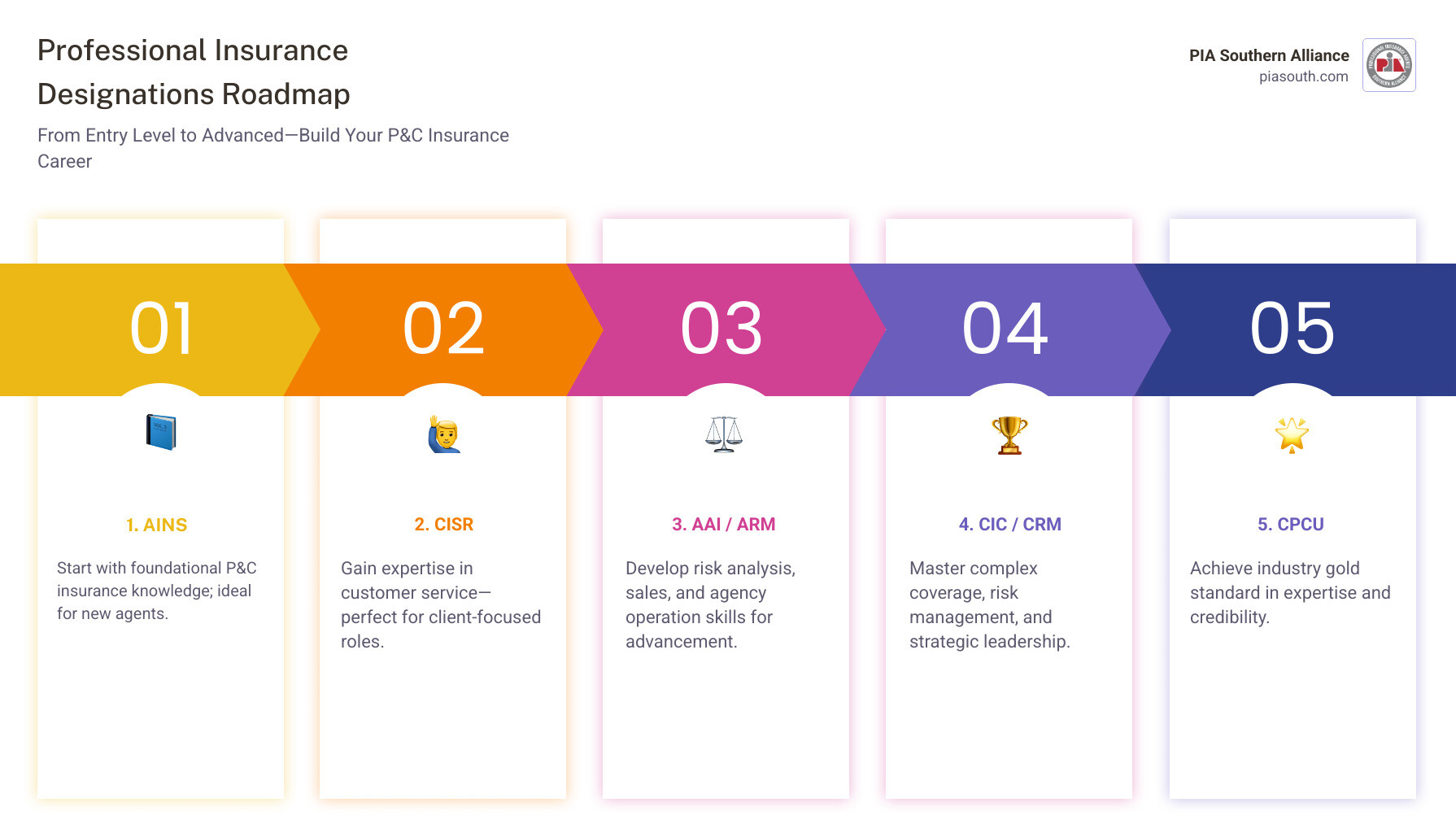
- CPCU (Chartered Property Casualty Underwriter) – The gold standard for P&C professionals
- AINS (Associate in Insurance) – Foundation-level credential covering insurance basics
- AAI (Accredited Adviser in Insurance) – Mid-tier designation for agency operations
- ARM (Associate in Risk Management) – Focuses on risk assessment and management
- CIC (Certified Insurance Counselor) – Advanced credential for complex coverage analysis
- CISR (Certified Insurance Service Representative) – Customer service excellence
- CRM (Certified Risk Manager) – Enterprise risk management expertise
The insurance industry recognizes these credentials as proof of professional competency, with research showing that certified professionals can earn up to 15% higher compensation than their non-designated peers. In Georgia, Alabama, and Mississippi, these designations often fulfill continuing education requirements while positioning agents as trusted advisors in an increasingly complex marketplace.
As someone who has worked extensively with independent insurance agencies across the Southeast, I’ve seen how professional insurance designations transform careers and improve agency capabilities. Through PIA Southern Alliance, we’ve supported countless agents in pursuing these credentials to better serve their clients and grow their businesses.
Professional insurance designations terms at a glance:
- chartered property casualty underwriter designation
- property and casualty underwriter
- property casualty insurance classes
Why Designations Matter in P&C Insurance
The property and casualty insurance industry has evolved dramatically over the past decade. Climate change, cyber threats, and complex commercial risks require agents who can steer sophisticated coverage scenarios. Professional insurance designations serve as industry standards that signal an agent’s commitment to excellence and advanced knowledge.
For agents in Georgia, Alabama, and Mississippi, these credentials provide a competitive edge in a crowded marketplace. While a risk management degree offers the most aligned educational foundation for insurance careers, designations allow practicing professionals to demonstrate specialized expertise without returning to formal degree programs.

Career Advancement & Marketability
The financial benefits of earning professional insurance designations are substantial and well-documented. Scientific research on certification ROI shows that designated professionals consistently outperform their peers in both earning potential and career advancement opportunities.
Key Career Benefits:
- 15% higher average compensation compared to non-designated peers
- Faster promotion paths within agencies and carriers
- Improved credibility with clients and prospects
- Greater job security during market downturns
- Access to specialized roles and leadership positions
The talent shortage in insurance makes designated professionals even more valuable. With over 400,000 industry professionals expected to retire in the next decade, agents with advanced credentials are positioned to fill critical leadership roles.
Compliance & CE Benefits
One of the most practical advantages of pursuing professional insurance designations is their ability to fulfill continuing education requirements. In Georgia, Alabama, and Mississippi, many designation courses qualify for CE credits, allowing agents to advance their careers while maintaining their licenses.
Compliance Advantages:
- Most designation courses qualify for CE credit
- Some designations can waive certain state licensing exam requirements
- Structured learning paths ensure comprehensive coverage of regulatory updates
- Digital badges and certificates provide easy verification for compliance audits
Master List of Professional Insurance Designations
The landscape of professional insurance designations can seem overwhelming at first glance. We’ve organized this comprehensive list to help you understand the hierarchy and purpose of each credential, from entry-level foundations to advanced strategic certifications.

Entry-Level Professional Insurance Designations
These foundational credentials provide essential knowledge for new insurance professionals or those transitioning from other industries. They typically require 3-6 months to complete and focus on core insurance principles.
AINS (Associate in Insurance)
The AINS designation covers fundamental insurance principles and serves as an excellent starting point for career development. This credential requires four courses covering insurance operations, legal principles, property insurance, and liability insurance basics.
CISR (Certified Insurance Service Representative)
Perfect for customer service representatives and account managers, the CISR designation focuses on client interaction skills and policy servicing. The program requires completing 5 of 9 available courses, with the CISR Elite designation available for those who complete all courses.
ACA (Accredited Claims Adjuster)
While primarily for claims professionals, the ACA provides valuable knowledge for agents who work closely with the claims process. Many community colleges in Georgia, Alabama, and Mississippi offer ACA programs.
Key Benefits of Entry-Level Designations:
- Build foundational knowledge quickly
- Demonstrate commitment to professional development
- Qualify for CE credits
- Prepare for advanced designations
- Improve customer service capabilities
Mid-Tier Professional Insurance Designations
These intermediate credentials bridge the gap between foundational knowledge and advanced expertise. They typically require 6-12 months to complete and focus on specialized areas of practice.
AAI (Accredited Adviser in Insurance)
The AAI designation emphasizes agency operations, sales skills, and ethics. This credential requires three core courses plus an ethics course, making it ideal for producers and account managers seeking to improve their business development capabilities.
ARM (Associate in Risk Management)
Focusing on risk analysis and management techniques, the ARM designation teaches the five fundamental steps of risk management. This credential is particularly valuable for agents working with commercial accounts where risk assessment is critical.
Course Structure for Mid-Tier Designations:
- 4-5 courses per designation
- 6-8 week course durations
- Comprehensive exams for each course
- Practical application components
- Ethics requirements
Advanced Professional Insurance Designations
These prestigious credentials represent the pinnacle of insurance education and typically require 12-24 months to complete. They focus on strategic thinking, complex risk analysis, and leadership development.
CPCU (Chartered Property Casualty Underwriter)
The Chartered Property Casualty Underwriter designation represents the gold standard in property and casualty insurance. With over 90,000 professionals holding this credential since 1928, the CPCU requires eight courses plus ethics training and demonstrates mastery of complex insurance concepts.
CIC (Certified Insurance Counselor)
The CIC designation focuses on advanced coverage analysis and requires 120 hours of classroom time. With fewer than 32,000 CICs in the United States, this credential provides significant market differentiation.
CRM (Certified Risk Manager)
The CRM designation emphasizes enterprise risk management and strategic risk assessment. This credential requires over 120 hours of coursework and is ideal for agents working with large commercial accounts.
Advanced Designation Benefits:
- Significant salary increases (often 20-30% above base)
- Access to executive-level positions
- Recognition as industry thought leaders
- Improved client trust and confidence
- Networking opportunities with industry leaders
Specialty & Niche Credentials for P&C Experts
Beyond the core professional insurance designations, numerous specialty credentials address specific industry sectors and emerging risks. These niche designations allow agents to develop expertise in high-value market segments.

Property & Casualty Focused Micro-Specialties
CRIS (Construction Risk and Insurance Specialist)
This IRMI designation focuses on construction industry risks, including project-specific coverage, contractor liability, and wrap-up programs. Given the robust construction markets in Georgia, Alabama, and Mississippi, this credential offers significant value.
ERIS (Energy Risk and Insurance Specialist)
With the growing energy sector across the Southeast, the ERIS designation provides expertise in traditional and renewable energy risks, including offshore operations and environmental exposures.
AFIS (Agribusiness and Farm Insurance Specialist)
Perfect for agents serving agricultural clients, the AFIS designation covers crop insurance, livestock coverage, and agribusiness operations – particularly relevant in rural areas of our three-state region.
MLIS (Management Liability Insurance Specialist)
This credential focuses on directors and officers liability, employment practices liability, and fiduciary liability – essential knowledge for agents serving middle-market and large commercial accounts.
TRIP (Transportation Risk and Insurance Professional)
The TRIP designation addresses the complex world of transportation insurance, including motor carrier liability, cargo coverage, and logistics risks.
Risk Management & Benefits Crossovers
RF (RIMS Fellow)
The Risk and Insurance Management Society’s fellowship program represents the highest level of risk management education, focusing on enterprise risk management and strategic risk assessment.
FHIAS (Fellow, Health Insurance Advanced Studies)
While primarily focused on health insurance, this credential provides valuable knowledge for agents who cross-sell employee benefits alongside property and casualty coverage.
FAHM (Fellow, Academy for Healthcare Management)
This designation addresses the unique risks facing healthcare organizations, including professional liability, cyber risks, and regulatory compliance issues.
How to Earn, Maintain & Leverage Your Designation
Successfully earning and maintaining professional insurance designations requires strategic planning and consistent effort. We’ve developed a systematic approach to help agents maximize their investment in professional development.
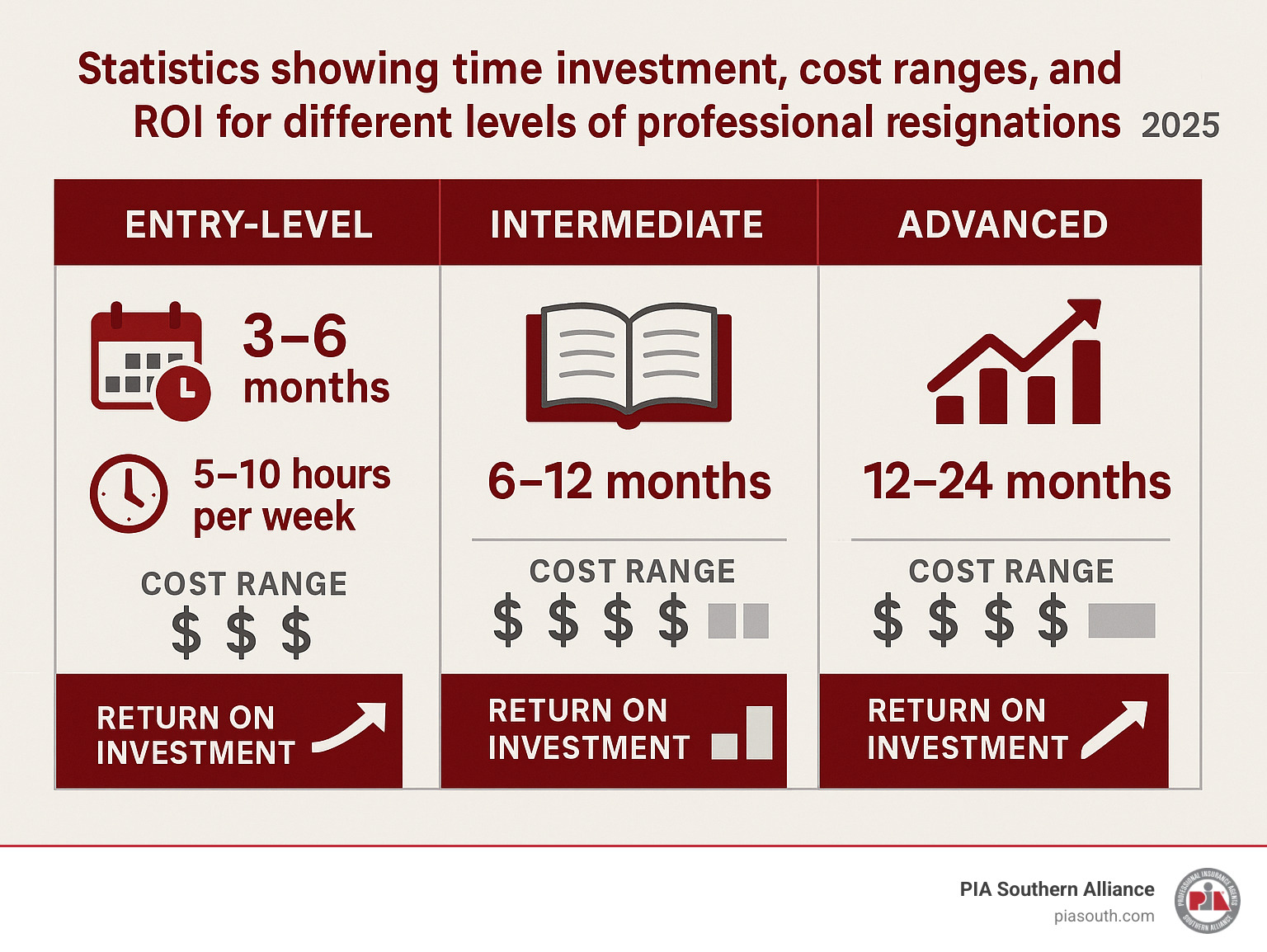
Time & Cost Planning for Professional Insurance Designations
Entry-Level Designations (3-6 months):
- Course count: 3-5 courses
- Time commitment: 5-10 hours per week
- Typical cost: $1,500-$3,000
- ROI timeline: 6-12 months
Mid-Tier Designations (6-12 months):
- Course count: 4-6 courses
- Time commitment: 8-12 hours per week
- Typical cost: $3,000-$6,000
- ROI timeline: 12-18 months
Advanced Designations (12-24 months):
- Course count: 6-10 courses
- Time commitment: 10-15 hours per week
- Typical cost: $6,000-$12,000
- ROI timeline: 18-36 months
Budgeting Tips:
- Many employers offer tuition reimbursement
- Designations qualify for tax deductions as business expenses
- Some organizations offer payment plans
- Group discounts may be available through professional associations
Maintaining Good Standing
Once earned, professional insurance designations require ongoing maintenance to remain valid. Understanding these requirements is crucial for long-term career planning.
Common Maintenance Requirements:
- 24 hours of continuing education every two years (typical for most designations)
- Annual ethics updates and compliance training
- Renewal fees ranging from $100-$500 annually
- Participation in professional development activities
Record-Keeping Best Practices:
- Maintain digital copies of all certificates and transcripts
- Track CE hours using professional development software
- Document all designation-related expenses for tax purposes
- Update professional profiles and marketing materials promptly
For specific requirements, agents should consult the CIC insurance designation requirements and similar resources for their chosen credentials.
Maximizing ROI After Completion
Earning a professional insurance designation is just the beginning. The real value comes from leveraging these credentials strategically throughout your career.
Salary Negotiation Strategies:
- Research market rates for designated professionals
- Document the additional value you bring to clients
- Present case studies of improved client outcomes
- Negotiate for continuing education support
Cross-Selling Improvement:
- Use designation expertise to identify coverage gaps
- Develop specialized service offerings
- Create educational content for clients
- Position yourself as a trusted advisor rather than just a vendor
Leadership Development:
- Volunteer for industry committees and boards
- Speak at professional conferences and events
- Mentor junior staff members
- Contribute to industry publications
For detailed salary information, review our analysis of certified insurance professional salary trends.
Frequently Asked Questions about Professional Insurance Designations
How long does it take to earn common P&C designations?
The timeline varies significantly based on the designation level and your study schedule:
- Entry-level designations (AINS, CISR): 3-6 months with 5-10 hours weekly study
- Mid-tier designations (AAI, ARM): 6-12 months with 8-12 hours weekly study
- Advanced designations (CPCU, CIC): 12-24 months with 10-15 hours weekly study
Most professionals complete their first designation within 6-9 months while working full-time. The key is consistent study habits and realistic goal-setting.
Can a designation replace a state licensing exam in GA, AL, or MS?
In some cases, yes. Certain professional insurance designations can waive specific licensing exam requirements:
Georgia, Alabama, and Mississippi Recognition:
- CPCU holders may be exempt from certain state licensing exams
- AAI, AINS, and other designations often qualify for CE credit
- Specific exemptions vary by state and designation
Always verify current requirements with your state insurance department, as regulations change periodically.
Which designation should I choose if I focus on commercial property accounts?
For commercial property specialists, we recommend this progression:
- Start with AINS for foundational knowledge
- Progress to ARM for risk management expertise
- Advance to CPCU for comprehensive commercial coverage mastery
- Consider CIC for complex coverage analysis
Agents focusing on specific commercial sectors should also consider specialty designations like CRIS for construction or ERIS for energy risks.
Conclusion
Professional insurance designations represent one of the most effective investments property and casualty agents can make in their careers. From entry-level credentials that build foundational knowledge to advanced designations that position you as an industry leader, these credentials provide measurable benefits in terms of credibility, earning potential, and career advancement.
The research is clear: designated professionals earn up to 15% more than their peers and enjoy faster career progression. More importantly, these credentials improve your ability to serve clients effectively, identify coverage gaps, and provide strategic risk management advice.
At PIA Southern Alliance, we’ve witnessed countless success stories of agents who transformed their careers through strategic designation planning. Whether you’re just starting in the industry or looking to advance to the next level, professional insurance designations provide a proven path to professional excellence.
The key is to start with a clear plan, choose designations that align with your career goals and client base, and commit to the ongoing professional development that these credentials require. With the right approach, your investment in professional insurance designations will pay dividends throughout your career.
For more information about how PIA Southern Alliance can support your professional development journey, visit our professional designations resource center. We’re here to help you achieve your career goals and better serve the insurance needs of Georgia, Alabama, and Mississippi.