
At its heart, an NCCI class code is a four-digit number that acts like a risk fingerprint for a specific job. Think of it as shorthand that captures an entire industry's history of claims and on-the-job injuries. Getting this code right isn't just a technicality—it’s an absolutely critical skill for every agent.
A single misclassification can have massive financial consequences for your client, and it’s one of the fastest ways to create an E&O nightmare for your agency.
What Are NCCI Workers Comp Class Codes?
The NCCI system is designed to group businesses with similar levels of job-related risk. Insurers use these codes to price workers' compensation policies fairly and accurately. Instead of applying a one-size-fits-all rate, this system recognizes that the risk for a clerical employee is worlds apart from that of a roofer climbing a three-story building.
For independent agents in states like Georgia, Alabama, and Mississippi, mastering these codes is a true competitive advantage. The correct classification can literally save a client thousands of dollars a year, cementing your reputation as a trusted advisor who looks out for their bottom line.
On the flip side, getting it wrong can trigger painful premium audits, leaving your client with unexpected bills and putting your agency’s credibility on the line.
The governing principle is pretty straightforward: the greater the historical risk of a job, the higher the rate for its class code. It’s a data-driven approach that ensures the premium directly reflects the real-world potential for injury.
This diagram breaks down how a job's inherent risk gets translated into a specific NCCI code, which then becomes the foundation for the entire premium calculation.
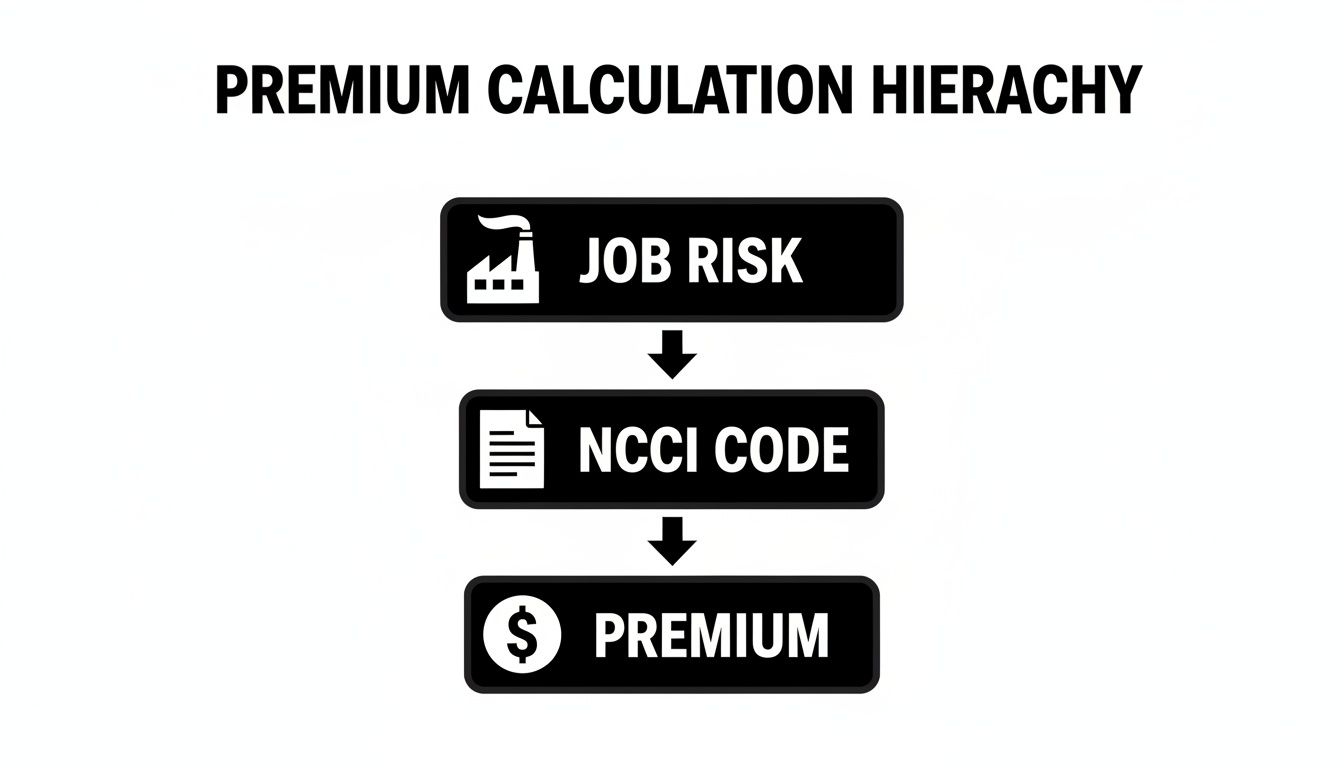
This simple flow from risk to code to premium highlights the critical link between a business's daily operations and its final insurance costs. When you navigate this system skillfully, you build stronger client relationships and protect your agency from unnecessary risk.
It all comes down to a deep commitment to understanding compliance standards in the insurance industry and applying them with precision. By framing code proficiency as a core service, you deliver tangible value that goes far beyond just quoting a policy. You become an essential partner in your client's financial health.
How One NCCI Class Code Impacts Premiums
To see just how dramatically the right code can affect a client's bottom line, let’s look at a simple comparison. We’ll use the same $50,000 employee payroll but apply three different class codes to see the premium swing.
| Employee Role | Example NCCI Code | Sample Rate (per $100 payroll) | Annual Premium (on $50K payroll) |
|---|---|---|---|
| Clerical Office Employee | 8810 | $0.25 | $125 |
| Landscaping / Gardener | 0042 | $4.50 | $2,250 |
| Roofer | 5551 | $25.00 | $12,500 |
As you can see, the difference is staggering. Misclassifying that roofer as a general landscaper might seem like a small error, but it could lead to a premium shortfall of over $10,000 that would come due after an audit. This is why meticulous classification is non-negotiable.
How NCCI Assigns and Governs Class Codes

The logic behind how NCCI assigns workers' comp class codes boils down to one simple, yet powerful, idea: a business is defined by its main operation. This is what the industry calls the governing classification.
Instead of trying to assign a different code to every single task an employee might do in a day, the system identifies the one code that best describes what the business as a whole does. This is almost always the classification that covers the largest chunk of the company's total payroll.
This approach creates a stable and predictable way to calculate premiums. It keeps things fair and prevents businesses from creatively splitting up payroll across dozens of codes just to hunt for lower rates, which would completely throw off the data integrity of the whole system.
The Governing Classification in Action
Let's look at a small construction firm in Alabama. This company has carpenters, plumbers, and general laborers all working out on job sites. Back at the office, they have one full-time office manager handling the books, scheduling jobs, and answering client calls.
Under the governing classification rule, the company's primary business is construction. Simple enough. That means the single construction code that accounts for the most payroll will apply to all the field employees—the carpenters, the plumbers, and the laborers. It doesn't matter that their individual jobs are different; their work is all part of the main construction operation.
But what about the office manager? This is where a key exception comes into play.
Key Takeaway: The governing classification isn't about individual job titles. It’s about the overall business enterprise. The code representing the majority of payroll and risk becomes the default for almost everyone.
Standard Exception Codes
Some job roles are so common across countless industries and carry such a distinct, lower level of risk that NCCI carves them out as "standard exceptions." These roles get their own unique code, even if it’s not the business's main classification.
The most common standard exception codes are:
- Code 8810 Clerical Office Employees: This is for administrative staff who work exclusively in an office, physically separated from the primary operational hazards.
- Code 8742 Salespersons, Collectors, or Messengers: This applies to employees who work mostly outside the office but aren't exposed to the operational risks of the business (think outside sales, not job site supervisors).
- Code 7380 Drivers, Chauffeurs, and Their Helpers: This covers employees whose main job is driving and making deliveries.
Getting back to our construction firm, that office manager would be correctly assigned Code 8810. This ensures their lower-risk work is rated appropriately and kept separate from the higher-risk field operations covered by the governing construction code.
Getting the NCCI class code right is make-or-break for premium accuracy, especially in high-stakes states like those served by PIA Southern Alliance. Riskier jobs like construction naturally have higher rates because historical data shows more injuries. NCCI compiles these averages from claims across nearly 900 insurers it serves today—a massive jump from just 69 back in 1923. You can explore a century of ratemaking insights on their website to see how they've used this data over time.
A Look Back: How Workers' Comp Classification Got Smarter
To really get a handle on the NCCI class codes we use today, it helps to know where they came from. The system wasn't always the logical tool agents now have at their fingertips. It was born from a tangled, fragmented model that made pricing a policy consistently next to impossible.
This classification system has been a pillar of the U.S. insurance world since the early 20th century, rolling with the punches as our economy and workplaces changed dramatically. When it kicked off around 1919, the structure was a maze of 1,319 different classifications pulled from old employers' liability insurance. These early codes were tied to specific jobs, which scattered the data and made it a nightmare to analyze. You can dig deeper into the historical journey of these classifications to see just how messy it was.
Shifting Focus from the Worker to the Workplace
The biggest headache with that original occupation-based system was watered-down data. Think about trying to set a stable rate for "carpenters." You’d have data from carpenters building houses, carpenters in manufacturing plants, and carpenters doing fine woodworking. Their risk levels were wildly different, but they were all lumped under one code.
This made it incredibly tough for insurers to gather enough meaningful data on any single job to create rates that were stable, accurate, and fair. Something had to give.
The big idea was to stop classifying the individual's job and start classifying the employer's business. This pivot allowed insurers to collect much more concentrated and reliable data, paving the way for the industry-focused system we have now.
Trimming the Fat for Stability and Accuracy
That strategic shift from occupation to industry was a total game-changer. It kicked off a massive cleanup, dramatically shrinking the number of codes over several decades. By the 1970s, the list was down to around 700, and by the 1990s, it had been whittled down to about 600.
Today, we're working with approximately 550 NCCI class codes. This streamlined system gives agents and their clients some major advantages:
- Better Data: Grouping by industry creates much larger pools of payroll and loss data for each code. This makes the resulting rates far more statistically sound.
- More Stable Rates: With stronger data, rates are less likely to bounce all over the place year after year just because of a few big claims.
- Simpler to Use: Classifying an entire business is a whole lot more straightforward than trying to pin a specific code on every single employee's daily tasks.
This whole evolution story really drives home why using the most current NCCI workers comp class codes is so important. It’s a living system, constantly refined for accuracy. Understanding its history shows you the data-driven logic that makes fair workers' comp premiums possible today.
Your Toolkit for Finding and Verifying NCCI Codes
Getting NCCI workers' comp class codes right isn’t about guesswork; it’s about having a systematic approach and the right tools. Think of it like a detective’s kit—each tool has a specific job, and when you use them together, you get the right answer and can confidently defend your classification.
The first step, always, is gathering detailed client information. Before you even think about looking up a code, you need a crystal-clear picture of what your client actually does. Ask for detailed job descriptions, operational workflows, and even a breakdown of the materials and equipment they use. This groundwork is absolutely non-negotiable for accuracy.
Starting Your Search with NCCI
Your primary resource should always be NCCI's own online Class Look-Up tool. It’s a user-friendly database that lets you search for classifications using keywords related to a client's business. It’s the perfect starting point to narrow down the possibilities from over 500 codes to a manageable few.
Here is what the interface looks like when you begin a search.
The tool provides the basic "phraseology," which gives you a high-level description of what operations a specific code covers. It’s an essential first stop to quickly find potential matches for your client.
The Agent's Rulebook: The Scopes Manual
Once you have a few potential codes from the look-up tool, your next stop is the NCCI Scopes® Manual. This is the definitive guide, the ultimate "rulebook" for agents. It contains comprehensive descriptions of every class code, outlining precisely what is included and, just as importantly, what is excluded.
Think of the Scopes® Manual as the final authority that validates your choice. It provides the detailed context you need to make a final decision, helping you document exactly why you chose a particular code over another. That documentation is your best defense against an E&O claim.
The Scopes® Manual transforms classification from an educated guess into a verifiable, evidence-based process. It's the key to confidently advising your clients and protecting your agency.
For more complex scenarios, having the right resources is crucial. For advanced research and information processing, integrating a legal AI assistant into your toolkit can streamline the navigation of complex regulatory landscapes, including NCCI class codes.
Remember, a diligent process not only leads to accurate premiums but also demonstrates your expertise. Committing to thorough research and verification is a core part of being a professional. To further build your expertise, explore our resources on commercial insurance underwriting training to deepen your skills. By using these tools effectively, you can refine your quoting process, conduct more effective policy reviews, and minimize your agency's risk exposure.
Common Misclassification Pitfalls to Avoid

Let's be honest—misclassifying an employee is one of the most damaging mistakes an agency can make. It's a ticking time bomb that almost always detonates during a premium audit, leaving your client with a massive, unexpected bill. This instantly sours a relationship you’ve worked hard to build.
These aren't just simple clerical slips; they expose your agency to a significant Errors & Omissions (E&O) risk.
The good news? Most of these pitfalls are entirely avoidable if you're proactive and detail-oriented. By recognizing the common missteps, you can frame classification reviews as a high-value service that protects your clients and sets your agency apart.
Misusing Standard Exception Codes
One of the most frequent errors we see involves the clerical code, 8810. This code is strictly for employees whose duties are exclusively administrative and who are physically separated from the business's operational hazards. A classic mistake is assigning Code 8810 to an office manager who occasionally steps onto the factory floor to check inventory. Another is using it for a receptionist at a construction firm who sometimes runs errands to active job sites.
If a clerical employee's duties involve any exposure to the operational risks of the business—even just once in a while—they must be assigned the business's governing classification. There’s no gray area here. The moment their work crosses that physical and operational threshold, the lower-risk classification no longer applies.
An annual audit can easily uncover this misstep by reviewing job duties and payroll records. The result? The employee's entire payroll gets reclassified to the higher-rated governing code, often leading to a substantial premium hike for your client.
Improperly Splitting Payroll
The desire to lower premiums can sometimes lead to the temptation of splitting a single employee's payroll between a high-risk and a low-risk code. For most industries, this is explicitly forbidden by NCCI rules. An employee's entire payroll must be assigned to the single class code that best represents their work.
For example, a machine operator in a workshop who also spends part of their day cleaning the shop floor cannot have their payroll divided. Their entire wage falls under the governing code for the workshop.
The only major exception is for construction or erection operations, which have specific rules that demand meticulous, verifiable time records to support any payroll division.
The Employee vs. Contractor Gray Area
Another huge landmine is the world of independent contractors. One of the most significant common misclassification pitfalls for businesses involves correctly distinguishing between employee vs. contractor classification, which directly impacts NCCI workers' comp class codes and a host of other labor laws.
Here’s the scenario: if an uninsured subcontractor is deemed to be an employee during an audit, your client can be held responsible for the premium on that contractor's entire payroll. This is a massive liability just waiting to happen.
Always, always secure certificates of insurance from all subcontractors. Without proof of their own workers' compensation coverage, their payroll will almost certainly be picked up and added to your client's policy at audit. To make matters worse, it's often assigned the highest-rated classification applicable to the work they performed. Proactively managing certificates isn't just paperwork; it's a critical risk management service.
State-Specific Rules in Georgia, Alabama, and Mississippi

It’s a common mistake to think that because Georgia, Alabama, and Mississippi all use the NCCI framework, workers' comp is the same across the board. Nothing could be further from the truth. Each state has its own advisory organization, its own legislative quirks, and its own economic realities that create significant local differences.
For independent agents, this means the base NCCI code is just a starting point—never the final answer. State-level nuances can completely change how NCCI workers comp class codes are applied. For example, if a state has a booming manufacturing sector, you can bet underwriters will scrutinize any codes related to production and fabrication with a fine-tooth comb.
Think of NCCI as the national building code for workers' comp. Each state still has its own local ordinances that you must follow to get the final permit. Ignoring these local rules can lead to significant compliance issues down the road.
This is exactly where your local expertise becomes your client's most valuable asset.
Local Factors That Impact Premiums
Beyond the base NCCI rates, several state-specific factors directly affect the final premium. Staying on top of these moving parts is what separates a good agent from a great one, ensuring your quotes are accurate and your advice is sound.
Here are a few key variables you have to track:
- Loss Cost Multipliers (LCMs): Carriers don’t just use NCCI’s advisory loss costs. They file their own LCMs with the state to tweak those numbers based on their internal expenses, profit goals, and claims experience.
- State-Specific Rules: Each state’s department of insurance can issue rules that modify how certain classifications are interpreted or applied, sometimes creating exceptions to the standard NCCI manual.
- Legislative Updates: When state laws change—especially around employee benefits or liability standards—it can send ripples through the entire rate structure.
Ultimately, NCCI class codes are the engine of workers' comp ratemaking. They fuel a massive dataset that tracks premiums, losses, and trends. But it's the state-specific data that fine-tunes the engine, blending national experience with local benefit costs and legislative adjustments.
To dig deeper, you can find incredibly detailed state-by-state data in NCCI’s Annual Statistical Bulletin. And for a broader look at managing risk, check out our guide on commercial property insurance in Georgia.
Got Questions About NCCI Class Codes? We've Got Answers.
Even after you get the hang of the NCCI system, the real world always throws a few curveballs. Practical questions pop up all the time. Here are some straightforward answers to the most common queries we hear from agents, designed to reinforce the key concepts that protect both your clients and your agency.
What if a New Business Doesn’t Have an Obvious Governing Classification?
This happens more than you’d think. When a business's operations don't slide neatly into a single code, the governing classification defaults to whichever code would command the largest portion of the total payroll.
It's absolutely critical to document your thought process and the specific operational details that led you to that decision. If a couple of codes seem like they could both fit, your first stop should be the NCCI Scopes® Manual for its detailed rules. But your best move? Pick up the phone and talk it over with an underwriter before binding the policy. Getting their sign-off upfront can prevent a world of headaches and disputes down the road.
How Often Should I Review a Client’s NCCI Class Codes?
Simply put: at every single policy renewal. A client's business is never static. Operations change, they roll out new services, and they hire different types of employees with new job functions.
A quick review during your renewal discussion is all it takes to catch these shifts and make sure the classification is still on the money. This proactive step does more than just prevent nasty audit surprises; it clearly shows your client that you're a diligent, professional agent who is actively looking out for their bottom line.
Can One Employee Be Assigned to Multiple Class Codes?
For the vast majority of businesses, the answer is a firm no. An individual employee's payroll typically can't be split between different class codes, even if they wear multiple hats and perform a variety of tasks. Their entire payroll gets assigned to the single governing class code that best describes their main duties and exposure.
The big exception here is for construction or erection operations. In that world, an employee might perform distinct jobs with vastly different risk levels. Splitting payroll is allowed, but only if it's backed up by precise, verifiable, and contemporaneous timekeeping records.
Outside of construction, an employee is assigned to the governing class code unless they qualify for a standard exception, like Clerical Office Employees (8810).
What Is the Premium Auditor's Role in Verifying Codes?
Think of the premium auditor as the fact-checker. Their job is to make sure the business operations and payroll you reported at the beginning of the policy actually match reality. They do this by digging into payroll records, talking to management about job duties, and sometimes even visiting the worksite.
If an auditor finds misclassifications, they have the authority to reassign employees to the correct codes and recalculate the final premium. This adjustment can lead to a significant—and often unexpected—bill for your client. This makes getting the classification right from the start your best defense against a painful audit.
At PIA Southern Alliance, we give independent agents in Georgia, Alabama, and Mississippi the resources, education, and advocacy needed to handle complexities like NCCI class codes with total confidence. Learn more about how a PIASA membership can benefit your agency.