
At its core, a four-digit NCCI class code is the insurance industry's shorthand for a business's operational risk. Think of it as a specific risk category assigned to an employer—the higher the risk, the higher the rate for their workers' compensation premium.
For independent agents, getting this classification right is everything. It's how you protect clients from overpaying and shield your agency from devastating E&O claims.
What Are NCCI Class Codes and Why They Matter
The National Council on Compensation Insurance (NCCI) class code system is essentially the universal language of workers' comp. It's a standardized framework that groups businesses with similar risk profiles, making sure premiums are calculated fairly and consistently. These codes aren't just pulled out of thin air; they're the product of decades of data on workplace injuries and loss costs.
Imagine a giant library where every book is a different type of business. Without a good cataloging system, it would be total chaos. NCCI class codes are that system, sorting every business onto the right "shelf" based on its unique operational hazards. A roofing company, for instance, belongs in a completely different section than a quiet accounting firm.
The Foundation of Fair Premiums
The whole point of this system is to create a logical basis for insurance rates. By grouping similar businesses together, carriers can analyze their collective loss data to predict future claims and set fair premium rates for each classification.
This process ensures that a low-risk office environment isn't subsidizing the much higher risks of a heavy manufacturing plant. The link between classification and cost is direct, which makes getting the code right from day one an absolutely critical task.
An incorrect code can have serious financial blowback:
- Overpayment: Assigning a code with a higher rate than necessary means your client is forced to pay inflated premiums, sometimes for years on end.
- Underpayment and Audit Shock: On the flip side, using a code with a rate that's too low creates a false sense of savings. That illusion shatters during the annual premium audit, often leaving your client with a massive, unexpected bill.
For an independent agent, mastering NCCI class codes isn't just a technical skill—it's a fundamental part of risk management and client advocacy. Correct classification is the bedrock of a trusting client relationship and a profitable, well-protected agency.
Why This Matters for Your Agency
For agencies in states like Georgia, Alabama, and Mississippi that use the NCCI system, getting classification right isn't optional. When you get it wrong, you expose your agency to significant Errors & Omissions (E&O) risk. A client blindsided by a huge audit bill or one who finds out they've been overpaying for years will almost certainly point the finger at their agent.
That's why you have to understand how to interpret and apply NCCI class codes accurately. It gives you the power to advise your clients properly, defend your choices during an audit, and ultimately, protect your agency’s reputation and bottom line. This guide will give you the practical know-how to turn a classification challenge into a competitive advantage.
Understanding How NCCI Class Codes Work
To get a handle on NCCI class codes, you first have to grasp the core principle of the whole system: a business gets assigned one primary classification that best describes its overall operation. This is what we call the Governing Classification.
It’s the code that represents the main business enterprise, not the specific job of every single employee.
Think of a bustling restaurant. You’ve got chefs, servers, hosts, and dishwashers. While their day-to-day tasks are wildly different, they are all part of the same core operation—making and serving food. Because of this, they’d all typically fall under one governing code, like 9079 Restaurant. The system is designed to look at the collective risk of the entire business, not each individual's role.
This approach keeps the process from getting messy and helps ensure the premium accurately reflects the company's biggest source of risk and payroll.
The Governing Classification Rule
The Governing Classification is found by identifying the single class code that accounts for the most payroll. It’s the code that captures the true essence of what the company does day in and day out. Once that code is set, it applies to every employee involved in that primary operation—with a few key exceptions we'll cover in a moment.
This rule is critical because it prevents businesses from trying to game the system by splitting an employee's payroll between a high-risk code and a low-risk one to get a lower premium. If a worker jumps between tasks covered by different classifications, they must be assigned to the highest-rated classification that applies to any part of their work.
The foundational rule is simple but powerful: one business, one primary operation, one governing code. This prevents complex and often inaccurate payroll divisions, ensuring the rate reflects the true nature of the business's risk.
Standard Exceptions to the Rule
Of course, some jobs are common to almost every business, no matter the industry. These roles have a risk profile that’s completely distinct from the company's main operations, and NCCI recognizes this with what are called Standard Exceptions.
These are specific job functions that are always classified separately, as long as the employees work exclusively in that role. This is a huge point of confusion for agents and a common source of audit trouble. The two big ones you’ll see constantly are clerical office employees and outside sales staff.
Below is a quick reference table to keep these straight.
Standard Exceptions to the Governing Classification Rule
| Standard Exception Code | Description | Typical Job Functions | Common Agency Pitfall |
|---|---|---|---|
| 8810 | Clerical Office Employee | Receptionists, bookkeepers, data entry clerks working in a physically separate office. | Misclassifying an office worker who occasionally steps onto the shop floor or job site. If they do, they lose the 8810 classification. |
| 8742 | Outside Salesperson | Salespeople, collectors, or messengers who work primarily away from the business premises. | Applying this code to "inside" sales staff or delivery drivers. The work must be conducted off-site to qualify. |
| 8748 | Automobile Salespersons | Sales staff working at a car, truck, or motorcycle dealership. | Confusing this with 8742. This code is specific to vehicle sales and has its own rate. |
| 7380 | Drivers, Chauffeurs & Messengers | Employees whose main job is driving vehicles to transport goods or people. | Assigning this to employees who drive incidentally, like a roofer who drives the company truck to a job site. Driving must be their primary duty. |
Understanding these exceptions is key to avoiding classification errors during an audit. If you’re not sure, it’s always better to ask the underwriter than to guess.
This system didn't just appear overnight. When NCCI began in 1923, classifications were much broader. Today, the system has been honed to about 550 codes, a refinement that concentrates data to give agents in the Southeast and beyond much more accurate rates.
From Code to Premium Calculation
This is where the rubber meets the road. Connecting these codes to the final premium is straightforward once you know the formula.
The formula is: (Payroll / $100) x Class Code Rate = Base Premium
Let's walk through it:
- Find the Payroll: Start with the total gross payroll for all employees under a specific class code.
- Divide by 100: Workers' comp rates are always expressed as a cost per $100 of payroll, so you divide the total payroll by 100.
- Apply the Rate: Multiply that number by the specific rate assigned to that NCCI class code.
For example, imagine a client has $300,000 in payroll under a code with a rate of $2.50. The math looks like this:
($300,000 / 100) x $2.50 = $7,500 in base premium.
This simple but powerful formula is the engine of workers' compensation pricing. For a deeper dive, check out our other resources on workers' compensation premium calculation.
Common Classification Mistakes and How to Avoid Them
Even the most seasoned agents can stumble into common traps when assigning NCCI class codes. These aren't just small clerical mistakes; they're financial landmines that often stay buried until a premium audit, blowing up into unexpected bills for your clients and potential E&O claims for you.
Knowing where the pitfalls are is the first step to sidestepping them altogether. A misclassification is like using a bad map—you think you're guiding your client safely, but you're actually leading them toward a steep financial cliff. The most frequent errors usually come from not fully grasping what a business actually does day-to-day, or from relying too much on the business name instead of its real operations.
The Overuse of NOC Codes
One of the biggest red flags in classification is leaning too heavily on NOC codes, which stands for "Not Otherwise Classified." Think of these as the "miscellaneous" drawer of class codes. They’re meant for genuinely unique businesses that don't fit neatly into any other specific category.
The problem is, they're often used as a shortcut when an agent isn't sure where a business belongs. This is a dangerous habit. Auditors are trained to zoom in on NOC codes because they know they're frequently misapplied. If a more specific, accurate code exists, an auditor will almost certainly switch it, and it's often to a code with a much higher rate.
Using an NOC code should be your last resort, not your first instinct. It’s supposed to signal that a business is truly one-of-a-kind, not that its operations are unclear. Always hunt for a better fit before you settle on a Not Otherwise Classified option.
Misinterpreting Key Operations
Another major source of headaches comes from getting the details wrong about what defines a classification. A few areas are notorious for causing trouble during audits, especially consultants, warehousing operations, and office staff who do a little bit of everything.
- Consultants (Code 8742): When a business calls itself a "consultant," that's just the beginning of the story. An auditor will want to know what kind of consultant. An IT consultant might fall under Code 8803, a safety consultant under Code 8601, and a marketing consultant under Code 8742. Each carries a different risk and a different rate.
- Warehousing (Code 8292): This code is designed for general merchandise warehouses. It often gets slapped onto businesses that are just storing their own products before selling them (which is a mercantile operation) or specialized facilities like cold storage, which have their own specific codes.
- Clerical Staff (Code 8810): The rules for the clerical exception are incredibly strict. If an office worker occasionally wanders into the shop, helps pack a box, or does any work outside of their physically separate office, they no longer qualify for Code 8810. They have to be assigned to the governing classification of the business.
Real-World Reclassification Data
These aren't just made-up scenarios. NCCI tracks which codes get changed most often during inspections, giving us a clear roadmap of where the industry commonly gets it wrong. For example, recent research found that Code 7380 (Drivers, Chauffeurs & Their Helpers NOC) is now the most frequently reclassified workers' compensation class code.
This kind of data is a wake-up call for independent agencies in states like Georgia, Alabama, and Mississippi, where these changes hit client premiums—and agency profitability—hard. Right behind drivers, Code 8292 (Warehousing NOC) saw nearly 59% of its policies changed after inspection, with most getting moved to mercantile codes for retail operations. You can dig deeper into these findings in NCCI's latest classification research.
By getting familiar with these frequently overturned NCCI codes, you can start to spot the same red flags in your own book of business. This isn't just about avoiding audit surprises; it's about showing a level of expertise that builds real, lasting trust with your clients.
A Practical Workflow for Verifying Class Codes
Getting classifications right isn't luck—it's the result of a repeatable, disciplined process. Just asking a business owner for their industry is a rookie mistake. You have to put on your investigator hat, dig into the day-to-day reality of their operations, and find the NCCI class code that fits.
This workflow turns classification from a guessing game into a strategic, defensible part of your agency's value. It all starts with a deep conversation that goes way beyond the business name on the sign out front.
Step 1: Conduct a Deep-Dive Client Interview
The first and most critical step is a detailed interview. Your mission is to understand exactly what employees do, where they do it, and what materials or equipment they use. A business named "Apex Solutions" tells you nothing, but learning they manufacture custom machine parts during a five-minute chat tells you everything.
Use a structured questionnaire to keep the conversation on track. You need to know:
- What is the end product or service? Ask them to describe what their customer actually buys from them.
- Walk me through your process. Have them explain the journey from raw materials or an initial idea to the final product or service delivery.
- What do most of your employees actually do all day? You need to separate the core operational roles from the administrative or sales staff.
- What kind of machinery or equipment is involved? The tools of the trade are a massive clue for determining the real risk and proper classification.
- Do any employees travel for work? This helps identify if you can apply specific classifications like "Outside Salesperson" or other exceptions.
Documenting the answers to these questions in your agency management system isn't just good practice—it's your first line of defense. This recorded rationale creates a clear, defensible trail of why you chose a specific class code, which is priceless when an audit dispute comes knocking.
Step 2: Leverage Official NCCI Resources
Once you have a clear picture of the client's operation, it’s time to hit the books. Guesswork and "gut feelings" have no place in this process. The one tool every agent must use is the NCCI Scopes® Manual, which provides the official phraseology and detailed descriptions for every single code.
Many carriers provide access to this manual right through their agent portals. If not, NCCI offers a suite of powerful online tools for subscribers that can make your research much more efficient.
The infographic below shows some of the most common pitfalls that this kind of careful research helps you avoid.
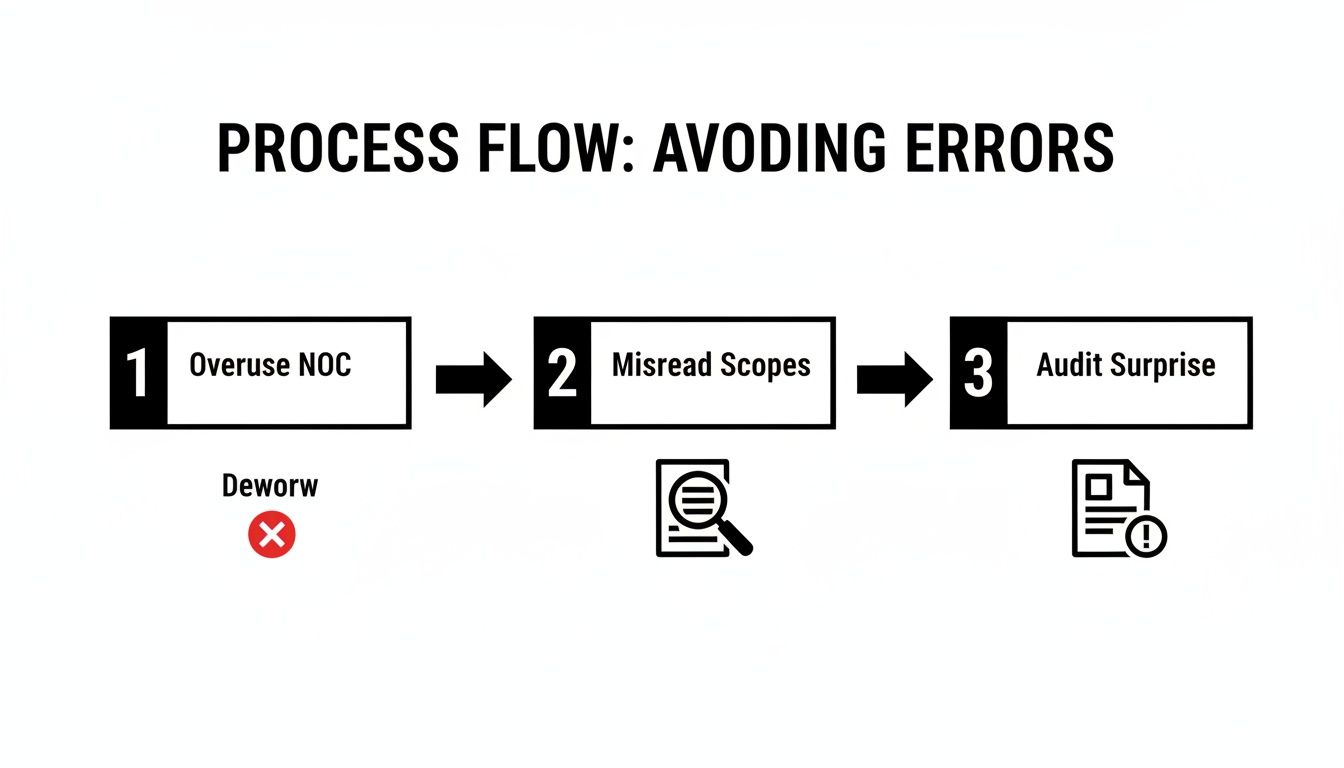
This visual is a stark reminder of how quickly simple mistakes, like overusing NOC codes or misreading a scope, can lead to a surprise audit bill for your client.
Step 3: Perform Your Own Investigation
Don't just take the client's word for it—verify it. Get online and scrutinize the business's website, look through their brochures, and even check their social media profiles. You're looking for photos, videos, or service descriptions that either confirm or contradict what they told you.
A website gallery showing employees on a factory floor is powerful evidence to support a manufacturing classification over a simple clerical one.
This verification step is absolutely critical. NCCI's own inspection programs show that Code 8292 (Warehousing NOC) recently topped the list of reclassifications. Over 60% of policies using this code were changed, mostly because it was being misapplied to retail operations. Clerical and sales codes also see huge adjustments, proving just how vital it is for agents to verify these roles. You can read more about these insights from NCCI's inspection program.
Step 4: Correcting a Misclassification
What happens when you take over an account and immediately spot an error from the prior agent? You have to be methodical.
- Gather Your Evidence: Compile everything you've found—your interview notes, screenshots from their website, and the official Scopes Manual descriptions.
- Build Your Case: Write a clear, concise email to the underwriter. Explain why the current code is wrong and why your proposed code is the correct fit. Attach all your documentation.
- Manage Client Expectations: Be upfront with your client. If the change means a higher premium, explain that it's necessary to prevent a much larger, more painful audit bill down the road. If it results in a credit, you’ve just become their hero.
Navigating State-Specific NCCI Rules
While NCCI writes the foundational rulebook for workers' compensation, it's a huge mistake to think it’s the only one that matters.
Think of the NCCI manual as the federal law of classification; individual states can—and frequently do—pass their own "state laws" that amend, add to, or even completely override the national standards. Assuming a code that works in Tennessee applies the exact same way in Georgia is a recipe for a compliance nightmare.
For independent agents, especially those writing business in multiple states like Georgia, Alabama, and Mississippi, this is where true expertise makes a difference. Each state that adopts NCCI as its rating bureau has the authority to introduce its own specific rules, endorsements, and exceptions. These state-level deviations aren't suggestions—they're non-negotiable and must be followed to the letter to rate a policy correctly.
Finding and Applying State-Level Rules
So, where do you track down these critical state variations? Your first stop should always be the state-specific section of NCCI’s materials or your carrier's underwriting guidelines. These documents are where you'll find any state-specific class codes, unique rules for certain industries, or different payroll limitation rules.
For example, a state might have unique rules that directly impact high-risk industries common to that region.
- Construction Trades: Some states create their own class codes to distinguish between residential and commercial construction work—a distinction that doesn't exist in the standard NCCI manual.
- Executive Officers: The maximum and minimum payroll figures used for rating executive officers can vary wildly from one state to another. A payroll cap that’s right for your Alabama client could be completely wrong for their new office in Georgia.
- Assigned Risk Plans: States also set their own rules for their assigned risk pools (the market of last resort), which often come with unique classification procedures.
These nuances might seem subtle, but they carry serious financial weight. An agent who misses a state-specific payroll cap for an executive officer could be significantly overcharging their client, opening up a major E&O exposure.
The bottom line is this: national NCCI rules tell you what to do, but the state-specific pages tell you how and where to do it. Always check for local rules that modify the standard classification logic before you finalize any quote.
A Look at Georgia, Alabama, and Mississippi
Even though all three of these states are NCCI jurisdictions, each operates in its own regulatory environment. For instance, a state legislature might pass a law changing how certain agricultural operations are classified to support a key local industry. One state might require specific endorsements for businesses that use a PEO, while its neighbor follows the standard NCCI guideline.
It's also helpful to understand how a state handles workers' compensation exemptions for additional context. To see how these rules create unique compliance situations, you can explore the details of the Tennessee workers' compensation exemption.
This regional focus is not optional. It demands diligence. You have to check for state-specific rules on every single policy, especially for clients operating across state lines. The best practice is to build a state-level check into your standard classification workflow.
When you do this, you move from just applying a code to providing precise, compliant, and defensible advice. That’s what protects both your client and your agency from costly surprises down the road—and it's what separates a good agent from a great one.
Managing Audits and Reducing Your E&O Exposure

The annual premium audit is the moment of truth for your classification work. It’s where even the smallest NCCI class code errors get exposed, often leading to some of the toughest conversations we have with clients about unexpected, and unbudgeted, premium increases.
These situations are more than just an operational headache; they are a fast track to potential Errors & Omissions claims.
For an independent agent, mastering classification isn’t just about writing a policy correctly—it's about managing risk for your own agency. A client blindsided by a five-figure audit bill because of a misclassification is almost guaranteed to point the finger back at their agent. Suddenly, a simple mistake becomes a serious threat to your agency’s reputation and financial health.
Proper classification is one of the most powerful E&O loss prevention tools you have. Every code you verify and every operational detail you document builds a defensive wall around your work, protecting your client from financial shock and your agency from liability.
Preparing Clients for a Smooth Audit
The best way to turn a dreaded audit into a routine check-up is with proactive preparation. Your job is to coach clients on keeping records that clearly and decisively back up the classification choices you made together. Remember, ambiguity is the auditor's enemy and your biggest risk.
Advise your clients to get their house in order long before the audit notice arrives. This means:
- Detailed Payroll Records: Payroll absolutely must be broken down by job function. This is non-negotiable, especially for employees split between operations and a Standard Exception like Code 8810 (Clerical).
- Clear Job Descriptions: Clients should have written job descriptions that mirror the language and duties described in the NCCI Scopes® Manual.
- Subcontractor Documentation: Always, always have valid Certificates of Insurance for every single subcontractor. If they can't produce one, the auditor will charge premium on that subcontractor's payroll, and your client will pay the price.
Helping your client get this documentation in order doesn't just make the audit smoother; it reinforces your value as a professional advisor who's looking out for them.
Handling Classification Disputes
Even with the best preparation, you’ll eventually run into a classification dispute with an auditor. When an auditor suggests reclassifying a business, it's not time to panic. It's time to pull out your file.
If you disagree with an auditor’s findings, a well-documented file is your best and only defense. This is where your initial interview notes, website screenshots, and the documented rationale for your code choices become priceless.
Present your evidence to the carrier clearly and professionally, referencing the specific language from the NCCI manual that supports your position. Keep your client in the loop throughout the process to manage their expectations and show you’re fighting for them.
Handling these situations effectively is a core competency for any successful agent. For more insights on protecting your agency, it’s always smart to understand your options when choosing Errors and Omissions insurance companies to partner with.
Finally, as you prepare for an audit, remember that you and your client will be exchanging sensitive financial data. It's critical to know how to secure your business's PDF documents to protect everyone's information. This simple step protects both you and your client from unnecessary risk.
Your Top Questions About NCCI Class Codes, Answered
As an agent, you're on the front lines, fielding tough questions about NCCI class codes every day. Let's walk through some of the most common scenarios that trip up clients (and sometimes even seasoned agents), so you can handle these conversations with confidence.
Can I Split an Employee’s Payroll Between Different Codes?
This one comes up a lot, especially from business owners trying to find savings. The short answer is almost always no. Unless a specific employee’s duties fall neatly into a Standard Exception (like a full-time bookkeeper who qualifies for Code 8810), you can't split their payroll.
NCCI rules are very direct on this. If a single employee does work that could be described by multiple class codes, their entire payroll must go into the single highest-rated class code that applies to any part of their job. It's a hard-and-fast rule designed to make sure the premium accurately reflects the highest potential risk.
How Do I Classify a Business That Hasn't Opened Yet?
Classifying a startup is a different ballgame. With no payroll history or established operations to look at, your classification is based entirely on the owner's plan. This means you have to go deeper than you would with an existing business.
Your best tool here is a detailed interview. Ask pointed questions and document the answers meticulously.
- What exactly will you be selling or what services will you provide?
- Walk me through the equipment and machinery your team will be using.
- Describe the day-to-day tasks of your very first hires.
When you're working with a new business, your notes are your best defense. Classify based on the owner's stated intentions, but—and this is critical—set a reminder to review that classification a few months after they open for business. You'll want to confirm the code still fits long before the first audit.
Where’s the Best Place to Look Up Official Code Descriptions?
When you need the final word on what a class code covers, the only truly authoritative source is the NCCI Scopes® Manual. This is the official rulebook, containing the precise wording and detailed descriptions that outline what's included (and excluded) from every single code.
You can usually get access to it through your agency's NCCI subscription or find it on your carrier's agent portal. While NCCI’s public "Class Look-Up" tool is great for a quick check, it just doesn't have the depth of the full Scopes® Manual. For decisions you need to stand behind, always go to the official source.
At PIA Southern Alliance, we're committed to giving independent agents in Georgia, Alabama, and Mississippi the tools and knowledge to master complex subjects like NCCI class codes. Our goal is to help you protect your clients, build your expertise, and run a more profitable and resilient agency. https://piasouth.com