
At their core, the insurance markets in Mississippi and Alabama are shaped by completely different risk profiles and, as a result, different regulatory priorities. While Alabama has put a lot of energy into creating broad incentives for property hardening against both tornadoes and hurricanes, Mississippi’s rules are intensely focused on its uniquely volatile coastal windpool.
This creates a much more challenging and concentrated risk environment for property insurers in Mississippi. That one fundamental distinction trickles down to affect everything from carrier appetite to an agency's day-to-day operational focus.
An Essential Comparison Of Mississippi And Alabama's Insurance Markets
For an independent insurance agency, treating Mississippi and Alabama as interchangeable Southern markets is a huge strategic mistake. Each state throws a unique mix of regulatory hurdles, market opportunities, and operational risks at you that demand a specific game plan. Getting a handle on these nuances is the first step toward building a resilient and profitable agency with a footprint in one or both states.
This guide is designed to be a detailed, actionable comparison of their insurance landscapes. We're going to dig much deeper than surface-level observations to really analyze the practical realities agencies like yours face every single day.
We'll take a close look at:
- State-specific rules for licensing, appointments, and continuing education.
- The real-world impact of coastal exposure and severe weather on property markets.
- Errors & Omissions (E&O) considerations shaped by local legal climates.
- Market penetration, carrier presence, and where the real growth opportunities are.
At A Glance Key State Differences
To get us started, it helps to see a high-level overview of what defines each state's insurance environment. This table highlights the main drivers that will influence your agency's strategy and your clients' needs.
| Feature Comparison | Mississippi | Alabama |
|---|---|---|
| Primary Property Risk | Concentrated hurricane/windpool exposure on the Gulf Coast. | Broader risk from hurricanes, tornadoes, and severe inland storms. |
| Regulatory Focus | Managing the Mississippi Windstorm Underwriting Association (MWUA). | Promoting statewide mitigation through programs like home hardening grants. |
| Economic Drivers | Agriculture, advanced manufacturing, and healthcare. | Automotive manufacturing, aerospace, and technology sectors. |
| Agency Challenge | Navigating a difficult and expensive coastal property market. | Balancing diverse weather risks across a larger geographical area. |
The key takeaway for agency owners is that a successful strategy in Mobile, AL won't just plug and play in Biloxi, MS. Alabama's market often requires a broader risk management conversation, while Mississippi demands deep specialization, particularly for agencies operating anywhere near the coast.
In the end, whether you're expanding into a neighboring state or just trying to optimize your current operations, success hinges on recognizing these differences. The following sections will break down these comparisons in much greater detail, giving you the insights needed to make smart decisions that protect your agency and serve your clients effectively in the dynamic Mississippi-Alabama insurance corridor.
Navigating State Licensing And Education Requirements
For any independent agency working across the Mississippi-Alabama state line, having a rock-solid grasp of licensing and continuing education (CE) is non-negotiable. While these states share a border, their regulatory frameworks have just enough of a difference to trip up a growing agency. Getting these details right is the foundation for staying compliant and letting your producers operate legally and effectively.
The path to becoming a licensed producer in either state starts with pre-licensing education. Both Mississippi and Alabama require aspiring agents to complete a certain number of course hours before they can even sit for the state licensing exam. It’s the baseline that ensures a producer understands insurance principles, state laws, and ethics.
But the devil is in the details, as specific hour mandates can vary slightly. For instance, both states currently require 40 hours of pre-licensing education for a combined Property and Casualty line, but it's always smart to verify this for each specific line of authority you're pursuing. When you're onboarding new talent, you have to track these initial steps carefully.
Producer Licensing And Appointment Processes
Getting the license is just the first hurdle. The real key to selling is getting appointed by a carrier. In both Mississippi and Alabama, the appointment process is the critical link connecting your producer, your agency, and the insurer. If you drop the ball here, you could face some serious compliance headaches.
Your agency needs a bulletproof internal process for submitting appointment requests the moment a new producer is hired or decides to represent a new carrier. This usually means sending an application to the carrier, which then files the appointment with the state's Department of Insurance. The goal is to eliminate any lag time where a producer might sell a policy without an active appointment—a massive E&O exposure waiting to happen.
A classic mistake for agencies expanding from Mississippi into Alabama (or vice versa) is assuming the appointment grace periods are the same. These timeframes can differ, so verifying the specific number of days allowed between writing business and finalizing an appointment is absolutely critical for compliance.
Continuing Education: A Tale Of Two States
Once your producers are licensed, their ongoing education requirements in Mississippi and Alabama become a top priority. Both states mandate that producers complete 24 hours of continuing education during each two-year licensing period. On the surface, that sounds simple enough, but this shared number hides some important differences in course content and credit rules.
For example, both states require a slice of those hours be dedicated to ethics training—3 hours, to be exact. Additionally, you’ll find specific requirements for certain lines of authority, like the mandatory 3 hours of flood insurance training for property producers. To get a handle on the specifics, it's a good idea to learn more about Alabama insurance continuing education to ensure your training programs are perfectly aligned.
Licensing And CE Requirements: A Side-By-Side Look
To make things easier, we’ve put together a quick-reference table that lays out the core licensing and CE rules for both states. It’s a handy tool for compliance managers and agency principals who need to see the key details at a glance.
| Requirement | Mississippi | Alabama |
|---|---|---|
| Pre-Licensing Hours (P&C) | 40 Hours | 40 Hours |
| Total CE Hours (2-Year Period) | 24 Hours | 24 Hours |
| Ethics CE Requirement | 3 Hours | 3 Hours |
| Flood Insurance CE | 3 Hours (For Property Producers) | 3 Hours (For Property Producers) |
| CE Rollover Credits Allowed | Up to 12 Hours | Up to 12 Hours |
| License Renewal Period | Biennial (Every 2 Years) | Biennial (Every 2 Years) |
As you can see, the requirements are very similar, but assuming they are identical is a risky bet. The best practice is to treat each state’s compliance as its own distinct responsibility.
Ultimately, a robust tracking system for producer licenses, appointments, and CE deadlines isn't just a "nice-to-have"—it's essential for avoiding fines, sanctions, or even the suspension of a producer's license. For agencies in the Mississippi-Alabama corridor, a dual-state compliance calendar is one of the most powerful tools you can have.
Comparing Coastal Risk And Property Market Dynamics
For independent agents, the property insurance markets in Mississippi and Alabama present two completely different strategic puzzles, both carved out by the immense power of Mother Nature. They might share a border on the Gulf of Mexico, but their unique geographies create distinct risk profiles that directly shape carrier appetite, premiums, and coverage availability.
Getting these differences isn't just an academic exercise—it's absolutely essential for advising clients properly and navigating an increasingly hard market.
Mississippi's coastline is short, but it's intensely exposed. This concentrated vulnerability to major hurricanes puts incredible pressure on its property market, especially in the coastal counties. Down there, the Mississippi Windstorm Underwriting Association (MWUA), better known as the "windpool," is a dominant force, often serving as the insurer of last resort for wind and hail.
Alabama, on the other hand, deals with a more geographically diverse set of threats. Yes, its coast is definitely vulnerable to hurricanes, but the state also stretches deep into "Dixie Alley," a region notorious for frequent and violent tornadoes. This double-whammy means agents in Alabama have to treat severe convective storm risk just as seriously as hurricane risk, even for clients hundreds of miles from the beach.
Navigating Coastal Property Volatility
The difference in risk concentration has a huge impact on the insurance market. In Mississippi, the conversation is almost entirely driven by hurricane exposure. This creates a high-stakes environment where a single storm can reshape the market for years. The result? Fewer private carriers are willing to write wind coverage near the coast, forcing more and more properties into the MWUA.
Alabama’s broader risk profile has led to a slightly different market response. While coastal spots like Mobile and Baldwin counties face challenges similar to Mississippi's, the statewide tornado threat has forced carriers to develop a more distributed approach to risk management. This can sometimes mean more options for consumers, but it also creates major rating volatility across the entire state, not just along the shore.
The core challenge for an agent in coastal Mississippi is simply finding coverage in a constricted market. For an agent in Alabama, the challenge is often explaining to a client in Birmingham why their premiums are soaring—driven by a combination of hurricane models and statewide tornado frequency. It’s a lesson in the interconnectedness of risk.
Staying on top of these complex, evolving markets requires continuous learning. This chart breaks down the continuing education requirements that serve as the foundation for agents in both states.
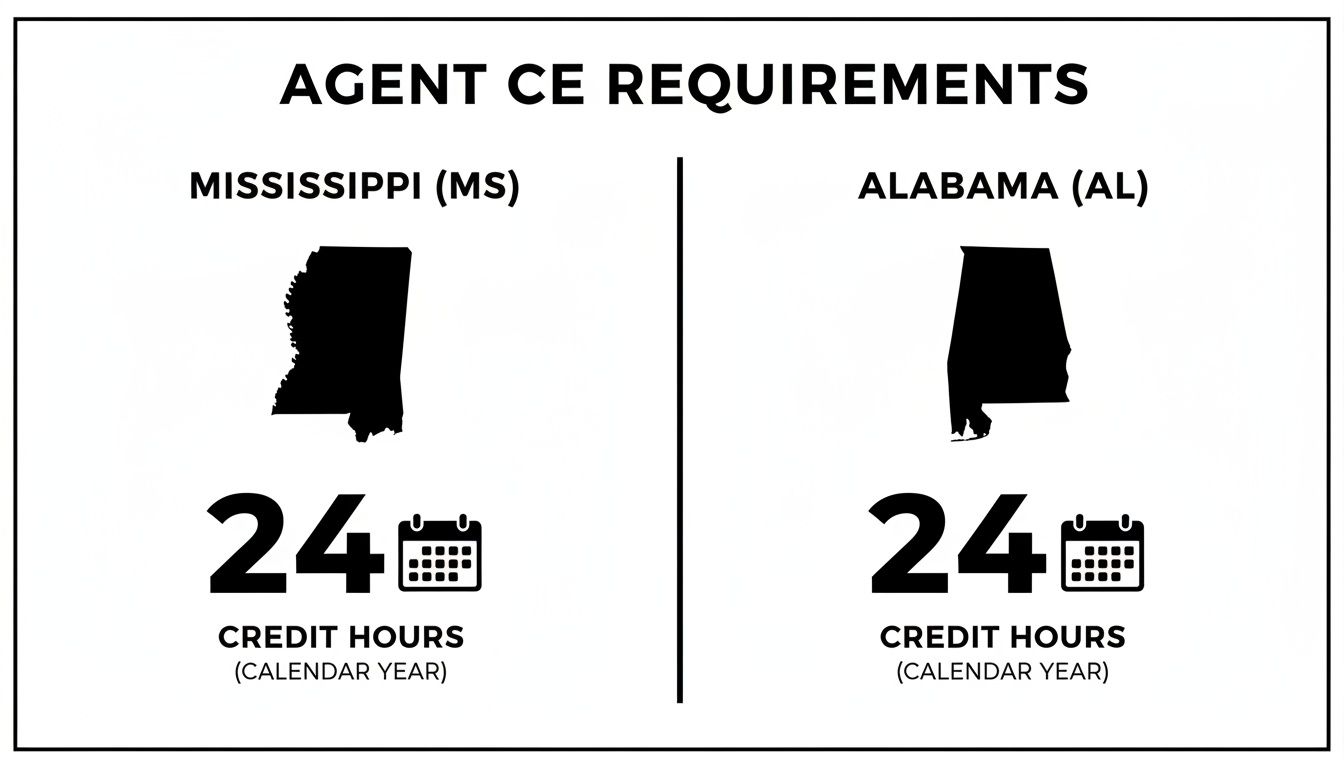
As you can see, both states require 24 hours of CE, ensuring agents stay educated on emerging risks, including the intricate details of flood damage and the claims that follow.
The Financial Impact Of Weather Risk
These different risk profiles translate directly into dollars and cents for your clients. Mississippi's coastal property market has been hammered by staggering rate pressure. For example, windpool rates are set to jump by another 16% soon, a direct reflection of the state's severe exposure.
Historically, coastal counties in Mississippi have paid nearly double what inland counties pay for insurance, and that gap just keeps widening. The financial toll from storms like Hurricane Zeta—which caused an estimated $635 million in losses from around 10,000 damaged homes—shows the immense risk carriers have to price for.
Alabama also has its affordability challenges, but they’re fueled by a mix of hurricane and severe storm losses. The state has been proactive in trying to manage this by incentivizing risk reduction.
- Alabama's Strengthen Alabama Homes Program: This fantastic program offers grants to homeowners for fortifying their roofs and structures to meet specific standards, which can earn them significant insurance discounts.
- Mississippi's Mitigation Efforts: Mississippi also has mitigation programs, but the focus is often tightly coupled with compliance for properties inside the windpool, making it a critical part of the insurance puzzle for any coastal resident.
For agencies, these programs are powerful tools. In Alabama, promoting mitigation grants can be a key value-add for clients anywhere in the state. In Mississippi, skillfully guiding clients through windpool requirements and mitigation credits is a fundamental service.
Agents who truly master these state-specific nuances can better serve their communities and write more resilient business. Properly handling these situations also requires a deep understanding of what comes after a major event; you can learn more about navigating the flood insurance claims process in our dedicated guide.
Finding Market Opportunities and Carrier Appetite
Understanding risk is just one piece of the puzzle. Pinpointing real market opportunities means digging into the economic and demographic realities of both Mississippi and Alabama. For an independent agency, knowing where to aim your business development—whether it’s personal lines in a growing suburb or commercial lines in a new manufacturing hub—is everything.
The economic engines driving these two states are quite different. Alabama has seen a flood of investment in sectors like automotive manufacturing, aerospace, and technology. This creates a rich environment for commercial lines agencies that specialize in complex risks like manufacturing liability, supply chain coverage, and technology E&O.
Mississippi, while also strong in advanced manufacturing and healthcare, has deep roots in agriculture. This opens up opportunities for agencies with expertise in farm and ranch insurance, crop insurance, and agribusiness risks—a niche that might be less saturated than the industrial sectors over in Alabama.
Reading the Demographic Tea Leaves
Population trends tell a compelling story, too. Certain counties in Alabama, particularly around Huntsville and the Gulf Coast, are absolutely booming. This growth fuels demand for personal lines products like homeowners and auto insurance, but it also creates a thriving ecosystem of small businesses, from contractors to retail shops, that all need coverage.
Mississippi's growth might be more measured, but strategic pockets of opportunity are definitely there, especially in its healthcare and logistics hubs. An agency that can zero in on these emerging commercial centers can establish a strong foothold. For example, the expansion of healthcare facilities creates an immediate need for specialized medical malpractice and business owners' policies.
The key is to look past statewide data and drill down to the county or even city level. A thriving small business climate in one Alabama city might present a better opportunity than a larger, but more stagnant, Mississippi market. Success in this corridor depends on this kind of granular market intelligence.
Carrier Presence and Market Competition
The availability and appetite of insurance carriers differ significantly between the two states, and that directly impacts your ability to place business. In Alabama, you’ll find a wider array of national and super-regional carriers competing for both personal and commercial lines, thanks to its more diverse economy.
But that competition can bring intense price pressure. The state’s significant exposure to severe weather, especially tornadoes, has created a volatile homeowners market. In fact, Alabama's home insurance market recently saw premiums jump by about 7% in a single year, with the average annual cost hitting $5,831. This trend, driven by events like the more than 400 tornadoes that caused over $34 million in property damage in the last five years, makes affordability a huge client concern. You can find more insights on the factors driving Alabama's high home insurance costs on wh-ins.com.
Mississippi’s market, particularly for property, is more constrained. The massive influence of coastal wind risk means fewer national carriers are willing to write wind coverage in the southern counties. This pushes a ton of business to the state's windpool and specialty markets. It also creates a critical role for Managing General Agents (MGAs) and surplus lines brokers who can access carriers with an appetite for catastrophic risk.
This table gives you a quick snapshot of the carrier landscape:
| Market Factor | Mississippi | Alabama |
|---|---|---|
| National Carrier Presence | Moderate, with big gaps in coastal property. | Strong, with broad competition across most lines. |
| Regional Carrier Focus | Strong in inland areas; specialized in certain niches. | Active in personal and small commercial markets. |
| MGA & Specialty Market Role | Essential for placing coastal property and complex risks. | Important for high-risk commercial and coastal properties. |
| Most Competitive Lines | Inland personal auto, small commercial BOP. | Personal auto, mid-market commercial, workers' comp. |
For an agency, this all boils down to market access. In Mississippi, strong relationships with MGAs aren't just a good idea—they are a core business necessity. In Alabama, the challenge is often sorting through a crowded field of carriers to find the best mix of coverage and value, which makes differentiating your agency through expert advice and service even more critical.
Evaluating E&O Coverage And Premium Finance Options
For any independent agency, keeping a sharp eye on your operational risk while giving clients flexible ways to pay are two sides of the same coin. When you’re weighing the insurance landscape in Mississippi versus Alabama, it's crystal clear that both Errors & Omissions (E&O) exposure and premium financing need a state-specific game plan. These aren't just back-office tasks; they have a direct line to your agency's financial health and how your clients see you.
The E&O risk you face in each state is heavily shaped by its unique, and often challenging, property market. In Mississippi, an agency’s liability is almost always tangled up in the complexities of the coastal windpool. One slip-up explaining coverage limitations or navigating the Mississippi Windstorm Underwriting Association (MWUA) can quickly turn into a negligence claim. Detailed documentation isn’t just good practice here—it’s your best defense.
Alabama presents a different kind of pressure. The state’s risk profile is broader, mixing devastating hurricanes with severe tornado threats that can pop up anywhere. Here, an agency could find itself in hot water for not properly advising a client on a specific endorsement or for underinsuring a property against statewide perils, not just the ones hitting the coast.
Assessing Your E&O Profile
The legal climate in each state adds another layer to your agency’s E&O strategy. You can almost predict where the vulnerabilities are by looking at common litigation trends. For instance, claims tied to inadequate flood coverage or fights over policy language are common in both states, but the specific legal precedents that swing the final decision can be quite different.
An agency operating across both states has to tailor its risk management procedures. It's not a one-size-fits-all situation.
- In Mississippi: Your E&O mitigation plan needs to be laser-focused on wind and hail exclusions, the ins and outs of MWUA processes, and ironclad flood insurance documentation.
- In Alabama: Your focus broadens. It could be anything from explaining ordinance and law coverage after a tornado to documenting conversations about home hardening grants and how they affect premiums.
The biggest E&O blind spot for a multi-state agency is assuming a single compliance checklist will work for both Mississippi and Alabama. The distinct property risks and regulatory nuances demand separate, state-specific procedures for client communication and documentation.
Getting a handle on these risks is the first step to securing the right protection for your agency. To learn more, check out our resources detailing the top Errors and Omissions insurance companies available to agencies like yours.
The Premium Finance Landscape
With insurance premiums on the rise across the South, premium financing has become more of a necessity than a nice-to-have. Clients in both Mississippi and Alabama are on the hunt for ways to manage the cash-flow crunch from higher property and casualty costs. The catch is that the availability and regulation of premium finance options aren't the same in both places.
Alabama generally has a very healthy market with plenty of financing companies vying for business. That competition can translate into better terms for your agency and your clients. The rules governing finance agreements are solid and well-established, but you absolutely have to partner with providers who play by Alabama’s state laws.
Mississippi's market is also well-served, but the sky-high cost of coastal property insurance can sometimes put a strain on financing options. Agencies in coastal counties have to find finance companies that truly get the unique cash-flow headaches their clients are dealing with.
At the end of the day, offering flexible payment solutions is a major service differentiator. Whether you’re in Mississippi or Alabama, a strong premium finance partnership helps you close more deals and keep clients who might otherwise be forced to slash their coverage just to afford the bill.
Actionable Strategies For Growth And Compliance

If you want to thrive as an independent agency in the Mississippi-Alabama corridor, you have to do more than just know the differences between the states. It’s all about having a deliberate, tailored strategy. Your agency's game plan for growth and compliance needs to be as nuanced as the markets themselves, turning those regional headaches into real competitive advantages.
Take coastal property, for example. In Alabama, the Strengthen Alabama Homes grant program is a massive value-add for your clients, putting real money back in their pockets for mitigation work. Over in Mississippi, success is all about your deep expertise in the state’s windpool—a completely different client conversation that requires you to master its complex rules and coverage specifics.
Situational Agency Guidance
The right strategy comes down to your agency’s focus. An agency chasing personal lines in Alabama’s booming suburbs needs a totally different playbook than one targeting commercial risks in Mississippi’s manufacturing hubs.
- For Coastal Property Specialists: In Alabama, you want to be the undisputed expert on mitigation grants. In Mississippi, your focus should be on building rock-solid MGA relationships to access specialty markets and mastering the windpool’s every detail.
- For Commercial Lines Agencies: In Alabama, the action is in the booming automotive and aerospace sectors. In Mississippi, you’ll win by developing deep expertise in agribusiness and healthcare to serve its core economic drivers.
- For Personal Lines Growth: Target high-growth Alabama counties like Baldwin and Madison. In Mississippi, the name of the game is exceptional service and multi-policy discounts to build loyalty in more stable markets.
The home insurance crisis hitting both states has huge economic implications, with all five Gulf Coast states now seeing higher-than-average home insurance costs. Beyond severe weather, soaring reinsurance costs have been a major driver of these premium hikes. This shaky financial ground makes an expert agent's guidance more critical than ever.
A Multi-State Compliance And Growth Checklist
To keep your agency compliant and growing across the Mississippi-Alabama border, you need a structured approach. This checklist gives you a solid framework for building a resilient, profitable operation in both states.
Producer and Agency Compliance:
- Dual-State CE Tracking: Get a system in place to monitor continuing education deadlines and specific course requirements (like flood and ethics) for both states at the same time.
- State-Specific E&O Training: Run regular training sessions that zero in on the unique E&O risks in each state—think windpool documentation for Mississippi and broad peril advisement for Alabama.
- Appointment Verification: Create a simple protocol to confirm carrier appointments are active in the right state before a producer writes a single piece of new business.
Client Communication and Marketing:
- Tailored Client Education: Develop state-specific flyers, emails, or blog posts that explain local risks, mitigation programs, and the real reasons behind premium changes.
- Targeted Digital Presence: To really execute on growth, your agency has to show up where potential clients are looking. It's worth exploring strategies to be found where customers look the most.
At the end of the day, success in this region comes down to strategic execution. Agencies that customize their compliance, training, and client communication for the unique realities of both Mississippi and Alabama won't just sidestep risks—they'll uncover major growth opportunities their one-size-fits-all competitors are guaranteed to miss.
Frequently Asked Questions
When you're navigating the insurance worlds of Mississippi and Alabama, a lot of questions pop up. For independent agents, getting clear answers is key to making smart moves, whether you're expanding across the border or just trying to sharpen your operations.
What Is The Biggest Licensing Difference Between The Two States?
On paper, the core requirements look pretty similar, but don't let that fool you. The biggest practical difference is where each state's regulators put their focus.
Both Mississippi and Alabama require 24 hours of continuing education every two years, and that includes 3 hours of ethics. But Mississippi’s intense focus on coastal risk means regulators and carriers expect a much deeper expertise in windpool operations and flood insurance. It’s not just a box to check; it’s central to your business.
Alabama also has a flood training requirement for its property producers, but the risks are more spread out—you've got hurricanes on the coast and tornadoes tearing through the rest of the state. This means the compliance conversations are often more varied. The biggest mistake an agency can make is seeing the identical CE hours and assuming the day-to-day priorities are the same. They absolutely are not.
Why Are Property Insurance Costs So High In Both States?
While both states are known for painfully high property insurance costs, the reasons why are a bit different. In Mississippi, the rates are almost entirely driven by the concentrated hurricane risk along the Gulf Coast. The Mississippi Windstorm Underwriting Association (MWUA), or the "windpool," is a massive player here, and whatever it needs to charge has a direct ripple effect on a huge chunk of the market.
Alabama gets a double whammy. You've got the same hurricane risk on its coast, but you also have a high frequency of severe tornadoes statewide. This means even properties far from the beach get rated for significant convective storm risk, creating a more widespread—though slightly less concentrated—affordability crisis.
For agents, the takeaway is to tailor your client conversations. In Mississippi, it’s all about explaining the realities of the windpool. In Alabama, you’re often justifying premiums based on a statewide combo of hurricane and tornado exposure.
What Advice Is There For An Agency Expanding Across State Lines?
My best advice? Treat the expansion like you're launching in a brand-new market, not just stepping over a state line. Forget a one-size-fits-all approach.
First, create a state-specific compliance checklist for everything: licensing, appointments, E&O procedures. Do not just copy-paste your existing one.
Next, get on the ground and do your homework on the local economy. An agency that built its book on Alabama's booming aerospace industry will need a completely different game plan to win over clients in Mississippi's agricultural sector. As you map out these growth plans, exploring the top small business funding options is a critical step to make sure your expansion is well-capitalized.
Finally, start building new relationships. Connect with MGAs and carriers who have a real appetite and deep expertise in your new state. Your current partners might be great where you are, but they may not have the same clout or focus just one state over.
At PIA Southern Alliance, we provide the resources, education, and advocacy independent agencies in Mississippi and Alabama need to thrive in these complex markets. From E&O coverage to premium financing solutions, we're here to support your growth and compliance every step of the way. https://piasouth.com