
Mastering Cross-Selling for Insurance Success
When it comes to growing your independent agency in today’s challenging market, few strategies deliver the impact of well-executed cross selling insurance techniques. These aren’t just sales tactics—they’re relationship-building approaches that create win-win scenarios for both your clients and your business.
For independent agents across Georgia, Alabama, and Mississippi, mastering cross-selling has become essential in navigating today’s hard market conditions. The most successful P&C agents understand that cross-selling isn’t about pushing unwanted policies—it’s about completing the protection puzzle for clients who already trust your expertise.
Cross selling insurance techniques are strategic methods that help you identify gaps in coverage and offer complementary policies that truly benefit your existing clients. When done right, these approaches boost retention rates, increase policy density per client, and significantly improve your agency’s profitability.
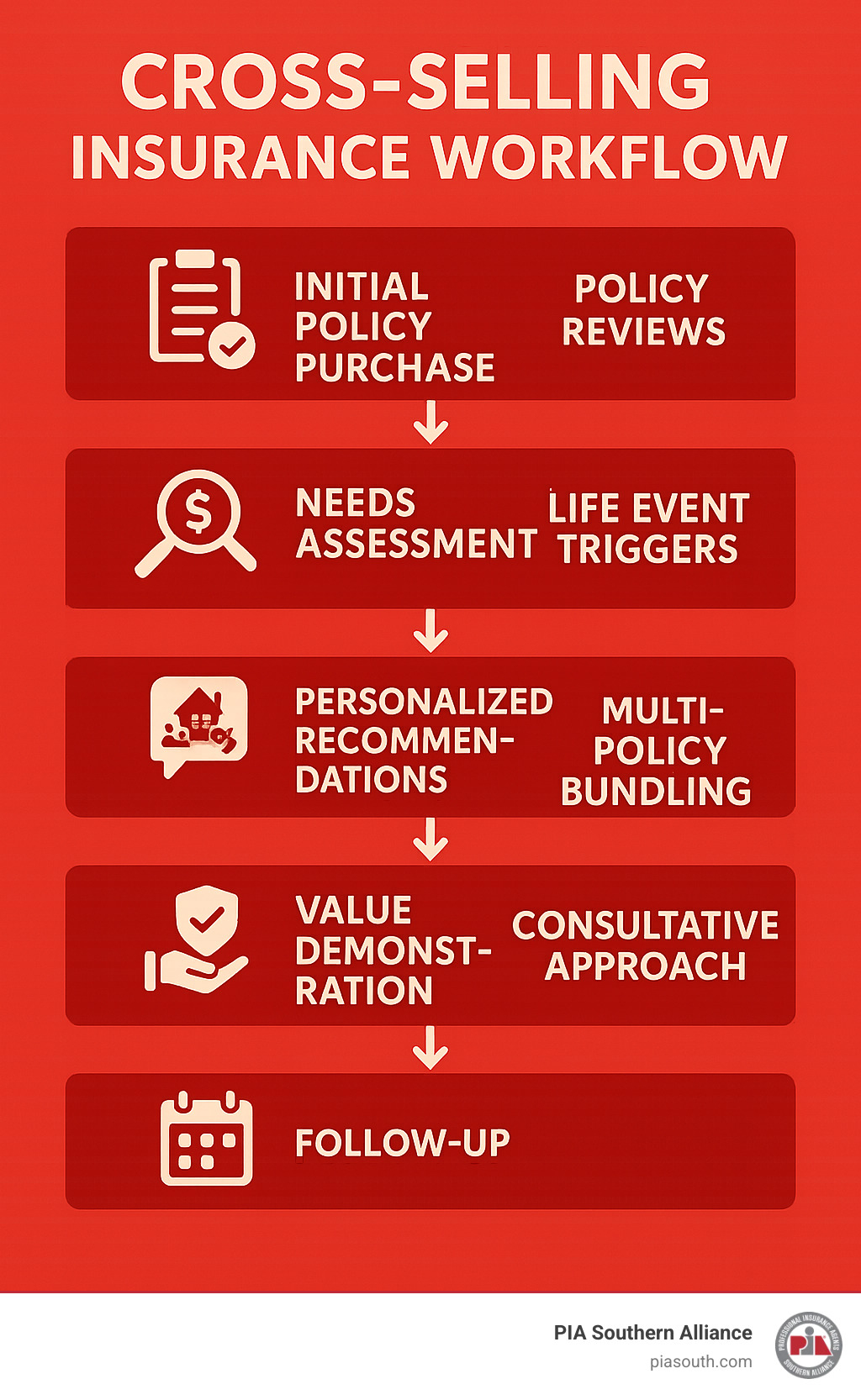
The most effective cross-selling approaches include conducting regular policy reviews to spot coverage gaps, leveraging life event triggers like home purchases or new businesses, using CRM data analysis for personalized recommendations, offering multi-policy bundling discounts, implementing comprehensive team training, and adopting a consultative approach that educates rather than pushes.
Here at PIA Southern Alliance, we’ve witnessed how implementing structured cross-selling systems transforms agency performance. Our members who consistently outperform their peers don’t just sell more policies—they create more satisfied, loyal clients who appreciate comprehensive protection custom to their unique needs.
The beauty of effective cross-selling is that it aligns perfectly with a customer-centric mindset. By understanding your clients’ evolving risks and protection needs, you position yourself as a trusted advisor rather than just another policy vendor. This approach is particularly valuable in today’s market, where clients face increasingly complex risks and appreciate guidance from professionals who see the big picture.
For independent agencies navigating the unique challenges of the Southeast region, implementing these proven cross selling insurance techniques has become less of an option and more of a necessity for sustainable growth. With the right approach, you’ll find yourself not just selling more policies, but building the kind of lasting client relationships that define successful agencies.
6 Cross Selling Insurance Techniques Every P&C Agent Must Master
Let’s face it—the difference between a good insurance agent and a great one often comes down to their ability to see the whole picture of a client’s protection needs. Before we jump into specific techniques, let’s clear up something that confuses even seasoned agents:
| Aspect | Cross-Selling | Upselling |
|---|---|---|
| Definition | Offering different types of insurance products | Encouraging upgrade within same product line |
| Example | Adding auto insurance for a homeowner | Increasing liability limits on existing auto policy |
| Primary Goal | Comprehensive protection | Improved coverage |
| Client Benefit | Multi-policy discounts, consolidated service | Better protection against specific risks |
| Agency Benefit | Increased policy density, improved retention | Higher premium per policy |
The most successful agents across Georgia, Alabama, and Mississippi have moved beyond random, opportunistic sales pitches. Instead, they’ve built systematic frameworks that make cross selling insurance techniques feel natural and helpful rather than pushy.
Cross Selling Insurance Techniques in Action
“I never directly ask if they want another policy,” shares a top-performing agent from Atlanta. “Instead, I say something like: ‘Do we handle your auto insurance as well? I’d love to make sure you’re getting all the discounts you deserve.’ This simple question gives me a 35% conversion rate on adding auto policies to existing homeowners.”
This approach works because it focuses on client benefits rather than agency goals. While average agencies maintain a modest 1.2 to 1.5 policies per customer, those with thoughtful cross-selling programs often achieve two or more—sometimes reaching three policies per customer in the most successful cases.
A Birmingham agent adds her personal touch: “I never end a client conversation without asking, ‘When was the last time someone looked at your life insurance needs?’ Even if they don’t purchase immediately, it plants the seed for future discussions and positions me as someone who thinks about their complete protection.”
Cross Selling Insurance Techniques Checklist
The agencies that excel at cross-selling don’t leave it to chance—they track specific metrics that matter:
Policy Density: The average number of policies per customer tells you how effectively you’re cross-selling overall. If this number isn’t growing quarterly, your program needs attention.
Cross-Sell Ratio: What percentage of your customers have multiple policy types? This reveals how well you’re covering their various protection needs.
Ask-to-Quote Ratio: How often do your cross-sell mentions convert to actual quotes? This measures the effectiveness of your conversation starters.
Quote-to-Bind Ratio: Once you provide a cross-sell quote, how often does it convert to a policy? This reflects both your pricing competitiveness and how well you’re matching solutions to needs.
Retention Improvement: Multi-policy customers typically stay longer. Tracking the reduced churn rate for these clients helps justify your cross-selling investments.
Smart agencies also know that incentives drive behavior. Some of the most effective motivators include commission boosts for successful cross-sales, recognition programs for staff who excel at spotting opportunities, reduced administrative duties for CSRs who generate quality cross-sell leads, and quarterly bonuses tied to agency-wide cross-sell metrics.
Effective cross selling insurance techniques require both strategic planning and genuine care for your clients’ complete protection needs. When done right, everyone wins—clients get better coverage and discounts, while your agency builds stronger, more profitable relationships.
Technique #1 – Map Opportunities Through Policy Reviews & Renewal Touchpoints
Let’s face it – policy renewal time isn’t just paperwork season. For savvy agents, it’s prime time to strengthen client relationships and uncover new opportunities. Using cross selling insurance techniques during these natural touchpoints feels genuine because you’re already discussing their coverage.

The numbers tell the story – clients who receive thoughtful renewal reviews are 42% less likely to shop around when renewal time comes. That makes these conversations dual-purpose: they’re both cross-selling goldmines and powerful retention tools.
A thriving agency in Mississippi recently shared their success story with us: “We made renewal reviews a non-negotiable part of our process last year. After 2,000+ reviews, we saw a 48% quote-to-sale conversion and kept 85% of clients from jumping ship to other carriers.” That’s the power of structured renewal touchpoints in action.
Timing matters here. The sweet spot for these reviews falls between 45-90 days before policy expiration. This window gives you enough breathing room to:
- Really understand what’s changed in their world
- Craft personalized recommendations that make sense
- Process any changes without the last-minute rush
- Address potential rate increases by showing added value options
Don’t forget to regularly audit your book of business (quarterly works well) to identify those “monoline” customers – folks with just one policy. These clients represent your highest-value cross-selling opportunities just waiting to be finded.
More info about client retention
Conversation Starters That Work
The magic isn’t just in having the conversation – it’s in how you start it. The most successful agents across Georgia, Alabama, and Mississippi use open-ended questions that naturally flow into deeper discussions:
“When was the last time we took a look at your umbrella coverage needs?” opens the door without pushing.
“Has anything changed in your life lately that might affect your insurance needs?” shows you care about their whole picture, not just their policies.
“Would you like me to run a quick quote to see what adding this coverage would cost monthly?” makes it easy for them to say yes to learning more.
When you hit resistance (and you sometimes will), the CENT approach works wonders: Concern, Example, Need, and Timing.
It might sound like this: “I completely understand being concerned about adding another expense right now (Concern). Just last month, we had a client in Birmingham whose home business wasn’t covered under their standard homeowner’s policy when they had a loss (Example). Having the right business coverage prevents these protection gaps (Need). The good news is we can add this protection before your next renewal cycle so you’re covered right away (Timing).”
This framework acknowledges their hesitation while gently guiding them toward understanding the value of comprehensive coverage. It’s not about the hard sell – it’s about helping them see blind spots in their protection plan.
Technique #2 – Harness Data, CRM, and Automation for Precision Targeting
Today’s successful insurance agents aren’t just relationship builders—they’re data wizards. The most profitable agencies across Georgia, Alabama, and Mississippi have finded that smart use of client data transforms random cross-selling into precision targeting.

“We were shooting in the dark before implementing our data strategy,” shares one agency owner from Montgomery. “Now our agents sell four times as many policies to customers with high propensity scores compared to those without.” This isn’t just luck—it’s the power of analytics at work.
The secret sauce of modern cross selling insurance techniques combines three key analytical approaches. First, propensity score modeling helps predict which clients are most likely to purchase additional coverage. Second, customer segmentation groups similar clients based on needs and behaviors. Finally, next-product analytics identifies exactly which policy each client needs next.
When implemented correctly, these data-driven approaches can boost conversion rates dramatically—reaching up to 70% compared to the 30-40% achieved through traditional methods. That’s nearly double the effectiveness without requiring additional staff!
Your CRM isn’t just for storing contact information—it’s your cross-selling powerhouse. Smart agencies program their systems to flag opportunities during routine interactions. When a client calls about their auto claim, your system should immediately notify your CSR that this client doesn’t have umbrella coverage yet.
Life events create natural windows for policy additions. A Birmingham agency recently automated triggers for five key life changes:
Home purchase creates an immediate need for homeowners coverage. Marriage often signals multi-car policy opportunities. When clients welcome a new child, life insurance becomes critically important. Starting a new business opens commercial coverage needs. And home renovations frequently require dwelling coverage adjustments.
By mapping these events to specific product needs and building automated follow-up sequences, you transform reactive service into proactive protection.
Using data and analytics
More info about digital marketing
Integrate Metrics & Dashboards
You can’t improve what you don’t measure. The agencies seeing the greatest cross-selling success in our region track specific metrics religiously.
Your ask rate reveals how consistently team members mention additional coverage options. The quote rate shows how often these mentions convert to formal quotes. And the bind rate tells you how many quotes actually become policies. Together, these numbers create a complete picture of your cross-selling effectiveness.
Looking at broader metrics matters too. Average premium per client reveals your overall relationship depth. Policy density growth tracks your progress in adding policies over time. Perhaps most importantly, your retention differential shows how much better multi-policy clients stick with you compared to single-policy holders.
“We increased our cross-sell success rate by 28% simply by putting these numbers on a dashboard everyone could see,” explains an agency owner from Jackson. “Something magical happens when the whole team can track progress daily.”
The best dashboards don’t just live on the agency principal’s computer—they’re visible to everyone. Morning huddles become more focused when the team can see exactly where opportunities exist and celebrate wins together.
When cross selling insurance techniques are powered by data and automation, what once felt like pushy selling transforms into helpful service. Clients appreciate receiving the right offer at the right time, and your bottom line reflects the precision of your approach.
Technique #3 – Personalize Bundles Around Customer Needs & Savings
When it comes to cross selling insurance techniques, policy bundling remains the gold standard—but there’s a world of difference between generic bundle offers and personalized recommendations that truly resonate with clients. The magic happens when you tailor bundles to address specific client needs while clearly communicating the tangible savings they’ll enjoy.
Did you know customers who bundle policies with the same carrier can save up to 25% on their overall premiums? That’s significant, but presenting this value in actual dollars rather than percentages makes it even more compelling.
“I never just tell clients they’ll save ‘up to 25%,'” shares one successful agent from Montgomery. “Instead, I show them they can save $437 annually by bundling home and auto policies. Then I break it down: ‘That’s about $36 back in your pocket every month.’ Suddenly, the decision becomes much easier for them.”
The most effective bundles aren’t one-size-fits-all. Homeowner + Auto might be the classic combination, but savvy agents across Georgia, Alabama, and Mississippi are finding success with targeted pairings like Auto + Renters for non-homeowners, Home + Umbrella for clients needing asset protection, Business Owner’s Policy + Commercial Auto for entrepreneurs, and Home + Flood coverage in vulnerable areas of Mississippi and Alabama.
What truly sets exceptional agents apart is their ability to connect these bundles to specific client situations. Rather than offering generic recommendations, they personalize their approach:
For new homeowners: “Congratulations on your new home! As a homeowner, you now have more assets to protect. Adding an umbrella policy to your bundle extends your liability coverage at minimal cost—especially important with a swimming pool in your backyard.”
For parents: “With young children and their friends frequently at your home, your liability exposure has increased significantly. Bundling an umbrella policy with your home and auto provides crucial additional protection at a surprisingly affordable rate.”
For business owners: “Many people don’t realize that their personal auto policy typically excludes business use. By bundling a commercial auto policy with your business coverage, you close this dangerous gap while saving money on both policies.”
claim bundling savings
More info about growth strategies
Educate, Don’t Push
The most successful cross-selling approaches focus on education rather than sales pressure. This consultative approach builds trust and positions you as an advisor rather than someone just trying to hit sales targets.
“I never tell clients they ‘should’ buy something,” explains a top-performing agent in Jackson. “Instead, I explain the risks they face, show how different policies work together to create a safety net, and let them make an informed decision. When people understand the ‘why’ behind the recommendation, they sell themselves.”
One common mistake is overwhelming clients with too many options or unnecessary features. Research shows nearly 60% of P&C customers carry unwanted policy features, creating dissatisfaction and increasing the likelihood they’ll shop around at renewal time. Focus on genuine needs rather than trying to sell every possible coverage.
Value storytelling has proven particularly effective when discussing bundle options. Sharing real examples of how proper coverage helped similar clients helps prospects visualize the protection in action. One agent with a remarkable 72% cross-sell success rate explains: “When I share stories about actual claims situations—like the client whose umbrella policy covered them when they were sued after a car accident—prospects can immediately see how the coverage would protect them in similar circumstances.”
The beauty of this educational approach is that it transforms the conversation from “selling insurance” to “solving problems.” Clients appreciate the difference, and your cross-selling results will reflect it.
Technique #4 – Train & Motivate the Whole Team (Including Non-Licensed CSRs)
Successful cross selling insurance techniques aren’t just for your sales superstars—they work best when everyone in your agency participates, including customer service representatives who don’t hold insurance licenses.

“Our CSRs are our secret weapon,” confides an agency owner from Savannah with a smile. “They chat with clients way more often than our producers do, catching opportunities that might otherwise slip through the cracks.”
Even without licenses, your CSRs can become cross-selling champions. They excel at gathering updated client information through fact-finding forms, asking simple qualifying questions that reveal needs, flagging promising opportunities for licensed team members, and scheduling those all-important follow-up appointments.
I recently visited an agency in Montgomery where CSRs use a simple form during routine service calls with questions like: “Has your family situation changed lately?” or “Do you own any boats or RVs we should know about?” These casual conversations uncover valuable cross-selling opportunities that licensed agents can then pursue. The system works beautifully because it feels natural and helpful rather than pushy.
Building new habits takes repetition—about 22 times for adults to reliably incorporate new behavior. That’s why consistent training and reinforcement matter so much. Your team needs regular practice with these conversations until they become second nature.
Within the compliance boundaries of your state, make sure everyone understands their role. Non-licensed staff should never provide specific coverage advice, but they can absolutely help identify needs and connect clients with the right licensed professional.
More info about agency best practices
Building a Cross-Sell Culture
Creating a true cross-selling culture goes beyond occasional training—it requires weaving these practices into your agency’s daily fabric.
Daily huddles make a tremendous difference. A quick 10-minute morning meeting to highlight cross-sell opportunities and celebrate recent wins keeps everyone focused and motivated. One agency in Jackson starts each day by recognizing yesterday’s cross-selling champion with a small trophy that moves around the office.
Clear responsibilities between producers and CSRs prevent confusion and ensure accountability. Your CSRs might excel at identifying opportunities while your producers shine at closing them—when everyone knows their lane, the system runs smoothly.
Smart incentive structures reward the entire team, not just producers. An agency in Atlanta gives quarterly bonuses to CSRs based on qualified leads generated, regardless of whether those leads convert. This acknowledges their crucial role in the cross-selling pipeline.
“We’ve found that non-monetary incentives work just as well as commission increases,” shares an agency principal from Birmingham. “Public recognition, reduced phone time, and professional development opportunities all motivate our team to participate enthusiastically.”
Role-playing sessions help staff become comfortable with cross-selling conversations. When your team practices handling common objections in a safe environment, they build confidence that translates directly to client interactions.
One multi-line agency implemented these elements in a six-month program and achieved remarkable results: 100% account round success for commercial lines and 87% success overall. The key was making cross-selling a team sport where everyone contributed and everyone benefited.
At PIA Southern Alliance, we’ve seen how agencies that involve their entire team in cross-selling consistently outperform those that leave it to producers alone. When everyone from the receptionist to the agency principal speaks the same language about protecting clients comprehensively, magic happens—both for your clients and your bottom line.
Technique #5 – Stay Compliant & Ethical While Maximizing Trust
Let’s face it – the line between helpful cross-selling and pushy sales tactics can sometimes feel blurry. But here’s the good news: when done right, ethical cross-selling actually builds deeper client relationships while keeping you safely within regulatory boundaries.
For independent agents across Georgia, Alabama, and Mississippi, understanding your state-specific regulations isn’t just about avoiding penalties – it’s about building a foundation of trust that pays dividends for years to come.
Each of our tri-state regions has particular requirements you’ll want to keep in mind. Georgia’s Insurance Code (O.C.G.A. § 33-6-4) specifically prohibits misrepresenting policy benefits during your cross-selling conversations. Over in Alabama, their Insurance Trade Practices Law (Ala. Code § 27-12-1) takes a firm stance against “twisting” – those misleading comparisons that push clients to replace perfectly good existing coverage.
“I’ve found that honest, transparent cross-selling not only keeps us compliant but actually increases our success rate,” shares a veteran agent from Atlanta. “We document every cross-selling conversation in our CRM, including when clients decline additional coverage. This protects both the client and our agency if questions arise later.”
Your documentation should always include:
– Thorough needs assessments
– Specific recommendations and your reasoning
– Client decisions (whether yes or no)
– All disclosures you’ve provided
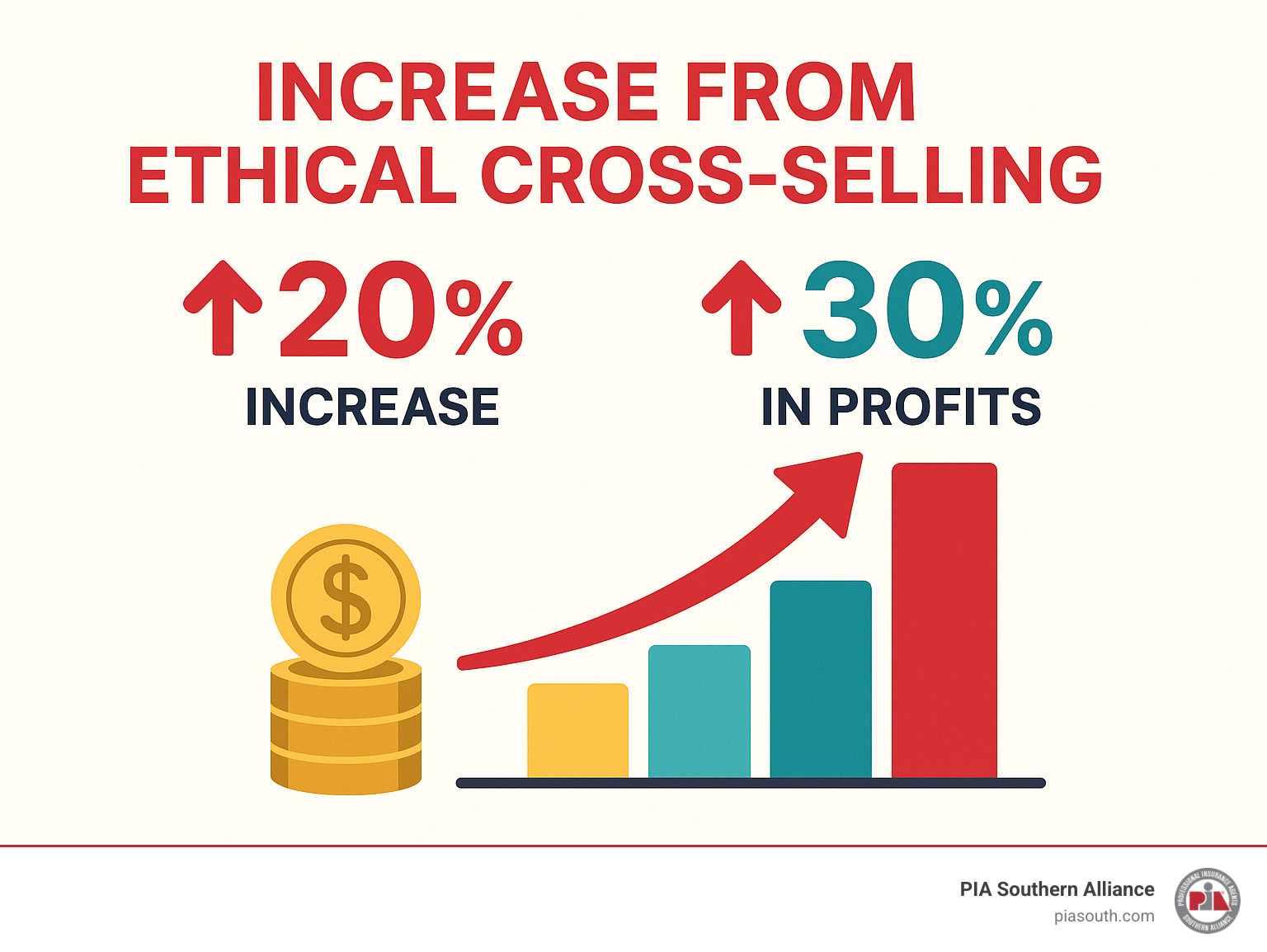
The payoff for doing things the right way is substantial. Research reveals that ethical cross-selling approaches can boost sales by 20% and increase profits by a remarkable 30% – but only when clients genuinely believe your recommendations have their best interests at heart.
Avoid Common Pitfalls
Even the most well-intentioned agents can stumble into cross-selling traps. A Mississippi agent with over twenty years of experience put it perfectly: “The moment you focus more on your commission than your client’s needs is the moment you’ve lost what makes this profession worthwhile.”
The biggest pitfalls to watch for? Overselling coverage beyond what clients actually need not only erodes trust but might violate suitability requirements. Misrepresentation – those little exaggerations about benefits or downplaying of limitations – can come back to haunt you when claim time arrives. Feature overload overwhelms clients with too many options, while pressure tactics might get the sale today but cost you the relationship tomorrow.
Instead, accept what one particularly successful Georgia agent calls the “Three R’s of Ethical Cross-Selling”:
Relevant: Every recommendation should directly address an actual client need or gap in coverage. When a client sees you’ve truly understood their situation, they’re far more receptive.
Reasonable: Both coverage amounts and premiums should make sense for the client’s specific situation. A young family in Alabama might need different protection than a retiree in Mississippi.
Respectful: Honor client decisions, even when they decline. One Birmingham agent notes, “Sometimes the seed you plant today grows into a policy next year. Respect builds the relationship that makes that possible.”
The bottom line? When clients feel you’re genuinely looking out for their best interests rather than just your commission, they’re not only more likely to consider additional coverage – they become your most powerful marketing force through referrals. As one agent with a remarkable 68% cross-sell acceptance rate puts it: “Trust isn’t just about feeling good – it’s the most profitable business strategy I’ve ever found.”
Frequently Asked Questions about Cross-Selling Insurance
How is cross-selling different from upselling?
While both strategies aim to increase client value, they serve different purposes in your insurance toolkit. Cross-selling means offering your homeowner client an auto policy or umbrella coverage – essentially, a different type of insurance product. Upselling, on the other hand, is encouraging your client to improve their existing coverage – like bumping up those liability limits on their current auto policy.
The real magic happens when you focus on cross-selling to boost policy density – that crucial number of policies each client maintains with your agency. Our Georgia agencies consistently report that clients with three or more policies are nearly 80% less likely to leave compared to single-policy clients. It’s not just about more commission; it’s about creating “stickier” client relationships that withstand competitive pressures.
What role do life events play in cross-selling P&C policies?
Life events create perfect cross-selling moments because they naturally shift your clients’ insurance needs. Think of these transitions as open doors to meaningful conversations about protection.
When your client buys their first home in suburban Atlanta, that’s your cue to discuss not just homeowners coverage, but also flood protection and umbrella policies. A marriage might prompt combining auto policies while updating homeowners coverage. That new baby? Now’s when parents are most receptive to umbrella coverage conversations.
“When you reach out during these transition moments, clients see it as helpful service rather than selling,” explains one of our top-performing Alabama agents. “I keep a calendar alert for client life events, and these touchpoints have become my most productive cross-selling opportunities.”
Home renovations, new business ventures, and retirement all create similar openings. The key is having systems to track these events and respond with timely, relevant conversations about expanded protection – not just product pitches.
Which KPIs prove a cross-selling program is working?
Measuring cross-selling success means tracking more than just new policy counts. The metrics that truly reveal program effectiveness include:
Policy Density should steadily climb as your program matures. While average agencies hover around 1.2-1.5 policies per customer, our top-performing Mississippi agencies achieve 2-3 policies per client through systematic cross-selling.
Retention Rate tells the real story. Multi-policy clients typically maintain 95% retention versus 85% for single-policy relationships. This 10-point differential directly impacts your agency’s stability and valuation.
Premium Per Customer should increase as clients add policies. Smart agencies track both average and median values to spot potential improvement areas.
Cross-Sell Conversion Rate breaks down into meaningful sub-metrics: your ask-to-quote ratio reveals how effectively you’re starting conversations, while your quote-to-bind percentage shows how well you’re closing them.
Customer Lifetime Value is where everything comes together – this comprehensive metric captures the long-term financial impact by factoring in retention improvements, premium increases, and servicing efficiencies.
“We saw our average policy density increase from 1.4 to 2.1 within 18 months of implementing our structured cross-selling program,” shares an agency owner from Columbus. “More importantly, our retention rate improved by 7 percentage points, dramatically increasing the lifetime value of our client relationships.”
When these numbers move in the right direction, you’re not just selling more policies – you’re building a more resilient, profitable agency that better serves your clients’ complete protection needs.
Conclusion
Mastering cross selling insurance techniques isn’t just a nice-to-have skill anymore—it’s become essential for independent P&C agencies across Georgia, Alabama, and Mississippi who want to thrive in today’s challenging market. Throughout this article, we’ve explored six powerful techniques that create a framework for systematic cross-selling that benefits everyone involved:
- Leveraging policy reviews and renewal touchpoints to naturally find opportunities
- Using data and automation to precisely target the right offers at the right time
- Personalizing bundles around actual customer needs and meaningful savings
- Training and motivating your entire team to participate in the cross-selling process
- Maintaining compliance while building the trust that sustains long-term relationships
- Measuring results and continuously refining your approach
Successful cross-selling isn’t about pushing products your clients don’t need. It’s about becoming a trusted advisor who provides comprehensive protection that addresses their evolving life situations. When done with genuine care and attention, cross-selling strengthens client relationships, dramatically improves retention rates, and significantly boosts your agency’s bottom line.
At PIA Southern Alliance, we’re passionate about helping independent agencies throughout our three-state region develop and refine their cross-selling capabilities. Our practical webinars, hands-on training programs, and specialized resources provide the guidance you need to implement these techniques in your agency—no matter your size or current capabilities.
Cross-selling is both an art and a science. The art lies in the conversation—asking thoughtful questions, truly listening to your clients, and presenting solutions that genuinely resonate with their specific situations. The science comes from implementing systematic processes, analyzing the right data, and continuously measuring what’s working.
By bringing together both elements, you can transform cross-selling from an occasional, opportunistic interaction into a consistent driver of agency growth and client satisfaction. Your clients get better protection, and your agency builds more resilient, profitable relationships. That’s the power of mastering these cross selling insurance techniques.