
Securing Your Clients’ Legacy: The Premium Financing Advantage
Life insurance premium finance loans are specialized lending arrangements that allow high-net-worth individuals to borrow funds from a third-party lender to pay large life insurance premiums without liquidating existing investments.
What Are Life Insurance Premium Finance Loans?
| Feature | Description |
|---|---|
| Definition | A loan from a third-party lender used specifically to pay life insurance premiums |
| Typical Client | High-net-worth individuals ($5M+ net worth, ages 29-75) |
| Common Structure | Interest-only loans with 80-90% loan-to-value against policy cash value |
| Primary Benefits | Preserves capital, minimizes gift taxes, maintains investment growth |
| Key Risks | Interest rate fluctuations, collateral requirements, policy performance |
When your wealthy clients face the prospect of paying substantial life insurance premiums, they often confront a difficult choice: liquidate profitable investments or divert significant cash flow. Premium financing offers a strategic alternative that preserves their capital while securing the coverage they need.
Premium financing works similarly to other leveraged strategies your clients might already use, such as mortgages or business loans. Rather than paying the full premium upfront, they borrow the funds, typically making interest-only payments while keeping their capital deployed in potentially higher-yielding investments.
For property and casualty agents in Georgia, Alabama, and Mississippi looking to expand their service offerings, understanding premium financing creates valuable cross-selling opportunities with your existing commercial clients. Business owners particularly benefit from this strategy for key-person coverage, succession planning, and buy-sell funding needs.
As a trusted advisor from PIA Southern Alliance with extensive experience helping independent agents steer complex financial strategies including life insurance premium finance loans, we’ve created this comprehensive guide to help you confidently discuss this sophisticated planning tool with your high-net-worth clients.
Know your life insurance premium finance loans terms:
– can an insurance agency finance a premium
– insurance premium funding interest rates
– insurance premium funding loan
Understanding Life Insurance Premium Finance Loans
What Are Life Insurance Premium Finance Loans?
When your high-net-worth clients need substantial life insurance coverage, life insurance premium finance loans offer a smart alternative to liquidating valuable assets. At their heart, these loans are strategic arrangements where a specialized lender provides the capital to pay premiums on a large life insurance policy, allowing your clients to keep their investments working for them.
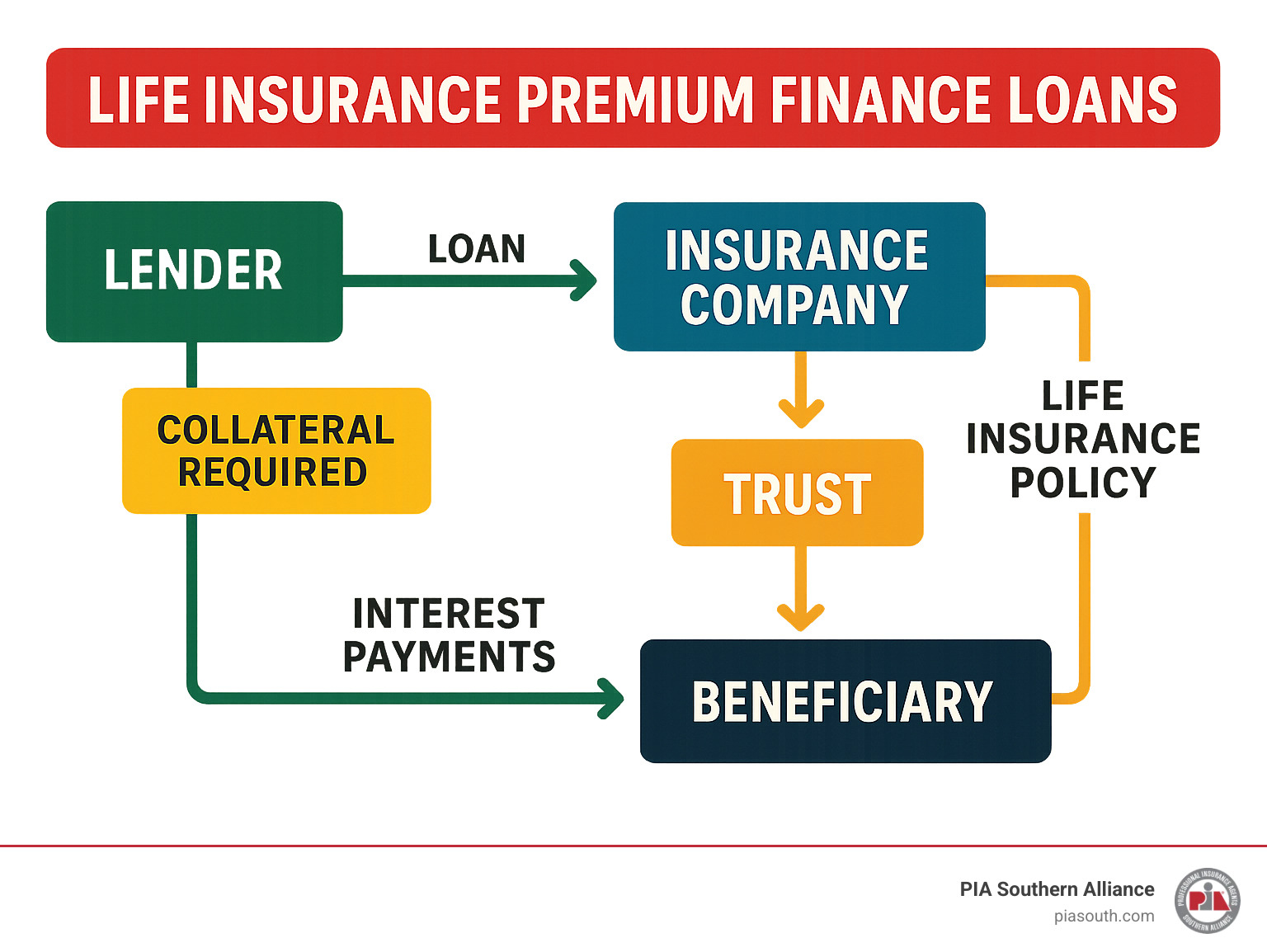
Think of premium financing as a sophisticated leverage tool – similar to how your commercial clients might use business loans to expand rather than depleting their operating capital. The arrangement typically involves an irrevocable life insurance trust (ILIT) serving as both the borrower and policy owner, which creates significant estate planning advantages by keeping the death benefit outside the insured’s taxable estate.
“Premium financing lets wealthy individuals maintain their investment strategies while securing the coverage they need,” explains one Georgia-based advisor. “It’s particularly valuable for business owners and high-net-worth families with complex estate planning needs.”
How Do Life Insurance Premium Finance Loans Work?
The premium financing cycle follows a straightforward path that your clients can easily understand:
First, your client establishes an irrevocable trust to own the policy. After qualifying for a substantial life insurance policy (typically $5M+), a third-party lender provides funds to the trust to cover the annual premiums. Your client then makes interest-only payments on the loan – or in some cases, the interest accrues within the arrangement.
The policy’s growing cash value serves as primary collateral, with additional assets sometimes required, especially in the early years. When the loan matures or upon the insured’s death, the loan gets repaid either from policy proceeds or other assets.
Consider Robert, a 45-year-old business owner in Alabama with two children. Rather than disrupting his investment portfolio, he financed a $5 million indexed universal life policy with annual premiums of $325,000 for 7 years. His annual interest payments started at just $13,000 in year one (though rising to $112,840 by year 14). This approach preserved his business capital while securing substantial coverage for his family’s future.
Most private banks allow borrowing between 80% and 90% of the policy’s day-one cash surrender value, making this strategy accessible for qualified clients with sufficient net worth.

Common Misconceptions About Life Insurance Premium Finance Loans
Despite growing popularity among affluent clients in Georgia, Alabama, and Mississippi, several misconceptions about life insurance premium finance loans persist:
Misconception #1: “It’s free insurance”
The reality? As one Mississippi advisor puts it with a chuckle, “Nothing in life is free – especially life insurance.” Premium financing carries costs including loan interest, collateral requirements, and ongoing administration. While it’s often more cost-effective than liquidating appreciating assets, it’s certainly not free.
Misconception #2: “Non-recourse loans eliminate all risk”
Non-recourse loans might limit personal liability, but they typically include substantial upfront fees and may not be carrier-endorsed. They can also create potential tax complications and often hide costs in other areas of the arrangement.
Misconception #3: “Interest rates will stay low forever”
Interest rate fluctuations represent one of the most significant risks in premium financing. With today’s shifting financial landscape, prudent planning requires stress-testing for rising rates and securing appropriate rate caps or fixed-rate options whenever possible.
Misconception #4: “The policy performance will always cover loan costs”
Policy crediting rates fluctuate with market conditions, potentially creating situations where loan costs exceed policy returns. This makes proper stress-testing essential before recommending this strategy to your clients.
For property and casualty agents looking to expand their service offerings, understanding life insurance premium finance loans creates valuable cross-selling opportunities with existing commercial clients who might benefit from this sophisticated planning approach. Visit our Insurance Premium Financing page to learn more about how PIA Southern Alliance can support your knowledge in this area.
Benefits vs. Risks: Is Premium Financing Right for You?
When considering life insurance premium finance loans for your clients, weigh both the potential upsides and downsides. This strategy isn’t a one-size-fits-all solution, but for the right client, it can be transformative.
Key Benefits You Can Leverage
Capital preservation is arguably the most compelling advantage of premium financing. Your high-net-worth clients can maintain their existing investment strategies without having to liquidate assets that may be performing well. As one Georgia-based financial advisor puts it, “Think of it as keeping your money working in two places at once.”
This approach prevents triggering unnecessary capital gains taxes while allowing continued growth in your client’s portfolio. For business owners across Alabama, Mississippi, and Georgia, this can be particularly valuable when business capital needs to stay working within the company.
The tax efficiency of properly structured premium financing arrangements is remarkable. When set up through an irrevocable trust, death benefits can pass both income and estate-tax-free to beneficiaries. Plus, only the interest payments—not the full premium amounts—may need to be gifted to the trust, preserving valuable lifetime gift tax exemptions.
Premium financing also creates leveraged returns similar to how a mortgage leverages home ownership. A client might only need to commit $200,000 to secure a $1 million premium, potentially multiplying their effective return compared to using cash alone. This financial leverage can be particularly powerful for wealth transfer strategies.
For family business owners in our tri-state region, premium financing offers valuable business continuity and succession planning tools. These arrangements can fund buy-sell agreements without disrupting company cash flow or forcing the premature sale of business assets—keeping family legacies intact across generations.
Major Risks You Must Monitor

Interest rate volatility represents perhaps the most significant challenge with premium financing. Most loans are structured with variable rates tied to benchmarks like SOFR (which replaced LIBOR), typically with a spread around 180 basis points. When rates climb substantially—as we’ve seen recently—financing costs can potentially exceed policy returns, creating a negative spread.
Your clients must also be comfortable with collateral requirements. Lenders require full collateralization of these loans, often meaning additional assets beyond just the policy’s cash value must be pledged, especially in early years. Market downturns can trigger collateral calls, requiring clients to post additional assets—sometimes at the most inconvenient times.
Policy performance risk is another factor that shouldn’t be overlooked. If the insurance policy underperforms projections, cash values may prove insufficient to support the loan or exit strategy. This concern is especially relevant with indexed and variable products where returns fluctuate with market conditions.
Insurance company stability matters too. Carrier credit rating risk can trigger loan covenants if downgrades occur, potentially forcing refinancing or requiring additional collateral. Most lenders require carriers maintain at least an “A” rating from major rating agencies to protect their interests.
Finally, there’s loan renewal uncertainty. As one Mississippi premium financing specialist cautions, “There’s no guarantee the lender will renew the loan indefinitely, so clients should never assume perpetual financing.” Having clear contingency plans for loan maturity dates is essential for long-term success.
Ideal Candidate Checklist
Life insurance premium finance loans typically work best for clients who fit a specific profile. The ideal candidate generally has:
✓ Net worth of $5 million or greater
✓ Age between 29-75 (though arrangements for those up to age 70 are more common)
✓ Comfort with sophisticated financial leverage strategies
✓ Strong health profile qualifying for preferred insurance rates
✓ Sufficient liquid assets available as collateral
✓ Clear exit strategy beyond simply relying on death benefit
✓ A coordinated team of advisors including a financial planner, attorney, and CPA
In our experience working with property and casualty agents throughout Georgia, Alabama, and Mississippi, clients who are business owners often make excellent candidates for premium financing. They understand leverage, appreciate tax efficiency, and recognize the value of preserving working capital.
While premium financing may seem complex at first, with proper education and support from organizations like PIA Southern Alliance, you can confidently guide your clients through these sophisticated strategies, expanding your service offerings beyond traditional property and casualty solutions.
For more detailed information about how premium financing can benefit high-net-worth clients, explore Premium Financing for High-net Worth Clients and What is Life Insurance Premium Financing?
Loan Mechanics: Collateral, Interest Rates, and Structures
Let’s explore the nuts and bolts of premium finance loans – these aren’t your everyday loans, and understanding how they work can make all the difference for your high-net-worth clients.
Collateral Management 101
Think of collateral as the safety net that makes lenders comfortable with these arrangements. When your client first sets up a life insurance premium finance loan, the policy’s cash surrender value only covers part of what’s needed.
“Most clients are surprised to learn they’ll need additional assets as collateral, especially in those early years,” says one of our premium finance specialists at PIA Southern Alliance.
The most client-friendly collateral options include cash and cash equivalents, which lenders value at 100%. Marketable securities work too, though lenders typically discount their value by 20-50% depending on volatility. Letters of credit are excellent options (valued at 100%), but they come with their own costs. Real estate is accepted but with significant “haircuts” – usually 30-50% of appraised value.
Most premium finance arrangements require full collateralization, meaning your client’s pledged assets must equal or exceed what they’ve borrowed. Lenders review this annually, and any shortfalls need prompt attention to avoid default.
One practical tip we share with agents across Georgia, Alabama, and Mississippi: advise clients to pledge liquid investments rather than property holdings when possible. This gives them flexibility if markets take a sudden downturn.

Interest Rate Structures and How They Impact Cost
Interest rates can make or break a premium financing strategy. Most commonly, your clients will encounter variable rate loans that adjust based on market conditions:
In the past, these were typically based on LIBOR plus a margin. Today, with LIBOR phased out, the Secured Overnight Financing Rate (SOFR) has become the standard benchmark. Most lenders add approximately 180 basis points to this rate. For example, if SOFR sits at 2.5%, your client might pay around 4.3%.
Fixed-rate options exist too, though they’re less common. While they provide payment certainty, they typically start higher than variable rates and may include prepayment penalties. They’re usually available for shorter terms of 3-5 years.
“Always run a stress test with your clients,” we recommend to our P&C agents looking to expand into this area. “Show them what happens if interest rates jump 2-3 percentage points. If that scenario breaks the strategy, it might not be right for them.”
Rate caps can provide protection against dramatic increases, though they add to the overall cost. For many clients in our southeastern states, this added security is worth the premium.
Exit Strategies to Repay the Loan
Every life insurance premium finance loan needs a clear exit path. Think of this as your client’s “get-out plan” – because relying solely on mortality isn’t a strategy, it’s a gamble.
The simplest exit happens at death, where the outstanding loan is subtracted from the death benefit, with beneficiaries receiving the remainder tax-free. But responsible planning requires living exit strategies too.
As policy cash values grow, they may eventually exceed the loan balance, allowing for partial withdrawals or policy loans to repay the financing. Some sophisticated clients in Georgia and Alabama use Grantor-Retained Annuity Trusts (GRATs) to transfer policies with minimal gift tax impact, then use personal funds for repayment.
Business owners – who make up a substantial portion of premium finance clients – often align their exit with planned liquidity events like business sales or partnership buyouts.
“Mark your calendar six months before loan maturity if refinancing is the plan,” we tell our agents. “This gives your client adequate runway to secure favorable terms or pivot to Plan B if needed.”
Understanding these mechanics isn’t just academic – it’s essential for property and casualty agents looking to have meaningful conversations with high-net-worth clients about comprehensive risk management that extends beyond traditional P&C coverages.
For more detailed information on current financing options, visit our resource on Insurance Premium Funding Interest Rates or learn more about the risks and rewards at Life Insurance Premium Financing: Worth the Risk?.
Strategic Applications & Compliance Considerations
Estate & Tax Planning Value
Premium financing shines brightest when used as part of a comprehensive estate plan. When your high-net-worth clients establish an irrevocable life insurance trust (ILIT) to own the policy and serve as the borrower, they open up a treasure chest of planning opportunities.
The death benefit stays outside their taxable estate—a huge win for families concerned about estate taxes. Rather than gifting the full premium amount to the trust each year (which could quickly exhaust lifetime gift tax exemptions), clients need only gift the interest payments. This preserves their gifting capacity for other planning needs.
“Life insurance proceeds can fund estate taxes and prevent liquidity crises for executors,” as one seasoned advisor puts it. This practical benefit resonates strongly with property owners across Georgia, Alabama, and Mississippi, where family farms, commercial real estate holdings, and closely-held businesses might otherwise face fire-sale liquidation to cover estate taxes.
For your clients with significant assets tied up in real estate or business interests, premium financing creates breathing room. The step-up in basis for appreciated assets remains intact, as these assets don’t need to be sold to fund premiums. Instead, the death benefit provides tax-free liquidity precisely when heirs need it most.
Business & Key-Person Use Cases
For your commercial property clients across the Southeast, premium financing offers neat solutions to thorny business continuity challenges.
Key-Person Coverage: When a Georgia manufacturing company depends heavily on its founder or star engineer, their unexpected death could threaten everything. Premium financing allows the business to secure substantial coverage without diverting precious cash flow from operations or growth initiatives.
Buy-Sell Funding: Partners in Alabama and Mississippi businesses can use premium-financed policies to fund cross-purchase or entity-purchase agreements. This ensures smooth ownership transitions without creating liquidity crises when a partner dies or becomes disabled.
One business owner in Savannah explained it perfectly: “We needed $10 million in coverage for our buy-sell agreement, but writing those premium checks would have crippled our expansion plans. Premium financing let us secure the coverage while keeping our growth capital working.”
Premium financing also works beautifully for executive benefits programs. Companies can implement tax-advantaged compensation strategies using company-owned life insurance (COLI) that provides tax-deferred cash accumulation and tax-free death benefits.
Regulatory & Legal Framework
As with any sophisticated financial strategy, premium financing comes with important legal and regulatory guardrails that vary by state. Understanding these considerations is crucial for proper implementation.
The insurable interest doctrine forms the foundation of all legitimate life insurance arrangements. This principle, rooted in English common law, requires that policy owners have a genuine financial or emotional stake in the insured’s continued life at policy inception.
“English courts first intervened when unrelated individuals essentially gambled on a sea captain’s life,” explains one legal historian. This doctrine remains alive and well in Georgia, Alabama, and Mississippi today, preventing speculative policies that amount to wagers on human lives.
Disclosure requirements add another layer of compliance. Lenders and insurance carriers must provide specific disclosures about premium financing arrangements to ensure all parties understand the transaction’s nature, costs, and risks. These disclosures help protect consumers and maintain the integrity of the insurance marketplace.
State-specific regulations can significantly impact premium financing arrangements. Working with legal counsel familiar with the insurance laws of Georgia, Alabama, or Mississippi is essential for compliance. As one premium finance specialist advises, “Always have an experienced attorney review all transaction documentation before signing.”
For property and casualty agents looking to expand their advisory capabilities, PIA Southern Alliance offers educational resources to help you steer these complex waters. Our custom programs help you identify cross-selling opportunities while ensuring regulatory compliance in the states we serve.
Step-by-Step Application Process & Best Practices

9 Steps to Secure a Premium Finance Loan
Navigating the premium financing journey doesn’t have to be overwhelming. Think of it as a well-choreographed dance between client needs, insurance design, and lending requirements. Let me walk you through what this looks like in practice.
It all begins with a thorough pre-qualification assessment. Here, you’ll evaluate your client’s financial situation—their net worth (ideally $5M+), income streams, and liquid assets. This is also when you’ll confirm they meet age requirements (typically 29-75) and have the health profile necessary for favorable insurance rates.
“The pre-qualification stage is where we separate serious candidates from those who might be better served with traditional insurance funding,” explains one premium finance specialist. “It saves everyone time and prevents disappointment down the road.”
Once pre-qualified, we move to policy design and selection. This isn’t just about picking any life insurance policy. You’ll want products specifically structured for premium financing—usually indexed universal life or whole life policies from carriers with strong financial ratings (A or better). Many successful arrangements include high early cash value riders to satisfy collateral requirements sooner.
The underwriting and medical evaluation follows the standard life insurance process but with heightened scrutiny. Your clients should expect a comprehensive medical exam and detailed financial verification. During this phase, you’ll receive preliminary offers, then final approved rates, allowing you to review realistic policy illustrations under various scenarios.
Lender selection is where your expertise as an advisor really shines. You’ll help clients compare terms from traditional banks versus specialized premium finance companies. Look beyond just the interest rate—evaluate collateral requirements, loan terms, and the lender’s experience with premium financing. Georgia, Alabama, and Mississippi agents should seek lenders familiar with regional business and estate planning needs.
Next comes trust establishment—typically an irrevocable life insurance trust (ILIT) created with a qualified attorney. The trust becomes the policy owner and borrower, providing essential estate tax benefits. Selecting the right trustee is crucial; many clients benefit from an independent professional rather than a family member.
Collateral planning often creates the most anxiety for clients. Help them identify which assets will serve as initial and ongoing collateral. This might include cash equivalents, marketable securities, or letters of credit. Document values carefully and prepare the necessary collateral assignment agreements.
The document execution stage brings everything together. Your client will review and sign insurance applications, loan agreements, collateral assignments, and trust documentation. This is where attention to detail matters most—a small oversight could create complications later.
Once all paperwork is complete, policy and loan funding occurs. The lender funds the initial premium payment, you confirm the policy is in force, and establish the interest payment schedule. Make sure your client understands exactly what payments they’re responsible for and when.
Finally, there’s ongoing management and monitoring—perhaps the most underappreciated step. Premium financing isn’t a “set it and forget it” strategy. Annual reviews of policy performance, collateral values, and interest rates are essential. As one advisor notes, “The annual review is where we catch small issues before they become big problems.”
Top Mistakes Agents & Clients Make
In my years working with property and casualty agents expanding into premium financing, I’ve seen several recurring pitfalls. Being aware of these can save you and your clients significant headaches.
Inadequate stress-testing tops the list. Many illustrations show only favorable scenarios with stable interest rates and consistent policy returns. Reality is messier. Insist on modeling various interest rate environments, policy performance outcomes, and collateral value fluctuations. Your clients will thank you when market conditions change.
Another major mistake is relying solely on death benefit as the exit strategy. While death will ultimately trigger the payment, clients need contingency plans for loan repayment during their lifetime. What happens if the arrangement becomes unfavorable due to rising interest rates or poor policy performance? Exit strategies might include policy loans, partial surrenders, or outside funds.
Many clients also underestimate collateral requirements, especially how they might change over time. Initial collateral needs can be substantial and may increase if interest rates rise or policy performance lags. Ensure your clients maintain sufficient liquid assets to meet potential collateral calls, particularly in the early years before cash values build.
I’ve also seen arrangements fall apart due to ignoring carrier financial strength. Insurance company downgrades can trigger loan covenants, potentially forcing refinancing at inopportune times. Select carriers with strong financial ratings and a history of stability through economic cycles.
Finally, many advisors make the mistake of overlooking exit strategy timing. “The best time to implement your exit strategy is rarely the last possible moment,” explains one premium finance expert. “Being proactive rather than reactive gives you negotiating leverage and prevents rushed decisions.”
For property and casualty agents across Georgia, Alabama, and Mississippi looking to discuss premium financing with commercial clients, understanding these pitfalls is essential. Your existing relationships with business owners give you a unique opportunity to introduce this sophisticated planning tool, but only if you can guide them safely through the process.
PIA Southern Alliance offers resources specifically designed to help independent agents expand their expertise in areas like premium financing. The right knowledge transforms this complex strategy into a powerful tool for strengthening client relationships and expanding your practice.
Frequently Asked Questions about Life Insurance Premium Finance Loans
What happens if the borrower dies before the loan is repaid?
Death is never an easy topic to discuss with clients, but it’s an essential part of the premium financing conversation. When someone with a premium-financed policy passes away, the process works quite smoothly:
The death benefit from the life insurance policy first goes toward settling the outstanding loan balance, including any interest that’s accumulated. After that’s taken care of, the remaining funds pass to the beneficiaries (typically the trust beneficiaries) completely tax-free.
As one of our premium finance specialists often tells property and casualty agents in Georgia, Alabama, and Mississippi: “Think of it as simple math – only the outstanding loan balance is subtracted from the death benefit, and everything else passes to the trust beneficiaries without tax consequences.”
This straightforward settlement happens relatively quickly since all the groundwork has already been laid through proper collateral assignments and loan agreements between the insurance carrier and lender.
How do rising interest rates affect an existing loan?
Interest rate fluctuations keep everyone in the financial world on their toes, and premium financing arrangements are no exception. When rates climb, several important shifts happen:
Your clients will face higher interest payments if they’re paying annually, which could strain their cash flow. They might also encounter increased collateral requirements as their projected loan balance grows faster than originally planned. Perhaps most concerning is the potential for negative arbitrage – that uncomfortable situation where loan interest rates exceed what the policy is earning.
Fortunately, there are ways to protect against these risks. Many savvy advisors recommend negotiating interest rate caps that put a ceiling on how high rates can climb. Fixed-rate options are available too, though they typically start at higher rates. Some clients choose to refinance with different lenders offering better terms, while others tap into policy cash values to reduce the principal.
“I always tell my commercial property clients in Mississippi to consider rate caps from day one,” shared one advisor who partners with PIA Southern Alliance. “It’s like insurance for your insurance financing – a little extra cost upfront for significant protection down the road.”
Can I refinance my life insurance premium finance loan?
Absolutely! Refinancing premium finance loans isn’t just possible – it’s a common strategy for optimizing these arrangements over time.
When your Alabama business owner client refinances their premium finance loan, they might secure lower interest rates if market conditions improve or their financial position strengthens. They could negotiate better loan terms including longer maturity periods or more favorable collateral requirements. Some find value in building an improved lender relationship with institutions that better understand their business needs. As policy cash values grow, refinancing can also reset loan-to-value ratios, potentially reducing additional collateral requirements.
Smart planning means starting the refinancing conversation about 6-12 months before the existing loan matures. This timeline gives everyone breathing room to compare options, complete applications, and make a smooth transition without risking any coverage gaps.
One Georgia agent we work with always reminds clients to “check for prepayment penalties before jumping ship.” Some loans include penalties that might offset the benefits of refinancing, especially in the early years of the arrangement.

Conclusion
The world of life insurance premium finance loans offers a sophisticated yet practical approach to wealth preservation and legacy planning. For your high-net-worth clients throughout Georgia, Alabama, and Mississippi, this strategy can be transformative—allowing them to secure substantial coverage while keeping their investment portfolios intact and business operations running smoothly.
As a property and casualty agent, you’re uniquely positioned to identify clients who could benefit from premium financing. That successful business owner who’s concerned about succession planning? The executive worried about estate taxes eroding their legacy? These are perfect opportunities to deepen your client relationships through thoughtful cross-selling.
Let’s be honest—premium financing isn’t a simple “set it and forget it” solution. It requires vigilant monitoring of interest rates, regular collateral assessments, and careful attention to policy performance. Like sailing a boat, you need to adjust your course as conditions change. That’s why creating a team approach with financial planners, attorneys, and CPAs proves so valuable for your clients starting on this journey.
Remember these essential takeaways:
Premium financing works best for clients with substantial resources—typically $5M+ net worth and between ages 29-75. The strategy shines brightest when it preserves capital while securing meaningful coverage. Most successful arrangements involve an irrevocable trust as both policy owner and borrower, creating that critical separation for estate planning purposes.
Perhaps most importantly, help your clients understand that while death benefit proceeds can repay the loan, having clear alternative exit strategies is crucial for long-term peace of mind. Market conditions change, and flexibility matters.
At PIA Southern Alliance, we believe in empowering independent agents across our three-state region to serve as trusted advisors who understand sophisticated financial strategies. By mastering premium financing concepts, you’ll stand apart in today’s competitive marketplace while delivering genuine value to your most significant clients.
The next time you’re reviewing coverage with that successful business client or high-net-worth family, consider whether premium financing might complement their property and casualty program. This holistic approach not only protects what they’ve built but helps ensure their legacy continues exactly as they envision.
For more insights on expanding your practice through premium financing strategies, explore these valuable resources:
– More info about professional agent funding
– How Does Insurance Premium Financing Work?
– Insurance Premium Financing
By adding this specialized knowledge to your toolkit, you’ll be better equipped to address the comprehensive needs of your most valuable clients while distinguishing yourself in today’s insurance landscape.