
Let's be honest, when you hear "life insurance continuing education (CE)," your first thought probably isn't "exciting." But staying on top of your CE is the bedrock of a secure license and a thriving business. It's not just a box to check—it’s the essential upkeep that keeps your professional skills sharp and relevant in an industry that's always changing.
Your Guide to Insurance CE Compliance

Trying to manage continuing education requirements can feel like navigating a maze. Every state has its own map of rules, deadlines, and credit types, which gets especially tricky for agents licensed across Georgia, Alabama, and Mississippi. But the core idea behind all of it is simple: making sure you're equipped to give your clients the best advice possible.
This guide cuts through the noise. We're laying out the core CE rules for agents in the Southeast to give you a clear, straightforward picture of what you need to do to keep your credentials in good standing. When you nail these fundamentals, you can build a compliance routine that’s stress-free, protects your license, and lets you focus on serving your clients with confidence.
Demystifying Core Requirements
Think of your insurance license like a professional athlete's contract; CE is the mandatory training that keeps you on the team and in the game. Skip it, and you risk getting benched with fines, license suspension, or even being cut from the league entirely. The two most important parts of this training regimen are your credit hours and ethics courses.
- Total Credit Hours: This is the baseline number of approved course hours you need to finish during each two-year licensing cycle (also called a biennium).
- Ethics Credits: States require a specific chunk of your total hours to focus on ethics. These courses are designed to reinforce the high standards of professional conduct you’re expected to uphold with every client interaction.
For a deeper dive, you can learn more about state insurance education requirements in our comprehensive guide.
Ultimately, the goal of life insurance CE is to protect consumers. By requiring agents to stay current on new products, evolving laws, and ethical standards, state regulators ensure that clients get reliable advice from knowledgeable professionals. It builds trust across the entire marketplace.
CE Requirements Snapshot for GA AL and MS
To help you get organized, we've put together a quick-reference table comparing the biennial continuing education requirements for licensed insurance producers in Georgia, Alabama, and Mississippi. It’s a simple overview of what you need to do to keep your license active in each state.
| State | Total Hours Required (Biennial) | Ethics Credit Requirement | Other Specific Requirements |
|---|---|---|---|
| Georgia | 24 hours (with exceptions) | 3 hours | Up to 12 excess CE hours can be carried over. |
| Alabama | 24 hours | 3 hours | At least 12 hours must be classroom or classroom equivalent. |
| Mississippi | 24 hours | 3 hours | New producers must complete a 12-hour "New Producer" course. |
Knowing these key differences is the first step toward a renewal process that doesn't cause you any headaches.
Why CE Is Your Agency's Growth Engine
Let’s be honest: it’s easy to see life insurance continuing education as just another box to check on a never-ending compliance list. But looking at it that way means you’re missing out on its true power. Think of CE less as a chore and more as a strategic investment in your agency's most valuable asset—your expertise.
This isn't just about staying compliant. It's about gaining the confidence and know-how to handle tricky client situations, recommend the right products, and ultimately, build a stronger, more profitable agency.
Bridging the Knowledge Gap to Build Trust
The opportunity in the life insurance market is massive, but it’s often hidden behind a wall of customer confusion. This is where you, the educated agent, become essential. What you know has a direct line to how well you connect with clients and earn their trust.
A well-informed producer can easily bust the common myths that keep people from getting the coverage they need. For example, the 2024 Insurance Barometer Study by Life Happens and LIMRA found that a staggering 102 million Americans are in the 'need gap'—meaning they're uninsured or underinsured.
Why does this gap exist? A big reason is cost misconception. A huge 72% of people overestimate the true cost of a life insurance policy. When you use your CE to master the details, you can speak with authority about affordability and value, opening the door for more families to get protected.
The most successful agents don't just sell policies; they sell confidence. Continuing education is the raw material for that confidence, giving you the ability to answer tough questions with clarity and provide solutions that genuinely fit a client's life.
Reducing Risk and Boosting Professionalism
Beyond just growing sales, a real commitment to CE is one of your agency’s best defensive plays. Every course you take on ethics, new laws, or specific products sharpens your professional edge and clarifies your compliance duties.
This knowledge directly lowers your agency’s risk of Errors & Omissions (E&O) claims. When you and your team are crystal clear on your duties and the fine print of every policy, the chance of making a mistake or giving the wrong advice drops dramatically.
This dedication to learning sends powerful signals:
- Strengthens Client Relationships: Clients know when they’re working with a true pro who is invested in their craft.
- Enhances Agency Reputation: A team of well-educated agents becomes known for being reliable and expert, attracting better clients.
- Improves How You Work: A culture of learning cuts down on costly mistakes and makes your agency run smoother.
Fueling Sustainable Agency Growth
When you treat CE as a core part of your business strategy, it stops being an expense and becomes an investment with a clear return. Every hour you spend learning about advanced topics like estate planning, business succession, or hybrid life/LTC products opens up new markets and equips you to handle more complex client needs.
This is how you stay relevant and competitive. While other agents might stick to the basics, you can become the go-to expert for sophisticated financial strategies. This doesn't just boost your income; it builds a resilient business that isn't easily shaken by market shifts.
In an industry where products and client needs are always changing, standing still is the fastest way to fall behind. By embracing life insurance continuing education as a growth engine, you're actively steering your agency toward more influence, profit, and success.
Navigating CE Rules in Georgia, Alabama, and Mississippi
If you’re licensed across the Southeast, you already know that keeping up with continuing education rules can feel like learning three different languages at once. While the goal is always the same—to keep you at the top of your game—each state has its own playbook.
Mastering the differences between Georgia, Alabama, and Mississippi is the real key to a stress-free renewal cycle. Let's break down the total hours, ethics mandates, and unique state rules you need to have on your radar.
Georgia CE Requirements
For agents in the Peach State, the magic number is 24 total hours of continuing education every two years. Your deadline is easy to remember: it’s the last day of your birth month, which makes planning ahead a breeze.
A critical piece of that is your ethics training. You have to complete 3 hours specifically focused on insurance ethics within that 24-hour total. These courses are all about reinforcing the professional standards clients expect when you’re guiding them through major financial decisions.
Georgia also offers a nice perk if you get ahead. If you complete more than the required 24 hours, you can carry over up to 12 excess hours to your next cycle. Just remember, ethics credits don’t carry over, so you’ll need a fresh 3-hour ethics course every two years.
Alabama CE Requirements
Producers in Alabama also have a 24 total CE hour requirement every two years, which must include 3 hours dedicated to ethics. This keeps you sharp on both your technical knowledge and professional conduct.
But here’s where Alabama throws a curveball. A minimum of 12 hours—exactly half of your total—has to be completed in a classroom or classroom equivalent format. That means you can’t just rely on self-study courses; you have to log time in live webinars or in-person sessions to meet this rule.
What is a "Classroom Equivalent" Course?
Think of it as a live, instructor-led online course or webinar. Unlike a pre-recorded video you watch on your own time, a classroom equivalent lets you ask questions, interact, and have discussions in real-time. It’s the classroom experience, just from your office or home.
This blended approach gives you the flexibility of self-study with the valuable interaction of live instruction. If you need a deeper dive, check out our guide on Alabama insurance continuing education.
Mississippi CE Requirements
Mississippi sticks to the same core standard as its neighbors: 24 total CE hours per two-year renewal period, with 3 of those hours in ethics. Your renewal deadline is tied to your license issuance date, happening every two years.
However, Mississippi has a couple of unique rules you can't afford to miss. First, all property and casualty producers must complete 3 hours of flood insurance training. You’ll need to do this during your first renewal period and then every other period after that. So, if you do it this cycle, you can skip the next one, but you’ll need it again for the one after that.
There’s also a special rule for newcomers. During their first compliance period, newly licensed agents must take a specific 12-hour "New Producer" course. This training is part of their initial 24-hour requirement and helps build a strong foundation right from the start.
Comparing Key State Rules
It’s the small details that often trip up agents, not just the total hours. Here’s a quick side-by-side look at the most important rules to remember for each state.
| State | Renewal Deadline | Carryover Credits | Special Mandates |
|---|---|---|---|
| Georgia | Last day of birth month, biennially. | Up to 12 general hours can be carried over. | No carryover for ethics credits. |
| Alabama | Based on birth month and year (odd/even). | No carryover credits are permitted. | 12 hours must be in a classroom or classroom-equivalent format. |
| Mississippi | Based on license issuance date, biennially. | No carryover credits are permitted. | 3 hours of flood insurance training required every other term. |
Knowing these state-specific nuances is the first step to building a smart compliance plan. By planning your life insurance continuing education around these distinct rules, you can stay ahead of any last-minute surprises and keep your licenses in good standing across the entire PIA Southern Alliance region.
A Step-By-Step Workflow for CE Compliance
Let's be honest—managing your life insurance continuing education can feel like a last-minute fire drill every two years. But it doesn't have to be. With a clear, repeatable workflow, you can turn compliance from a nagging chore into a routine part of your professional life.
Think of it like scheduling your car's oil change. You don't wait for the engine to seize on the highway; you handle it proactively to keep things running smoothly. Applying that same simple logic to your license renewal will save you a world of headaches.
This process breaks down into a few core steps: tracking your hours, nailing your ethics credits, and submitting your renewal on time.
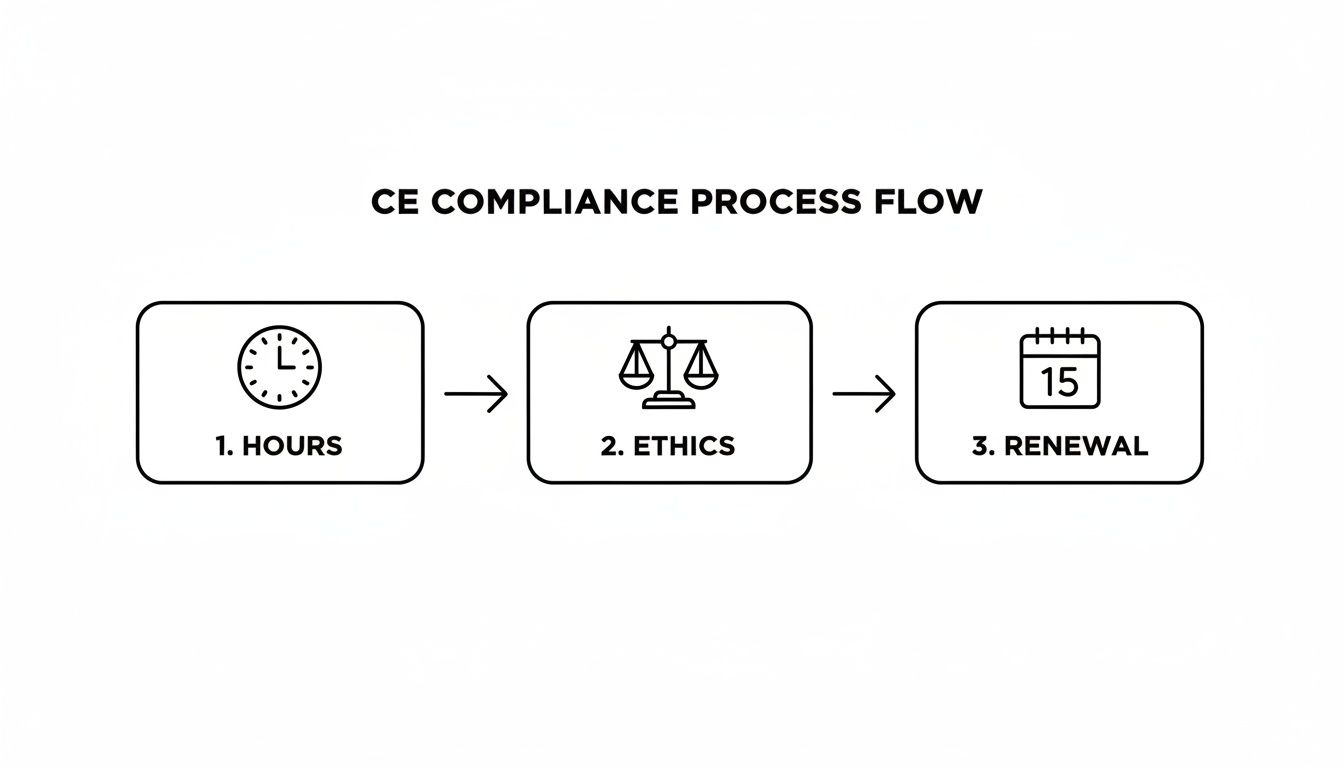
Following this simple cycle keeps you organized and ensures you never miss a beat.
1. Check Your Status and Know Your Deadline
Before you even think about signing up for a course, you need to know exactly where you stand. Your first move should always be to check your current CE credit status and confirm your license renewal deadline.
You can typically pull your official CE transcript directly from your state’s Department of Insurance website or use a third-party portal like NIPR or SIRCON. This report is your road map—it tells you how many credits you’ve finished and what you still need to complete.
Once you have that date, mark it everywhere. Put it on your wall calendar, in your phone, and anywhere else you’ll see it. That date is your finish line.
2. Find and Select Approved Courses
With your requirements in hand, it's time to find state-approved courses. This is a critical detail—your state will only grant credit for courses from providers it has officially approved.
You've got a few different ways you can get your credits, so you can pick what works for you:
- Online Self-Study: These give you total flexibility. You can knock them out at your own pace, which is perfect for busy producers juggling a packed schedule.
- Live Webinars: Sometimes called "classroom equivalent" courses, these are scheduled online sessions with a live instructor. They allow for real-time Q&A and are even mandatory in some states, like Alabama.
- In-Person Classes: The traditional classroom setting is great for direct engagement with instructors and peers. It’s also a solid networking opportunity.
Choose the topics and formats that fit your needs, but pay close attention to ensure they fulfill your specific credit types, especially the ethics requirement.
3. Complete and Confirm Your Credits
After you’ve enrolled, the next step is the most obvious but also the easiest to put off: finish the coursework. Don't procrastinate. Give yourself a buffer by aiming to complete your CE well ahead of the deadline, just in case any hiccups occur.
Once you finish a course, your job isn't quite done. You absolutely must follow up and confirm that your provider has reported your credits to the state. A simple reporting delay or a technical glitch could put your renewal at risk, so always double-check that your official transcript is updated.
Most providers report credits within a few business days, but it's ultimately your responsibility to make sure they show up on your record.
4. Renew Your License and Verify
The final step is to officially submit your renewal application and pay the fees to your state's Department of Insurance, which is almost always done through an online portal. Just finishing your CE hours doesn't automatically renew your license; you have to take this final, crucial action.
To make this even easier, you can explore compliance management apps that help automate tracking and reminders. After you've submitted everything, wait for the official confirmation that your license is renewed. Save a copy of that confirmation for your records, and you're good to go for another two years.
Strategic Course Topics That Give You an Edge

Meeting your biennial credit hour requirement is the starting point, not the finish line. While checking off your ethics and general hours keeps your license active, the most successful agents transform their life insurance continuing education into a competitive advantage.
It's about choosing courses not just for compliance, but for real-world relevance and professional growth. Think of it this way: every agent completes the basic training, but the top producers actively seek out advanced knowledge that sets them apart. This approach turns a mandatory task into a direct investment in your agency's future.
Aligning Your CE with Market Trends
Today’s clients have complex, interconnected financial lives. A basic term policy alone often can't solve their bigger problems, and your CE choices should reflect these evolving demands. Instead of just picking the fastest course available, consider topics that address major market shifts and position you as a go-to expert.
One of the most significant trends is the demand for products that serve multiple purposes. Focusing your education here can give you a substantial leg up.
Hybrid Life/Long-Term Care (LTC) Products: As healthcare costs continue to climb, clients are desperate for ways to protect their assets from being drained by long-term care needs. Courses on these combo products arm you with the confidence to explain their dual benefits, making you an essential resource for clients planning their later years.
Complex Annuity Products: Annuities are incredible retirement income tools, but their details can confuse clients and even some agents. Advanced training on different annuity types, suitability standards, and best-interest obligations builds massive credibility and ensures you provide compliant, client-first advice.
By mastering these sophisticated products, you're not just selling insurance; you're offering comprehensive financial security. This level of expertise opens the door to a more affluent client base that is actively seeking advanced solutions.
The global life insurance market was valued at $3.1 trillion in 2024, and with 39% of consumers planning to buy coverage, the opportunity is massive. In a U.S. market that makes up 27% of global premiums, agents who use CE to stay ahead are the ones who will thrive.
Courses for High-Value Client Solutions
Beyond specific product training, certain CE topics unlock your ability to serve high-value business and estate planning clients. These courses elevate your conversations from simple policy sales to holistic financial strategy, cementing your role as an indispensable advisor.
Business Succession Planning: Many business owners rely on life insurance to fund buy-sell agreements and ensure a smooth transition. CE in this area teaches you the mechanics of structuring these plans, allowing you to partner with business clients on one of their most critical financial challenges.
Advanced Estate Planning: Life insurance is a cornerstone of effective estate planning, providing the cash needed to pay taxes and equalize inheritances. Courses focused on its role within trusts and wealth transfer strategies enable you to collaborate effectively with attorneys and CPAs, adding immense value to your client relationships.
For more ideas, explore our list of the top continuing education courses for insurance agents in 2025. Choosing your CE topics with purpose is how you build a differentiated, high-performing agency that stands out in a crowded market.
Here is the rewritten section, crafted to match the specified human-written style and tone:
How PIA Southern Alliance Supports Your CE Requirements
Trying to keep up with life insurance continuing education rules on your own can feel like a full-time job. As an independent agent, your time is much better spent with clients, not trying to figure out state compliance websites. This is where your PIA Southern Alliance membership becomes one of your agency’s biggest assets.
We’re not just another association. Think of us as your built-in support team, connecting the dots between state rules, course selection, and the real-world success of your agency. We live and breathe the challenges that agents in Georgia, Alabama, and Mississippi face every day.
Exclusive Access to CE and Training
A major perk of being a member is getting access to top-notch, relevant courses without stretching your budget. PIA Southern Alliance has built strong relationships with trusted CE providers to give you exclusive discounts on the courses you need to stay compliant and sharp.
This means you can easily find and afford a whole range of state-approved courses, including:
- Mandatory Ethics Courses: Knock out your 3-hour ethics requirement with engaging content that actually feels relevant to your daily work.
- Product-Specific Training: Deepen your expertise in annuities, hybrid Life/LTC policies, and other products that can really grow your book of business.
- E&O Risk Management: Take part in crucial training that earns CE credits and can help lower your agency's risk exposure at the same time.
These member-only discounts help you meet your biennial requirements without the hassle, all while learning things that directly help you write more business.
Your PIA Southern Alliance membership is more than just a resource; it’s a community. It provides the tools, expertise, and peer support network essential for turning compliance challenges into growth opportunities.
A Community Built for Agency Success
Beyond just discounted courses, your membership plugs you into a strong community of other independent agents. This is where you get the kind of peer-to-peer learning and advice that you just can't find anywhere else. Through our live events and online forums, you can swap best practices and get real-world insights from others who know exactly what you’re going through.
At PIA Southern Alliance, our commitment is to give you the tools and advocacy your agency needs to master CE requirements and build a stronger, more profitable business. We’re your partner in success, providing the support system you need to thrive.
Frequently Asked Questions About Life Insurance CE
Even with the best intentions, life insurance continuing education can get confusing. Let's clear up a few of the most common questions we hear from agents all the time, so you can stay on top of your requirements without the stress.
What Happens If I Miss My CE Deadline?
Missing your CE deadline is a serious misstep, and the consequences can be a major headache for your business. Depending on your state’s rules, you could be looking at hefty fines, a license suspension, or having your license go inactive altogether.
The bottom line? You won’t be able to legally sell policies until you’re back in good standing. If you find yourself past the deadline, contact your state's Department of Insurance immediately. They'll give you the exact steps for late compliance, which usually involves completing your hours, paying penalty fees, and applying for reinstatement. Acting fast is crucial to minimizing the disruption.
How Do I Check My Current CE Credit Status?
You can’t hit a target you can’t see. Knowing exactly where you stand with your credit hours is the first step to a stress-free renewal. Thankfully, you don't have to guess.
The most reliable way to check is to pull up your official CE transcript online. Most agents use one of two methods:
- State Department of Insurance Portal: Your state's DOI almost certainly has a secure online portal where you can log in and see every credit that’s been reported on your behalf.
- Third-Party Services: National providers like SIRCON and NIPR offer transcript services that pull all your reported credits into one simple, easy-to-read report.
Make it a habit to check your transcript, especially right after you finish a course. This ensures your provider reported your hours correctly and that you’re on track to meet your deadline.
Think of your CE transcript as your compliance report card. It gives you a real-time snapshot of your progress and highlights exactly what you still need to accomplish before your deadline.
Can I Use CE Credits From Another State?
This is a classic question for agents licensed in multiple states, and the short answer is: maybe. Whether credits from one state can satisfy requirements in another comes down to reciprocity rules.
Many states do have reciprocity agreements, which means an approved course for your non-resident license might count toward your resident license, too. But—and this is a big but—there are almost always catches. For example, state-specific mandates like Alabama's classroom-equivalent rule or Mississippi's flood insurance requirement must be fulfilled with courses approved specifically by that state.
Before you ever assume credits will transfer, call or email your home state’s insurance department to verify their reciprocity rules. A quick check can save you from a last-minute panic when you discover a course you took doesn't count, putting your license in jeopardy.
As an independent agent, you don't have to manage these complexities alone. PIA Southern Alliance provides the resources, discounted CE access, and expert guidance you need to navigate compliance in Georgia, Alabama, and Mississippi with ease. Learn more about how a PIA membership can support your agency's success.