
Why Insurance Marketing Automation Is Changing Independent Agencies
Insurance marketing automation is a specialized technology platform that streamlines client communications, nurtures leads, and automates renewal campaigns specifically for insurance agencies and brokers. Here’s what you need to know:
Key Insurance Marketing Automation Features:
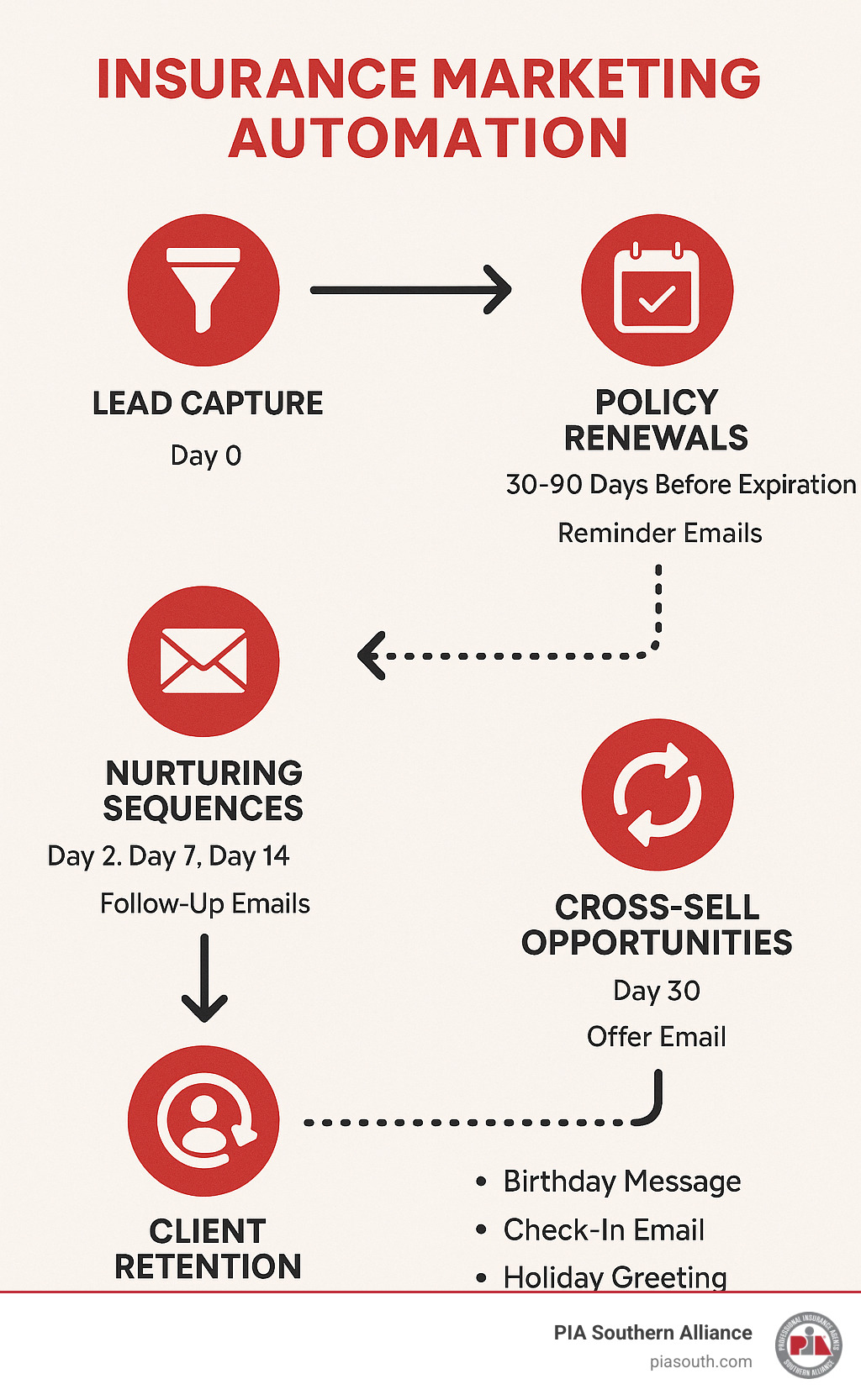
– Policy renewal reminders – Automated email sequences 30-90 days before expiration
– Cross-sell campaigns – Targeted offers based on existing coverage gaps
– Lead nurturing workflows – Educational content sequences for prospects
– Birthday and holiday messaging – Relationship-building touchpoints
– NPS surveys – Client satisfaction tracking and review generation
– AMS integration – Syncs with your agency management system data
The numbers tell a compelling story. Research shows that 77% of insurance consumers are moved to purchase by customized promotions, while agencies implementing automation report saving 3-5 hours per week per account manager. Columbia Insurance increased client retention rates by approximately 2% year-over-year after implementing marketing automation.
For property and casualty agencies across Georgia, Alabama, and Mississippi, this technology addresses a critical challenge: how to maintain personal relationships at scale while driving consistent growth. Manual processes that once took 6-8 hours per day can now be reduced to 2-3 hours through intelligent automation.
The insurance industry is experiencing rapid digital change, with agencies recognizing that personalized, timely communication is no longer optional—it’s essential for competitive survival.
As someone who has worked extensively with independent agencies throughout the Southeast, I’ve seen how insurance marketing automation can transform agency operations and client relationships. Through my experience with PIA Southern Alliance, I’ve helped agencies steer the complexities of implementing these systems while maintaining compliance and maximizing ROI.
Insurance Marketing Automation Fundamentals & Benefits
The insurance industry is experiencing remarkable growth, with the global market projected to reach $7.07 trillion in 2024 and climb to $8.40 trillion by 2026—that’s a 9% annual growth rate. For independent property and casualty agencies across Georgia, Alabama, and Mississippi, this expansion brings exciting opportunities alongside real challenges.
The question isn’t whether your agency will grow with this market surge. It’s whether you’ll have the tools to handle that growth while keeping the personal touch that makes independent agencies special.
What Is Insurance Marketing Automation?
Think of insurance marketing automation as your agency’s digital assistant that never sleeps, never forgets a renewal date, and always knows exactly what to say to each client. But it’s so much more than fancy email marketing.
This technology manages your entire customer journey from that first nervous phone call about coverage through decades of policy renewals and life changes. Unlike those generic marketing platforms that treat insurance like selling widgets, insurance marketing automation understands that Mrs. Johnson’s commercial property policy expires in March and she might need workers’ comp coverage for her growing business.
The system watches every interaction—website visits, email clicks, phone calls—and builds a complete picture of each person’s needs and interests. When someone downloads your guide to commercial property coverage, the platform automatically starts a carefully crafted conversation that builds trust over time.
The magic happens through behavioral triggers that respond to what people actually do, dynamic content that speaks directly to their situation, lead scoring that flags your hottest prospects, and automated workflows that nurture relationships for months or even years without you lifting a finger.
How It Differs From Generic Marketing Automation
Here’s where most agencies get tripped up. They grab a generic marketing platform thinking it’ll work for insurance, then wonder why everything feels so complicated and disconnected.
Property and casualty agencies face unique challenges that generic platforms simply weren’t built to handle. Regulatory compliance tops that list—every email and text message must follow state regulations and TCPA requirements. Generic platforms leave you flying blind on compliance, while insurance-specific systems have these protections built right in.
Then there’s AMS integration. Your agency management system holds your most valuable information—policy details, renewal dates, claims history, payment records. Insurance marketing automation platforms connect directly with your AMS, automatically syncing data so you’re never working with outdated information or manually entering the same details twice.
For agencies operating across multiple locations in Georgia, Alabama, and Mississippi, the complexity multiplies. Different state regulations, varying carrier relationships, and location-specific branding requirements can turn simple campaigns into administrative nightmares. Insurance automation handles these variations automatically.
Most importantly, generic platforms can’t think like insurance professionals. They don’t understand that a homeowner with just property coverage might need auto insurance, or that a small business owner approaching renewal time might be ready to discuss umbrella coverage. Insurance marketing automation understands these relationships naturally.
Benefits for Acquisition, Retention, and Engagement
The change happens across every part of your agency operations, and the results speak for themselves.
Lead generation and acquisition gets boostd when prospects receive relevant, helpful information at exactly the right time. Instead of letting downloaded leads go cold, automated nurturing sequences can increase your conversion rates by 2-4 times. When someone downloads your commercial property guide, they automatically enter a sequence that builds trust and demonstrates your expertise over weeks or months.
Retention and renewals improve dramatically with consistent, valuable communication. Research shows that satisfied customers are 80% more likely to renew when they receive regular touchpoints throughout the policy year. Automated renewal campaigns starting 90 days before expiration give you multiple opportunities to address concerns and prevent lapses.
Cross-selling and upselling becomes systematic rather than hit-or-miss. Top-performing agencies see 30% higher profitability through effective cross-selling, and automation makes this scalable. The system identifies coverage gaps and delivers targeted campaigns suggesting relevant additional policies based on what clients already have.
Staff efficiency might be the most immediate benefit your team notices. Account managers consistently report saving 3-5 hours per week on routine communications. That time gets redirected to high-value activities like relationship building, complex problem-solving, and face-to-face meetings that truly differentiate your agency.
The global insurance market growth creates unprecedented opportunities for agencies that can scale efficiently while maintaining service quality. Insurance marketing automation provides exactly that capability—growth without losing the personal touch that makes independent agencies irreplaceable.

Feature Checklist & Platform Selection
Choosing the right insurance marketing automation platform can make or break your implementation. We’ve worked with dozens of agencies across Georgia, Alabama, and Mississippi to identify the features that truly matter versus those that sound impressive but provide little practical value.
Key Features Every Agency Needs
CRM and AMS Integration: This isn’t optional—it’s fundamental. Your automation platform must sync seamlessly with your existing systems. Look for native integrations with major AMS providers rather than generic API connections that require ongoing maintenance.
Hot Lead Alerts: When a prospect visits your commercial property insurance page three times in one week, you need to know immediately. Real-time prospect alerts allow your team to strike while interest is highest.
Dynamic Content Capabilities: The ability to personalize emails based on policy types, renewal dates, and demographic information dramatically improves engagement rates. This goes beyond simple name personalization to include policy-specific recommendations and timing.
Multi-Channel Communication: Modern clients expect to communicate via email, text, phone, and social media. Your platform should orchestrate campaigns across all channels while maintaining message consistency.
Advanced Segmentation: The ability to segment your database using 100+ data points allows for precise targeting. You might create segments for “commercial property clients in Georgia with policies expiring in Q2” or “personal lines clients who haven’t purchased umbrella coverage.”
Compliance Management: Built-in opt-in tracking, subscription management, and audit trails ensure you stay compliant with evolving regulations. This is particularly crucial for agencies operating across multiple states.
Analytics and Reporting: Native reporting should provide insights into campaign performance, engagement metrics, and ROI measurement without requiring additional tools.
| Must-Have Features | Nice-to-Have Features |
|---|---|
| AMS Integration | Social Media Scheduling |
| CRM Synchronization | Advanced AI Content Generation |
| Multi-Channel Campaigns | Predictive Lead Scoring |
| Compliance Tracking | Video Email Capabilities |
| Real-Time Alerts | Advanced A/B Testing |
| Dynamic Content | Mobile App Access |
Evaluating Vendors & Avoiding Pitfalls
The insurance automation landscape includes both established players and emerging solutions. Here’s how to evaluate options effectively:
Implementation Timeline: Beware of platforms promising immediate results. Quality implementations typically require 30-60 days for proper setup, data migration, and staff training. Vendors promising overnight success often deliver subpar results.
Data Security: Insurance agencies handle sensitive personal and financial information. Ensure any platform meets industry security standards including SOC 2 compliance, data encryption, and regular security audits.
Scalability: Your automation needs will evolve as your agency grows. Choose platforms that can accommodate additional users, increased email volume, and expanded functionality without requiring complete system changes.
User Adoption: The most sophisticated platform is worthless if your team won’t use it. Look for intuitive interfaces, comprehensive training programs, and ongoing support resources.
Total Cost of Ownership: Beyond monthly subscription fees, consider implementation costs, training time, and ongoing maintenance requirements. Some platforms require dedicated IT support while others operate as true turnkey solutions.
Common pitfalls we’ve observed include:
– Choosing platforms based on feature lists rather than actual utility
– Underestimating the time required for proper implementation
– Failing to secure buy-in from all team members before implementation
– Neglecting to establish clear success metrics before launch
For more guidance on selecting the right tools for your agency, explore our resources on Agency Management Tools.

Implementation Playbooks, Compliance, and Future Trends
Successfully implementing insurance marketing automation requires more than selecting the right platform—it demands strategic thinking about workflows, compliance requirements, and long-term evolution.
High-Impact Workflows for Insurance Marketing Automation
Renewal Reminder Campaigns: Start renewal communications 90 days before expiration with educational content about market conditions and coverage updates. Follow with specific renewal offers at 60, 30, and 15 days out. This systematic approach can reduce lapse rates by 15-20%.
Welcome Series for New Clients: New policyholders should receive a carefully orchestrated onboarding sequence that includes policy summaries, claims procedures, and additional coverage options. This builds confidence and identifies early cross-selling opportunities.
Cross-Sell Trigger Campaigns: When a client purchases commercial property insurance, automatically trigger a sequence highlighting general liability, cyber liability, and business interruption coverage. Timing these campaigns 30-45 days after initial purchase maximizes receptivity.
Lead Nurturing Sequences: Prospects who download educational content enter automated sequences that provide value while demonstrating expertise. A commercial property prospect might receive guides about risk management, market updates, and case studies over 6-8 weeks.
Re-engagement Workflows: Dormant prospects who haven’t engaged recently receive targeted campaigns designed to reignite interest. These might include market updates, new product announcements, or exclusive educational webinars.
NPS Survey Automation: Quarterly satisfaction surveys help identify at-risk clients before renewal time while encouraging satisfied clients to provide online reviews and referrals.
Compliance & Data Privacy Essentials
Insurance marketing operates under strict regulatory oversight that varies by state and coverage type. Automation platforms must include robust compliance features:
Opt-in Management: Every communication must include clear opt-out mechanisms, and the system must honor unsubscribe requests immediately. This is particularly critical for text messaging, which falls under TCPA regulations.
Audit Trails: Maintain detailed records of all communications, including delivery confirmations, open rates, and opt-out requests. These records prove invaluable during regulatory reviews or client disputes.
Regional Compliance: Agencies operating across Georgia, Alabama, and Mississippi must steer different state regulations. Your automation platform should handle these variations automatically.
Data Privacy: With increasing focus on data privacy, ensure your platform provides granular control over data collection, storage, and usage. This includes GDPR compliance for any international clients.
Error Reduction: Automated compliance checks prevent common mistakes like sending renewal reminders to lapsed policies or marketing to opted-out contacts.
For comprehensive guidance on maintaining compliance while growing your agency, review our Insurance Agency Best Practices resources.
Measuring Effectiveness & ROI
Insurance marketing automation success requires tracking the right metrics and understanding their interconnections:
Email Performance Metrics: Monitor open rates (industry average: 20-25%), click-through rates (2-5%), and unsubscribe rates (less than 0.5%). More importantly, track these metrics by campaign type and client segment.
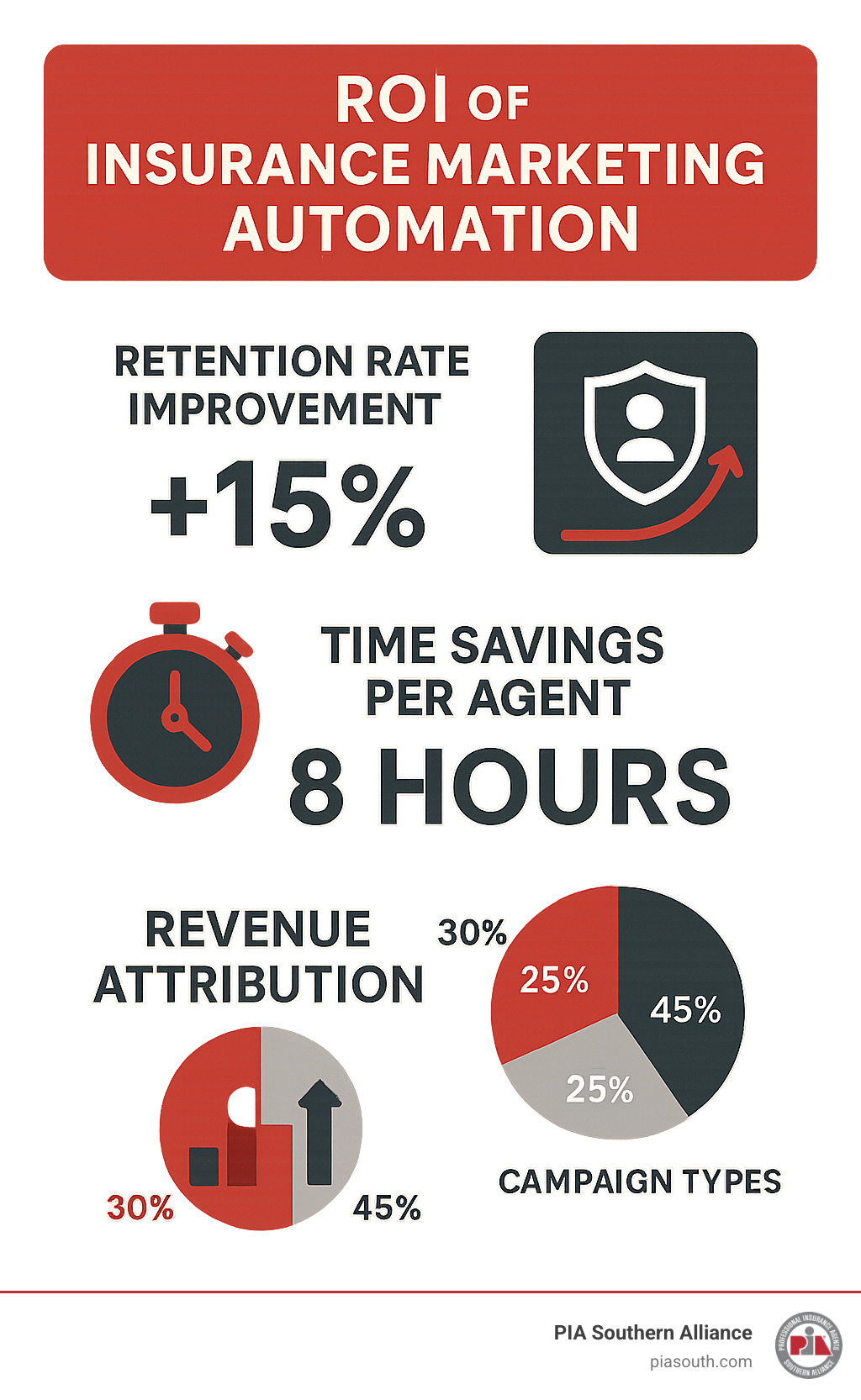
Retention Improvements: Measure policy retention rates before and after automation implementation. Even a 2% improvement in retention can significantly impact agency profitability.
Policies Per Customer: Track the average number of policies per client, which should increase through effective cross-selling automation. Top-performing agencies average 2.5-3 policies per household.
Revenue Attribution: Connect automation campaigns directly to new business and renewals. This requires proper tracking codes and CRM integration but provides the clearest ROI picture.
Time Savings: Quantify the hours saved through automation and calculate the value of redirecting that time to high-value activities like relationship building and complex problem-solving.
Lead Quality Improvements: Measure how automation affects lead scoring accuracy and conversion rates from prospect to client.
AI, Machine Learning, and Multi-Channel Evolution
The future of insurance marketing automation is increasingly intelligent and predictive:
Predictive Lead Scoring: AI algorithms analyze hundreds of data points to identify prospects most likely to purchase specific coverage types. This allows agents to prioritize their time more effectively.
Content Generation: AI-powered tools can create personalized email content, social media posts, and even blog articles custom to specific client segments. These tools understand insurance terminology and regulatory requirements.
SMS Automation: Text messaging is becoming increasingly important for client communication, particularly for claim updates and urgent policy matters. Integration with email campaigns creates seamless multi-channel experiences.
Chatbot Integration: AI-powered chatbots can handle routine inquiries about policy details, claims procedures, and coverage options, freeing agents for more complex interactions.
Behavioral Prediction: Machine learning algorithms can predict which clients are at risk of lapsing, which prospects are ready to buy, and which existing clients are prime candidates for additional coverage.

Frequently Asked Questions about Insurance Marketing Automation
If you’re considering insurance marketing automation for your property and casualty agency, you’re probably wondering about the practical details. Let me address the most common questions we hear from agencies across Georgia, Alabama, and Mississippi.
How can I integrate automation with my existing AMS/CRM?
The good news is that most modern insurance marketing automation platforms were built with integration in mind. Think of it like connecting two puzzle pieces that were designed to fit together—not forcing square pegs into round holes.
Start with data mapping, which sounds scarier than it actually is. You’re simply identifying which information in your AMS matches what the automation platform needs. Client names, policy details, renewal dates, and contact preferences all need clear pathways between systems.
Two-way synchronization is where the magic happens. Your automation platform should talk to your AMS like good neighbors sharing information over the fence. When someone opens an email about commercial property coverage, that activity gets recorded in your AMS. When a policy renewal date changes, your automation campaigns adjust automatically.
Testing is your safety net. Start with a small group of clients—maybe 50 or 100—before rolling out to your entire database. This helps you catch any hiccups without affecting your whole operation. It’s like testing a new recipe on your family before serving it to dinner guests.
Ongoing maintenance keeps everything running smoothly. Set up monthly check-ins to ensure data is flowing correctly and address any integration issues quickly. Most problems are minor and easily fixed when caught early.
The secret is choosing platforms designed specifically for insurance agencies rather than generic marketing tools that require custom workarounds. Insurance-specific platforms understand renewal cycles, policy types, and regulatory requirements from day one.
What KPIs prove ROI for independent agencies?
Here’s where the rubber meets the road—proving that insurance marketing automation actually improves your bottom line. Focus on metrics that directly impact your agency’s profitability rather than vanity numbers that look impressive but don’t pay the bills.
Client retention rate is your golden metric. Even a small improvement—say from 85% to 87%—can justify your entire automation investment. Track retention by policy type to see which campaigns work best. Commercial property clients might respond differently than personal auto clients.
Revenue per client tells the cross-selling story. When automation helps you identify coverage gaps and deliver targeted recommendations, you should see the average policy count per client increase. Top-performing agencies often see this number rise from 1.8 to 2.5 policies per household.
Time savings might be hard to measure, but it’s real money. When your account managers save 3-5 hours per week on routine communications, they can focus on relationship building and complex problem-solving. Calculate what those hours are worth at their billing rate.
Lead conversion rates show how automation affects your sales funnel. If automation helps you nurture prospects more effectively, you should see more quotes turn into policies. Track this by lead source to understand which campaigns work best.
Campaign attribution connects specific automation efforts to actual revenue. When a client purchases umbrella coverage after receiving your automated cross-sell sequence, that’s measurable ROI you can take to the bank.
How do I stay compliant with email and texting regulations?
Compliance doesn’t have to be scary, but it does require attention to detail. Think of it as building good habits that protect both your agency and your clients.
Opt-in management is your foundation. Every person in your database should have clearly agreed to receive communications from you. This is especially critical for text messaging, where TCPA regulations carry serious penalties. When in doubt, ask for permission explicitly.
Clear unsubscribe options aren’t just polite—they’re legally required. Make it easy for people to opt out, and honor those requests immediately. A good automation platform handles this automatically, removing unsubscribed contacts from all future campaigns.
Content compliance means being honest and transparent in your communications. Avoid misleading subject lines like “URGENT: Your Policy” when it’s really a marketing message. Always identify your agency clearly and include any required disclaimers for insurance communications.
Record keeping saves you during regulatory reviews. Your automation platform should maintain detailed logs of who received what messages, when they opted in, and how they responded. These records are your proof of compliance.
State-specific requirements add complexity since regulations vary across Georgia, Alabama, and Mississippi. Choose automation platforms that understand these differences and handle compliance automatically. You shouldn’t have to become a regulatory expert to market your agency effectively.
The key is building compliance into your processes from the beginning rather than trying to fix problems later. Good insurance marketing automation platforms make compliance easier, not harder.
Conclusion
The change is already happening. Insurance marketing automation has moved beyond being a “nice-to-have” technology to becoming essential for independent agencies that want to thrive in today’s competitive landscape.
For property and casualty agencies across Georgia, Alabama, and Mississippi, the choice isn’t whether to accept automation—it’s how quickly and effectively you can implement it. The agencies that figure this out first will have a significant advantage over those still managing renewals with spreadsheets and sending birthday cards by hand.
Your roadmap to success starts with honest assessment. Take a hard look at how your team currently spends their time. If your best agents are spending hours each week on routine renewal reminders instead of building relationships with commercial prospects, you’re leaving money on the table.
Define what success looks like before you start. Whether it’s improving retention rates by 2%, saving each agent 5 hours per week, or increasing your average policies per client, having clear goals makes everything else easier. The most successful implementations we’ve seen had specific targets from day one.
Choose your platform wisely. Fancy features don’t matter if your team won’t use them. Focus on insurance-specific solutions that integrate seamlessly with your existing systems. The goal is to make your agents’ lives easier, not more complicated.
Implementation timing matters more than you think. Rushing into automation without proper setup and training usually backfires. Give yourself 30-60 days to do it right. Your future self will thank you for taking the time upfront.
The beauty of insurance marketing automation lies in its ability to scale the personal touch that makes independent agencies special. You’re not replacing human relationships—you’re enhancing them with timely, relevant communication that shows clients you’re thinking about them even when you’re not on the phone.
At PIA Southern Alliance, we’ve watched agencies transform their operations through smart automation choices. The common thread among successful implementations isn’t the specific platform they chose—it’s their commitment to doing it thoughtfully and systematically.
The competitive landscape is shifting rapidly. Agencies that combine technology’s efficiency with the personal expertise that independent agents provide will dominate their markets. Those that resist change risk being left behind.
For comprehensive guidance on implementing these systems effectively, explore our detailed resources on Insurance Agency Automation Systems. The future belongs to agencies that accept both innovation and the personal relationships that define independent insurance.
Your clients deserve better communication. Your agents deserve more efficient processes. And your agency deserves the growth that comes from doing both exceptionally well. Insurance marketing automation makes all of this possible—but only if you take action.