
Why Mississippi Employers Are Seeking Alternative Funding Solutions
Insurance funding solutions Mississippi employers are exploring range from traditional fully insured plans to innovative approaches like Individual Coverage Health Reimbursement Arrangements (ICHRA) and self-funded strategies. With health insurance premiums rising 25% over the past decade and only 39% of small businesses with fewer than 10 employees offering benefits, Mississippi employers need cost-effective alternatives.
Quick Overview of Mississippi Insurance Funding Options:
- Fully Insured Plans – Traditional group coverage with fixed premiums
- Self-Funded Plans – Employer pays claims directly with stop-loss protection
- Level-Funded Plans – Fixed monthly payments with potential surplus sharing
- ICHRA – Tax-advantaged individual coverage allowances with no participation requirements
- Captive Arrangements – Shared risk pools for larger employers
Individual health coverage in Mississippi averages nearly $8,000 per person annually, while family coverage approaches $23,000. Most small group plans require at least 70% employee participation, creating barriers for many businesses.
The Mississippi Insurance Department handled over 10,000 consumer inquiries last year, recovering more than $10 million for consumers. State regulations impact everything from participation requirements to premium calculations, making expert guidance essential.
Relevant articles related to insurance funding solutions Mississippi:
Understanding the Landscape of Insurance Funding Solutions Mississippi
Mississippi’s insurance funding landscape shows adaptation and innovation as employers seek alternatives to rising premium costs that have climbed 25% over the past decade.
Fully insured plans remain the go-to choice for most Mississippi employers. You pay fixed premiums to insurance carriers, who assume all claims risk. It’s straightforward and predictable, with the average small employer group plan hitting $8,722 in 2023. However, there’s no opportunity to benefit when claims run lower than expected.
Self-funded plans flip this equation – you pay claims directly while purchasing stop-loss insurance for catastrophic protection. This requires 25-200 employees minimum but allows you to keep savings when claims run favorably. You gain detailed claims data for wellness programs but accept claims volatility and increased administrative complexity.
Level-funded plans offer middle ground with fixed monthly payments like fully insured plans, but you may receive surplus sharing at renewal if claims run lower than projected. It provides budget predictability with upside potential.
ICHRA – Individual Coverage Health Reimbursement Arrangements – allows employers to provide tax-advantaged allowances for individual coverage purchases rather than traditional group plans. With no participation requirements, ICHRA offers flexibility that traditional group plans cannot match.
Captive arrangements represent sophisticated risk sharing where multiple employers pool risks in a controlled insurance company structure, offering long-term cost savings for larger employers.
Mississippi’s regulatory framework shapes how these options work in practice, ensuring consumer protections while allowing innovation in funding approaches.
Fully Insured vs Self-Funded in Insurance Funding Solutions Mississippi
The choice between fully insured and self-funded approaches represents the most fundamental decision in insurance funding solutions Mississippi planning.
Fully insured plans offer peace of mind with predictable monthly costs and no surprise bills. The insurance carrier handles claims processing and regulatory compliance. However, you have limited control and no upside potential when claims run favorably.
Self-funded plans put you in control – you pay claims directly and keep savings when claims run lower than expected. You gain detailed claims data and plan design flexibility but accept claims volatility and increased administrative responsibilities.
| Factor | Fully Insured | Self-Funded |
|---|---|---|
| Claims Surplus Share | 0% | Up to 100% |
| Premium Predictability | High | Variable |
| Administrative Burden | Low | High |
| Minimum Employees | 2-50 | 25-200 |
| Stop-Loss Required | No | Yes |
| Claims Data Access | Limited | Full |
The decision often comes down to risk tolerance and administrative capacity. Employers comfortable with claims volatility often benefit from self-funding, while those prioritizing predictability prefer fully insured arrangements.
Level-Funded & Captive Arrangements
Level-funded plans have emerged as compelling middle ground for Mississippi employers wanting more control than fully insured plans offer without traditional self-funding complexity.

Level-funded plans establish fixed monthly payments covering expected claims, administrative costs, and stop-loss premiums. You get budget predictability but may receive surplus sharing at renewal if claims fall below projections. These plans often work well for groups as small as 25 employees.
Captive arrangements allow multiple employers to pool risks in a controlled insurance company structure. While requiring significant commitment and typically working best for employers with 500+ employees, captives offer long-term cost savings and improved control over claims management.
ICHRA & Defined Contribution Options
Individual Coverage Health Reimbursement Arrangements represent a fundamental shift in insurance funding solutions Mississippi thinking, available since 2020.
The concept is simple – instead of managing group health plans, you set monthly allowances for employees to purchase individual coverage. Employees shop ACA marketplaces for plans meeting their needs. Allowances are tax-deductible for employers and tax-free for employees.
ICHRA eliminates traditional group plan headaches – no participation requirements, no minimum contributions, and minimal ongoing administration. Setup typically takes just 10 minutes.
The flexibility is remarkable – employees choose plans matching their preferences and keep coverage when changing jobs. For Mississippi employers, budget control is appealing since you set fixed allowance amounts based on what you can afford.
ICHRA works particularly well for small employers struggling with group plan participation requirements, seasonal businesses, and companies with multi-state employees.
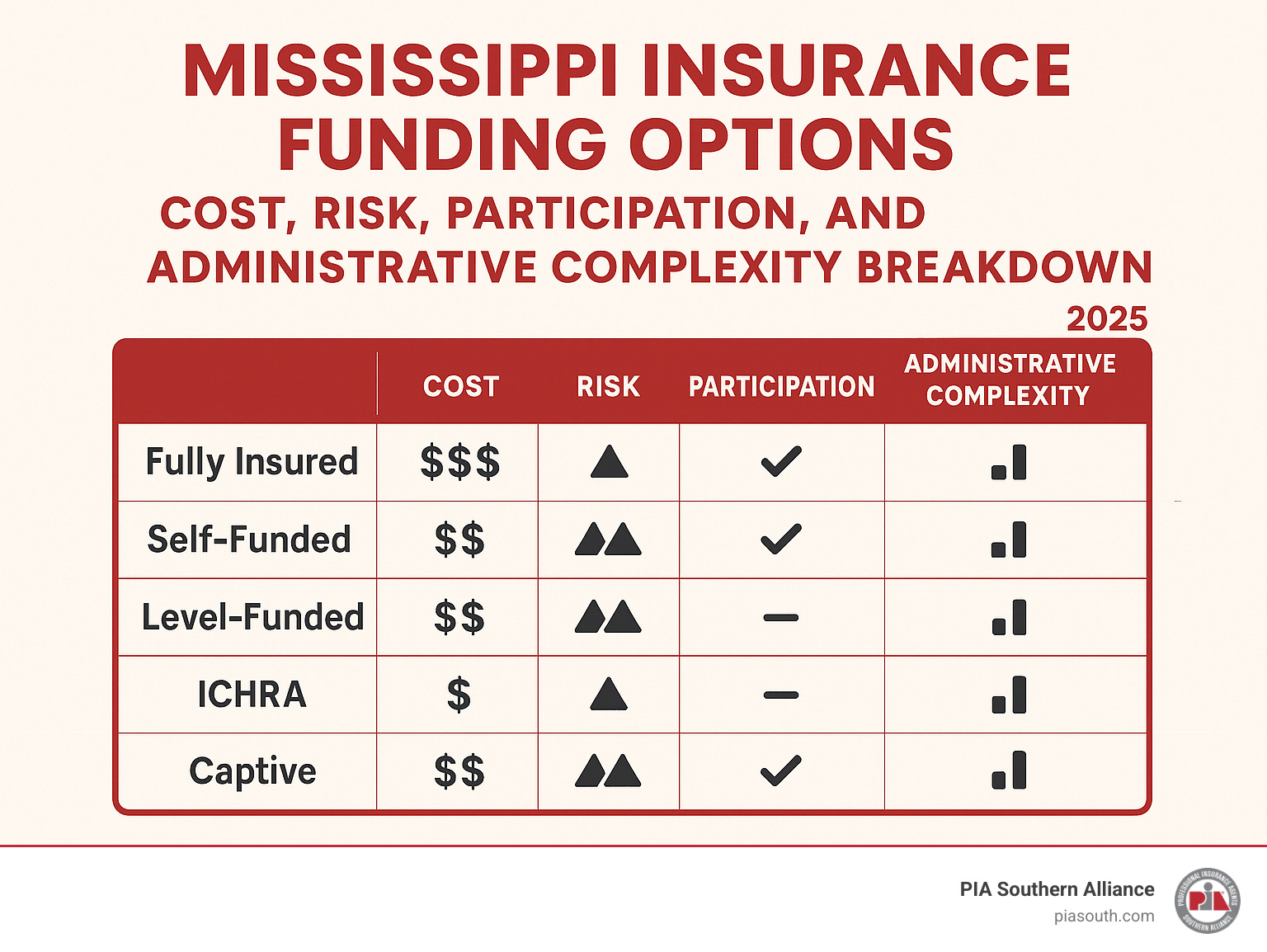
Comparing Costs, Risks, and Administration
When Mississippi employers explore insurance funding solutions Mississippi options, understanding the cost-risk-administration balance becomes crucial for making informed decisions.

Current premium landscape shows individual coverage costing nearly $8,000 annually, while family coverage approaches $23,000. Small group plans average $8,722 in 2023, representing a 25% increase over the past decade.
Risk levels vary significantly across funding options. Low-risk fully insured plans offer predictable premiums but eliminate surplus sharing opportunities. Medium-risk approaches like level-funded plans provide upside potential with reasonable predictability. High-risk self-funded strategies work best for larger employers with adequate reserves.
Administrative complexity ranges from minimal (fully insured, ICHRA) to substantial (traditional self-funded). Cash flow management becomes critical with self-funded arrangements since claims don’t arrive predictably.
Applying Insurance Funding Solutions Mississippi to Small Businesses
Small businesses face unique challenges with fewer than 50 employees, limited HR staff, and tight budgets requiring solutions that balance cost control with operational simplicity.
ICHRA emerges as a game-changer for small businesses struggling with participation requirements. With no minimum participation threshold, employers can offer tax-advantaged allowances regardless of employee uptake. Setup takes about 10 minutes.
Level-funded plans work well for small businesses with 25+ employees seeking predictability with upside potential through surplus sharing at renewal.
Cash flow management tools like Insurance Premium Funding Loan options help small businesses handle implementation costs without disrupting operations.
Mid-Sized & Large Employers: Maximizing Surplus & Data
Larger employers have distinct advantages in leveraging insurance funding solutions Mississippi for significant cost savings through data-driven approaches.
Claims analytics reveal patterns in high-cost conditions, pharmacy utilization, and provider efficiency, enabling targeted wellness programs and strategic benefit design modifications.
Captive insurance arrangements offer long-term cost savings for larger employers willing to share risks with similar organizations, providing greater control over claims management.
Surplus retention strategies allow employers to keep funds that would otherwise contribute to insurance company profits, funding improved benefits or wellness programs.
Integrating Supplemental & Voluntary Benefits
Comprehensive insurance funding solutions Mississippi often include supplemental benefits that improve overall packages while managing primary plan costs.
Gap coverage options become important with high-deductible health plans. Dental, vision, and medical gap plans provide additional protection at relatively low employer cost.
Voluntary benefits can include critical illness, accident coverage, and disability insurance improvements, often providing high perceived value at low cost, making them effective recruitment tools.
State Regulations, Compliance & Consumer Protections
Mississippi’s regulatory environment significantly impacts insurance funding solutions Mississippi employers can implement, requiring understanding of state requirements for compliance.

The Mississippi Insurance Department handled over 10,000 consumer inquiries last year, recovering more than $10 million for consumers.
Participation requirements create problems – most small group plans require 70% employee participation, which can make or break benefits programs for smaller companies.
Premium calculations follow strict state guidelines covering age banding, geographic factors, and tobacco surcharges, ensuring fair pricing while limiting employer flexibility.
Mississippi maintains consumer protections through guaranty associations managing insurer insolvencies, having paid over $177 million in benefits at no taxpayer cost.
Mississippi Insurance Department Oversight & Filing Rules
Rate review processes ensure carriers cannot charge excessive rates. Every rate must be filed for regulatory review to confirm adequacy and fairness.
Forced-placed insurance regulations under Mississippi Bulletin No. 2000-8 establish 20% maximum schedule rating adjustments and daily pro rata premium refunds upon cancellation.
The department’s consumer protection services provide help through their helpline (800-562-2957) and online complaint system. Their Life Insurance Policy Locator Tool recovered $35 million for 1,600 users in 2024.
Regulatory filing requirements vary by funding arrangement – fully insured plans require comprehensive rate and form filings, while self-funded arrangements have different ERISA reporting obligations.
Reporting, Taxes & Participation Rules
Form 5500 requirements apply to self-funded plans, requiring annual Department of Labor reports about plan operations and financial conditions.
PCORI fees apply to most health coverage, including self-funded plans – typically $2-3 per covered person annually for comparative effectiveness research funding.
ACA tracking and reporting requirements affect employers with 50+ full-time employees, including Forms 1094-C and 1095-C preparation.
Participation rule variations create opportunities – traditional group plans require 70% participation, while ICHRA arrangements have no participation requirements.
Interest rate considerations become important when financing premium payments, significantly impacting total costs.
Risk Management & Stop-Loss Strategies
Effective risk management forms the foundation of successful insurance funding solutions Mississippi implementation beyond traditional fully insured arrangements.
Stop-loss insurance comes in two types: Specific stop-loss protects against individual high-cost claims (typically $25,000-$500,000 per person), while Aggregate stop-loss protects against total plan claims exceeding expected levels (usually 110-125% of expected claims).
Lasering strategies may exclude specific high-cost individuals from stop-loss coverage, requiring careful evaluation of risk exposure impact.
Reserve management requires maintaining 2-3 months of expected claims reserves to manage cash flow volatility, funded through surplus sharing or gradual accumulation.
Choosing and Implementing the Right Funding Strategy
Selecting optimal insurance funding solutions Mississippi requires systematic evaluation of organizational needs, risk tolerance, and implementation capabilities.

The decision-making process starts with understanding your unique circumstances. Financial considerations include current premium costs, cash flow capacity, and risk tolerance for claims volatility. Organizational factors like company size, HR staff capacity, and leadership comfort with risk all influence optimal choices.
Employee considerations matter significantly – workforce demographics, geographic distribution, and participation likelihood vary across industries. Market conditions including carrier relationships and regulatory environment add complexity.
The stakeholder survey process ensures all voices are heard – senior leadership provides strategic direction, HR understands administrative impacts, finance evaluates cash flow implications, and employee representatives share workforce perspectives.
Step-by-Step Decision Framework
Phase 1: Goal Setting and Assessment – Define primary objectives clearly, analyze current plan performance thoroughly, and assess organizational capabilities honestly.
Phase 2: Cost Modeling and Analysis – Project costs under various arrangements, analyze claims history to understand risk profile, and model cash flow implications carefully.
Phase 3: Compliance and Regulatory Review – Verify regulatory requirements for each funding option, assess ERISA and ACA compliance implications, and review Mississippi-specific regulations.
Phase 4: Implementation Timeline – Develop realistic milestones with contingency planning. Employee communication deserves special attention since change management often determines success more than the funding arrangement itself.
Phase 5: Vendor Selection and Contracting – Evaluate proposals objectively, negotiate protective contract terms, and establish ongoing relationship management procedures. Professional Agents Funding considerations become important as independent agents may require financing support.
Role of Independent Agents & Brokers
Independent agents play crucial roles in helping Mississippi employers steer insurance funding solutions Mississippi options effectively.
Market access and expertise provide objective comparisons across multiple carriers and funding arrangements, bringing specialized knowledge particularly valuable for complex arrangements.
Negotiation leverage becomes especially important for mid-sized employers lacking internal expertise or market clout. Experienced agents leverage relationships to negotiate better terms and pricing.
Education and support help employers understand options and make informed decisions. PIA Southern Alliance supports independent agents through specialized webinars and resources focused on commercial property insurance and funding solutions.
Implementation support provides crucial coordination during complex transition processes, continuing through ongoing plan management and renewal processes.
Compliance guidance addresses employers’ biggest concerns about alternative funding arrangements, providing ongoing support to ensure continued compliance with state and federal requirements.
Frequently Asked Questions about Insurance Funding Solutions Mississippi
Mississippi employers exploring insurance funding solutions Mississippi often have similar questions about participation rules, risk management, and compliance requirements.
What are the minimum participation requirements for group plans?
The 70% participation requirement affects many Mississippi employers shopping for traditional group health insurance to prevent adverse selection.
Traditional group plans require 70% participation – if you have 20 employees, at least 14 need to enroll. This challenges businesses with younger workforces or part-time employees.
ICHRA eliminates participation requirements completely. You could have 100 employees with only 10 using allowances – that’s perfectly acceptable.
Self-funded arrangements offer more flexibility, with some allowing 50-65% participation depending on administrator and stop-loss carrier requirements.
How does stop-loss insurance cap my financial exposure?
Stop-loss insurance acts as a safety net for self-funded plans, crucial for insurance funding solutions Mississippi employers considering this route.
Specific stop-loss protects against individual employee claims. With a $75,000 attachment point, if an employee incurs $300,000 in treatment costs, you pay $75,000 and stop-loss covers the remaining $225,000.
Attachment points directly impact premiums – lower points mean higher premiums but less risk. Most Mississippi employers find the sweet spot between $50,000-$150,000.
Aggregate stop-loss protects against total plan claims exceeding expectations. If your plan projects $800,000 annually with 120% aggregate protection, you’re covered if claims exceed $960,000.
Stop-loss premiums typically run 10-15% of total plan costs, providing valuable protection during bad claims years.
Can I mix ICHRA allowances with a self-funded medical plan?
You cannot offer both ICHRA and traditional group coverage to the same employee class simultaneously due to IRS rules preventing double-dipping on tax advantages.
However, you can offer ICHRA to some employee classes and group coverage to others – for example, traditional group coverage to full-time employees and ICHRA allowances to part-time workers.
Transitioning from group coverage to ICHRA is possible during open enrollment periods. Supplemental benefits work well with ICHRA – dental, vision, life insurance, and disability coverage alongside ICHRA allowances often provide better overall value.

Conclusion
Finding the right insurance funding solutions Mississippi employers need doesn’t have to feel overwhelming. With premiums climbing 25% over the past decade and only 39% of small businesses offering benefits, traditional approaches aren’t working anymore.
You have more options than ever. ICHRA arrangements eliminate participation requirements while providing tax-advantaged benefits. Self-funded plans let you keep surplus funds instead of padding insurance company profits. Level-funded options provide predictable payments with potential renewal savings.
Stop-loss insurance offers solid protection against catastrophic scenarios, while supplemental benefits deliver impressive value without breaking budgets.
Compliance matters. The Mississippi Insurance Department handled over 10,000 consumer questions last year, recovering more than $10 million. Proper compliance protects your business and employees.
The right partner makes the difference. Independent agents who understand these solutions can negotiate better terms, avoid costly mistakes, and guide you through regulatory requirements.
PIA Southern Alliance keeps independent agents informed about evolving insurance funding solutions Mississippi through specialized training and resources, ensuring agents have tools to help clients succeed.
Ready for next steps? Evaluate current spending and results, consider your team’s needs and risk tolerance, then find an experienced independent agent to explore options without pressure.
For additional financing resources, Insurance Premium Financing offers support. Working with PIA Southern Alliance members provides access to expertise and industry relationships that make the difference between good and great decisions.
The bottom line? Finding the right insurance funding approach takes upfront work, but the payoff – better cost control, happier employees, and more business flexibility – makes every minute worthwhile.
