
Drone insurance is a specialized policy that protects operators from the financial fallout of accidents, damage, or liability claims. Think of it this way: just as a commercial truck needs auto insurance, a drone used for business needs its own protection against third-party injuries, property damage, and physical damage to the drone itself.
Without it, a simple flight error can spiral into a massive legal and financial headache.
Why Drone Insurance Is Now Essential for Business
It wasn't long ago that drones felt more like high-tech toys for hobbyists. Today, they're critical tools in major industries like real estate, construction, and agriculture. This explosion in commercial use has completely changed the risk landscape, making drone insurance a core business need, not just an optional extra.
Flying an uninsured drone is like sending a commercial vehicle out on the road without liability coverage. The potential for a catastrophic loss is huge. A real estate agent flying a drone for aerial photos could accidentally crash it into a neighbor's brand-new car. A construction firm surveying a site might have a drone malfunction and injure someone below. In either scenario, the business could be staring down a six-figure lawsuit with no safety net.
The New Standard of Professional Operation
With so many drones in the sky, clients, regulators, and even property owners now expect—and often demand—proof of insurance. Flying without it isn’t just a financial gamble; it signals a lack of professionalism that can cost you contracts and damage your reputation. For us independent insurance agents, this shift is a huge opportunity to step in and protect clients who might not even realize the new risks they're facing.
The reality is that an uninsured drone flight is a major liability. A simple mistake—a lost signal, a sudden gust of wind, or pilot error—can easily turn a thousand-dollar piece of equipment into a hundred-thousand-dollar legal problem.
To give clients the right advice, we first need to master the fundamental types of coverage that make up a solid drone insurance policy. These are the essential shields that protect a business’s assets, reputation, and ability to keep operating.
- Liability Coverage: This is the absolute cornerstone of any commercial drone policy. It protects the business if the drone hurts someone or damages their property.
- Hull Insurance: This covers physical damage to the drone itself. Whether it’s from a crash, a rough landing, or a flyaway incident, hull insurance helps repair or replace the aircraft.
- Payload Insurance: This specifically covers the expensive gear attached to the drone. Think high-resolution cameras, thermal sensors, or LiDAR scanners—equipment that is often worth far more than the drone itself.
Getting a handle on these coverages is the first step toward properly safeguarding your clients' drone operations. To get a comprehensive overview, check out this excellent article on Drone Insurance Explained: How To Protect Your Investment. When you frame the conversation around these core protections, clients start to see insurance not as a cost, but as a vital investment in their business's future.
Understanding the Core Types of Drone Insurance Coverage
Navigating drone insurance can feel a little confusing at first, but it really boils down to three main pieces. I like to think of building a policy like putting together a toolkit for your client. Each piece has a very specific and vital job in protecting their business from financial trouble. When you combine them correctly, they’re covered no matter what goes wrong.
This diagram shows how the three core coverage types—liability, hull, and payload—fit together to create a solid foundation for a drone insurance policy.
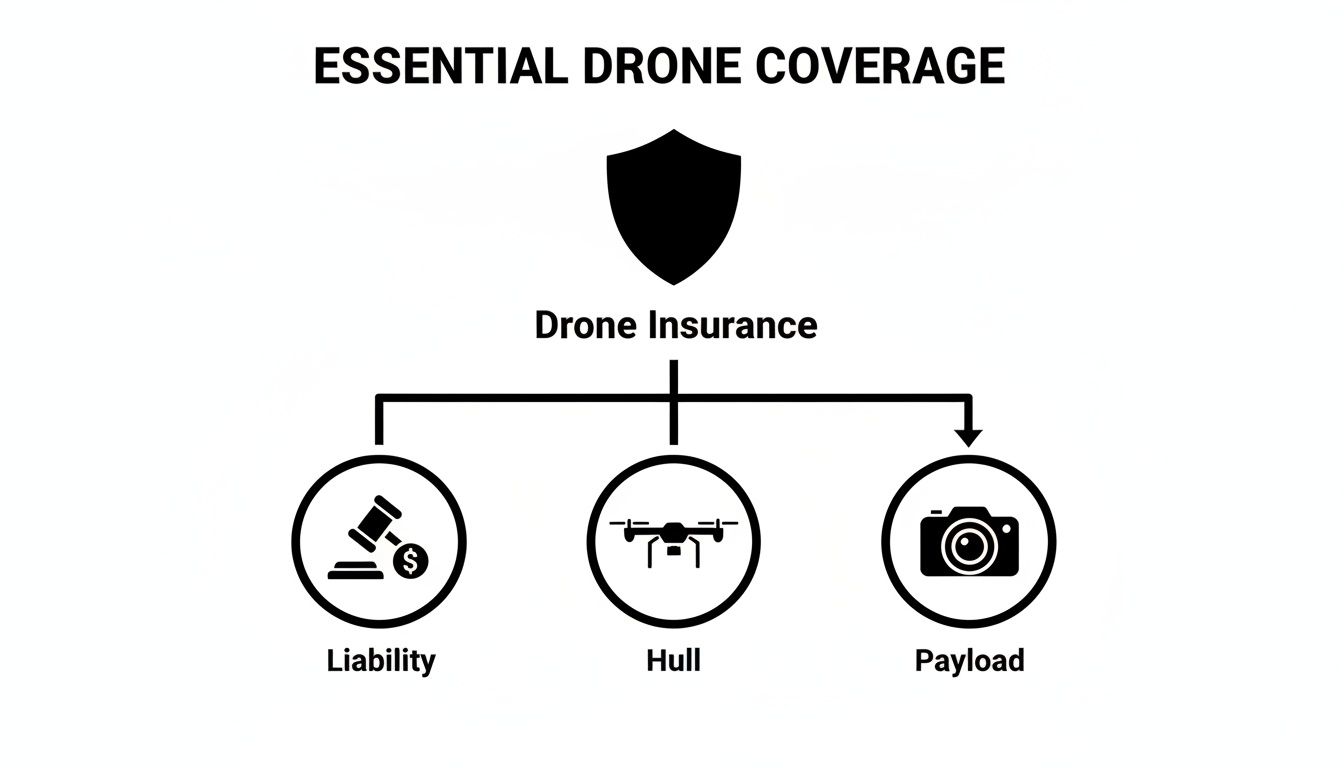
As you can see, each one tackles a different kind of risk that comes with flying drones for work.
Drone Insurance Coverage at a Glance
To make this even clearer, here’s a quick-reference table that breaks down the main coverage types, what they protect, and the kind of client who typically needs them.
| Coverage Type | What It Protects | Typical Client Scenario |
|---|---|---|
| Liability | Third-party property damage and bodily injury caused by the drone. | A real estate photographer's drone malfunctions and crashes onto a neighbor's expensive car. |
| Hull/Physical Damage | The drone itself from damage, destruction, or loss (flyaway). | A construction surveyor's drone is hit by a sudden gust of wind and crashes, breaking its frame. |
| Payload | High-value equipment attached to the drone (cameras, sensors, LiDAR). | A filmmaker's drone has a rough landing, damaging the drone slightly but destroying the $10,000 cinema camera. |
This table helps you quickly match the right protection to your client's specific operational risks, ensuring there are no gaps in their coverage.
Liability Coverage: The Essential Shield
Drone liability insurance is the absolute bedrock of any commercial policy. It’s not optional—it’s the fundamental protection that covers damages your client’s drone might cause to other people or their property. Think of it as the "slip-and-fall" insurance for the sky.
If a drone operator loses connection and their aircraft smashes into a parked car, liability coverage is what steps in to pay for the repairs. Likewise, if a drone accidentally injures a bystander, this coverage handles the medical bills and any potential legal defense costs.
Without liability protection, a single accident could trigger a lawsuit that could easily bankrupt a small business. This is the single most important coverage for any commercial drone pilot.
This non-negotiable need is a huge reason the global drone insurance market is taking off. It grew from USD 1.5 billion in 2023 and is expected to climb to USD 3.5 billion by 2033. North America, which held a 38.6% market share in 2023, is a major player here, largely because FAA regulations mandate this coverage for commercial use.
Hull Coverage: Protecting the Drone Itself
While liability covers damage to others, hull insurance protects the drone itself. This is basically the "comprehensive auto" coverage for the aircraft. If the drone is damaged, destroyed, or even lost in a flyaway incident, hull insurance helps pay to repair or replace it.
Imagine a surveyor flying a $5,000 mapping drone. A sudden gust of wind sends it spiraling into a tree, causing serious damage to its frame and motors. With hull insurance, the operator can file a claim to get their essential equipment back in the air without a massive out-of-pocket expense. This coverage is absolutely critical for businesses whose daily operations depend on having a functional drone.
To get a deeper look at the specific protections available, you can check out a detailed guide on commercial UAV insurance that really breaks down the different coverage types designed for drone operations.
Payload Coverage: Insuring the Expensive Gear
Finally, we have payload insurance. This is a highly specialized coverage that protects the valuable equipment carried by the drone—which is often worth far more than the drone itself. Think of it as a separate, high-value policy just for your most important tools.
Common payloads can get very pricey, very fast:
- High-Resolution Cameras: Used by photographers and cinematographers, these can easily cost upwards of $10,000.
- Thermal Sensors: Essential for inspections and search-and-rescue, these advanced sensors are extremely expensive.
- LiDAR Scanners: Used in construction and surveying, LiDAR units can carry price tags of $25,000 or more.
Let’s say a wedding videographer has a minor crash. The drone itself might only have a few hundred dollars in damage, but the $8,000 cinema camera attached to it is destroyed. Standard hull insurance wouldn't touch the camera. This is exactly what payload insurance is for, making sure the most valuable part of the operator’s setup is protected.
How Regulations and Underwriting Shape Drone Policies

Securing the right insurance for a drone isn't just about what the aircraft is worth. It's deeply tied to a world of strict regulations and careful risk assessment.
Think of it this way: you wouldn't insure a long-haul trucker who doesn't have a commercial driver's license. The same logic applies to drone pilots. Without the right credentials and a solid track record, finding affordable—or any—insurance is next to impossible.
For commercial drone pilots, the most critical credential is the FAA's Part 107 certification. This is the federal standard for anyone flying a drone for business, and for insurance carriers, it's a non-negotiable starting point. It proves the pilot gets the rules of the sky, understands how weather impacts flight, and knows how to operate safely.
The FAA Part 107 Certification Mandate
A pilot holding a Part 107 certificate is immediately viewed as a lower-risk, more professional operator. This certification isn't just another piece of paper; it’s the very foundation of their insurability. Without it, most carriers won't even look at an application for commercial drone operations.
When you present a client who has their Part 107, you're making the underwriter's job easier. It signals that the pilot is serious about safety and compliance, which directly translates to better premiums and broader coverage options. If a pilot is flying for business without it, they are operating illegally and are essentially uninsurable for commercial liability. Understanding compliance standards in the insurance industry is absolutely key here.
What Underwriters Want to See
Beyond that all-important federal certificate, underwriters will dig into the operator's professionalism and history. They are trying to build a complete picture of the risk they're being asked to cover. Helping your client gather this information before you submit the application will make the whole process smoother and lead to much better terms.
Here are the key things underwriters are looking for:
- Pilot Experience and Training: How long has the pilot been flying? Do they have a log of flight hours, especially with the specific drone they want to insure? Any specialized training for complex jobs, like flying in crowded urban areas, is a huge plus.
- Detailed Flight Logs: Meticulous logs are an underwriter’s best friend. They want to see records of every flight—date, location, duration, and a note of any incidents. This shows a professional, organized approach to managing risk.
- Maintenance Records: Drones are aircraft, and they need regular upkeep. Records of battery health checks, firmware updates, and propeller replacements prove the operator is committed to keeping their equipment airworthy.
- Operational Territory: Where will the drone be flying? An operation over a rural farm field is a much lower risk than one in a dense city or near an airport. Clear documentation of the intended flight areas is critical.
An underwriter's job is to assess and price risk. A pilot who comes to the table with comprehensive flight logs, maintenance records, and proof of certification isn't an unknown liability—they are a calculable, professional risk.
A well-prepared application makes all the difference. When you present a client with all their ducks in a row, you’re not just asking for a quote. You’re making a strong case for why they deserve the best terms. It shows the underwriter that your client is a true partner in safety, not just another policy number. This proactive approach is how you secure the best insurance coverage for drones at the most competitive price.
Decoding Drone Policy Pricing and Key Exclusions
Have you ever quoted drone insurance and wondered why one policy comes in at $600 and another, with seemingly similar limits, is a whopping $6,000? It’s a common question. The truth is, pricing a drone policy is a lot like pricing car insurance—it’s all about risk, the value of the asset, and the operator's track record. Getting a handle on these drivers is the first step to setting realistic expectations for your clients.
Just like a high-performance sports car costs more to insure than a family sedan, the drone itself is a huge piece of the puzzle. A $1,500 photography drone simply doesn't carry the same physical damage risk as a $50,000 surveying drone kitted out with an advanced LiDAR sensor. The more valuable the equipment flying in the air, the higher your hull and payload premiums will be.
Liability limits also play a massive role, of course. A policy with a $1 million liability limit will naturally cost less than one providing $10 million in coverage. The art is in matching the limit to the actual operational risk. A solo real estate photographer shooting empty properties needs a different level of protection than a company flying drones over active, bustling construction sites.
Key Factors That Drive Drone Insurance Premiums
At its core, an underwriter's job is to put a price on the specific risks of an operation. A pilot flying over a wide-open farm field is an entirely different risk profile than one navigating a dense urban center full of people and property.
Here are the main ingredients that go into the premium calculation:
- Operational Risk: Where and how the drone is flown is everything. Flying over crowds, near airports, or in complex city environments will always push costs up compared to flights over empty, rural land.
- Pilot Experience: An experienced pilot with thousands of logged flight hours and a spotless safety record is a much more attractive risk than a newly certified operator. A documented history of safe flying can lead to some serious savings.
- Flight History: Has the operator had previous claims or accidents? A history of incidents, even minor ones, signals a higher risk to the carrier, and you can bet that will be reflected in the premium.
The market for this coverage is expanding at an incredible pace, with commercial use now making up the lion's share of insurance premiums in North America. For a fairly standard policy, you can expect to see annual premiums in the U.S. fall between $500 and $800. These typically come with deductibles from $250 to $600 and cover liability limits anywhere from $500,000 up to $10 million.
With commercial drone operations projected to fuel a $90 billion market by 2030, the demand for solid insurance isn't just growing—it's set to skyrocket. You can dive deeper into these market projections and get a better sense of this booming drone economy.
Watch Out for These Common Policy Exclusions
Knowing what a policy covers is important, but knowing what it doesn't cover is absolutely critical. This is where you can prevent a devastating, uncovered claim. The fine print is filled with limitations that can turn a seemingly covered incident into an E&O nightmare for your agency.
"A policy is only as good as its weakest exclusion. An uncovered claim often happens not because the right coverage wasn't purchased, but because an operational exclusion was unknowingly violated."
One of the most common—and most dangerous—exclusions is for illegal acts. If a pilot breaks FAA regulations, like operating Beyond Visual Line of Sight (BVLOS) without a proper waiver, any claim that results from that flight will almost certainly be denied. It’s a clean-cut denial for the carrier.
Here are a few other frequent exclusions to keep an eye out for when you review a policy:
- Operations by Unlisted or Uncertified Pilots: The policy will only respond to flights conducted by pilots who are specifically named and certified (Part 107) on the policy declarations.
- Intentional Wrongdoing: This should go without saying, but any deliberate invasion of privacy, illegal surveillance, or malicious acts are never, ever covered.
- Flights in Restricted Airspace: Flying in no-fly zones, near airports without authorization, or over sensitive government facilities will void coverage instantly.
- War, Terrorism, and Hijacking: These are standard exclusions you’ll find in almost any insurance policy, and drone coverage is no exception.
Walking your client through these exclusions isn't just good customer service; it's a crucial risk management practice for your agency. Making sure they understand these operational lines in the sand is the key to ensuring their drone insurance is there for them when they actually need it.
Sales Strategies and E&O Protection for Your Agency

As an independent agent in Georgia, Alabama, or Mississippi, you’re already sitting on a goldmine of prospects for drone insurance. You just might not realize it yet. Many of your existing commercial clients are using drones in their day-to-day work, often without understanding the major new liabilities they've introduced to their business.
By proactively spotting these clients, you do more than just sell another policy. You become an indispensable risk advisor, open up fresh revenue streams, and protect your clients from a huge emerging exposure that their standard policies almost certainly won't cover.
Identifying Your Top Prospects
It's time to look at your current book of business with a fresh pair of eyes. Drones have become essential tools in several industries, and your clients in these fields are your warmest leads for a conversation about insurance coverage for drones.
Start by scanning your client list for these prime prospects:
- Real Estate Agents and Agencies: Aerial photos and video tours are no longer a luxury; they're a standard part of marketing a property.
- Construction Contractors and Roofers: These pros rely on drones for everything from site surveys and progress reports to inspections, often flying over busy and unpredictable job sites.
- Professional Photographers and Videographers: Many have expanded their services to offer aerial shots for weddings, corporate events, and commercial projects.
- Agricultural Operations and Farmers: Drones are now critical for monitoring crops, spraying fields, and managing livestock across hundreds or thousands of acres.
Once you’ve got a list, the next step is a simple, proactive conversation. During your next annual review, just ask: "Hey, are you using any drones in your operations?" That one question can open the door to a crucial coverage discussion.
Cross-Selling and Bundling Opportunities
Drone insurance shouldn't be a one-off sale. It works best when you integrate it into a client's complete risk management program. The most natural fit? Cross-selling it right alongside their Commercial General Liability (CGL) policy.
Most CGL policies have a glaring aircraft exclusion that leaves a drone-related incident completely uncovered. When you point this out, you can smoothly pivot to offering a specialized drone policy that plugs that dangerous gap. Bundling the coverage not only gives your client total protection but also deepens their relationship with your agency, making them far less likely to shop their policies elsewhere.
The conversation is simple: "Your current liability policy is great for your work on the ground, but it likely stops the second your drone takes off. Let's add the right aviation coverage to make sure you're protected in the air, too."
A Checklist to Protect Your Agency from E&O Risks
Stepping into a new product line like drone insurance also means stepping into new potential liabilities for your agency. If a client crashes their drone and finds their claim denied because they weren’t following an FAA rule, their frustration could easily turn into an E&O claim against you. Meticulous documentation is your best defense.
Protecting your agency means being methodical. By carefully documenting every step of the quoting and binding process, you create a clear paper trail of the expert advice you gave and the informed decisions the client made. For more on this, you can learn more about finding the right E&O insurance companies to partner with for your agency's protection.
Here’s a practical checklist to follow for every drone insurance prospect to help shield your agency from E&O exposure:
- Verify FAA Part 107 Certification: Always ask for the pilot’s Part 107 certificate number and document it. Never quote or bind commercial drone coverage without having this certification on file.
- Document a Detailed Description of Operations: Get the specifics in writing. How, where, and why are they using their drones? Are they flying over open fields or crowded events? Note it all in your agency management system.
- Review Key Exclusions with the Client: Don't just send the policy. Walk them through the big exclusions, like flying beyond visual line of sight (BVLOS), operating in restricted airspace, or letting unlisted pilots fly. Get their signature or an email confirming they understand these critical limitations.
- Offer and Document All Coverage Options: Clearly present liability, hull, and payload coverage. If a client wants to skip hull or payload coverage for their expensive equipment to save money, document their rejection in writing. A simple confirmation email is perfect for this.
Following these steps builds a strong defense, proving you acted as a diligent and thorough advisor. It’s the best way to protect both your client and your agency.
Your Checklist for Quoting and Binding Drone Coverage
Placing drone coverage takes a bit more legwork than a standard BOP, but it’s a straightforward process once you know what underwriters are looking for. Think of it like getting a client ready for a home loan. The more organized and complete their information is, the quicker and better the underwriter’s response will be. This checklist is your agency's guide to getting it right on the first try.
Nailing down these details upfront is the secret to getting accurate insurance coverage for drones. It cuts out the endless email back-and-forth and shows the underwriter you’re working with a professional, low-risk operator.
Essential Client and Pilot Information
First things first, let's cover who is actually flying the drone. This information is the bedrock of the entire risk profile and tells the underwriter what kind of operator they're dealing with.
- Pilot Names and FAA Certificate Numbers: This one is non-negotiable. For any commercial operation, you have to get the pilot's Part 107 Remote Pilot Certificate number. If you have multiple pilots, you need this for every single one of them. No exceptions.
- Pilot Experience and Flight Logs: How many hours does each pilot have under their belt? More importantly, can they show you flight logs to prove it? A documented history of safe flights, especially with the drone model being insured, is a huge win in an underwriter's book.
Aircraft and Payload Details
Next up, we need the specifics on the hardware itself. The value and type of equipment flying in the air directly shape the hull and payload premiums.
A detailed equipment list is absolutely crucial. An underwriter can't accurately price the physical damage risk without knowing exactly what's flying. Is it a $1,500 photography drone or a $40,000 unit with a specialized thermal camera?
For each drone, you’ll need to list:
- Drone Make, Model, and Serial Number: This gives the aircraft a unique identity.
- Purchase Price and Date: This establishes a baseline for its current value.
- Payload Details: Don't forget to list any attached gear—like cameras, LiDAR sensors, or sprayers—separately. You'll need the make, model, serial number, and value for each. This is critical for making sure the payload coverage is adequate.
Describing the Operations
Finally, you need to paint a clear picture of how the drone will be used. The "where, when, and why" of their flights is the single biggest factor driving their liability risk. You should write up a detailed description of your client's operations, covering typical flight locations (think rural farmland vs. busy urban construction sites), the purpose of the flights (real estate photos, crop monitoring, etc.), and the liability limits they need.
When you present this complete package to a carrier or MGA, it shows you’ve done your homework. For a deeper look into the underwriter's mindset, our guide on commercial insurance underwriting training offers some great insights. A buttoned-up submission doesn't just speed up the quoting process—it helps you lock in the best possible terms for your client.
Frequently Asked Questions About Drone Insurance
When you're helping clients navigate drone insurance, a lot of the same questions tend to pop up. Think of this as your quick-reference guide to give clear, practical answers when you’re talking through coverage options for unmanned aircraft.
Is My Client’s Drone Covered by Their Homeowner’s Policy?
This is a big one, and a critical point to clarify with every client. The short answer is almost always no. Most standard homeowner's or renter's policies have a specific exclusion for "aircraft," and a drone absolutely falls into that category.
Even if you found a rare policy with a tiny bit of coverage for a toy drone, it wouldn't touch a liability claim. If a hobbyist's drone goes rogue and smashes into a neighbor’s car or, worse, injures someone, they'd likely have zero protection. This is why specialized drone insurance is a must-have, even for recreational pilots.
Do Recreational Pilots Really Need Drone Insurance?
While it’s obvious why businesses need coverage, recreational pilots face the exact same liability risks. A simple flyaway incident can still lead to thousands in property damage or a serious personal injury lawsuit, leaving the operator holding the bag for every penny.
Even the FAA recommends that all drone operators carry insurance for this very reason. A basic liability policy for a recreational pilot is surprisingly affordable—it's a small price to pay for peace of mind and protection from what could be a financially devastating event.
Can My Client Get Covered for Just a Single Job?
Absolutely. On-demand or short-term policies are a popular and incredibly flexible option that many carriers now offer. A client can buy coverage for a single day, a week, or even just for a few hours. This is perfect for a photographer shooting a one-day wedding or a contractor doing a quick roof inspection.
On-demand insurance is an excellent entry point for clients who are hesitant about an annual policy. It allows them to secure the necessary protection for a specific contract without a long-term commitment, ensuring they are compliant and covered for every flight.
This flexibility makes your job easier, too. It’s a much simpler sell when clients can match their insurance costs directly to the revenue from a specific project.
What if a Client Needs to Fly in Restricted Airspace?
Flying in restricted airspace, like near an airport, is a huge red flag for underwriters and is almost always excluded from standard policies. But that doesn't mean coverage is impossible.
If your client has done their homework and secured the proper authorization and waivers from the FAA for that specific flight, some specialty carriers will consider it. This isn't a simple process—it requires meticulous documentation and proactive communication with the underwriter to get the policy endorsed correctly for that one, authorized flight.
At PIA Southern Alliance, we provide the resources and partner connections that help independent agencies in GA, AL, and MS master emerging risks like drone operations. Join today and gain the expertise you need to protect your clients and grow your business.