
Insurance continuing ed is an essential part of maintaining your insurance license and staying compliant with state regulations. This structured learning process helps insurance agents—especially those in property and casualty fields—keep up-to-date with industry changes, deepen their professional knowledge, and improve their service offerings to clients. Meeting these requirements ensures that agents remain licensed to practice and are well-prepared to steer the complexities of commercial claims and cross-selling opportunities.
Key aspects of insurance continuing ed include:
- State-Specific Requirements: Each state, including Georgia, Alabama, and Mississippi, has unique CE requirements that agents must follow.
- Credit Hours: Most states mandate a minimum number of hours, typically around 24 every two years, though this can vary.
- Course Formats: Options range from online sessions for convenience to traditional classroom settings, often with proctor requirements for exam integrity.
- Specialized Training: Courses may cover topics such as ethics, flood insurance training, and annuity training, aimed at improving an agent’s skills.
As part of the PIA Southern Alliance, we understand the challenges faced by mid-sized independent insurance agencies. With years of experience in promoting high standards within the industry, we provide resources and educational opportunities designed to improve compliance, cross-selling expertise, and overall business growth for agencies in the Southeast.

Let’s explore the nuances of these requirements, helping you steer the landscape of insurance continuing ed with ease and confidence.
Key terms for insurance continuing ed:
– Commercial insurance agent training
– Cross-selling insurance techniques
– insurance agent classes
Understanding Insurance Continuing Ed
Insurance continuing education (CE) is crucial for agents who want to stay compliant and keep their licenses current. It’s more than just a checkbox—it’s about staying informed and capable in a fast-changing industry. Let’s break down what you need to know about insurance continuing ed requirements.
CE Requirements and License Renewal
CE requirements are essential for renewing your insurance license. Every state has its own rules, and these dictate how many credit hours you need and what types of courses you must take. In states like Georgia, Alabama, and Mississippi, agents usually need around 24 hours of CE every two years. This includes specific courses on topics like ethics and property and casualty insurance.
Failing to meet these requirements can mean losing your ability to legally sell insurance. That’s why stay on top of your CE credits and ensure you complete them on time.
State-Specific Courses
Each state tailors its CE requirements to reflect its regulatory environment and market needs. In Georgia, for example, agents selling Long-Term Care insurance must complete an 8-hour initial training course, followed by 4 hours every two years. Meanwhile, flood insurance training is a one-time requirement, ensuring agents understand this unique product’s complexities.
Alabama and Mississippi might have different focus areas, but the goal remains the same: to ensure agents are well-versed in the products they sell and the regulations they must follow.
Course Formats
Flexibility is key in meeting CE requirements. Many agents opt for online courses, which allow you to learn at your own pace and on your own schedule. These courses are mobile-compatible, so you can study anywhere, anytime.
For those who prefer more interaction, webinars combine live instruction with the convenience of online access. Some states, like Georgia, require a disinterested third-party proctor for online exams to maintain exam integrity.
In-person classes are also available for those who value face-to-face learning. However, these may require more time and travel, so consider your schedule and learning style when choosing your courses.
By understanding these elements of insurance continuing ed, you can steer the requirements with confidence and ensure your professional development stays on track.
Next, we’ll dive into the specific regulations and requirements in Georgia, Alabama, and Mississippi to further guide your journey in maintaining compliance and advancing your career.
Navigating CE Requirements in Georgia, Alabama, and Mississippi
When it comes to insurance continuing ed, each state has its own set of rules and requirements. For agents in Georgia, Alabama, and Mississippi, understanding these can make the difference between a smooth license renewal and a last-minute scramble.
State Regulations
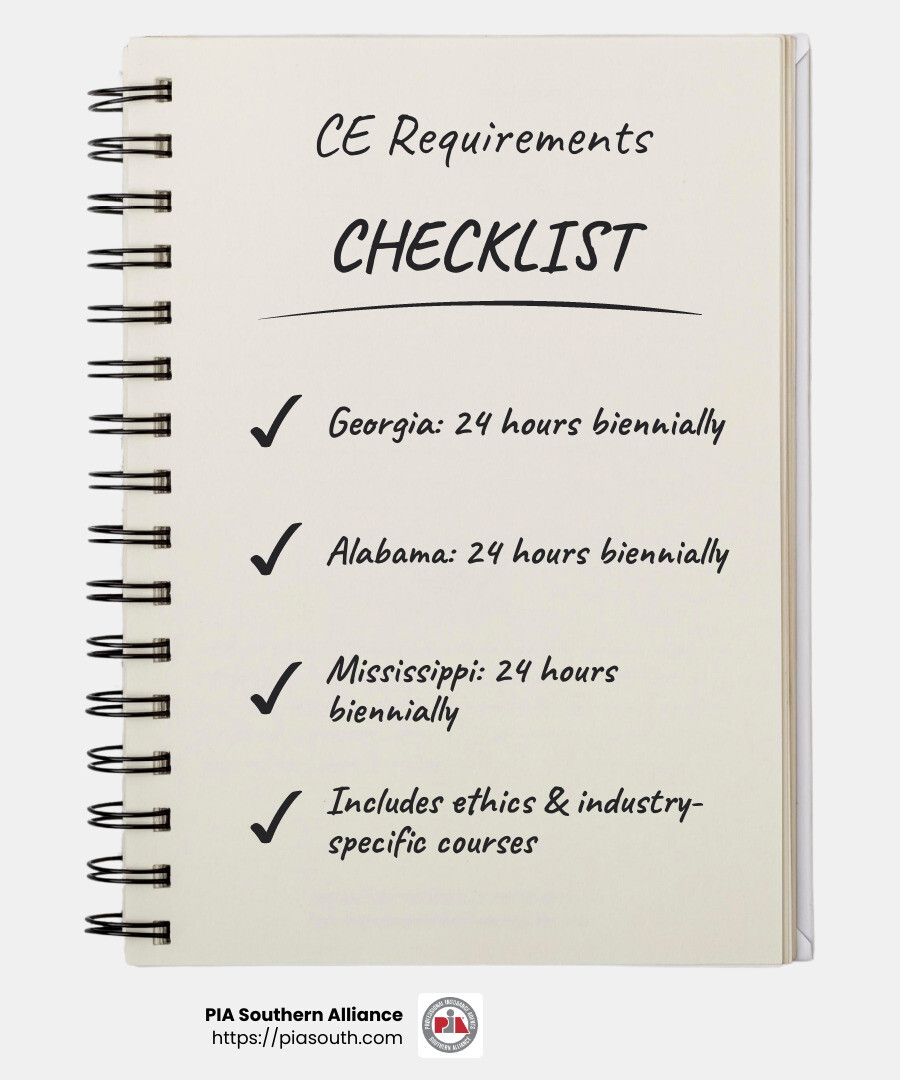
Each state mandates specific continuing education (CE) requirements custom to its regulatory environment. In Georgia, for instance, insurance agents must complete 24 hours of CE every two years. This includes 3 hours focused on ethics to ensure agents uphold high standards in their practice.
Alabama and Mississippi also require 24 hours of CE biennially, with similar emphasis on ethics and industry-specific courses. These requirements are designed to ensure that agents remain knowledgeable about the latest industry trends and regulations.
Property & Casualty Focus
For agents specializing in property and casualty insurance, the focus is on courses that improve understanding of these complex products. Courses might cover topics like risk management, claims handling, and regulatory changes affecting property and casualty policies.
In these states, agents must often complete specific courses related to their specialty. This ensures they not only meet regulatory requirements but also stay competitive in the market.
Compliance Data
Compliance is crucial. In fact, failing to meet CE requirements can result in penalties or even suspension of your license. Fortunately, tools like MYNIPR provide access to compliance data, making it easier for agents to track their CE credits and ensure they’re on track for renewal.
Agents can view their CE transcript data for states like Georgia, Alabama, and Mississippi, helping them stay informed about their progress and any upcoming deadlines.
By keeping up with state regulations and focusing on the right courses, you can steer the insurance continuing ed landscape with ease. This not only ensures compliance but also improves your skills and knowledge, positioning you for success in the industry.
Next, we’ll explore the benefits of continuing education for insurance agents and how it can drive professional growth and strategic decision-making.
Benefits of Insurance Continuing Ed
Continuing education isn’t just about keeping your license active. It’s a powerful tool for professional development and can significantly impact your career as an insurance agent. Let’s explore how insurance continuing ed can improve your skills and open new opportunities.
Professional Development
Continuing education courses are designed to keep you at the forefront of the insurance industry. They cover the latest trends, regulatory updates, and best practices. This ongoing learning ensures that you can provide the best advice and service to your clients. By staying informed, you not only meet state requirements but also build a solid reputation as a knowledgeable and trustworthy professional.
Cross-Selling Skills
One of the most practical benefits of insurance continuing ed is the improvement of cross-selling skills. Courses often include training on a range of products, allowing you to diversify your offerings. For instance, if you’re primarily focused on property and casualty insurance, CE courses can introduce you to other lines like life or health insurance. This broadens your expertise and increases your potential to meet diverse client needs, ultimately boosting your sales.
Strategic Decision-Making
Continuing education also sharpens your ability to make strategic decisions. By understanding the nuances of various insurance products and market dynamics, you can better assess risks and tailor solutions for your clients. This strategic insight is invaluable, helping you advise clients more effectively and position yourself as a key advisor in their decision-making process.

In short, insurance continuing ed is more than a regulatory hurdle; it’s a pathway to career advancement. By investing in your education, you not only ensure compliance but also improve your professional skills, making you a more versatile and valuable agent.
Next, we’ll discuss how to access and complete your CE courses, ensuring you can meet your requirements with ease and flexibility.
How to Access and Complete Your CE Courses
Accessing and completing your insurance continuing ed courses has never been easier. With the rise of online platforms, you can fulfill your CE requirements from the comfort of your home or on the go. Let’s explore how you can make this process smooth and efficient.
Online Courses
Online courses are a game-changer for busy insurance agents. They offer the flexibility to study at your own pace, anytime and anywhere. You can choose from a wide range of topics, ensuring you meet both mandatory and elective requirements. These courses are designed to be user-friendly, with clear instructions and interactive elements to improve learning.
Example: In Georgia, you can take courses on long-term care insurance or annuity best interest training, all from your computer or tablet. This means you don’t need to travel or attend in-person classes, saving you time and effort.
Mobile Compatibility
In today’s world, being able to learn on the go is crucial. Many CE platforms offer mobile-compatible courses, allowing you to study from your smartphone or tablet. This means you can squeeze in study sessions during your lunch break or while commuting.
Quick Tip: While course materials are optimized for larger screens, you can still access key content on your phone. This flexibility ensures you never miss a learning opportunity, no matter where you are.
Flexible Scheduling
One of the biggest advantages of online CE courses is the ability to create a schedule that fits your lifestyle. You can start and stop courses as needed, picking up right where you left off. This is perfect for agents who juggle multiple responsibilities and need to balance work, family, and education.
Pro Tip: Set a study schedule that aligns with your peak productivity times. Whether you’re a morning person or a night owl, online courses allow you to learn when you’re most focused.
By leveraging online courses, mobile compatibility, and flexible scheduling, you can efficiently complete your insurance continuing ed requirements. This approach not only ensures compliance but also empowers you to improve your professional skills at your own pace.
Next, we’ll answer some frequently asked questions about insurance continuing ed to clear up any lingering doubts and help you steer the process with confidence.
Frequently Asked Questions about Insurance Continuing Ed
What is the meaning of continuing education requirement in insurance?
Continuing education (CE) requirements in the insurance field are designed to ensure that insurance agents remain knowledgeable about the latest industry trends, regulations, and best practices. These requirements are set by the state department of insurance and vary from state to state. For example, in Georgia, agents must complete a specific number of CE hours every two years to renew their licenses. This includes mandatory ethics-related courses to uphold high professional standards. The goal is to ensure that agents are well-equipped to provide accurate and ethical advice to their clients.
How many CE hours do I need in Texas?
While we’re focusing on Georgia, Alabama, and Mississippi, it’s useful to know that CE requirements can vary significantly. In Texas, for instance, insurance agents typically need to complete 24 hours of CE every two years. This includes at least 2 hours of ethics-related courses. Some courses can be taken in a classroom equivalent setting, but the flexibility of online courses is often preferred by busy agents. Always check with the Texas Department of Insurance for the most current requirements, as they can change.
How do I check my CE credits in NC?
Checking your CE credits in North Carolina is straightforward. You’ll need to log into the state’s licensing website using your licensee login credentials. Once logged in, you can view your CE record, which shows the number of hours completed and any outstanding requirements. This online system helps agents track their progress and ensure they meet all necessary CE requirements before their license renewal deadline. For those practicing in other states, similar systems are often in place, so be sure to familiarize yourself with the specific process in your area.
By understanding these frequently asked questions, insurance agents can steer their continuing education requirements more effectively, ensuring they remain compliant and up-to-date in their professional knowledge. Next, we’ll wrap up with key resources available through PIA Southern Alliance to help you succeed in your CE journey.
Conclusion
In the changing world of insurance, staying ahead is crucial. This is where PIA Southern Alliance comes into play. We are committed to supporting insurance agents, especially those focusing on property and casualty, by providing top-notch educational resources and development programs.
Our goal is to empower agents in Georgia, Alabama, and Mississippi with the skills they need to excel. Through our specialized webinars and courses, we focus on enhancing cross-selling abilities and strategic decision-making. This not only benefits agents by boosting their sales potential but also ensures they can offer comprehensive coverage options to their clients.
One of the unique aspects of our programs is the focus on commercial property insurance. We understand the complexities of this field and tailor our courses to address these challenges, ensuring agents are well-equipped to meet their clients’ needs.
For those ready to take the next step in their professional journey, explore our education calendar to find the right courses for you. Whether you’re looking to fulfill your continuing education requirements or improve your skills, PIA Southern Alliance is here to be your partner in success.
By choosing us, you’re not just meeting compliance standards; you’re investing in your future as a knowledgeable and trusted insurance professional. Let’s steer the complexities of the insurance industry together and build a successful career.