
Choosing the Right Insurance Client Management System: A Comparison Framework
Let’s face it – choosing the right insurance client management system feels a bit like dating. You need compatibility, long-term potential, and that special spark that makes daily work life enjoyable. For independent agencies across Georgia, Alabama, and Mississippi, this decision can truly transform your business trajectory.
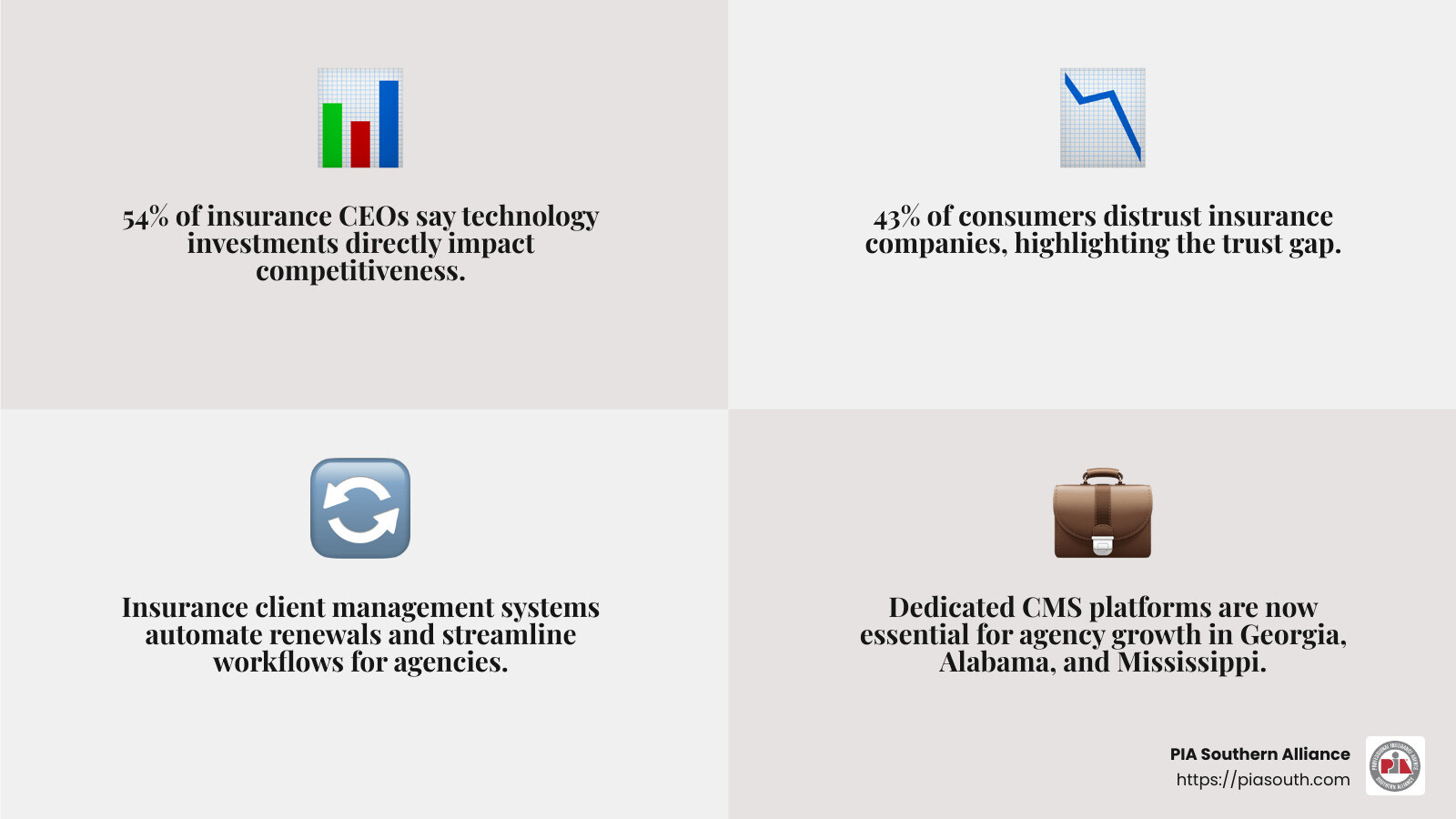
When 54% of insurance CEOs report that technology investments directly impact competitiveness, we’re not just talking about a fancy digital filing cabinet – we’re talking about your agency’s growth engine for years to come.
The stakes are high. Industry data shows that the #1 reason clients leave an agency is lack of communication. That’s particularly troubling when you consider that 43% of consumers already approach insurance companies with skepticism. A robust insurance client management system directly addresses this challenge by automating touchpoints and ensuring your clients feel valued and connected.
Here at PIA Southern Alliance, we’ve guided countless P&C agencies through technology transitions that dramatically improved both efficiency and client retention. Let’s walk through how to make this critical choice.
| System | Best For | Key Features | User Satisfaction |
|---|---|---|---|
| Applied Epic | Mid to large agencies | Policy lifecycle management, integrated benefits | 8.6/10 |
| EZLynx | Small to mid-sized agencies | Combined rating engine & management | High performer |
| AgencyBloc | Health & benefits focus | Commission tracking, lead management | 4.8/5 |
| HawkSoft | Ease of use | Intuitive interface, workflow automation | Top rated |
| Jenesis | Small agencies | Simplicity, affordability | 9.9/10 |
When evaluating systems, start with a thorough needs assessment. What are your agency’s pain points? Are you struggling with renewals, producer management, or client communications? The right system should directly address these challenges.
Consider scalability carefully. That budget-friendly option might work today, but what happens when you add five new producers next year? Look for platforms that grow with you without punishing your success through dramatically escalating costs.
Ease of use might sound basic, but it’s critical. The most feature-rich system fails if your team won’t use it. Request demonstrations with your actual staff involved – their feedback is invaluable.
Be realistic about implementation timeline. The perfect system still requires data migration, staff training, and workflow adjustments. Most agencies underestimate this process by 30-50%. Plan accordingly, especially during busy renewal seasons.
Never overlook support and training options. When you’re stuck at 5pm on a Friday with a client waiting, how quickly can you reach helpful support? What ongoing training is provided as the system evolves?
Security certifications matter tremendously in our industry. Look for SOC 2 compliance at minimum, with clear protocols for data protection and disaster recovery.
Finally, calculate your expected ROI realistically. The best systems pay for themselves through efficiency gains, improved retention, and cross-selling opportunities. For more on maximizing these returns, check out our guide on insurance agency best practices.
Evaluation Checklist for Georgia, Alabama & Mississippi Agencies
Our region has unique considerations that should factor into your decision. Regional regulations vary across our three states, particularly regarding data privacy and electronic signatures. Ensure your chosen system accommodates these nuances.
Catastrophe exposure data management is crucial for our hurricane and tornado-prone region. Look for systems that excel at tracking property details, claims history, and catastrophe modeling integration.
Consider your carrier panels carefully. Does the system integrate seamlessly with your primary carriers? The difference between automatic downloads and manual data entry can mean hours of staff time each week.
Local integrations matter too. Does the system connect with regional payment processors, inspection companies, and other vendors you regularly use? These connections streamline workflows significantly.
Cost Structures & Pricing Models
Understanding the true cost requires looking beyond the initial quote. Most systems use per-user SaaS pricing, but the definition of “user” varies widely. Some count only producers, while others include every staff member who accesses the system.
Watch for tiered modules that might add significant costs. Basic policy management might be affordable, but adding commission tracking, marketing automation, or advanced reporting often comes with premium pricing.
Data migration fees can be substantial surprises. Converting your existing client database, especially from legacy systems, rarely comes free. Get these costs in writing.
Be vigilant about hidden costs like training, support tiers, and system updates. The difference between included and premium support can mean thousands annually for mid-sized agencies.
The right insurance client management system isn’t necessarily the cheapest or the most feature-rich – it’s the one that best aligns with your agency’s unique needs and growth trajectory. Take your time with this decision; it’s one of the most important investments your agency will make.
Understanding the Insurance Client Management System Landscape
At its heart, an insurance client management system is a specialized software solution custom to the unique dance between agencies, clients, and carriers. Unlike generic CRMs that simply track contacts and sales opportunities, these systems accept the full complexity of insurance relationships.
For independent P&C agencies across Georgia, Alabama, and Mississippi, these platforms have become the central nervous system of daily operations. They manage everything from that first exploratory quote conversation through policy issuance, renewal cycles, and those critical moments when claims arise. The best systems provide that elusive “360-degree view” of each client—showing policies, communication history, stored documents, and compliance status all in one place.
“When we talk about client management in insurance, we’re really talking about trust management,” explains a veteran agent from Alabama. “These systems help us deliver consistent service that builds long-term relationships.”
This need for specialized tools has only grown as consumer behaviors shift. Today’s reality is undeniably omnichannel—90% of insurance shoppers start their journey online, yet half still prefer finalizing purchases with a human touch. Modern agencies need technology that seamlessly tracks these cross-platform conversations.
What Makes an Insurance Client Management System Different from Traditional CRM?
The differences between generic CRMs and insurance client management systems go far beyond surface-level features. While traditional CRMs focus on moving contacts through sales funnels, insurance platforms are built around the unique rhythms and requirements of our industry.
Most notably, these systems organize information around policies rather than just contacts. This policy-centric approach lets agents track detailed coverage information, endorsements, and exclusions that would overwhelm a standard CRM. They also include specialized workflows for claims tracking—from first notice of loss through resolution—that simply don’t exist in generic platforms.
Commission management represents another critical difference. Insurance client management systems excel at tracking complex producer splits and reconciling carrier payments—essential capabilities for agency financial health. Many also offer direct carrier connectivity through IVANS, TransactNOW, or proprietary APIs, enabling real-time policy information exchange.
Perhaps most importantly for agencies in Georgia, Alabama, and Mississippi, these specialized systems include built-in audit trails and compliance tools that align with our states’ specific regulatory requirements.
As one satisfied EZLynx user puts it: “The rater and management system work together seamlessly, and all on one platform. In addition, the price is very affordable, it’s easy to use, and their customer support is outstanding! I now use EZLynx for everything.”
Insurance Client Management System vs Agency Management Software: Are They the Same?
The terminology in our industry can sometimes create confusion, particularly between client management systems and agency management software (AMS). While related, they traditionally served different purposes:
Agency Management Software typically casts a wider net, covering accounting functions, commission management, and broader operational concerns. Meanwhile, Client Management Systems dive deeper into relationship nurturing, communication tracking, and sales opportunity management.
In today’s market, however, these distinctions have blurred considerably. Many modern platforms blend these capabilities into integrated solutions that handle both relationship management and operational functions. The key is finding the right balance of depth and breadth for your specific agency needs.
Scalability becomes increasingly important as agencies grow. As one Georgia-based agent shared, “We started with a basic CRM, but as we grew from 3 to 15 agents, we needed something that could grow with us while keeping our client data consistent.”

Core Features Every Modern Platform Should Offer
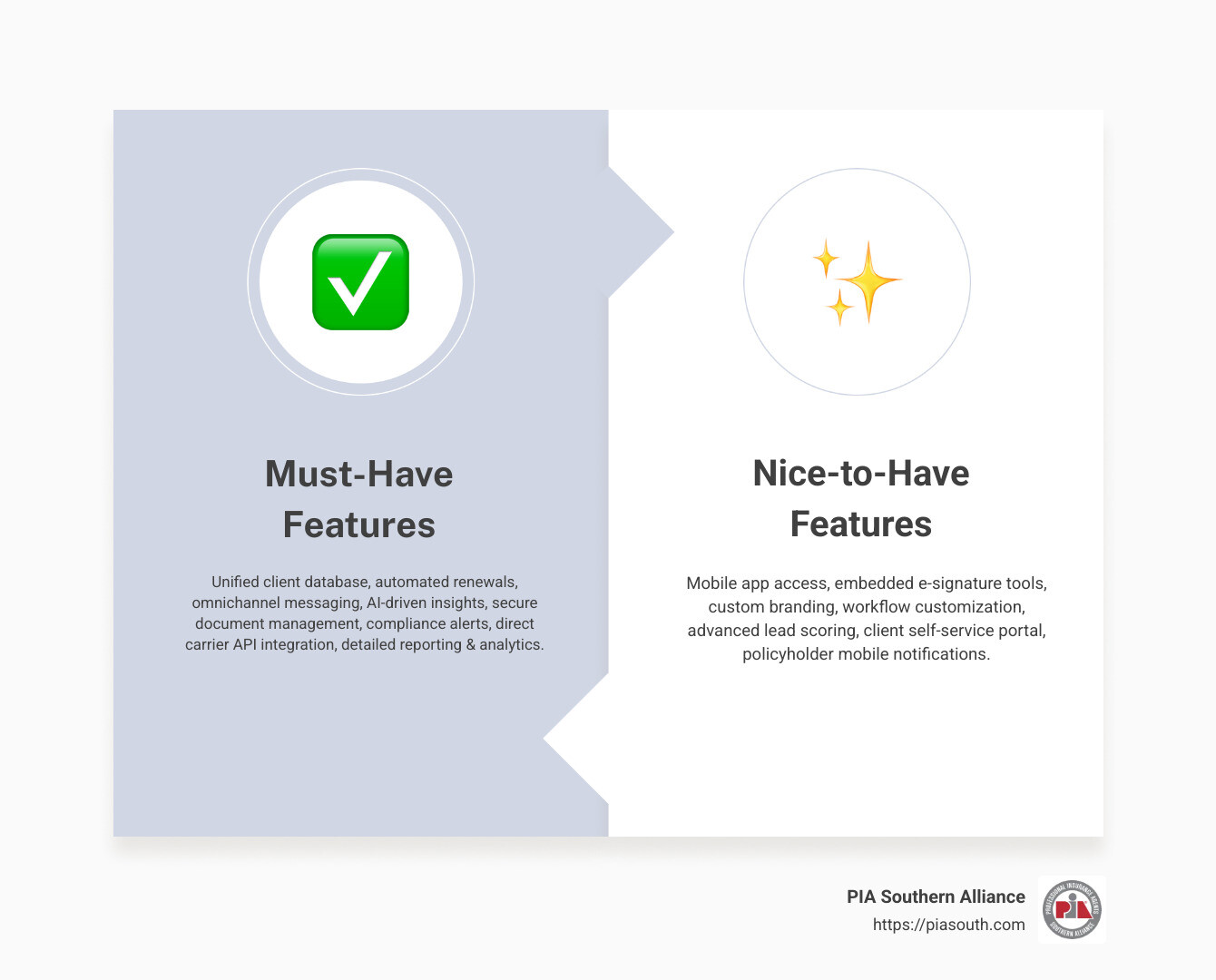
When evaluating an insurance client management system, certain core capabilities should be non-negotiable. These features provide the foundation for efficient agency operations and exceptional client service:
A truly effective system creates a single source of truth where all client information, policies, claims, and communications live together in perfect harmony. For independent agents across Georgia, Alabama, and Mississippi, this eliminates those frustrating information silos that cause so many headaches.
Automated renewals might just be the secret weapon in your retention arsenal. The best systems will flag upcoming renewals, kick off necessary workflows, and generate renewal documents without anyone lifting a finger. One agency owner in Alabama told me, “Our renewal retention jumped 14% just by implementing automated reminders and touchpoints.”
Today’s clients expect to connect with you in whatever way suits them at the moment. Omnichannel communication capabilities let them reach you by email, text, phone, or through a sleek client portal. As one satisfied AgencyBloc user put it: “Take the advice from the agencies that have adopted AgencyBloc; most of them have done their due diligence and they chose AgencyBloc. The big players in the industry are using it, so trust in their choice.”
The power of AI-powered insights can’t be overstated. These tools identify cross-selling opportunities you might miss, flag retention risks before they become problems, and automate those routine tasks nobody wants to do anyway. Industry data tells us that 30% of customers who had a bad claims experience switched insurers within a year—AI helps you spot these relationships at risk before they walk out the door.
Document management might not sound exciting, but when you need to find that specific endorsement from three years ago in seconds rather than hours, you’ll appreciate secure storage, version control, and easy retrieval systems.
For agencies operating in Georgia, Alabama, and Mississippi, compliance alerts are worth their weight in gold. Each state has its own regulatory quirks, and automated compliance monitoring helps you avoid those costly violations that keep agency owners up at night.
Carrier API downloads dramatically reduce manual data entry (and the errors that come with it). Direct integration with carrier systems ensures your policy information stays accurate and current without constant updating.
Comprehensive reporting and analytics give you the insights to make smarter decisions about your agency’s future. From book of business composition to retention metrics, these tools help you understand where you’ve been and where you’re headed.
Policy & Document Automation
Let’s be honest—document handling can be the bane of an insurance agency’s existence. Modern insurance client management systems tackle this challenge head-on with clever automations that save countless hours.
Those prefilled ACORD forms alone can transform your day. By pulling client and policy data directly from your system, forms practically fill themselves. A Georgia agent recently told me, “What used to take 15 minutes now takes 30 seconds. Do that math across a week, and you’ve found hours of productive time.”
E-signatures have revolutionized the closing process. Remember the days of printing, signing, scanning, and emailing? Or worse—physical mail? As one Mississippi agent put it, “What used to take days of mailing documents back and forth now happens in hours.” Your clients appreciate this convenience as much as you do.
With automatic version control, everyone on your team works from the most current information. This is particularly valuable for policies with frequent endorsements or complex coverage structures. No more awkward calls where you realize you’re discussing different versions of the same document.
Detailed audit logs provide peace of mind by tracking who accessed or modified documents and when. This supports both compliance requirements and offers valuable E&O protection when questions arise down the road.
AI-Powered Sales & Marketing Tools
Artificial intelligence isn’t just for tech giants anymore—it’s changing how savvy insurance agencies identify and pursue sales opportunities.
Lead scoring algorithms analyze prospect data and behavior patterns to help you prioritize your efforts. Instead of treating all leads equally, these tools help you focus where you’re most likely to succeed. A small agency in Alabama reported converting 22% more leads after implementing AI-based scoring.
Churn prediction might be the most valuable AI application for established agencies. By analyzing patterns in client behavior and policy changes, these tools flag accounts at risk of non-renewal, giving you time for proactive retention efforts. Keeping an existing client costs far less than acquiring a new one.
Smart systems provide cross-sell prompts by identifying coverage gaps based on client profiles. For example, a homeowner in coastal Mississippi might receive an automatic prompt about flood insurance options, or a small business client in Georgia might get a reminder about cyber liability coverage.
Hyper-personalized campaigns take marketing effectiveness to another level. AI enables targeted outreach based on detailed client data, life events, and behavioral triggers. According to a Zoho CRM case study, “Our bottom line has increased by over $100K per year from the cost savings alone. That’s not including the increased revenue due to our improved customer experience.”
Mobile capabilities are increasingly important, with mobile app revenues projected to reach around $613 billion by 2025, according to Statista research.
Commission & Revenue Management
Following the money matters, and advanced insurance client management systems offer sophisticated tools to help you track every dollar.
Producer splits can get complicated fast, especially in collaborative agencies. Automated calculation and tracking ensures fair compensation when multiple producers handle different aspects of a client relationship. This transparency builds trust within your team and eliminates compensation disputes.
Commission reconciliation might sound mundane until you find missing payments. Automatic matching of carrier commission statements against expected earnings helps identify discrepancies that might otherwise slip through the cracks. One AgencyBloc user shared, “We found thousands of dollars in previously missed commission payments in our first month of using the system.”
Real-time dashboards give agency owners immediate insights into performance metrics that matter. Instead of waiting for monthly reports, you can see production, revenue, and profitability metrics as they happen, allowing for faster course corrections when needed.
Beyond simple revenue tracking, advanced profitability metrics help measure client and policy profitability, supporting strategic decisions about market focus. A Mississippi agency owner noted, “We finded our farm policies were actually more profitable than commercial auto, despite lower premiums. That completely changed our marketing strategy.”
How an Insurance Client Management System Boosts Agency Efficiency
The right insurance client management system doesn’t just digitize your agency—it transforms how you operate from the ground up. When implemented thoughtfully, these systems create ripple effects of efficiency throughout your entire organization.

Think about your daily operations. How much time does your team spend on repetitive tasks? With workflow automation, standard processes like policy renewals and endorsements follow consistent, predefined paths—reducing human error and freeing up your staff for what really matters: building client relationships.
“The day we stopped entering the same information three different times was the day our agency started growing,” shares one agency owner from Alabama. Reduced double entry isn’t just a convenience—it’s a competitive advantage. When your systems talk to each other, your data flows seamlessly from quoting to policy management to accounting.
Your staff productivity skyrockets when information is at their fingertips. No more hunting through filing cabinets or searching through email threads. Everything they need is in one place, allowing them to handle higher volumes of work without burning out. One agency reported saving “4× the cost of AgencyBloc just in administrative work” after implementation.
Perhaps most importantly, these systems drive meaningful retention gains. We all know the math—acquiring a new client costs 5-7 times more than keeping an existing one. Automated renewal workflows and timely communication touchpoints keep clients feeling valued and informed, dramatically reducing churn.
When claims happen (and they always do), claims cycle time matters enormously to client satisfaction. Modern systems streamline the process from first notice of loss to resolution, turning a potentially negative experience into a loyalty-building moment.
Client satisfaction isn’t just about handling claims well, though. It’s about consistent communication, quick responses, and making clients feel remembered. As one agency put it, “We would not be able to maintain the reputation we have without our management system.”
For agencies across Georgia, Alabama, and Mississippi, where hurricane season and severe weather can disrupt office operations, remote work enablement isn’t just nice to have—it’s essential for business continuity. Cloud-based systems ensure your team can serve clients effectively from anywhere.
Real-World Wins for Independent Agencies
The numbers don’t lie. When agencies implement the right insurance client management system, the results can be remarkable:
A mid-sized agency in Georgia saw a 30% reduction in client churn after implementing automated renewal workflows. Think about what that means for your bottom line—if you typically lose 100 clients annually, keeping 30 more each year compounds your growth dramatically.
Administrative savings add up quickly. “This transition has saved us 4× the cost of AgencyBloc just in administrative work,” reported one agency owner. ROI isn’t theoretical—it’s measurable and significant.
Speed matters in today’s market. One AgencyBloc user shared, “We can now send initial quotes in 10-15 minutes after we get the census. Quote+ has been a huge benefit and advantage for us.” When prospects are shopping multiple agencies, being first with a quote often wins the business.
The paperless efficiency gains extend beyond just saving trees. Agencies report reclaiming office space previously devoted to file storage, reducing printing costs, and eliminating the frustration of misplaced documents. “Go DIGITAL and say goodbye to all those paper documents! Access every information you need in just a few clicks,” as one system vendor aptly puts it.
Smart agencies leverage these systems for cross-selling success. With better visibility into existing clients’ coverage, identifying gaps becomes systematic rather than occasional. An Alabama agency reported a 22% increase in policies per household after implementing cross-sell alerts—turning single-policy clients into multi-line relationships.
For agency owners, clear visibility into producer performance transforms management from gut feeling to data-driven coaching. “I am able to manage my insurance agency and my team in a much easier way,” noted one principal, highlighting how these systems support leadership as well as operations.
Challenges When Agencies Operate Without a Dedicated System
If your agency hasn’t yet adopted a specialized insurance client management system, you’re likely familiar with these pain points:
Siloed spreadsheets create information islands that nobody can steer efficiently. When client data lives in multiple places—some on spreadsheets, some in email, some in paper files—inconsistencies multiply and nothing feels reliable.
The cost of missed renewals goes beyond lost commissions. Each oversight damages client relationships and agency reputation. Without automated tracking, even the most diligent staff will occasionally let policies slip through the cracks.
For agencies operating across Georgia, Alabama, and Mississippi, compliance risk increases dramatically without systematic documentation. Each state has its own regulatory requirements, and manual processes make consistent compliance nearly impossible.
When new producers join your team, slow onboarding delays their productivity. Without structured workflows and centralized information, the learning curve steepens unnecessarily. What could take days instead takes months.
Agency owners lacking limited visibility into performance metrics make decisions in the dark. Which products are most profitable? Which producers need coaching? Which marketing efforts are working? Without data, it’s all guesswork.
Perhaps most costly are the client communication gaps that develop without automated touchpoints. As industry research consistently shows, “The #1 reason clients leave an agency is due to lack of communication.” When clients feel forgotten, they start shopping around—and in today’s competitive market, someone else is always happy to quote them.
At PIA Southern Alliance, we’ve seen how the right technology transforms agencies across our tri-state region. The difference between struggling with outdated systems and thriving with modern tools isn’t just operational—it’s existential in today’s digital insurance landscape.
Choosing the Right Insurance Client Management System: A Comparison Framework
Finding the perfect insurance client management system for your agency isn’t just about features and price tags—it’s about finding a technology partner that understands the unique rhythm of your business. As independent agencies across Georgia, Alabama, and Mississippi have finded, the right system can be transformative, while the wrong choice can lead to frustration and wasted resources.

Needs Assessment
Start by gathering your team around the table—literally or virtually—to map out what’s working and what isn’t in your current processes. The front-line CSRs who handle client calls daily often have the most valuable insights about workflow bottlenecks. Your producers can highlight sales problems, while your accounting team can pinpoint commission tracking headaches.
“We thought we knew exactly what we needed until we actually sat down with our staff,” shares one agency owner from Biloxi. “Our receptionist identified issues none of the managers had even considered.”
Scalability
Today’s cozy five-person agency might be tomorrow’s regional powerhouse. The system you choose should be able to grow alongside you without requiring a painful migration down the road.
Ask vendors pointed questions: How many users can the system support? Is there a limit on policy counts? Will adding specialty lines require expensive customization? Many agencies in our region have experienced growing pains when their initial system choice couldn’t keep pace with their success.
Ease of Use
A beautiful system with all the bells and whistles is worthless if your team avoids using it. User-friendly interfaces and intuitive workflows make all the difference in adoption rates.
Jenesis consistently earns praise in this area, with one reviewer noting its “user satisfaction score of 9.9/10 for business partnership.” When evaluating systems, bring in staff members with varying technical abilities to test-drive the interface. Their feedback will be invaluable.
Implementation Timeline
The transition period can be challenging, especially for busy agencies. Some vendors have dramatically improved their onboarding processes, reducing implementation from six months to as little as two months. Ask about data migration timelines, training schedules, and what resources you’ll need to dedicate during the transition.
“We planned our implementation during our traditionally slower season,” advises an agency owner from Montgomery. “That breathing room made all the difference in our success.”
Support & Training
Even the most intuitive systems require support at times. Investigate the vendor’s support hours (especially important for those early morning or late evening emergencies), available channels, and typical response times.
Training resources matter too—are there on-demand videos, regular webinars, or in-person options? EZLynx users frequently mention that “their customer support is outstanding!” in reviews, highlighting the importance of responsive help when you need it.
Security Certifications
With cyber threats growing more sophisticated daily, security can’t be an afterthought. Verify that any system you’re considering meets industry standards for data protection, particularly for handling sensitive client information.
Look for SOC 2 compliance, data encryption practices, and regular security audits. As an agency, you’re not just protecting your business—you’re safeguarding your clients’ most sensitive personal and financial information.
ROI Modeling
While it’s tempting to focus on the monthly subscription cost, the true measure of value comes from understanding the full return on investment. Work with vendors to develop realistic projections of time savings, retention improvements, and new business opportunities.
A thoughtful ROI model should include both hard savings (reduced paperwork, fewer E&O claims) and soft benefits (improved client experience, staff satisfaction). One Alabama agency calculated a complete return on their investment within nine months, primarily through administrative time savings and improved renewal retention.
Evaluation Checklist for Georgia, Alabama & Mississippi Agencies
Our southeastern region presents unique challenges that should influence your selection process:
Regional Regulations deserve special attention. Each state has its own regulatory quirks, particularly around documentation requirements and disclosure forms. Your system should support compliance with Georgia, Alabama, and Mississippi regulations without creating administrative headaches.
Catastrophe Exposure Data tracking is crucial in our hurricane-prone region. Look for systems that can generate quick reports showing your exposure concentration in coastal areas and support efficient claims handling during major weather events. This capability alone can save countless hours during the chaos following a major storm.
Carrier Panels vary significantly by region. Ensure the system integrates smoothly with the carriers most relevant to your specific book of business. An otherwise perfect system that doesn’t connect with your primary carriers will create daily frustrations.
Local Integrations with regional service providers can streamline operations. Does the system connect with the flood zone determination tools, inspection companies, and restoration contractors you use regularly? These connections can eliminate significant manual work.
Mobile Capabilities aren’t just nice-to-have in our region—they’re essential. When offices close due to hurricanes or severe weather, robust mobile access ensures business continuity for both your team and your clients.
Cost Structures & Pricing Models
Understanding the various pricing approaches helps avoid budget surprises down the road:
Most modern systems use per-user SaaS subscriptions, typically ranging from $50-$200 monthly depending on features included. This model scales naturally with your agency growth, but watch for minimum user requirements that might inflate costs for very small agencies.
Many vendors offer tiered modules with core functionality at a base price and add-ons available for specific needs. This approach lets you pay only for what you’ll use, but be wary of finding yourself needing multiple add-ons that significantly increase your total cost.
Data migration fees often catch agencies by surprise. Converting data from legacy systems typically incurs one-time charges that vary based on your existing data’s complexity and cleanliness. Get detailed quotes for this work upfront.
Watch for hidden costs in storage limits, API calls, document generation, or excess users. As one Georgia agency owner warns, “We budgeted for the monthly subscription but didn’t anticipate the overage charges for document storage. Those added nearly 20% to our annual cost.”
The right insurance client management system is an investment in your agency’s future. By taking a methodical approach to selection, you’ll find a system that not only meets today’s needs but positions you for long-term growth and efficiency. You can always reach out to PIA Southern Alliance for guidance specific to our region’s unique challenges.
Future Trends: AI, Automation & Omnichannel Engagement
The insurance client management system landscape is evolving at a breathtaking pace. For independent agencies across Georgia, Alabama, and Mississippi, staying ahead of these trends isn’t just about having shiny new tools—it’s about maintaining competitive advantage in an increasingly digital marketplace.
Generative AI Summaries
Remember those hours spent crafting policy summaries and claim narratives? Generative AI is changing the game. Today’s most advanced systems can automatically create personalized client communications while maintaining your agency’s unique voice.
“It’s like having a skilled writer on staff who never takes a vacation,” jokes one Georgia agency principal. “Our clients get consistent, clear explanations without our team spending hours drafting them.”
Chatbots
Virtual assistants have moved far beyond basic FAQ responders. Modern insurance client management systems now offer sophisticated chatbots that can answer policy questions, provide certificates of insurance, and even initiate claims—all while your human team focuses on more complex client needs.

Voice-Activated Service
For producers constantly on the move between client sites across rural Alabama or Mississippi, voice interfaces are a game-changer. The ability to update records hands-free or pull up policy details while driving transforms previously lost time into productive work hours.
“I can dictate notes right after leaving a client meeting while everything is fresh in my mind,” shares a veteran producer. “The accuracy is remarkable, and it keeps me from having a backlog of paperwork.”
Predictive Renewals
Gone are the days of one-size-fits-all renewal strategies. Today’s advanced analytics can predict renewal likelihood with remarkable accuracy and suggest custom retention approaches based on client history, market conditions, and even social media sentiment.
For example, a coastal Mississippi homeowner facing a significant premium increase might receive a different retention strategy than an inland commercial client with multiple policies. These nuanced approaches are proving to be significantly more effective than traditional methods.
API Ecosystems
The most powerful insurance client management systems no longer try to do everything. Instead, they serve as hubs within broader technology ecosystems, connecting seamlessly with specialized insurtech solutions through open APIs.
This approach allows independent agencies to create customized technology stacks that perfectly match their unique business models and client needs. An agency focusing on high-net-worth coastal properties in Georgia might integrate specialized flood modeling tools, while one serving small businesses in Alabama might prioritize workers’ compensation compliance modules.
Embedded Insurance
Forward-thinking agencies are leveraging their client management systems to support embedded insurance models, where coverage is seamlessly integrated into related purchases. For example, a system might enable offering equipment breakdown coverage at the point of sale for commercial equipment dealers.
According to G2 Grid® Scoring, systems supporting these advanced capabilities consistently rank higher in user satisfaction and market presence, with top performers achieving scores above 4.5/5 in innovation metrics.
Data Security & Regulatory Compliance
With great data comes great responsibility. As insurance client management systems store increasingly sensitive client information, security has become a non-negotiable priority.
Two-Factor Authentication has become standard across enterprise-grade systems, providing an essential layer of protection against unauthorized access. For agencies handling sensitive data across multiple states, this basic security measure is just the starting point.
SOC 2 Compliance goes deeper, with rigorous third-party security audits verifying that vendors follow strict information security policies. When evaluating systems, ask specifically for SOC 2 Type II certification, which tests controls over an extended period rather than just a point-in-time snapshot.
GDPR/NAIC Alignment matters even for agencies exclusively serving Georgia, Alabama, and Mississippi. Systems designed with these global and national standards in mind provide better protection against evolving domestic regulations and demonstrate a commitment to client privacy.
Disaster Recovery capabilities are particularly critical for agencies in hurricane-prone regions. Robust backup protocols and geographically distributed data centers ensure business continuity even during regional disasters when clients need you most.
Integrations & Open APIs
Today’s most effective insurance client management systems don’t operate in isolation—they’re the central hub of a connected technology ecosystem.
Core Policy Systems integration reduces the tedious double-entry that drains staff productivity. When a policy change happens in the carrier system, it automatically updates in your CMS, ensuring everyone works from the same information.
Rating Engines connected directly to your client management platform streamline the quoting process dramatically. “What used to take us 30 minutes now happens in under five,” reports an Alabama commercial lines agent.
Marketing Stacks integration creates a cohesive client communication strategy where your email campaigns, social media, and content management all draw from and feed back into your client data.
Finance Applications connected to your CMS provide a complete financial picture, from initial quote to policy issuance, premium collection, and commission management.
As one satisfied user put it, “It’s not just about having great individual tools—it’s about how seamlessly they work together.” This integration capability has become perhaps the most important differentiator when selecting a modern insurance client management system for your agency’s future.
Frequently Asked Questions About Insurance Client Management Systems
How much does an insurance client management system typically cost?
When budgeting for an insurance client management system, independent agencies across Georgia, Alabama, and Mississippi often ask about costs first. The truth is, pricing varies significantly based on your agency’s size and needs.
Most systems use a per-user subscription model with monthly fees typically ranging from $50-$200 per user. A small agency might invest $5,000-$15,000 in the first year (including setup), while larger operations could spend $20,000-$100,000+ depending on complexity.
Beyond the monthly subscription, consider these potential additional expenses:
- One-time implementation and data migration ($1,000-$10,000+)
- Staff training programs ($500-$5,000)
- Optional specialized modules or add-ons
The good news? Many vendors offer special pricing for smaller agencies or startups. As one satisfied user shared, “I’m gonna be saving over $400 a month just between the phone system and another data program” after consolidating their technology on AgencyBloc.
Can a CMS integrate with my existing policy administration platform?
Integration capabilities are crucial when selecting an insurance client management system, especially for established agencies with existing technology investments. Most modern systems offer connectivity with popular policy administration platforms, though the depth and ease of these connections vary significantly.
These integrations typically happen through direct API connections, IVANS or TransactNOW interfaces, batch file imports/exports, or custom integration services. Before making your decision, verify compatibility with your specific platforms and understand any limitations in how data will synchronize between systems.
Some vendors provide pre-built connectors to common systems used by P&C agencies in the Southeast, while others may require custom development work. As one Applied Epic user explained, “Applied Epic is a management system that centralizes various functions such as accounting, policy information, client information, and employee records, and allows for easy navigation and application of changes to files.”
For agencies across Georgia, Alabama, and Mississippi, carrier connectivity is particularly important given the unique catastrophe exposures and regional markets served.
What ROI should agencies expect within the first year?
The return on investment for an insurance client management system comes from multiple sources, often delivering meaningful results within the first year. Most agencies achieve full ROI within 6-18 months, with smaller operations typically seeing faster returns due to lower implementation costs.
Administrative efficiency is usually the first noticeable benefit, with many agencies reporting 15-30% time savings for CSRs and producers through reduced paperwork and streamlined workflows. “This transition has saved us 4× the cost of AgencyBloc just in administrative work,” reported one agency owner.
Improved retention represents another significant ROI driver. Automated renewal workflows and proactive client communication typically increase retention by 5-10% – particularly valuable in today’s competitive market across the Southeast.
Cross-selling success improves as staff gain better visibility into coverage gaps, usually increasing policies per client by 10-20%. For P&C agencies in Georgia, Alabama, and Mississippi, this ability to identify additional protection needs (like flood insurance in coastal areas) delivers both revenue growth and better client protection.
Producer productivity often rises by 15-25% through streamlined workflows. One agency noted, “Since implementing Quote+, we’ve been able to significantly increase our companies under management and the premiums generated by them, while also decreasing our average sales cycle.”
While the initial investment may seem significant, the combined impact of these improvements typically delivers substantial returns that continue growing over time.
Conclusion
Selecting the right insurance client management system is one of the most consequential decisions an independent agency can make. The system you choose will influence nearly every aspect of your operation—from client acquisition and retention to staff productivity and financial management.
For P&C agencies across Georgia, Alabama, and Mississippi, these systems have evolved from nice-to-have technology to essential business infrastructure. With 54% of insurance CEOs reporting that technology investments directly impact competitiveness, agencies that fail to adopt modern client management capabilities risk falling behind more digitally savvy competitors.
The good news is that the market now offers solutions custom to agencies of every size and specialty. Whether you’re a small agency focused on personal lines or a larger firm with complex commercial accounts, there’s a system designed to meet your specific needs.
As you evaluate options, implementation is just the beginning. The most successful agencies approach their client management system as a strategic asset that requires ongoing refinement and optimization. Regular training, process reviews, and feature updates ensure you continue to extract maximum value from your investment.
At PIA Southern Alliance, we’re committed to helping independent agencies across our tri-state region steer the complex technology landscape. Through our educational resources, development programs, and member services, we provide the guidance agencies need to make informed technology decisions that drive sustainable growth.
The insurance landscape continues to evolve, but one thing remains constant: agencies that effectively leverage technology to improve client relationships will always have a competitive advantage. The right insurance client management system isn’t just about managing data—it’s about creating exceptional client experiences that build trust, loyalty, and long-term profitability.
Learn more about Insurance Agency Client Management Software