
Why Insurance Certifications Matter for Your Agency’s Success
Insurance certifications are professional designations that demonstrate specialized knowledge and expertise in specific areas of insurance. These credentials can significantly improve your career and agency’s success.
Top Insurance Certifications for P&C Agents:
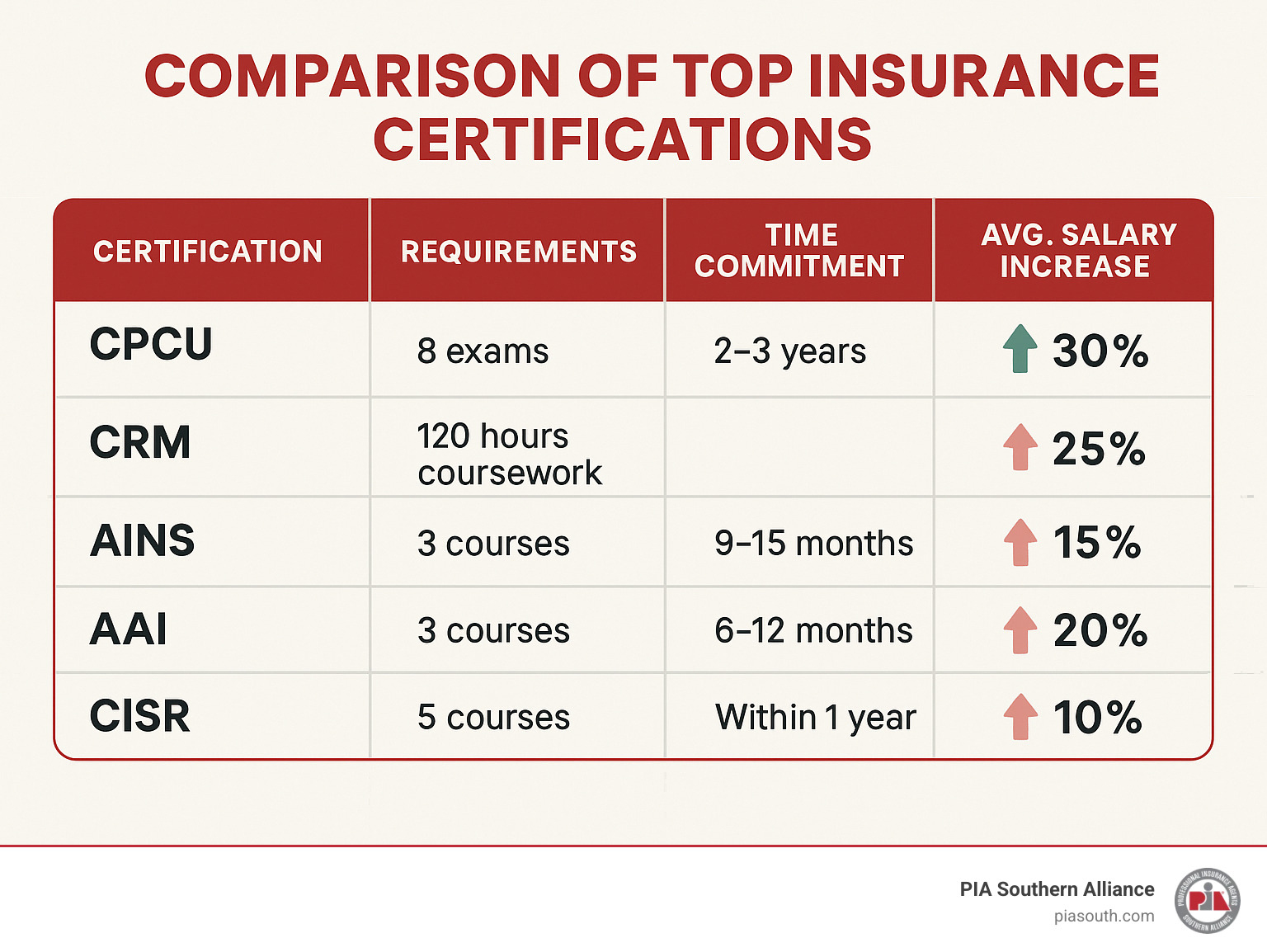
- CPCU (Chartered Property Casualty Underwriter) – The highest-level designation requiring 8 exams over 2-3 years
- CRM (Certified Risk Manager) – Focused on risk management with 120 hours of coursework
- AINS (Associate in General Insurance) – Entry-level designation taking 9-15 months to complete
- AAI (Accredited Adviser in Insurance) – Sales-focused designation with client relationship emphasis
- CISR (Certified Insurance Service Representative) – Customer service focused requiring 5 of 9 courses
For independent agency owners in Georgia, Alabama, and Mississippi, earning these credentials can boost your income by up to 30% while enhancing client trust and agency credibility. Unlike basic state licensing, these designations demonstrate deeper expertise in complex insurance matters and strengthen your agency’s competitive position.
The PIA Southern Alliance provides resources and support for independent agents seeking to advance their careers through professional development. With a focus on promoting the highest standards of care for consumers and the industry throughout the Southeast, we’re committed to helping you protect your clients while growing your business through quality education.
Key terms for insurance certifications:
– health insurance certification programs
– insurance agent license
Why Insurance Certifications Matter in P&C Agency Success
In today’s competitive insurance landscape across Georgia, Alabama, and Mississippi, having the right insurance certifications isn’t just a nice addition to your resume—it’s become essential for your agency’s growth and long-term success. As independent agents face increasing competition and clients with increasingly complex needs, professional designations provide a clear path to standing out from the crowd.
The numbers tell a compelling story. Research consistently shows that agents with professional designations earn significantly more than their non-certified colleagues. Industry data reveals professionals with certain designations can earn up to 15% higher income than the market average, with prestigious certifications like the CPCU potentially boosting earnings even further. That’s real money in your pocket for investing in your expertise.
But the value goes well beyond just financial rewards. When your business card and email signature display respected industry credentials, clients immediately recognize your commitment to excellence. This trust factor is particularly important in our southeastern states, where business relationships are built on personal connections and reputation.
“The certifications on my card aren’t just letters—they’re conversation starters that immediately establish credibility with new prospects,” shares one successful agency owner in Mississippi.
Many of these insurance certifications also satisfy the continuing education (CE) requirements mandated by Georgia, Alabama, and Mississippi. This dual benefit means you’re simultaneously maintaining your license requirements while building specialized expertise that sets you apart in the marketplace.
For those newer to the industry, a risk management degree provides an excellent foundation, but insurance certifications build upon that knowledge with practical, specialized training directly applicable to daily agency operations. According to scientific research on career benefits, professional credentials significantly improve employability and career advancement opportunities.
The Competitive Edge of Insurance Certifications
The advantages of earning insurance certifications extend far beyond just adding knowledge:
Substantial Salary Bump: The data doesn’t lie—certified professionals can earn up to 30% more than their non-certified peers. For an established agent, this could represent tens of thousands of additional dollars annually.
Hiring Advantage: In today’s competitive job market where agencies are fighting for top talent, candidates with professional designations stand out immediately. Agency principals often place resumes with relevant certifications at the top of their consideration pile.
Job Satisfaction: Interestingly, certified professionals consistently report higher job satisfaction. This likely stems from increased confidence in their abilities, greater respect from colleagues and clients, and improved career advancement opportunities.
One Georgia agency principal put it perfectly: “The investment in my team’s certifications has paid dividends not just in new business, but in retention—both of clients and our top-performing staff.”
Licenses vs. Certifications
Understanding the fundamental difference between state licenses and professional certifications helps clarify their distinct roles in your career:
State Insurance Licenses:
– Mandatory legal requirement to sell insurance
– Focus on basic regulatory knowledge and minimum competency standards
– Renewal through basic CE credits
– The permission to operate in the industry
Insurance Certifications:
– Voluntary professional development showcasing your commitment
– In-depth specialized knowledge in specific areas of insurance
– Advanced professional standards recognized industry-wide
– Maintenance through more rigorous continuing education
While your license is the foundation that grants permission to sell insurance products, insurance certifications demonstrate your commitment to excellence and specialized expertise. Think of licensing as the starting point of your journey and certifications as the vehicles that take your career to new heights.
In Georgia, Alabama, and Mississippi, successful agents need both to truly thrive. Your license keeps you in business, but your certifications help your business grow exponentially by opening doors to new markets, more complex risks, and higher-value clients.
Quick-Glance List of Must-Have Insurance Certifications

Navigating insurance certifications can feel overwhelming, especially when you’re trying to determine which ones will give you the biggest bang for your buck. Let’s break down the most valuable designations for P&C agents across Georgia, Alabama, and Mississippi – think of this as your roadmap to professional growth!
Top 3 Entry-Level Insurance Certifications
The AINS (Associate in General Insurance) is perfect for newcomers to the industry. Taking about 9-15 months to complete at a cost of $1,200-$2,000, this certification builds a rock-solid foundation of P&C knowledge. I’ve seen many agents use this as their springboard into more specialized areas.
If you’re looking to sharpen your sales skills, the AAI (Accredited Adviser in Insurance) might be your perfect match. This 3-6 month program ($1,500-$2,500) focuses on relationship-building techniques that can dramatically improve your closing rates. Many agents in our southern states have told me this certification helped them connect more authentically with clients.
The AIS (Associate in Insurance Services) rounds out our entry-level trio, taking 6-12 months and costing $1,000-$1,800. This customer service-focused designation is particularly valuable for CSRs and account managers who want to streamline operations while delivering exceptional client experiences.
Top 4 Advanced Insurance Certifications
Often called the “PhD of insurance,” the CPCU (Chartered Property Casualty Underwriter) is the gold standard of P&C designations. Yes, it’s a commitment – 2-3 years and $6,000-$9,000 – but agency leaders who’ve earned this credential consistently report it was worth every penny and late-night study session.
For those working with complex commercial risks, the CRM (Certified Risk Manager) offers tremendous value. The 120 hours of coursework (typically spread over 1-2 years at $3,500-$5,000) equips you with sophisticated risk assessment strategies that clients genuinely appreciate.
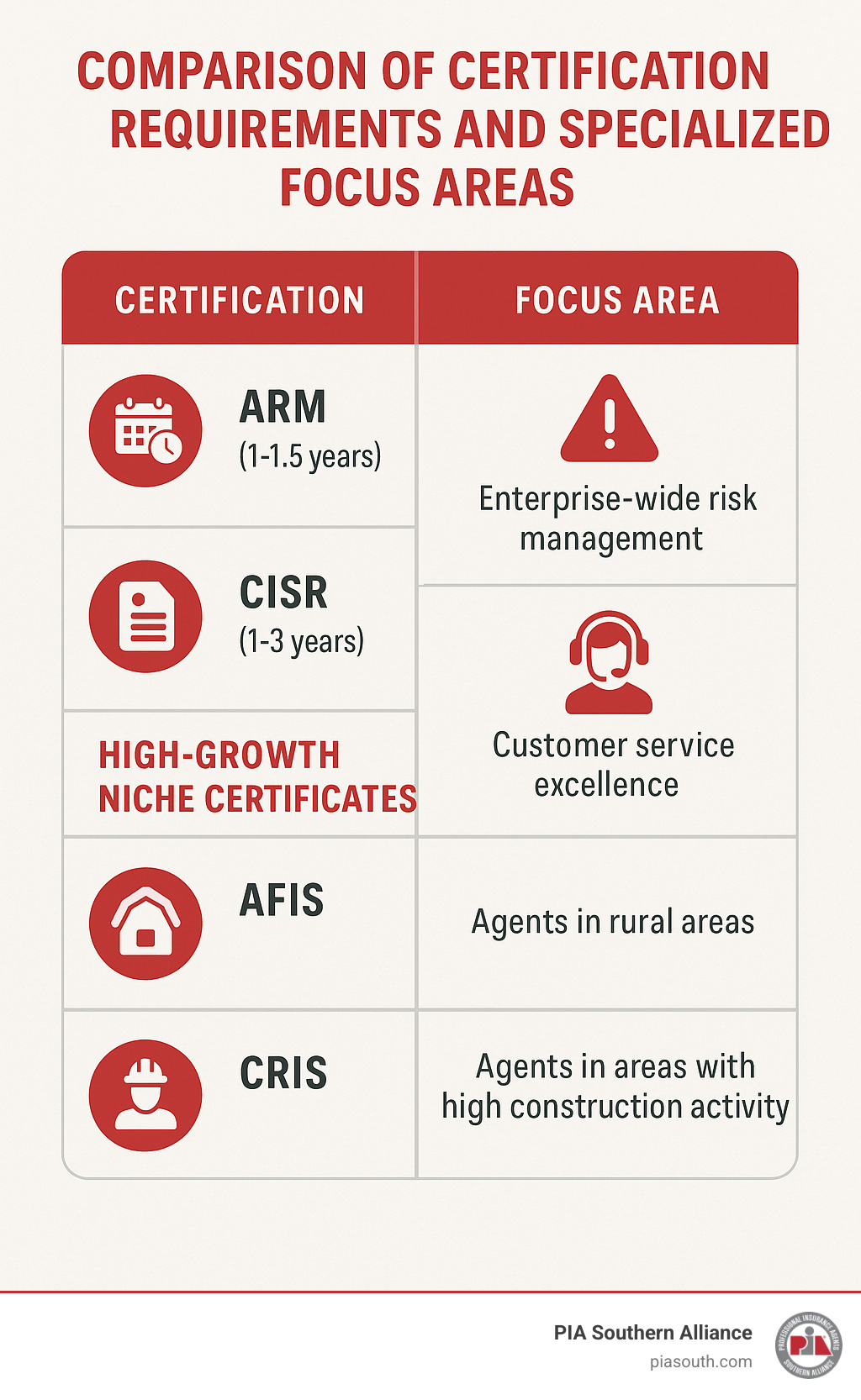
The ARM (Associate in Risk Management) takes a broader approach, focusing on enterprise-wide risk management over its 1-1.5 year program ($2,500-$4,000). Commercial lines specialists working with larger businesses throughout our southeastern states find this designation particularly relevant.
Rounding out the advanced options, the CISR (Certified Insurance Service Representative) balances technical knowledge with service excellence. This flexible program (1-3 years, $1,500-$2,500) allows you to choose from various modules to customize your learning path.
High-Growth Niche Certificates
The Southeast’s diverse economy creates unique opportunities for specialization. The AFIS (Agribusiness and Farm Insurance Specialist) is invaluable for agents serving Georgia, Alabama, and Mississippi’s thriving agricultural communities.
With construction booming across our region, the CRIS (Construction Risk Insurance Specialist) positions you as the go-to expert for contractors and developers.
For agents working with corporate clients, the MLIS (Management Liability Insurance Specialist) provides critical insights into directors and officers liability, employment practices, and cyber exposures.
Finally, our region’s strategic location as a transportation hub makes the TRIP (Transportation Risk and Insurance Professional) increasingly valuable for agents serving trucking and logistics companies.
When choosing your certification path, consider both your current role and where you want to be in five years. Many successful agents in our southern states start with an entry-level designation, then add specialized certifications as they identify their niche markets. The best investment isn’t necessarily the most expensive one – it’s the one that aligns with your unique client base and career aspirations.
Entry-Level Insurance Certifications to Jump-Start Your Career
Starting your insurance career on the right foot means choosing the best foundational insurance certifications to build your expertise. For newer agents in Georgia, Alabama, and Mississippi, these entry-level designations can help you establish credibility quickly without overwhelming time commitments.
These certifications aren’t just resume boosters—they’re practical tools that will improve your daily client interactions and boost your confidence when explaining complex insurance concepts.
Associate in General Insurance (AINS)
The AINS designation is widely considered the perfect starting point for anyone serious about a P&C insurance career. Think of it as your comprehensive foundation in property-casualty principles and practices.
Most agents complete their AINS in about 9-15 months, making it an achievable goal even while working full-time. The coursework covers both personal and commercial lines fundamentals, giving you immediately applicable knowledge for client conversations.
“After completing my AINS, I felt like I finally spoke the language of insurance fluently,” shared one Mississippi agent. “Suddenly, I could explain coverage options with real confidence, and clients noticed the difference.”
What makes the AINS particularly valuable is its flexibility—you can complete it through self-paced online courses or instructor-led formats, depending on your learning style. Plus, the coursework typically satisfies CE requirements in Georgia, Alabama, and Mississippi, giving you double value for your investment.
Accredited Adviser in Insurance (AAI)
If your focus is on sales and building strong client relationships, the AAI program deserves your attention. This certification is designed specifically to improve your ability to attract, serve, and retain clients through superior insurance advice.
The AAI can be completed in as little as 3-6 months, making it one of the quicker paths to a respected designation. What makes it particularly valuable is its practical focus on advisory skills rather than just technical knowledge.
“The AAI designation transformed how my clients see me,” noted an Alabama agency owner. “I went from being viewed as just a salesperson to becoming a trusted adviser. That shift has been invaluable for my business.”
The program is available in both segmented and non-segmented online formats, and even includes a free micro-course so you can sample the content before committing. Upon completion, you’ll receive a digital badge and diploma—tangible credentials that signal your expertise to clients and colleagues alike.
For more information about professional designations, visit our professional designations page.
Associate in Insurance Services (AIS)
While the AINS and AAI focus primarily on insurance knowledge and sales skills, the AIS designation emphasizes something equally important: operational excellence and outstanding customer service.
This certification is particularly valuable for customer service representatives and account managers who want to improve client retention while increasing their value to the agency. The AIS program teaches continuous improvement principles that can transform your service approach.
One of the most appealing aspects of the AIS is its customizable completion options, allowing you to tailor the program to your specific needs and interests. The curriculum focuses heavily on client retention strategies—a critical skill in today’s competitive insurance landscape.
A Georgia agency operations manager told us: “After our service team completed the AIS program, we saw measurable improvements in our retention rates. Even better, our cross-selling success improved dramatically. The investment paid for itself within months.”
For independent agents in Georgia, Alabama, and Mississippi, these entry-level insurance certifications provide the perfect foundation for a successful career. They combine technical knowledge with practical skills, helping you serve clients better while positioning yourself for future growth and advancement.
Your state license gives you permission to sell insurance, but these professional designations show clients you’re committed to being the best in the business.
Advanced & Specialized Insurance Certifications for Growth

When you’ve established your foundation in the insurance world across Georgia, Alabama, or Mississippi, it’s time to consider the advanced insurance certifications that can truly lift your career. Think of these prestigious designations as your pathway to expertise that clients can’t help but notice—and are willing to pay a premium for.
Chartered Property Casualty Underwriter (CPCU)
The CPCU isn’t just another acronym to add to your business card—it’s widely considered the “PhD of insurance” and represents the pinnacle of P&C expertise.
“Earning my CPCU transformed how clients and colleagues view my advice,” shares one agency owner in Georgia. “It’s like having a master key that open ups every door in the insurance world.”
This comprehensive credential requires completing eight challenging exams over a 2-3 year period, covering everything from insurance operations and regulation to risk management theory. What sets the CPCU apart is its ethics requirement—a formal commitment to upholding the highest standards of professional conduct.
With a total investment between $6,000-$9,000, the CPCU isn’t for the faint of heart. But the payoff is substantial, with many designees reporting salary increases of 20-30% following completion. Plus, you’ll gain access to the exclusive CPCU Society, a powerful networking community that can open doors throughout your career.
Certified Insurance Counselor (CIC)
The CIC designation strikes an ideal balance between depth of knowledge and practical application, making it particularly valuable for independent agents serving communities across the Southeast.
With its five-exam structure covering personal lines, commercial lines, life and health, agency management, and insurance company operations, the CIC equips you with a comprehensive toolkit for addressing diverse client needs. Many agents report that this versatility helps them confidently cross-sell between personal and commercial lines.
According to industry data, CIC holders typically earn about 30% more than non-designated peers—a significant return on your educational investment. The program’s practical focus on real-world scenarios makes it immediately applicable to your daily client interactions.
For more details on requirements and benefits, check out More info about CIC Insurance Designation Requirements.
Certified Risk Manager (CRM)
If you’re looking to lift your conversations with commercial clients beyond basic coverage discussions, the CRM designation provides the sophisticated risk assessment toolkit you need.
“My CRM credential has completely changed how I approach client meetings,” explains an Alabama agent. “Instead of just talking about policies, I’m helping businesses identify and quantify risks they didn’t even know they had.”
The CRM program involves 120 hours of coursework covering risk identification, analysis, control, financing, and administration. What makes this designation particularly valuable is its cross-industry applicability—the principles you’ll learn apply whether your client operates a manufacturing plant, a restaurant chain, or a technology startup.
The strategic nature of this credential positions you as a true consultant rather than just an insurance salesperson. For independent agents in Georgia, Alabama, and Mississippi looking to work with larger commercial accounts, this perspective shift can be game-changing.
Associate in Risk Management (ARM)
The ARM designation dives deep into the financial aspects of risk management, making it especially valuable for agents working with financially sophisticated clients.
This credential focuses on helping businesses understand the true cost of risk—not just premium dollars, but the entire financial impact of risk decisions. You’ll learn to speak the language of CFOs and risk managers, discussing retention strategies, captive formations, and enterprise risk management frameworks with confidence.
“After earning my ARM, I found myself invited to strategic planning meetings I wouldn’t have been included in before,” notes a Mississippi agent. “I’m now viewed as a financial advisor who specializes in risk, not just an insurance provider.”
The program typically requires three courses covering risk assessment, control techniques, and financing strategies. With its emphasis on cost-benefit analysis, the ARM helps you demonstrate the ROI of various risk management approaches—a powerful selling point when working with business clients.
Industry-Specific Micro-Certs
The Southeast has diverse economic sectors with unique insurance needs. Specialized micro-certifications can help you become the go-to expert in high-demand niches across Georgia, Alabama, and Mississippi.
For agricultural regions, the AFIS (Agribusiness and Farm Insurance Specialist) designation provides deep expertise in farm property, liability, and specialized coverages that ordinary agents might miss. This knowledge is invaluable when serving the robust agricultural communities throughout our three-state region.
In areas experiencing construction booms, the CRIS (Construction Risk Insurance Specialist) credential equips you to steer the complex world of builder’s risk, wrap-ups, and construction defect exposures. With construction activity remaining strong across the Southeast, this expertise positions you to capture valuable commercial accounts.
For agents serving trucking and logistics companies, the TRIP (Transportation Risk and Insurance Professional) certification addresses the unique challenges of motor carrier liability, cargo coverage, and regulatory compliance—critical knowledge in transportation hubs throughout Georgia, Alabama, and Mississippi.
The MLIS (Management Liability Insurance Specialist) focuses on protecting corporate leadership through directors and officers coverage, employment practices liability, and cyber risk management—increasingly important as businesses face growing regulatory scrutiny and litigation threats.
These specialized designations allow you to confidently say, “I don’t just understand insurance—I understand your business,” creating a powerful competitive advantage in your chosen niche.
The PIA Southern Alliance offers resources to help you steer these certification options and align them with your career goals. Visit More info about Insurance Certification Programs to explore how we can support your professional development journey.
Choosing and Maintaining the Right Certification

Selecting the perfect insurance certifications is a bit like choosing the right tool for a job – it needs to match your career goals, complement your agency’s direction, and fit within your available time and budget. For independent agents across Georgia, Alabama, and Mississippi, making smart certification choices can dramatically accelerate your success.
Matching Insurance Certifications to Agency Strategy
Your certification journey should align with where you want your career and agency to go. Think of it as mapping out a road trip – you need to know your destination before choosing the route.
Start by taking a good look at your current client base. Are you serving lots of construction companies? A CRIS designation might be your golden ticket. Working in farm country? An AFIS certification could set you apart from competitors who lack agricultural expertise.
Cross-selling opportunities should also guide your decision. If your agency is looking to expand its commercial lines business, pursuing a CRM or ARM designation gives you the knowledge foundation to confidently serve more complex accounts. As one agency owner in Alabama told us with a smile, “Getting my CRM was like getting a backstage pass to conversations with larger commercial clients I couldn’t access before.”
Regional economic factors matter too. Georgia’s busy transportation sector might make a TRIP designation especially valuable, while Mississippi’s agricultural heritage could make AFIS credentials particularly attractive. In Alabama, with its strong manufacturing presence, risk management certifications like CRM can open many doors.
“We actually sat down with a map of our territory and identified the dominant industries,” shared a successful Georgia agent. “Then we divided up certification paths among our team members to make sure we had expertise in each key area. It’s been a game-changer for our agency’s growth.”
Maintaining Designations & CE
Earning your insurance certifications might feel like crossing a finish line, but it’s really more like getting your driver’s license – keeping it current requires ongoing attention.
Each southeastern state has its own continuing education requirements. Georgia, Alabama, and Mississippi each maintain specific CE rules for license maintenance. The good news? Many designation courses qualify for state CE credit, letting you kill two birds with one stone.
Most credentials require some form of upkeep:
– Your CISR designation needs an annual update course
– CRM requires you to recertify periodically
– CPCU has ongoing professional development expectations
“I keep a color-coded calendar with all my designation maintenance deadlines,” laughed one Mississippi agent. “It looks a bit like a kindergarten art project, but it works! I haven’t missed a deadline in 15 years.”
Consider mixing learning formats for the best experience. Online courses offer convenience for busy schedules, but classroom settings and interactive webinars provide valuable networking and peer learning opportunities. Many agents find a blend of both approaches keeps their education fresh and engaging.
Free & Low-Cost Learning Paths
Building your expertise doesn’t always require emptying your wallet. PIA Southern Alliance offers several affordable pathways to improve your knowledge while managing costs.
Many certification providers offer free micro-courses that serve as “samples” of their full programs. These bite-sized learning opportunities can provide valuable knowledge even if you don’t pursue the complete designation immediately.
Insurance certifications often come with substantial price tags, but PIA Southern Alliance’s Insurance Certification Programs include several budget-friendly options specifically designed for independent agents in our region. Regular webinars cover timely insurance topics, many qualifying for CE credit across Georgia, Alabama, and Mississippi.
Self-paced modules allow you to learn during slower periods at your agency without sacrificing productivity during busy times. One agent from Alabama shared how she completed most of her ARM coursework “during the quiet hours before the office opened and after most clients had gone home for the day.”
“I was worried about the cost of getting certified,” admitted a new agent from Georgia, “but my mentor suggested starting with free micro-courses to get a feel for different designation paths. It helped me figure out which one aligned best with my strengths before making a bigger investment.”
Your PIA Southern Alliance membership includes access to numerous educational resources specifically designed for independent agents in our southeastern region. From webinars to study groups to reference materials, your membership delivers ongoing value to your professional development journey.
The right insurance certifications not only improve your expertise but also signal to clients that you’re committed to being the best possible advisor for their needs. With thoughtful planning and strategic selection, your certification path can become a powerful differentiator in our competitive southeastern insurance market.
Frequently Asked Questions about Insurance Certifications
What is the typical time commitment and cost for popular designations?
When considering insurance certifications, one of the first questions agents ask is about the investment required – both in time and money. The commitment varies significantly depending on which credential you’re pursuing:
For those just starting out, entry-level designations like AINS, AIS, and CISR typically require 6-15 months to complete, with costs ranging from $1,000 to $2,500. You’ll want to set aside about 5-10 hours weekly for study time – roughly the equivalent of one evening plus a few weekend hours.
Moving up to mid-level designations such as AAI and ARM, you’re looking at a more substantial commitment of 1-1.5 years, with costs between $1,500 and $4,000. The weekly study time increases to 8-12 hours – similar to taking a part-time college course.
The advanced designations like CPCU and CRM represent the most significant investment. The CPCU typically takes 2-3 years to complete, while the CRM requires 1-2 years. Costs range from $3,500 to $9,000, with weekly study requirements of 10-15 hours – comparable to a challenging graduate-level course.
The good news? Most certification programs understand these are significant investments and offer flexible payment plans. Many agencies throughout Georgia, Alabama, and Mississippi provide tuition reimbursement for successful completion. The PIA Southern Alliance can also connect you with information about scholarships and financial assistance to help make these valuable credentials more accessible.
Can insurance certifications help me move into management roles?
Insurance certifications absolutely serve as stepping stones to leadership positions – they’re often the differentiating factor between staying in production and moving into agency management.
These credentials help pave your leadership path in several key ways:
First, they develop the technical expertise that’s essential for leading others. It’s difficult to guide a team when you don’t thoroughly understand the complexities of the products and services you’re selling. Advanced designations demonstrate this foundational knowledge.
Second, programs like CRM and CPCU cultivate strategic thinking skills that are critical for leadership. These designations train you to analyze situations from multiple angles – a crucial skill when making agency-wide decisions.
Third, these credentials build credibility with both clients and staff. When your team sees you’ve invested in your professional development, they’re more likely to respect your guidance and follow your lead.
Finally, certified professionals often receive industry recognition that opens doors. You’ll find yourself invited to participate in industry committees and leadership groups, expanding your network and visibility.
As one agency owner in Georgia shared with us: “My CPCU designation was the turning point in my career. It signaled to agency leadership that I was serious about the business and opened doors to management opportunities that might have otherwise taken years longer to access.”
How do CE requirements differ from recertification requirements?
This is a common source of confusion for agents in Georgia, Alabama, and Mississippi, and understanding the difference is crucial for maintaining both your license and your professional designations.
Continuing Education (CE) Requirements are mandated by state insurance departments to maintain your basic insurance license. These typically involve completing 24 hours of approved courses every two years, though the exact requirements vary by state. The focus is primarily on regulatory compliance and keeping your fundamental knowledge current.
Recertification Requirements, on the other hand, are established by the organizations that issue professional designations. These requirements ensure you maintain the advanced knowledge represented by your credential. Some designations require annual updates, while others involve periodic courses or other professional development activities. The focus here is on advanced concepts and emerging industry trends.
The silver lining is that many recertification courses also qualify for state CE credit, allowing you to “double-dip” and satisfy both requirements simultaneously. This efficiency is something the PIA Southern Alliance can help you steer – we can identify courses that provide maximum credit while enhancing your professional knowledge.
One particularly organized agent in Alabama shared her approach: “I create a two-year calendar mapping out both my CE and recertification deadlines. Then I identify courses that will satisfy multiple requirements at once, which saves me both time and money. It’s like hitting two birds with one stone.”
By strategically planning your educational path, you can maintain both your license and your professional credentials while minimizing the time and financial investment required.
Conclusion
As we’ve explored throughout this guide, insurance certifications aren’t just fancy acronyms to add to your business card—they’re powerful career accelerators for independent agents in Georgia, Alabama, and Mississippi. In today’s increasingly complex insurance landscape, these credentials provide the expertise, confidence, and credibility needed to stand out in a crowded marketplace.
Think of professional designations as investments rather than expenses. The time and resources you dedicate to earning certifications like CPCU, CIC, or AINS typically return dividends through higher earnings, stronger client relationships, and greater job satisfaction. As one agency principal from Mississippi shared with us, “My certifications paid for themselves within the first year through new business opportunities alone.”
Whether you’re just starting your insurance journey or looking to lift an established career, there’s a certification pathway aligned with your goals. Perhaps you’re ready to tackle the rigorous CPCU program, or maybe an entry-level AINS designation makes more sense for your current situation. The key is to start somewhere and commit to continuous professional growth.
At PIA Southern Alliance, we’re passionate about helping independent agents throughout Georgia, Alabama, and Mississippi achieve their professional development goals. We understand the unique challenges and opportunities facing P&C agents in our region, and we’ve custom our resources accordingly. From guidance on choosing the right certification path to support throughout your educational journey, we’re here to help you succeed.
Professional development isn’t a one-and-done achievement—it’s an ongoing process. The most successful agents view learning as a career-long commitment, continuously building expertise through formal designations, continuing education, and hands-on experience. This mindset not only improves your value to clients but also keeps you engaged and fulfilled in your work.
We encourage you to take that next step in your professional journey. Explore the certification options that align with your career aspirations and agency strategy. Consider how specialized knowledge in areas like agricultural insurance, construction risks, or management liability could open doors to new market opportunities across our southeastern states.
For more information about insurance certifications and the educational resources available through PIA Southern Alliance, visit our Insurance Certification Programs page. We’re committed to helping you steer the certification landscape and identify the opportunities that will best serve your professional growth.
Your success is our success, and we look forward to supporting you every step of the way on your path to becoming an even more knowledgeable, trusted, and successful insurance professional.