
Starting Your Journey to an Insurance Career
Insurance agent license requirements create the foundation for a successful career in the insurance industry. If you’re looking to obtain an insurance agent license, here’s what you need to know:
Basic Steps to Obtain an Insurance Agent License:
1. Choose your line of authority (Property & Casualty, Life & Health, etc.)
2. Complete prelicensing education (20-60 hours depending on state)
3. Pass the state licensing exam
4. Submit fingerprints and background check
5. Apply for your license and pay fees ($300-$1,000 total cost)
6. Get appointed with insurance carriers
In Georgia, Alabama, and Mississippi, becoming a licensed insurance agent offers exceptional career flexibility and growth opportunities. Most people can become licensed in just a few weeks without requiring a bachelor’s degree, though a risk management degree provides an excellent foundation for this career path.
The insurance agent licensing process, while detailed, follows a straightforward path that opens doors to a rewarding profession helping clients protect their most valuable assets. Independent agents particularly benefit from the ability to offer multiple carrier options to their clients once properly licensed.
As an organization dedicated to supporting independent agents throughout Georgia, Alabama, and Mississippi, PIA Southern Alliance has guided countless professionals through the licensing process and into successful insurance careers focused on property and casualty lines.

Why You Need a License to Sell P&C Insurance
Let’s be honest – you can’t just wake up one morning and decide to sell insurance. Every state requires insurance professionals to be properly licensed before they can discuss, sell, or negotiate insurance products. This isn’t just bureaucratic red tape; it’s a vital consumer protection measure ensuring anyone who sells insurance has proven they understand what they’re talking about.
The National Association of Insurance Commissioners (NAIC) reports there are over 2 million licensed insurance agents across the United States. Each of these professionals had to meet their state’s specific requirements before earning the right to guide clients through important coverage decisions.
“Working as an insurance agent without a license isn’t just risky—it’s illegal,” as experienced agents at PIA Southern Alliance often remind newcomers. “State insurance departments take unlicensed activity very seriously, and the consequences can derail your career before it even starts.”
In Georgia, Alabama, and Mississippi, attempting to sell insurance without proper licensing can result in substantial monetary fines, blocked commission payments, formal cease-and-desist orders, and in some severe cases, criminal charges that could be classified as felonies.
These regulations exist because property and casualty insurance involves complex knowledge about coverage forms, exclusions, and endorsements that directly impact a client’s financial security. Your insurance agent license demonstrates you’ve mastered this knowledge and can be trusted to provide sound advice.
Captive vs. Independent Models
Once you’ve obtained your insurance agent license, you’ll face an important career decision: captive or independent?
Captive agents represent just one insurance company exclusively. They often receive company support with marketing, training, and office setup, which can be valuable for newcomers. Their compensation plans tend to be more structured and predictable, though they typically come with non-compete restrictions that limit future flexibility.
Independent agents, by contrast, represent multiple insurance companies. This freedom allows them to shop rates and coverage options across different markets, often resulting in higher commission percentages. The trade-off? Independent agents must build their own business infrastructure and cultivate strong carrier relationships.
In Georgia, Alabama, and Mississippi, independent agents maintain a particularly strong presence in property and casualty lines. The ability to offer clients multiple options creates a significant competitive advantage in these regional markets.
Consequences of Selling Without an Insurance Agent License
The fallout from attempting to sell insurance without proper licensing can be severe and career-ending. Financial penalties often start in the hundreds but can quickly escalate to thousands of dollars. Any commissions earned through unlicensed activity will be forfeited – meaning all your hard work generates zero income.
Beyond the immediate financial impact, state insurance departments can issue formal cease-and-desist orders. In many states, unlicensed activity constitutes a felony offense. Perhaps most damaging of all is the permanent reputation damage – once marked as someone who attempted to circumvent licensing requirements, future opportunities in the insurance industry may be permanently closed to you.
A cautionary tale comes from Florida (setting a precedent relevant to our states), where an individual selling homeowners policies without a license faced felony charges under Section 626.112 of the Florida Statutes. The case ended with substantial fines and probation, effectively ending that person’s insurance career before it properly began.
The bottom line? Your insurance agent license isn’t just a piece of paper – it’s your professional credential, your legal protection, and your ticket to building a legitimate, rewarding career in the property and casualty insurance industry.
Are You Eligible? Key Requirements in GA, AL & MS

Ready to pursue your insurance agent license? Before you invest your time and money, let’s make sure you meet the basic eligibility requirements in your state. While Georgia, Alabama, and Mississippi each have their own licensing processes, they share several common requirements that form the foundation of your insurance career journey.
You’ll need to be at least 18 years old and either a resident of the state where you’re applying or qualify for non-resident status. U.S. citizenship or legal residency with work authorization is also essential. The licensing process includes passing a criminal background check and submitting fingerprints for state and FBI database checks—steps that ensure only trustworthy individuals enter this profession built on client trust.
Though not required, a risk management degree gives you a significant advantage both when applying for your license and later when seeking carrier appointments. This specialized education signals to carriers that you’re serious about understanding the technical aspects of insurance—something they value highly when deciding who to work with.
Here’s how the pre-licensing education requirements compare across our three states:
| State | Property & Casualty | Personal Lines | Adjuster |
|---|---|---|---|
| Georgia | 40 hours | 20 hours | 40 hours |
| Alabama | 40 hours | 20 hours | 40 hours |
| Mississippi | 40 hours | 20 hours | 40 hours |
Choosing Your Lines of Authority
When applying for your insurance agent license, you’ll need to decide which “lines of authority” best match your career goals. Think of these as your specialized permissions that determine what types of insurance you can sell.
The Property & Casualty (P&C) license offers the most flexibility, allowing you to sell both commercial and personal insurance products. With this comprehensive license, you can help homeowners protect their properties, assist drivers with auto insurance, and work with business owners on everything from property coverage to workers’ compensation.
A Personal Lines license limits you to consumer products like homeowners, auto, and renters insurance—perfect if you prefer working exclusively with individuals rather than businesses.
If claims handling interests you more than sales, the Adjuster license allows you to evaluate and settle claims for insurance carriers. For those looking to work with hard-to-place risks, a Surplus Lines license permits you to access non-admitted carriers for unique coverage situations.
Most agents in Georgia, Alabama, and Mississippi start with the Property & Casualty license because it opens the most doors. As one PIA Southern Alliance member puts it, “Starting with P&C gave me the broadest foundation. I could help both families and businesses, which made building my book of business much faster.”
Education Paths That Impress Carriers & Clients
While meeting minimum requirements will get you licensed, certain educational backgrounds make you significantly more attractive to both insurance carriers and potential clients.
A risk management degree stands at the top of the list, providing comprehensive knowledge of insurance principles, risk assessment, and business practices. “Having a risk management degree opened doors immediately,” shares one Georgia agent. “Carriers were more willing to appoint me, and clients appreciated my technical knowledge when explaining complex coverage options.”
Business or finance degrees also demonstrate valuable analytical skills and business acumen that translate well to insurance sales. But don’t worry if you don’t have a specialized degree—high-quality pre-licensing courses from respected providers still show your commitment to professional standards.
Once licensed, pursuing advanced designations and certifications demonstrates your dedication to ongoing professional development. Carriers notice this commitment, often rewarding it with better commission structures and expanded binding authority.
The path you choose should align with your personal career goals and timeline. While a risk management degree provides the strongest foundation, many successful agents have built thriving practices by starting with basic pre-licensing education and continuing to learn throughout their careers.
For more information about educational resources and development programs that can help you stand out, visit our licensing information page.
Step-by-Step Insurance Agent License Roadmap in GA, AL & MS

Securing your insurance agent license is like following a treasure map – each step brings you closer to a rewarding career helping clients protect what matters most. While Georgia, Alabama, and Mississippi share similar paths, there are a few state-specific twists and turns along the way. Let’s walk through this journey together!
1. Complete Pre-Licensing Education (or Qualify by Degree)
Your trip begins with pre-licensing education – the foundation of your insurance knowledge. In the southern states we serve, you’ll need to complete:
Property & Casualty: 40 hours of approved coursework that covers everything from basic insurance concepts to specific policy types and state regulations. About 3 hours will focus specifically on ethics – because doing right by your clients is the cornerstone of this profession.
“I juggled my full-time job while completing my courses online,” shares a Mississippi agent who recently made the career switch. “The flexibility made it possible to change careers without losing income during the transition.”
If you’re wondering about format options, you’ve got choices! You can learn through online self-paced programs, virtual live classes, traditional classroom settings, or even home study programs where permitted. Each has its advantages depending on your learning style and schedule.
Those with a risk management degree might qualify for exemptions from certain pre-licensing requirements – another reason this specific educational path gives you a head start in the industry.
2. Schedule & Pass the Insurance Agent License Exam
With your education complete, it’s time to put your knowledge to the test – literally! In all three states, Pearson VUE administers the licensing exams at testing centers throughout the region.
The computer-based exams typically take 2-3 hours and include 50-200 multiple-choice questions depending on which line of authority you’re pursuing. You’ll receive your results immediately after finishing – that moment of relief when you see “Pass” is worth all the study hours!
“The exam isn’t designed to be a trick,” explains a veteran Georgia agent. “It’s testing knowledge you’ll actually use every day with clients. Focus on understanding concepts rather than memorizing facts.”
When exam day arrives, bring two forms of ID (one must be government-issued with a photo) and your course completion certificate. Pro tip: arrive 30 minutes early to give yourself time to check in and take a deep breath before starting.
3. Submit Fingerprints & Background Check
Trust is everything in insurance, which is why fingerprinting and background checks are non-negotiable steps in the licensing process. All three states require clean records before putting clients’ financial security in your hands.
IdentoGO typically handles the fingerprinting process, which involves scheduling an appointment online, visiting a location near you, and having digital fingerprints captured. The fee ranges from $25-$60 depending on your state.
Here’s a crucial piece of advice that could save your career before it starts: be completely honest about any past legal issues on your application. Even minor incidents that happened years ago should be disclosed. Insurance departments are far more concerned with dishonesty than with minor past mistakes that were properly addressed.
4. File Your Online Application & Pay State Fees
With education complete, exam passed, and fingerprints submitted, you’re ready to apply for your insurance agent license. Each state has streamlined this process with online portals:
Georgia uses the Department of Financial Services MyProfile portal, while Alabama and Mississippi process applications through the National Insurance Producer Registry (NIPR) system.
Be prepared to provide personal information, course completion details, exam information, and a citizenship affidavit. Application fees range from $40-$120 depending on your state and license type – and unfortunately, these fees are non-refundable, so double-check everything before hitting “submit”!
“What used to take weeks can now be completed in days if all your documentation is in order,” notes an Alabama agent who recently went through the process. “The online systems have become much more user-friendly.”
For detailed information about specific state requirements, the NIPR’s state requirements page offers helpful guidance.
5. Receive Your License & Carrier Appointments
Congratulations! When your application is approved, you’ll receive your insurance agent license – usually electronically, though some states still mail physical copies as well. This is your official permission to begin your insurance career, but there’s one more critical step: securing carrier appointments.
An appointment is essentially permission from a specific insurance company to sell their products. For independent agents in Georgia, Alabama, and Mississippi, you’ll typically apply for appointments with multiple carriers, complete their specific training requirements, and receive binding authority (the ability to officially create insurance contracts).
“Your first carrier appointment is often the hardest to get,” explains a Mississippi agent with years of experience. “But once you establish a track record, adding additional carriers becomes much easier.”
Most carriers will require you to have Errors & Omissions (E&O) insurance, which protects you if a client claims you made a mistake. They may also have minimum production commitments or require specific product training before you can start selling.
The beauty of being an independent agent is that once you’re licensed and appointed, you can offer clients multiple options – finding them the perfect coverage at the best possible price. That’s the advantage PIA Southern Alliance members enjoy as they build their property and casualty businesses throughout Georgia, Alabama, and Mississippi.
Cost & Timeline: What to Expect

Let’s talk money and time – two things everyone wants to know about when pursuing their insurance agent license. The good news? Getting licensed won’t break the bank, and the timeline is surprisingly manageable for most people.
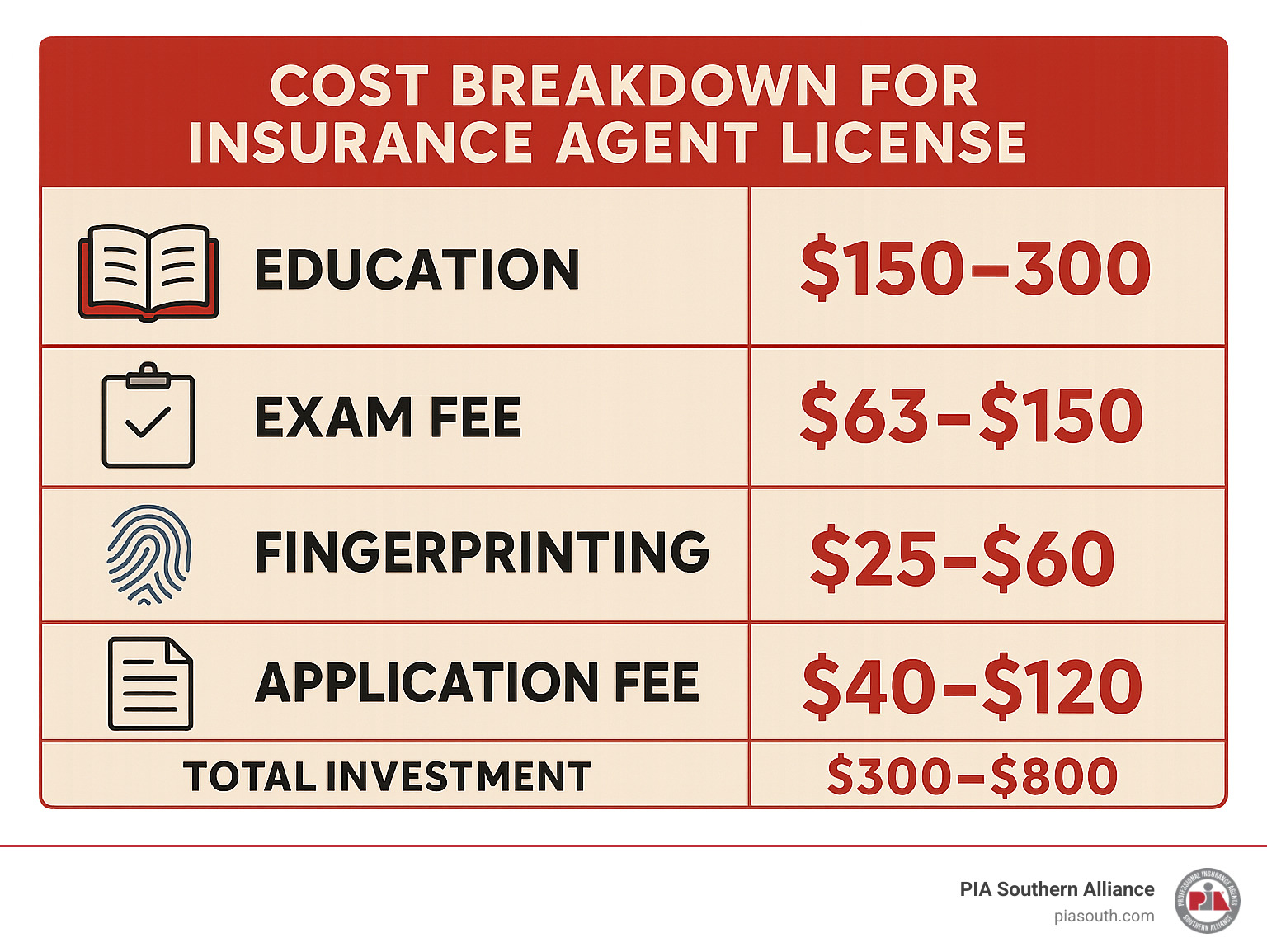
The investment to become a licensed insurance agent in Georgia, Alabama, or Mississippi typically ranges from $300-$800 total. This covers everything from education to application fees. Here’s how those costs typically break down:
Your pre-licensing education will run about $150-$300, with online courses generally being more budget-friendly. If you prefer the energy and interaction of a classroom setting, you might pay a bit more, but many agents find the in-person guidance well worth it.
When it’s exam time, expect to pay between $63-$150 depending on your state and which license type you’re pursuing. Property & Casualty exams are comprehensive but fairly priced considering the career opportunities they open up.
The fingerprinting and background check process is a modest $25-$60 investment in proving you’re trustworthy to handle clients’ insurance needs. This security step protects both consumers and the integrity of the industry.
Finally, your application fee ($40-$120) puts everything in motion with your state’s insurance department. While this fee is non-refundable regardless of outcome, with proper preparation, you should have no issues getting approved.
“I was pleasantly surprised by the affordable path to licensing,” shares one Georgia agent. “For less than what I spent on a single college course, I launched an entirely new career.”
As for timing, most agents go from zero to licensed in about 2-6 weeks. Your pre-licensing education might take 1-4 weeks, depending on whether you’re studying full-time or fitting it around other commitments. Exam scheduling and preparation typically add another 1-2 weeks, while background checks and application reviews take 1-2 weeks and 3-10 business days, respectively.
One Mississippi agent advises, “Don’t rush through your education just to save time. Those fundamentals will serve you throughout your entire career.”
The smartest approach? Budget for the full process upfront. You don’t want momentum to stall halfway through because you didn’t plan for all the expenses.
Funding Your First Year as a Licensed Agent
Beyond licensing itself, new agents should prepare for additional first-year investments. Your insurance agent license is just the beginning – think of it as the ticket that gets you into the game, not the entire season.
Errors & Omissions Insurance is a must-have that typically costs $500-$1,500 annually. It’s not just required by most carriers; it protects you from claims of professional negligence that could otherwise devastate your new business.
Setting up your operation brings its own expenses. Whether you’re working from home or leasing space, you’ll need the basics: reliable computer equipment, professional software, business cards, and a website that inspires confidence. Professional association memberships, while optional, provide valuable networking and educational opportunities that can accelerate your success.
Don’t forget about ongoing Continuing Education, which runs about $100-$300 annually. These courses aren’t just required to maintain your license – they keep you sharp and informed in an industry that’s constantly evolving.
“Your first year involves more investment than income,” notes a veteran Alabama agent affiliated with PIA Southern Alliance. “I recommend having six months of living expenses saved or maintaining part-time work until your commission pipeline fills up.”
The good news? With proper planning, these startup costs quickly transform from expenses into investments that pay dividends throughout your insurance career. And unlike many professional paths, you can begin generating income almost immediately after receiving your license.
Keeping Your License Active & Growing Your Book
Getting your insurance agent license is just the first step in your insurance career journey. What comes next is equally important – maintaining that license while building a thriving business.
In Georgia, Alabama, and Mississippi, your license typically needs renewal every two years. This isn’t just a simple fee payment – there’s a bit more involved to keep your credentials active:
You’ll need to complete 24 hours of continuing education during each renewal cycle, with at least 3 hours focused specifically on ethics. These requirements aren’t just bureaucratic hoops – they ensure you stay updated on industry changes and can provide your clients with the most current advice and solutions.
“Mark your renewal deadline on your calendar the day you get your license,” a veteran Georgia agent told us recently. “Missing that deadline can mean retaking exams or completing additional requirements to reinstate your license – headaches nobody needs!”
For Georgia agents specifically, we’ve compiled detailed information on our Georgia Insurance License Continuing Education Requirements page.
Beyond just maintaining your credentials, growing a successful book of business requires several key elements:
Errors & Omissions Insurance is non-negotiable – this professional liability coverage protects your business from claims of negligence or inadequate work. Most carriers won’t even consider appointing you without it.
Niche Marketing can dramatically accelerate your growth. Rather than trying to be everything to everyone, many successful agents focus on specific industries or coverage types where they can develop deep expertise. Whether it’s contractors, restaurants, or coastal properties, specialization helps you stand out.
Strategic Networking with mortgage brokers, realtors, and business associations creates referral channels that can provide steady leads. These centers of influence interact with potential clients at exactly the moments when insurance needs arise.
Digital Presence matters more than ever. Today’s clients research online before making contact, so a professional website and active social media profiles help establish your credibility from the first Google search.
Continuing Education Made Simple
Meeting CE requirements doesn’t have to feel like a chore. PIA Southern Alliance has designed learning options specifically for busy agents in our three-state region:
Our online webinars let you participate in live or on-demand training that fits around your client meetings and family obligations. Many agents complete their requirements during evenings or slower periods in their schedule.
For those who prefer in-person learning, our seminars offer engaging sessions while providing valuable networking opportunities with fellow agents. These connections often lead to mentorships, market access sharing, and even perpetuation opportunities.
Our annual conferences efficiently pack multiple CE credits into events that also deliver industry insights and practical business strategies. Many agents tell us these events are highlights of their professional year.
We place special emphasis on property and casualty training that directly applies to your daily client work. As one Mississippi member shared, “Continuing education should be viewed as an investment, not an obligation. The right courses give you knowledge that directly translates to better service for clients and more sales opportunities.”
For more details about our education offerings, visit our page on Approved Continuing Education Provider for Insurance License in Georgia.
Reciprocity & Multi-State Expansion
As your insurance business grows, expanding into neighboring states becomes a natural progression. Thankfully, Georgia, Alabama, and Mississippi have reciprocity agreements that simplify this process considerably.
With reciprocity, your existing license in your home state may exempt you from repeating pre-licensing education and examination requirements when applying for the same license type across state lines. You’ll still need to submit a non-resident application, pay fees, provide proof of your home state license, and complete any state-specific training – but you’re spared the full licensing process.
The National Insurance Producer Registry (NIPR) makes this expansion remarkably straightforward, allowing applications for multiple state licenses through a single portal.
One PIA Southern Alliance member explains her experience: “I started in Georgia but now write business in Alabama and Florida as well. Reciprocity made expansion much more manageable than starting from scratch in each state – it saved me weeks of preparation and testing.”
This multi-state capability often becomes a competitive advantage, particularly for agents in border communities or those serving clients with properties in multiple states. When a client can handle all their insurance needs through one trusted advisor, their loyalty deepens significantly.
Common Mistakes New Agents Make — And How to Avoid Them

Your insurance agent license is just the beginning of your professional journey. The early years can be filled with both excitement and challenges as you build your business. Let’s talk honestly about some pitfalls that trip up many new agents—and how you can sidestep them with a little foresight.
Underinsuring clients is perhaps the most common mistake with the most serious consequences. It’s tempting, especially when you’re hungry for business, to focus on offering the lowest price rather than the right coverage. We’ve all heard the story of the new agent who sold a policy with inadequate limits to save the client money, only to have that client face a catastrophic loss that exceeded their coverage.
“My biggest mistake was trying to compete on price alone,” confesses a Georgia agent. “I quickly learned that expertise and service are far more valuable to clients than saving a few dollars on premium.”
The solution? Approach each client as an educator first, salesperson second. Take time to explain coverage options thoroughly, document all client decisions about limits, and always err on the side of recommending proper protection.
Missing continuing education deadlines can derail your career just as it’s getting started. In Georgia, Alabama, and Mississippi, letting your CE requirements slip can result in license suspension—meaning you’ll have to stop writing business until you’re back in compliance. Smart agents mark their renewal dates on their calendar system with plenty of advance notice and complete requirements early. PIA Southern Alliance offers numerous convenient options for meeting these requirements without disrupting your business.
Weak networking leaves many new agents wondering where their next client will come from. Insurance is fundamentally a relationship business, yet many new licensees spend too much time behind their desk instead of making connections. Successful agents join local business organizations, attend community events, and build relationships with complementary professionals like mortgage brokers, realtors, and attorneys who can provide a steady stream of referrals.
Skipping E&O coverage is a dangerous gamble that some new agents take to save money. Professional liability insurance isn’t just something most carriers require—it’s essential protection for your business and personal assets. One misunderstanding or oversight with a client could result in a claim that dwarfs the cost of your annual E&O premium. Consider this coverage as fundamental as your insurance agent license itself—you shouldn’t be in business without it.
Trying to be a jack-of-all-trades dilutes your expertise and credibility. Many new agents try to sell everything from homeowners to life insurance before they’ve truly mastered any one area. Focus first on becoming an expert in property and casualty lines, then consider expanding. Developing expertise in specific niches—whether it’s contractors, restaurants, or high-value homes—allows you to provide genuine value that clients can’t find elsewhere.
Poor documentation habits can haunt you years later. The conversation you had with a client about coverage options might be crystal clear today, but will you remember the details three years from now if there’s a claim? Develop systematic procedures for documenting every client interaction, especially coverage rejections. A simple follow-up email summarizing your discussion can be invaluable protection.
“Documentation saved my business,” shares an Alabama agent. “A client claimed I never offered higher liability limits, but I had the email where they declined the coverage. That simple paper trail prevented what could have been a devastating E&O claim.”
Mistakes are part of the learning process. What separates successful agents from those who struggle is not avoiding all errors—it’s learning quickly from them and implementing systems to prevent their recurrence. PIA Southern Alliance provides the mentoring and resources to help you steer these early challenges and build a sustainable, profitable insurance business across Georgia, Alabama, and Mississippi.
Frequently Asked Questions about the Insurance Agent License
What score do I need to pass the exam in GA, AL, or MS?
The magic number is 70% across Georgia, Alabama, and Mississippi! You’ll need to correctly answer at least 70% of the questions on your licensing exam to pass. Don’t worry about waiting for results—you’ll know whether you’ve passed before you even leave the testing center.
If those test jitters get the better of you the first time around, take a deep breath. Many of today’s most successful insurance professionals didn’t pass on their initial attempt. You can typically schedule a retake after a brief 24-48 hour waiting period, giving you just enough time to focus on any challenging areas before trying again.
“I failed my first exam by just three points,” shares one of our Georgia members. “Two days later, I retook it and passed with flying colors. That temporary setback didn’t slow down my career one bit.”
Can I get licensed without a risk management degree?
Absolutely yes! While a risk management degree provides an excellent foundation and can give you a competitive edge when seeking carrier appointments, it’s certainly not a requirement for obtaining your insurance agent license.
What you do need is to complete your state’s pre-licensing education requirements—typically 40 hours for property and casualty lines. These courses are specifically designed to prepare you for the exam and provide essential knowledge for your new career.
The insurance industry welcomes professionals from all backgrounds. Former teachers, retail managers, military veterans, and career-changers of all types have found tremendous success as insurance agents. The pre-licensing courses level the playing field, ensuring everyone has the fundamental knowledge needed to begin their insurance journey.
How soon can I start selling after passing the exam?
While passing your exam is a significant milestone, you can’t start selling insurance until you’ve officially received your insurance agent license and secured appointments with carriers. Here’s what the typical timeline looks like:
After passing your exam, expect about 2-4 weeks before you can sell your first policy. This includes:
– Completing your license application (1-2 days)
– Waiting for background check processing (1-2 weeks)
– Receiving your official license (3-10 business days)
– Securing carrier appointments (1-7 days per carrier)
This waiting period isn’t wasted time! Smart new agents use these weeks to set up their business systems, complete carrier-specific training programs, and develop their initial marketing strategy.
“I used my waiting period to shadow an experienced agent,” recalls a Mississippi member. “By the time my license and appointments came through, I already had a list of prospects and a much clearer understanding of the day-to-day work.”
This in-between period is the perfect time to connect with PIA Southern Alliance for additional training opportunities. Our Insurance Certification Programs can help you hit the ground running once your insurance agent license is officially in hand.
Conclusion
Obtaining your insurance agent license marks the beginning of what can be an incredibly rewarding career journey. While the process requires dedication and investment, the opportunities awaiting licensed property and casualty agents in Georgia, Alabama, and Mississippi are truly substantial.
Your license is merely the gateway to your insurance career. The agents who thrive in this industry commit themselves to continuous learning, relationship cultivation, and unwavering ethical standards. As one of our veteran Georgia agents often says, “Your license might get you in the door, but it’s your knowledge and integrity that keep you in business for the long haul.”
The journey from classroom to closing your first policy takes determination, but you don’t have to steer it alone. PIA Southern Alliance stands ready to support independent agents at every stage—from those first studying for their licensing exams to established professionals expanding their expertise. Our specialized P&C webinars, mentoring opportunities, and continuing education courses are specifically designed to help you maximize your potential in this dynamic industry.
For many new agents, the licensing process reveals just how much there is to learn about insurance. That’s why we’ve developed comprehensive Insurance Certification Programs that can improve your expertise and cross-selling capabilities once you’ve established yourself in the field. These programs help you develop specialized knowledge that clients and carriers alike will value.
The property and casualty insurance landscape continues to evolve, with new risks emerging and coverage solutions developing in response. As a licensed agent, you’ll be on the front lines of helping businesses and individuals protect what matters most to them. There’s something deeply satisfying about providing that peace of mind to your community.
Your journey in insurance begins with that crucial first step—getting your insurance agent license. From there, the path is yours to chart, with endless possibilities for specialization, growth, and professional fulfillment. Whether you’re drawn to commercial lines, personal insurance, or a blend of both, your license opens doors to a career with remarkable flexibility and staying power.
We at PIA Southern Alliance look forward to supporting your insurance journey every step of the way, from your first day as a licensed agent through the many milestones of your career ahead.