
Starting an insurance agency isn’t a small undertaking—it requires a real financial commitment. The total cost can land anywhere between $5,000 for a lean, home-based operation to over $800,000 for a tech-heavy independent buildout. Your final number really hinges on your business model, where you set up shop, and how fast you want to grow.
This initial investment covers all the essential one-time expenses and, just as importantly, provides the working capital you need to keep the lights on until commissions start creating a steady cash flow.

Unpacking Your Initial Financial Blueprint
Launching an independent insurance agency is a lot like building a house. The final price tag can vary wildly depending on the foundation you choose. You could go for a modest, efficient build or design a sprawling custom home loaded with the latest smart technology. The key is figuring out which blueprint fits your vision and your wallet.
For many aspiring agency owners, the dream is to build a sophisticated agency from the ground up, complete with a custom software stack and a full team. But that path requires some serious capital.
In fact, according to some detailed financial models, launching a fully independent, tech-focused agency from scratch requires a budget of at least $881,000. That number includes around $230,000 in upfront costs, with a massive $150,000 chunk going just toward developing a proprietary platform for agent onboarding, quoting, and compliance. If you're curious, you can learn more about the breakdown of these startup figures and see exactly how they calculated that investment.
The Two Paths to Agency Ownership
That high barrier to entry forces every new agent to make a fundamental choice: Are you going to build from scratch or leverage an existing framework?
The Ground-Up Independent Model: This is the path of total autonomy, but it also comes with the highest insurance agency startup costs. You're on the hook for every single detail, from securing carrier appointments and building your tech stack to creating a brand and marketing it. It’s a capital-intensive route best suited for entrepreneurs who have deep industry experience and significant funding already lined up.
The Streamlined Franchise or Network Model: On the flip side, joining a franchise or an established agency network dramatically lowers the initial financial hurdle. These models offer a turnkey solution—you get pre-built systems, carrier access, and brand recognition right out of the gate. While you do trade some autonomy, the startup investment is just a fraction of the independent route, making it a much more accessible entry point for most people.
The most critical financial decision you'll make isn't about the specific software you choose, but about the fundamental business model you adopt. This single choice will dictate your entire startup budget and the speed at which you can achieve profitability.
Getting this distinction straight is the very first step in creating a realistic budget. It frames every other decision you’ll make, from office space and staffing to your marketing spend. Before you even think about individual line items, you have to decide which of these two paths aligns with your financial reality and your long-term goals. Your answer will define the scale of your entire initial investment.
Mapping Your Foundational One-Time Investments
Before you ever write your first policy, you have to lay the groundwork. Think of it like pouring the concrete foundation for a new house—it's a critical, one-time investment that everything else gets built on. These foundational insurance agency startup costs are the non-negotiable expenses you'll face just to legally open your doors.

These aren't the recurring monthly bills you'll see later. They are the essential, upfront charges that turn your idea into a real, functioning agency. Getting these right from the jump will save you from some serious legal and operational headaches down the road.
Legal and Licensing Foundations
Your first big spend is getting your agency set up as a legitimate business. This isn't just about shuffling paperwork; it's the move that makes your agency official in the eyes of the state and your future clients, and it's your first real line of defense.
To start, you need to pick a business structure. Many new agency owners go with a Limited Liability Company (LLC) because it offers personal liability protection without the tax complexities of a full-blown corporation. Here’s what those costs look like:
- Business Registration: Filing fees to set up your LLC or corporation will run you anywhere from $100 to $800. This really depends on your state and if you bring in a legal service to help.
- Agency & Producer Licensing: You’ll need a license for the agency itself, plus a separate one for each producer selling insurance. State licensing fees usually fall between $50 and $200 per license. Tack on another $50 to $100 per attempt for exam fees.
Don't even think about skipping these. Operating without the right licenses can lead to massive fines and could even get you permanently banned from the industry.
Protecting your new venture is paramount. One of the most critical one-time investments you will make is your down payment for Errors & Omissions (E&O) insurance. This isn't just a good idea—it's often a requirement to get carrier appointments.
Your initial E&O insurance down payment can range from $500 to over $2,500. This is the policy that protects you if you're ever accused of negligence or making a mistake. It’s a cornerstone of your agency's risk management plan.
Setting Up Your Workspace and Technology
Once the legal framework is solid, it's time to build out an operational workspace. Your choice between a physical office or a remote setup will heavily impact your startup costs, but some investments are unavoidable no matter what. You simply need the right tools to serve your clients well from day one.
Even if you're running a lean, remote agency, you can't get away from needing reliable tech. Here are the core hardware and software setup costs to plan for:
- Essential Hardware: Budget for a dependable computer or laptop ($800 – $2,000), a multi-function printer/scanner ($200 – $500), and a business phone system. A solid VoIP service setup will likely cost between $100 – $400 upfront.
- Initial Software Purchases: While a lot of software is subscription-based these days, some still come with one-time setup fees. This could include certain accounting programs or specialized quoting tools. You can learn more about cost considerations for insurance automation software implementation to help nail down your tech budget.
Finally, you need to establish your brand. This means creating a professional identity that will catch the eye of your first clients. Think about logo design, business cards, and getting a simple but professional website off the ground. These branding essentials can collectively cost anywhere from $500 to $5,000, depending on how polished you want to look at launch.
Your Monthly Blueprint for Operational Expenses
Once you've made those big, one-time investments, your attention has to shift to the steady, recurring expenses that will ultimately decide your agency's financial health. These are the operational costs—the lifeblood of your business. They keep the lights on, the software humming, and the new leads flowing in. Getting a handle on your monthly budget is how you build a profitable, sustainable agency.
I like to think of it this way: your one-time costs are like buying a car, but your recurring expenses are the gas, insurance, and oil changes. You can't go anywhere without budgeting for both. Mastering these predictable monthly bills is absolutely critical for managing your cash flow, especially in those early months when commission revenue is just starting to trickle in.
Core Technology and Workspace Costs
Whether you’re in a traditional brick-and-mortar office or running a lean remote operation, some monthly bills are just part of the game. This is the basic infrastructure that allows you to serve clients and manage policies. While going remote slashes your overhead, you still need to budget for the essential digital tools that make a modern insurance agency tick.
Here’s a realistic look at what you can expect for monthly tech and workspace expenses:
- Office Rent and Utilities: For a physical agency, this will likely be your biggest recurring line item. Depending on where you are in Georgia, Alabama, or Mississippi, this could easily run from $1,500 to $5,000+ a month. Remote agencies get to sidestep this cost, though a co-working space membership ($100 – $400/month) can be a great compromise.
- Agency Management System (AMS): Your AMS is the brain of your operation, holding all your client and policy data. Plan on $75 to $300 per user, per month, depending on how feature-rich you need it to be.
- Customer Relationship Management (CRM): A good CRM is key for tracking your sales pipeline and client communications. This will typically cost $50 to $200 per user, per month.
- Quoting and Rating Tools: To provide fast, multi-carrier quotes, these tools are a must. Costs can swing pretty widely, but a safe bet is to budget somewhere between $100 and $400 a month.
Fueling Growth with Marketing and Lead Generation
Just opening your doors isn't a strategy—you need a consistent plan to bring in new clients. Your marketing budget isn't an expense; it's a direct investment in your agency's growth. Without a steady stream of leads, even the most buttoned-up agency will eventually stall out. This is a non-negotiable part of your monthly insurance agency startup costs.
The most common mistake I see new agency owners make is massively underestimating their marketing budget. They think clients will just find them. The reality is you have to actively, and consistently, invest in getting your story out there.
How much you spend on marketing will have a direct impact on how fast you grow. Here are the key areas to budget for:
- Digital Advertising: Platforms like Google Ads or paid social media can get your phone ringing almost immediately. A smart starting budget is $500 to $2,000+ per month.
- Search Engine Optimization (SEO): This is the long game. Investing in SEO helps you attract high-quality organic traffic over time. An agency retainer for this usually falls between $1,000 to $3,500 per month.
- Content Creation and Social Media: Building trust means creating valuable content. You can do this yourself or outsource it for $300 to $1,500 per month. For a deeper dive, check out our complete guide on the essentials of insurance agency digital marketing.
The Human Element: Staff Salaries and Payroll
As you grow, you'll quickly realize you can't do it all alone. Hiring your first team members is a huge milestone, but it will also become your most significant recurring expense. It's crucial to budget not just for base salaries but also for payroll taxes, benefits, and all the other associated costs. For a new agency in the Southeast, looking at typical salary ranges is a great place to start your financial planning.
A lean but effective startup team might look like this:
- Licensed Producer: This person is your sales engine. Compensation is often a mix of base salary and commission. A starting base salary could be in the $35,000 – $50,000 per year range.
- Customer Service Representative (CSR): The backbone of client relationships and policy servicing. Plan for a salary of $30,000 – $45,000 per year.
And don't forget this part: you need to add another 15-20% on top of those salaries for payroll taxes, workers' compensation, and any benefits you plan to offer. Ignoring these "hidden" staffing costs is a fast way to blow up an otherwise solid budget.
Building a Realistic First-Year Startup Budget
Moving from big ideas to actual numbers is where your business plan gets real. A detailed first-year budget is so much more than a laundry list of expenses; it's your financial roadmap. It helps you see bumps in the road before you hit them and turns your vision for an independent agency into a plan you can actually follow.
Think of your budget as the blueprint for your agency's financial house. Without one, you're just guessing where the walls go and hoping it all holds together. A well-thought-out budget shows you exactly how every decision—from getting a physical office to launching a big marketing campaign—shapes how much cash you'll need.
From Line Items to a Living Document
To make this tangible, let's walk through a sample startup budget you can tweak for your own agency. We'll break down the costs into two simple buckets: one-time investments to get the doors open and monthly recurring costs to keep them open. For each line item, I'll give you a low, average, and high estimate to account for different startup styles.
A crucial part of this is learning how to properly define operating budgets. This discipline gives you clear financial control and sets you up for predictable, profitable growth. It turns your budget from a static spreadsheet into a hands-on tool for managing cash flow and making smart decisions all through your first year.
The chart below gives you a quick visual on how three of the biggest recurring costs—tech, marketing, and staff—stack up in a typical monthly spend.
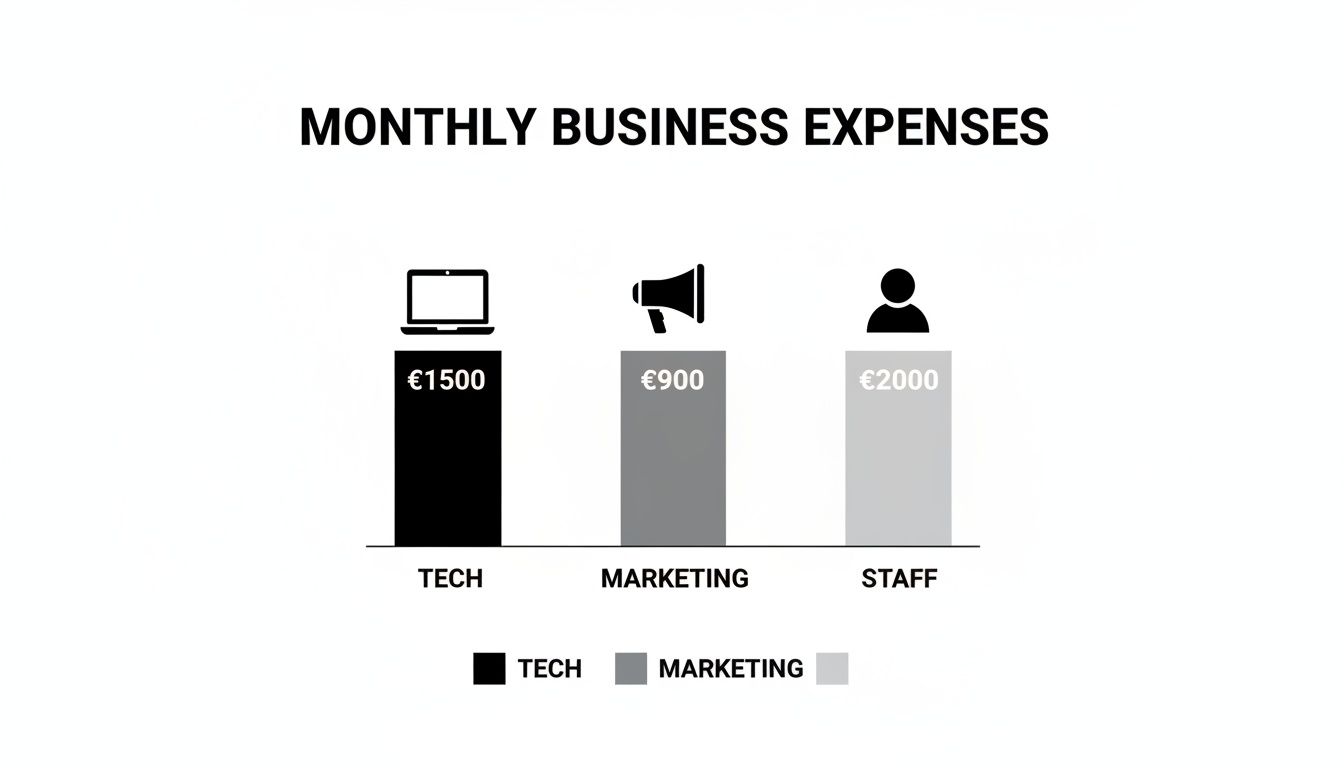
As you can see, staff is often the biggest piece of the pie. This is exactly why so many new agency owners start out lean and handle most things themselves before they start hiring.
Sample Startup Budget for an Independent Insurance Agency (First Year)
Here's a sample budget to give you a clearer picture of what your first-year insurance agency startup costs could look like. Think of the "Low Estimate" column as the path for a lean, remote-first agency. The "High Estimate" is for a more traditional setup with a physical office, a small team from day one, and a heavier marketing spend.
| Expense Category | Line Item | Low Estimate | Average Estimate | High Estimate |
|---|---|---|---|---|
| One-Time Costs | Business Formation & Licensing | $500 | $1,500 | $3,000 |
| E&O Insurance Down Payment | $500 | $1,500 | $2,500 | |
| Office Setup (Furniture, Deposits) | $0 | $4,000 | $10,000 | |
| Technology Hardware (Computers, Phones) | $1,000 | $2,500 | $5,000 | |
| Website & Initial Branding | $500 | $2,500 | $5,000 | |
| Recurring Costs (Monthly) | Rent & Utilities | $50 | $2,500 | $5,000 |
| Agency Management System (AMS) & CRM | $150 | $350 | $600 | |
| Marketing & Lead Generation | $500 | $2,000 | $5,000 | |
| Salaries & Payroll (for one producer/CSR) | $0 | $3,500 | $5,000 | |
| Phones, Internet & Other Software | $100 | $250 | $500 | |
| Totals | Total One-Time Costs | $2,500 | $12,000 | $25,500 |
| Total Monthly Costs | $800 | $8,600 | $16,100 | |
| First-Year Operating Capital (6 months) | $4,800 | $51,600 | $96,600 | |
| TOTAL ESTIMATED FIRST-YEAR BUDGET | $7,300 | $63,600 | $122,100 |
Of course, this is just a starting point. Your own finances, the market you're in, and how fast you want to grow will all require you to adjust these numbers to fit your specific situation.
Funding Your Launch and Smart Cost-Saving Strategies
Figuring out your insurance agency startup costs is the first step. Actually securing the capital? That’s the moment your dream starts to look like a real business. While many entrepreneurs dip into personal savings for that initial seed money, leaning on that alone can be a risky move. A much smarter approach is to explore a mix of funding options to build a more resilient agency right from the gate.

Think of it like building a financial safety net. A single rope might hold you, but a woven net made of multiple strands gives you far more security. This strategy lets you launch with confidence, knowing you have the resources to cover unexpected bumps in the road and navigate those first few months before commission checks start rolling in consistently.
Traditional and Modern Funding Avenues
Beyond your own bank account, there are several well-established routes to get the capital you need to get your agency off the ground. Each comes with its own set of requirements, so it's wise to research which one clicks with your business plan and personal financial picture.
Common funding sources include:
- Small Business Administration (SBA) Loans: These government-backed loans are a popular choice for new businesses because they often come with better terms and lower down payments. Just be prepared for a thorough application process—they'll want to see a rock-solid business plan.
- Business Lines of Credit: This gives you flexible access to cash, letting you draw funds as you need them to cover operational costs. It’s an amazing tool for managing the inevitable cash flow ups and downs of a new agency.
- Strategic Partnerships: Bringing on a partner who chips in capital for a slice of the equity can be a powerful move. It’s not just about the cash infusion; you could also gain invaluable expertise for your leadership team.
Don't overlook the power of premium financing. This innovative tool allows clients to pay their premiums in installments, which can dramatically improve your agency's cash flow by ensuring you receive commissions more quickly and predictably.
By exploring these options, you can piece together a funding strategy that reduces your personal financial strain and sets your agency on solid footing from day one. To get a better sense of what's out there, you can learn more about specific professional agents funding solutions built for the independent agency channel.
Smart Strategies to Reduce Your Burn Rate
Getting funded is only half the battle. The other half is making that money last. Your "burn rate"—the speed at which you spend your cash—is a critical number to watch. Every dollar you save is another dollar you can plow back into growing your business.
One of the most powerful moves you can make is starting with a remote or virtual setup. By cutting out the massive expense of a physical office lease, you immediately slash your overhead. That frees up thousands of dollars a month that can go straight into marketing or tech.
Here are a few other powerful cost-saving tactics:
- Negotiate with Vendors: Never take the first price you’re given. Whether it's for your AMS, marketing services, or even office supplies, there is almost always wiggle room. Don't be afraid to ask.
- Embrace Automation: Time is money, simple as that. Use technology to handle repetitive tasks like data entry, email follow-ups, and social media posts so you can focus on selling.
- Join an Association: Organizations like PIA Southern Alliance offer members huge discounts on essentials, especially Errors & Omissions insurance, which is one of the biggest checks you'll write as a startup.
To keep your operations lean, consider how an efficient financial system, potentially using an AI data entry service, can cut down on manual work and its associated costs right from the start. Launching lean and operating smart gives your agency the best possible shot to not just survive, but truly thrive.
How Partnering with PIA Southern Alliance Cuts Your Startup Risk
Starting an agency feels like navigating a minefield of expenses and operational headaches. The good news is, you don’t have to do it alone. Think of an organization like PIA Southern Alliance as your experienced guide, helping you chart the unfamiliar territory and sidestep the risks that can sink a new business.
For independent agents in Georgia, Alabama, and Mississippi, membership is a massive competitive advantage right out of the gate. Instead of scrambling to piece together essential services and just hoping you made the right calls, you get instant access to a network of vetted resources and deep industry expertise. This connection helps you run a tighter ship and avoid those costly rookie mistakes.
Slashing Your Biggest Upfront Expenses
Let's be honest, one of the scariest line items in any new agency budget is Errors & Omissions (E&O) insurance. Getting affordable, high-quality coverage isn’t just a good idea; it’s usually a requirement to even get your first carrier appointment. Hunting for the right policy on your own can be a painful, expensive, and time-consuming mess.
This is one of the first problems PIA Southern Alliance helps solve. We give our members access to top-tier E&O programs at highly competitive, group-negotiated rates. This benefit alone can save your agency thousands of dollars, freeing up critical cash you can pump back into marketing or tech. It dramatically lowers one of the single biggest financial hurdles for new agents.
The real value of an alliance isn’t just about saving money on one or two items. It’s about creating a stable operational foundation that lets you focus your energy on what truly matters: serving clients and generating revenue.
This stability even extends to your cash flow—the lifeblood of any startup. Through our network of endorsed partners, members can tap into vital funding and premium finance options. These aren't generic bank loans; they are solutions built specifically for the independent agency channel, designed to ease the cash flow squeeze that cripples so many new agencies before they ever find their footing.
Gaining an Instant Operational Edge
Beyond the direct cost savings, PIA Southern Alliance arms you with the knowledge to run your business smarter and more profitably. The insurance industry is a complicated beast that’s always changing, and if you’re not keeping up, you’re falling behind.
We provide a ton of resources to sharpen your skills and streamline how you work:
- Continuing Education: Get your hands on affordable, relevant CE courses to keep your license active and stay on top of industry trends without draining your budget.
- Networking Opportunities: Connect with seasoned veterans and other agents at our events. You’ll gain priceless insights and build relationships that can turn into real business.
- Best-Practice Resources: Tap into a library of proven strategies for agency management, marketing, and client service to build your business on a rock-solid foundation from day one.
When you use these benefits, you start turning those scary startup risks into manageable challenges. Instead of guessing your way through, you can move forward with the confidence that comes from having a trusted partner who is genuinely invested in your success.
Let's Answer Your Burning Questions About Startup Costs
As you get closer to launching and start putting numbers to your business plan, a few big questions always seem to pop up. Getting straight answers to these common worries will help you build a more realistic budget and walk into your opening day with a lot more confidence. Let's tackle the questions I hear most often from aspiring agency owners.
What’s the Absolute Minimum I Can Get Away With Spending?
If you’re a solo agent planning to work from a home office and laser-focus on a specific niche, you can potentially get the doors open for somewhere between $5,000 and $15,000.
Now, this is a true bare-bones budget. It's designed to cover only the absolute must-haves: state licensing fees, the down payment on your Errors & Omissions (E&O) policy, business registration, a basic website, and a subscription to a low-cost Agency Management System (AMS). This shoestring approach assumes you already have a decent computer and phone, and it completely skips big-ticket items like a physical office, staff salaries, or any significant marketing spend.
How Much Working Capital Do I Really Need on Hand?
After you’ve paid for all your initial, one-time costs, you absolutely must have a cash reserve to keep the lights on. This isn't optional.
A solid rule of thumb is to have at least six months of your total recurring operating expenses socked away as working capital. Think of this buffer as your agency's financial safety net.
Let's say your monthly nut—covering your own salary (owner's draw), software subscriptions, and marketing—adds up to $8,000. In that case, you should aim to have $48,000 in the bank, ready to go. This is so critical because commission revenue can take months to build into a steady, reliable cash flow. Running out of working capital is one of the top reasons new agencies go under in their first year.
Are There Hidden Costs I Should Be Planning For?
You bet. There are always smaller expenses that are easy to forget about, but they can add up surprisingly fast and throw a wrench in a tight budget. Thinking about them now saves you a massive headache later.
Be sure to account for these often-overlooked costs:
- Professional Association Fees: Dues for groups that give you resources and networking opportunities.
- Continuing Education (CE) Credits: The ongoing cost to keep your state licenses active.
- State and Local Taxes: Business taxes that come after your initial registration fees.
- Bank and Payment Processing Fees: Those monthly charges for business bank accounts and credit card processing.
- Cybersecurity Software: Protecting your client data is non-negotiable and an expense from day one.
I also tell every new owner to build a contingency fund of 10-15% of their total startup budget. This isn't "extra" money; it's for the inevitable curveballs and unexpected expenses that always pop up. It’s what keeps a small surprise from turning into a major crisis.
Figuring out these financial questions is much less daunting when you have a strong partner in your corner. PIA Southern Alliance gives independent agents in Georgia, Alabama, and Mississippi access to competitively priced E&O insurance, unique funding options, and the expert resources you need to build a resilient and profitable agency right from the start. Learn more about how PIASA can reduce your risk and support your growth.