
Why Customer Retention Is Your Agency’s Secret Weapon
Insurance agency retention strategies are the difference between agencies that struggle and those that thrive. The numbers don’t lie – it costs 7 to 9 times more to acquire a new customer than to keep an existing one, yet the average insurance agency only retains 84% of their clients.
Here are the most effective insurance agency retention strategies:
- Proactive renewal reviews – Contact clients 30-60 days before renewal
- Cross-selling bundled policies – Increases retention to 91% vs 67% for single policies
- Handling premium increases transparently – Explain market conditions and offer alternatives
- Segmenting A-tier clients – Focus 30-50% of resources on top 20% of profitable clients
- Training staff on retention scripts – 80% of clients who talk to an agent before leaving will stay
- Creating “wow” moments – Small gestures that make clients feel valued
- Using predictive analytics – Identify at-risk clients before they shop around
- Asking for referrals systematically – Referred customers have 92% retention vs 67% for other sources
The stakes are high for property and casualty agencies in Georgia, Alabama, and Mississippi. A 5% improvement in retention can double your profits in five years. Meanwhile, 65% of clients who leave never even spoke to their agent first.
As someone who has spent years helping independent agencies across the Southeast build stronger client relationships, I’ve seen how the right insurance agency retention strategies can transform an agency’s growth trajectory and profitability.

Why Retention Matters for P&C Agencies in GA, AL & MS
The Southeast insurance market isn’t for the faint of heart. Between Alabama’s tornado seasons, Georgia’s hail storms, and Mississippi’s hurricane threats, property and casualty agencies face unique challenges that make every client relationship precious.
When you’re operating in a hard market with rising premiums and tightening underwriting, losing clients feels like watching money walk out the door. But here’s the thing – agencies that master insurance agency retention strategies don’t just survive these tough times, they actually come out stronger.
How Customer Retention Drives Profitability
Let me share something that might surprise you: keeping just 5% more of your current clients can double your profits within five years. I know it sounds too good to be true, but the math checks out.
Think about it this way – every client who walks away takes their entire lifetime value with them. For a typical P&C client, that’s often $15,000 to $25,000 in premiums over their lifetime. When you factor in the acquisition costs of replacing them (marketing, time, commissions), losing clients becomes incredibly expensive.
But retention does more than stop the bleeding. Long-term clients become profit multipliers. They’re more likely to bundle policies, refer friends and family, and stick with you through market ups and downs. A client who’s been with you for five years generates nearly three times more profit than a first-year client.
The referral lift alone is worth the effort. Happy clients don’t just stay – they become your best salespeople. And in tight-knit Southern communities, word-of-mouth still carries serious weight.
Why Clients Leave & When They’re Most at Risk
Here’s what keeps me up at night: 65% of clients who leave never even complained first. They just quietly slip away, often to that agent down the street who promised to save them fifty bucks.
First-year churn is brutal. New clients are still forming their opinion of your agency, and any hiccup – a confusing bill, a slow claims response, or just feeling ignored – can send them shopping around.
Post-claim fatigue is another killer. Even when you handle a claim perfectly, clients often feel emotionally drained by the process. If they don’t hear from you for months afterward, they start wondering if you really care about them or just their premium payments.
But the biggest threat? Premium shock without context. When that renewal comes in 20% higher and there’s no explanation, clients assume you’re either not working for them or taking advantage of them. Neither feels good.
The truth is, most clients don’t leave because of price alone – they leave because they don’t feel valued. They want to know their agent remembers their name, understands their business, and genuinely cares about protecting what matters most to them.
The good news? Every one of these problems is solvable with the right approach to client relationships.
Top 10 Insurance Agency Retention Strategies
Let’s explore the specific tactics that turn good agencies into great ones. These insurance agency retention strategies aren’t just theory – they’re battle-tested approaches that work in the real world of property and casualty insurance.
Strategy 1-2: Proactive Communication & Renewal Reviews
Here’s something that might surprise you: most clients who leave never even talked to their agent first. They just quietly slip away, often to save a few dollars with an online carrier. The fix? Get ahead of the conversation.
Proactive communication means reaching out 30-60 days before renewal, not waiting for them to call you. Send personalized emails or texts based on how they prefer to communicate. Share relevant industry updates and risk management tips throughout the year – not just when it’s time to renew.
But here’s where it gets really powerful: the renewal review process. Schedule these calls systematically, don’t leave it to chance. Use a pre-call checklist to review their current coverage, then ask about life changes that might affect their insurance needs. Maybe they bought a boat, started a side business, or their teenager just got a license.
Document everything in your agency management system. Those little details become golden opportunities for deeper relationships and additional coverage.
Agencies that implement formal renewal review programs typically see their retention rates jump by 1.5% to 2% within six months. You’ll connect with about 50% of your clients this way, and those conversations often lead to cross-selling opportunities that benefit everyone.
More info about renewal reviews
Strategy 3-4: Hyper-Personalization & Smart Segmentation
Not all clients deserve the same level of attention – and that’s not being mean, it’s being smart. The most successful insurance agency retention strategies focus energy where it matters most.
Smart segmentation means dividing your book into A-tier, B-tier, and C-tier clients. Your A-tier clients – the top 20% of profitable accounts – should get 30-50% of your time and attention. These are the clients who value relationships over price and generate the most revenue.
B-tier clients are solid and stable. Maintain regular contact, but don’t over-service them. C-tier clients tend to be price-sensitive. Focus on efficiency here – great service, but streamlined processes.
Now for the personalization magic. Remember personal details like family milestones, hobbies, or business challenges. Send birthday cards or congratulations when they hit business milestones. Reference previous conversations to show you’re actually listening, not just going through the motions.
The data tells the story: top-performing agencies allocate 30-50% of their resources to A-tier clients, compared to just 20-30% for average agencies. This focused approach pays dividends in both retention and referrals.
Strategy 5-6: Cross-Selling Power Plays & Referral Engines
Here’s a retention secret many agencies miss: bundled policies have a 91% retention rate compared to just 67% for single-line policies. The more coverage you provide, the stickier the relationship becomes.
Strategic cross-selling starts with identifying gaps during renewal reviews. Offer umbrella policies to high-net-worth clients, bundle auto and home for maximum retention, and present commercial coverage for business owners. The key is making it feel natural, not pushy.
Building your referral engine is equally powerful. Ask A-tier clients directly: “How could we find five more clients like you?” Train your staff on low-risk referral requests – timing and approach matter. Offer reciprocal referrals to client businesses when appropriate, and always thank referral sources promptly and meaningfully.
The numbers don’t lie: referred customers have a 25% higher retention rate within the first three years. They’re also more profitable from day one because they come pre-sold on your value.
Strategy 7-8: Tackling Premium Increases & Transparency
Premium increases are like the weather – inevitable and often unpleasant. But how you handle them determines whether clients stay or start shopping around. The secret weapon? Transparency and context.
Call clients before they receive renewal notices. Explain the market conditions driving increases – whether it’s hurricane activity in the Southeast, rising construction costs, or increased claim frequency. Compare their increase to state or industry averages. If they’re facing an 8% increase but the state average is 15%, suddenly their situation looks reasonable instead of outrageous.
Always offer alternatives like higher deductibles or coverage adjustments. Provide a menu of options, not just one take-it-or-leave-it quote. This approach shows you’re working for them, not just collecting commissions.
Strategy 9-10: Employee Engagement & “Wow!” Customer Experiences
Your team is your retention secret weapon. When staff are engaged and properly trained, it shows in every client interaction. Develop scripts for common retention scenarios, but train on empathy and active listening too. Teach the value proposition beyond price, and create incentives tied to retention metrics.
Creating “wow!” moments doesn’t require a big budget – just thoughtfulness. Send handwritten thank-you notes, remember and acknowledge important dates, provide unexpected value through risk management tips or industry insights. Respond faster than clients expect and take ownership of problems instead of blaming carriers.
Here’s the research that should get your attention: when customers are merely “satisfied” (3 out of 5), about 50% will leave within three years. But when satisfaction rises to the “wow” level (5 out of 5), 92% remain loyal.

Technology & Automation That Make Retention Scalable
Let’s be honest – you can’t personally call every client every month. But here’s the thing: the right technology doesn’t replace those meaningful conversations. It actually makes them more powerful by telling you exactly who to call and when.
The best insurance agency retention strategies today blend human touch with smart automation. Think of technology as your retention assistant, not your replacement. It handles the routine stuff so you can focus on building relationships that matter.
Agency Management Systems (AMS) form the backbone of scalable retention. Your AMS should track every client interaction, flag upcoming renewals, and remind you about important follow-ups. The magic happens when you integrate your AMS with CRM workflows that automatically trigger the right message at the right time.
For example, when a client’s policy renews, your system can automatically send a thank-you note, schedule a follow-up call, and flag any cross-selling opportunities. No more sticky notes or hoping you remember to call Mrs. Johnson next Tuesday.
Predictive analytics might sound fancy, but it’s really just pattern recognition. The software notices that clients who stop opening emails and skip two premium payments usually shop around within 90 days. Armed with this insight, you can reach out proactively instead of reactively.
AI chatbots handle simple questions 24/7, while self-service portals let clients access their documents without calling your office. Text reminders about payment due dates prevent lapses that could trigger shopping behavior.
Scientific research on customer experience shows that companies using integrated retention technology see 15-20% higher retention rates. The key is choosing tools that work together, not against each other.
Choosing the Right Tools
Walking into a technology vendor’s office can feel overwhelming. They’ll promise the moon, but you need solutions that actually work in your day-to-day operations.
Start with integration capabilities. If your new retention tool can’t talk to your existing AMS, you’ll spend more time managing systems than managing clients. The best tools plug into what you already use and make everything work better together.
Ease of use matters more than fancy features. Your team needs to actually use the system, not fight with it. If it takes 15 clicks to send a simple follow-up email, that’s a problem. Look for dashboard criteria that show critical information at a glance – retention rates, upcoming renewals, and at-risk clients.
Budget fit is crucial, but think beyond the monthly fee. Calculate the potential revenue from just a 2% retention improvement. If you retain 10 more clients worth $1,000 each in annual premium, that’s $10,000 in revenue. Most retention tools pay for themselves within months.
Don’t forget about user training. The best system in the world is worthless if your team doesn’t know how to use it effectively.
Detecting At-Risk Clients Before They Churn
This is where technology really shines. Instead of finding out clients are unhappy when they call to cancel, you can spot trouble brewing weeks or months ahead.
Propensity scores analyze dozens of factors to predict which clients are likely to leave. The system might notice that clients who receive premium increases above 12% and haven’t had a renewal conversation in the past year have a 40% chance of shopping around.
Lapse alerts catch payment issues before they become cancellations. Renewal flags identify clients who haven’t responded to renewal communications. These early warning signs give you time to intervene with a personal touch.

A good risk heatmap shows your book of business color-coded by retention risk. Green clients are solid, yellow clients need attention, and red clients require immediate outreach. This visual approach helps you prioritize your time where it matters most.
The beauty of predictive analytics is that it gets smarter over time. As you track which interventions work, the system learns what signals matter most for your specific client base in Georgia, Alabama, and Mississippi.
Measuring Success & Continuously Improving
The best insurance agency retention strategies mean nothing if you’re not tracking whether they actually work. Think of it like cooking – you can follow the recipe perfectly, but if you don’t taste as you go, you’ll never know if you need more seasoning.
The most successful agencies I’ve worked with in Georgia, Alabama, and Mississippi don’t just implement retention programs and hope for the best. They measure everything, adjust quickly, and celebrate wins along the way.
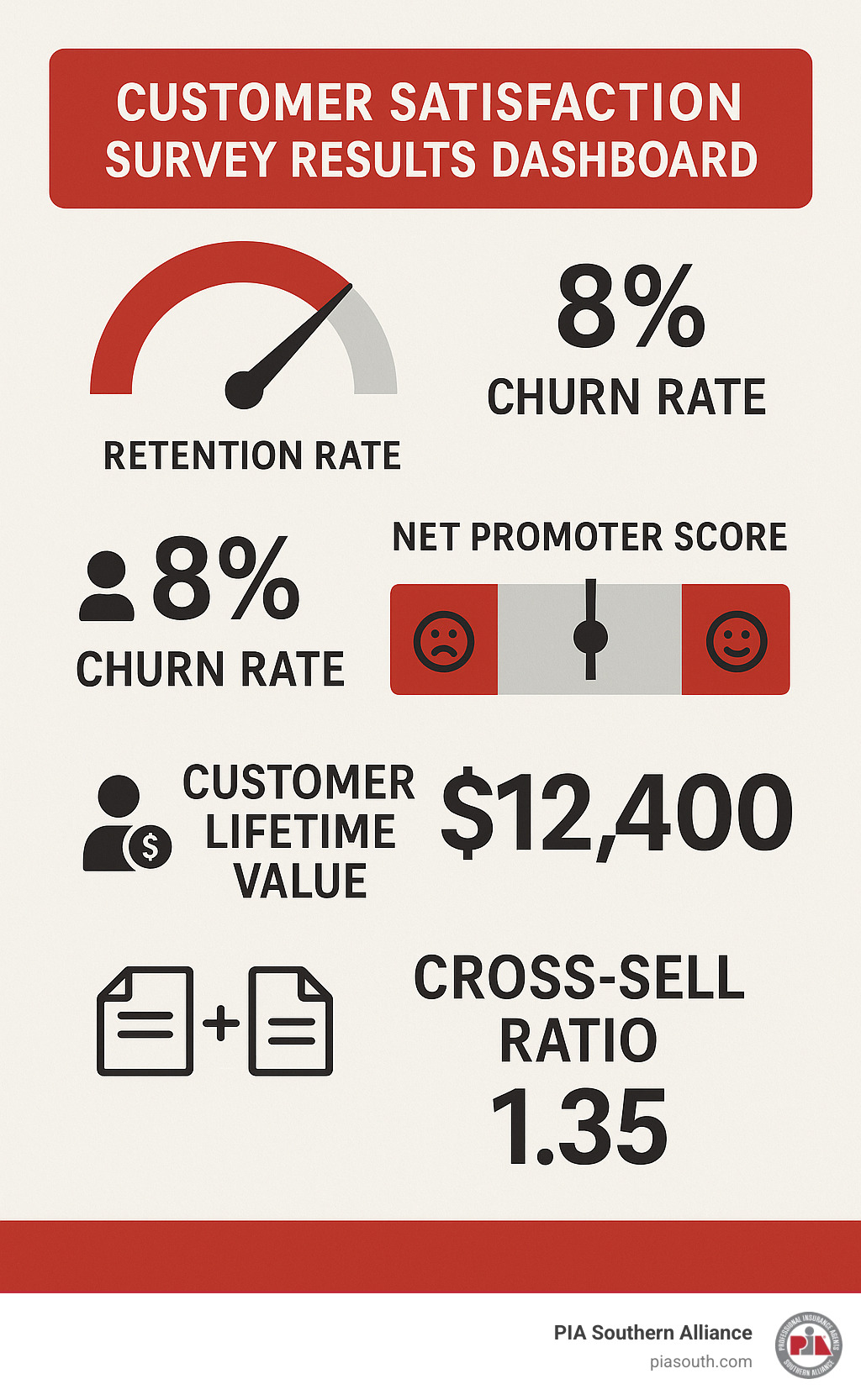
The essential metrics every P&C agency should track are retention rate (what percentage of policies actually renewed), churn rate (how many clients walked away), and Net Promoter Score (whether clients would recommend you to friends). But don’t stop there – also monitor Customer Lifetime Value to see the long-term impact of your efforts and cross-sell ratio to understand how well you’re bundling coverage.
Here’s what I’ve learned: agencies that check these numbers monthly instead of annually can spot problems early and fix them before they become expensive. It’s like checking your car’s oil regularly instead of waiting for the engine to seize up.
Building a Real-Time KPI Dashboard
Remember the old days of tracking everything in spreadsheets? Those days should be long gone. The agencies that thrive today have dashboards that show them exactly what’s happening with their retention efforts right now, not three months ago.
| Metric | Manual Tracking | Automated Tracking |
|---|---|---|
| Retention Rate | Monthly spreadsheet updates | Real-time dashboard |
| At-Risk Clients | Gut feeling | Predictive scoring |
| Communication History | Paper files | Digital timeline |
| Cross-Sell Opportunities | Agent memory | System alerts |
The difference is night and day. Instead of scrambling to figure out why retention dropped last quarter, you can see warning signs this week and do something about them. Your weekly team meetings become strategic planning sessions instead of damage control discussions.
Color-coded dashboards work best – green for good, yellow for caution, red for urgent action needed. When everyone can see the same information at a glance, your whole team stays focused on what matters most.
Leveraging Customer Feedback Loops
Here’s something that might surprise you: most clients who leave never complained first. They just quietly shopped around and found someone else. That’s why creating multiple ways for clients to share feedback is so important.
The smartest agencies send brief surveys after renewals or claims, but they don’t stop there. They monitor online reviews and respond thoughtfully to both praise and criticism. During renewal calls, they ask specific questions about what’s working and what could be better.
Social listening has become incredibly valuable too. Clients often share their insurance frustrations on social media before they ever call their agent. By staying tuned in, you can address concerns before they become cancellations.
The goal isn’t to achieve perfect scores on every survey – that’s unrealistic. Instead, focus on continuous improvement based on real client input. When you show clients that their feedback leads to actual changes, they feel heard and valued. That emotional connection is often what keeps them loyal even when a competitor offers a slightly lower price.
One agency I know started asking a simple question during every renewal call: “What’s one thing we could do better for you next year?” The answers weren’t always what they expected, but implementing even small changes based on that feedback improved their retention rate by 3% in just one year.
More info about client management
Frequently Asked Questions about Insurance Customer Retention
Let’s tackle the most common questions I hear from P&C agents across Georgia, Alabama, and Mississippi about building stronger client relationships and improving retention.
What KPIs should a P&C agency track first?
If you’re just getting started with measuring retention, don’t overwhelm yourself with dozens of metrics. Focus on the big three that give you the clearest picture of your client relationships.
Retention rate is your north star – what percentage of policies actually renew each year? Most agencies hover around 84%, but top performers consistently hit 93-95%. This single number tells you whether your insurance agency retention strategies are working.
Churn rate is the flip side of retention – how many clients are you losing and when? Track this monthly, not just annually. You’ll start to see patterns, like higher churn rates in certain months or after specific events like claims or premium increases.
Net Promoter Score (NPS) measures whether clients would recommend you to friends and family. It’s a powerful predictor of both retention and referrals. Ask this simple question during renewal calls: “On a scale of 0-10, how likely are you to recommend our agency?”
Once you’ve mastered these three, add customer lifetime value to understand which clients are most profitable long-term, and cross-sell ratios to track how well you’re expanding relationships.
How early should we contact clients before renewal?
Timing is everything when it comes to renewal conversations. The sweet spot for most personal lines policies is 30-60 days before renewal. This gives you enough time to address concerns, explore coverage options, and strengthen the relationship without being pushy.
For complex commercial accounts, start the conversation 90 days out. Business owners need more time to evaluate options, especially if you’re recommending changes or dealing with challenging market conditions.
Here’s what works best: Make that first contact a relationship call, not a sales pitch. Ask about changes in their business or family situation. Listen for clues about new risks or coverage needs. Save the heavy renewal discussion for the second conversation.
The key is being proactive rather than reactive. When clients hear from you first, they feel valued. When they only hear from you after they’ve already started shopping around, you’re playing defense.
What’s the best way to explain a premium hike?
Nobody likes delivering bad news about rate increases, but how you handle this conversation often determines whether clients stay or start shopping around.
Call them before they open the renewal notice. This can’t be emphasized enough. When clients find a premium increase in the mail without any context, they immediately feel like you’re trying to slip something past them.
Start with context and transparency. Explain what’s happening in the broader insurance market. If their homeowner’s premium is increasing 8%, mention that the state average is 15%. Suddenly, their increase looks reasonable instead of outrageous.
Offer alternatives, not ultimatums. Present options like adjusting deductibles, modifying coverage limits, or bundling policies for discounts. Give them control over their decision rather than a take-it-or-leave-it scenario.
Most importantly, reinforce your value beyond just price. Remind them of your claims advocacy, your local presence, and the personalized service they receive. Price shoppers focus on premium; loyal clients focus on value.
80% of clients who have a conversation with their agent before shopping around will stay with the agency. That conversation is your retention lifeline.
Conclusion
Building strong client relationships isn’t just good business – it’s the difference between agencies that flourish and those that barely survive. The insurance agency retention strategies we’ve covered aren’t theoretical concepts. They’re proven tactics that independent agencies across Georgia, Alabama, and Mississippi are using right now to transform their businesses.
Think about it: retention is 7 to 9 times more cost-effective than acquisition. When you improve retention by just 5%, you can double your profits within five years. Those aren’t small numbers – they’re game-changers for any property and casualty agency.
The foundation starts with proactive communication and renewal reviews. But it doesn’t end there. Technology can help you scale your efforts, but it’s the human touch that keeps clients loyal. The handwritten thank-you note, the phone call before a premium increase, the genuine interest in their business challenges – these moments matter more than any fancy software.
Measurement drives improvement. You can’t fix what you don’t track. Start with your retention rate, churn rate, and client satisfaction scores. Build from there as you get comfortable with the data.
At PIA Southern Alliance, we see how the right approach to client retention transforms agencies. Our educational resources and development programs are built specifically for the unique challenges facing property and casualty agents in the Southeast. We understand the hurricane seasons, the competitive pressures, and the opportunities that exist in our markets.
The best time to start implementing these insurance agency retention strategies was yesterday. The second-best time is today. Pick one or two strategies that feel right for your agency. Test them, measure the results, and expand what works.
Your clients want to stay with you – they just need a reason. Give them that reason, and watch your agency grow stronger, more profitable, and more resilient than ever before.