
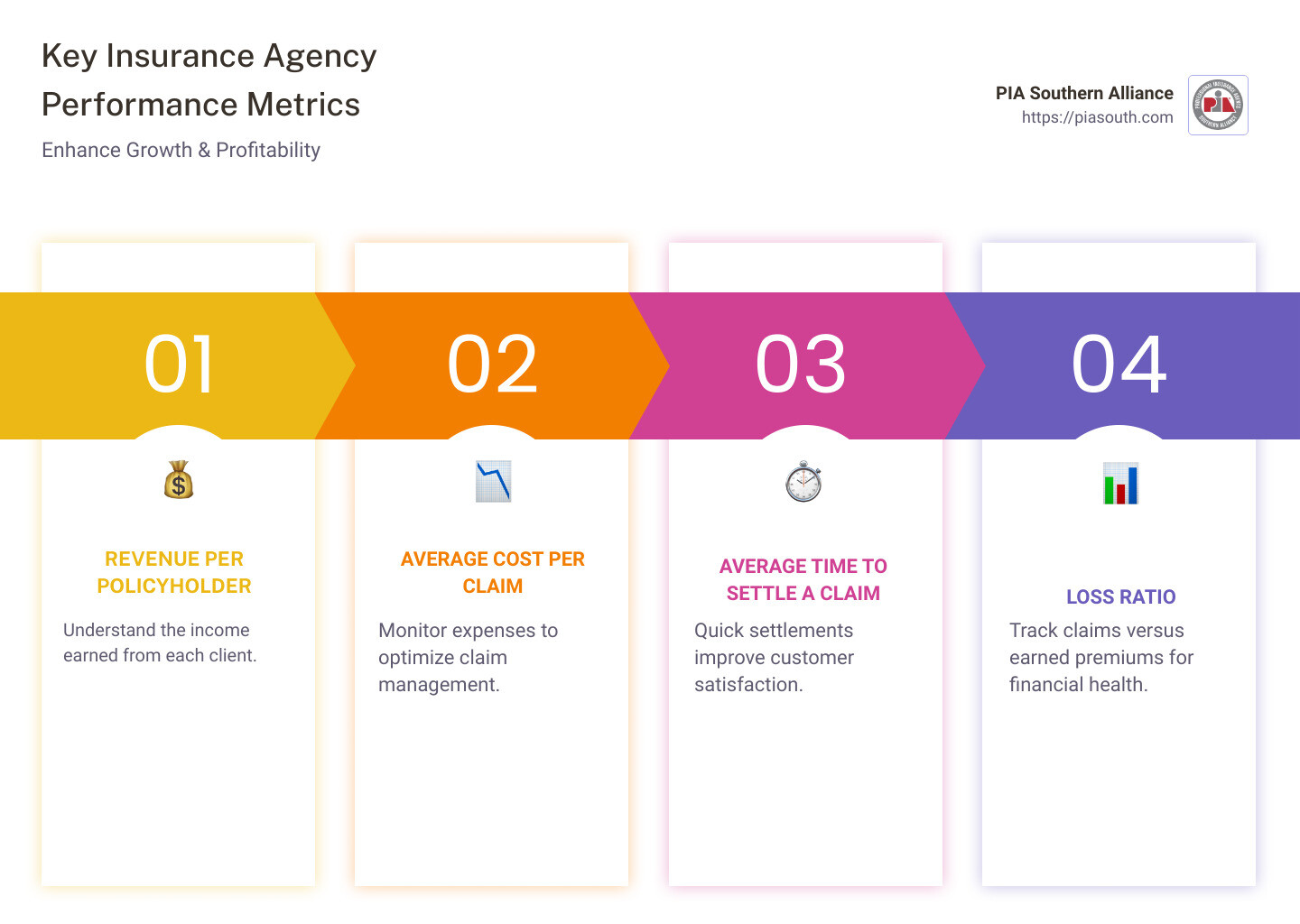
Insurance agency performance metrics are the backbone for any agency aiming to improve growth and profitability. Measuring these metrics helps agencies assess their sales efficiency, customer satisfaction, and operational strength. Here’s a snapshot of key insurance agency performance metrics to keep in mind:
- Revenue per Policyholder: Understand how much income you earn from each client.
- Average Cost per Claim: Monitor expenses to optimize claim management.
- Average Time to Settle a Claim: Quick settlements boost customer satisfaction.
- Loss Ratio: Keep an eye on the claims compared to earned premiums.
- Return on Surplus: Gauge your financial stability through profits over assets.
Identifying and tracking these metrics will provide valuable insights into your agency’s current performance and highlight areas for improvement. This approach not only boosts internal efficiency but also improves client relationships, a vital factor for long-term sustainability.
At PIA South, we prioritize education and strategic support to help independent insurance agencies, particularly in Georgia, Alabama, and Mississippi, harness these metrics effectively. With years of experience advising agencies, we understand that leveraging performance data is crucial for navigating complex commercial claims and expanding offerings.
Transitioning to the next sections, we’ll dive deeper into some critical KPIs that can significantly impact your agency’s success.
Key Performance Indicators (KPIs) for Insurance Agencies
When it comes to insurance agency performance metrics, Key Performance Indicators (KPIs) are the secret sauce. They help agencies measure performance and efficiency in a clear, objective way. Let’s break down some of the most important KPIs that can drive success for your agency.
Sales KPIs
Quote Rate: This is the percentage of leads that receive a quote. A higher quote rate means your team is effectively engaging with prospects.
Bind Rate: This measures how many quotes turn into actual policies. It’s a direct indicator of your sales team’s ability to close deals.
New Policies Per Agent: Tracking the number of new policies each agent sells is crucial. It helps identify top performers and those who might need additional training.
Claims KPIs
Average Cost Per Claim: This KPI shows how much you’re spending on each claim. Keeping this cost down is essential for profitability.
Claim Frequency: How often are claims being filed? This metric helps assess risk levels and the effectiveness of underwriting practices.
Average Time to Settle a Claim: Fast resolutions keep customers happy. This KPI measures how quickly claims are processed, impacting customer satisfaction and retention.
Financial KPIs
Expense Ratio: This is the total operating expenses divided by the total written premiums. A lower expense ratio indicates better operational efficiency.
Loss Ratio: Calculated by dividing total incurred losses by total earned premiums, this metric shows how much of the premiums are being paid out in claims.
Revenue Per Policyholder: Understanding the income generated from each policyholder can help tailor services and improve profitability.

By focusing on these KPIs, insurance agencies can gain a clear picture of their operational health and make informed decisions to improve their performance. Whether you’re aiming to increase sales, speed up claims processing, or improve financial efficiency, these metrics are your roadmap to success.
Next, we’ll explore the top metrics that directly influence insurance profitability, providing a deeper understanding of how to drive growth and sustainability.
Top Metrics for Insurance Profitability
When it comes to ensuring the profitability of an insurance agency, focusing on the right metrics is crucial. Gross written premium, combined ratio, and policy renewal rate are three key indicators that provide insight into financial health and growth potential.
Gross Written Premium
Gross written premium is the total revenue from all insurance policies sold before deductions like reinsurance costs. It’s a simple yet powerful metric that reflects the agency’s ability to generate income.
Why is this important? A higher gross written premium indicates a strong sales force and effective marketing strategies. It’s like the heartbeat of your agency, showing how well you’re attracting and retaining clients. Tracking this metric helps you understand your market position and identify trends in customer demand.
Combined Ratio
The combined ratio is a critical measure of profitability. It compares the sum of incurred losses and expenses to earned premiums. A ratio below 100% means you’re making a profit on underwriting, while anything above indicates a loss.
This metric is essential because it combines both expense and loss ratios, providing a comprehensive view of operational efficiency. For instance, if an agency in Georgia consistently maintains a combined ratio of 95%, it shows effective cost management and risk assessment practices.
Policy Renewal Rate
The policy renewal rate measures the percentage of policies renewed compared to those up for renewal. It’s a direct reflection of customer satisfaction and loyalty.
Why focus on renewals? High renewal rates mean your clients are happy and trust your services, reducing the need for costly new customer acquisition. Agencies in Alabama, for example, that achieve renewal rates above 85% often see higher profitability due to lower churn and stable revenue streams.
By keeping a close eye on these metrics, insurance agencies can not only track their current financial performance but also strategize for future growth. Next, we’ll dig into how data collection and reporting can improve agency performance, ensuring you stay ahead in a competitive market.
Enhancing Agency Performance through Data
Using Technology for KPI Tracking
Insurance agency performance metrics are more important than ever. They help agencies in Georgia, Alabama, and Mississippi stay competitive. But tracking these metrics can be a challenge. This is where technology comes in.
Automated Data Collection
Gone are the days of manually entering data into spreadsheets. With automated data collection, agencies can gather information without lifting a finger. This means less time on data entry and more time on what really matters—serving clients and growing the business.
Centralized Data
Centralized data storage is like having a digital filing cabinet. All your data is in one place, easily accessible to those who need it. This eliminates the need for constant back-and-forth emails or searching through endless files. When data is centralized, teams can make faster, more informed decisions.
Insurance BI Software
Business Intelligence (BI) software is a game-changer for insurance agencies. It not only collects data but also analyzes it. With BI software, you can visualize your KPIs through dashboards. These dashboards provide real-time insights into sales, claims, and financial performance.
Imagine having a dashboard that shows you the bind rate, expense ratio, or even gross written premium at a glance. This makes it easier to spot trends and make strategic decisions.
KPI Dashboard
A KPI dashboard is like a car’s dashboard. It shows you everything you need to know to keep your agency running smoothly. With a KPI dashboard, you can track performance metrics in real time. This means you can quickly identify areas that need improvement and take action.
For example, if you notice a dip in the policy renewal rate, you can investigate and address the issue before it affects your bottom line.
By embracing these technologies, insurance agencies can improve their performance and drive growth. Next, we’ll explore some frequently asked questions about insurance agency performance metrics and how they can guide your agency to success.
Frequently Asked Questions about Insurance Agency Performance Metrics
How to measure performance of an insurance company?
Measuring the performance of an insurance company involves looking at several key metrics. One of the most important is gross written premiums. This metric shows the total value of all policies sold before deductions like reinsurance. It’s a clear indicator of growth and market presence.
Another critical metric is the loss ratio. This ratio compares claims paid to the premiums earned. A high loss ratio might suggest poor underwriting or an unusual number of claims, while a lower ratio indicates better risk management and profitability.
The expense ratio is also vital. It measures the company’s operating expenses against the premiums it earns. A high expense ratio indicates inefficiency, while a lower ratio suggests more efficient operations.
Together, these metrics provide a comprehensive view of an insurance company’s performance, helping to identify strengths and areas for improvement.
What is KPI in insurance?
A Key Performance Indicator (KPI) in insurance is a measurable value that shows how effectively an insurance company is achieving key business objectives. KPIs help monitor performance and operational success.
For instance, the combined ratio is a common KPI that combines the loss ratio and expense ratio. It shows the overall efficiency of the company in underwriting and managing expenses. A combined ratio below 100% indicates profitability, as the company is earning more from premiums than it is paying out in claims and expenses.
KPIs like these allow insurance agencies to track their progress and make informed decisions to improve their operations.
What are the metrics for insurance profitability?
When it comes to insurance profitability, several metrics are crucial. Gross written premium is one, as it shows the total revenue potential from all policies issued.
The loss ratio is another key metric. It helps assess how much of the earned premiums are being used to pay claims. A lower loss ratio generally indicates better profitability.
Finally, the combined ratio is essential for understanding overall profitability. It combines both the loss and expense ratios, providing a complete picture of the company’s financial health. A combined ratio under 100% means the company is making a profit from its underwriting activities.
By focusing on these metrics, insurance agencies can better understand their profitability and make strategic decisions to improve their success.
Conclusion
In today’s insurance market, strategic decision-making is more important than ever. At PIA Southern Alliance, we understand this challenge and are committed to supporting independent insurance agencies in Georgia, Alabama, and Mississippi. Our goal is to empower these agencies with the tools they need to thrive.
Strategic decision-making is at the heart of any successful insurance agency. By focusing on key metrics, agencies can make informed choices that drive growth and efficiency. Whether it’s optimizing the combined ratio or improving the loss ratio, understanding these metrics is crucial for making strategic decisions that improve agency performance.
Another vital component of success is cross-selling abilities. By effectively cross-selling, agencies can increase their revenue and improve customer retention. We offer specialized webinars and courses that focus on enhancing these skills, providing agents with the knowledge they need to succeed in today’s competitive market.
Our educational resources and development programs are designed to help agents not only understand these metrics but also apply them to real-world scenarios. By leveraging our resources, agents can steer the complexities of the insurance landscape with confidence.
Ready to lift your agency’s capabilities? Explore our professional designations and educational programs today and let PIA Southern Alliance be your partner in building a successful agency.