
Why Insurance Agencies Need a Steady Lead Pipeline
Insurance agency lead generation is the process of identifying and attracting potential customers who need property and casualty coverage, then guiding them through your sales funnel to become paying clients. Without a consistent flow of qualified prospects, even the most experienced agencies struggle to maintain growth and replace natural client attrition.
The core strategies for insurance agency lead generation include:
- Digital marketing – SEO, Google Ads, and social media advertising to capture online shoppers
- Referral programs – Leveraging existing clients and professional partnerships for warm introductions
- Local networking – Chamber events, community sponsorships, and educational workshops
- Paid lead services – Purchasing exclusive or shared leads from vetted providers
- Content marketing – Educational resources that attract prospects researching coverage options
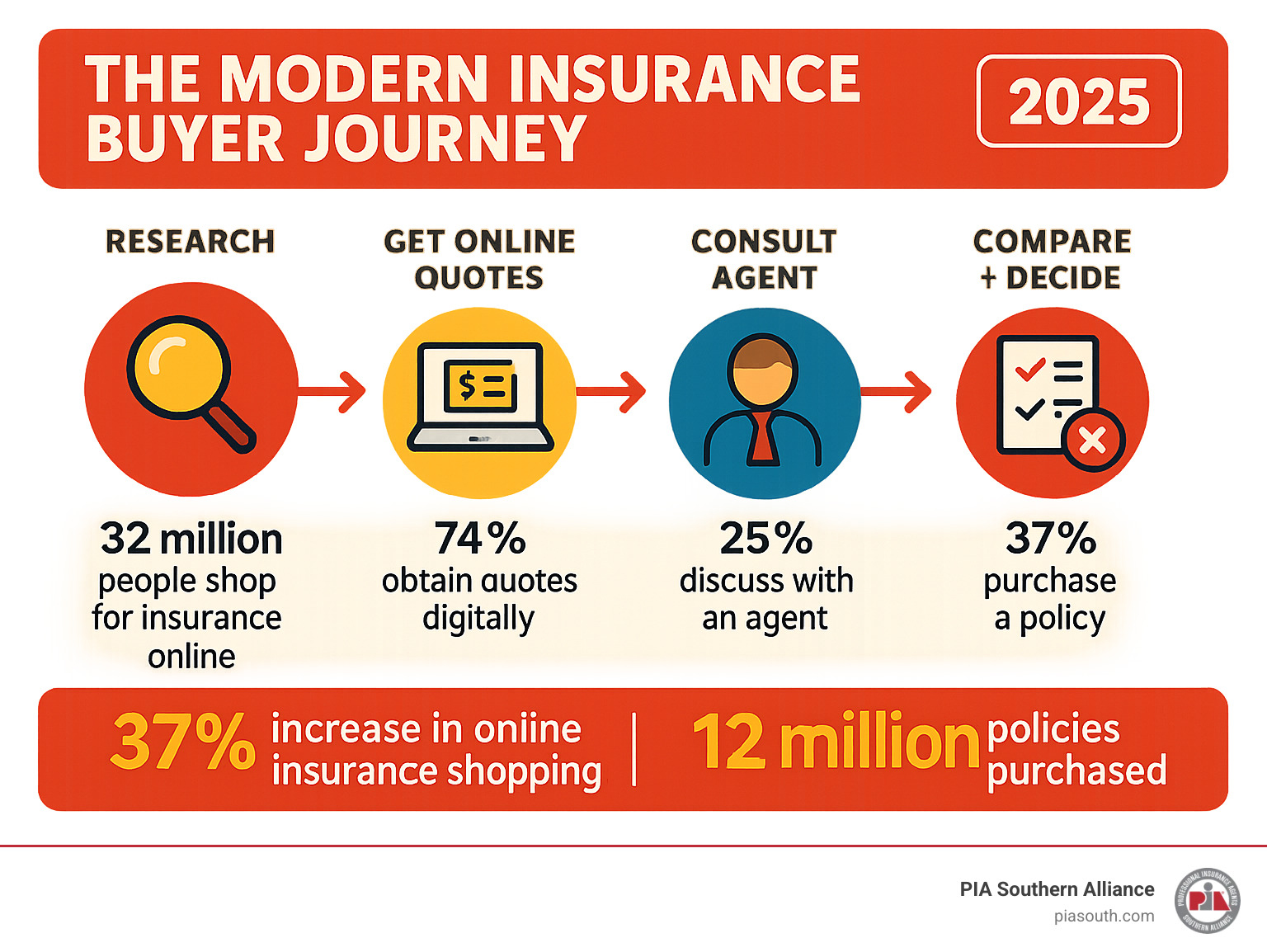
ComScore found that 32 million people went online to shop for auto insurance quotes, with over 12 million actually purchasing policies—a 37% increase compared to the previous year. This massive shift toward digital research means agencies that master online lead generation have a significant competitive advantage.
Most agency owners feel overwhelmed by the sheer number of tactics available. Between managing existing clients, handling claims, and staying compliant with regulations, finding time to build a systematic lead generation process can feel impossible.
Successful agencies in Georgia, Alabama, and Mississippi focus on mastering 2-3 core strategies that align with their target market and resources. The key is building sustainable processes that work even when you’re not actively prospecting.
Why Lead Generation Still Matters in 2024
Today’s consumers don’t just call the first agent they find in the Yellow Pages anymore. Instead, they’re doing their homework online, comparing quotes, reading reviews, and researching coverage options before they ever think about picking up the phone.
This shift creates a fascinating dynamic for property and casualty agencies across Georgia, Alabama, and Mississippi. Consumer intent has never been clearer or stronger. When someone types “homeowners insurance near me” or “commercial property coverage” into Google at 11 PM on a Tuesday, they’re not window shopping—they’re ready to buy.
That 37% year-over-year growth in online insurance shopping isn’t some temporary blip caused by the pandemic. It’s the new normal, and it’s accelerating. Agencies that keep waiting for things to “go back to how they were” are essentially watching their future competitors build unbeatable advantages.
Revenue stability depends entirely on consistent lead flow. Even if your book of business looks solid today, you’re going to lose 10-15% of your clients every year through completely natural attrition. Without fresh prospects entering your pipeline regularly, your agency’s growth hits a wall.
The Cost of Inaction
Lost renewals start feeling catastrophic when you’re not actively prospecting. Instead of viewing client departures as normal business fluctuations, every lost account becomes a crisis.
Book erosion accelerates during tough economic times. When money gets tight, clients shop more aggressively for better rates. Agencies without steady lead flow find themselves playing defense constantly.
Competition creep becomes overwhelming. While you’re focused entirely on servicing existing clients, other agencies are actively marketing to your prospects and your current policyholders.
The Opportunity in P&C Lines
Auto insurance leads convert quickly because coverage is mandatory and policies renew annually. Speed-to-contact isn’t just helpful—it’s everything in auto insurance lead generation.
Homeowners insurance opens doors to entire households. A single home insurance inquiry often leads to auto coverage, umbrella policies, valuable items protection, and sometimes even commercial lines.
Commercial property insurance commands higher premiums and typically results in longer client relationships. One good commercial account can transform an agency’s profitability.
Catastrophe coverage creates natural urgency in our Southeast markets. Hurricane season, severe weather events, and flooding concerns drive immediate demand for comprehensive coverage reviews.
Core Strategies for Insurance Agency Lead Generation
The most successful agencies we work with don’t try to master every lead generation tactic simultaneously. Instead, they build expertise in 2-3 core strategies that complement each other and align with their target market.

Email marketing generates 50% more sales than any other lead generation method for insurance companies. Content marketing generates 50% more leads than traditional marketing for insurance agencies.
Modern insurance agency lead generation requires a multi-channel approach. Your prospects might find you through a Google search, engage with your content on social media, and ultimately convert through a referral from a satisfied client.
For comprehensive guidance on building your digital presence, explore our resource on Digital Marketing for Insurance Agents.
Digital Marketing Essentials for Insurance Agency Lead Generation
Search engine optimization (SEO) remains the foundation of sustainable digital lead generation. Start with keyword clusters around your core services:
– “auto insurance [your city]”
– “homeowners insurance quotes [your state]”
– “commercial property coverage [your area]”
– “flood insurance [your region]”
Local SEO amplifies your reach within your service area. Optimize your Google Business Profile with accurate information, encourage client reviews, and ensure your NAP (Name, Address, Phone) information is consistent across all online directories.
Email list building should be automatic. Every website visitor should have multiple opportunities to join your email list through valuable content offers.
Chatbots handle initial qualification when you’re not available. A simple bot can collect contact information, determine coverage needs, and schedule appointments.
For detailed guidance on selecting and implementing customer relationship management tools, review our guide on Insurance Agency CRM Software.
Referral Engines for Insurance Agency Lead Generation
Referrals represent pre-qualified leads who already trust your expertise based on recommendations from people they know. The challenge is creating systematic processes that generate referrals consistently.
Client reviews drive referral behavior. Make review generation a standard part of your client onboarding and renewal processes.
Professional partnerships multiply your reach. CPAs, mortgage brokers, real estate agents, and financial advisors all serve clients who need insurance coverage.
Word-of-mouth marketing amplifies through social proof. Encourage and facilitate this sharing through thank-you campaigns and social media engagement.
Cross-selling existing clients often leads to referrals as they experience the value of working with a full-service agency. Learn advanced techniques in our guide on Cross-Selling Insurance Techniques to Skyrocket Your Sales.
Paid Leads—Pros, Cons, and Compliance
Exclusive leads cost more but convert better because you’re not competing with multiple agents for the same prospect. Industry data shows that exclusive leads can achieve close rates of 10-20% with proper follow-up systems.
Shared leads offer lower cost per lead but require faster response times and more aggressive follow-up.
TCPA compliance is non-negotiable when purchasing leads. Ensure your lead provider obtains proper consent for phone calls and text messages.
ROI math determines viability. If you buy ten leads per day for $100 and close 1-2 policies earning $300 commission each, you’re achieving a 300-600% return on investment.
For agencies considering professional lead services, EverQuote experts offer consultation on lead quality and compliance standards.
Online vs. Offline Lead Tactics: Choosing Your Mix
The most successful insurance agency lead generation strategies don’t pick sides between digital and traditional methods. Instead, they blend both approaches to create a comprehensive system that captures leads from multiple touchpoints.

Digital channels shine when it comes to capturing high-intent prospects who are actively shopping for coverage. These are the folks typing “homeowners insurance quotes” into Google at 11 PM or clicking through Facebook ads about commercial property protection.
The beauty of digital marketing lies in its measurability. You can track exactly how much each lead costs, which channels perform best, and what messaging resonates with your target market.
Community outreach and offline relationship building create a different type of value that’s harder to measure but equally important. When you sponsor the local Little League team or speak at the Chamber of Commerce, you’re building long-term brand recognition and trust.
Direct mail campaigns still deliver results when executed thoughtfully. High-net-worth homeowners and established business owners often respond better to well-designed postcards than generic digital ads.
Educational seminars and workshops position you as the local insurance expert while generating qualified leads who value professional guidance.
Maximizing Local Presence in GA, AL, MS
Chamber of Commerce membership and active participation opens doors that digital marketing simply can’t. Regular attendance at networking events creates a steady stream of commercial insurance referrals.
Strategically sponsoring community events that align with your target market transforms growth trajectory. Sponsoring the annual business expo puts your name in front of hundreds of potential commercial clients.
Storm preparedness workshops leverage our region’s unique weather challenges to provide genuine value while showcasing your expertise. Partner with local emergency management offices to host “Hurricane Preparedness for Homeowners” sessions.
Scaling Without Losing Your Mind
Marketing automation saves your sanity by handling routine follow-up tasks. When a prospect downloads your “Home Insurance Checklist,” an automated email sequence can nurture them over several weeks without any manual effort.
Drip email campaigns work especially well for prospects who aren’t ready to buy immediately. Someone researching commercial property insurance for a business they’re planning to open might not be ready to purchase for six months.
The smartest agencies delegate lead qualification and initial follow-up to trained team members. This frees up the agency owner to focus on closing sales and building strategic relationships.
Tools & Tech Stack to Capture and Nurture P&C Leads
Building a successful insurance agency lead generation system requires the right technology foundation. Think of your tech stack as the engine that powers your sales process—it captures prospects, nurtures relationships, and helps you close more business without working around the clock.
Your Customer Relationship Management (CRM) system serves as mission control for everything lead-related. Without a solid CRM, even the best lead generation tactics fall apart because prospects slip through the cracks.
AI chatbots have become game-changers for agencies that want to capture leads outside business hours. Instead of waiting until Monday morning, your chatbot collects their information, asks qualifying questions, and schedules a follow-up call.
Marketing automation takes the guesswork out of follow-up. Once a prospect enters your system, automated email sequences educate them about coverage options, share client success stories, and gradually build trust.
Call tracking systems answer the age-old question: “Which marketing efforts actually generate phone calls?” When you know that your Google Ads drive 15 calls per month while your radio sponsorship generates just 2, you can make smarter decisions.
For comprehensive guidance on implementing these systems, explore our resource on Insurance Agency Automation.

Must-Have Apps for Insurance Agency Lead Generation
Lead scoring applications help you focus on prospects most likely to buy. Instead of treating every inquiry the same way, these tools analyze behavior patterns to identify hot prospects.
SMS follow-up tools can be absolute lifesavers for connecting with busy prospects. While email gets buried in crowded inboxes, text messages get read within minutes.
Calendar scheduling links eliminate the back-and-forth that kills momentum. When a prospect shows interest, you can immediately send them a link to book a consultation.
Analytics dashboards give you the real story behind your marketing efforts. You’ll see which Google keywords generate the most qualified leads and which email campaigns drive appointments.
Scientific research on response time shows that contacting leads within five minutes increases conversion rates by 900% compared to waiting 30 minutes.
Staying Compliant While Scaling
Recorded consent becomes automatic when your systems are set up properly. Every form submission, phone call, and text message enrollment should be documented and stored.
Opt-out workflows must be bulletproof. Every marketing email needs a clear unsubscribe link that works immediately. Text message recipients should be able to reply “STOP” to end communications.
Regular data audits keep your information clean and compliant. Monthly reviews help you catch and fix issues before they become regulatory headaches.
Compliance isn’t just about avoiding fines—it’s about building trust. Prospects who see that you handle their information professionally are more likely to trust you with their insurance needs.
Tracking Success & Continuous Improvement
The most successful agencies measure everything. But they don’t get lost in vanity metrics that look impressive but don’t pay the bills. Instead, they focus on Key Performance Indicators (KPIs) that directly impact revenue and guide smart investment decisions.
Cost Per Lead (CPL) tells only half the story. A $50 lead that converts at 3% costs you more than a $150 lead that converts at 15%.
Close rates reveal the truth about lead quality and your sales process effectiveness. Track these rates by source religiously. You might find that referrals convert at 40% while paid leads convert at 8%.
The real game-changer is understanding lifetime value calculations. When you know that the average client stays for four years and generates $2,400 in total commissions, you can justify spending $400 to acquire them.
For comprehensive guidance on measuring what matters most, review our resource on Insurance Agency Performance Metrics.

Growth Levers for Georgia, Alabama & Mississippi Agencies
Risk management degree graduates from universities across Georgia, Alabama, and Mississippi represent an incredible talent pool that many agencies overlook. These professionals already understand insurance fundamentals and can become productive team members quickly.
Coastal property specialization creates premium opportunities for agencies willing to develop expertise in hurricane and flood coverage. This specialization often leads to higher commissions and stronger client relationships.
Catastrophe modeling capabilities set your agency apart when serving commercial clients. Business owners facing hurricane season want agents who understand exposure analysis and can recommend appropriate coverage limits.
When to Pivot Your Insurance Agency Lead Generation Plan
Market shifts demand strategy evolution—what worked perfectly in 2022 might struggle in 2024’s economic environment. Stay alert to changing consumer behavior and competitive pressures.
Ad fatigue is real and expensive. When your Google Ads or Facebook campaigns start seeing declining performance despite consistent spend, it’s time for creative refreshes.
Carrier appetite changes can dramatically affect which prospects you should target. If your primary carrier stops writing coastal properties, your lead generation focus needs to shift accordingly.
Frequently Asked Questions about Generating P&C Leads
How fast should I contact a new digital lead?
The answer might surprise you: contact digital leads within 5 minutes whenever possible. We know that sounds intense, but the research backs it up completely. Studies consistently show that leads contacted within the first hour are 7 times more likely to convert than those contacted after an hour passes.
Think about it from your prospect’s perspective. They just filled out a form requesting auto insurance quotes. Their phone is probably in their hand, and they’re actively thinking about their coverage needs. That’s your golden window.
Set up automated responses that acknowledge receipt immediately—even a simple “Thanks for your interest, we’ll call you within 10 minutes” text message works wonders. Then follow up with a personal call or email as quickly as you can manage.
If you can’t respond immediately during business hours, automation becomes your best friend. Use it to schedule follow-up reminders and ensure no lead slips through the cracks. Your insurance agency lead generation success often comes down to who responds first, not necessarily who has the best rates.
Are paid leads worth it for small agencies?
Paid leads can absolutely be valuable for small agencies—but only if you approach them strategically. Too many agency owners jump in without proper systems and get burned by poor conversion rates.
Start small and track everything. Begin with exclusive leads even though they cost more upfront. Why? Because you won’t be competing with three other agents who are calling the same prospect. This gives you time to perfect your follow-up process without the pressure of speed-to-contact battles.
Focus on your conversion process first. If you’re only closing 5% of the leads you buy, the problem isn’t the leads—it’s your sales process. Work on that foundation before scaling up your lead purchases.
Once you’ve developed solid systems and can consistently convert 15-20% of exclusive leads, then you can experiment with shared leads to reduce costs. The key is having realistic expectations and treating paid leads as one part of your overall insurance agency lead generation strategy, not the entire solution.
What metrics predict long-term profitability?
Here’s where most agencies focus on the wrong numbers. Customer lifetime value and retention rates matter far more than cost per lead or even initial conversion rates.
A lead generation strategy that brings in clients who stick around for five years and buy multiple policies will always beat one that focuses solely on volume. We’ve seen agencies celebrate high conversion rates while their clients churn after the first year—that’s not sustainable growth.
Track the metrics that really matter: average client tenure, policies per client, annual premium per client, and referral rates from new clients. These numbers tell you whether your lead generation efforts are building a profitable book of business or just keeping you busy.
Cross-selling success rates also predict long-term profitability. Clients who purchase both auto and home coverage from your agency are significantly more likely to stay long-term and refer others. This is why insurance agency lead generation should focus on attracting prospects who fit your ideal client profile, not just anyone who needs coverage.
The best agencies we work with in Georgia, Alabama, and Mississippi understand that sustainable growth comes from building relationships, not just collecting leads. When you focus on metrics that reflect relationship quality, the revenue naturally follows.
Conclusion
You don’t need to master every marketing tactic under the sun to build a thriving insurance agency lead generation system. The secret? Pick 2-3 strategies that actually fit your agency’s personality and stick with them until they work like clockwork.
Maybe that’s local SEO paired with a solid referral program and some targeted Google Ads. Or perhaps it’s community networking combined with educational content and strategic partnerships with mortgage brokers. The magic happens when you go deep instead of wide.
Here in the Southeast, we’ve got some serious advantages working in our favor. Auto insurance is mandatory, homeowners coverage opens doors to umbrella policies and valuable items protection, and commercial property clients tend to stick around for years when you treat them right.
The agencies crushing it in Georgia, Alabama, and Mississippi treat lead generation like the business system it is—not some side project they’ll get to “when things slow down.” They track their numbers religiously, tweak what’s not working, and double down on what brings results.
Think about it this way: every month you delay building systematic prospecting processes, your competitors are capturing prospects who could have been your clients. That’s revenue walking out the door that you’ll never get back.
At PIA Southern Alliance, we see this challenge every day. That’s why our programs focus so heavily on strategic thinking and cross-selling skills—because these directly impact how effectively you can convert leads into long-term, profitable relationships.
Consistent prospecting beats sporadic bursts of activity every single time. Systematic follow-up trumps hoping prospects will call you back. And exceptional service delivery creates the referrals that make lead generation feel effortless.
Get the technology working for you instead of against you. Build processes that run smoothly whether you’re in the office or dealing with a claim emergency. Create systems that turn satisfied clients into your best salespeople.
For a complete roadmap to scaling your agency, check out our guide on Insurance Agency Growth Strategies. It’ll show you how to tie lead generation into your broader growth strategy.
Your next great client is probably searching for coverage right now. The question isn’t whether quality leads exist—it’s whether you’ve built the systems to capture them, nurture them, and convert them into the profitable relationships your agency deserves.
The time for hoping and wishing is over. It’s time to build a lead generation machine that works.