
The Digital Change of Insurance Marketing
Insurance agency digital marketing is the strategic use of online channels and tools to attract, engage, and convert insurance prospects. For independent agents looking to transform their marketing approach, here are the essential components:
- Website Optimization: Mobile-friendly design with clear CTAs
- Local SEO: Google Business Profile + consistent NAP information
- Content Marketing: Educational blogs that answer prospect questions
- Email Campaigns: $36 ROI for every $1 spent
- Social Media: 71% of agencies report active social presence
- Online Reviews: 97% of customers read reviews before purchasing
The insurance industry is facing a digital revolution. As technology becomes more widely used and consumer behavior shifts, the ways prospective clients search for coverage and find your agency are fundamentally changing. Independent agents in Georgia, Alabama, and Mississippi who accept digital marketing aren’t just staying competitive—they’re thriving.
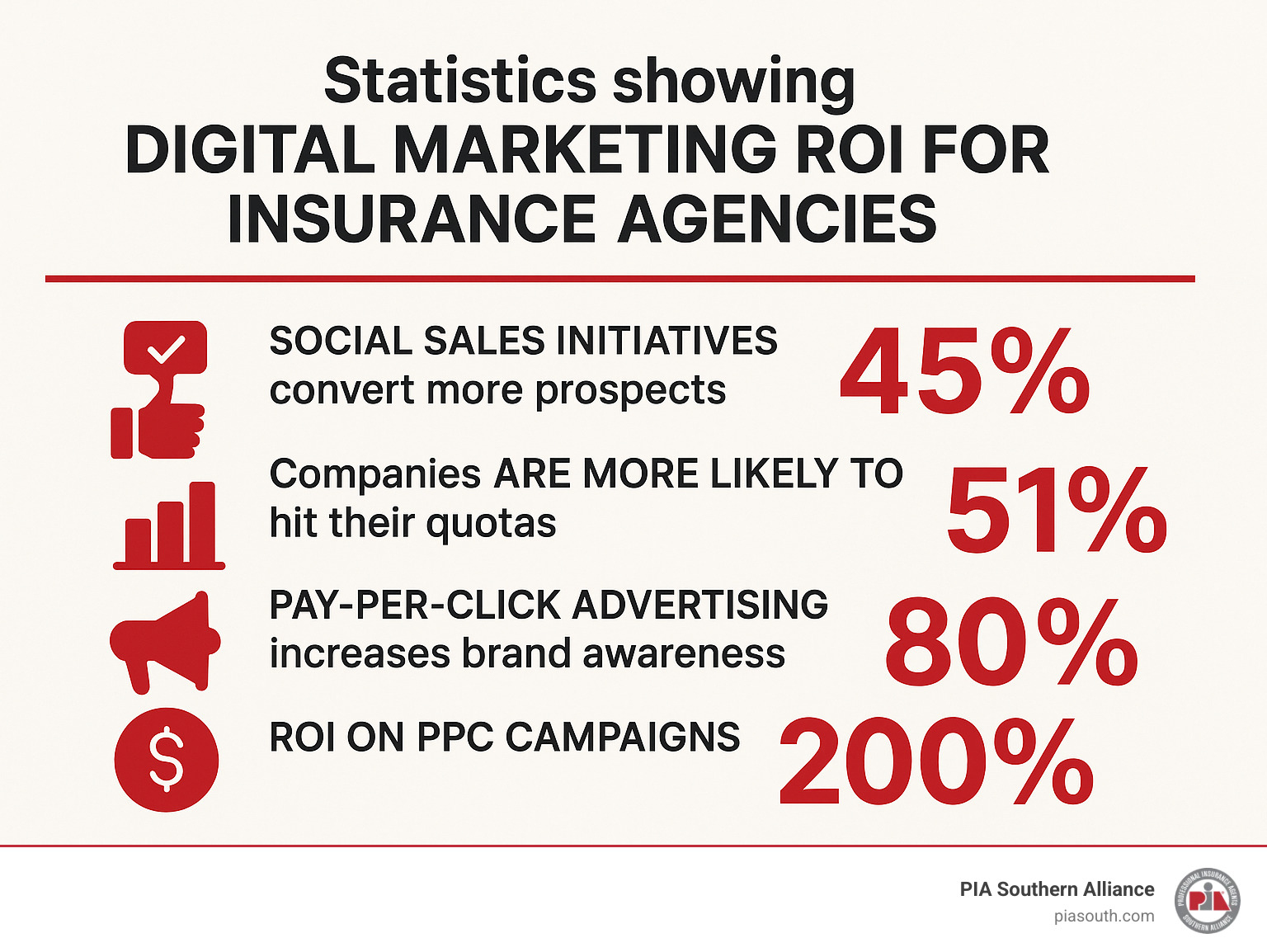
The statistics paint a clear picture: companies with leading social sales initiatives convert 45% more prospects than their competitors and are 51% more likely to hit their quotas. Meanwhile, agencies adopting omnichannel digital marketing (using three or more channels) experience nearly 500% more conversions than those relying on single-channel efforts.
For property and casualty insurance agencies, the digital shift isn’t optional—it’s essential. Today’s insurance buyers begin their journey online long before they pick up the phone or walk through your door. If your agency isn’t visible where they’re searching, you’re missing critical opportunities to grow your book of business.
As a member of PIA Southern Alliance, I’ve witnessed how insurance agency digital marketing has transformed independent agencies across the Southeast, helping them compete effectively against direct writers and captive agents.

Key insurance agency digital marketing vocabulary:
– insurance agency automation systems
– insurance agency client retention
– insurance agency best practices
Mastering Insurance Agency Digital Marketing Fundamentals
The heartbeat of successful insurance agency digital marketing is embracing an omnichannel approach – a strategy that weaves multiple marketing channels together to create one seamless experience for your prospects and clients, no matter how they interact with your agency.
As one Georgia-based agency owner told me over coffee last month, “Digital marketing expanded our networking reach to new clients in ways we never imagined possible. When we finally connected all our marketing channels instead of treating them as separate islands, our conversion rates jumped nearly 500% compared to our old single-channel efforts.”
Understanding the difference between pulling clients in versus chasing them down makes all the difference for insurance agencies today:
Inbound marketing acts like a magnet, attracting prospects through helpful content that answers questions they’re already asking online. Your blogs about “What affects home insurance rates in coastal Mississippi?” or “Georgia commercial property coverage gaps” position you as the helpful expert before prospects even reach out.
Outbound marketing, meanwhile, is the traditional approach of reaching out directly through cold calls, mailers, and broadcast ads – still valuable, but increasingly less effective on its own.
For P&C agencies across Alabama, Georgia, and Mississippi, the digital revolution isn’t just about finding new clients. The real power lies in cross-selling opportunities to your existing book. Agencies implementing structured digital referral programs report a remarkable 71% increase in conversion rates when approaching current clients with complementary coverage options.
Why Going Digital Matters in 2024
The insurance landscape has transformed dramatically in recent years. With nearly 3 million insurance professionals competing for attention nationwide, standing out requires more than just a business card and a handshake.
Search dominance has become non-negotiable – over 70% of insurance shoppers now research and receive quotes online before purchasing a policy. If your agency doesn’t appear when someone in your community searches “commercial property insurance near me,” you might as well be invisible.
Client expectations have fundamentally shifted too. Today’s insurance buyers – whether they’re homeowners in suburban Atlanta or commercial property managers in Birmingham – expect instant information, round-the-clock accessibility, and frictionless digital experiences. Meeting these expectations isn’t just about growth; it’s about survival.
The economics make digital marketing essential as well. The insurance industry faces the highest average cost-per-click at around $59 for paid advertising, making organic digital marketing strategies significantly more budget-friendly for independent agencies with limited marketing dollars.
For local P&C agents across our three states, digital marketing creates a genuine competitive advantage against massive national carriers. Your community connections and personalized service become powerful differentiators when highlighted through targeted local digital strategies.
As one marketing expert colorfully put it: “Water. Food. Insurance. Things people always need—and yet companies spend millions advertising bottled water. If Nestlé dropped nearly $5 million advertising Pure Life in 2014, shouldn’t your agency invest in marketing something people actually need?”
Insurance Agency Digital Marketing Success Metrics
Measuring what matters separates successful digital marketing from expensive time-wasting. Focus your agency’s attention on these key performance indicators:
Cost Per Lead (CPL) tells you exactly how much you’re spending to acquire each new prospect across different channels. For P&C agencies in our region, aim for a CPL below $50 for personal lines and under $150 for commercial lines – anything higher deserves scrutiny.
Policy Growth Rate should be tracked monthly and quarterly, broken down by line of business and marketing source. This granular view helps you identify which digital channels are truly driving your agency’s growth.
Retention Rate matters just as much as acquisition. Your digital marketing shouldn’t just bring clients in the front door – it should help keep them from leaving through the back door. Measure how your email newsletters, educational content, and client communication strategies impact your renewal rates.
Return on Ad Spend (ROAS) calculates the premium generated for every dollar spent on digital advertising. Successful agencies typically aim for a 3:1 ROAS for established campaigns – anything less might need refinement.
Engagement Metrics like website visits, time on page, email open rates, and social media interactions provide early indicators of audience interest long before they translate to policies.
A Mississippi agency owner recently shared, “After implementing proper analytics tracking, we finded our email campaigns were yielding a $36 return for every $1 spent—far more effective than we realized. We immediately shifted budget from underperforming channels to double down on what was working.”
By mastering these fundamentals, independent P&C agencies across Georgia, Alabama, and Mississippi can build digital marketing systems that consistently attract, engage, and convert the right prospects while strengthening relationships with existing clients.
For more comprehensive information about digital marketing strategies specifically custom for insurance agents, visit Digital Marketing for Insurance Agents. And to explore the latest research on how social selling impacts conversion rates, check out Social Selling Statistics.
Crafting Laser-Focused P&C Buyer Personas
The foundation of effective insurance agency digital marketing is understanding exactly who you’re trying to reach. Buyer personas aren’t just marketing jargon – they’re your secret weapon for connecting with ideal clients. Think of them as detailed character sketches of the people who need your insurance solutions.

For P&C agencies across Georgia, Alabama, and Mississippi, your local knowledge gives you a tremendous advantage. The commercial property owner in coastal Mississippi worries about hurricane coverage, while your Atlanta business client is more concerned with liability protection for their growing workforce. These regional nuances matter deeply.
When building your personas, dig beyond basic demographics. Yes, you need to know their age, income, and family status – but the magic happens when you understand their deeper motivations. What keeps them up at night? Is it protecting their family home in suburban Birmingham? Or ensuring their small business in Savannah can survive a disaster?
As one successful Georgia agent shared with me, “I like to use LinkedIn, Sales Genie, and Salesforce to create lists and content to hyper-focus on the clients and businesses I’d like to work with.” This targeted approach helped him achieve an impressive 40% closing rate through digital prospecting. Not bad at all!
Your personas should capture essential attributes including demographics (age, income, family status), psychographics (values, risk tolerance), pain points (coverage concerns, price sensitivity), information sources (where they research), common objections, and most importantly, their motivations for seeking coverage.
Mapping the Policyholder Journey
Once you’ve crafted your personas, it’s time to walk in their shoes. The policyholder journey isn’t a straight line – it’s a winding path with specific needs at each turn.
During the Awareness Stage, your prospect might not even realize they have an insurance gap. Your educational blog posts about flood risks in low-lying Alabama communities or social media tips about commercial property protection can plant the seed.
When they enter the Consideration Stage, they’re actively comparing options. This is where your testimonials from satisfied Mississippi business owners or comparison content showing your agency’s advantages really shine.
At the Quote Stage, speed and simplicity become critical. Is your quote form mobile-friendly for the busy contractor checking rates between job sites? Can prospects easily schedule a call with a real human?
The Bind Stage transforms prospects into clients. Clear next steps and a warm digital welcome make all the difference here.
Finally, the Renewal Stage offers prime opportunities for deepening relationships. As one Alabama agency owner told me, “Understanding each stage allowed us to create targeted content that addressed specific concerns at the right time. Our conversion rates improved dramatically once we stopped treating all prospects the same.”
Insurance Agency Digital Marketing Personalization Tactics
With personas and journey maps in hand, you can now personalize every interaction. This isn’t just nice-to-have – it’s essential for standing out in today’s crowded insurance landscape.
Dynamic website content lets you show different messages based on who’s visiting. A commercial property manager in Columbus, Georgia might see content about business coverage, while a young family in Jackson, Mississippi gets homeowners information.
Segmented email campaigns allow you to nurture relationships with targeted messages. Your new homeowners might receive storm preparation tips during hurricane season, while your commercial clients get risk management strategies.
Remarketing lists help you stay top-of-mind with prospects who’ve shown interest. Someone who browsed your commercial auto page last week might see your targeted ad while checking the weather forecast today.
Localized content addressing specific regional concerns builds tremendous trust. Content about flood insurance for coastal Mississippi residents or hail damage protection for North Georgia homeowners demonstrates you understand their unique challenges.
“The key to personalization is data,” a digital marketing specialist recently explained to me. “Collecting and leveraging prospect data ethically allows you to create meaningful, relevant experiences that convert at much higher rates.”
By truly understanding who you’re trying to reach and meeting them exactly where they are in their journey, your insurance agency digital marketing efforts will connect more deeply and convert more effectively. That’s the real power of persona-based marketing.
Building a High-Converting Website & Local SEO
Your agency website is the digital front door to your business. For independent P&C agents in Georgia, Alabama, and Mississippi, a high-performing website isn’t just nice to have—it’s essential for turning curious visitors into loyal clients.

I recently spoke with an agency owner in Savannah who transformed her website and told me, “It was like flipping a light switch. Suddenly, leads started flowing in while we slept.” What made the difference? Her site acceptd several critical elements that today’s insurance consumers expect.
First and foremost, mobile-first design isn’t optional anymore. With over half of Google searches happening on smartphones, your site needs to shine on small screens. Google’s research reveals a sobering truth: 53% of mobile users will abandon your site if it takes longer than 3 seconds to load. That’s right—just 3 seconds stands between you and a potential client.
Page speed matters tremendously. As loading time creeps from 1 to 3 seconds, bounce rates jump by 32%. Think about it—would you wait around for a slow website when you’re shopping for insurance quotes? Neither will your prospects.
SSL security (that little https:// at the beginning of your URL) builds instant trust. This is particularly crucial for insurance agencies handling sensitive client information. One Alabama agent told me: “Adding SSL was a no-brainer—our form submissions increased almost overnight.”
Every page should feature clear call-to-actions that guide visitors toward the next logical step, whether that’s requesting a quote, calling your office, or downloading your helpful guide to business property coverage. Make these CTAs impossible to miss.
Your site navigation should be intuitive enough that visitors find what they need within three clicks. Organize by what matters to clients (homeowners, auto, business coverage), not by your internal agency structure.
The results speak for themselves. Consider this change from a Mississippi agency:
| Metric | Legacy Website | Optimized Website | Improvement |
|---|---|---|---|
| Page Load Time | 7.2 seconds | 2.1 seconds | 71% faster |
| Mobile Conversion Rate | 1.3% | 6.8% | 423% higher |
| Bounce Rate | 68% | 31% | 54% lower |
| Average Time on Site | 1:12 | 3:47 | 214% longer |
| Quote Form Completions | 23/month | 97/month | 322% more leads |
Insurance Agency Digital Marketing SEO Checklist
When it comes to search engine optimization, many agents feel overwhelmed. But breaking it down into manageable steps makes all the difference for your insurance agency digital marketing efforts.
Start with thorough keyword research to understand what your ideal clients are actually typing into search engines. Focus on location-specific terms like “commercial property insurance Atlanta GA” and question-based searches such as “how much does general liability insurance cost in Mississippi.” These longer phrases often have less competition but high buying intent.
Your on-page optimization should naturally incorporate these keywords into page titles, headings, and opening paragraphs. Create unique meta descriptions that entice clicks, and structure your content with clear heading hierarchies. One agent in Birmingham told me, “Once we restructured our content with proper H1s and H2s, our organic traffic jumped 47% in just two months.”
Don’t overlook technical SEO elements like proper image alt text (which helps visually impaired visitors and search engines understand your images), creating an XML sitemap, and implementing schema markup. These behind-the-scenes elements help search engines properly categorize and rank your content.
A solid backlink strategy builds your site’s authority. Secure listings in insurance directories, contribute guest articles to industry publications, and partner with local business associations. As one agent put it, “Our chamber of commerce partnership didn’t just give us a quality backlink—it brought us three new commercial clients.”
SEO isn’t a set-it-and-forget-it task. “Monthly technical SEO audits keep us ahead of algorithm changes,” explained a digital marketing expert I recently interviewed. “The agencies that maintain their SEO consistently outperform those who treat it as a one-time project.”
For more comprehensive guidance, check out our detailed guide to Insurance Agency Digital Change.
Local SEO Domination in Georgia, Alabama & Mississippi
For independent P&C agencies, local search visibility often drives more business than national rankings. Your neighborhood dominance starts with a fully optimized Google Business Profile.
Claim and verify your listing, then complete every section with rich, detailed information about your agency. Add high-quality photos showing your office, team members, and community involvement. Regular posts about agency news, policy updates, and local events keep your profile fresh and engaging.
NAP consistency might sound like technical jargon, but it’s simply ensuring your Name, Address, and Phone number appear exactly the same across all online listings. This seemingly small detail significantly impacts how search engines understand your business location and relevance.
Incorporate city, county, and neighborhood names throughout your content. Research shows a staggering 136% increase in “near me” searches in recent years. When someone in Montgomery types “commercial insurance agent near me,” you want your agency appearing at the top of those results.
Build local citations on relevant directories like your Chamber of Commerce website, BBB, and insurance-specific platforms. Each mention reinforces your local authority to search engines.
Perhaps most importantly, implement a systematic review management process. According to research, 97% of consumers read online reviews before making purchasing decisions. An Atlanta agency owner shared her success story: “After implementing a systematic review request process, we increased our Google reviews from 12 to 87 in six months. Our local search visibility improved dramatically, and we now rank in the top three results for all our target keywords.”
With 46% of all Google searches seeking local information, your insurance agency digital marketing strategy must prioritize local SEO to capture these high-intent prospects. For more insights on optimizing your local presence, explore our guide to Insurance Agency Automation Systems that can help streamline your review collection process.
The digital landscape continues evolving, but one thing remains constant: local prospects want to find and connect with trusted insurance professionals in their community. A well-executed website and local SEO strategy ensures they find you first.
Omni-Channel Execution: Content, Social, Email, PPC & Analytics
Successful insurance agency digital marketing isn’t about picking one perfect channel—it’s about orchestrating multiple touchpoints that work together harmoniously. Think of it as conducting your own marketing symphony where each instrument plays its part in converting prospects into policyholders.

Insurance Agency Digital Marketing Content Engine
Content is the fuel that powers your digital presence. When done right, it positions your agency as the trusted local expert that Georgia, Alabama, and Mississippi residents turn to for insurance guidance.
I’ve seen agencies transform their market position through consistent, quality content. One Alabama agency owner told me, “We started publishing one deep-dive article monthly about commercial property risks specific to our region. Within six months, we were getting calls specifically mentioning these resources.”
Your content strategy should feel less like selling and more like helping. Educational blog posts addressing regional concerns—like how Georgia’s liability laws affect small businesses or hurricane preparedness for Alabama coastal properties—establish your expertise while answering real questions prospects are asking.
Video content humanizes your agency in ways text simply can’t. Brief walkthroughs of the claims process or introductions to your team help prospects envision working with you before they ever walk through your door. As one Mississippi agent put it, “Our claim explanation videos have dramatically reduced client anxiety during the most stressful part of their insurance experience.”
Webinars and downloadable resources serve dual purposes—they provide genuine value while capturing contact information. A commercial property risk assessment checklist or home inventory spreadsheet becomes a lead generation tool that prospects actually want to receive.
Social Trust & Lead Generation
Social media success in insurance isn’t about posting policy information—it’s about building relationships that eventually lead to policies.
“Insurance is fundamentally about trust,” a successful Georgia agent recently shared with me. “Our social channels focus on showing who we are as people first, insurance experts second. We’ve found clients choose us because they feel they know us before they ever call.”
Platform selection matters tremendously. Rather than spreading yourself thin across every network, focus your energy where your ideal clients spend their time. LinkedIn works wonders for commercial lines and professional connections, while Facebook excels for community engagement and personal lines.
The agencies seeing the greatest social media success share glimpses behind the curtain—team birthdays, community volunteer days, and client appreciation events. These posts routinely outperform purely informational content because they showcase the humans behind the policies.
The statistics back this approach: companies with strong social selling convert 45% more prospects and are 51% more likely to hit their quotas. For independent agencies competing with billion-dollar advertising budgets, social media creates a level playing field where authenticity often trumps ad spend.
Data-Driven Optimization & Paid Ads
While organic strategies build your foundation, strategic paid advertising accelerates your growth trajectory. The key word here is strategic—the insurance industry has some of the highest cost-per-click rates, making random ad spending a quick way to drain your marketing budget.
Search engine marketing works particularly well when you target high-intent, location-specific keywords. Someone searching for “commercial property insurance quote Mobile Alabama” is much further along in their buying journey than someone searching “what is business insurance.”
Smart agencies implement proper tracking to understand which channels actually drive conversions. As one agent explained, “We finded our email campaigns were yielding a $36 return for every $1 spent—far higher than we realized before implementing proper attribution models.”
Testing different approaches is non-negotiable for optimization. Try various headlines, images, and calls-to-action to identify what resonates with your specific audience. What works for a coastal Mississippi agency might fall flat in metropolitan Atlanta.
Compliance, Reviews & Online Reputation
Operating in the highly regulated insurance industry means balancing marketing innovation with compliance requirements. Each piece of content must adhere to state regulations in Georgia, Alabama, and Mississippi—including appropriate disclaimers and record-keeping practices.
Your online reputation often makes or breaks potential relationships before you ever know they existed. A staggering 90% of consumers read reviews before contacting a business, and this percentage climbs even higher for services involving financial decisions like insurance.
Implementing a systematic review request process can transform your online presence. One Alabama agency that automated review requests after positive client interactions saw their Google reviews jump from 23 to 156 in just twelve months. The owner noted, “These reviews now generate more qualified leads than any other marketing channel we use.”
The one-week review response rule is crucial—whether feedback is glowing or critical. Responding to negative reviews professionally shows prospects how you handle challenging situations, while thanking positive reviewers reinforces client relationships.
The digital marketing landscape continues evolving, but the fundamentals remain: provide value, build trust, measure results, and optimize accordingly. For more comprehensive strategies custom specifically to independent agents, explore our guide on Insurance Agency Growth Strategies.
Frequently Asked Questions about Insurance Agency Digital Marketing
How long does it take to see measurable results?
The journey to digital marketing success isn’t a sprint—it’s more of a strategic marathon. Most insurance agencies begin seeing meaningful results within six months of launching a comprehensive strategy, though your mileage may vary depending on your market and starting point.
The typical timeline unfolds something like this:
During the first three months, we’re laying groundwork—optimizing your website, setting up your Google Business Profile, and creating initial content. It’s like preparing the soil before planting. Months four through six is when those first green shoots appear—traffic increases and leads start coming in more consistently.
By months seven through twelve, you’ll typically see steady growth in organic traffic and lead quality. As one Georgia agency owner told me, “We saw a significant spike in traffic within six months, showing our keywords were gaining traction. By month 12, we were dominating local search results for our target terms.”
The real magic happens beyond that first year, when your content library and online authority create compounding returns. Think of it as interest on your digital investment—the longer you stay committed, the greater the rewards.
Of course, your timeline might shift based on several factors. Agencies in less competitive rural markets across Alabama or Mississippi might see faster results than those in metropolitan Atlanta, where competition for digital visibility is fierce.
What budget should a P&C agency allocate first year?
Budget allocation for insurance agency digital marketing depends largely on your agency’s size and growth objectives. For independent P&C agencies across our tri-state region, I typically recommend scaling your investment according to your premium volume:
Smaller agencies writing under $1 million in premium should consider investing 5-7% of revenue, focusing primarily on website optimization, local SEO, and Google Business Profile management. These foundational elements deliver the strongest initial return.
Mid-sized agencies ($1M-$5M in premium) can often achieve efficiency at scale with a 3-5% allocation, expanding into content marketing, email automation, and targeted paid advertising.
Larger regional agencies (over $5M in premium) typically invest 2-4% of revenue, adding sophisticated analytics, marketing automation, and coordinated multi-channel campaigns to their arsenal.
Regardless of size, successful agencies typically prioritize investments in a similar sequence: start with a professional, conversion-focused website; build out your local SEO and Google presence; develop quality content; implement email automation; establish targeted social media; and finally, add paid advertising once your organic foundation is solid.
As a digital marketing specialist who works with agencies across Georgia, Alabama, and Mississippi notes, “Website design and SEO consistently deliver the most substantial ROI. Other channels like PPC, social media, and email marketing amplify results when added to a strong organic foundation, but rarely perform well in isolation.”
How do I stay compliant with state insurance regulations online?
Navigating compliance while marketing your insurance agency online requires careful attention—particularly when operating across Georgia, Alabama, and Mississippi, each with their own regulatory nuances.
Know your state requirements first and foremost. Each state insurance department has specific guidelines regarding marketing practices. What’s perfectly acceptable in Alabama might raise red flags in Georgia or Mississippi. Take time to understand the specific requirements in every state where you’re licensed.
Include appropriate disclaimers on all marketing materials. Clearly state that products and services may vary by state and that not all offerings are available everywhere. This simple step prevents misunderstandings and potential compliance issues.
Avoid absolute language around coverage, rates, or claims handling. Words like “guarantee,” “best,” or “lowest” can create regulatory headaches. Instead, focus on your agency’s service approach and values.
Maintain thorough records of all your digital marketing materials. Archive copies of website versions, emails, and social posts according to state retention requirements—typically 3-5 years, though requirements vary.
Review all testimonials carefully. Client success stories are powerful, but ensure they don’t make specific claims about financial outcomes or service guarantees that could violate regulations.
Clearly identify your agency on all digital properties. Your agency name, location, and license information should be prominently displayed, making it clear who stands behind the marketing.
Implement robust security for any forms or processes collecting personal information. Data protection isn’t just good practice—it’s increasingly mandated by regulations.
“Compliance isn’t just about avoiding penalties—it’s about building trust,” explains an agency owner from Mississippi. “We have our compliance officer review all digital content before publication to ensure we’re always operating within regulatory guidelines.”
When uncertain about a specific marketing initiative, it’s always wise to consult with your state insurance department or legal counsel. PIA Southern Alliance also provides members with compliance resources specific to digital marketing in our tri-state region.
Conclusion
The digital change of insurance marketing isn’t just changing how agencies connect with prospects—it’s completely reshaping the entire client relationship journey. For independent P&C agencies across Georgia, Alabama, and Mississippi, embracing insurance agency digital marketing has moved beyond being optional to becoming absolutely essential for both survival and growth in today’s competitive landscape.
Throughout this guide, we’ve explored the critical components that make up successful digital marketing for insurance agencies. The path forward is clear—agencies that thrive will be those that master:
A thoughtful, multi-channel approach that meets potential clients exactly where they spend their time online. Gone are the days when a single marketing channel could sustain your agency’s growth.
Deep understanding of your ideal clients through carefully crafted buyer personas. When you truly know who you’re speaking to, your marketing resonates more powerfully.
A website that doesn’t just look good but performs exceptionally well, creating a seamless experience for both visitors and search engines. Your digital storefront never closes, making it your hardest-working marketing asset.
Local SEO strategies that help you dominate your specific geographic markets in Georgia, Alabama, or Mississippi. Being found when local prospects search is the digital equivalent of prime real estate.
Valuable, educational content that builds trust long before a prospect reaches out. Today’s insurance buyers want to be informed, not just sold to.
Social media approaches that showcase the human side of your agency and foster genuine relationships. Insurance is ultimately a people business, even in digital spaces.
Data-driven decision making that relies on meaningful metrics rather than guesswork. What gets measured improves.
Strict adherence to compliance and privacy regulations that protect both your clients and your agency. Trust once broken is nearly impossible to rebuild.
The most successful independent agencies aren’t abandoning the relationship-focused approach they’re known for—they’re extending it into digital spaces where their clients and prospects spend increasing amounts of time. Digital tools don’t replace the personal touch; they amplify it, starting conversations that can later flourish through in-person or phone interactions.
PIA Southern Alliance stands ready to support your agency’s digital journey with the training, resources, and advocacy needed to succeed in this change. Our educational programs, webinars, and development resources are designed specifically for independent P&C agencies in Georgia, Alabama, and Mississippi, helping you build the skills and strategies needed to compete effectively in today’s digital marketplace.
Begin your agency’s digital metamorphosis today by implementing the strategies we’ve outlined. Start small, measure your results carefully, and continuously refine your approach based on both data and client feedback. The journey to digital marketing excellence is ongoing, but the rewards make it worthwhile—greater visibility, higher-quality leads, stronger client relationships, and sustainable growth for years to come.
Learn more about agency management tools that can streamline your digital marketing efforts while boosting your agency’s overall efficiency and effectiveness.