
Finding the Right Technology for Your Insurance Business
Insurance agency CRM software is specialized technology designed to help independent agencies manage client relationships, streamline sales processes, and improve retention rates through better organization and automation. If you’re looking for a quick overview, here are the top options:
| CRM Type | Best For | Key Features | Price Range |
|---|---|---|---|
| Lightweight CRM | Small agencies | Contact management, basic automation | $7-20/user/month |
| All-in-One CRM/AMS | Mid-sized agencies | Policy management, carrier integration | $50-100/user/month |
| Marketing-Centric | Growth-focused agencies | Campaign tools, lead nurturing | $25-75/user/month |
| Enterprise Platforms | Large multi-office agencies | Advanced analytics, custom workflows | $100-300/user/month |
From Savannah to Birmingham to Jackson, independent insurance agencies across Georgia, Alabama, and Mississippi face the same critical challenge: building and maintaining strong client relationships while managing increasingly complex policy information. The statistics tell a compelling story – 43% of consumers don’t trust insurance companies, often due to inconsistent communication, and the #1 reason clients leave an agency is lack of contact. Meanwhile, over 91% of companies with more than ten employees now use CRM systems to address these exact issues.
For P&C agencies especially, the right CRM solution can transform how you manage renewals, cross-sell opportunities, and client communications. But with dozens of options available, ranging from simple contact managers to comprehensive agency management systems, finding the perfect fit requires careful consideration of your specific needs.
“We were missing out on so much business before implementing our CRM system. With the increase of referrals from automated thank-you campaigns alone, we’ve paid for the software for the next two years,” shares one agency owner from Atlanta.
The PIA Southern Alliance has analyzed the CRM landscape to help independent agents in our region identify solutions that truly address the unique challenges of property and casualty insurance sales and service. As an organization dedicated to promoting the prosperity of independent agents across Georgia, Alabama, and Mississippi, we’ve seen how the right insurance agency CRM software can dramatically improve retention rates and operational efficiency.

Insurance agency CRM software further reading:
– automated insurance claims processing
– digital change for insurance
What You’ll Learn
In this comprehensive guide, we’ll walk you through everything you need to know about selecting the right insurance agency CRM software for your business. You’ll find:
- A detailed feature checklist to evaluate CRM options
- The different categories of CRM solutions and which fits your agency size
- Realistic cost expectations and ROI calculations
- Implementation tips to ensure successful adoption
- Common pitfalls to avoid during selection and rollout
By the end of this article, you’ll have a clear roadmap for choosing a CRM that aligns with your agency’s specific needs and growth objectives.
Why P&C Agencies in GA, AL & MS Need a Modern CRM
The property and casualty insurance landscape across Georgia, Alabama, and Mississippi is changing faster than ever before. With the U.S. insurance market generating over $1 trillion in premiums annually, the battle for clients has become increasingly intense. Independent agencies throughout our southern region face challenges that are both unique and pressing.
Communication breakdowns have become the silent agency killer. Did you know the #1 reason clients leave an agency isn’t price—it’s simply lack of consistent communication? When clients feel forgotten, they quickly become someone else’s opportunity.
Retention risks are equally concerning. Studies show that 30% of customers who had a negative claims experience switched insurers within a year. In our relationship-driven business, that’s simply too high a price to pay for preventable service gaps.

Our region is experiencing a dramatic shift toward mobile-first clientele. About 90% of consumers now research insurance online, with smartphone usage growing exponentially. If your agency isn’t equipped to engage with clients where they are, you’re already a step behind.
Meanwhile, compliance pressures continue to mount. Georgia, Alabama, and Mississippi each have state-specific regulations requiring meticulous documentation and follow-up. Without proper systems, meeting these requirements becomes a time-consuming burden that pulls agents away from revenue-generating activities.
The numbers tell the story: over 91% of companies with more than ten employees now use CRM systems. This technology isn’t just nice to have—it’s becoming the standard across our industry.
“Before implementing our CRM, we were losing an estimated 15% of our renewal business simply because we couldn’t keep track of all the touchpoints needed,” explains a property insurance specialist from Montgomery. “Now our retention rate has improved by nearly 20%.”
For more insights on how digital change is reshaping insurance agencies in our region, visit our Insurance Agency Digital Change resource center.
Key Pain Points a CRM Solves
Independent P&C agencies across our tri-state region consistently report several challenges that the right insurance agency CRM software can effectively address:
Lead leakage is perhaps the most costly problem. Without a centralized system, valuable leads from various sources—website forms, phone calls, referrals—often slip through the cracks. One Savannah agency owner told us, “We were essentially paying for leads twice: once to acquire them, and again in lost revenue when we couldn’t follow up properly.”
Missed renewal opportunities plague even well-organized agencies relying on manual systems. When policy expiration dates are tracked through spreadsheets or calendar reminders, preventable non-renewals become almost inevitable as volume increases.
Cross-selling visibility remains limited when client information is fragmented. Agents can’t easily see what other policies a client might need, leaving money on the table and clients potentially underprotected. This is particularly problematic for P&C agencies where bundling opportunities are substantial.
Data silos create inefficiency and frustration. When client information is scattered across spreadsheets, emails, and paper files, providing consistent service becomes nearly impossible. “Before our CRM, asking ‘What’s the status of the Johnson account?’ could trigger a 20-minute office scavenger hunt,” joked one Birmingham agent.
Remote servicing challenges have only intensified in recent years. Without cloud-based tools, providing seamless service when clients or agents aren’t physically in the office creates unnecessary friction in relationships.
One agency owner from Jackson summed it up perfectly: “We were using spreadsheets to track everything from prospects to renewals. It was a nightmare trying to keep it all updated. Since implementing our CRM, we’ve recaptured about 15 hours per week of productive time across our team.”
Modern insurance agency CRM software isn’t just about keeping up with technology—it’s about creating the space for meaningful client relationships to flourish while ensuring your agency’s continued growth and profitability in our increasingly competitive southern market.
Essential Features of Insurance Agency CRM Software
When shopping for insurance agency CRM software, P&C agencies across Georgia, Alabama, and Mississippi need solutions that address their specific challenges. Let’s explore the must-have features that make a real difference in your day-to-day operations.
Client Contact & Policy 360° View
Think of this as your client command center. A good CRM gives you the full picture at a glance:
Your agents should see complete contact details, communication preferences, and a comprehensive policy inventory with renewal dates clearly marked. Claims history, document storage, and a timeline of every client interaction should be right there at your fingertips.
“Having everything in one place changed everything for us,” shares one agency owner from Columbus. “No more digging through emails or paper files when a client calls with a question about their coverage.”
Workflow Automation
This is where the magic happens for busy agencies. Modern insurance agency CRM software can automatically:
Send renewal reminders at strategic intervals (90, 60, and 30 days before expiration), create and assign tasks based on policy events, welcome new clients with personalized sequences, and even send birthday greetings that strengthen relationships. The system can also alert you to cross-selling opportunities when clients experience life events like buying a new home or vehicle.

Renewal Dashboards
Your renewal strategy becomes much clearer with visual dashboards showing:
Upcoming renewals organized by date, premium size, or agent; status tracking as policies move from quoted to submitted to bound; retention analytics broken down by line of business or agent; and early warning systems for policies at risk of non-renewal.
“Our retention rate jumped by 12% in the first year after implementing renewal dashboards,” notes an agency principal from Birmingham. “We simply stopped letting renewals fall through the cracks.”
Omnichannel Communications
Today’s clients expect seamless communication across multiple channels:
Look for insurance agency CRM software with integrated email, SMS, and phone capabilities. Template libraries ensure consistent messaging, while automatic logging captures every client interaction. Smart systems also respect client preferences about how and when they want to be contacted.
Segmentation Capabilities
Treating all clients the same is a recipe for mediocrity. Powerful segmentation lets you:
Group clients by policy type, premium size, or location; identify households ready for cross-selling; create custom fields that match your agency’s unique needs; and build dynamic lists that update automatically as client situations change.
Security Features
With sensitive client information at stake, security isn’t optional:
Your CRM should offer two-factor authentication, role-based permissions that limit data access appropriately, bank-level encryption for stored and transmitted data, and compliance features that satisfy state regulations across Georgia, Alabama, and Mississippi.
For deeper insights on protecting your valuable client data, check out these security measures.
Analytics and Reporting
You can’t improve what you don’t measure. Look for robust reporting on:
Production metrics by agent, line, or carrier; conversion rates from lead to bound policy; retention statistics with early warning indicators; household cross-sell penetration; and revenue forecasting based on your sales pipeline.
Client Communication & Retention Boosters
The heart of any successful agency is client retention, and the right CRM tools make a tremendous difference:
Automated Touchpoints: Schedule policy anniversary messages, seasonal safety tips, regular policy reviews, and claims follow-ups that show clients you’re thinking about them even when they’re not thinking about insurance.
SMS & Email Integration: Connect with clients where they are with two-way texting, email tracking, automatic message logging, and template libraries that keep your messaging professional and consistent.
Personalized Drip Campaigns: Nurture relationships through targeted content sequences, educational materials, renewal preparation, and timely cross-sell suggestions based on life events or policy milestones.
“We set up a simple three-email sequence for new homeowners’ policies,” explains an agent from Jackson. “It educates clients about coverage, offers umbrella policy information, and reminds them about auto bundling discounts. That automation alone has generated over $43,000 in additional premium in six months.”
For inspiration on creating effective email marketing campaigns, visit email marketing examples.

Sales & Lead Management Power Tools
Growth-minded agencies need specialized tools to accelerate their sales process:
Custom Pipeline Stages: The insurance sales cycle is unique, so your CRM should allow customizable stages that reflect reality, with probability weighting, automated tasks, and visual pipeline management.
Instant Quoting Links: Speed wins in today’s market. Look for rating engine integration, the ability to send quote links via email or text, tracking of quote views, and organized storage of saved quotes.
Lead Scoring and Routing: Not all prospects are created equal. Smart systems automatically score leads based on potential premium, assign them to the right agent, manage territory rules, and track response times.
Producer Performance Metrics: Keep your team accountable with close ratio tracking, pipeline velocity analysis, activity monitoring, and premium production dashboards that motivate healthy competition.
For more ways to optimize your agency operations, visit our Agency Management Tools resource.
Compliance, Security & Mobile Access
Southern agencies face unique compliance challenges that the right insurance agency CRM software can address:
Encrypted Data Storage: Protect your clients with 256-bit encryption, secure document sharing, automatic backups, and data retention policies that align with regulations.
Comprehensive Audit Trails: When E&O carriers or regulators come calling, you’ll have complete interaction histories, disclosure delivery documentation, time-stamped system activities, and exportable compliance reports.
Role-Based Permissions: Control who sees what with granular permission settings, producer-specific client visibility, management-only reporting, and carrier-specific information restrictions.
Mobile App Functionality: Today’s agents need flexibility with native iOS and Android apps, offline capabilities for rural areas across our three-state region, desktop-equivalent functionality, and location-based client mapping for efficient route planning.
For agencies looking to expand their technology stack with complementary tools, explore the apps marketplace for integration options.
Comparing Insurance Agency CRM Software: Which Type Fits Your Agency?
Let’s face it – not all insurance agency CRM software is created equal. When you’re running a busy P&C agency in Georgia, Alabama, or Mississippi, the last thing you need is a system that doesn’t fit your unique needs. Think of CRM selection like buying a suit – you need one that fits just right, not something off-the-rack that leaves you uncomfortable.
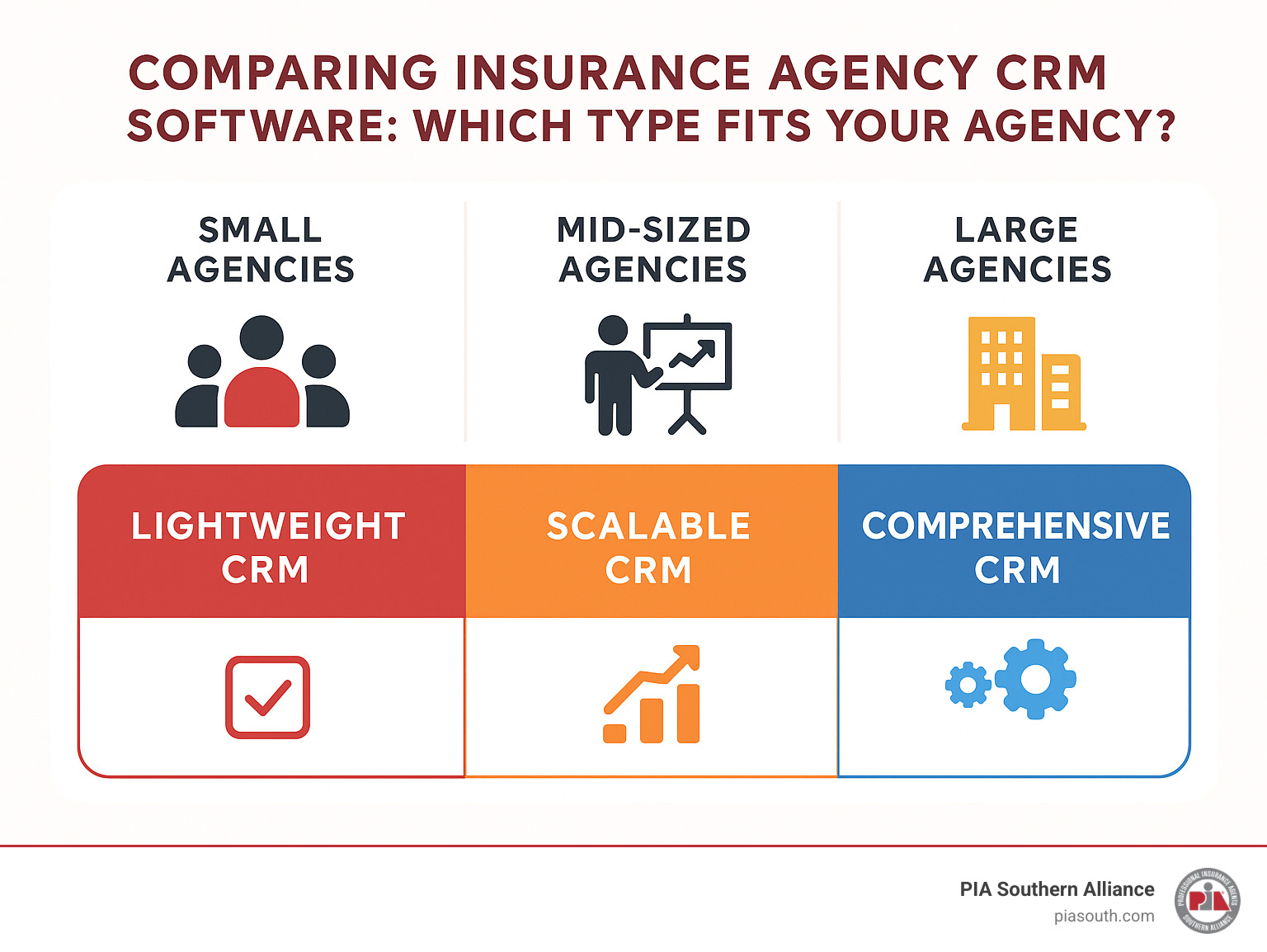
Lightweight “Starter” Insurance Agency CRM Software
Best for: Small agencies with 1-5 users, limited budget, basic needs
When you’re just starting out or running a small shop, you don’t need all the bells and whistles. These entry-level solutions focus on the basics: simple contact management, basic task tracking, and essential email integration. With minimal customization required and setup often taking less than a day, these systems get you organized quickly without breaking the bank.
Priced between $7-20 per user monthly, these systems offer tremendous value for agencies looking to graduate from spreadsheets. The learning curve is gentle, and you’ll see immediate benefits in organization.
“We started with a simple CRM when we were just three people,” shares an agency owner from Columbus. “It was perfect for getting our contacts organized and making sure nothing fell through the cracks. After growing to 12 people, we needed something more specialized, but it was a great starting point.”
The main drawback? You’ll find limited policy management capabilities and few insurance-specific workflows. As your agency grows, you’ll likely outgrow this solution – but it’s an excellent place to begin your digital change.
All-in-One CRM/AMS Hybrids for Growing Agencies
Best for: Established agencies with 5-25 users seeking comprehensive solutions
When your agency hits its stride, these comprehensive systems offer the best of both worlds – combining client relationship management with policy administration. These powerhouses include full policy management, carrier download integration, and commission tracking alongside robust CRM features.
Yes, they’re pricier ($50-100 per user monthly), but the return on investment comes from eliminating duplicate work across systems. The document management capabilities and customizable dashboards give your team everything they need in one place.
“After trying to manage separate systems for marketing, sales, and policy administration, we consolidated everything into one platform,” explains an agency principal from Birmingham. “The initial setup took about three weeks, but we’ve gained at least 20% efficiency across all departments.”
Be prepared for a more involved implementation process and thorough staff training. The feature set can initially feel overwhelming, but most vendors offer phased implementation approaches to ease the transition.
Marketing-Centric CRM Platforms
Best for: Agencies focused on growth, digital marketing, and lead generation
If your agency is aggressively pursuing growth through digital channels, these platforms shine. With built-in marketing automation, lead scoring, and social media integration, they’re designed to turn prospects into clients efficiently.
The magic happens in the detailed analytics – you’ll see exactly which marketing efforts drive results. Email campaigns, landing pages, and content management tools make it easy to nurture prospects until they’re ready to buy.
“Our agency generates 65% of new business through digital channels now,” notes a digital marketing manager from an agency in Mobile. “Our marketing-focused CRM tracks every touchpoint from initial website visit through policy binding, giving us clear ROI on our marketing spend.”
Priced between $25-75 per user monthly, these systems offer tremendous value for growth-minded agencies. The main consideration is that you may need a separate system for policy administration, which can create integration challenges.
When selecting the right category for your agency, consider your current size, growth plans, and where you most need efficiency improvements. Many PIA Southern Alliance members find that starting with a simpler system and upgrading as they grow provides the most sustainable path to digital change.
Budget considerations should include not just the monthly subscription, but also implementation costs, training time, and potential integration expenses. The right insurance agency CRM software isn’t always the one with the most features – it’s the one that best addresses your specific challenges.
Implementation, Costs & ROI
Investing in insurance agency CRM software is a significant decision that requires thoughtful planning and realistic expectations. Let’s walk through what this journey looks like for agencies across Georgia, Alabama, and Mississippi.
Licensing Models and Pricing
When it comes to CRM pricing, you’ll typically encounter these common structures:
Most vendors offer per-user licensing – the straightforward approach where you’ll pay between $7-300 monthly for each team member who needs access. The wide price range reflects the vast difference between basic contact management and enterprise-level solutions. Many agencies find the sweet spot in the middle tier, typically running $50-75 per user each month.
Tiered plans offer another popular option, where packages like Basic, Professional, and Enterprise provide increasing functionality as you move up. This model often becomes more cost-effective as your team grows, giving you better economies of scale.
Beyond the monthly subscription, remember to budget for these potential extras:
Implementation services can range from free (for simple systems) to $5,000 for complex setups with customizations. Data migration – the process of moving your existing contacts and information – typically costs between $500-3,000 depending on how much data you have and how messy it might be. Training costs vary widely from self-service videos (free) to comprehensive in-person sessions ($2,500), while custom integrations with other systems can run anywhere from nothing to $10,000.
“We budgeted only for the monthly fees and were caught off guard by implementation costs,” shares an agency owner from Savannah. “Make sure you understand the full picture before committing.”

ROI Calculations
The good news? The return on your CRM investment is typically substantial and measurable. Here’s what agencies in our region commonly report:
Insurance agency CRM software delivers tangible benefits including retention improvements of 5-15% (keeping more clients means steadier revenue), cross-selling increases of 10-25% (more policies per household), lead conversion boosts of 15-30% (turning prospects into clients more effectively), and significant time savings (often 7-12 hours weekly per team member).
Let’s look at a realistic example for a 10-person agency:
– Annual CRM cost at $50/user/month: $6,000
– One-time setup and training: $2,500
– First-year total investment: $8,500
The potential returns? Even conservative estimates show dramatic results:
– A modest 10% improvement in retention on a $2M premium book saves $200,000
– Just 15% more cross-selling success generates $50,000-100,000
– Staff time savings of 3,500+ hours (valued at $35/hour) equals $122,500
When you run the numbers, most agencies see ROI exceeding 300% in the first year alone. The key is tracking these metrics from day one so you can demonstrate value to stakeholders.
For deeper insights into client management solutions, visit our Insurance Agency Client Management Software resource page.
Onboarding Best Practices
The difference between CRM success and failure often comes down to how you implement it. Follow these field-tested approaches:
1. Stakeholder Alignment
Before touching any technology, gather your team to define what success looks like. What problems are you solving? What metrics will improve? Who will champion the process internally? Creating this clarity upfront prevents the all-too-common scenario where different team members have conflicting expectations.
“Getting our producers and CSRs aligned on goals before implementation made all the difference,” notes an agency principal from Montgomery. “Everyone understood why we were making the change.”
2. Phased Rollout
Resist the temptation to implement everything at once. Start with core functionality like contact management and basic pipelines. As your team masters these fundamentals, gradually introduce more sophisticated features. This approach builds confidence and prevents overwhelm.
Consider starting with a pilot group – perhaps your most tech-savvy team members or a particular department – before expanding agency-wide.
3. Data Migration Strategy
Clean data is the foundation of CRM success. Before migration, audit your existing information sources, establish consistent naming conventions, and remove duplicates and outdated records. Many agencies find it effective to prioritize active clients and hot prospects for initial migration while handling older records in later phases.
4. Training Program
Different people learn differently, so provide varied training options: hands-on sessions, written documentation, video tutorials, and peer support. Schedule follow-up training a few weeks after implementation when users have real questions based on actual usage.
“We created internal CRM champions – one in sales, one in service – who became the go-to resources for questions,” shares an operations manager from Jackson. “Having these peer experts dramatically improved adoption.”
Common Mistakes to Avoid
Learn from the experiences of other agencies who’ve walked this path before you:
Overbuying features is a common pitfall. Start with what you absolutely need, then expand as your team masters the basics. Many agencies invest in advanced features they never end up using, wasting both money and implementation effort.
Neglecting user input almost guarantees resistance. Include frontline staff in the selection process and gather their feedback regularly. Your CSRs and producers will use this system daily – their buy-in is essential for success.
Weak security configuration creates unnecessary risk. Implement two-factor authentication, role-based permissions, and strong password requirements from day one. Insurance agencies handle sensitive client information, making proper security non-negotiable.
Skipping renewal workflows misses one of the biggest ROI opportunities. Automate your renewal process with multi-touch campaigns, clear task ownership, and dashboard visibility for upcoming expirations. This alone can justify your CRM investment through improved retention.
“We initially focused on sales features and neglected service workflows,” admits an agency owner from Birmingham. “Once we built out our renewal processes, we saw immediate improvements in retention and cross-selling.”
For more insights on modernizing your agency operations, check out our resource on Insurance Agency Automation Systems.
Frequently Asked Questions about Insurance Agency CRM Software
What is the difference between a CRM and an Agency Management System?
If you’re shopping for technology solutions, you’ve probably wondered about the difference between these two common systems. While there’s some overlap, they serve distinctly different purposes in your agency:
CRM (Customer Relationship Management) is primarily focused on the sales and relationship side of your business. Think of it as your tool for nurturing prospects and strengthening client bonds through:
– Lead tracking and sales pipeline management
– Marketing campaigns and automated follow-ups
– Client communication and relationship building
– Cross-selling opportunity identification
AMS (Agency Management System), on the other hand, handles the operational backbone of your agency:
– Policy administration and servicing tasks
– Carrier downloads and uploads for policy information
– Accounting functions and commission tracking
– Claims management processes
– Certificate issuance and documentation
Many independent agencies across Georgia, Alabama, and Mississippi use both systems with data flowing between them, creating a comprehensive technology ecosystem. Others, particularly smaller agencies, might opt for hybrid solutions that combine elements of both. Your agency’s size, complexity, and existing technology will ultimately guide this decision.
How does insurance agency CRM software improve cross-selling for P&C agents?
Cross-selling is where many agencies find the greatest ROI from their insurance agency CRM software investment. The systems improve your cross-selling success through several powerful mechanisms:
First, they provide complete household visibility, showing all policies and family members in one consolidated view. This immediately highlights coverage gaps you might otherwise miss.
Your CRM can also set up life event triggers – automated alerts when clients experience qualifying events like purchasing a home, adding a teen driver, or starting a business. These moments represent perfect cross-selling opportunities.
The coverage gap analysis features in modern CRMs can systematically identify missing policies based on client profiles. For example, flagging homeowners without umbrella coverage or business owners lacking cyber liability protection.
Many agencies in our region have found tremendous success with automated campaigns that deliver targeted messaging for specific cross-sell opportunities at exactly the right time. One agency in Huntsville shared that they increased their policies per household from 1.7 to 2.4 within just 18 months of implementing cross-sell workflows in their CRM.
Finally, your CRM can transform routine renewal touchpoints into strategic cross-selling conversations by prompting agents with relevant suggestions based on the client’s current coverage portfolio.
What integrations should be prioritized during setup?
When setting up your insurance agency CRM software, not all integrations deliver equal value. While specific needs vary, these connections typically provide the most immediate return on investment:
Your email system (whether Outlook or Gmail) should be your first integration priority. This ensures all client communications are automatically captured in their history, creating a complete record of every interaction.
Next, focus on calendar integration to prevent scheduling conflicts and enable automated appointment reminders that reduce no-shows. Phone system integration is similarly valuable, logging calls automatically and enabling one-click dialing.
For agencies with existing systems, agency management system integration creates a seamless flow of client and policy data between platforms, eliminating duplicate entry. Comparative rater connections streamline the quoting process, significantly reducing time spent generating proposals.
“Start with the integrations that eliminate double-entry of data,” advises an agency technology consultant from Montgomery. “Each manual data transfer you eliminate saves time and reduces errors.”
Other high-value integrations include e-signature platforms to facilitate paperless transactions and marketing automation tools to coordinate lead nurturing activities across channels.
The key is prioritizing integrations that address your specific workflow bottlenecks. Take time to map your current processes before implementation, identifying where your team spends the most time on manual tasks – those are your integration priorities.
Conclusion
Choosing the right insurance agency CRM software isn’t just a technology decision—it’s a strategic investment in your agency’s future. The journey to finding your perfect CRM match might seem daunting, but the rewards of getting it right are substantial and long-lasting.
For independent P&C agencies across Georgia, Alabama, and Mississippi, today’s competitive landscape leaves little room for communication gaps or missed opportunities. Whether you’re a small agency in rural Mississippi taking your first steps into CRM territory, or a multi-location operation in Atlanta looking to upgrade your existing system, the right technology can truly transform your client relationships and operational efficiency.
Think about what matters most to your agency. Is it improving retention rates? Streamlining the renewal process? Enhancing cross-selling opportunities? Let these priorities guide your selection process. The most successful implementations start with clear objectives, involve your team members throughout the journey, and focus on solving your specific business challenges—not just adding technology for technology’s sake.
“The right CRM doesn’t just organize your data—it gives you back the time to be the trusted advisor your clients hired you to be,” as one agency owner from Montgomery put it.
We at PIA Southern Alliance understand the unique challenges facing independent agents in our region. Our commitment remains steadfast: helping you thrive in an increasingly digital marketplace. Through our educational resources, training programs, and member benefits, we support agencies like yours in making informed technology decisions that drive sustainable growth.
The path to CRM success isn’t about implementing every feature at once. Start with the essentials, build confidence among your team, celebrate early wins, and expand your usage as your comfort level grows. This phased approach has proven time and again to deliver the highest adoption rates and strongest returns on investment.
For agencies ready to explore additional ways to streamline operations beyond CRM, our Insurance Agency Automation Systems resource center offers valuable insights into complementary technologies.
Your agency’s future success depends on making meaningful connections with clients while operating efficiently behind the scenes. With the right insurance agency CRM software as your foundation, you’ll be well-positioned to grow, adapt, and thrive in the changing insurance landscape across Georgia, Alabama, and Mississippi.