
Why Your Agency Can’t Afford to Stay Manual
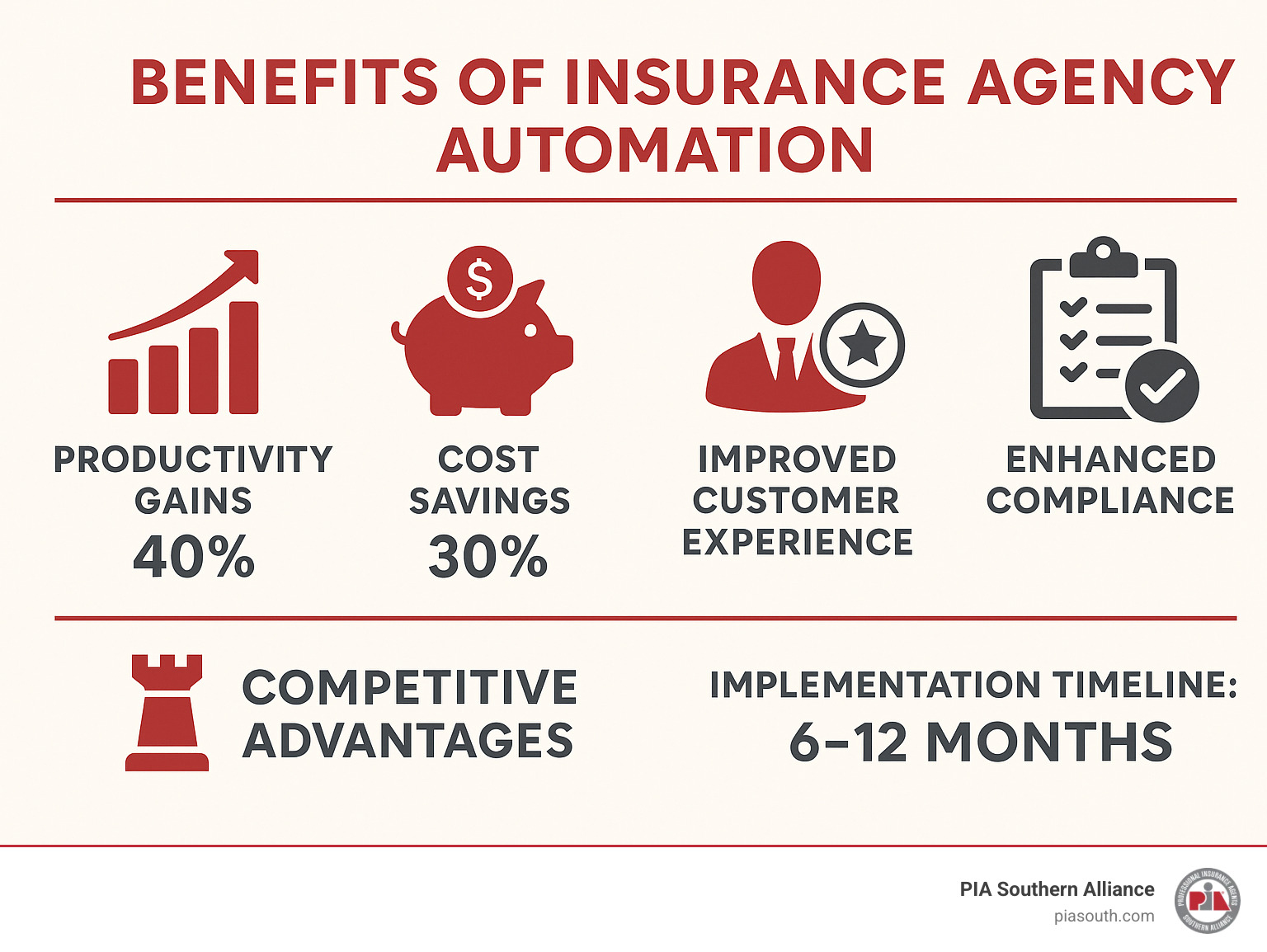
Insurance agency automation is changing how property and casualty agencies operate, delivering up to 40% productivity gains while cutting operational costs by 30%. Here’s what automation can do for your agency:
Key Benefits:
– Streamline workflows – Automate policy renewals, claims processing, and customer onboarding
– Boost productivity – Free up staff time for high-value client interactions and sales
– Reduce errors – Eliminate manual data entry mistakes and improve compliance
– Improve customer experience – Provide instant quotes, self-service portals, and faster responses
– Increase profitability – Cut administrative costs while improving cross-selling opportunities
The insurance industry has reached a tipping point. Manual processes are becoming a competitive liability as customer expectations rise and profit margins tighten.
Property and casualty agencies across Georgia, Alabama, and Mississippi are finding that automation isn’t just about efficiency – it’s about survival. When 88% of small and medium-sized businesses report that automation helps them compete with larger firms, the message is clear: automate or fall behind.
Through work with PIA Southern Alliance, we’ve seen how insurance agency automation transforms agencies from reactive service providers to proactive growth engines. The right automation strategy doesn’t replace the personal touch – it amplifies it.

Insurance agency automation terms you need:
– automated insurance claims processing
– digital change for insurance
– insurance agency CRM software
Why Insurance Agency Automation Matters in 2025
The insurance world in 2025 looks nothing like it did just five years ago. If you’re running a property and casualty agency in Georgia, Alabama, or Mississippi, you’ve felt the squeeze from rising costs, demanding customers, and overnight competition.
Insurance agency automation isn’t just a nice-to-have anymore. It’s the difference between agencies that thrive and those that barely survive. McKinsey’s research on productivity shows agencies can boost productivity and slash operational expenses by up to 40% through smart automation strategies.
Cost pressures are hitting P&C agencies hard. Administrative expenses keep climbing while commission rates stay flat. Meanwhile, clients expect instant responses and 24/7 access to their policies. The regulatory landscape adds complexity with compliance requirements demanding consistent, auditable processes that manual systems can’t deliver reliably.
The talent shortage means competing harder for good people while managing growing workloads. This is where automation becomes your secret weapon – handling routine tasks so your team can focus on building relationships and solving complex problems.
AI adoption in insurance is accelerating. Industry experts predict 33% of enterprise applications will include AI capabilities by 2028. Agencies that wait too long risk watching competitors deliver superior customer experiences while operating more efficiently.
For property and casualty agencies across our three-state region, automation offers a path to sustainable growth. Instead of hiring more staff every time business increases, smart automation lets you scale operations without proportionally increasing overhead.
Search-Intent Snapshot: “insurance agency automation”
When P&C agents search for “insurance agency automation,” they’re dealing with specific pain points – endless data entry, frustrated customers waiting for quotes, or overwhelming renewal paperwork.
These searches reveal agencies looking for competitive advantages through operational efficiency. They want practical solutions that integrate with existing systems and deliver quick wins while building toward comprehensive digital change. The goal isn’t to replace the personal touch that independent agencies are known for – it’s to amplify it by eliminating mundane tasks that prevent meaningful client interactions.
High-Impact Workflows to Automate for P&C Agencies

Knowing where to start with insurance agency automation can feel overwhelming. Focus on workflows that deliver the biggest bang for your buck, and you’ll see results quickly.
Claims processing should be your first priority. Automating First Notification of Loss intake can cut processing time in half while capturing all important details. Many agencies in Georgia, Alabama, and Mississippi use simple chatbots to handle initial claim reports, automatically route them to adjusters, and keep clients updated.
Policy renewals are another goldmine. Instead of scrambling at the last minute, automated systems start working 90 days before expiration, pulling policy data, spotting coverage gaps, and suggesting additional products.
Customer onboarding sets the tone for client relationships. Automated welcome sequences guide new clients step by step, collect necessary documents, and deliver policies promptly. Your clients feel taken care of while your staff focuses on relationship building.
Compliance checks protect your agency through automated systems that verify required coverages, flag missing endorsements, and ensure documentation meets regulations across Georgia, Alabama, and Mississippi.
Document management automation eliminates paper shuffling. Modern systems read documents, identify them, file them correctly, and extract important information automatically.
Reporting becomes effortless with real-time dashboards showing agency performance, helping you spot trends early and catch problems before they become headaches.
For a deeper dive, check out our guide on Automated Insurance Claims Processing.
Customer Experience Wins Through Insurance Agency Automation
Self-service portals give clients freedom to access policy documents, make payments, and request certificates 24/7. This convenience keeps clients happy while reducing routine calls.
Instant quotes change the game completely. Instead of promising callbacks in days, you deliver professional proposals within minutes. The system pulls rates from multiple carriers and creates polished proposals while clients are still on the phone.
Omnichannel alerts keep everyone informed without overwhelming staff. Clients get automatic updates about renewals, policy changes, and claim status through their preferred communication method.
Back-Office Efficiency Workflows
Policy issuance that used to take hours now happens in minutes. Systems generate documents, calculate premiums, and process endorsements with remarkable accuracy.
Certificate processing automation tackles commercial lines’ biggest time waster. Instead of manually creating certificates and tracking expiration dates, automated systems generate certificates on demand and send renewal reminders.
Accounting integrations eliminate double-entry work. Policy data flows automatically into accounting software, commissions process without manual calculation, and financial reports generate themselves.
For comprehensive automation options, explore our Insurance Agency Automation Software resource.
Tangible Benefits & ROI of Automation

When property and casualty agencies in Georgia, Alabama, and Mississippi implement insurance agency automation, the financial impact is both immediate and long-lasting.
Cost savings hit your books first. Digitizing underwriting and onboarding processes delivers cycle time reductions of 50-70% and administrative expense cuts of 20-30%. For agencies processing 1,000 policies annually, these labor cost savings add up quickly.
Productivity boosts of up to 40% are achievable through automation. This means handling significantly more policies without hiring proportionally more staff. Your per-employee revenue generation increases, making your entire operation more profitable.
Claims processing becomes a profit center instead of a cost drain. Automated workflows eliminate manual errors, reduce processing mistakes, and speed up claim resolution by up to 30%. Customers get faster service while your administrative burden shrinks.
Client retention improvements follow naturally when automation enables consistent communication and lightning-fast service. Automated renewal processes with personalized touches can boost retention rates by 5-10%. Since acquiring new customers costs significantly more than keeping existing ones, this directly impacts profitability.
Cross-selling and upselling opportunities multiply when automation identifies coverage gaps and triggers targeted campaigns. Agencies report 60-70% higher conversion rates when cross-selling to existing customers through automated workflows.
| Metric | Manual Process | Automated Process | Improvement |
|---|---|---|---|
| Policy Processing Time | 2-4 hours | 30-60 minutes | 70% reduction |
| Claims FNOL Processing | 45-60 minutes | 10-15 minutes | 75% reduction |
| Certificate Generation | 15-30 minutes | 2-5 minutes | 85% reduction |
| Renewal Processing | 60-90 minutes | 15-30 minutes | 70% reduction |
| Customer Response Time | 4-24 hours | Instant-2 hours | 90% improvement |
| Data Entry Errors | 3-5% | 0.1-0.5% | 90% reduction |
Calculating Payback Period with Insurance Agency Automation
The typical payback period for insurance agency automation ranges from 12-24 months, depending on agency size and automation scope.
Staff time savings form the ROI backbone. Calculate hours saved per week and multiply by average hourly costs, including benefits and overhead (typically 1.3 to 1.5 times salary).
Technology subscription costs need careful planning consideration. Factor in software licensing, implementation expenses, and training costs as predictable monthly expenses that scale with growth.
Error reduction savings often surprise agencies. Quantify costs associated with manual errors – not just time to fix mistakes, but potential E&O exposure and customer satisfaction issues.
A mid-sized P&C agency implementing comprehensive automation typically sees 15-25% ROI in year one after implementation costs, 35-50% ROI in year two, and 50-75% ROI in year three and beyond with full optimization.
Implementation Challenges & Best Practices
Implementing insurance agency automation isn’t always smooth sailing. After working with countless property and casualty agencies across Georgia, Alabama, and Mississippi, we’ve seen the same roadblocks repeatedly. The good news? These challenges are manageable when you know what to expect.
Legacy systems are often the biggest headache. Your agency management system might be older than some staff members and wasn’t built for modern automation tools. The key is choosing automation platforms with robust API connections that speak your system’s language. Work with vendors who understand insurance tech, not just general business software.
Data scattered everywhere creates major problems. Customer information living in management systems, spreadsheets, email, and sticky notes makes automation nearly impossible. Before automating anything, map all your information sources and establish basic rules about where different data types should go.
Staff resistance can sink even the best automation plans. Change is scary, especially when people worry about their jobs. The most successful agencies involve their teams in planning from day one. When staff helps choose automation tools and workflows, they become champions instead of obstacles.
Trying to automate everything at once is a disaster recipe. Start with one workflow that will make a real difference, get it working smoothly, then move on. This approach builds confidence and lets you learn as you go.
No-code tools have been game-changers for smaller agencies. You don’t need a computer science degree to build effective automation workflows anymore. These platforms let you drag and drop your way to better processes.
Agencies that struggle most treat automation like a magic wand. Successful ones understand automation is a journey, not a destination. They invest in proper training, maintain realistic expectations, and stay committed even when things get bumpy.
For detailed guidance on navigating these challenges, check out our comprehensive guide on Insurance Agency Digital Change.
Roadmap to Successful Insurance Agency Automation Rollout

Think of insurance agency automation implementation like renovating your house while living in it. You need a solid plan, realistic timelines, and flexibility to adjust when things don’t go exactly as expected.
Your workflow audit comes first. Document how things actually work in your agency, not how you think they work. Shadow your staff for a few days and map out every step of key processes. This isn’t fun, but skipping it leads to automation that doesn’t match reality.
Pick your battles wisely when selecting your first automation target. Look for workflows that are repetitive, time-consuming, and cause team frustration. Certificate requests, renewal reminders, and new client welcome sequences often deliver quick wins without major complexity.
Start your pilot program with realistic expectations and plenty of support. Choose one workflow and implement it completely before moving on. Train staff thoroughly on new tools and why changes matter. Monitor everything closely and be ready to make adjustments.
Expansion phase is where magic happens. Once your first automation runs smoothly, your team will see possibilities everywhere. Resist the urge to automate everything at once. Stick to your plan and add workflows systematically.
Continuous improvement never stops. Regular check-ins help identify new opportunities, fix problems before they become major issues, and keep your team engaged.
Successful agencies share common traits: leadership commitment from the top down, clear communication about goals, adequate training resources, and flexibility to adjust course when needed. They celebrate wins along the way, recognizing that automation success is worth acknowledging.
Compliance, Security & Future Trends
When it comes to insurance agency automation, security and compliance aren’t just nice-to-have features – they’re absolutely essential. Property and casualty agencies across Georgia, Alabama, and Mississippi handle incredibly sensitive client data, and one security breach can destroy decades of trust-building.
Modern automation actually makes compliance easier, not harder. Instead of relying on staff to remember every regulatory requirement, automated systems build compliance checks right into workflows.
Data encryption should be your first line of defense. Any automation platform worth considering encrypts data both in transit and at rest. Look for AES-256 encryption – the industry standard that keeps client information locked down tight.
SOC 2 compliance has become the gold standard for insurance technology. When evaluating automation vendors, always ask for SOC 2 Type II certification. This means independent auditors have verified their security controls.
NAIC guidelines provide the roadmap for insurance data protection nationwide. Your automated systems need to align with these Model Laws, especially around data breach notification and cybersecurity risk management. Once these requirements are built into workflows, compliance becomes automatic.
Georgia’s Department of Insurance has specific cybersecurity requirements that differ from Alabama and Mississippi. Good automation platforms handle these jurisdictional differences seamlessly.
Cyber risk management becomes more complex with automation but remains manageable. Automated systems create new potential attack points but eliminate human error – which causes most data breaches.
Looking ahead, predictive analytics research shows we’re moving toward systems that can predict customer behavior, identify fraud patterns, and assess risks before claims happen.
Agentic AI represents the next big leap. Unlike today’s rule-based automation, agentic AI can make decisions and handle exceptions independently. Industry experts predict about one-third of business applications will include this intelligent automation by 2028.
Staying Audit-Ready with Automated Controls
Insurance agency automation actually makes audits less stressful. Instead of scrambling for documentation when regulators call, automated systems create detailed records of everything.
Rule-based compliance checks work like having a compliance officer built into every transaction. Automated workflows verify required coverages, check documentation completeness, and flag potential issues before they become problems.
Automated audit trails capture everything – who did what, when, and what data changed. This documentation becomes invaluable during regulatory examinations or E&O claim investigations.
These systems work consistently every day, never forgetting to check something because of busy schedules or difficult clients. They quietly ensure compliance while staff focuses on building relationships and growing business.
For detailed compliance information in marketing efforts, check out our guide on Insurance Marketing Automation.
Frequently Asked Questions about Insurance Agency Automation
What processes deliver the fastest ROI?
Claims processing should top your insurance agency automation list. Agencies experience benefits within 30-60 days of implementation, with processing times improving by up to 70%. When clients can report claims faster and get quicker responses, everyone wins.
Policy renewal automation comes second. Most agencies report 15-25% efficiency gains within their first renewal cycle. Instead of scrambling at the last minute, teams can focus on identifying coverage gaps and cross-selling opportunities.
Customer onboarding automation also delivers quick wins you’ll notice immediately. Reducing time from application to policy issuance by 50-70% prevents prospects from walking away during crucial first days.
Starting with these high-impact processes builds momentum. Once teams see time savings on routine tasks, they become champions for expanding automation to other areas.
How does automation affect agency staff roles?
Insurance agency automation doesn’t eliminate jobs – it makes them more interesting and valuable. CSRs stop spending days on data entry and start having meaningful conversations with clients about coverage needs. Most staff members find this change makes work more satisfying.
Producers benefit tremendously from automation tools handling lead management and follow-up sequences automatically. Instead of wondering whether they remembered to call prospects back, they can focus on building relationships and closing sales.
Account managers find more time for proactive client service when policy servicing becomes automated. This extra capacity often translates to better client retention and increased revenue per client.
The key to smooth transitions involves comprehensive training and clear communication about how automation improves rather than replaces human skills. Agencies that invest in their people during automation implementation see much better results.
What safeguards protect client data?
Modern insurance agency automation platforms understand data security importance. Multiple protection layers work together, starting with encryption that protects data both stored and in transit between systems.
Access controls ensure only authorized team members view sensitive information, while multi-factor authentication adds extra security layers making unauthorized access much more difficult.
Regular security audits and penetration testing identify potential vulnerabilities before they become problems. SOC 2 Type II certification provides third-party validation that automation platforms maintain robust security controls.
Data backup and disaster recovery procedures protect against data loss while ensuring agencies can continue operating if something goes wrong. These systems typically include both local and cloud-based backups with regular testing.
Compliance monitoring tools continuously scan for potential regulatory violations and alert you to issues needing attention. These automated controls help agencies maintain compliance across Georgia, Alabama, and Mississippi without constant manual oversight.
Conclusion

The change happening in property and casualty insurance isn’t waiting for anyone. Insurance agency automation has moved from “nice to have” to “must have” for agencies that want to thrive in 2025 and beyond.
The numbers don’t lie. Agencies embracing automation see 40% productivity gains and 30% cost reductions while their clients enjoy faster service and fewer errors. More importantly, these agencies free up their most valuable resource – time – to focus on what they do best: building relationships and providing expert guidance.
We’ve seen this change across Georgia, Alabama, and Mississippi. Agencies that once struggled with manual processes now handle more policies with the same staff, close more sales, and keep clients happier. The secret isn’t replacing the human touch – it’s amplifying it through smart technology.
Your existing advantages as an independent agent – trusted relationships, local market knowledge, and personalized service – become even more powerful when supported by efficient automated systems. While others shuffle papers, you’re providing instant quotes and proactive service that builds lasting loyalty.
Starting your automation journey doesn’t have to be overwhelming. Focus on high-impact workflows like claims processing and policy renewals first. These areas deliver quick wins that build momentum for bigger changes.
Successful agencies share common traits: they invest in their people, choose technology that works with existing systems, and view automation as an ongoing journey rather than a one-time project.
PIA Southern Alliance remains your partner in this digital journey. Our educational resources and peer networks provide practical guidance you need to implement automation successfully. We understand unique challenges facing independent agents in our region.
The future belongs to agencies that blend human wisdom with technological efficiency. Your clients still want personal relationships, but they also expect modern convenience. Insurance agency automation lets you deliver both without compromise.
The window for competitive advantage through automation is still open, but it won’t stay that way forever. Early adopters are already pulling ahead, setting new standards for service and efficiency.
Ready to take the next step? Our comprehensive guide on Insurance Agency Automation Systems provides detailed information about platforms and strategies that can work for your specific situation and budget.
The best time to start was yesterday. The second best time is right now. Your future self – and your clients – will thank you for taking action today.