
Why Independent Agencies Need Automation More Than Ever
Insurance agency automation software is changing how property and casualty agencies operate, moving beyond traditional manual processes to intelligent, integrated platforms that handle everything from lead management to policy administration. These comprehensive solutions combine CRM functionality with automated workflows, AI-powered insights, and seamless carrier integrations to streamline operations and boost profitability.
Top Insurance Agency Automation Software Options:
– AgencyZoom – Mobile-first CRM with automated Google reviews and commission tracking
– EZLynx – All-in-one platform combining comparative rating with policy management
– UiPath – Enterprise-grade RPA platform for complex workflow automation
– Creatio – No-code automation platform with AI-driven customer insights
– Applied Systems – Market-leading agency management with extensive carrier connections
– HawkSoft – Cloud-based AMS promising ROI within the first year
– NowCerts – Intelligent system with self-serve certificate capabilities
The numbers tell the story: agencies using automation report 30-40% lower costs in underwriting and claims processing, while teams save an average of 17 hours per week on routine tasks. One agency owner noted, “My commissions increased by 14.5% after using AgencyZoom” – highlighting how the right automation platform doesn’t just cut costs, it drives revenue growth.
For independent agencies across Georgia, Alabama, and Mississippi, automation isn’t just about efficiency anymore. It’s about survival in a market where direct writers spend billions on technology while independent agents often struggle with outdated systems that limit their competitive edge.
Through our work with PIA Southern Alliance, we’ve seen how insurance agency automation software can transform agency operations and profitability.
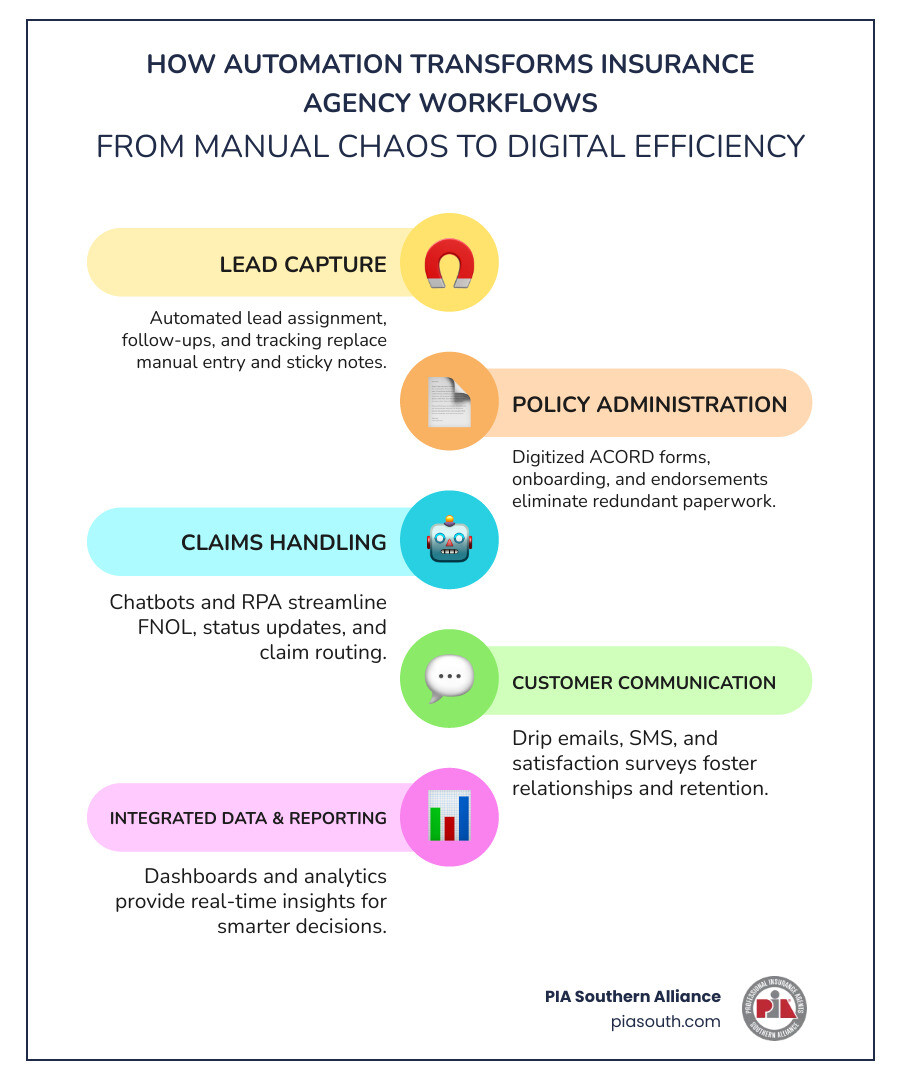
What Is Insurance Agency Automation Software?
Think of insurance agency automation software as your agency’s digital brain – a smart system that knows exactly what needs to happen next, without you having to remember every detail. Instead of juggling multiple systems that don’t talk to each other, these platforms create one unified command center where everything flows together naturally.
This isn’t just about making your computer do more work. It’s about creating an intelligent ecosystem where information moves seamlessly from the moment a prospect visits your website to the day they renew their policy – and every touchpoint in between.
The magic happens through three core technologies working together. Robotic Process Automation (RPA) handles those mind-numbing tasks we all hate – data entry, form completion, and downloading carrier information. Artificial Intelligence acts like your smartest team member, spotting risks, predicting which clients might leave, and suggesting the perfect time to cross-sell. Workflow orchestration connects all your systems so they work as one cohesive unit instead of isolated islands.
McKinsey research shows that 75% of transactional operations in insurance can be automated. Even better, about 40% of strategic work like reporting and planning can benefit from automation too. We’re not talking about replacing human judgment – we’re talking about freeing you up to use that judgment on what matters most.
| Traditional Systems | Modern Automation Platforms |
|---|---|
| Separate CRM and AMS | Unified platform |
| Manual data entry | Automated carrier downloads |
| Reactive customer service | Proactive engagement alerts |
| Paper-based processes | Digital-first workflows |
| Limited reporting | Real-time analytics |
| Single-device access | Mobile and cloud-based |
Insurance Agency Automation Software vs. Traditional Systems
Remember the days when your agency management system felt more like a digital filing cabinet than a business partner? Traditional systems were built to store information, not to make your life easier. You’d enter a client’s information in one place, then manually recreate it somewhere else, then do it again for carrier submissions.
Insurance agency automation software flips this entire approach on its head. When a prospect fills out a quote request on your website, the system springs into action like a well-trained assistant. It automatically assigns the lead based on your rules, starts follow-up sequences, pulls quotes from multiple carriers, and creates tasks for the right team members – all while you’re probably still having your morning coffee.
The real game-changer is how these platforms eliminate the dreaded “silo effect.” Modern automation platforms bring everything together so information flows naturally throughout your entire operation.
The Difference Between Insurance Agency Automation Software & Simple CRM Tools
A basic CRM is like having a really good address book – it remembers who your clients are and when you last talked to them. Insurance agency automation software is more like having a knowledgeable assistant who understands the insurance business inside and out.
Your CRM might remind you to call a prospect next Tuesday. But insurance automation software knows that commercial lines prospects need different handling than personal lines clients. It understands that certain endorsements trigger specific compliance requirements. It remembers that renewal timing varies by coverage type and automatically adjusts its actions accordingly.
This specialized knowledge makes all the difference in day-to-day operations. The system can automatically complete ACORD forms using information it already has, route workflows based on carrier-specific requirements, and generate compliant documents without you having to double-check every regulation.
For property and casualty agents in Georgia, Alabama, and Mississippi, this context-awareness is invaluable. The software understands regional requirements, state-specific forms, and local market conditions.
Key Benefits & ROI You Can Expect

When independent agencies in Georgia, Alabama, and Mississippi implement insurance agency automation software, they often wonder if the investment will truly pay off. The answer is a resounding yes – but the benefits go far beyond what most agency owners initially expect.
The financial change typically happens in three waves. First comes the immediate cost relief. Agencies consistently report 30-40% reductions in underwriting and claims processing costs within the first six months. This isn’t just about cutting expenses – it’s about eliminating the hidden costs of manual errors, duplicate data entry, and time spent hunting for information across multiple systems.
Time savings create the most dramatic change in daily operations. The average agency saves 17 hours per week on routine administrative tasks once automation takes hold. Picture this: instead of your team spending Monday mornings manually entering weekend leads and updating carrier systems, they’re making warm calls to prospects while the system handles data entry automatically.
The revenue growth often surprises agency owners most. While they expect to save time and reduce costs, many don’t anticipate how automation drives new business. Agencies report commission increases averaging 14.5% as they convert more leads, identify cross-selling opportunities faster, and provide better customer service through automated touchpoints.
Employee productivity jumps by 25% when teams can focus on relationship-building instead of data shuffling. Your commercial lines specialist becomes more valuable when they’re analyzing coverage gaps instead of filling out ACORD forms.
According to McKinsey research on automation savings, the compound effect of these improvements creates lasting competitive advantages. Agencies that accept automation early often find themselves capturing market share from competitors still struggling with manual processes.
Customer retention improves naturally when automated systems ensure no renewal falls through the cracks and every service request gets prompt attention. Happy clients refer more business, creating a growth cycle that automation helps sustain.
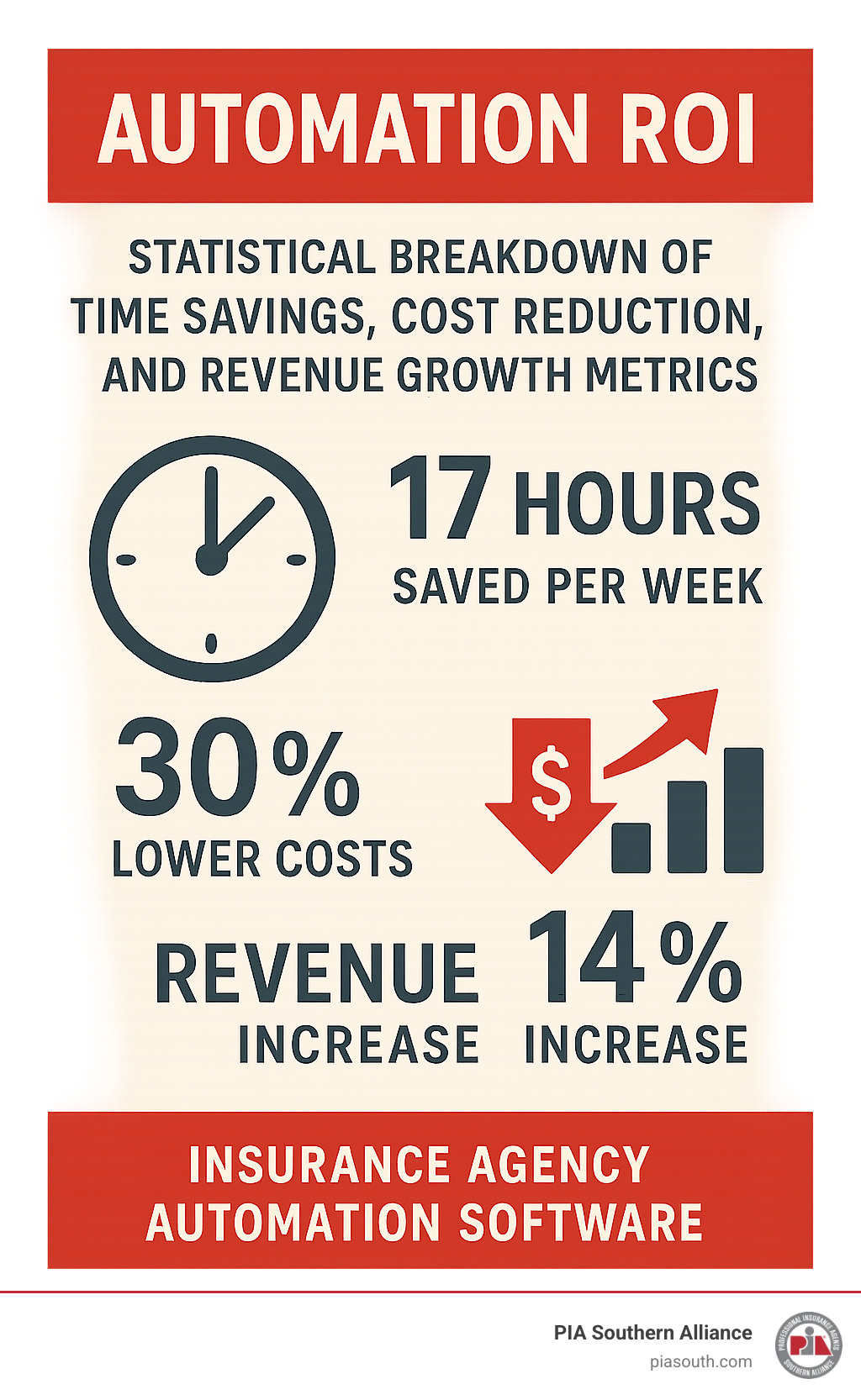
The beauty of insurance agency automation software lies in how these benefits multiply over time. What starts as simple time savings evolves into strategic advantages that position independent agencies to compete effectively against direct writers and larger competitors.
Core Agency Processes Ready for Automation
Think of automation as the fastest way to clear your agency’s traffic jams. The biggest wins come from high-volume, rule-based tasks that eat up staff hours every day.
- Lead capture & qualification
- Comparative quoting & proposal generation
- Policy issuance, endorsements & bulk carrier downloads
- Certificate of insurance (COI) delivery
- Claims first notice of loss (FNOL) intake
- Renewal processing & cross-sell alerts
- Commission reconciliation & accounting sync
Lead & Sales Pipeline Automation

Modern insurance agency automation software pulls leads from your website or social media, assigns them instantly, and requests quotes from carriers before a human even sees the record. Custom follow-up sequences, task creation, and e-signatures close the loop so hot prospects never cool off.
Policy & Endorsement Workflows
Bulk downloads push policy data to every connected system, while ACORD forms and task reminders populate automatically. Self-serve portals let customers handle routine changes, and agents focus on higher-value conversations.
Claims Intake & FNOL Automation
Chatbots, web forms, or SMS all feed a single FNOL workflow. RPA grabs the details, notifies carriers, and schedules adjusters. Customers receive automated status texts, freeing your team to intervene only on complex cases.
Customer Communication & Retention
Drip emails, SMS reminders, NPS surveys, and Google review requests run on autopilot, making sure no renewal or cross-sell opportunity slips through the cracks.
More info about Insurance Marketing Automation
How AI & Machine Learning Boost Automation

Basic automation removes keystrokes; artificial intelligence tells you which keystrokes matter most.
- Predictive lead scoring ranks prospects by their likelihood to buy.
- Next-best-action suggestions recommend when to call, what to offer, or whether to upsell.
- Fraud detection flags claims with unusual timing or documentation.
- Computer vision can pre-assess damage from uploaded photos.
- Speech analytics learns which phrases boost close rates.
Saskatchewan Blue Cross reported a 25% lift in employee performance after layering AI on top of existing workflows—a result any Georgia, Alabama, or Mississippi agency can replicate with the right platform.
Learn the latest automation best practices in insurance
Choosing the Right Insurance Agency Automation Software for Georgia, Alabama & Mississippi
Treat software selection like underwriting: start with a clear risk—or in this case, pain-point—profile. Which manual processes drain time? Which carriers drive most revenue? How tech-comfortable is your team? Honest answers steer you to the right fit and avoid shiny-object syndrome.
Integration is king. If the platform can’t talk to carrier portals, accounting tools, or your email system, you’ll create a new data silo instead of destroying the old ones. Open APIs and proven IVANS connections are must-haves.
Scalability matters, even for a three-person shop. Choose a tool that can add users, lines of business, or new state filings without a major re-implementation. An intuitive, mobile-friendly interface reduces training time and boosts adoption.
Must-Have Features in Insurance Agency Automation Software
- Open API architecture
- Full-function mobile access
- Automated carrier downloads
- Role-based security & audit logs
- Seamless ACORD & COI generation
- Commission tracking & QuickBooks sync
- Automated renewal workflows
Common Implementation Pitfalls & How to Avoid Them
- Data migration surprises – budget for cleanup and professional conversion.
- Staff resistance – highlight the tedious tasks automation removes.
- “Big-bang” rollouts – tackle one workflow at a time.
- Skimped training – name internal champions and use vendor resources.
- Untested integrations – pilot before going live agency-wide.
Security, Compliance & Data Privacy Essentials
Modern platforms should ship with SOC 2 reports, multi-factor authentication, encryption at rest and in transit, plus automated backups. They also need built-in support for PCI DSS and the state-specific rules that regulate Georgia, Alabama, and Mississippi agencies. Anything less leaves your clients—and your E&O policy—exposed.
More info about Agency Management Tools
Frequently Asked Questions about Insurance Agency Automation Software
How does automation boost customer retention?
Think of insurance agency automation software as your agency’s memory that never forgets a birthday, renewal date, or follow-up call. While you’re busy handling new business and putting out fires, automation works quietly in the background to keep your existing customers happy and engaged.
The magic happens in those small, consistent touchpoints that manual processes often miss. When your system automatically sends a renewal reminder 60 days before expiration, follows up with a competitive quote comparison, and schedules a coverage review call, your customers feel valued and informed rather than neglected.
Automation drives retention through proactive service that anticipates customer needs. The system can flag accounts that haven’t had recent contact, identify coverage gaps based on life events, and even spot patterns that suggest a customer might be shopping around.
AgencyZoom’s automated Google review generation helps agencies build stronger online reputations, while their lifecycle automation ensures no customer gets lost in the shuffle. When customers see consistent, professional communication from your agency, they’re far more likely to stick around when competitors come calling.
Can small independent agencies afford robust automation?
Here’s the truth that might surprise you: small agencies often see the biggest impact from insurance agency automation software because they have the most to gain from efficiency improvements. When you’re running lean and every hour counts, automating routine tasks can feel like adding staff without the payroll costs.
Modern platforms understand that not every agency has enterprise budgets. Flexible pricing models make advanced capabilities accessible to shops with just a few agents. Many platforms use per-user pricing that grows with your agency, while others offer modular approaches where you can start with essential features and add capabilities as your business expands.
The real question isn’t whether you can afford automation – it’s whether you can afford to keep doing everything manually while your competitors gain efficiency advantages. If automation saves 17 hours per week per employee, the labor cost savings alone often justify the software investment within the first few months.
NowCerts starts at $99 monthly for unlimited agents, while HawkSoft promises their system will pay for itself in the first year through efficiency gains. For agencies across Georgia, Alabama, and Mississippi, these tools level the playing field against larger competitors with bigger technology budgets.
What integrations should top solutions support?
The best insurance agency automation software acts like a universal translator, helping all your different systems talk to each other seamlessly. Without proper integrations, you end up with another data silo instead of the connected workflow you need.
Carrier connections form the foundation of any serious automation platform. Look for IVANS compatibility for standardized data exchange, plus individual carrier APIs that pull real-time policy data. EZLynx’s platform integrates with 330 carriers across 48 states, showing the scale of connectivity that’s possible with comprehensive automation platforms.
Your financial systems need attention too. QuickBooks integration eliminates double data entry for accounting, while payment processor connections streamline premium collection. Commission tracking and reconciliation tools can save hours of manual spreadsheet work each month.
Communication platform integrations keep customer engagement flowing smoothly. Email marketing systems like Mailchimp, SMS messaging for urgent communications, and VoIP phone systems for call logging all help create a complete customer interaction history.
Don’t forget the productivity tools your team already uses. Microsoft Office 365, Google Workspace, DocuSign, and project management systems should all play nicely with your automation platform.
Conclusion

The change happening in independent agencies across Georgia, Alabama, and Mississippi isn’t just about technology – it’s about survival and growth in a rapidly changing insurance landscape. Insurance agency automation software has moved from “nice to have” to “must have” for agencies serious about competing with direct writers and maintaining profitable operations.
Think about it: while you’re manually entering data and chasing down carrier downloads, your automated competitors are processing renewals, generating quotes, and nurturing leads around the clock. The 30-40% cost reductions and 17 hours of weekly time savings we’ve discussed aren’t just numbers on a page – they represent real money back in your pocket and real time returned to revenue-generating activities.
The beauty of modern automation lies in how it improves rather than replaces human expertise. Your years of experience understanding client needs, navigating complex commercial risks, and building relationships remain irreplaceable. Automation simply frees you to focus on these high-value activities instead of getting bogged down in administrative tasks.
Starting your automation journey doesn’t require a complete overhaul overnight. Begin with high-impact processes like lead management or certificate generation, then expand as your team becomes comfortable with the new workflows. The agencies seeing the biggest wins are those that view automation as an ongoing evolution rather than a one-time project.
For property and casualty agencies in our region, the timing couldn’t be better. The platforms available today offer sophisticated carrier integrations, mobile-first design, and compliance features specifically built for independent agents. Whether you’re a two-person shop or a growing regional agency, there’s a solution that fits your needs and budget.
At PIA Southern Alliance, we’ve watched countless agencies transform their operations through smart automation choices. The difference between thriving agencies and struggling ones often comes down to their willingness to accept tools that multiply their effectiveness. We’re here to support you through educational resources, development programs, and advocacy that helps you make informed decisions about your agency’s future.
The question isn’t whether automation will reshape the insurance industry – it already has. The question is whether your agency will be among the leaders or the followers. The choice, and the opportunity, is yours.