
Valuing an insurance agency is so much more than just slapping a multiple on your revenue. It really comes down to the quality and predictability of your future cash flow. The real story of your agency's worth is a mix of hard numbers—like consistent profits and killer client retention—and the softer assets, like your carrier relationships and how efficiently your office runs.
Bottom line: a strong agency is one that doesn't need the owner babysitting it every second of the day.
What Really Drives Your Insurance Agency's Value
Before we get into the weeds with formulas and multiples, let's get one thing straight. A potential buyer isn't just buying your current book of business; they're investing in its future. They want to see potential for profit and growth.
That's why top-line revenue only tells a tiny part of the story. The true drivers of value are the foundational pieces that make your revenue sustainable and scalable.
It's pretty common to see two agencies with the exact same revenue, but one is worth 30-50% more than the other. That difference almost always boils down to the underlying health and stability of the business.
The Bedrock of Value: Your Book of Business
The quality of your book is, without a doubt, the most important factor. A buyer's biggest fear is risk, and a stable, predictable book is the best medicine for that fear. They're going to put these key areas under a microscope:
- High Client Retention: A retention rate consistently north of 90% is the gold standard. It’s proof of client loyalty and predictable commission streams, which is exactly what a buyer wants to see.
- Diverse Client Base: Relying too heavily on a few jumbo accounts is a major red flag. An agency with a good spread, where no single client makes up more than 5% of revenue, is far more appealing and a lot less risky.
- Favorable Loss Ratios: Clean loss ratios tell carriers you’ve got a profitable book of business. This doesn’t just make you more attractive to a buyer; it makes you more valuable to the carriers themselves.
A predictable, high-retention book of business is the foundation of your agency's worth. It transforms your agency from a simple collection of policies into a reliable, cash-generating asset that commands a premium price.
Intangible Assets That Command Higher Prices
Beyond the hard numbers, a few other things can seriously pump up your agency's appeal and final price tag. Think of these as the competitive moat around your business. Getting a handle on what truly drives your insurance agency's value often requires a sophisticated financial eye, which is where specialized guidance from Fractional CFO services can be incredibly helpful.
Having a well-defined niche, for instance, immediately positions you as an expert. This leads to better carrier relationships and attracts higher-quality clients. Strong carrier appointments, especially with preferred or limited-distribution markets, are another huge asset a buyer can't just go out and replicate overnight.
The Ultimate Value Multiplier: Your Team and Systems
Here’s the value driver that gets overlooked most often: operational independence. If your agency can't function without you, its value is capped. Buyers are looking to purchase a business, not create a new job for themselves.
Building a talented team that can handle the day-to-day, service clients, and bring in new business without you holding their hand is a total game-changer. This is all propped up by efficient, documented workflows and modern tech that handles the routine stuff. An agency that runs like a well-oiled machine is a turnkey investment, and buyers will absolutely pay a premium for that.
To get a better sense of what they're looking for, you can check out our guide on the key insurance agency performance metrics that buyers focus on.
The Core Valuation Methods Explained
Putting a real number on your agency’s worth means getting familiar with the valuation methods buyers actually use. While it can feel a little complicated at first, it usually comes down to a couple of trusted formulas designed to get a clear picture of your agency's earning power. Before we jump into the math, it's a good idea to understand the basics of how to value a business accurately, which covers different ways of looking at value.
For insurance agencies, it’s almost always about cash flow. A buyer is essentially purchasing your future profits, so the goal is to calculate a realistic picture of what that performance will look like. Let's break down the two most common approaches you'll encounter.
The SDE Method for Main Street Agencies
For most small to mid-sized independent agencies, the Seller’s Discretionary Earnings (SDE) method is the industry standard. Think of SDE as a practical way to show the total financial benefit an agency provides to a single owner-operator. It starts with your net profit and then adds back certain expenses a new owner might not have.
This approach is perfect for smaller agencies because it recognizes the reality of how they're run—the owner's salary, benefits, and even some personal expenses often get mixed in with the business's finances. The whole idea is to show a potential buyer the total cash flow they could expect if they stepped into your shoes tomorrow.
To calculate your SDE, you start with your pre-tax net profit and add back:
- Owner’s Salary: Your personal compensation.
- Owner’s Perks: This is discretionary spending, like a personal vehicle, family health insurance, or club memberships run through the business.
- One-Time Expenses: Any unusual, non-recurring costs that aren't part of normal operations get added back. Think of a major office renovation or a one-off legal settlement.
- Interest, Depreciation, and Amortization: These non-cash expenses are standard add-backs.
Once you have that SDE figure, you apply a multiple. For insurance agencies, SDE multiples typically land somewhere between 2.0x to 4.0x. This range depends on things like client retention, the strength of your carrier relationships, and how consistent your growth has been.
SDE Calculation Example
Let's say an agency shows a pre-tax net profit of $120,000.
- The owner pays himself a salary of $80,000.
- He runs $15,000 in personal health insurance and auto expenses through the business.
- There was a one-time $10,000 expense for a new server.
- The agency has $5,000 in interest expenses.
SDE = $120,000 (Profit) + $80,000 (Salary) + $15,000 (Perks) + $10,000 (One-Time) + $5,000 (Interest) = $230,000
Using a conservative 2.5x multiple, the agency’s estimated value would be $575,000.
The EBITDA Multiple for Larger Agencies and PE Buyers
When an agency gets bigger and has a more formal management structure, the conversation shifts to EBITDA (Earnings Before Interest, Taxes, Depreciation, and Amortization). This is the go-to metric for larger firms, private equity (PE) groups, and strategic acquirers.
EBITDA gives a cleaner, more standardized look at operational profitability. It makes it easier to compare agencies of different sizes and financial structures. The key difference from SDE is that it assumes the owner will be replaced by a manager drawing a market-rate salary, which is treated as a regular operating expense.
Even with economic headwinds, the insurance M&A market has stayed hot, keeping EBITDA multiples strong. A June 2025 market update from Capstone Partners revealed that deal multiples averaged a stunning 16.7x EV/EBITDA from 2022 through early 2025. That's a huge jump from the 13.1x average seen between 2019 and 2021 as buyers aggressively pursued consolidation.
The less an agency depends on its owner to run day-to-day, the more attractive it is to a buyer. This decision tree shows that relationship perfectly.
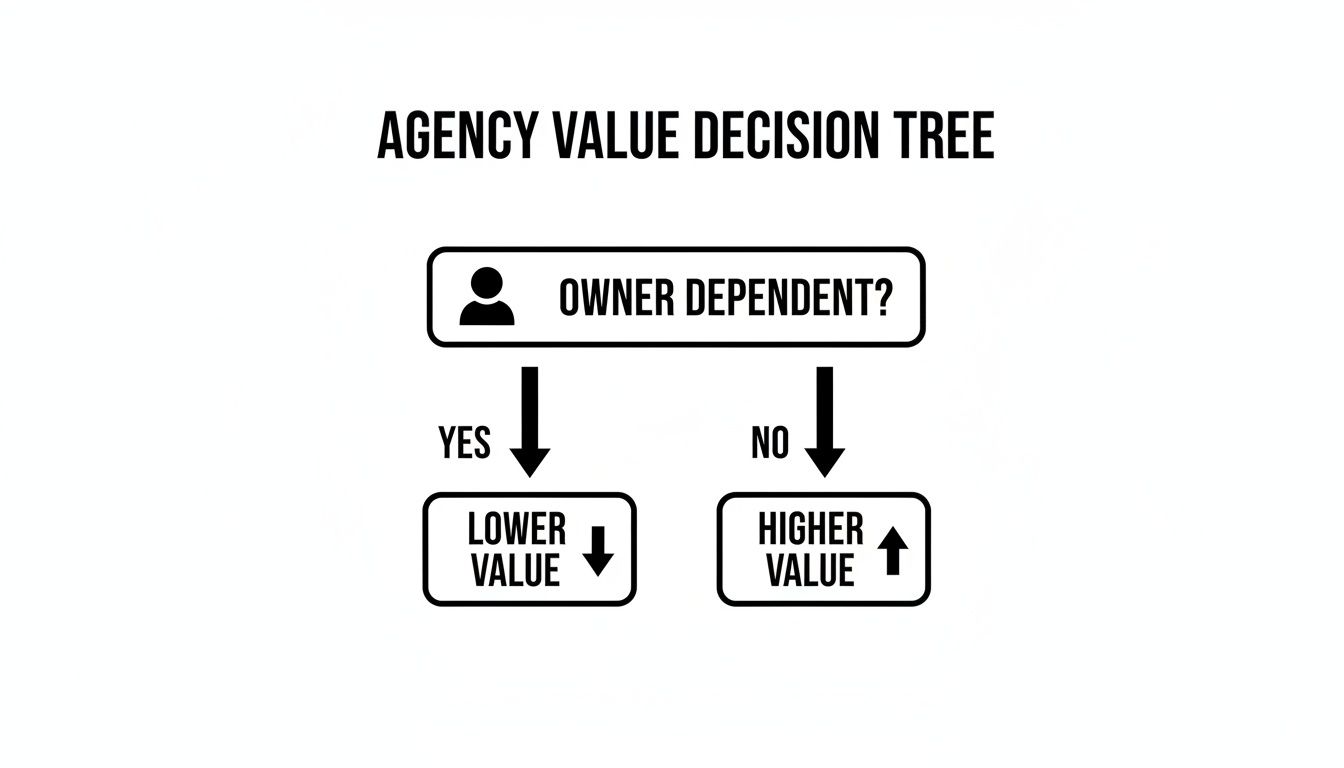
This visual drives home a core principle in valuation: a business that can run without its founder is simply more valuable.
Comparing SDE and EBITDA Valuation Methods
So, which method is right for your agency? It really depends on your size and the type of buyer you're likely to attract. This table breaks down the main differences.
| Valuation Factor | Seller's Discretionary Earnings (SDE) | EBITDA Multiple |
|---|---|---|
| Best For | Smaller, owner-operated agencies (typically <$1M in revenue) | Larger, professionally managed agencies (typically >$1M in revenue) |
| Owner's Salary | Added back to earnings as a "discretionary" item | Treated as a normal operating expense; not added back |
| Typical Multiples | Generally lower, often ranging from 2.0x to 4.0x | Generally higher, reflecting scale and lower perceived risk |
| Primary Audience | Individual buyers, smaller regional firms | Private equity groups, large strategic acquirers, national brokers |
At the end of the day, getting a handle on both methods is powerful. It allows you to see your agency through different buyers' eyes and grounds your valuation expectations in what the market is actually doing.
Making Financial Adjustments That Maximize Value
An agency's profit and loss statement is a good start, but it rarely tells the whole story. Your initial valuation calculation is just a raw number—it doesn't reflect the real earning potential a new owner will inherit. To truly understand an agency's worth, you have to dig deeper.
This is where financial adjustments, sometimes called "recasting" or "normalizing," come into play. It’s all about painting an accurate picture of the cash flow available to a buyer by adding back expenses unique to your ownership. Getting these adjustments right is non-negotiable; it directly impacts the final number and can add significant dollars to the sale price.

Uncovering Hidden Profits with Add-Backs
The heart of recasting is the "add-back." These are legitimate business expenses on your books that are either discretionary or non-recurring. By adding them back to your net income, you give a potential buyer a much clearer view of the agency's core profitability.
The goal is to meticulously comb through several years of financial statements to identify every possible add-back. Every dollar you can legitimately add back increases your SDE or EBITDA, which in turn gets multiplied to determine your agency's value.
Here are the most common places to look:
- Owner's Compensation: This isn't just your salary. It includes bonuses and any payroll taxes the company pays on your behalf. The idea is to "normalize" this by adding back your total compensation and then subtracting what a fair market salary would be for a general manager to replace you.
- Discretionary Spending: This is a big one. It’s a catch-all for owner perks run through the business. Think of personal vehicle expenses, family health insurance plans, non-essential travel, or country club memberships.
- Non-Recurring Expenses: These are one-and-done costs that won't hit the books again. Maybe you had legal fees from a specific lawsuit, did a major office renovation, or paid for a complete website redesign last year.
A Practical Example of Financial Adjustments
Let's see how this works in the real world. Imagine an agency with a stated net profit of $150,000. On paper, that's the number a buyer would apply a multiple to.
But when you start digging, you find some key adjustment opportunities:
- The owner pays himself a salary of $100,000.
- The company covers his family’s health insurance at $24,000 a year.
- Last year, the agency spent $20,000 on a one-time rebranding project.
- The owner’s car lease and fuel, totaling $12,000, are run through the business.
Now, let's add these back to calculate the real Seller's Discretionary Earnings (SDE):
$150,000 (Profit) + $100,000 (Salary) + $24,000 (Insurance) + $20,000 (Rebrand) + $12,000 (Auto) = $306,000 SDE
Using a conservative 2.5x multiple, the adjusted valuation is now $765,000. That's a huge leap from the $375,000 valuation based on the initial profit alone. This shows why adjustments aren't just a formality; they are a critical driver of value.
An unadjusted financial statement tells a buyer what the business has done for you. A properly adjusted statement tells a buyer what the business can do for them. That shift in perspective is what unlocks a premium valuation.
Identifying and Mitigating Risk Factors
Just as add-backs can boost your valuation, certain risk factors can drag it down. Any savvy buyer and their advisors will be looking for weaknesses that could threaten future cash flow. You need to be ready to address these head-on.
These are the most common risks that can hurt your valuation:
- Client Concentration: If one or two large clients make up a huge chunk of your revenue (say, more than 10-15%), a buyer will see that as a major risk. If that one account leaves, the agency could be in serious trouble.
- Key-Person Dependency: This is the classic "it's all about the owner" problem. If clients and staff would likely walk out the door when you do, the business itself holds less standalone value.
- Carrier Concentration: Just like with clients, relying too heavily on a single carrier for most of your book is a red flag. If that carrier relationship changes or they slash commissions, the agency's revenue could plummet overnight.
Proactively diversifying your client base, building solid operational systems, and strengthening relationships with multiple carriers are some of the most powerful moves you can make. They de-risk your agency and help you defend a higher valuation when it's time to sell.
Understanding Market Multiples and M&A Trends
Figuring out your agency's value with a method like SDE or EBITDA is a great starting point, but that number doesn't exist in a bubble. The final price tag is always going to be shaped by the wider market, especially what’s happening in mergers and acquisitions (M&A).
Think of it like selling your house. The value is a mix of its condition—the leaky roof you fixed, the new kitchen—and what buyers are willing to pay in the current real estate market.
Right now, the insurance agency market is hotter than it's ever been. And one group is fanning the flames more than anyone: private equity (PE) firms. These investment groups have flooded the independent agency channel with billions, completely changing the game. They aren't just buying agencies; they're building massive, efficient platforms and are willing to pay top dollar to fuel their growth.
This flood of cash has pushed valuation multiples to historic highs. You have to understand this trend, as it sets the baseline for what all buyers—whether PE-backed or another independent agency—are willing to pay.
The Private Equity Effect on Valuations
You really can't overstate the impact of private equity. These firms look at the independent agency model and see a perfect investment: recurring revenue, sticky clients, and a fragmented market ripe for consolidation. With aggressive growth targets and very deep pockets, they’ve created an incredibly competitive buyer's market.
For an agency owner looking to sell, all this competition is a huge advantage. When you have multiple well-funded buyers fighting over a limited supply of quality agencies, prices naturally shoot up. This is what has pushed EBITDA multiples into territory that would have been unthinkable just a decade ago.
The data makes it crystal clear. Over 80% of broker M&A activity in 2024 and early 2025 was driven by these deep-pocketed investors. PE firms themselves snapped up 72.6% of the deals, pushing average EBITDA multiples to a staggering 11.8x for agencies with at least $1 million in EBITDA in the first half of 2025. You can dig into more of these insurance agency valuation trends at Sonant.ai.
The current M&A environment is a seller's market, and it's largely thanks to private equity's aggressive acquisition strategy. If your agency is well-run and profitable, this puts you in a powerful negotiating position.
How Broader Economic Factors Play a Role
While private equity is the main character in today's M&A story, other economic factors are also working behind the scenes. These are the elements that can make the market even hotter or cool it down a bit.
- Interest Rates: When interest rates are low, money is cheap for buyers. This fuels more deal-making and gives them the confidence to offer higher prices. As rates go up and down, it directly affects the financing acquirers can get, sometimes making them a bit more conservative with their offers.
- Deal Volume: The sheer number of agency sales is a great pulse check on the market's health. High, consistent deal volume points to strong buyer confidence and an active marketplace. This activity builds momentum and helps lock in clear benchmarks for valuation multiples.
- Economic Stability: A steady or growing economy gives buyers the confidence to pull the trigger on acquisitions. During periods of uncertainty, some might hit the pause button, which can temporarily cool things down.
Getting a handle on these forces gives you the context needed to make sense of your agency's valuation. It helps you see if the offers you get are in line with market realities and allows you to time a potential sale to your best advantage. To learn more about navigating this process, you might be interested in our resources on planning your insurance agency buy-sell strategy.
Actionable Strategies to Boost Your Agency's Valuation
Knowing the math behind your agency's value is one thing. Actually making that number bigger is where the real work begins.
The best time to start isn't six months before you want to sell—it's today. By focusing on a handful of high-impact areas, you can build a more resilient, profitable, and ultimately more valuable business asset for the future.
Think of it as getting your house ready to sell long before you plant the "For Sale" sign. The goal is to create an operation so strong and self-sufficient that it becomes a premium acquisition target. This isn't about quick fixes; it's about making fundamental improvements to the health and stability of your agency.

Lock in Your Client Retention
If there’s one metric buyers obsess over, it’s client retention. It’s the clearest signal of your agency's health and the stability of its future revenue. A high retention rate tells a buyer that your clients are loyal and your income stream is predictable, which significantly lowers their perceived risk.
The current M&A market, with nearly 700-800 annual deals becoming the new normal, has put an intense spotlight on quality. Private equity now dominates the scene, accounting for over 80% of activity, which means buyers are more sophisticated than ever. They know retention is king.
Hitting a 90%+ client retention rate is the benchmark for securing top-tier valuation multiples. It's direct proof of your durable cash flow. You can learn more about how retention benchmarks are shaping valuations over at Demotech.com.
Systematize Everything to Reduce Owner Dependency
One of the biggest drags on an agency's value is owner dependency. If the whole business crumbles the moment you take a two-week vacation, a buyer sees that as a massive liability. The fix is to build systems and processes that make your agency run like a well-oiled machine, with or without you.
This means documenting every key workflow, from quoting new business to handling claims and renewing policies. When you create a standardized operational playbook, you empower your team to handle tasks consistently and efficiently. It not only makes your business more scalable but proves to a buyer they are acquiring a sustainable operation, not just hiring you.
A business that relies on its owner is a job. A business that runs on its systems is an asset. Your goal is to build an asset.
Diversify Your Revenue Streams
Concentration risk is another red flag that will have buyers running for the hills. This applies to your clients, your carriers, and even your lines of business. Leaning too heavily on any single source of revenue makes your agency vulnerable.
Here are a few ways to build a more diversified and valuable agency:
- Broaden Your Client Base: Work actively to ensure no single client makes up more than 5% of your total revenue.
- Strengthen Carrier Relationships: Avoid placing more than 25-30% of your book with any single carrier. It's crucial to cultivate strong relationships with multiple A-rated carriers.
- Expand Your Product Mix: If you're heavily weighted in personal lines, look at strategically adding commercial lines or even niche products like life and benefits to create a more balanced portfolio.
Embrace Modern Technology
In today's market, operational efficiency is a key driver of value. Buyers expect to see modern tools managing the agency. An updated Agency Management System (AMS), automated marketing tools, and digital client service platforms aren't luxuries anymore—they're necessities.
Investing in the right technology does more than just make your life easier. It creates measurable efficiencies, improves the client experience, and provides the clean data analytics buyers need during due diligence. It shows them you're running a forward-thinking business built for growth, not one stuck in the past.
These kinds of long-term improvements are a critical part of any successful insurance agency perpetuation plan, ensuring the business can thrive for years to come.
Common Questions on Insurance Agency Valuation
Selling your agency is a big decision, and it’s only natural to have a lot of questions swirling around. Getting straight answers is the first step toward making a move you can feel good about. Let's tackle some of the most common things we hear from agency owners.
How Long Does a Professional Agency Valuation Take?
A formal, professional valuation usually takes somewhere between three to six weeks. What really dictates the timeline is the complexity of your agency and—this is the big one—how organized your financial records are.
The process involves a deep dive into several years of financial statements, commission reports, carrier agreements, and other key documents. The single best thing you can do to speed things up is to get all of that paperwork in order before you even hire an expert. A little prep work on your end can easily shave a couple of weeks off the process.
What Is the Biggest Mistake Owners Make?
Without a doubt, the most common and costly mistake is getting fixated on top-line revenue instead of profitability and the actual health of the business. It’s an easy trap to fall into. But an agency with huge revenue but paper-thin margins and a total reliance on the owner is far less attractive than a smaller, more profitable agency that runs like a well-oiled machine.
Buyers aren't buying your past revenue; they're investing in your future cash flow. If you ignore crucial financial adjustments, overlook risks like having all your eggs in one client's basket, or overestimate how much the agency can run without you, you're setting yourself up for unrealistic expectations and a very frustrating sale.
Should I Use an M&A Advisor to Sell My Agency?
You can certainly sell an agency on your own, but working with a professional M&A advisor almost always leads to a much better outcome. Their value goes way beyond just finding a buyer.
A good advisor brings a whole network of qualified, vetted buyers to the table. This creates a competitive environment that naturally pushes the sale price up. They also quarterback the entire complex process—from building the marketing materials and fielding all the inquiries to navigating due diligence and the final, tough negotiations. This frees you up to keep running your business, which is critical for keeping its value high right through the sale. In many cases, the higher price they secure for you more than covers their fee.
How Much Does My Physical Office Location Matter Anymore?
In today's world, the importance of a physical office has dropped dramatically. For most modern buyers, your agency’s operational efficiency and digital savvy are way more important than a fancy street-front location.
They’re more interested in your:
- Technology Stack: Is your Agency Management System (AMS) up to date?
- Remote Capabilities: Can your team work effectively from anywhere?
- Digital Client Service Model: Do you offer a smooth, modern digital experience for your customers?
Honestly, a long-term, expensive office lease can sometimes be seen as a liability, not an asset, because it locks a new owner into an expense they might not want. The focus has shifted for good from a physical footprint to a smart, streamlined operational one.
At PIA Southern Alliance, we provide the resources, education, and support to help independent agency owners in Georgia, Alabama, and Mississippi build more valuable and resilient businesses. Learn more about how we support independent agents.