
How Does Insurance Premium Financing Work?
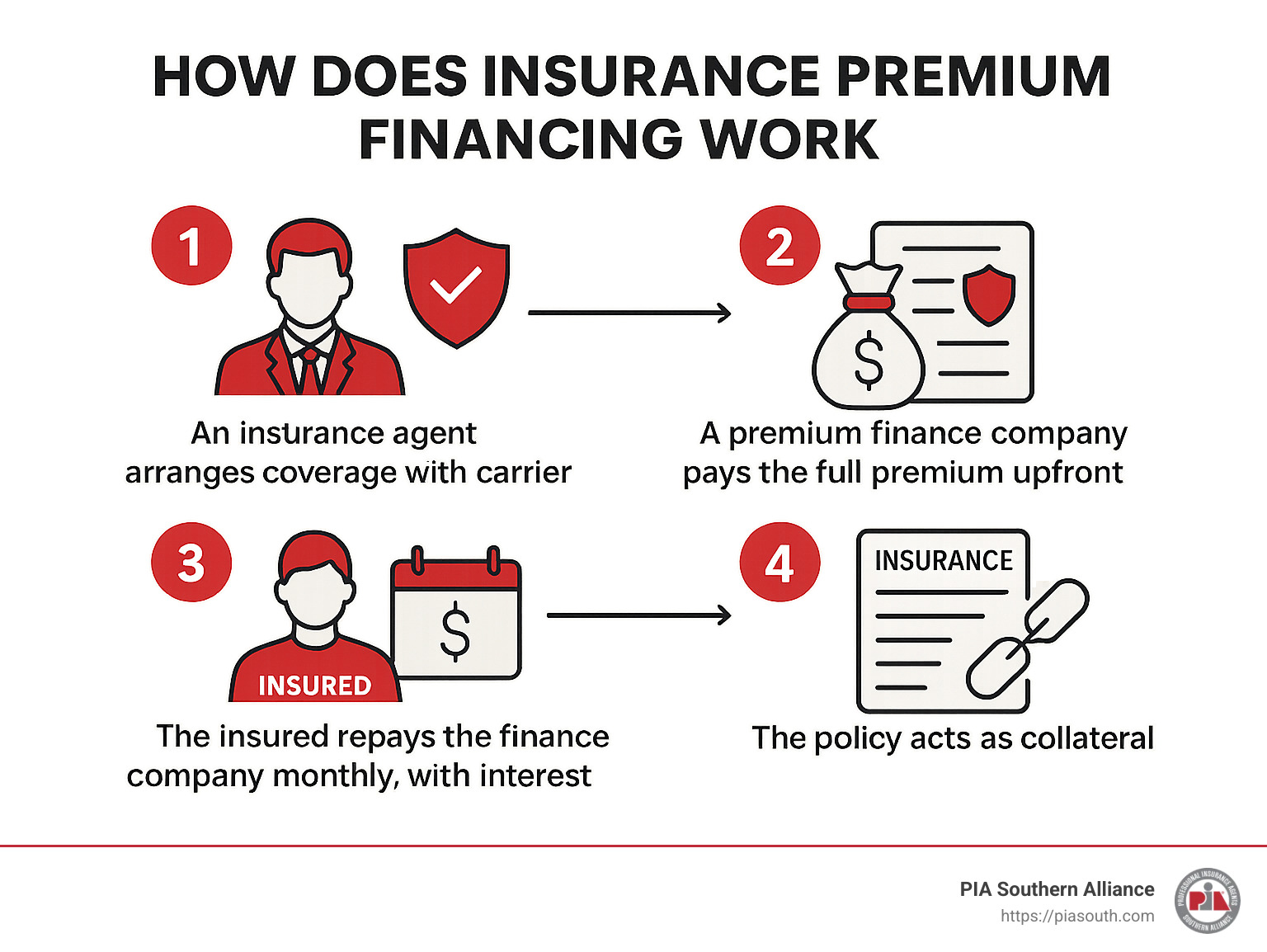
How does insurance premium financing work? Simply put, it’s a lending solution that helps policyholders pay their insurance premiums in installments rather than in a single lump sum. Here’s a quick snapshot:
- The insurance agent arranges coverage through a chosen carrier.
- A premium finance company pays the full annual premium to the insurance carrier upfront.
- The policyholder repays the finance company in monthly installments, including interest and fees.
- The financed insurance policy serves as collateral, meaning if payments aren’t made, the policy can be cancelled.
Insurance premium financing can be a game-changer for independent property & casualty agencies in Georgia, Alabama, and Mississippi. It allows your commercial clients—especially those facing large upfront premium charges—to maintain liquidity, free up capital for growth, and simplify their cash flow management.
I’m Scott Hansard, and at PIA Southern Alliance, we’ve guided independent agencies across Georgia, Alabama, and Mississippi for years, helping them understand concepts like how does insurance premium financing work. My mission is to support agencies in navigating complex insurance strategies and compliance challenges every step of the way.
Find more about how does insurance premium financing work:
– can an insurance agency finance a premium
– insurance premium funding interest rates
– insurance premium funding loan
Understanding Insurance Premium Financing

Insurance premium financing is a powerful financial strategy that plays a big role in helping businesses manage their property and casualty insurance costs. But before we dive deeper into exactly how does insurance premium financing work, let’s first make sure we’re clear on what it is and who can benefit from it.
What is Insurance Premium Financing?
Simply put, insurance premium financing is a lending solution that allows businesses (and sometimes individuals) to pay their insurance premiums over time rather than in one hefty, upfront payment. It’s especially useful for property and casualty insurance because premiums for things like commercial buildings, equipment, vehicles, and liability coverage can really add up.
Here’s the official definition, plain and simple, from Wikipedia: “Premium financing is the lending of funds to a person or company to cover the cost of an insurance premium.” Basically, a premium finance company steps in, pays the entire annual premium to the insurance carrier upfront, and then allows the insured party to repay the loan in smaller, manageable monthly payments—plus a little interest, of course.
This arrangement is incredibly helpful for businesses across Georgia, Alabama, and Mississippi, who often face challenging cash-flow decisions. Rather than tying up critical working capital in insurance payments, premium financing frees up money to be reinvested in the business, fueling growth and day-to-day operations.
Who Uses Insurance Premium Financing?
Across the Southeast—especially in Georgia, Alabama, and Mississippi—insurance premium financing is popular with a broad range of businesses. Often, it’s the businesses that face higher insurance costs or cash flow challenges who stand to benefit the most.
For example, commercial businesses such as construction firms with large equipment needs, manufacturers with significant property values, transportation companies running fleets of vehicles, hospitality businesses managing extensive properties, and retail operations with multiple locations frequently use premium financing to maintain liquidity.
It’s also especially handy for businesses with seasonal cash flow fluctuations, such as agriculture businesses, tourism operations, and retailers. Premium financing helps smooth out expenses, spreading them evenly throughout the year instead of creating large peaks in spending.
Growing organizations—those rapidly expanding and investing heavily into their own growth—also love premium financing. It allows them to invest available capital back into their operations rather than tying up significant sums in annual insurance premiums.
Even businesses experiencing temporary cash flow crunches find premium financing to be a lifesaver. Rather than missing out on critical coverage or putting their business at risk, they can maintain consistent insurance protection without straining their finances.
Considering that around 41% of businesses report cash flow troubles at some point, it’s easy to see why premium financing has become such a popular tool. Property and casualty insurance agents in Georgia, Alabama, and Mississippi regularly recommend premium financing to their clients as a smart way to stay covered without exhausting their financial resources.
By clearly understanding exactly how does insurance premium financing work, independent agencies and their commercial clients can make informed, strategic choices about managing insurance costs. At PIA Southern Alliance, we’re here to help agents across Alabama, Georgia, and Mississippi leverage premium financing effectively, ensuring their clients can keep their businesses secure and thriving.
How Does Insurance Premium Financing Work?

Now that you’re familiar with what premium financing is and who typically benefits from it, let’s solve exactly how does insurance premium financing work. Rest assured, it’s simpler than it might seem at first glance! We’ll walk you through the key stages, the parties involved, and some essential considerations—so you’ll feel totally comfortable discussing this option with your property & casualty clients in Georgia, Alabama, and Mississippi.
How Does the Premium Finance Agreement Work?
Think of the premium finance agreement as the “rule book” for the entire financing arrangement. It’s a clear, straightforward legal contract between the insured (your client) and the premium finance company. Here’s how it usually unfolds:
First, your client selects the right insurance coverage with your help as their trusted agent. Once coverage is finalized, they apply to a premium finance company to fund the annual premium. The finance company then reviews the application, typically considering your client’s credit history and financial stability.
Upon approval, your client signs the premium finance agreement. This document outlines crucial details such as the total amount being financed, any required down payment (typically between 15% and 25%), the interest rate charged, a clear schedule for repayments (often 9-10 monthly payments), and any additional fees. It also explains what happens if payments aren’t made—so it’s important to review these terms carefully with your client.
After executing the agreement, the finance company pays the full annual premium directly to the insurance carrier or agency. Your client then begins making monthly payments to the finance company, gradually paying back both the principal premium amount and interest.
For more specifics, check out our page on the insurance premium funding loan—it explains this straightforward financing process in greater detail.
How Does Collateral Work in Insurance Premium Financing?
Here’s the good news: your clients typically don’t need to offer separate assets like their buildings or equipment as collateral. Instead, the insurance policy itself does the heavy lifting as collateral—simple, right?
When your client signs the premium finance agreement, they usually assign certain rights in their insurance policy to the finance company. This assignment includes a limited power of attorney, allowing the finance company to cancel the policy if payments go unpaid.
If payments stop and the finance company needs to cancel the policy, the insurance carrier refunds what’s known as the “unearned premium.” This is simply the portion of the premium covering the unused policy term. That refund goes directly back to the finance company, helping to offset any remaining loan balance. Easy-peasy, as they say!
In some cases, especially for particularly large commercial policies, the finance company might ask for a bit more reassurance—additional collateral such as cash deposits or letters of credit. However, more often than not, the insurance policy itself is enough to secure the loan.
How Does Interest Rate Affect Insurance Premium Financing?
Ah, interest rates—the unavoidable reality of financing anything. Interest rates can significantly impact the total cost to your clients, making it essential to understand how they work. Let’s decode it together.
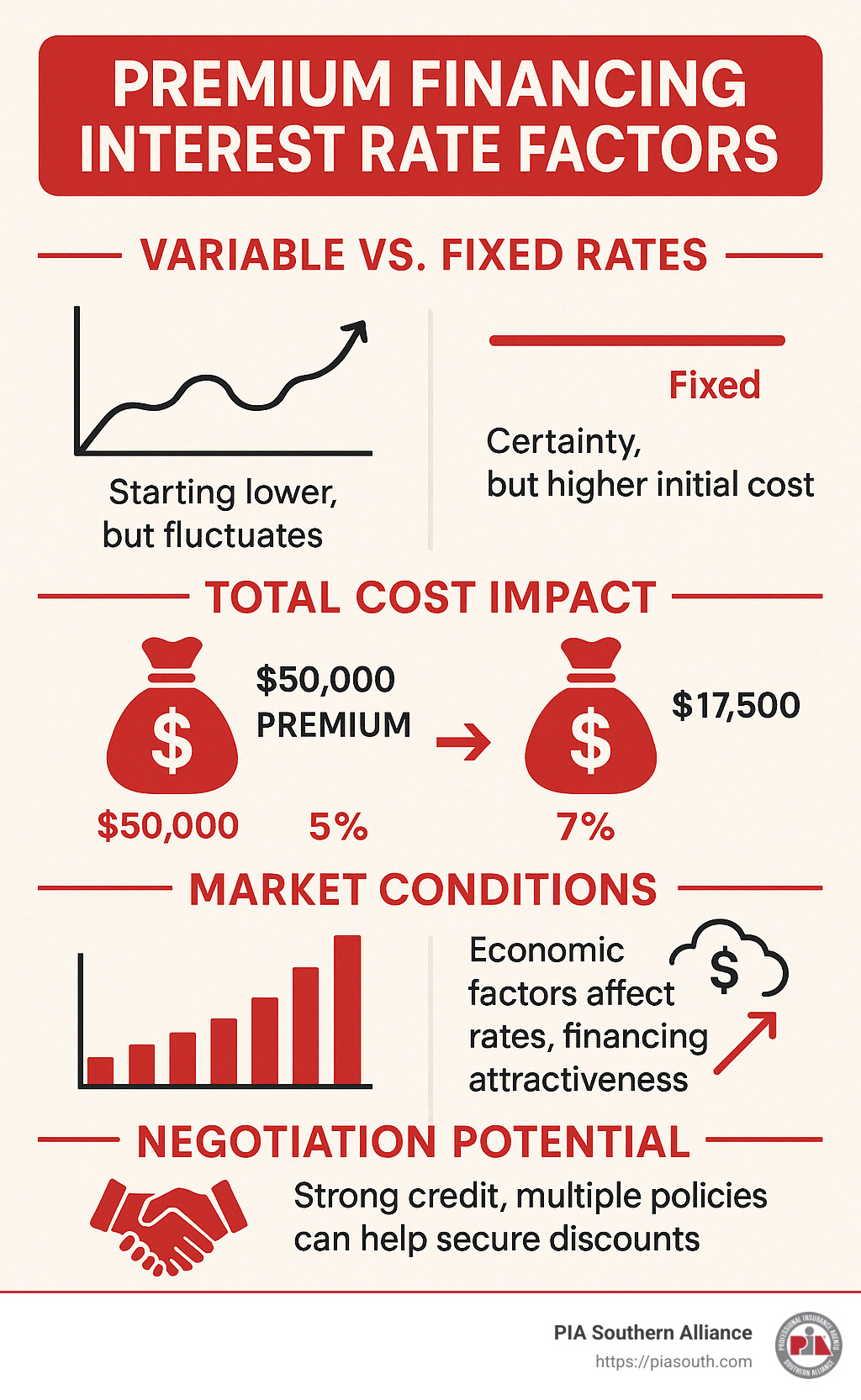
Interest rates for insurance premium financing typically fall into two types: fixed and variable. Fixed rates remain consistent throughout the loan’s term, giving your clients peace of mind with predictable costs. Variable rates, on the other hand, fluctuate based on market conditions, such as benchmarks like the 1-year LIBOR rate.
Several factors affect the interest rate your clients receive, including their credit profile, the total amount financed, the financing term length, and current market conditions. Historically, rates have usually ranged between 2.5% and 6%, although economic shifts can push them higher or lower. Even a small difference in interest rate can significantly impact your client’s total payments, so it’s worth paying close attention to this detail.
For a deeper dive, check out our page detailing insurance premium funding interest rates—it’s a great resource for understanding this crucial aspect of premium financing.
At PIA Southern Alliance, we’re here to support independent property & casualty agents like you across Georgia, Alabama, and Mississippi. Understanding exactly how does insurance premium financing work empowers you to better serve your clients, helping them optimize cash flow, preserve capital, and secure the coverage they need with confidence.
Benefits of Insurance Premium Financing
Insurance premium financing is more than just a handy financial tool—it’s a solution that can genuinely transform how businesses across Georgia, Alabama, and Mississippi manage their cash flow. Let’s take a closer look at the key benefits of premium financing and why it might be the right choice for you or your clients.
Enhancing Cash Flow for Businesses
Cash really is king, especially when running a business. One of the primary benefits of premium financing is that it helps preserve your capital. Instead of paying a hefty insurance premium in one lump sum, your business can spread payments out over time. That means more cash stays in your business to handle unexpected expenses, invest in growth opportunities, or simply cover day-to-day operations.
In fact, industry research shows that a significant number of businesses opt for premium financing precisely because it helps them hold onto their valuable resources. This makes sense—why tie up cash in insurance premiums when it could be working harder elsewhere?
Another advantage is how it can improve your financial metrics. By financing your insurance premiums, your business can maintain stronger liquidity ratios and healthier balance sheets. This can even improve your overall financial standing, potentially improving your borrowing capacity for future needs.
Plus, premium financing helps with budget management. Breaking large yearly premiums into smaller monthly installments helps businesses better predict their monthly costs. If your revenue fluctuates—perhaps you’re a seasonal business like a hotel on the Gulf Coast or a farm operation in rural Georgia—premium financing can smooth out your expenses, making those slower months less stressful.
Take it from one Alabama business owner who recently said, “Premium financing allowed us to maintain full insurance coverage during our expansion project when cash was tight. We didn’t have to choose between growth and protection.” That’s how powerful this financial tool can be.
Flexibility in Payment Options
Another big reason businesses appreciate premium financing is the flexibility it provides. Not every business is the same, and premium financing lets you tailor your payment plans to your unique needs.
Finance companies usually offer a range of customized payment plans. For example, you might choose to pay 25% upfront and spread the rest over nine monthly installments. Or maybe you’d prefer a lower down payment (say 15%) and ten monthly repayments. There are even quarterly or semi-annual options if that’s what works best.
What’s more, you can align payments with your cash flow cycles. Seasonal businesses, such as Mississippi tourism companies, Georgia’s agricultural industries, or retailers in Alabama, can structure their premium payments around peak earning periods. Basically, premium financing fits your schedule—not the other way around.
If your business has multiple insurance policies (common for property & casualty), premium financing allows you to consolidate multiple policies into a single financing arrangement. This simplifies administration, makes tracking payments easier, and often leads to lower overall financing costs due to economies of scale.
And don’t forget about technology integration. Modern premium finance companies usually offer helpful digital tools like online account management, automatic payments, mobile apps, and convenient payment reminders. These tools keep things streamlined, so you spend less time worrying about paperwork and more time running your business.

A construction company owner in Georgia recently mentioned, “Spreading our equipment and liability insurance costs throughout the year has been invaluable. The flexibility has given us breathing room when client payments are delayed, but our coverage remains rock-solid.”
And it’s not just good for policyholders—insurance agents benefit too. Premium financing empowers property & casualty agents in Georgia, Alabama, and Mississippi by letting them offer comprehensive coverage options without upfront price tags becoming a barrier. Agents can focus on advising what’s best for their clients—not what’s cheapest just because it’s easier to swallow upfront.
In short, understanding how does insurance premium financing work isn’t just about the mechanics—it’s about appreciating the peace of mind, flexibility, and improved cash flow it can provide. If you’re an insurance agent or a business owner, exploring premium financing could be the best financial decision you make this year.
Risks and Considerations in Premium Financing

Let’s be honest – while premium financing can be a fantastic tool for managing cash flow, it’s not without its challenges. Think of it like using a credit card for a major purchase: convenient, but with strings attached. Before diving in, property and casualty insurance clients across Georgia, Alabama, and Mississippi should understand both the potential pitfalls and regulatory landscape.
Understanding the Risks
How does insurance premium financing work when things don’t go as planned? That’s the question every business owner should consider before signing on the dotted line.
Interest rate fluctuations can catch even savvy business owners off guard. Just ask any financial advisor who watched the one-month LIBOR rate skyrocket from 0.09% to 3.35% in a single year! When rates climb unexpectedly, that affordable financing arrangement can suddenly become much more expensive.
The most significant worry keeps many business owners up at night: policy cancellation. Miss a few payments, and you could find yourself without essential coverage when you need it most. The premium finance company typically has the right to cancel your policy, collect the unearned premium refund, and still come after you for any remaining balance.
I recently spoke with a property manager in Alabama who learned this lesson the hard way: “We missed two payments during a tough quarter and suddenly faced losing coverage on all our properties. We had to scramble to catch up to maintain protection. The lesson was clear – don’t enter premium financing without a rock-solid payment plan.”
Qualifying for premium financing can also be challenging for businesses with less-than-stellar credit histories. And even if you qualify initially, renewal isn’t guaranteed – changes in your financial situation could affect availability or terms when it’s time to renew your policy.
For businesses required to provide additional collateral beyond the unearned premium, there’s another layer of risk. If that collateral’s value drops, you might face calls for additional security – just when you can least afford it.
Legal and Regulatory Considerations
The regulatory landscape for premium financing varies significantly across Georgia, Alabama, and Mississippi. Each state maintains its own rules governing everything from licensing requirements to maximum allowable interest rates and fees.
Insurance agents and finance companies must steer a complex web of compliance requirements, including Truth in Lending Act provisions, state insurance department regulations, proper documentation protocols, and specific cancellation notification timeframes. Getting any of these wrong can create serious headaches for everyone involved.
A seasoned Mississippi insurance agent recently shared: “Each state has nuanced regulations around premium financing. What’s permissible in Alabama might not be in Mississippi. We always ensure we’re following the specific requirements of the state where the client is located.”
The State Insurance Departments Overview from the National Association of Insurance Commissioners serves as a valuable resource for staying current on these changing regulations.
Beyond regulatory concerns, all parties must thoroughly understand their contractual obligations. The fine print matters tremendously – payment schedules, default provisions, cancellation procedures, refund calculations, and collection practices can vary widely between agreements.
To protect yourself, always:
- Read every word of your premium finance agreement before signing
- Understand all terms, conditions, and potential penalties
- Ensure you have a bulletproof payment plan
- Partner only with reputable, licensed premium finance companies
- Consult with your trusted insurance agent about the most appropriate options
For property and casualty insurance agents across the Southeast, transparency about these risks is essential. By helping clients understand both the benefits and potential pitfalls of premium financing, you enable them to make informed decisions that support their overall financial and risk management strategies.
How does insurance premium financing work isn’t just about the mechanics – it’s about understanding the complete picture, including what happens when things don’t go according to plan. At PIA Southern Alliance, we believe that educated clients make better decisions, and better decisions lead to stronger, more resilient businesses.
Is Insurance Premium Financing Right for You?
Deciding if insurance premium financing is the right fit for your business requires taking a close look at your unique situation and needs. As helpful as premium financing can be, it won’t be ideal for every company. Lucky for you, figuring this out can be straightforward—especially when you’re informed and have the support of a knowledgeable insurance agent.
Let’s explore how you can confidently decide if premium financing aligns with your business goals and explore the important role your agent plays in guiding you through this decision.
How to Decide
The first step is understanding your own business. Start by looking at your cash flow patterns. Do you experience seasonal ups and downs in revenue? Maybe you’re in Georgia’s agricultural sector, Mississippi’s busy tourism scene, or Alabama’s booming construction industry—all of which often face seasonal cash flow challenges. If large insurance premiums are difficult to pay upfront during your off-season, premium financing can ease that burden by spreading payments out over the year.
Next, do a quick cost-benefit check. Calculate exactly what premium financing would cost you in interest and fees. Then consider the opportunity cost—what else could you do with the money you’d otherwise use to pay premiums in full? Could that capital help you invest in new equipment, hire additional staff, or expand your business operations? If the returns from those investments clearly outweigh the financing costs, premium financing might be a smart choice.
Think carefully about your business’s growth plans, too. When you’re growing fast—maybe opening a new location in Alabama or upgrading equipment for your Mississippi manufacturing facility—capital can be scarce. Premium financing can free up essential funds, letting you invest in growth without sacrificing the quality of your insurance protection.
Finally, it’s important to assess potential financing risks. Ask yourself honestly if your business is prepared to reliably make monthly payments. Consider the risks of interest rate increases if you choose a variable-rate agreement, and be aware that missed payments could result in policy cancellation. It’s essential that you’re comfortable managing these risks before committing.
One Georgia construction business owner put it perfectly: “We weighed the cost of premium financing against the profits we’d earn by investing our capital in a new project. The math was clear—financing our premiums helped us grow faster and smarter.”

Working with Your Insurance Agent
Of course, figuring all this out might feel overwhelming at first. That’s where your property and casualty insurance agent steps in as your trusted advisor and guide. A good agent does far more than sell you policies—they help you make informed, strategic decisions about your insurance spending.
Your agent will start by understanding your specific needs. They’ll look closely at your company’s risks, coverage levels, and financial limitations. Then they’ll identify policies that might benefit from financing and explain the options clearly, highlighting differences in rates and repayment terms. If you’re wondering “can an insurance agency finance a premium?”, your agent will answer that too, helping you decide on the best solution for your unique circumstances.
Once you’ve chosen a financing path, your agent will help you steer the application process. They’ll ensure all documentation is accurate and complete, communicate clearly with the financing company, and handle the policy assignment properly. And their support doesn’t stop there—your agent will continue to assist you, answering questions throughout the financing period and helping you manage policy adjustments or renewals.
At PIA Southern Alliance, we understand the importance of knowledgeable, supportive agents. We provide independent property and casualty agents across Georgia, Alabama, and Mississippi with specialized educational resources, webinars, and guidance, empowering them to support businesses like yours confidently.
A Mississippi agent summed it up well: “Our job isn’t just selling coverage—it’s helping clients find smart, sustainable ways to pay for it. Premium financing helps many of our business clients maintain full protection without tying up crucial capital.”
To get the most from your agent, be prepared to share essential details, such as financial statements, cash flow projections, credit information, growth plans, and insights into any existing financing commitments. The better your agent understands your business, the better they can tailor their recommendations specifically to you.
Premium financing isn’t always the best choice for everyone. But with thoughtful consideration and the guidance of a trusted P&C agent, you can confidently determine whether insurance premium financing is the right move for your business.
Wondering more about exactly how does insurance premium financing work? Learn more by exploring these helpful resources:
Frequently Asked Questions about Insurance Premium Financing
At PIA Southern Alliance, we regularly talk with property and casualty agents across Georgia, Alabama, and Mississippi about the ins and outs of premium financing. It’s normal to have questions! In fact, we hear some of the same great questions from agents and their clients all the time. Let’s explore some frequently asked questions about premium financing to give you clear answers—and maybe even bring a smile to your face (we promise insurance can sometimes be fun, too!).
What Types of Insurance Policies are Commonly Financed?
Insurance premium financing works best when there’s a substantial premium involved. Typically, property and casualty insurance policies with larger annual premiums make the most sense for financing. For instance, commercial property insurance is a popular candidate—businesses often finance coverage for buildings, contents, and valuable equipment to manage budgets more effectively.
General liability insurance, especially for construction companies or manufacturers throughout Georgia, Alabama, and Mississippi, is another common premium financing choice. And don’t forget commercial auto or fleet insurance! Businesses operating multiple vehicles—like contractors, delivery companies, or transportation fleets—often find financing their auto insurance policies helps manage cash flow smoothly.
Workers’ compensation policies, required by law, often carry sizeable premiums and are frequently financed. Other property and casualty policies you might see regularly financed include professional liability (errors & omissions), umbrella or excess liability policies, and specialized coverages like cyber liability or environmental liability policies.
While there’s no strict rule, premiums over about $5,000 per year tend to be the most common threshold where businesses decide premium financing is beneficial. But this isn’t set in stone—every business should carefully consider whether financing makes sense for their unique situation.
How Does Interest Rate Affect Premium Financing?
Ah, interest rates—the sneaky factor that can make or break the appeal of premium financing! Generally, the interest rate directly impacts your overall financing costs and influences whether premium financing makes financial sense.
There are two main types of rates you’ll see—variable and fixed. Variable rates typically start out lower but fluctuate with the broader market (often based on benchmarks like LIBOR or Prime Rate plus a margin). Fixed rates, on the other hand, remain constant throughout the financing agreement, giving businesses predictable cost certainty.
Let’s say your policy premium is $50,000, financed over 10 months. Financing at a 5% rate versus a 7% rate can mean roughly $500 difference in interest charges. As you can see, even small rate changes matter. That’s why many businesses in Georgia, Alabama, and Mississippi carefully weigh their options and sometimes shop around with different finance companies before signing the dotted line.
It’s also worth noting that businesses with stronger credit profiles often qualify for better rates. Similarly, financing multiple policies at once could help businesses secure a volume discount or lower overall rate. In any case, it’s important to understand the full cost of borrowing and consider it against the benefits of preserving your operational cash flow and capital.
What Should I Consider When Signing a Premium Finance Agreement?
Signing a premium finance agreement isn’t something to rush into. It’s important to slow down and read the details—no skimming allowed (we see you!). Here are some key things to carefully consider:
Interest Rate & Fees: Pay close attention to the quoted interest rate, whether it’s variable or fixed, and any additional fees. Know exactly how much financing will cost you over the life of the agreement.
Down Payments & Payment Schedule: Understand exactly how much you’ll need upfront and the repayment schedule—are payments monthly, quarterly, or semi-annually? Make sure the timing lines up with your cash flow.
Collateral Requirements: Typically, your policy itself serves as collateral. But sometimes, larger policies may require extra collateral, like cash deposits or letters of credit. Be clear on what’s expected.
Cancellation and Default Provisions: Read carefully what happens if payments are late or missed. Policies can be canceled for nonpayment, leaving you unprotected. Alongside this, understand the policy reinstatement process and how unearned premiums are handled.
Disclosures and Compliance: Familiarize yourself with the Truth in Lending disclosures, annual percentage rate (APR), and total amount paid over the term. Insurance premium financing agreements in Georgia, Alabama, and Mississippi must comply with state regulations, so make sure everything looks transparent and clearly stated.
An experienced insurance agent from Alabama once shared this valuable insight: “Before you sign, make sure you’re crystal clear on cancellation provisions. Knowing exactly how a missed payment impacts your coverage can help avoid some sleepless nights!”
Beyond these factors, consider the overall reputation and financial stability of the premium finance company you choose. Do they have strong customer service? Can you easily manage your account and make payments online? Your property and casualty agent can help you gauge all of these important factors and make the best possible decision for your business.
At PIA Southern Alliance, we encourage every business owner to approach premium financing thoughtfully, with clear eyes and full understanding. After all, informed decisions lead to happier clients—and happier clients mean happier insurance agents. It’s a win-win!
Conclusion
Insurance premium financing can be a powerful way to manage property and casualty insurance costs for businesses in Georgia, Alabama, and Mississippi. Throughout this guide, we’ve explored how does insurance premium financing work, revealing a straightforward yet strategic tool that can help businesses balance protection with financial flexibility.
One of the biggest advantages of insurance premium financing is how it helps businesses keep more capital available for growth and operations. Instead of tying up significant cash to pay an insurance premium upfront, companies can spread their payments throughout the year. This improved cash flow can be especially helpful during periods of growth, seasonal fluctuations, or when unexpected expenses pop up.
Premium financing also lets businesses enjoy greater flexibility. By tailoring payment plans to match business cycles, companies can more effectively manage their budgets. Whether you run a construction company in Georgia, a manufacturing plant in Alabama, or a hospitality business in Mississippi, the ability to align insurance payments with income streams can be a huge relief. Plus, consolidating multiple policies into one financing agreement simplifies administration and may even qualify you for better rates.
But like any financial tool, premium financing comes with a few caveats. Interest rates and fees will add to the total cost, so it’s important to carefully weigh these expenses against the benefits of preserving capital. And because your insurance policy serves as collateral, missing payments could lead to cancellation of coverage—something no business wants to face.
Regulatory requirements also vary from state to state. Businesses and their agents must carefully follow the specific laws and licensing rules in Georgia, Alabama, and Mississippi. Working with a reputable, experienced premium finance company that understands these state-specific rules is essential.
Deciding whether premium financing is right for your business involves careful consideration. Look closely at your cash flow, business growth plans, and the total cost of financing compared to alternative uses for that cash. Thankfully, you don’t have to make these decisions alone.
Property and casualty insurance agents play a critical role in helping businesses steer premium financing options. A knowledgeable agent can analyze your insurance needs, walk you through the terms of premium financing agreements, and help you structure payments that best fit your business. At PIA Southern Alliance, our goal is to ensure agents across Georgia, Alabama, and Mississippi have the training and resources needed to guide their clients confidently through these important decisions.
As our friends at Professional Agents Funding often say, “We truly believe we serve the best clients in the industry.” And it’s true—independent agents in the Southeast are dedicated professionals committed to serving their clients’ best interests.
If you’re an independent insurance agent looking to deepen your understanding of how does insurance premium financing work, or if you’re a business owner wondering if premium financing makes sense for you, PIA Southern Alliance is here to help. Our webinars, educational programs, and resources are all designed to strengthen your strategic decision-making and cross-selling abilities.
Ready to learn more? Feel free to reach out and explore how PIA Southern Alliance can support your premium financing needs. Together, we can find the best solutions to protect your business and improve your financial flexibility.