
Choosing an E&O provider is a critical business decision that safeguards your agency's future—it's not just a box to check on a compliance list. The best E&O insurance companies become true strategic partners. They offer specialized expertise and a robust defense against claims that could otherwise threaten your agency's very existence. This isn't just about buying a policy; it's about securing a long-term risk management ally.
Why Your Agency’s Future Depends on the Right E&O Partner
Picking an Errors & Omissions provider is easily one of the most consequential decisions any agency owner will make.
Picture this: a client claims your team failed to secure the right coverage, leaving them exposed to a massive, uncovered loss. Without a strong partner in your corner, that single event could cripple your agency's reputation, drain your finances, and grind your long-term growth to a halt. This is where the right relationship moves beyond a simple transaction and becomes a lifeline.
The value of a top-tier E&O carrier extends far beyond the policy document. They bring deep industry knowledge, claims-handling expertise specific to insurance agents, and a proactive approach to risk management. A great partner doesn't just show up after a claim is filed; they help you build the internal processes to prevent them from ever happening.
The Strategic Value of a True Partner
A true E&O partner gets it. They understand the unique exposures your agency navigates every single day and recognize that these risks are definitely not one-size-fits-all.
- Proactive Risk Management: The best carriers provide real-world resources like workflow checklists, compliance guides, and training materials that help you stop potential errors before they start.
- Specialized Claims Defense: When a claim does arise, you need a team that has defended hundreds of agencies, not a generalist law firm. Their specific expertise can be the difference between a swift, quiet resolution and a drawn-out, costly legal battle.
- Market Insight: A dedicated partner keeps you ahead of the curve, informing you about emerging risks like new forms of cyber liability or evolving professional standards of care.
Choosing the right E&O partner transforms a daunting compliance task into a powerful risk management strategy. This shift in perspective is crucial for protecting your assets and ensuring long-term business stability.
Just look at the stringent requirements for law firm data security to understand the need for an E&O partner with specialized knowledge. This is especially true as exposures grow in unexpected places; for instance, many agents tragically underestimate the E&O risks found in personal lines.
This is where organizations like the PIA Southern Alliance play such a vital role. They do the hard work of vetting and endorsing partners who are genuinely committed to the independent agency channel. This helps members cut through the noise of a complex market, turning the selection process from a search for a vendor into a strategic alignment with a partner truly invested in your success.
Getting Beyond the Jargon: What Your E&O Policy Really Says
An Errors & Omissions policy is so much more than a document—it’s the financial backstop for your agency when a claim threatens your livelihood. But its real protective power is hidden in the details, often wrapped in dense legal language that can trip up even the most experienced agents. Misunderstanding these terms isn't a small oversight; it can leave your agency with massive, uninsured gaps in its professional liability armor.
To truly compare E&O insurance companies, you have to look past the premium and dig into the core components of the policy itself. Let’s pull back the curtain on the critical terms that define your agency's safety net.
This timeline shows the path from simply identifying a risk to building a solid wall of protection around your agency.
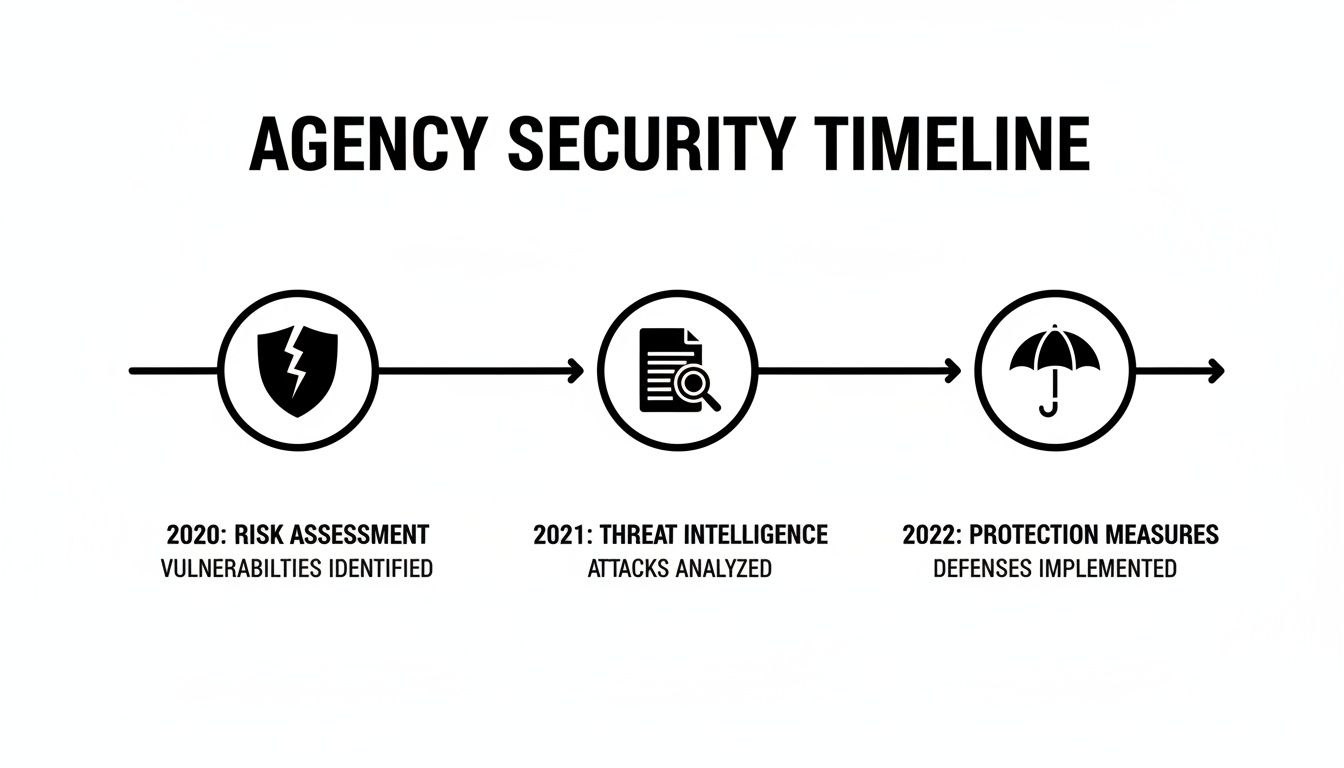
As you can see, proactive protection isn't just a good idea—it’s the final, essential step after a potential threat has been identified.
Claims-Made vs. Occurrence Policies
Almost every professional liability policy, and certainly E&O for insurance agents, is written on a claims-made basis. This is a fundamental concept, and it dictates when your coverage actually kicks in.
You might be more familiar with an occurrence policy from the general liability world. It covers a loss that happens during the policy period, no matter when the claim is eventually filed. A claims-made policy, however, is different. It only covers claims that are first made against you and reported to the carrier during your current policy period. This single distinction introduces several other crucial policy features you have to manage, especially if you ever switch carriers.
Why Your Retroactive Date is Everything
Your retroactive date (or "retro date") is arguably the single most important date on your entire policy. It marks the starting line for your coverage. Any professional service you provided before this date is not covered—period.
Imagine this all-too-common scenario: An agency switches its E&O carrier to get a better premium. The new carrier, however, sets the retroactive date to the new policy's start date. A year down the road, a former client sues the agency over advice given two years ago. Since the alleged error happened before the new retro date, the new carrier denies the claim. The agency is left holding the bag.
The single biggest mistake an agency can make when changing E&O providers is failing to maintain its original retroactive date. This creates an uninsured gap for all your prior work, effectively wiping out years of continuous coverage.
When you move to a new provider, it is non-negotiable that they carry over your existing retroactive date. This is known as prior acts coverage, and it's the only way to ensure seamless, uninterrupted protection for your agency's entire history.
Getting a "Tail" When You Need It Most
What happens when you sell your agency, retire, or simply close up shop? Because a claims-made policy only covers claims made and reported during the policy period, your protection vanishes the day your policy ends. This leaves you personally exposed to lawsuits from past work that might not surface for years.
This is exactly where tail coverage, officially called an Extended Reporting Period (ERP), becomes essential.
- What it is: An endorsement you purchase that gives you an extended window of time to report claims that stem from work you did before your policy expired.
- How it works: Let's say you retire on December 31, and your policy terminates. The following March, a client files a claim over an error from two years prior. Your tail coverage would allow you to report that claim to your former E&O carrier.
- Why it's essential: Without it, you are personally on the hook for defense costs and potential judgments from your entire career. It’s your professional liability safety net after you’ve left the business.
Navigating these policy mechanics is the key to securing protection that actually protects you. A knowledgeable partner can help you dissect quotes, spot potential gaps, and make sure your coverage is structured correctly from the very start.
The E&O Insurance Market Landscape Explained
Ever get that renewal notice and wonder why your E&O premium jumped? It can feel random, but I promise you, it’s not. The professional liability market is a living, breathing thing, shaped by some powerful economic and legal forces. Getting a handle on these trends is the first step to turning your renewal from a reactive scramble into a strategic move.
The thing is, the demand for professional liability coverage isn't just growing—it's picking up speed. And this isn't just an insurance agency problem. Professionals everywhere, from tech consultants to architects, are dealing with a more lawsuit-happy environment. That broader trend directly squeezes the E&O insurance companies that serve your agency, affecting their appetite for risk and how much capacity they have.
This is all part of a much bigger market shift. The global errors and omissions insurance market was pegged at around USD 15 billion in 2023, and it's on track to hit USD 25 billion by 2032. That's a huge expansion, and it tells us there's a growing awareness of professional risks worldwide. Of course, that trickles right down to how carriers behave and calculate your premiums. You can dig deeper into these market projections to see what's driving them.
Forces Shaping Today's E&O Market
A few key factors are really stirring the pot right now when it comes to coverage and pricing. When carriers start getting nervous about their profitability in the E&O space, they do what any business would: they tighten up. That means stricter underwriting, higher rates, or sometimes even pulling out of certain markets entirely.
Here's what's keeping them up at night:
- Skyrocketing Litigation Costs: The price tag to defend a claim—even a bogus one—has gone through the roof. Legal fees, expert witness costs, and settlement demands are all climbing, forcing carriers to price their policies much more defensively.
- "Social Inflation": This is a big one. It’s the general trend toward massive jury awards and a legal climate that often favors the plaintiff. A verdict that might have been a five-figure headache a decade ago could easily be a six- or seven-figure nightmare today. Carriers have to price for that risk.
- Emerging Tech Risks: The race to adopt new tech, especially artificial intelligence, is creating all sorts of new and unpredictable liabilities. We’re already seeing some insurers slap broad AI exclusions on their policies, which could leave a huge coverage gap for agencies using these tools.
Think of it like this: navigating the E&O market is like sailing in shifting winds. If you understand the currents of litigation trends, carrier appetite, and new tech risks, you can adjust your sails and stay on course. If you don't, you're just waiting to get caught off guard by a storm at renewal.
Knowing what’s happening behind the curtain turns the frustrating "why" of your quotes into insight you can actually use.
Before we dive into market cycles, it’s helpful to see these drivers laid out. They aren't just abstract concepts; they have a direct and tangible impact on your agency's bottom line.
Key Drivers of E&O Market Growth
| Driving Factor | Impact on Insurance Agencies |
|---|---|
| Increased Litigation | Higher frequency and severity of claims lead directly to increased premium costs and stricter underwriting from carriers. |
| "Social Inflation" | The potential for massive jury awards forces insurers to hold more capital in reserve, driving up the base cost of coverage for everyone. |
| Complex Regulations | Ever-changing state and federal rules create more opportunities for compliance-related errors, increasing an agency's risk profile. |
| New Technology Risks | The use of AI, big data, and automated systems introduces novel liabilities that many standard E&O policies may not be designed to cover. |
As you can see, these factors create a challenging environment. But a challenging market is also one where the right knowledge and partnerships can give you a significant edge.
Carrier Appetite and Market Cycles
The E&O market, like any other insurance line, runs in cycles. These are driven by one simple thing: carrier profitability. That profitability determines their "appetite"—how hungry they are to take on your agency's risk.
When claims are high and profits are low, we enter a "hard" market. You’ll know you’re in one when you see:
- Higher premiums and deductibles.
- Underwriting questions that feel more like an interrogation.
- New, restrictive exclusions appearing on your policy.
- Fewer carriers even willing to offer you a quote.
On the flip side, a "soft" market is a great time to be an insurance buyer. It’s fueled by high carrier profitability and fierce competition. In this environment, you’re more likely to find:
- Lower, more stable premiums.
- Broader coverage terms with fewer gotchas.
- More E&O insurance companies fighting for your business.
So, where are we now? The truth is, it’s a mixed bag. Certain segments are still tough, but new capacity is entering the market and creating pockets of competition. This kind of complex landscape is exactly why having an experienced partner who can access a wide range of carriers is so critical. They can find those opportunities for you, even in a generally hard market, to make sure you get the best terms without giving up essential protection. This is where an association-endorsed program really proves its worth.
What Goes into Your E&O Premium? A Look at Underwriting and Pricing
Ever get an E&O quote and wonder how the carrier landed on that specific number? It can feel a bit like a black box, but it all comes down to a detailed risk assessment.
At the end of the day, underwriters are trying to answer one core question: how likely is your agency to generate a claim? The more you can do to position your agency as a "preferred risk," the better your pricing and terms will be.
It’s all about proving you run a tight, professional, and consistent operation. Underwriters will look closely at your agency's profile, piecing together a number of factors that paint a clear picture of your potential liability.

This process isn't just about the numbers you put on an application; it's about the story those numbers tell. And a well-documented story of proactive risk management is your single most powerful tool for securing favorable terms.
Key Factors Under the Underwriting Microscope
Underwriters are going to scrutinize several core areas of your agency to build your risk profile. While every carrier has its own "secret sauce," a few ingredients are always in the mix.
- Agency Revenue and Size: It’s a simple correlation. Higher revenue generally suggests a larger volume of transactions and potentially more complex risks, which can influence your premium.
- Lines of Business: An agency focused on standard personal auto and home policies is viewed very differently than one specializing in complex commercial liability or high-net-worth clients. The more intricate the products you sell, the higher the perceived risk of an error.
- Claims History: This is the most direct indicator of future risk, for obvious reasons. A "clean" record with zero claims is the gold standard. If you have had claims, underwriters will dig into the details and want to see what steps you took to prevent a similar incident from happening again.
To really get a handle on the factors driving your premium, it's worth looking at your own internal practices, like mastering the operational risk management process.
Your agency's documented procedures are your best evidence of professionalism. An underwriter can't see your good intentions, but they can see a consistently used E&O checklist or a log of mandatory staff training on coverage specifics.
This kind of proactive approach shows a real commitment to preventing errors—and that's exactly what carriers want to see.
The Power of Strong Internal Controls
This is where you can truly move the needle. You can't change last year's revenue or erase a past claim, but you have 100% control over your internal risk management procedures. For an underwriter, this is the most compelling part of your story.
Strong internal controls signal to E&O insurance companies that your agency is a well-managed, low-risk partner. The most impactful procedures are pretty straightforward:
- Documented Workflows: Do you have standardized, written procedures for quoting, binding, and servicing policies? This shows consistency and dramatically reduces the chance of an individual error slipping through the cracks.
- Consistent Staff Training: Regular training sessions on policy language, new endorsements, coverage gaps, and compliance updates are absolutely crucial. Keep a log of who attended which training—it provides powerful proof.
- Checklists and Audits: Implement mandatory checklists for key processes (like new business onboarding) and conduct regular internal file audits. This helps you catch potential errors before they ever become claims.
Think of it from the underwriter's seat. An agency with clear, documented risk management practices is a far more predictable and attractive risk than one running on informal habits. We've got more tips on how you can find affordable E&O insurance just by strengthening these areas.
Regional Influences and Market Conditions
Finally, your geographic location plays a role. The legal and regulatory environments in states like Georgia, Alabama, and Mississippi absolutely influence E&O rates. Underwriters are keenly aware of regional litigation trends and state-specific insurance laws that might increase liability exposure for agents.
The broader insurance market dictates pricing, too. Currently, we're in a bit of a mixed bag. While some professions are seeing sharp rate increases, the market for insurance agents is benefiting from new capacity, which creates a more competitive environment. This "buyer's market," supported by new MGAs, provides more flexibility for professionals like PIA Southern Alliance members.
By understanding these factors, you can build a much stronger application and have a more productive conversation with your E&O provider, positioning your agency to lock in the best possible terms.
How to Select the Right E&O Insurance Partner
Choosing the right partner among the many E&O insurance companies out there is about so much more than just comparing premiums. Let's be honest, the lowest price tag doesn't mean a thing if the carrier vanishes when a claim hits your desk.
You're not just buying a policy; you're looking for a genuine partner—an extension of your agency's risk management team that brings stability, deep expertise, and unwavering support to the table. This is about finding someone truly invested in protecting your agency for the long haul.

Financial Stability: The Non-Negotiable First Step
Before you even glance at a policy form, you need to vet the carrier’s financial health. A cheap premium from a shaky insurer is a gamble you simply can't afford to take. The absolute last thing you want is for your carrier to become insolvent right when you need them to defend a major claim.
The industry's gold standard for this is the A.M. Best rating. This isn't just a number; it's an independent assessment of an insurer's financial strength and its ability to actually pay its claims. A good rule of thumb? Only consider carriers with an "A-" (Excellent) rating or higher. This tells you they have the capital and reserves to handle market swings and, most importantly, pay what they owe.
Claims Philosophy: Where the Rubber Meets the Road
How an E&O carrier handles claims is the ultimate litmus test. This is a critical conversation you need to have before signing anything because different carriers have vastly different approaches.
Get straight to the point and ask some pointed questions:
- Do they lean toward early resolution and settlement, or do they prefer to fight claims tooth and nail in court? There are pros and cons to both, but their philosophy has to align with yours.
- Do they have in-house lawyers or use an external panel? If it’s a panel, dig deeper. Ask about the law firms' specific experience defending insurance agents. You want experts in your corner.
- How much say will you have in the claims process? Will you be part of key decisions, like whether to settle a claim that could impact your reputation?
Your E&O partner's claims philosophy directly impacts your time, your stress level, and your agency's reputation. Find a carrier that sees you as a partner in the defense process, not just another claim number.
The market is also feeling the heat from external pressures. Ransomware demand payments have skyrocketed 104% to an average of $1.13 million, and with combined ratios hovering around 97%, underwriting margins are razor-thin. Still, a recent surge in capacity is creating more competition, which is good news for informed buyers.
To help you put all this into practice, we've put together a quick-reference checklist. Use this table to organize your thoughts and make a more structured comparison as you talk to different carriers.
Checklist for Evaluating E&O Insurance Companies
| Evaluation Criteria | Key Questions to Ask | Why It Matters for Your Agency |
|---|---|---|
| Financial Health | What is your current A.M. Best rating? How long have you maintained this rating? | Ensures the carrier has the financial reserves to pay claims, even large ones, and remain stable through market cycles. A rating of "A-" or better is essential. |
| Claims Handling Philosophy | Do you prioritize early settlement or litigation? Who makes the final call on settling a claim? | This determines how disruptive and costly a claim can be for your agency. You want a partner whose approach aligns with your risk tolerance and business values. |
| Legal Counsel | Do you use in-house counsel or an external panel? What is their specific experience defending insurance agents? | The quality of your legal defense is paramount. You need lawyers who understand the nuances of the independent agency world, not generalists. |
| Policy Form & Coverages | Does the policy include First Dollar Defense? Are cyber liability and data breach coverages included or separate? | The fine print matters. Understanding what is (and isn't) covered prevents surprise gaps in protection when you need it most. |
| Risk Management Support | What kind of risk management resources do you offer? (e.g., contract reviews, procedure checklists, webinars) | A true partner helps you prevent claims from happening in the first place. Strong risk management support adds immense value beyond just the policy itself. |
| Industry Commitment | How long have you been insuring independent agents? Are you active in industry associations? | A long-term commitment to the independent agency channel signals stability and a deeper understanding of your specific challenges and exposures. |
This checklist isn't exhaustive, but it's a solid starting point for a more meaningful conversation. It moves the discussion beyond price and helps you identify a partner who is genuinely equipped to protect your agency's future.
The Association Advantage: The Power of Endorsed Programs
For independent agencies, there's a huge strategic advantage in working with an association-endorsed partner, like the ones offered through PIA Southern Alliance. These aren't just random carriers; they are carefully selected partnerships designed specifically with the needs of member agencies in mind.
This approach offers several real-world benefits you won't find on your own:
- Pre-Vetted Excellence: The association has already done the heavy lifting. They've evaluated carriers for financial stability, claims handling, and their commitment to the independent agency channel.
- Exclusive Access and Terms: These programs often come with proprietary policy forms that offer broader coverage and more competitive pricing than what you can find on the open market.
- An Advocate in Your Corner: If a dispute with the carrier ever comes up, you have the full backing of the association. They can be a powerful advocate on your behalf, giving you a level of support a standard broker just can't match.
By going through an endorsed program, you gain the confidence that your E&O partner was chosen for its proven track record. It ensures you’re aligning with a carrier that truly gets your world. And if you ever need to formalize a new partnership, understanding the process of a broker of record letter can help make the switch seamless.
Answering Your Top Agency E&O Insurance Questions
When it comes to Errors & Omissions coverage, it’s natural to have questions. A little bit of uncertainty can feel like a lot, especially when the protection of your agency is on the line. Over the years, we’ve found that agency owners tend to grapple with the same core concerns about cost, coverage gaps, and how to handle a potential claim.
Let's cut through the noise and get straight to the answers you need. Think of this as your quick-reference guide for navigating the most critical aspects of your E&O policy.
How Much Does E&O Insurance Cost for a Small Agency?
This is almost always the first question asked, but the honest answer is always: it depends. E&O premiums can swing wildly based on a few key factors that paint a picture of your agency's unique risk profile.
An underwriter is going to look at several things when pricing your policy:
- Your Annual Revenue: Higher revenue generally means a higher volume of transactions and, therefore, more exposure.
- Your Lines of Business: An agency focused on standard personal lines is a very different risk than one specializing in complex commercial liability or employee benefits.
- Your Agency's Location: The legal climate in states like Georgia, Alabama, and Mississippi can have a direct impact on insurance rates and claims trends.
- Your Claims History: A clean track record is your single best asset for securing favorable pricing.
A small, brand-new agency might find annual premiums starting in the low thousands. On the other hand, larger agencies or those with a bumpy claims history will pay significantly more. The best way to keep this cost in check is to maintain a stellar claims record, implement strong risk management controls inside your agency, and partner with an organization like PIA Southern Alliance. Our endorsed programs give you access to multiple top-tier E&O insurance companies, which means you get competitive, member-exclusive options you can't find on your own.
What’s the Single Biggest Mistake Agencies Make with Their E&O?
Failing to protect your original retroactive date. This is a devastating and surprisingly common mistake, often made when an agency switches to a new E&O carrier to save a little money on the premium.
Here’s the scenario: You move to a new claims-made policy, but the new carrier moves your retroactive date forward to the new policy's start date. In that single moment, you've created a massive, uninsured coverage gap. It completely exposes you for every piece of advice you've given and every policy you've sold before that new date, effectively erasing years of continuous protection.
When you switch E&O carriers, ensuring your original retroactive date carries over is absolutely non-negotiable. It's the only thing that guarantees seamless coverage for your agency's entire history. This is one detail you should never compromise on for a lower price.
Does My E&O Policy Cover Cyber Liability?
Almost never, and certainly not in any meaningful way. This is one of the most dangerous assumptions an agency owner can make today. Most standard E&O policies contain very specific exclusions for losses that come from data breaches, ransomware attacks, and other cyber incidents.
While some carriers might offer a small, sub-limited endorsement for cyber, it's rarely enough to cover the true cost of a real-world cyber event. A standalone Cyber Liability policy is essential. It's specifically built to cover first-party costs (like forensic investigation, data recovery, and notifying clients) and the third-party liability that your E&O policy simply won't touch. Relying on your E&O for a cyber event is a high-stakes gamble you can’t afford to lose.
What Should I Do If I Think a Claim Might Be Coming?
Report it. Immediately. Don't wait for a formal lawsuit or even a written demand letter. E&O policies are written on a "claims-made and reported" basis, which is a critical distinction. It means the incident must be reported to the carrier during the policy period to trigger coverage.
Even a client’s angry phone call or a vague email hinting at a problem should be reported. Think of it as your best defense. Reporting early allows the carrier's experts to step in, provide guidance, and start mitigating the situation. More often than not, this can prevent a small issue from snowballing into a full-blown, expensive legal battle.
At PIA Southern Alliance, we provide our members with exclusive access to top-rated E&O programs designed for the unique risks independent agencies face. Let us help you secure the protection you need with the expert guidance you deserve. Learn more about our member benefits.