
The Digital Revolution Reshaping Insurance
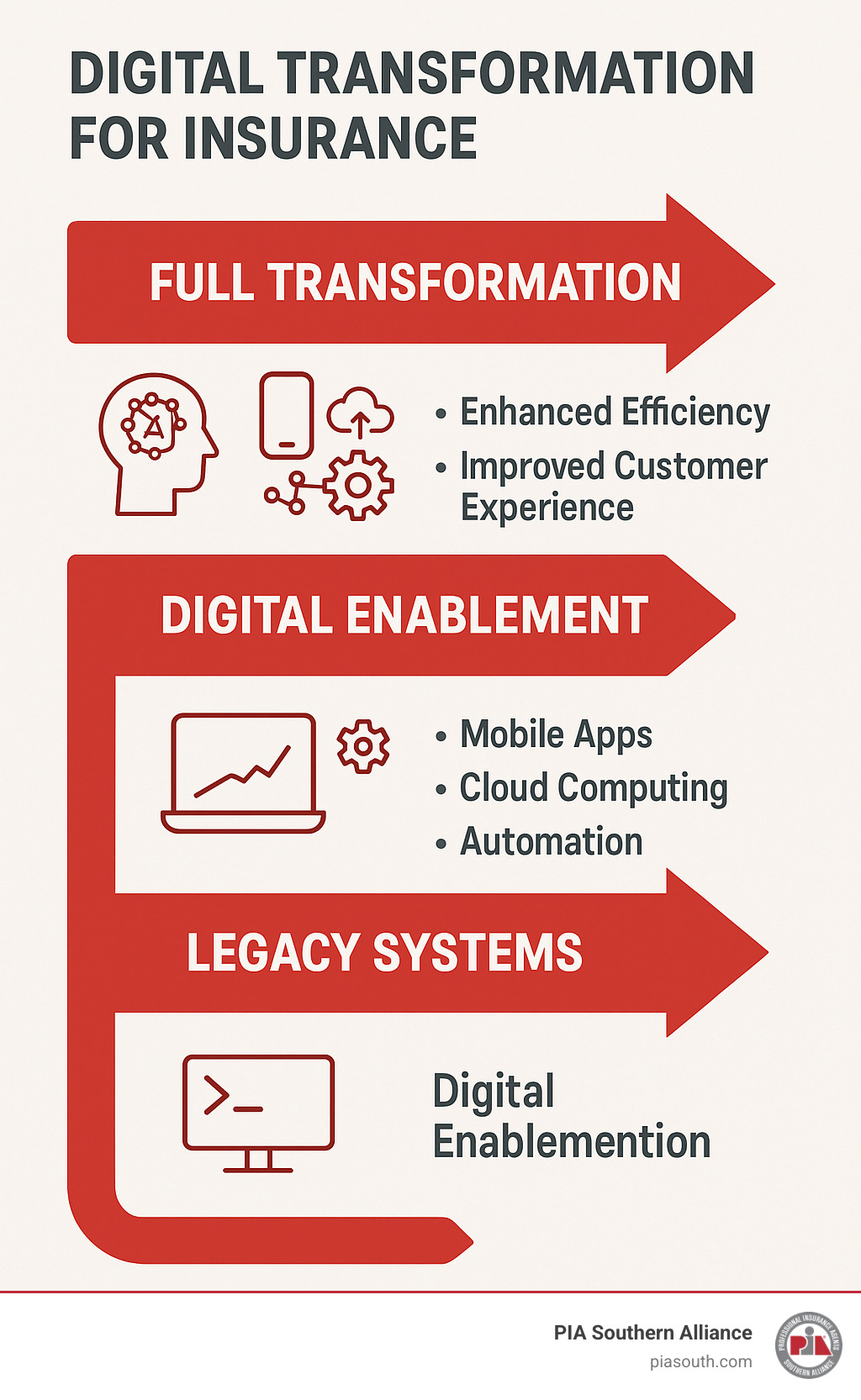
Digital change for insurance is the strategic integration of modern technologies across all aspects of the insurance value chain to improve operational efficiency, improve customer experience, and drive business growth.
For independent agents seeking to remain competitive in today’s market:
| Key Component | What It Involves | Business Impact |
|---|---|---|
| Customer Experience | Self-service portals, mobile apps, omnichannel communication | 24/7 service capability, increased retention |
| Claims Processing | AI-driven assessment, automated payouts | 30% reduction in processing time, lower costs |
| Underwriting | Machine learning algorithms, predictive analytics | More accurate pricing, reduced risk |
| Operations | RPA (Robotic Process Automation), cloud solutions | 25% increased efficiency, reduced manual errors |
| Data Analytics | Real-time insights, personalized offerings | Improved cross-selling, proactive risk management |
The insurance industry has traditionally been slow to innovate, but that’s changing rapidly. With 90% of insurance executives now having coherent, long-term technology innovation plans in place, digital change has become a necessity rather than an option.
“The companies that are going to win are the ones that are going to deliver speed and an exceptional customer experience,” notes a study from Whatfix, highlighting how today’s mobile-savvy policyholders expect seamless digital experiences.
For independent agencies across Georgia, Alabama, and Mississippi, this shift presents both challenges and opportunities. Legacy systems, skill gaps, and change management problems may seem daunting, but the rewards—improved efficiency, personalized customer experiences, scalability, and increased agility—far outweigh the initial investment.
As an organization dedicated to protecting and empowering independent agents, PIA Southern Alliance provides the resources and guidance you need to steer this digital journey successfully, ensuring you can focus on what matters most: protecting your clients and communities through digital change for insurance.
What You’ll Learn
This comprehensive guide will walk you through the essentials of digital change in the insurance industry, with a special focus on how independent P&C agencies in Georgia, Alabama, and Mississippi can leverage technology to thrive in today’s market. We’ll cover:
- Why digital change is no longer optional for insurance agencies
- Key technologies reshaping every aspect of the insurance value chain
- Practical strategies for overcoming common implementation challenges
- How to measure ROI and demonstrate value early in your digital journey
- A 5-step roadmap customized for independent agencies in our region
- Future trends that will continue to reshape the industry
Why Digital Change for Insurance Is Critical Now
The insurance landscape is shifting beneath our feet. In our conversations with agencies across Georgia, Alabama, and Mississippi, we’re hearing the same thing: digital change for insurance isn’t just a buzzword anymore—it’s survival.
Recent research confirms what many of us already sense: three-quarters of insurers believe that the new customer behaviors we’re seeing aren’t temporary pandemic adjustments but permanent changes in how people want to buy, use, and interact with insurance services.

Why is this happening now? Several powerful forces are converging:
Your clients have changed. Today’s policyholders compare their insurance experience not just to other agencies but to Amazon, Netflix, and DoorDash. When they can order dinner with three taps on their phone, they’re increasingly frustrated with insurance processes that require paperwork and waiting.
Meanwhile, those nimble InsurTech startups don’t have decades of legacy systems weighing them down. They’re building digital-first solutions that appeal particularly to younger customers who will simply “vote with their feet” if traditional agencies don’t step up their digital game.
The dollars and cents make sense too. Manual processes aren’t just slower—they’re significantly more expensive. Many agencies are finding that digital change for insurance can reduce processing costs by up to 30% while actually improving accuracy.
COVID-19 didn’t create these trends, but it certainly poured gasoline on the fire. When face-to-face meetings suddenly became impossible, agencies with digital capabilities thrived while others struggled to adapt. Even as in-person interaction has returned, customer preferences for digital convenience have remained.
Finally, keeping up with changing regulatory requirements becomes far more manageable with digital systems that can adapt quickly and maintain thorough audit trails.
Defining Digital Change for Insurance
When we talk about digital change for insurance, we’re describing something far more profound than just putting PDF forms online or adding a basic customer portal.
True digital change means reimagining the entire insurance experience from the ground up. It’s about creating an end-to-end digital journey where every touchpoint—from that first quote to the final claim payment—leverages modern technology to be faster, easier, and more personalized.
At its heart, this change encompasses several key elements:
Making every process digital-enabled and customer-friendly. Using data and analytics to drive smarter decisions about pricing, risk, and customer engagement. Creating seamless experiences across all channels—whether your client contacts you through your website, mobile app, phone call, or walks into your office. Implementing intelligent automation for routine tasks so your team can focus on what humans do best: building relationships and solving complex problems.
Perhaps most importantly, digital change for insurance requires a cultural shift. As one industry leader put it, “Insurance companies are evolving from technology users to technology companies that deliver insurance.” That mindset change can be the biggest hurdle of all.
COVID-19 and Market Forces Driving Digital Change for Insurance
The pandemic served as a wake-up call for many agencies. When in-person interactions suddenly vanished, the industry had to innovate rapidly:
Claims adjusters learned to assess damage through policyholder photos and videos instead of site visits. Agents developed virtual sales processes to quote, bind, and issue policies without meeting clients face-to-face. Electronic signatures and digital document delivery became the norm rather than the exception.
These changes weren’t just temporary fixes—they revealed better ways of working. A PwC study found that five out of six insurers now expect AI to become core to their service delivery within the next 3-5 years, a trend that accelerated dramatically during COVID-19.
For independent P&C agencies across Georgia, Alabama, and Mississippi, this doesn’t mean you need to transform everything overnight. Strategic, incremental changes can yield significant benefits. The key is to start moving now rather than waiting for the perfect moment.
The good news? At PIA Southern Alliance, we’re seeing member agencies that accept digital change for insurance not only surviving but thriving—winning new business, improving retention, and actually strengthening those personal relationships that have always been the heart of independent insurance.
Tech & Operational Impact: From Claims to Customer Portals
Digital change for insurance is changing every corner of the insurance world, creating new possibilities that were unimaginable just a few years ago. For independent agents across Georgia, Alabama, and Mississippi, these technologies aren’t just buzzwords—they’re practical tools reshaping how we serve our clients.

Claims & FNOL Revolution
Remember when claims processing meant mountains of paperwork and weeks of waiting? Those days are rapidly disappearing. Today’s digital claims revolution is bringing speed and transparency to what was once the most frustrating part of the insurance experience.
AI-powered image analytics now allows systems to “see” vehicle or property damage through uploaded photos and instantly estimate repair costs. In one remarkable case, an AI chatbot processed an entire claim in just three seconds—from filing to payout! That’s not science fiction; it’s happening right now.
Mobile FNOL submission has become a game-changer for policyholders across our southern states. Instead of playing phone tag with adjusters, your clients can now report claims via smartphone apps while standing right at the scene of an accident or damage. Industry data shows this approach can shave 1-15 days off claims processing time—a difference your clients will definitely notice and appreciate.
For simpler claims, straight-through processing allows automatic assessment and payment without human intervention. One British insurer implemented robotic process automation across 70+ processes and saved £7.5M annually. These tools don’t just cut costs—they dramatically improve customer satisfaction by providing instant updates rather than leaving clients wondering where their claim stands.
Looking to deepen your understanding of these innovations? Learn more about Automated Insurance Claims Processing on our dedicated resource page.
Bionic Underwriting & Pricing
We’re entering the era of “bionic underwriting”—where human expertise combines with machine intelligence to create something more powerful than either could achieve alone.
Automated risk assessment algorithms now analyze mountains of data in seconds, evaluating risk factors more comprehensively than even the most experienced underwriter could manage alone. For independent agents in weather-prone areas of Georgia, Alabama, and Mississippi, these tools can be particularly valuable in assessing regional risks like flood, hurricane, or tornado exposure.
Predictive modeling has transformed from a nice-to-have into a competitive necessity. Machine learning models identify patterns in historical data that humans might miss, leading to more accurate pricing and fewer surprises down the road. For your agency, this means being able to offer clients rates that truly reflect their individual risk profiles.
Real-time pricing systems generate personalized quotes instantly, moving us away from the broad category pricing of the past. And with telematics and IoT devices, we’re now using actual behavior data rather than just demographics. Auto insurers across our region are using GPS trackers to reward safe drivers with lower premiums—a win-win for both carriers and clients.
Servicing & Retention via Portals
Customer service has undergone perhaps the most visible change. Today’s policyholders expect the same digital convenience from their insurance that they get from their banking or shopping experiences.
Policyholder portals have become essential, not optional. These online platforms allow customers to view policy details, make payments, and request changes without calling an agent. Research shows that 74% of insurers now offer mobile apps for policy management—and the remaining 26% are quickly falling behind consumer expectations.
AI-powered chatbots and virtual assistants now handle routine customer inquiries around the clock, maintaining impressive resolution rates above 90%. This 24/7 availability means your clients get answers even outside business hours, while freeing your staff to focus on more complex client needs.
Data analytics enable highly targeted communications based on customer preferences and life events. Instead of generic renewal notices, imagine sending personalized messages that acknowledge a client’s specific situation. For agencies looking to improve their client management approach, our Insurance Client Management System resources provide valuable guidance.
The stakes are high—one study found that 80% of customers would consider switching providers if a policyholder portal wasn’t available. For independent agencies across our southern states, offering these digital service options isn’t just about staying current—it’s essential for client retention.

Want to explore how automation can transform your agency’s operations? Visit our comprehensive guide to Insurance Agency Automation Systems to learn practical next steps custom for independent agencies in our region.
Conquering Challenges & Measuring ROI
The road to digital change for insurance is paved with both opportunities and obstacles. While the destination is promising, the journey itself requires careful navigation through common challenges that many agencies in Georgia, Alabama, and Mississippi encounter along the way.
Bridging the Skills Divide
Let’s face it – insurance professionals are experts at assessing risk and serving clients, but many weren’t trained for our increasingly digital world. This skills gap represents one of the biggest problems to digital adoption.
“We know insurance inside and out, but this tech stuff feels like learning a new language,” as one agency owner in Alabama recently shared with us. This sentiment echoes throughout our industry.
To successfully bridge this divide, agencies need a multi-faceted approach. Start by investing in targeted training that focuses on practical digital skills relevant to specific roles. Your claims team needs different digital competencies than your producers do. The good news? You don’t need to transform everyone into IT experts overnight.
Fostering a digital mindset matters just as much as specific technical skills. Create an environment where curiosity and experimentation are rewarded, not punished. When team members feel safe trying new digital approaches, innovation flourishes naturally.
Digital adoption platforms (DAPs) have proven particularly effective for insurance agencies. These tools provide in-app guidance that teaches staff how to use new systems while they’re actually doing their work – no separate training sessions required. One agency in Mississippi reported that their team became proficient with a new client management system in half the expected time using this approach.
When bringing new talent onboard, look for candidates with both insurance knowledge and digital aptitude. A background in risk management provides an excellent foundation that can be improved with digital skills training. These “bilingual” team members who speak both insurance and technology often become your most valuable digital champions.
Proving Value Early
Digital initiatives can sometimes feel like planting trees – you invest today for fruit you’ll harvest years from now. But agency principals and staff need to see results sooner to maintain enthusiasm and justify continued investment.
The secret to sustaining momentum? Quick wins that demonstrate tangible value.
Start with what industry experts call “low-hanging fruit” – processes that cause significant pain but are relatively straightforward to digitize. For many agencies in our region, document signing and policy delivery make excellent starting points. One Georgia agency reported that implementing electronic signatures reduced their policy issuance time from three days to just 20 minutes – a win that immediately resonated with both staff and clients.
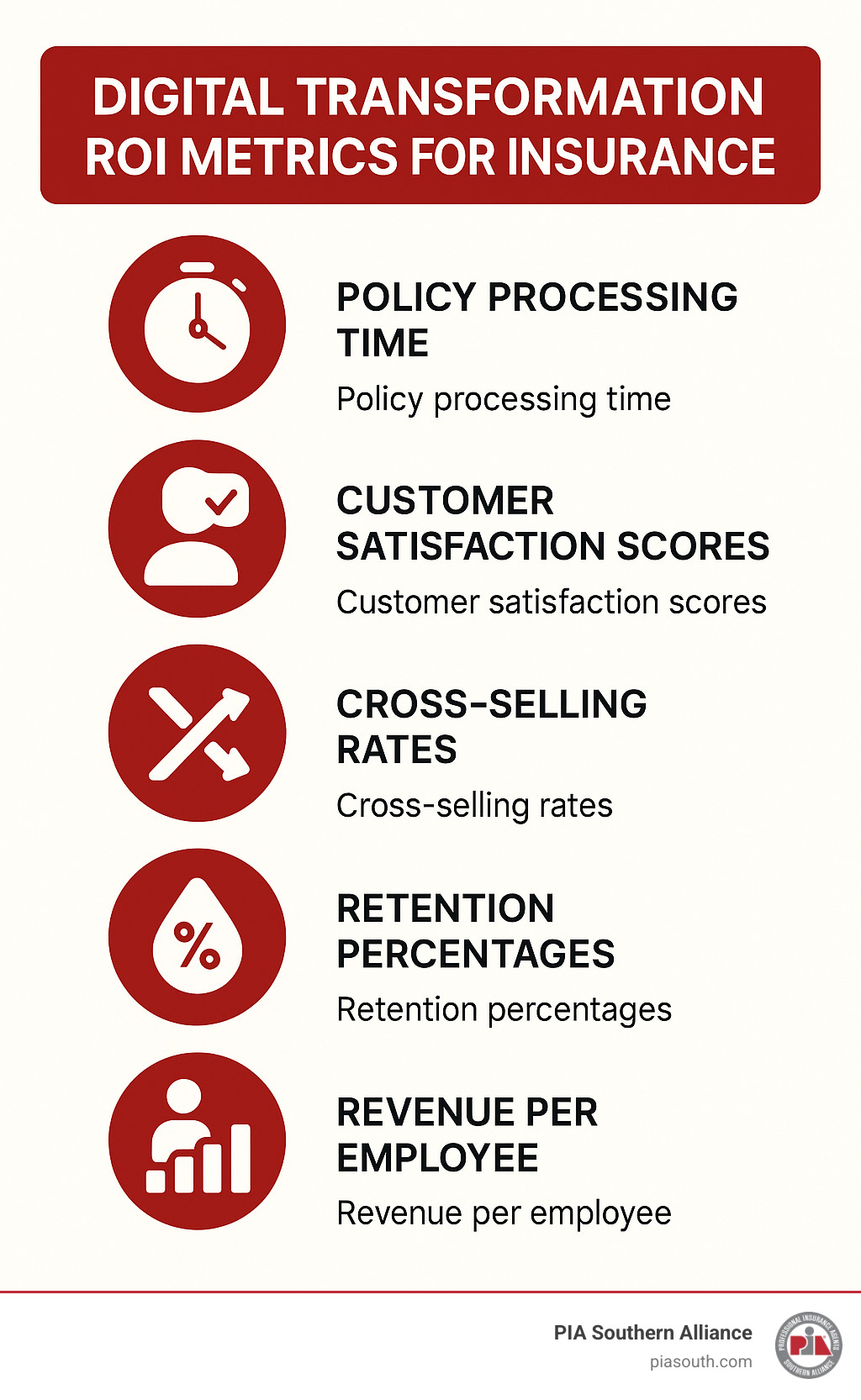
Measuring and communicating results is crucial. Define clear metrics that matter to your agency, whether that’s processing time reduction, error rate decreases, improved customer satisfaction scores, or direct cost savings. Share these wins widely and celebrate them within your team.
Some of the most valuable improvements aren’t easily quantifiable in dollars and cents. A streamlined application process might not directly reduce costs but could significantly boost your conversion rates. One Alabama agency found that their online quote request form, while a modest investment, increased qualified leads by 35% in just three months.
For independent agencies across our three-state region, early digital wins often include:
- Automated renewal reminders that have improved retention rates by 15-20%
- Client self-service portals that reduce routine phone calls by up to 40%
- Digital document management that eliminates filing cabinets and makes information instantly accessible
These tangible improvements build confidence and create momentum for more ambitious digital initiatives. As one agency owner in Mississippi put it, “Once we saw how much time electronic signatures saved us, we started looking for other processes we could improve.”
PIA Southern Alliance offers specialized resources to help agencies in Georgia, Alabama, and Mississippi identify their best opportunities for early digital wins, ensuring your digital change for insurance journey builds momentum from day one.
Future Trends & Partnership Ecosystem
The pace of innovation in insurance technology continues to accelerate. Understanding emerging trends is crucial for making forward-looking investment decisions that won’t quickly become obsolete.

Collaborating for Speed
One of the most significant shifts in digital change for insurance is the move from building everything in-house to forming strategic partnerships that accelerate innovation.
Remember when agencies tried to create their own customer portals from scratch? Those days are rapidly disappearing. Today’s successful agencies in Georgia, Alabama, and Mississippi are becoming masters of collaboration instead.
“We spent six months trying to build our own digital quote system before realizing we could implement a partner solution in weeks, not months,” shares one agency owner in Montgomery. “The time and cost savings were incredible, and the finished product was far better than what we could have created ourselves.”
These partnerships take several forms:
InsurTech collaborations have transformed from competitive threats to powerful allies. Rather than viewing startups as disruptors, forward-thinking agencies are leveraging their specialized technologies to improve specific capabilities without rebuilding the wheel.
Banking integration creates seamless financial ecosystems that customers increasingly expect. When your clients can manage their insurance alongside their banking in one unified experience, retention rates typically improve by 15-20%.
API-driven ecosystems allow different systems to communicate smoothly, creating flexible technology stacks rather than clunky all-in-one platforms. One Mississippi agency integrated their management system with carrier APIs and saw quote turnaround times drop from days to minutes.
SaaS adoption enables even small agencies to implement enterprise-grade capabilities without major capital investments. With 61% of insurers citing digital change for insurance as their primary driver for SaaS adoption, this trend shows no signs of slowing.
For independent agencies across our southern states, these partnerships provide access to sophisticated technology that would otherwise be unattainable. By thoughtfully connecting carrier portals, agency management systems, and specialized tools, even small local agencies can deliver experiences that rival the national direct writers.
Data Ethics & Security Frontier
As we collect and analyze more data, the ethical considerations become just as important as the technological ones.
Data privacy regulations continue to evolve, requiring thoughtful governance approaches. Agencies operating in Georgia, Alabama, and Mississippi must steer both federal and state-specific requirements while still delivering personalized service. Finding that balance between knowing your customers well and respecting their privacy isn’t just good ethics—it’s good business.
Algorithmic fairness matters deeply, especially in underwriting and pricing. AI-driven systems must avoid unintentional bias or discrimination. This is particularly important across our diverse southern states, where ensuring fair treatment across different communities builds trust and strengthens relationships.
“We’re seeing carriers invest heavily in explainable AI,” notes a recent industry report from Deloitte. “The ability to clearly explain how an algorithm reached a pricing decision is becoming essential for regulatory compliance and customer trust.”
Cybersecurity concerns grow more pressing as operations become increasingly digital. The average cost of a data breach in the insurance sector now exceeds $5.8 million, making robust protection not just a technical issue but a business survival requirement. Zero-trust security models and continuous monitoring are becoming standard practice for agencies of all sizes.
For forward-looking agencies, these ethical considerations aren’t constraints—they’re opportunities to differentiate. Clients increasingly want to work with agencies that handle their data responsibly and make fair, transparent decisions.
Industry forecasts suggest that AI and data analytics will capture approximately half of the insurance industry’s digital investment budget over the next three years. Agencies that thoughtfully address these ethical and security considerations now will be better positioned to leverage these powerful technologies as they continue to evolve.
The generative AI revolution is just beginning to reshape insurance. Early adopters in our region are already using these tools to draft policy summaries, create personalized client communications, and analyze complex coverage needs—all while maintaining the human touch that independent agents are known for.
As your trusted partner, PIA Southern Alliance is committed to helping independent agencies steer this evolving technological landscape with confidence, ensuring you can harness these innovations while staying true to your values and the communities you serve.
5-Step Roadmap for P&C Agencies in GA, AL & MS
Let’s face it—implementing digital change for insurance can feel like trying to renovate your house while still living in it. Especially for independent agencies across Georgia, Alabama, and Mississippi, where relationships and personal service have always been your competitive edge, going digital might seem daunting. But don’t worry—we’ve created a practical roadmap that breaks this journey into manageable steps custom specifically for your agency.
Step 1: Audit & Prioritize Processes
Before investing a single dollar in new technology, take time to understand what’s actually happening in your agency right now:
Roll up your sleeves and map out how work really flows through your office. Where do your team members spend most of their time? Where do clients express frustration? One agency in Mississippi finded their producers were spending 40% of their time on administrative tasks rather than selling—a revelation that immediately highlighted where digital tools could make the biggest impact.
Remember the 80/20 rule—focus on the 20% of your processes that create 80% of your headaches (or opportunities). For many agencies across our region, these pain points include certificate issuance for commercial clients, disaster response capabilities for coastal property owners, and providing service to rural clients who can’t easily visit your office.
The most successful digital initiatives start with honest conversations. Talk to your CSRs, producers, and most importantly, your clients about what’s working and what isn’t. Their insights will be invaluable in prioritizing your digital investments.
Step 2: Build the Business Case for Digital Change for Insurance
Now that you know where to focus, it’s time to make the financial case for change:
Put real numbers behind your current processes. How many hours does your team spend manually entering data that could be automated? What’s the true cost of a paper-based renewal process? One Georgia agency finded they were spending over $30,000 annually just in staff time handling routine endorsements that could be largely automated.
Next, estimate the potential benefits. Industry benchmarks suggest that digital change for insurance can reduce claims processing costs by up to 30% and improve customer retention by 15-20%. What would those improvements mean for your agency’s bottom line?
Create a simple spreadsheet showing expected costs against projected benefits. This doesn’t need to be complicated—even basic projections help guide decision-making and secure buy-in from stakeholders. For specific help with ROI calculations custom to agencies in our region, PIA Southern Alliance offers members access to benchmarking data and calculation tools through our Insurance Agency Performance Metrics resources.
Step 3: Select Core Platforms & Partners
With your strategy and business case in place, it’s time to choose the technology that will power your digital agency:
Your Agency Management System (AMS) should serve as the central nervous system of your digital operations. Look for systems with strong API capabilities that can easily connect with your carriers and other tools. Many agencies in Alabama have found success with cloud-based systems that allow producers to access client information while meeting with customers at their businesses or homes.
Consider whether your current document management approach is holding you back. Moving from paper files to secure digital documents not only improves efficiency but enables your team to work remotely when needed—a capability that proved invaluable during recent hurricane seasons across our region.
A client portal or mobile app can dramatically reduce routine service calls while improving customer satisfaction. Mississippi agencies report that clients particularly value the ability to access ID cards and make payments through their phones.
When evaluating technology vendors, look beyond the flashy demos to understand:
– Their experience with agencies of your size and lines of business
– Integration capabilities with your regional carriers
– The quality of implementation support and training
– Their track record of ongoing improvements
For comprehensive guidance on selecting the right technology for your agency, explore our resources on Insurance Agency Client Management Software and Insurance Agency Automation Systems.
Step 4: Train, Test, Iterate
Even the best technology will fail without proper implementation and user adoption:
Start small with a pilot program. One Georgia agency began their digital journey by focusing solely on personal auto policies before expanding to other lines. This allowed them to work out kinks in their process with minimal disruption to the overall business.
Invest in proper training that goes beyond basic functionality to show how these tools support your specific workflows. Digital Adoption Platforms (DAPs) can provide in-app guidance, helping your team learn while doing their actual work. According to case studies, these tools can reduce training time by up to 40%.
Create a safe space for your team to practice using new systems without fear of making mistakes that affect real clients. This “sandbox” approach builds confidence and identifies potential issues before they impact your business.
Schedule regular check-ins with users to identify pain points and opportunities for improvement. Make adjustments based on this feedback before expanding to the full agency. The most successful digital implementations are those that evolve based on real-world usage.
Step 5: Scale & Measure
As your digital initiatives prove successful, expand them across your agency while establishing metrics to measure ongoing performance:
Digital change for insurance should deliver measurable improvements to your business. Track metrics that matter, such as policy processing time, customer satisfaction scores, cross-selling rates, and revenue per employee. One Alabama agency saw their policy processing time drop from 3 days to just 4 hours after implementing digital workflows—a change that directly improved their bottom line.
Establish clear ownership for ongoing system management and support. Digital tools require care and feeding—designate someone in your agency to be responsible for system maintenance, updates, and training new staff.
Create a rhythm of regular reviews to identify opportunities for optimization and expansion. Technology is constantly evolving, and the most successful agencies stay current with new capabilities that can further improve their operations.
Stay vigilant about compliance with regulations specific to Georgia, Alabama, and Mississippi, particularly regarding data security and privacy. Digital processes must meet all state insurance department requirements.
Digital change isn’t a one-time project but an ongoing journey. The independent agencies thriving across our region are those that view technology as a core part of their business strategy, continually evolving to meet changing market needs and customer expectations.
Frequently Asked Questions about Digital Change for Insurance
What Technologies Deliver the Fastest ROI?
When it comes to digital change for insurance, not all technologies deliver equal returns. From our experience working with agencies across Georgia, Alabama, and Mississippi, certain solutions consistently provide quicker payback:
Robotic Process Automation (RPA) often delivers the fastest returns by tackling those mind-numbing repetitive tasks that drain your team’s energy. Imagine eliminating hours of data entry, certificate issuance, and policy checking! One British insurer saved a remarkable £7.5M annually by automating just 70 processes with RPA. That’s money going straight back to the bottom line.
Electronic signatures might seem simple, but they’re transformative for independent agencies, especially in our region’s rural areas. When clients can sign documents from their phone while sitting at their kitchen table in rural Mississippi rather than driving an hour to your office, everyone wins. Policy binding that once took days now happens in minutes.
The claims process is another area ripe for quick returns. AI-assisted claims processing using smartphone photos and videos can dramatically cut adjustment times. Picture this: a client has a fender bender, snaps photos at the scene, and receives an estimate before they even leave the parking lot. Industry data shows AI-driven claims settlement can be up to 10 times faster than traditional methods.
Lastly, don’t underestimate the power of client self-service portals. When clients can handle routine transactions themselves, your staff can focus on more valuable activities like cross-selling and relationship building. Research reveals a startling fact: 80% of customers considered switching providers simply because a self-service portal wasn’t available. That’s retention dollars walking out the door!
The secret to fast ROI isn’t tackling everything at once. Start with focused solutions addressing your biggest pain points, then build from there.
How Can Small P&C Agencies Tackle Legacy Systems?
Legacy systems can feel like anchors dragging down your digital ambitions, especially for smaller independent agencies. But there’s good news – you don’t need a massive IT budget to make meaningful progress.
Take a phased approach instead of attempting a complete overhaul. Think of it as remodeling your house room by room rather than demolishing and rebuilding. Prioritize systems based on their business impact and how outdated they’ve become. As one industry expert wisely puts it, “Modernize legacy infrastructure in incremental phases to avoid disruption.”
Cloud migration offers perhaps the most accessible path forward for agencies in Georgia, Alabama, and Mississippi. Cloud-based solutions eliminate expensive on-premises hardware while offering better security and integration capabilities than you could likely afford on your own. One agency reported a 25% reduction in technology costs after moving to the cloud, while gaining the ability for staff to work remotely – a game-changer during storm season in our coastal areas.
Don’t overlook what’s already available to you. Leverage carrier portals to their fullest extent. Many carriers have invested millions in digital capabilities they offer at no additional cost to their agency partners. These can serve as digital stepping stones while you build your own infrastructure.
When systems simply can’t talk to each other, consider middleware solutions that can bridge old and new technologies. These integration platforms can breathe new life into legacy systems while you transition at your own pace.
Above all, start with your data. Even before replacing systems, focus on cleaning and organizing your client information. Well-organized data will make future migrations dramatically smoother and more successful.
PIA Southern Alliance offers technology assessment tools and vendor evaluation resources specifically designed for independent agencies in our three-state region. You don’t have to steer these decisions alone.
What KPIs Prove a Successful Digital Change for Insurance?
Measuring the impact of your digital change for insurance initiatives requires tracking both operational improvements and customer experience gains. The right metrics will help you demonstrate ROI and guide ongoing refinements.
On the operational side, Straight-Through Processing (STP) Rate reveals how many transactions complete without human intervention. When your agency achieves STP rates above 70% for standard processes (as industry leaders do), you’ll feel the difference in your workday. Closely related is Cycle Time – how long it takes to complete key processes like policy issuance or claims settlement. Digital improvements typically slash these times by 30-50%, freeing your team for higher-value activities.
Your Expense Ratio (operating expenses as a percentage of written premium) should gradually decrease as digital efficiencies take hold. Meanwhile, Error Rates often plummet to near-zero for standardized processes, eliminating the frustration and rework that plague manual systems.
Customer metrics tell an equally important story. Net Promoter Score (NPS) measures client loyalty and satisfaction, with digital insurance leaders typically achieving scores 15-20 points higher than traditional competitors. That translates directly to referrals and growth. Customer Effort Score (CES) reveals how easy it is for clients to accomplish their goals – and in today’s world, “easy” wins the race every time.
Track your Digital Adoption Rate to see what percentage of customers are embracing your new tools. Low adoption might signal usability issues or the need for better client communication. The ultimate customer metric is your Retention Rate, which typically improves by 5-10 percentage points with effective digital engagement. In the P&C world, each point of retention goes straight to profitability.
Growth metrics complete the picture. Watch your Lead Conversion Rate to see how digital tools influence sales success. Your Cross-Selling Ratio (products per customer) should increase with better data and engagement. And Revenue per Employee provides a holistic view of productivity improvements.
For independent agencies in Georgia, Alabama, and Mississippi, we recommend starting with just 3-5 KPIs that align with your specific business goals. Trying to track everything at once creates more confusion than clarity. As your digital journey progresses, you can expand your measurement approach.
Conclusion
The digital revolution in insurance isn’t some distant future event—it’s happening right now, changing every aspect of how policies are sold, serviced, and experienced. For independent P&C agencies across Georgia, Alabama, and Mississippi, embracing digital change for insurance isn’t just about staying current—it’s about staying relevant and competitive in a rapidly evolving marketplace.
If the journey seems overwhelming, successful digital change doesn’t happen overnight. The agencies seeing the greatest success are taking thoughtful, incremental steps, prioritizing the changes that deliver the most immediate value to both their operations and their clients.
Think of digital change as enhancing rather than replacing the human touch that makes independent agencies special. When routine tasks are automated, you and your team can focus more energy on the consultative, advisory role that truly differentiates you from direct writers and digital-only competitors. After all, technology alone can’t build the trust and community connections that independent agents have cultivated for generations.
PIA Southern Alliance stands ready to support your digital journey with resources specifically designed for independent agents in our region:
- Educational programs that translate tech jargon into practical applications for P&C insurance
- Assessment tools to help you evaluate technology options against your specific business needs
- Hands-on training to build digital confidence across your entire team
- Advocacy efforts ensuring that regulatory frameworks promote innovation while protecting both agents and consumers
By blending your local expertise and personal relationships with the efficiency and convenience of digital tools, you create a powerful value proposition that neither traditional agencies nor digital-only competitors can match.
The insurance landscape is changing, but the core mission remains the same: helping people and businesses steer risk with confidence. Digital change for insurance simply gives you better tools to fulfill that mission, allowing you to serve more clients more effectively while maintaining the personal touch that matters most.
We invite you to explore our Insurance Agency Automation Systems resources as you continue your digital journey. Together, we’ll ensure that independent P&C agencies remain the trusted choice for insurance consumers throughout Georgia, Alabama, and Mississippi for generations to come.