
Customer service certification programs are formal training courses that arm your team with the skills to deliver outstanding client support, culminating in a professional credential. For an independent insurance agency, this isn't just an expense—it's a direct investment in your people, your client loyalty, and your bottom line.
Why Certification Is a Game-Changer for Insurance Agencies
In the world of insurance, where policies can look nearly identical on paper, exceptional service isn't just a nice-to-have. It's your agency's single greatest defense. That client experience is what decides whether a customer renews for a decade or walks away after one frustrating phone call.
This is precisely where formal customer service certification programs become a strategic necessity.
Think of it like the difference between a self-taught musician and one who is classically trained. Both might play the same song, but the trained musician brings a deep understanding of theory, timing, and emotion, creating a far richer and more memorable performance. In the same way, a certified service representative doesn't just answer questions; they de-escalate tough situations, uncover unstated needs, and build the kind of trust that turns a policyholder into a lifelong client.
Elevating Service From a Cost to a Competitive Advantage
Properly structured training turns your service team from reactive problem-solvers into proactive relationship managers. This is a critical shift, especially when you consider that U.S. businesses lose an astonishing $75 billion annually because of poor customer service. Investing in your team is a direct investment in keeping your agency from becoming part of that statistic.
Certification moves your team beyond just putting out fires. It equips them with a framework to create consistently positive, high-quality interactions. That consistency is the bedrock of client trust and long-term retention.
One of the most powerful advantages these programs instill is the ability to cultivate genuine Empathy in Customer Service. This isn't just about being polite; it's about teaching your team to truly understand the client's perspective, especially during a stressful claim or a complex billing issue. Connecting on that human level builds loyalty far more effectively than any ad campaign ever could.
A great example for independent agencies in Georgia, Alabama, and Mississippi is the training offered through PIA Southern Alliance. Programs like the highly-respected Certified Insurance Service Representative (CISR) designation give your team the specialized knowledge needed to excel. You can learn more about how the Certified Insurance Service Representative program can become a cornerstone of your agency's development.
Ultimately, this isn't just about soft skills. It’s about building a true operational advantage that strengthens client bonds, reduces costly errors, and drives sustainable growth for your agency.
The Business Impact of Certified vs Uncertified Service Teams
When you're weighing the investment, it helps to see the difference side-by-side. The contrast between a trained, certified team and an uncertified one shows up in nearly every key performance metric for an agency.
| Performance Area | Uncertified Service Team | Certified Service Team |
|---|---|---|
| Client Retention | Higher churn, often driven by inconsistent service experiences. | Significantly higher retention due to consistent, professional interactions. |
| E&O Risk | Increased risk from undocumented conversations and procedural errors. | Reduced risk through standardized processes and better documentation. |
| Upsell/Cross-Sell | Missed opportunities as focus is on closing tickets quickly. | Proactively identifies client needs, leading to more account-rounding. |
| Efficiency | Longer call times and more escalations to resolve issues. | Higher first-call resolution rates and improved operational efficiency. |
| Team Morale | Higher burnout and turnover from handling difficult situations without training. | Increased confidence, job satisfaction, and lower employee turnover. |
| Agency Reputation | Brand perception is inconsistent and vulnerable to negative reviews. | A reputation for excellence becomes a key market differentiator and referral driver. |
As the table makes clear, the impact of certification extends far beyond just "better service." It directly influences your agency's profitability, risk profile, and long-term stability. Investing in your team's skills is one of the highest-ROI decisions an agency owner can make.
The Four Pillars of Agency Growth Through Certification
When we talk about investing in customer service certification programs, we're not just talking about theory. We're talking about tangible results that strengthen an insurance agency from the ground up. Too many agency owners see training as a cost center. It's time to reframe that thinking. Think of it as building four critical pillars that support sustainable, profitable growth.
These pillars—client retention, risk reduction, compliance, and team performance—are what turn your service department into a true strategic asset.
A certified team just operates on a different level. They don't simply process requests; they build relationships and solve problems. Imagine a client calling with a complex, frustrating claim. An uncertified rep might give a technically correct but cold answer, leaving the client feeling like just another policy number. A certified professional, however, knows how to use empathy and advanced problem-solving skills to guide that client, turning a negative event into an experience that reinforces their decision to stay with your agency.
This is the path: you invest in your people, they become a proactive force, and your entire agency grows as a result.
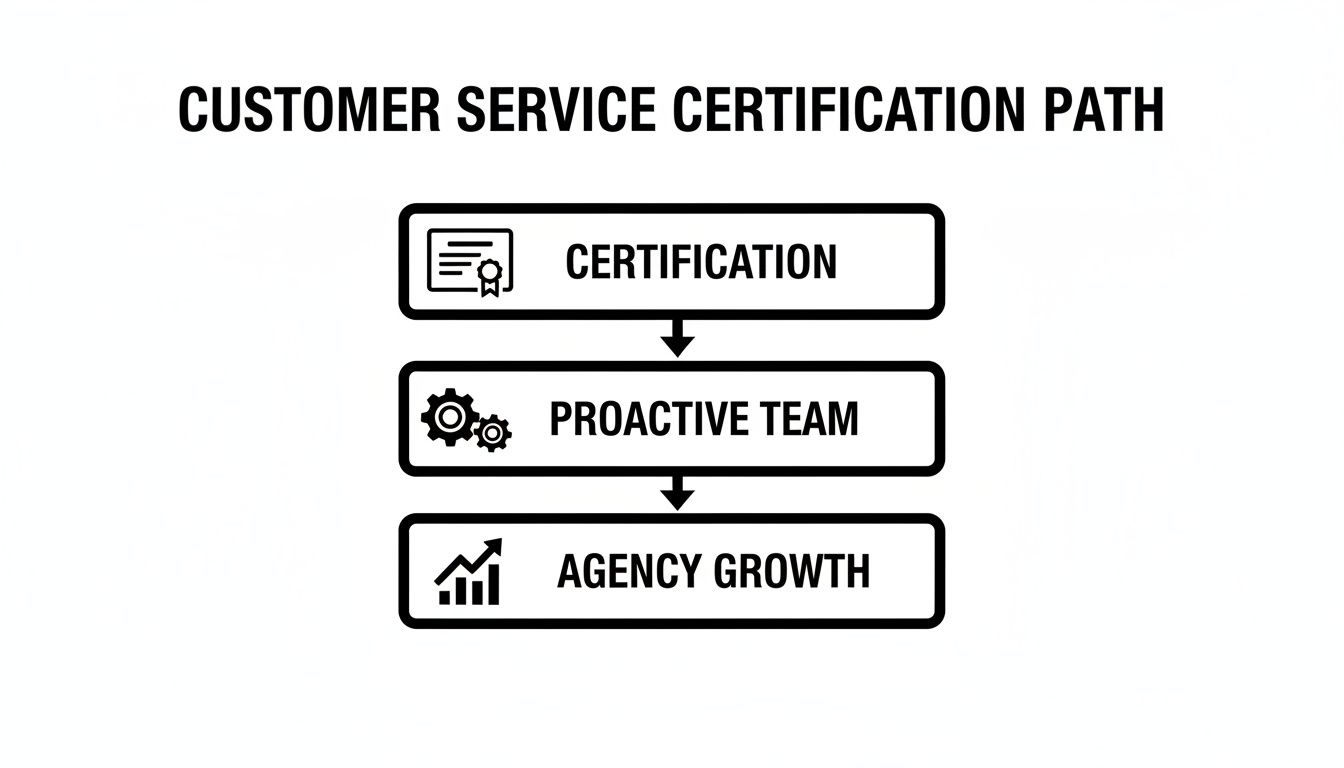
As you can see, professional development isn't just a "nice-to-have." It's the foundational first step toward building a high-performing team and hitting your long-term business goals.
Pillar 1: Ironclad Client Retention
We all know it costs far more to acquire a new client than to keep an existing one. Certification directly shores up your retention rate by standardizing what excellence looks like in your agency. When every single client interaction is handled with professionalism and deep policy knowledge, you build trust.
That kind of consistency means clients are far less likely to start shopping around at renewal. A certified team can create an experience so positive that leaving for a slightly lower premium becomes almost unthinkable.
Pillar 2: Bulletproof E&O Risk Reduction
Errors and Omissions (E&O) claims are every agency owner’s worst nightmare. So many of them spring from simple miscommunications or procedural slip-ups made by well-meaning but undertrained staff.
Certification programs drill down on the very things that prevent these mistakes:
- Proper Documentation: Creating a clear, consistent paper trail for every client interaction becomes second nature.
- Policy Language Mastery: Staff learn to truly understand the nuances of coverage, which helps them avoid misrepresenting policies.
- Adherence to Procedures: Everyone on the team follows the exact same compliant workflow for critical tasks like binding coverage or processing endorsements.
This intense focus on process and detail dramatically reduces the human error that so often leads to costly claims.
Pillar 3: Consistent Compliance
The insurance industry is governed by a tangled web of regulations that are constantly in flux. A formal certification program ensures your team is always up-to-date on the latest legal and ethical standards. This isn't just about dodging fines; it's about protecting your agency's reputation and its very license to operate.
A proactive approach to compliance, reinforced through regular training, is far more effective than reacting to a problem after the fact. Certification instills this proactive mindset across your entire service team.
Pillar 4: Measurable Service Team KPIs
Finally, you can't improve what you don't measure. One of the biggest wins from certification is that it provides a clear framework for setting up and tracking key performance indicators (KPIs) for your service team.
Once you implement a formal training program, you can start putting real numbers to your team's performance. You can track metrics like:
- First-call resolution rates
- Client satisfaction (CSAT) scores
- Number of cross-sell opportunities identified
- A reduction in client complaints over time
These metrics give you objective data to evaluate performance, reward your top people, and pinpoint areas for more coaching. It’s how you turn your service team from a cost center into a quantifiable engine for agency growth.
Finding the Right Certification for Your Agency's Toolkit
Not all customer service certification programs are the same. Picking the right one is a lot like stocking a mechanic's toolbox—you can't fix an engine with a tire iron. You need a mix of specialized tools and all-purpose gear to handle whatever rolls into the shop. Choosing wisely ensures your investment turns into real skills that bring immediate value to your agency.
The trick is to match the program to your agency's specific tech stack, client base, and growth plans. A one-size-fits-all approach just doesn't cut it. Instead, take a hard look at where your team needs the most support and find a certification that fills that exact gap.
Vendor-Specific Training
Often, the training with the most immediate impact comes straight from the vendors whose software you rely on every single day. Think about your Agency Management System (AMS) or other core platforms. These certifications are laser-focused on turning your team into power users of the tools they already have.
- Pros: The ROI is fast. You'll see a quick boost in efficiency and fewer user errors in your daily workflow. A CSR who has mastered every shortcut in your AMS can handle client requests faster and more accurately, period.
- Cons: The skills are tied to one specific piece of software. If you decide to switch vendors down the road, that certification loses a lot of its practical punch.
Industry-Focused Certifications
This next category is about building deep, lasting expertise. These are the broader, highly respected insurance designations that go way beyond software. They dive into the nitty-gritty of policy language, risk management principles, and professional ethics.
A perfect example is the Certified Insurance Service Representative (CISR) designation, which is truly a gold standard in our industry. It gives your staff the comprehensive knowledge they need to handle complex client situations with confidence and authority.
An industry certification transforms a CSR from someone who can process a request to a professional who can advise a client. That shift is absolutely critical for building long-term trust and elevating your agency's reputation.
These designations show a serious commitment to professionalism and are recognized across the industry. They become a valuable, long-term asset for your team members' careers and your agency's brand. In fact, many of the best classes for insurance agents fall into this category, offering a clear path to meaningful professional growth.
Skills-Based Programs
Finally, some programs are less about the technical details and more about the universal "soft skills" that define truly exceptional service. These certifications focus on the core human competencies that make all the difference in any client-facing role.
Key Skills-Based Topics Include:
- Empathy and Active Listening: Training your team to hear the emotion behind a client's words, not just the words themselves.
- De-escalation Techniques: Giving them a toolkit for calming frustrated clients and turning tough situations into positive resolutions.
- Advanced Problem-Solving: Teaching a structured way to break down complex issues and find solutions that actually work.
The beauty of these programs is their versatility. The skills they teach are valuable no matter what software you use or what policies you sell. A balanced approach—one that combines technical, industry, and skills-based training—is what creates a truly well-rounded service team ready to tackle any challenge that comes their way.
Navigating State CE Credits in Georgia, Alabama, and Mississippi
For independent agencies in the Southeast, a great customer service certification program can pull double duty. It’s not just about sharpening your team’s skills; the right program can also knock out mandatory state Continuing Education (CE) requirements. This is a huge win for managing license renewals efficiently.
But here’s the catch: not just any training course will count. Think of it like a prescription—it has to be exactly what the doctor, or in this case, the state’s Department of Insurance, has ordered. Each state plays by its own rulebook and has its own approval process.

A course that’s approved for CE credits in Georgia might be completely unrecognized in Alabama or Mississippi. It’s absolutely critical to verify that a program is officially sanctioned in every single state where your team members hold a license.
State-Specific Approval Is Non-Negotiable
If you pick a program that isn't approved, your team’s hard work won't count toward their license renewal. That forces them to spend extra time—and you to spend extra money—on duplicate training. It’s an expensive and frustrating mistake to make.
To avoid this headache, you must confirm a program's status directly with the state's Department of Insurance or through a provider you trust. This is where an organization like PIA Southern Alliance becomes an indispensable partner. They live and breathe this stuff, offering training that’s pre-approved and built for regional compliance.
By selecting state-sanctioned customer service training, you streamline compliance, save money, and ensure your investment directly supports both professional growth and mandatory licensing requirements. This turns a regulatory burden into a strategic advantage for your agency.
How PIA Southern Alliance Simplifies Compliance
Trying to navigate the CE landscape across Georgia, Alabama, and Mississippi can feel like a full-time job. PIA Southern Alliance cuts through the complexity. Because they have a deep understanding of the region's specific rules, their educational offerings and endorsed programs are designed from the ground up to meet these state mandates.
Benefits of using a regional partner for CE:
- Guaranteed Approval: You can be confident their courses are already vetted and qualify for CE credits in GA, AL, and MS.
- Simplified Tracking: They often help with reporting completed hours to the state boards, which takes a huge administrative task off your plate.
- Relevant Content: The training isn’t just compliant; it’s also highly relevant to the market challenges and opportunities you face every day in the Southeast.
When you work with a dedicated partner, you can stop worrying about compliance and focus on what matters: building a skilled team that’s ready for anything.
How to Choose the Right Certification Program for Your Team
So, you’re ready to invest in sharpening your team’s skills, but the sheer number of customer service certification programs out there feels a bit overwhelming. Where do you even start? The best way to think about it is like hiring a critical new team member—you have to do your homework to find the perfect fit, not just a fancy certificate to hang on the wall.
It’s crucial to look past the marketing hype. The right program will drive real, tangible performance improvements that show up on your agency’s bottom line. A poorly chosen one, on the other hand, just wastes time and money, leaving everyone frustrated. The goal is to find a curriculum that speaks directly to the day-to-day challenges your team faces in the insurance world.
This investment is becoming more important than ever. While a staggering 92% of contact centers have quality assurance programs, only 61% are actually effective at measuring all types of errors. That points to a massive training gap that the right certification can fill. You can read the full customer service statistical report on emapta.com to see just how big this gap is. A targeted program closes it for good.
Evaluate Curriculum Relevance
First things first: is the program actually relevant? A generic customer service course might teach some nice principles, but will it prepare your CSR for a tough conversation about a policy non-renewal or a complicated liability claim? Probably not. A program's real value comes from its direct application to the insurance industry.
Look for training that covers:
- Insurance-Specific Scenarios: The best programs use role-playing and case studies that mirror realistic client interactions, from explaining coverage limits to handling sticky billing questions.
- E&O Prevention Tactics: The curriculum must be built around documentation best practices and communication strategies that actively reduce your agency's errors and omissions risk.
- Compliance and Ethics: All content should be grounded in the regulatory landscape that governs independent insurance agencies in your state.
Think of the curriculum as a blueprint for your future client experience. If the plan doesn't include the specific challenges of your industry, the final structure will be weak and ineffective.
Assess the Delivery Format and Instructors
How the material is taught is just as important as what is taught. Think about your team’s learning style and what works with your agency's daily operations. Online, self-paced courses offer great flexibility, while live sessions—whether in-person or virtual—provide invaluable real-time interaction and networking.
Just as critical is the credibility of the instructors. Who’s leading the course? You want trainers with real-world insurance dirt under their fingernails—former agency owners, senior CSRs, or compliance officers. Their firsthand knowledge brings the material to life in a way a pure academic never could.
Measure the True Return on Investment
Finally, any program worth its salt should offer a clear return on your investment. Before you commit, ask how the certification will help you hit tangible business goals.
- Will it provide the necessary hours for state CE credits?
- Does it offer a pathway to a recognized industry designation like the CISR?
- Can its impact be measured through KPIs you already track, like client retention or first-call resolution rates?
This is where organizations like PIA Southern Alliance become invaluable. They vet programs specifically for agents in Georgia, Alabama, and Mississippi, making sure the training isn’t just high-quality but also regionally relevant and compliant. By leaning on their expertise, you can confidently pick a certification that builds lasting skills and truly strengthens your agency.
Putting Your Training Plan into Action
So, you’ve picked a great customer service certification program. That’s a huge step, but the real work starts now. Just signing your team up and hoping for the best won't cut it. The program’s value comes from how well you weave it into your agency's day-to-day operations.
Think of it like getting a new piece of high-tech farming equipment. It's useless if it just sits in the barn. You need a plan to get it into the field, teach everyone how to use it, and make it part of the regular workflow. This is about moving from a good idea to real, lasting change without grinding everything else to a halt.

Build Excitement and Get Everyone on Board
Your team’s buy-in is everything. Before a single module is opened, you need to sell them on the why. This isn’t a top-down mandate; it's a genuine investment in their careers that will make their jobs better and less stressful.
Explain how these new skills will give them more confidence on tough calls, cut down on frustrating, repetitive mistakes, and even open up paths for growth within the agency. When your CSRs see this as a tool for their own success, you get energized teammates, not just attendees. As you build out your strategy, it helps to look at different frontline employee training programs to see what structures work best.
Schedule Smart and Reinforce What They Learn
The way you schedule the training can make or break the whole effort. Don’t pull your entire service team off the phones at the same time—that’s a recipe for chaos. A staggered approach works well, as do self-paced online courses that let people learn during slower periods.
The most important part of any training happens after the class is over. New skills are like muscles; if you don't use them, they disappear. Real mastery only comes from applying what's learned in the real world, over and over again.
To make sure the knowledge sticks, you have to build it directly into your agency’s DNA.
- Practice with Realistic Scenarios: Use part of your team meetings for role-playing. Take actual client situations—the good, the bad, and the ugly—and work through them using the new techniques. This is how theory becomes instinct.
- Connect Training to Performance Reviews: Tie the certification goals to your performance reviews. Set clear, measurable targets, like improving your first-call resolution rate or boosting positive client feedback scores.
- Create a Peer Coaching System: Pair team members up to support each other. Having a colleague to gut-check a new approach or celebrate a win makes a huge difference in cementing new habits.
By following these steps, you’re not just holding a training session; you’re building a system for continuous improvement. For more ideas, check out our guide on how to improve customer service skills at your agency. This approach turns a one-off event into a permanent upgrade for your agency culture—one that drives real, measurable growth.
Common Questions About Customer Service Certifications
It's natural to have questions before you commit time and money to a new training initiative. Agency owners are right to be skeptical. Let's tackle some of the most common questions we hear about customer service certification programs so you can decide if they're the right fit for your team.
Are These Programs Worth the Cost for a Small Agency?
That's a fair question, especially when every dollar counts. For a smaller agency, the financial hit from losing just one key client or facing a single E&O claim can be a massive blow. Think of certification not as an expense, but as a strategic investment in protecting your agency and nurturing client loyalty.
But this isn't just about playing defense; it's about going on offense, too. A well-trained team is sharper at spotting cross-sell opportunities and better at retaining the business you already have, both of which feed your bottom line. Plus, programs offered through associations like PIA Southern Alliance are often priced specifically to be accessible for agencies of all sizes, making a positive ROI a very real goal.
How Do I Measure the ROI of Certification?
You need to know if your investment is actually working. The best way to track the return is to get a clear picture of where you are before the training starts. Establish a baseline, then keep a close eye on a few key metrics afterward.
Key indicators to track include:
- Client Retention Rate: This is the most direct measure of customer loyalty and satisfaction.
- Customer Satisfaction (CSAT) Scores: Use simple, quick surveys after a service interaction to see how you’re doing.
- Policy Errors & E&O Incidents: A drop here provides an immediate and direct financial benefit.
- Team Productivity: Are you seeing more issues resolved on the first call? Are fewer problems being escalated to management?
By tracking these tangible metrics, you can draw a straight line from your training investment to a healthier, more profitable agency. The numbers won't lie.
Do Experienced CSRs Really Need This Training?
Yes, even your most seasoned pros can get a lot out of it. Certification isn't just for bringing new hires up to speed. It’s a fantastic way to standardize your service level and promote ongoing professional growth for the whole team.
These programs introduce modern best practices, refresh everyone on forgotten compliance rules, and ensure every single client gets the same high-quality service, no matter who picks up the phone. More than anything, it sends a clear message to your experienced staff: you're invested in their careers. That alone is a powerful way to boost morale and keep your best people right where you need them.
Ready to build a more resilient and profitable agency? PIA Southern Alliance provides the training, resources, and E&O solutions you need to thrive. Explore our membership benefits and start your journey today at https://piasouth.com.