
Understanding the Path to Underwriting Excellence
Commercial insurance underwriting training is essential for anyone looking to build expertise in evaluating and pricing business risks. If you’re searching for information about becoming a commercial underwriter, here’s what you need to know:
Quick Guide to Commercial Insurance Underwriting Training:
* Time Investment: Most designation programs take 12-15 months
* Core Credentials: Associate in Commercial Underwriting (AU) is the industry standard
* Delivery Methods: 100% online options with virtual exams are now available
* Cost Range: Free employer-sponsored programs to $1,000+ for designations
* No Experience Required: Many programs accept candidates without prior insurance knowledge
Commercial underwriting is the backbone of the property and casualty insurance industry. It’s where calculated decisions about risk acceptance, pricing, and policy terms happen—decisions that directly impact both carrier profitability and business protection.
Why proper training matters:
- Underwriters make decisions that affect millions in premium dollars
- Well-trained underwriters build more profitable books of business
- Understanding risk evaluation protects both clients and carriers
- Technology is rapidly changing how underwriting decisions are made
According to the U.S. Bureau of Labor Statistics, insurance underwriters earn a median annual salary of $76,390, with approximately 8,400 job openings projected each year through 2031. However, the industry faces a troubling statistic: less than 1% of commercial insurance producers ever receive effective training in critical areas.
“There’s no better feeling than knowing you can dictate your own career moves. Having a professional designation gives you that much-needed advantage,” notes one CPCU-designated underwriter who completed formal training.
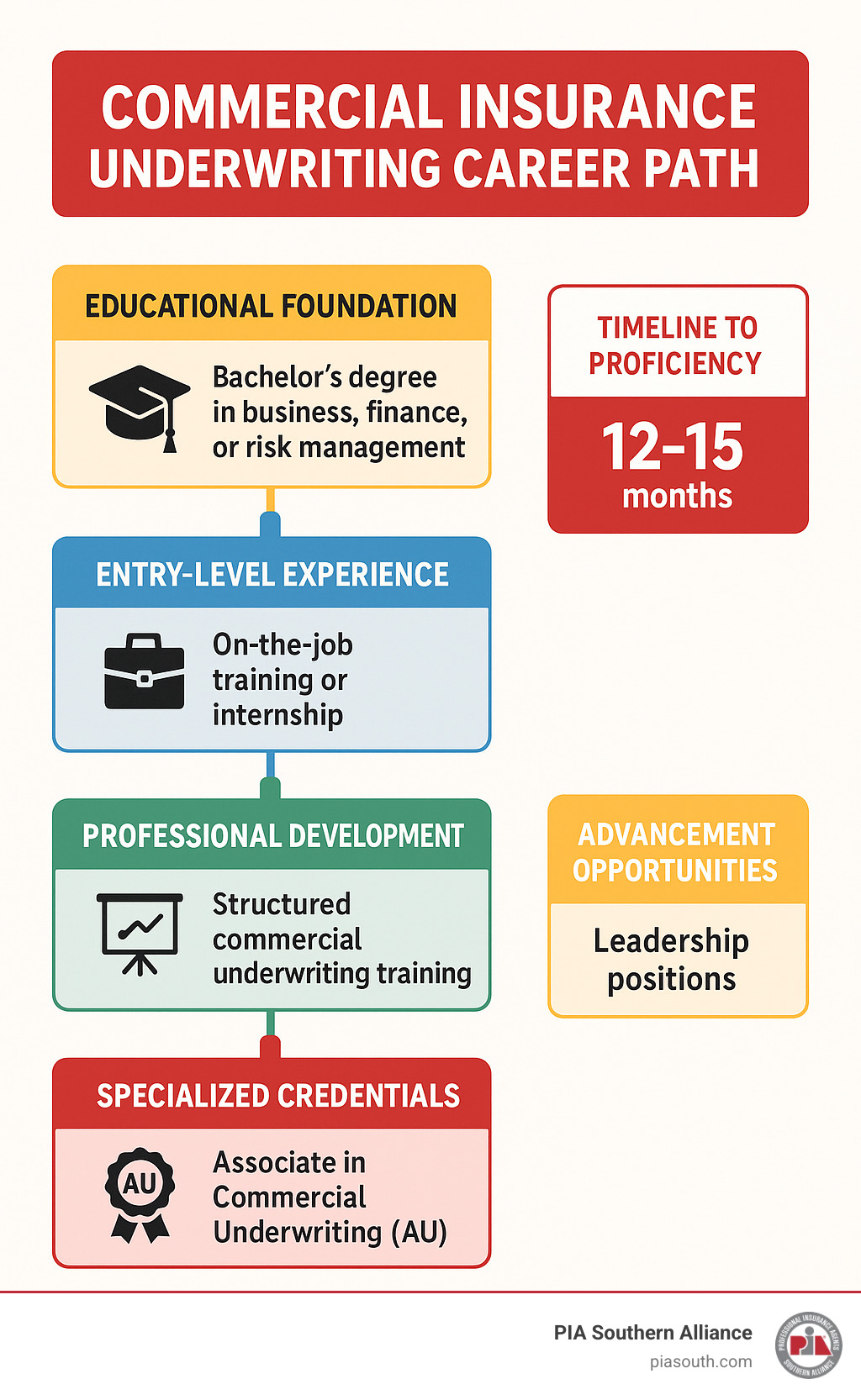
The path to becoming a commercial underwriter typically involves:
- Educational Foundation: Bachelor’s degree in business, finance, or risk management (preferred but not always required)
- Entry-Level Experience: On-the-job training or internship
- Professional Development: Structured commercial underwriting training
- Specialized Credentials: Industry designations like the AU (Associate in Commercial Underwriting)
PIA Southern Alliance supports independent agents throughout Georgia, Alabama, and Mississippi by providing access to quality commercial insurance underwriting training resources that promote the highest standards of professional practice.
What Is Commercial Insurance Underwriting & Why It Matters
Think of commercial insurance underwriting as the heartbeat of the insurance industry – it’s where careful analysis meets business intuition. At its core, underwriting is about making smart decisions on which business risks to accept, how to price them fairly, and what terms to offer.
Good underwriters wear many hats – part detective, part financial analyst, and part risk consultant. While they rely on data and actuarial tables, there’s also that special “sixth sense” that experienced underwriters develop after years in the field.
Commercial underwriting creates real value for everyone involved. It ensures local businesses in Georgia, Alabama, and Mississippi get protection custom to their unique needs. It keeps the insurance marketplace stable and functioning smoothly. It safeguards insurance carriers from taking on too many risky policies that could threaten their financial health. And perhaps most importantly, it creates fair pricing where businesses pay rates that actually match their risk level.
In today’s competitive business landscape, well-trained underwriters are absolutely essential. They’re the careful decision-makers who separate acceptable risks from those that simply don’t fit a carrier’s appetite. Without this expertise, we’d quickly see insurance markets become either unprofitable or completely inaccessible to many business owners.
The economic impact of quality underwriting is substantial – proper risk assessment helps keep regional economies resilient by ensuring businesses can recover from unexpected losses without devastating financial consequences.
The Property-Casualty Lens
Commercial property and casualty (P&C) underwriting is a whole different animal compared to life or health insurance. P&C underwriters need to understand the nuts and bolts of diverse business operations and the physical assets they’re protecting.
Commercial property underwriting requires evaluating buildings based on their construction type, who occupies them, what protection systems are in place, and external risk factors (often called COPE analysis). An underwriter needs to know why a brick building in downtown Atlanta might present different risks than a wood-frame structure in coastal Mississippi.
General liability underwriting digs into how a business operates, what products they make or sell, what happens after their work is completed, and risks associated with their physical premises. The liability profile of a small restaurant in Birmingham looks completely different from a manufacturing plant in rural Georgia.
Workers comp underwriting examines workplace safety protocols, properly classifies employees by risk level, and reviews past claims history to predict future losses.
“When you’re building a profitable book of business, there’s no substitute for disciplined underwriting,” as one veteran underwriter with 15+ years of experience told us. “The right commercial insurance underwriting training gives you a systematic framework for evaluating risks that others might miss.”
Underwriting & the Local Market
The southeastern states of Georgia, Alabama, and Mississippi present unique underwriting challenges that require specialized knowledge of regional risks and business patterns.
Coastal wind exposure is a major consideration for properties along the Gulf Coast and Atlantic seaboard. Underwriters need to understand hurricane and tropical storm patterns that can dramatically affect policy terms and pricing. A commercial building in coastal Mississippi requires a completely different underwriting approach than one in northern Georgia.
Agribusiness is big business in our tri-state region, with seasonal risks and operational exposures that demand specialized underwriting knowledge. From cotton farms to poultry operations, agricultural risks have their own unique considerations.
The manufacturing presence in our region, particularly Alabama and Georgia’s substantial automotive and aerospace sectors, requires underwriters who understand these complex operations and their specialized coverage needs.
Flood exposures throughout our extensive river systems and coastal areas demand careful evaluation and often specialized coverage solutions beyond standard policies.
The construction boom in metropolitan areas like Atlanta creates evolving risks that require underwriters to stay current on building trends, materials, and safety practices.
PIA Southern Alliance helps agents throughout our tri-state region understand these local nuances through specialized commercial insurance underwriting training that directly addresses regional market conditions. This local expertise becomes invaluable when working with underwriters to place challenging risks that might otherwise be declined.
Core Responsibilities & Daily Workflow of an Underwriter
Commercial underwriters are the decision-makers who evaluate business risks with both analytical precision and thoughtful judgment. Understanding their workflow provides valuable insight for anyone pursuing commercial insurance underwriting training.

At its heart, commercial underwriting blends technical analysis with relationship building. Underwriters spend their days evaluating risks, determining appropriate coverage, and collaborating with agents to find solutions that work for both carriers and clients.
The core responsibilities include thorough application review to ensure all information is complete and accurate. This leads to detailed risk assessment focusing on the COPE factors (Construction, Occupancy, Protection, Exposure) that form the backbone of property underwriting. Underwriters also conduct financial analysis by reviewing business statements to gauge stability and assess potential risks.
Once the evaluation is complete, underwriters handle pricing determination, carefully setting premiums that reflect the actual risk exposure. They also work on policy customization, recommending specific endorsements and coverage modifications custom to each business’s unique needs.
“Effective underwriting requires both technical knowledge and relationship skills,” notes an experienced commercial lines manager. “You need to understand the numbers, but also communicate effectively with agents and policyholders.”
The role also involves significant negotiation with agents on terms and conditions, making final decision-making calls to approve, decline, or modify coverage requests, and ongoing portfolio management to monitor how existing accounts perform over time. For larger or more complex risks, underwriters may handle reinsurance coordination, identifying exposures that might require additional risk transfer.
Typical Day-in-the-Life
The daily rhythm of a commercial underwriter blends focused analysis with collaborative communication. Most underwriters start their day by triaging their email inbox, prioritizing submissions based on urgency and complexity.
Morning hours often focus on analyzing new business applications, pulling loss runs, and reviewing supplemental data. By mid-morning, an underwriter might join a virtual meeting with an agent to discuss the nuances of a complex manufacturing risk, followed by conducting a virtual property inspection using digital tools.
After lunch, attention typically shifts to renewal portfolios, identifying accounts that need special attention due to claims activity or changing exposures. Afternoons might include collaboration with loss control specialists on recommendations for high-hazard accounts, making final decisions on pending submissions, and communicating those decisions to agents.
The day typically concludes with documenting underwriting rationale and updating systems to maintain a clear record of decisions made. This varied workflow demands strong organizational abilities and the skill to balance competing priorities – elements that quality commercial insurance underwriting training programs emphasize alongside technical knowledge.
Emerging Tasks With Tech
Technology has dramatically transformed the underwriter’s workbench, creating new responsibilities that weren’t part of the job just a few years ago. Today’s underwriters increasingly work with sophisticated tools that improve decision-making.
AI-assisted scoring helps pre-screen applications, flagging potential concerns before human review. Underwriters now analyze telematics dashboards that provide real-time data from connected vehicles and equipment, offering unprecedented visibility into actual usage patterns and risk exposures.
Predictive analytics has become a cornerstone of modern underwriting, allowing professionals to leverage big data to identify trends and loss probabilities with greater accuracy than ever before. Meanwhile, drone imagery provides detailed aerial perspectives for property inspection, eliminating the need for physical visits in many cases.
Some forward-thinking carriers are exploring blockchain verification to authenticate asset ownership and claims history, while digital collaboration tools enable virtual teams to work seamlessly across geographic boundaries.
“Underwriting has been transformed by emerging technology and data analytics,” explains a digital change specialist. “Today’s underwriters need to be as comfortable with data visualization tools as they are with insurance policy forms.”
This technological evolution underscores why ongoing commercial insurance underwriting training remains essential, even for seasoned professionals. The skills needed to excel as an underwriter continue to evolve rapidly, creating both challenges and opportunities for those in Georgia, Alabama, and Mississippi who accept these changes.
Pathways to the Profession: Education, Degrees & Prerequisites
There are multiple entry points to a commercial underwriting career, though most paths share common educational foundations. Understanding these pathways helps aspiring underwriters plan their career trajectory.

The journey to becoming a commercial underwriter doesn’t follow just one route. Many successful professionals start with a risk management degree, which provides the most direct path to understanding insurance principles and practices. But don’t worry if you’re coming from a different background – degrees in finance, business, accounting, or economics also build valuable foundations.
“The process of becoming an insurance underwriter is relatively straightforward compared to other finance careers,” notes a university career counselor specializing in risk management placement. “With the right educational background and training, you can advance quickly.”
What matters most is developing analytical thinking and business acumen. Courses in statistics help you understand probability and risk assessment, while business law teaches you the regulatory framework. Add in some accounting classes to read financial statements, and computer science to steer today’s tech-driven underwriting environment.
Internships prove invaluable for gaining practical experience. Many carriers throughout Georgia, Alabama, and Mississippi offer summer programs where you can shadow experienced underwriters and learn the day-to-day realities of the profession. These experiences often lead directly to job offers upon graduation.
Preferred Qualifications
When carriers in the Southeast review applications for underwriting positions, they typically look beyond just academic credentials. They want well-rounded professionals who bring both technical aptitude and people skills to the table.
A bachelor’s degree remains the standard educational requirement, though the specific major matters less than the skills you’ve developed. Excel proficiency ranks high on most employers’ lists – you’ll spend countless hours analyzing data spreadsheets as an underwriter.
Your critical thinking abilities will be tested daily as you evaluate complex risks and determine appropriate coverage terms. Can you spot inconsistencies in an application? Do you ask insightful questions that reveal hidden exposures?
Don’t underestimate the importance of communication skills. Contrary to the stereotype of underwriters as behind-the-scenes number crunchers, today’s professionals regularly interact with agents, brokers, and even clients. Your ability to clearly explain your decisions and negotiate terms can make or break your success.
“I look for candidates who can translate complex underwriting concepts into simple language,” explains a senior underwriting manager at a regional carrier serving the Southeast. “Someone who can help our agency partners understand why we’re taking a particular position on a risk.”
Alternate Entry Routes
Not everyone finds their passion for underwriting while in college. Many successful underwriters find their way to the profession through unexpected paths.
Community colleges throughout Georgia, Alabama, and Mississippi offer associate degrees and certificate programs in insurance that can provide a solid foundation. These programs often cost significantly less than four-year universities while still teaching essential concepts.
Military veterans bring valuable skills to underwriting – discipline, attention to detail, and experience evaluating complex situations under pressure. Many carriers actively recruit veterans, recognizing how well these abilities transfer to risk assessment.
Career changers also thrive in commercial underwriting. If you’ve worked in banking, accounting, or financial analysis, you already understand many of the principles. Your fresh perspective might even give you an advantage in spotting unusual risks.
“I started as a customer service representative at an agency in Mississippi,” shares one successful underwriter. “After learning the basics of commercial coverage, I moved to an assistant underwriter position and built my career from there. The key was getting quality commercial insurance underwriting training once I made the transition.”
Agency experience provides another common pathway. Working directly with clients helps you understand their businesses and risk concerns – invaluable knowledge when you later evaluate similar accounts as an underwriter.
Even claims adjusters make excellent underwriters. They’ve seen what happens when risks go wrong, giving them unique insight into loss prevention and policy wording. This perspective helps them craft coverage that truly protects businesses while protecting the carrier’s interests.
No matter which path you choose, commercial insurance underwriting training will help you develop the specialized knowledge needed to excel in this rewarding career.
Commercial Insurance Underwriting Training Programs & Delivery Options
Once you’ve built your educational foundation, specialized commercial insurance underwriting training becomes your next crucial step for career advancement. The good news? You’ve got options that fit your learning style, schedule, and career goals.

“There’s no better investment than quality training,” a regional underwriting manager told me recently. “The difference between an average underwriter and an exceptional one often comes down to the depth and quality of their training.”
Most underwriters find success through a combination of these popular training paths: carrier academies where insurance companies train their new hires through structured programs; professional designations like the respected Associate in Commercial Underwriting (AU); focused micro-courses that drill down on specific underwriting topics; mentorship programs that pair you with seasoned professionals; ongoing webinars and workshops; and university extension certificate programs.
What’s particularly helpful is understanding how these different formats compare:
| Training Format | Time Commitment | Cost Range | Best For | Key Benefits |
|---|---|---|---|---|
| Online Self-Paced | Flexible, 3-15 months | $500-$2,000 | Working professionals | Study on your schedule |
| Virtual Instructor-Led | Scheduled sessions, 2-6 months | $800-$3,000 | Visual/interactive learners | Real-time feedback |
| In-Person Workshops | 2-5 days intensive | $1,000-$5,000 | Networking-focused | Hands-on exercises |
| Employer Programs | 3-12 months | Employer-paid | New hires | Company-specific practices |
| Mentorship | 6-12 months | Time investment | Practical learners | Real-world application |
Commercial Insurance Underwriting Training Online
The digital revolution has made quality underwriting education accessible to everyone – a game-changer for professionals in rural areas across Georgia, Alabama, and Mississippi who previously had limited options.
Effective online training typically includes self-paced modules that break complex concepts into digestible pieces. You’ll likely encounter virtual labs where you can practice with simulated underwriting scenarios without real-world consequences. Many programs foster community through discussion boards where you can problem-solve with peers facing similar challenges.
“I was skeptical about online training at first,” admits a commercial underwriter from rural Alabama. “But the video demonstrations and interactive assessments actually helped me grasp concepts better than some in-person classes I’d taken before.”
The best online programs also provide extensive digital resources – giving you immediate access to forms, manuals, and reference materials you’ll need throughout your career. This convenience factor is why online training has become increasingly popular, especially for working professionals balancing career advancement with existing job responsibilities.
PIA Southern Alliance recognizes this need, offering specialized commercial insurance training programs designed specifically for independent agents in our tri-state region who want to improve their underwriting knowledge.
Commercial Insurance Underwriting Training In-Person
While digital learning continues to expand, there’s still something irreplaceable about face-to-face instruction. In-person training offers unique benefits that complement what you learn online.
Nothing quite compares to field inspections where you walk properties with experienced underwriters who can point out subtle risk factors you might miss in photos. The peer networking opportunities create professional relationships that often last throughout your career. Many participants particularly value the mock negotiations – roleplaying exercises that prepare you for real-world interactions with agents and clients.
“There’s something powerful about working through a complex risk scenario with a team,” explains a training coordinator with 15 years of experience. “The collaborative problem-solving and immediate feedback you get in a room full of underwriters – from novices to veterans – creates learning moments you simply can’t replicate online.”
In-person training also provides natural opportunities for industry connections that can lead to mentorships or even job opportunities. This is why PIA Southern Alliance periodically offers regional in-person training events throughout Georgia, Alabama, and Mississippi – combining face-to-face learning benefits with the convenience of local access.
Whether you choose online convenience, in-person immersion, or a blend of both, investing in quality commercial insurance underwriting training creates the foundation for a successful, rewarding career evaluating and pricing commercial risks.
Essential Skills, Tools & Technology
Successful commercial underwriters blend technical expertise with people skills – much like a chef combines precise measurements with creative intuition. Commercial insurance underwriting training should develop both sides of this professional equation.

Think of modern underwriting as a craft that requires both science and art. On the technical side, today’s underwriters need solid skills in data analytics to spot patterns in complex information sets. They must understand financial analysis well enough to read between the lines of business statements and ratios. The ability to apply rating methodologies correctly ensures fair pricing, while policy form interpretation prevents coverage gaps.
“Today’s underwriters need to be as comfortable with data as they are with policy language,” notes a digital change leader I recently spoke with. “The ability to extract insights from large datasets is becoming as important as traditional risk assessment skills.”
Industry-specific knowledge matters tremendously – an underwriter working with manufacturers in Alabama needs different expertise than someone handling coastal property risks in Mississippi. Add in regulatory compliance requirements and software proficiency, and you can see why quality training is so essential.
How Technology Has Transformed Underwriting
Remember when underwriting meant paper applications and filing cabinets? Those days are long gone. The digital revolution has reshaped commercial underwriting in ways that would astonish professionals from even a decade ago.
Modern commercial insurance underwriting training must address innovations like machine learning algorithms that identify risk patterns humans might miss. The Internet of Things (IoT) now provides real-time data from connected sensors in commercial buildings and vehicles. Automated rating systems handle preliminary pricing calculations that once required hours of manual work.
Digital submission platforms standardize applications while geospatial analysis tools evaluate location-based risks with remarkable precision. Even natural language processing technology now extracts key information from unstructured data like emails and notes.
“The underwriter of tomorrow will be part data scientist, part risk consultant,” an insurtech executive recently told me. “Technology will handle routine tasks, freeing underwriters to focus on complex risks and relationship management.”
This technological change doesn’t eliminate human underwriters – it lifts their role toward higher-value activities requiring judgment and expertise. In Georgia, Alabama, and Mississippi, where relationship-based business remains strong, this human element is especially valuable.
Building Soft-Skill Muscle
While technical abilities open doors, interpersonal skills determine how far an underwriter will go. The most successful professionals develop client empathy – truly understanding the business challenges their policyholders face. Strong negotiation skills help find solutions that work for everyone involved.
“I’ve seen brilliant technical underwriters struggle because they couldn’t explain their decisions clearly,” confides a veteran trainer from the Southeast. “Being able to translate complex concepts into everyday language is invaluable.”
Beyond communication, relationship building creates trust with agents and stakeholders. Ethical decision-making maintains integrity even when pressured to bend rules. Adaptability helps professionals steer changing market conditions, particularly important in states like Georgia, Alabama, and Mississippi where weather patterns and business environments evolve rapidly.
Teamwork might be the most underrated skill – successful underwriters collaborate seamlessly with claims adjusters, loss control specialists, and actuarial teams. As one underwriting executive puts it: “Technical skills get you in the door, but soft skills determine how far you’ll go.”
These interpersonal abilities become increasingly critical as underwriters advance into leadership positions, where influence and communication often outweigh technical expertise. The best commercial insurance underwriting training programs recognize this reality and develop both sides of the professional equation.
Certification & Continuous Development Roadmap
Professional designations create clear pathways for growing your underwriting expertise. These respected credentials don’t just validate your knowledge—they show everyone your serious commitment to professional growth.

The journey to becoming a respected commercial underwriter often includes earning credentials that matter. The Associate in Commercial Underwriting (AU) serves as the foundation for commercial lines specialists. The Chartered Property Casualty Underwriter (CPCU) represents the gold standard that many seasoned professionals aspire to achieve. For those just starting out, the Associate in General Insurance (AINS) provides a broad introduction to insurance principles, while the Associate in Insurance Services (AIS) focuses on the customer service aspects that are increasingly important in today’s market. Many find the Commercial Lines Coverage Specialist (CLCS) designation valuable for its concentration on commercial coverage forms.
“Earning a professional designation is one of the best investments you can make in your career,” shared one underwriting manager from Alabama. “I’ve seen how these credentials open doors and create opportunities that simply weren’t there before.”
Beyond formal designations, today’s commercial insurance underwriting training increasingly includes microlearning options, ethics modules, and continuing education credits that keep professionals current with industry developments. Regular webinars on emerging risks and regional issues help underwriters stay sharp in an ever-changing landscape.
Associate in Commercial Underwriting (AU) Fast Facts
The AU designation stands as the premier credential specifically designed for commercial underwriters. What makes this program particularly attractive is its accessibility and thoroughness.
The program consists of four comprehensive courses plus an ethics requirement, typically completed in 12-15 months. Today’s busy professionals appreciate that it’s available 100% online with virtual exams. Each course exam includes 50 questions to be completed in 65 minutes, covering essential topics like commercial underwriting principles, property and liability exposures, financial analysis, and risk assessment.
Students receive robust preparation materials including practice quizzes, flashcards, and simulated exams that mirror the actual testing experience.
A recent graduate from Georgia shared, “The AU program transformed how I evaluate risks. I learned to leverage various data sources for making better coverage and premium decisions. The financial analysis section was particularly valuable—I now confidently analyze commercial financial statements and assess business income exposures in ways I never could before.”
For complete program details, visit the AU webpage.
Beyond Your First Credential
Professional development resembles a journey rather than a destination. After earning your first designation, numerous pathways open for continued growth.
Leadership certificates help technical experts transition into management roles, focusing on the people skills and strategic thinking that successful leaders need. As data becomes increasingly central to underwriting, data analytics credentials provide specialized training in insurance data interpretation and application.
Many underwriters find value in developing industry specialization through certifications targeting specific sectors like healthcare, construction, or manufacturing. These specialized credentials can be particularly valuable in regions like Mississippi, where certain industries dominate the commercial landscape.
Advanced designations build on your foundational knowledge with deeper, more specialized expertise. Regular continuing education ensures you stay current with emerging risks, regulatory changes, and best practices.
“The insurance industry never stands still, which means learning can’t either,” explains a veteran underwriter from Alabama. “In my twenty years in this business, I’ve seen the most successful underwriters make continuous education a career-long habit, not just a one-time achievement.”
PIA Southern Alliance supports this philosophy of lifelong learning through regular webinars and updates specifically designed for insurance professionals in Georgia, Alabama, and Mississippi. Our commercial insurance underwriting training resources adapt to the evolving needs of professionals working in our unique regional markets, helping you build expertise that directly applies to the risks you encounter every day.
Career Growth, Leadership & Specialized Tracks
A commercial underwriting career offers diverse advancement opportunities. Understanding these pathways helps professionals strategically plan their career development.
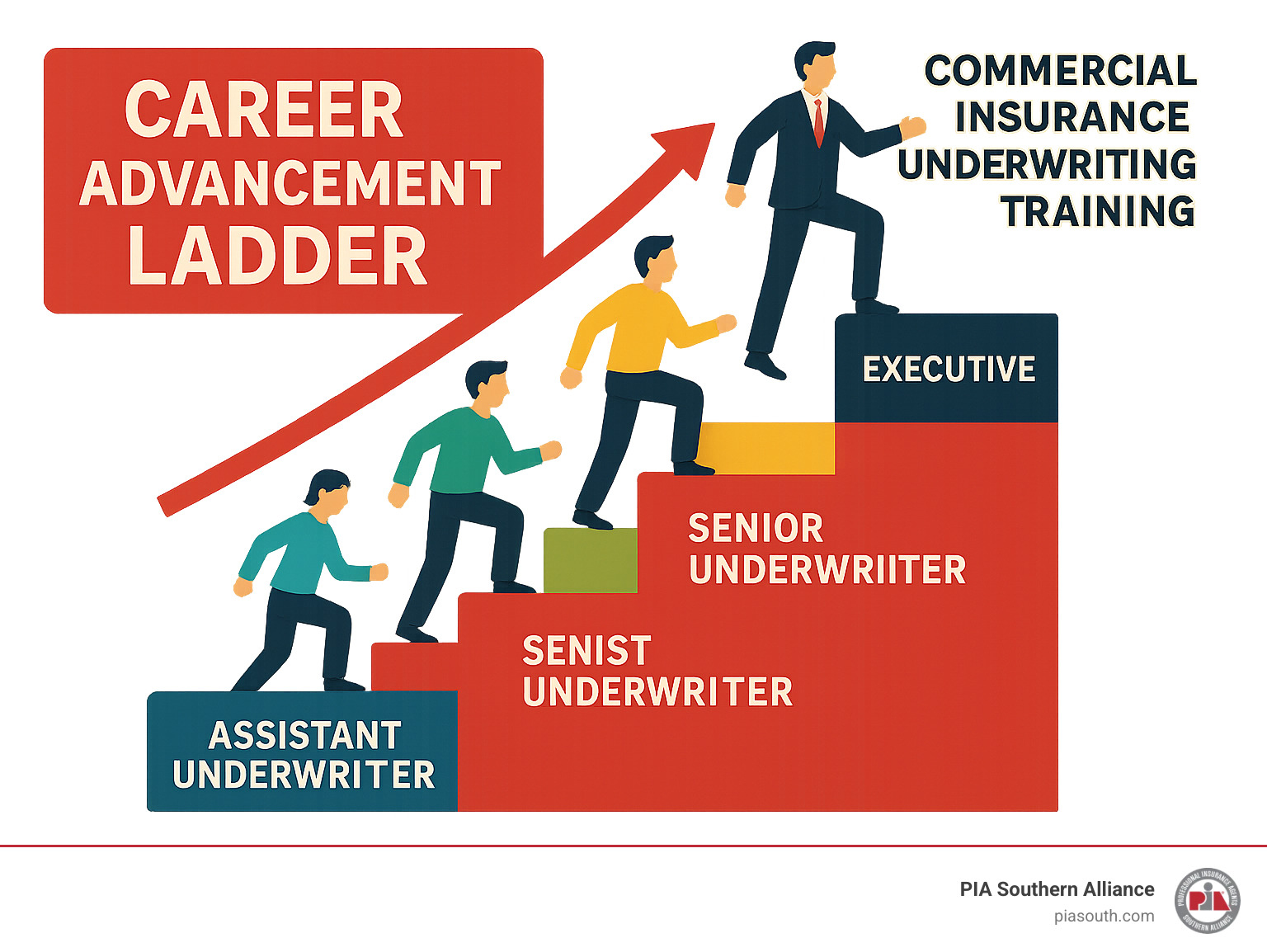
The beautiful thing about starting in commercial underwriting is that you’re never locked into just one career path. Your journey typically begins as an Assistant Underwriter, where you’ll cut your teeth on processing applications and basic risk analysis. With experience and proper commercial insurance underwriting training, you’ll advance to a full Underwriter position, making independent decisions within your authority limits.
“I remember my first day with my own authority limits,” shares a Georgia-based underwriter. “It was terrifying and exhilarating all at once – suddenly my analysis and judgment really mattered.”
As you continue to grow, you might become a Senior Underwriter handling complex risks with expanded authority, or perhaps specialize in a particular industry as an Underwriting Specialist. Many underwriters eventually move into management, first as an Underwriting Manager leading a team, then potentially advancing to Regional Underwriting Director or even Chief Underwriting Officer at the enterprise level.
“Underwriting provides an excellent foundation for various insurance careers,” explains a talent development executive. “The analytical skills and business knowledge you develop can open doors throughout the organization.”
From Analyst to Leader
The journey from technical underwriter to effective leader doesn’t happen overnight. It requires developing a whole new set of skills beyond risk analysis.
Successful leaders in underwriting often participate in mentoring programs, where they guide less experienced colleagues. Many carriers offer rotational assignments that provide exposure to different lines of business and departments – invaluable for understanding the bigger picture.
Executive education becomes increasingly important as you climb the ladder. This might include formal management training, participating in cross-functional projects, or becoming active in industry associations throughout Georgia, Alabama, and Mississippi.
“Leadership in underwriting is about balancing technical excellence with business strategy,” observes a regional underwriting director based in Alabama. “You need to understand not just individual risks, but how they fit into the broader portfolio and company goals.”
This evolution from technical expert to strategic leader often determines long-term career success and compensation potential. The most effective leaders never stop learning – they continuously seek out commercial insurance underwriting training opportunities to stay ahead of industry trends.
Specialized Commercial Insurance Underwriting Training Paths
As your career advances, specializing in a particular niche can set you apart from the crowd. These specialized paths often offer both intellectual challenges and financial rewards.
Medical stop-loss underwriting focuses on self-funded health plans, requiring expertise in both health risks and financial structures. If you enjoy evaluating layers of protection, excess & umbrella underwriting might be your calling – these high-limit policies require careful analysis of underlying coverage.
In states like Georgia, Alabama, and Mississippi, agribusiness underwriting offers particularly rewarding opportunities. With the rich agricultural heritage of these states, specialists who understand the unique risks of farms and agricultural operations are always in demand.
Other popular specializations include environmental liability for pollution risks, cyber risk for our increasingly digital world, and specialized construction or energy sector underwriting.
“Specialization allows you to develop deep expertise that’s highly valued in the market,” advises a specialty lines manager from Mississippi. “It’s often the path to handling the most interesting and complex risks.”
These specialized roles typically command higher compensation and offer greater job security due to the scarcity of specialized talent. The key is finding a niche that aligns with both your interests and market demand in your region.
PIA Southern Alliance offers specialized resources to help underwriters in our tri-state region develop expertise in these niche areas, recognizing that local market knowledge combined with technical specialization creates exceptional value for both carriers and insureds.
Costs, Employer Support & Choosing the Right Program
Investing in commercial insurance underwriting training is a significant career decision that involves weighing costs against potential returns. Like any worthwhile investment, understanding what you’re getting into financially helps you make smarter choices about your professional development.
The price tag for training varies considerably depending on the path you choose. Employer-provided programs often come at no cost to you, while professional designations like the AU typically range from $1,000 to $3,000 for the complete program. University certificates represent a bigger investment at $5,000 to $15,000, while individual workshops and seminars generally fall between $500 and $2,000. For those on tighter budgets, online courses offer focused learning for $100 to $500, though industry conferences can run $1,000 to $2,500 when you factor in travel expenses.
“I was hesitant about spending money on my AU designation until I calculated the return on investment,” shares a commercial underwriter from Alabama. “Within eight months of completing the program, I received a promotion that more than covered the cost.”
Many insurance employers recognize the value of well-trained underwriters and offer meaningful support. This might include full or partial tuition reimbursement, dedicated study time during work hours, or bonus programs tied to successful completion. Some companies even tie promotion eligibility directly to certification, while others build automatic salary increases into their professional development ladders.
“The best employers see underwriting training not as an expense but as an investment in their talent pipeline,” explains a regional training director. “When my company covered my designation costs and gave me Friday afternoons for study time, it showed me they were invested in my growth.”
How to Vet a Program
Not all commercial insurance underwriting training delivers equal value. Before committing your time and money, take a close look at these key factors:
The curriculum should offer genuine depth rather than surface-level coverage. Look closely at who’s teaching – instructors with real commercial underwriting experience bring invaluable insights to the classroom. The program should incorporate current technology and platforms you’ll actually use in the field.
Practical application matters enormously. Programs heavy on case studies and real-world scenarios typically produce more job-ready graduates than purely theoretical approaches. Industry recognition is another critical factor – a certificate means little if employers don’t value it.
“I chose my program after speaking with three underwriting managers about which credentials they respect,” notes a Mississippi-based professional. “That conversation saved me from investing in a program that wouldn’t have advanced my career.”
Don’t overlook completion rates and alumni outcomes. Programs with high dropout rates may indicate problems with the curriculum or support systems. And nothing speaks louder than results – try to connect with previous graduates to learn how the training affected their career trajectory.
For more detailed guidance on evaluating training options specific to agency needs, visit PIA Southern Alliance’s guide to Commercial Insurance Agent Training.
Funding Your Education
Beyond employer support, resourceful professionals find multiple avenues to fund their education. Professional associations frequently offer scholarships or educational stipends to promising candidates. Many also provide member discounts that can significantly reduce training costs.
Payment plans can make larger investments more manageable by spreading costs over multiple months, while certain job-related education expenses may qualify for tax deductions (though you’ll want to consult your tax advisor). For those seeking more substantial support, grants and fellowships through educational institutions and industry foundations can provide meaningful financial assistance.
“I combined a partial scholarship from an industry association with my company’s tuition reimbursement program to cover my entire certification,” shares a Georgia underwriter. “The key was researching all available options rather than assuming I couldn’t afford it.”
PIA Southern Alliance members enjoy special rates on selected training programs, making professional development more accessible for independent agents throughout Georgia, Alabama, and Mississippi. These discounts often make the difference between putting off training and taking immediate action to advance your career.
While cost is an important consideration, the value of quality training extends far beyond the initial investment. The right program delivers returns throughout your career in the form of increased earning potential, greater job security, and expanded opportunities.
Frequently Asked Questions about Commercial Insurance Underwriting Training
How long does it take to become a competent commercial underwriter?
Becoming a truly competent commercial underwriter isn’t an overnight journey – it’s more like a carefully plotted road trip that typically spans 2-3 years of combined education, hands-on experience, and formal training.
Most underwriters develop along a fairly predictable timeline:
During your first 6 months, you’ll build that essential foundation of insurance principles and policy forms. Think of this as learning the language of insurance. By 6-12 months, you’ll start handling basic risks under supervision – like driving with someone in the passenger seat ready to grab the wheel if needed.
The 12-24 month period brings growing independence with moderate authority levels. And finally, somewhere between 24-36 months, most underwriters reach that sweet spot of full competency with complex risks and substantial authority.
“The learning curve varies by individual and by line of business,” explains a training director I spoke with recently. “Property underwriting may develop more quickly than liability or specialty lines, which often have more nuanced exposures.”
The good news? This timeline isn’t set in stone. With structured commercial insurance underwriting training programs and supportive mentorship, you can potentially accelerate your development. Many carriers throughout Georgia, Alabama, and Mississippi have formal development tracks that can compress this timeline for motivated, high-performing candidates.
Do I need the AU before pursuing CPCU?
Think of the AU (Associate in Commercial Underwriting) and CPCU (Chartered Property Casualty Underwriter) as cousins in the insurance designation family – related but distinct, with no strict requirement to complete one before the other. That said, there are some compelling reasons to start with the AU:
First, the AU zeroes in specifically on commercial underwriting skills – it’s laser-focused on what you’ll do day-to-day. Second, completing the AU gives you credits that count toward the CPCU – a nice head start on that longer journey. The AU can typically be completed in 12-15 months, compared to the CPCU’s 2-3 year commitment. And perhaps most importantly, the AU provides a foundation that makes those challenging CPCU studies more manageable when you’re ready to tackle them.
“I recommend the AU as a first step for commercial underwriters,” shared an insurance education specialist. “It provides immediate practical value while setting you up for future CPCU success if you choose to continue.”
Many professionals find that earning the AU helps them secure better positions and compensation that then supports their pursuit of the more extensive CPCU program. It’s like building a solid first floor before adding the second story to your house.
What software should I master first?
In today’s digital underwriting environment, technical proficiency is almost as important as insurance knowledge. If you’re new to the field, focus on mastering these platforms in order of priority:
Rating Systems should top your list – whether carrier-specific platforms or industry standards like ISO Rating. These are the engines that power your pricing decisions. Next, get comfortable with your Policy Administration Systems – these core platforms manage everything from policy issuance to maintenance.
Microsoft Excel remains the Swiss Army knife of underwriting – essential for data analysis and building custom calculations. As you advance, add Data Visualization Tools like Tableau or Power BI to your toolkit for spotting trends and patterns in your book of business. And don’t overlook Communication Platforms including email, video conferencing, and collaboration tools – the pandemic reminded us how crucial these are for effective underwriting.
“Start with the systems you’ll use daily in your specific role,” recommends a technology trainer with years of experience. “Then gradually expand to analytics and specialized tools as your responsibilities grow.”
The good news is that most commercial insurance underwriting training programs now include substantial technology components, recognizing that modern underwriting requires both deep insurance knowledge and digital fluency. This integrated approach ensures you’re prepared for the increasingly tech-driven world of risk assessment.
Conclusion
Becoming a commercial underwriting professional is a rewarding journey that combines analytical thinking, relationship building, and continuous learning. The path requires dedication but offers substantial rewards in terms of compensation, job security, and intellectual challenge.
As we’ve explored throughout this guide, quality commercial insurance underwriting training is the bridge between basic insurance knowledge and true underwriting expertise. Whether you’re just starting your career or looking to advance to the next level, structured training provides the foundation for success.
Key takeaways include:
- Commercial underwriting requires both technical knowledge and soft skills
- Multiple educational pathways can lead to an underwriting career
- Professional designations like the AU provide recognized credentials
- Technology is changing the underwriter’s role and required skillset
- Specialization offers opportunities for career advancement and differentiation
- Employers often support professional development through various programs
PIA Southern Alliance is committed to supporting insurance professionals throughout Georgia, Alabama, and Mississippi with resources that improve their underwriting knowledge and skills. Our educational programs, webinars, and networking opportunities provide valuable tools for career advancement.
For more information about our commercial insurance underwriting training resources and other professional development opportunities, visit our Commercial Insurance Training Programs page.
The insurance industry continues to evolve, but the need for skilled underwriters who can evaluate risk and make sound decisions remains constant. By investing in your professional development, you position yourself for long-term success in this essential and rewarding field.