
Why Commercial Insurance Training Is Essential for Agency Success
Ever wonder why some insurance agencies consistently outperform others? The secret often lies in how they approach commercial insurance training. At its heart, this specialized education equips insurance professionals across Georgia, Alabama, and Mississippi with the knowledge and confidence to steer the complex world of business insurance.
Think of quality commercial insurance training as the engine that powers your agency’s growth. Without it, even the most talented professionals can struggle when faced with complex commercial risks and coverage questions. Surprisingly, one in three commercial producers receive no formal training whatsoever, while less than 1% receive effective training in critical areas. That’s a gap we’re passionate about closing.
The human brain is fascinating but forgetful. Without reinforcement and practical application, your team will forget roughly 90% of new information within a week. That’s not just disappointing—it’s expensive. But here’s the good news: when training is done right, the change is remarkable. A full 97% of properly trained insurance professionals report significant improvements in their job performance, client relationships, and career trajectory.
Key Elements That Make Commercial Training Effective:
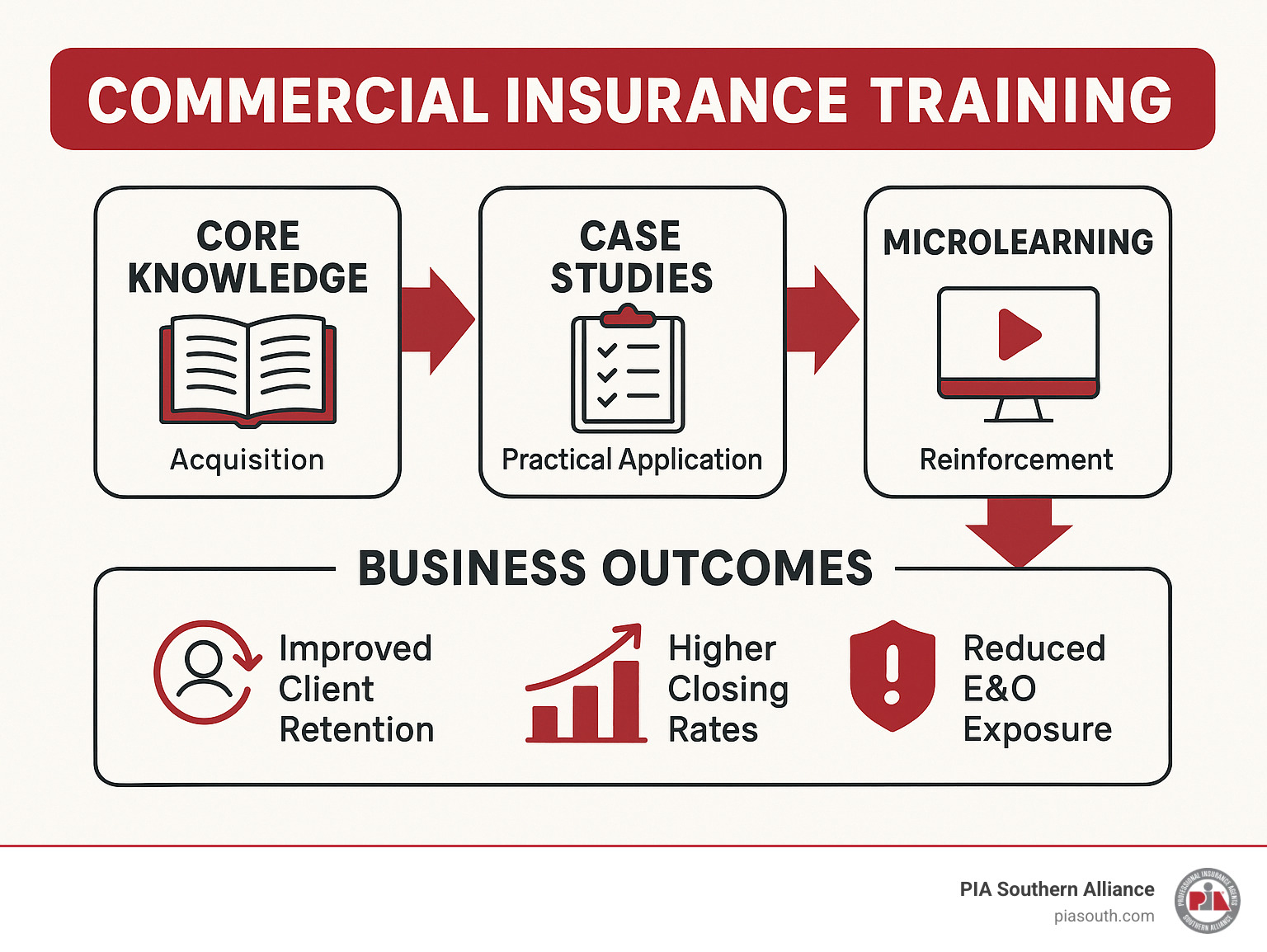
Technical coverage mastery helps your team confidently explain policy forms and endorsements, leading to more accurate client recommendations. Sales technique training focuses on consultative approaches that boost closing rates and premium volume. Risk assessment skills allow your team to identify and evaluate business exposures, providing better protection for clients. When claims handling expertise is developed, your team can steer complex commercial claims, dramatically improving client retention. And regulatory compliance training keeps everyone current with requirements in Georgia, Alabama, and Mississippi, reducing your E&O exposure.
The traditional approach to commercial insurance training often involved sending producers to “mini producer schools” at costs ranging from $10,000–$15,000 when factoring in tuition, travel expenses, and time away from selling. Modern training alternatives offer more flexible, cost-effective solutions with better results through consistent reinforcement and practical application.
At PIA Southern Alliance, we’ve witnessed how quality commercial insurance training transforms independent agencies across our three-state region. The right training empowers your team to better protect clients while simultaneously growing your business—a win-win that creates lasting success.
What Is Commercial Insurance Training & Why It Matters
Commercial insurance training is so much more than just learning policy details—it’s a journey that transforms insurance professionals into trusted risk advisors. At its heart, this training builds the technical knowledge, sales abilities, and risk assessment skills that are absolutely essential for serving business clients effectively.
Let’s face it—commercial insurance isn’t like personal lines. It involves complex exposures, multiple coverage forms, and significant financial stakes for everyone involved. Good training bridges that critical gap between knowing something in theory and applying it confidently in real-world situations.
As IBM’s risk management framework notes, “Risk management is the process of identifying, assessing, and controlling financial, legal, strategic, and security risks to an organization’s capital and earnings.” This is exactly where commercial insurance training makes all the difference—it equips you to guide your clients through this process with confidence and expertise.
The numbers tell a compelling story:
- Without repetition and application, we forget a staggering 90% of new information within just one week
- A remarkable 97% of properly trained professionals report improved job performance
- One in three commercial producers have never received formal training
- Less than 1% of producers ever receive effective training in the areas that matter most
As one veteran in our industry put it: “This is the program I’ve been looking for my entire 25-year career…I wholeheartedly recommend it.”
The Role of Commercial Insurance Training in Risk Management
When you’re properly trained in commercial insurance, you transform from order-taker to trusted advisor. With the right knowledge foundation, you can:
Help clients spot potential disasters before they happen by identifying industry-specific exposures they might never have considered. You become the expert who notices what others miss.
Become a contract detective, finding those dangerous coverage gaps hiding in existing policies and recommending solutions that truly protect your clients’ businesses.
Stand toe-to-toe with underwriters, presenting your clients’ risks in the most favorable light to secure better terms and pricing—a skill that directly impacts your clients’ bottom line.
Craft customized coverage packages that address each client’s unique situation rather than offering one-size-fits-all solutions that leave dangerous gaps.
This consultative approach creates deeper, more meaningful client relationships. You’re no longer just selling policies—you’re helping build more resilient businesses.
Commercial Insurance Training for Different Roles
The beauty of commercial insurance training is how it can be custom to different positions within your agency:
For producers, effective training focuses on the full sales cycle—from prospecting and qualifying accounts to conducting thorough exposure analyses. It builds the confidence to present comprehensive solutions, overcome objections, and close sales with authority.
For CSRs and account managers, training emphasizes the technical aspects of processing changes accurately, explaining coverage details in client-friendly language, and spotting those valuable cross-selling opportunities that might otherwise be missed.
For agency owners and managers, training provides the framework for establishing standardized processes, mentoring staff effectively, evaluating carrier relationships, and building a strong commercial lines culture that permeates the entire agency.
For new hires, training builds that crucial foundation of commercial coverage knowledge, introduces industry-specific exposures, and develops the client communication skills that will serve them throughout their careers.
As one agency owner in Alabama recently shared with us: “Investing in commercial insurance training for our team has been transformative. Our new producers now contribute meaningfully within months rather than years, and our retention rates have improved dramatically as our service team better understands the ‘why’ behind coverage recommendations.”
When your team understands not just what to do but why it matters, everything changes. That’s the true power of quality commercial insurance training.
Scientific research on risk management
More info about Commercial Insurance Training Programs
Core Curriculum: From Property to Liability
A comprehensive commercial insurance training program isn’t just about checking boxes—it’s about building a solid foundation that gives agents confidence when advising business clients. At PIA Southern Alliance, we’ve designed our curriculum to cover all the essentials while keeping the learning experience engaging and practical.

Think of commercial coverage knowledge like building a house—you need a solid foundation before adding the fancy finishes. Our core curriculum starts with the fundamentals and builds toward specialty coverages:
Commercial Property Coverage forms the cornerstone of business protection. We dive into building and personal property forms, helping you understand the critical differences between basic, broad, and special causes of loss. You’ll master business income coverage (often a mystery to new agents!) and learn the ins and outs of coinsurance, agreed value options, and equipment breakdown. We’ll even explain those tricky COPE underwriting factors that can make or break your submission.
Commercial General Liability (CGL) might seem straightforward, but the devil’s in the details. Our training breaks down occurrence versus claims-made forms, coverage triggers, and those all-important insuring agreements. We tackle products-completed operations, personal and advertising injury, and help you spot the exclusions that could leave your clients vulnerable. Plus, you’ll become an expert on additional insured endorsements—a skill that will immediately set you apart.
Business Auto Coverage goes well beyond personal auto knowledge. We’ll walk through those puzzling coverage symbols, explain hired and non-owned exposures (a frequent coverage gap!), and help you understand when garage coverage forms come into play. We’ll even touch on fleet safety programs that can help your clients manage their risk.
Workers’ Compensation varies significantly across Georgia, Alabama, and Mississippi, so we provide state-specific guidance on statutory requirements. You’ll learn the ins and outs of employers liability coverage, classification codes, and the experience modification process. We’ll also share practical tips on premium audits and return-to-work programs that your clients will appreciate.
Specialty Coverages round out your expertise with commercial umbrella and excess liability, inland and ocean marine, crime and employee dishonesty, professional liability, cyber liability, and employment practices liability. These are often the difference-makers in a comprehensive program.
Emerging Risks keep you ahead of the curve with the latest on PFAS liability (those “forever chemicals” making headlines), climate change impacts, pandemic exposures, supply chain disruptions, and cryptocurrency risks. Staying current on these evolving exposures positions you as a true advisor rather than just a policy peddler.
As Patrick Day, a commercial lines specialist, noted after completing our advanced training: “The Complex Restaurants Commercial Lines course is excellent! A great way to learn/review your field underwriting skills.”
Interactive Elements That Drive Retention
Let’s face it—most insurance training is about as exciting as watching paint dry. That’s why we’ve built our commercial insurance training with interactive elements that keep you engaged and help the knowledge stick.
Rather than passive listening, we incorporate case studies based on real-world scenarios that challenge you to apply what you’ve learned. Role-playing exercises build confidence before you face actual clients, while knowledge checkpoints throughout ensure you’re grasping key concepts.
Our secret weapon? The “weekly reinforcement” model that sends 3-minute microlearning challenges via email following your initial training. These bite-sized refreshers combat that natural forgetting curve (remember that 90% forgotten statistic?) and ensure concepts become part of your permanent knowledge base.
One Mississippi agent, Julie Lewis, shared: “Justin at ICA was incredibly helpful. I learned a lot in our commercial class and appreciate the classes being fun.” Yes, you read that right—fun and insurance training in the same sentence!
Staying Current With ISO Updates & Emerging Risks
Insurance never stands still, and neither should your knowledge. The commercial landscape constantly evolves with ISO form revisions, new endorsements, and emerging exposures requiring ongoing education.
ISO Form Updates can significantly change coverage interpretations overnight. Our training helps you understand not just what changed, but why it matters for your clients. BOP Endorsements have exploded to more than 150 options—we’ll help you steer which ones matter most for different business types.
PFAS Liability has emerged as a major concern, with these “forever chemicals” creating potentially unlimited liability exposures. Our courses explain which industries face the greatest risk and how to address these exposures with clients.
Cyber Evolution happens at lightning speed, with new threats and coverage responses developing monthly. We keep you current on the latest vulnerabilities and coverage solutions without requiring you to become an IT expert.
For agents in Georgia, Alabama, and Mississippi, we pay special attention to regional exposures like coastal property risks, hurricane deductibles, and flood zone changes—specialized knowledge that generic national training often overlooks.
Ready to transform your commercial lines knowledge? Learn more about our Commercial Insurance Training Programs or dive deeper into specific tracks like Commercial Property Insurance Courses and Commercial Casualty Courses.
Commercial Insurance Training Formats Compared
Commercial insurance training comes in various formats, each with distinct advantages and limitations. Understanding these differences helps agencies select the approach that best fits their needs.

Format Comparison
Let’s be honest – not all training is created equal. I’ve seen agencies spend thousands on fancy bootcamps only to watch their producers forget everything two weeks later. Meanwhile, other agencies invest in more modest programs and see tremendous results.
| Training Format | Typical Cost | Time Commitment | Pros | Cons |
|---|---|---|---|---|
| In-Person Bootcamps | $3,000-$15,000 total cost including travel | 1-2 weeks, full days | Immersive, networking opportunities, focused learning environment | Expensive, time away from office, information overload |
| Virtual Instructor-Led | $500-$3,000 | 2-4 hours per session over multiple weeks | Interactive, scheduled accountability, expert guidance | Requires set schedule, potential technology issues |
| Self-Paced Online | $500-$1,500 | Flexible, typically 20-40 hours total | Learn at own pace, revisit material as needed, no travel required | Requires self-discipline, limited peer interaction |
| Hybrid Programs | $1,000-$2,500 | Combination of scheduled sessions and self-paced work | Balances structure with flexibility, reinforcement opportunities | Coordination challenges, requires multiple learning styles |
| Microlearning | $20-$50 per module | 10-30 minutes per module | Bite-sized, focused content, easily fits into schedule | May lack comprehensive coverage, limited depth |
Remember those traditional “mini producer schools” that take your staff away for weeks at a time? By the time you factor in tuition, travel, lodging, and lost production time, you’re looking at $10,000–$15,000 or more. Meanwhile, modern digital programs can deliver comparable or even better results for around $1,000-$2,000, all while allowing your team to continue serving clients. That’s a win-win in my book!
Choosing the Right Commercial Insurance Training Format
Selecting the best training format isn’t just about cost – it’s about what works for your specific agency and team members.
Learning styles matter more than we often acknowledge. Some of your team members might be visual learners who thrive with video instruction and infographics. Others are auditory learners who absorb information best through lectures and discussions. And don’t forget your hands-on learners who need to actually practice applying concepts to really get it.
Budget considerations go beyond just the sticker price. There’s the direct cost of tuition and materials, but what about the indirect costs of taking producers away from selling? A seemingly expensive program that allows for continued production might actually cost less in the long run than a cheaper option that requires full-time attendance.
Schedule flexibility is especially important for busy agencies in Georgia, Alabama, and Mississippi, where market conditions and client needs don’t pause for training. Some questions to consider: Can your team dedicate blocks of time, or do they need something more flexible? Do you have seasonal busy periods to work around? How will you handle client service during training times?
Technological comfort varies widely among insurance professionals. Before committing to a digital learning program, honestly assess your team’s digital literacy, available equipment and connectivity, and access to technical support. The best content in the world won’t help if your team can’t access it comfortably.
For many of the agencies we work with across the Southeast, a hybrid approach hits the sweet spot: combining self-paced foundational learning with scheduled virtual sessions for application and reinforcement. It offers the best of both worlds – flexibility with accountability.
Commercial Insurance Training & Continuing Education Credits
One of the smartest ways to maximize your training investment is to choose commercial insurance training that also fulfills continuing education requirements. This approach kills two birds with one stone – building expertise while maintaining licensing compliance.
CE requirements are fairly consistent across our region, but there are nuances worth noting:
Georgia requires 24 hours every 2 years, with 3 of those hours dedicated to ethics training. Our Georgia agents particularly appreciate programs that help them track completion dates, as the state is quite strict about deadlines.
Alabama also requires 24 hours every 2 years, including 3 ethics hours. Alabama agents should verify that online courses include proper identity verification to meet state requirements.
Mississippi matches its neighbors with 24 hours every 2 years and the same 3-hour ethics requirement. Mississippi agents should note that the state has specific rules about self-study versus classroom credits.
When evaluating training programs for your agency, verify the CE approval status in your specific state(s), how credits are allocated by line of authority, and what the reporting procedures entail. The best programs handle the reporting for you, automatically submitting completion data to state departments of insurance – one less administrative headache for your busy team.
Looking for training that combines commercial expertise with CE credit? Learn more about our Independent Insurance Agency Training options designed specifically for agencies in the South.
Certifications & Designations That Boost Credibility
Professional designations do more than just look good on a business card – they show clients and colleagues that you’re serious about your commercial insurance expertise. Quality commercial insurance training often serves as the perfect stepping stone toward earning these respected credentials.

Key Commercial Insurance Designations
Let’s talk about the Commercial Lines Coverage Specialist (CLCS) designation. This practical credential focuses specifically on commercial coverage forms and their real-world applications. To earn it, you’ll need to complete the required coursework and pass an exam with a score of 70% or higher. Most professionals can prepare in about 2-4 weeks with dedicated study time. What makes the CLCS valuable is its clear signal to clients that you specialize in commercial lines – something that immediately sets you apart in the marketplace.
The Associate in General Insurance (AINS) takes a broader approach. This designation builds a solid foundation across multiple insurance lines and principles. It requires completing several courses and passing their corresponding exams. For example, the AINS 103 course (Commercial Insurance) typically requires about 6-9 hours of focused study time. The AINS is particularly respected by carriers and can open doors throughout your insurance career.
Both designations qualify for continuing education credits in Georgia, Alabama, and Mississippi, helping you maintain your license while building valuable expertise.
Mapping Designations to Career Goals
Your ideal designation really depends on where you want your insurance career to go. If you’re sales-focused, look for designations that strengthen your consultative selling skills and industry-specific knowledge. These credentials are particularly valuable when prospects ask about your qualifications – having the right letters after your name can be the difference between winning and losing an account.
For those who love the technical details of insurance, pursue designations that dive deep into policy forms and coverage analysis. These credentials earn respect from underwriters and can help you steer complex coverage situations with confidence. They’re particularly valuable when you need to advocate for your clients with carriers.
If you’re on a management track, consider designations that address agency operations and broader risk management frameworks. These credentials demonstrate leadership capabilities and can distinguish you within the broader insurance community.
As Art Sons, a successful designated professional, shared: “Roll The Hard Six lays out a clear and actionable sales and marketing plan…success has followed.” The right designation, paired with quality commercial insurance training, creates a powerful combination for career advancement.
Commercial Insurance Training as a Path to Professional Designations
Good commercial insurance training programs don’t just dump information on you – they prepare you to succeed in earning professional designations through thoughtful preparation. The best programs offer structured learning paths that build systematically toward designation requirements, making the journey manageable even for busy professionals.
They’ll include practice exams that mirror the actual testing experience, helping you identify knowledge gaps before the real thing. You’ll also get access to focused study resources like guides and reference materials that highlight the most important concepts.
Rather than just memorizing facts, quality training incorporates application exercises that help you truly understand the material through realistic scenarios. Many also provide exam preparation tips that help you study efficiently and approach test day with confidence.
The investment in earning designations pays significant dividends – insurance professionals with designations typically earn 20-30% more than their non-designated peers. That’s a substantial return on investment that continues throughout your career.
For independent agents in Georgia, Alabama, and Mississippi, commercial insurance agent training that leads to respected designations creates a powerful competitive advantage in a crowded marketplace.
How to Choose the Right Program for Your Agency in GA, AL & MS
Selecting the ideal commercial insurance training program requires careful consideration of agency needs, goals, and resources. Let’s walk through how agencies in Georgia, Alabama, and Mississippi can find their perfect match.

Think of choosing a training program like buying a new home—you wouldn’t purchase without checking that it meets your family’s specific needs. The same thoughtful approach applies here.
Start with an honest agency needs analysis. Which lines of business represent your best growth opportunities? Perhaps you’re seeing more manufacturing clients in your Alabama market, or maybe coastal property in Mississippi needs special attention. Identify the knowledge gaps among your current staff—are they comfortable explaining business income coverage or do they struggle with cyber liability concepts?
Next, consider role alignment. The training needs of a brand-new producer differ dramatically from those of a seasoned account manager. New hires might need foundational knowledge across all coverage lines, while experienced staff might benefit from deep dives into emerging risks or advanced sales techniques. Be specific about your learning objectives for each team member.
Your budget considerations matter too. Beyond the sticker price, factor in indirect costs like time away from production. A $1,500 program that allows staff to continue serving clients while learning might deliver better ROI than a $5,000 bootcamp that takes them away for a week. Consider how you’ll measure success—increased closing rates? Better retention? More cross-selling?
When evaluating content quality, look beyond slick marketing. Does the curriculum address regional exposures like hurricane deductibles that affect Georgia coastlines? Are ISO updates covered promptly? The best programs for Southeast agencies include specific content on industries prevalent in our region, from agriculture to manufacturing to hospitality.
The delivery method should match your team’s learning style and agency workflow. A small Alabama agency might prefer self-paced online modules that staff can complete between client meetings, while a larger Mississippi firm might invest in a hybrid program with both digital content and live virtual sessions.
Don’t forget CE compliance. Ensure the program is approved for continuing education credits in Georgia, Alabama, and Mississippi. The best programs handle reporting automatically, saving your team administrative headaches.
Evaluating Content Depth & Instructor Expertise
Not all commercial insurance training is created equal. The difference between mediocre and excellent programs often comes down to content depth and instructor quality.
Look for content that demonstrates ISO form mastery with specific form references rather than generalities. When a program mentions “the CGL pollution exclusion” without specifying which endorsements modify it, that’s a red flag. Quality training includes real-world claim scenarios relevant to businesses in Georgia, Alabama, and Mississippi.
The best instructors bring active commercial lines experience to their teaching. They can explain not just what a form says, but why it matters and how it applies to specific industries. They share stories about claims they’ve handled and accounts they’ve written, bringing dry policy language to life.
Great programs provide robust support resources that extend learning beyond the course itself. Look for reference materials, access to instructors for follow-up questions, and communities where learners can share experiences. These elements turn one-time training into ongoing professional development.
As Julie Lambirth noted after completing intensive training: “I truly enjoyed this course. It was incredibly helpful to me and I intend to revisit the course frequently to review the information there, and refresh my memory when needed. There is so much material there! ~ and the formatting of each page made the course less intimidating.”
Leveraging Commercial Insurance Training for Agency Growth
Smart agencies view commercial insurance training not as an expense but as a growth investment. The payoff comes in multiple forms.
Improved cross-selling happens naturally when your team understands coverage connections. A producer who truly understands equipment breakdown can easily spot opportunities when visiting manufacturing clients. An account manager who recognizes the gaps in a BOP policy can confidently suggest professional liability or cyber coverage. This isn’t pushy selling—it’s protecting clients from dangerous coverage gaps.
Client retention improves when your team provides knowledgeable service. Clients stay with agencies that can confidently answer their questions, handle claims effectively, and demonstrate ongoing value through risk advice. One Mississippi agency reported retention climbing from 83% to 91% after implementing comprehensive commercial training.
Premium volume increases when your team can write more complex, higher-premium accounts. With proper training, agents stop avoiding complicated submissions and start seeking them out. They retain larger portions of accounts instead of placing pieces with specialty brokers. One small Georgia agency grew commercial premium by 32% in the year following intensive training.
Operational efficiency gains shouldn’t be overlooked. Well-trained staff make fewer errors, submit cleaner applications to carriers, and spend less time researching basic coverage questions. This frees up time for more productive activities like account rounding and prospecting.
For agencies across Georgia, Alabama, and Mississippi, regional expertise provides a competitive edge. Understanding coastal property challenges, agriculture exposures, and manufacturing risks common to the Southeast allows you to position your agency as the local commercial expert in your community.
More info about Commercial Insurance Sales Training
Frequently Asked Questions about Commercial Insurance Training
What roles benefit most from commercial insurance training?
When it comes to commercial insurance training, the truth is that everyone in your agency stands to gain—but some roles see particularly dramatic changes.
New producers often experience the most visible impact. Rather than struggling through months or even years of trial-and-error learning, quality training accelerates their path to productivity. As one producer told us after completing our program, “I finally feel confident walking into meetings with complex businesses.”
Account managers find a new level of proactive service after training. Instead of simply processing renewals, they spot coverage gaps, recommend solutions, and truly protect clients. This deeper knowledge translates directly to improved retention rates.
For your CSRs, commercial insurance training reduces errors while improving client communication. When they understand the “why” behind coverage recommendations, they become more effective advocates for both clients and the agency.
Agency owners who invest in training gain strategic perspective on market opportunities and competitive positioning. As Ben Jonas, Vice President of Commercial & Specialty Insurance, shared: “ECLIPS gave me an ‘A to Z’ full blown process to follow…Uniquely specific to commercial insurance producers.”
How long does commercial insurance training take?
One of the most common questions we hear from busy agencies in Georgia, Alabama, and Mississippi is about time commitment. The honest answer? It varies, but effective learning doesn’t have to consume your calendar.
Comprehensive programs typically require 20-40 hours total, but the best ones spread this investment over weeks or months rather than cramming everything into intensive boot camps. This spacing allows for practical application between sessions—the key to actual retention.
Focused courses on specific coverage areas can be completed in 3-10 hours each. For example, a dedicated commercial property workshop might take a single morning, while a complete CGL deep-dive might span several sessions.
For those pursuing designations, preparation time varies by program. The AINS 103 commercial insurance module typically requires 6-9 hours of focused study to master.
What really matters is ongoing reinforcement. The most successful agencies build in just 10-15 minutes weekly for microlearning refreshers. This small investment dramatically improves retention and application of the initial training.
Are continuing education credits included in commercial insurance training programs?
Yes, quality commercial insurance training programs typically include CE credits, but it’s important to verify the specifics before enrollment.
For agencies in Georgia, Alabama, and Mississippi, state-specific approvals matter. Each state has unique requirements and approval processes—what qualifies in one state may not transfer to another.
The CE credit situation varies by training format:
– On-site programs are usually pre-approved for specific credit hours
– Virtual training may have different approval status than identical in-person versions
– Self-paced courses typically require exam completion to qualify for CE
– Webinars generally require live attendance with verification for CE qualification
At PIA Southern Alliance, we understand the importance of CE compliance for our members across Georgia, Alabama, and Mississippi. Our programs are designed to help you meet licensing requirements while building the commercial knowledge that grows your agency.
CE requirements in our tri-state region are consistent at 24 hours every two years, including 3 ethics hours—but the specific approval processes vary. We’re happy to answer any state-specific questions about how our commercial insurance training programs satisfy these requirements.

Conclusion
Commercial insurance training isn’t just another box to check—it’s a game-changing investment that transforms agency performance and client relationships. For independent agents across Georgia, Alabama, and Mississippi, quality training provides the confidence and competence needed to steer today’s complex risk landscape.
The numbers tell a compelling story about why training matters:
- 97% of properly trained insurance professionals report meaningful improvements in job performance
- One in three commercial producers enters the field with no formal training whatsoever
- Without reinforcement, traditional training approaches result in 90% knowledge loss within just one week
When you choose the right training approach—one that blends comprehensive technical knowledge with practical application and consistent reinforcement—your agency open ups remarkable benefits. Your producers develop faster, your clients stay longer, and your E&O exposure drops significantly. You’ll gain access to specialized markets that were previously out of reach, and gradually build a reputation as the go-to experts for commercial coverage in your community.
Here at PIA Southern Alliance, we’re deeply committed to supporting independent agencies throughout Georgia, Alabama, and Mississippi. We understand the unique challenges facing southeastern agencies—from coastal property concerns to regional industry exposures—and design our educational resources to address these specific needs.
Our specialized webinars and courses focus on practical skills that drive agency growth: enhancing cross-selling abilities, improving risk assessment techniques, and developing strategic market approaches that give our members a competitive edge. We believe that well-trained agents build stronger communities by protecting local businesses more effectively.
As one participant in our advanced commercial training program shared: “The emphasis on product knowledge combined with a roadmap for implementation will take producers to heights they haven’t dreamed of.”
Your journey toward commercial lines success begins with quality training that respects your time, fits your learning style, and delivers lasting results. We invite you to explore our Commercial Insurance Training Programs and find how PIA Southern Alliance can help your agency thrive in today’s challenging commercial marketplace.
When your team has the knowledge and confidence to handle complex commercial accounts, everyone wins—your agency, your clients, and the communities you serve.