
Why Commercial Insurance Education Matters for Agency Success
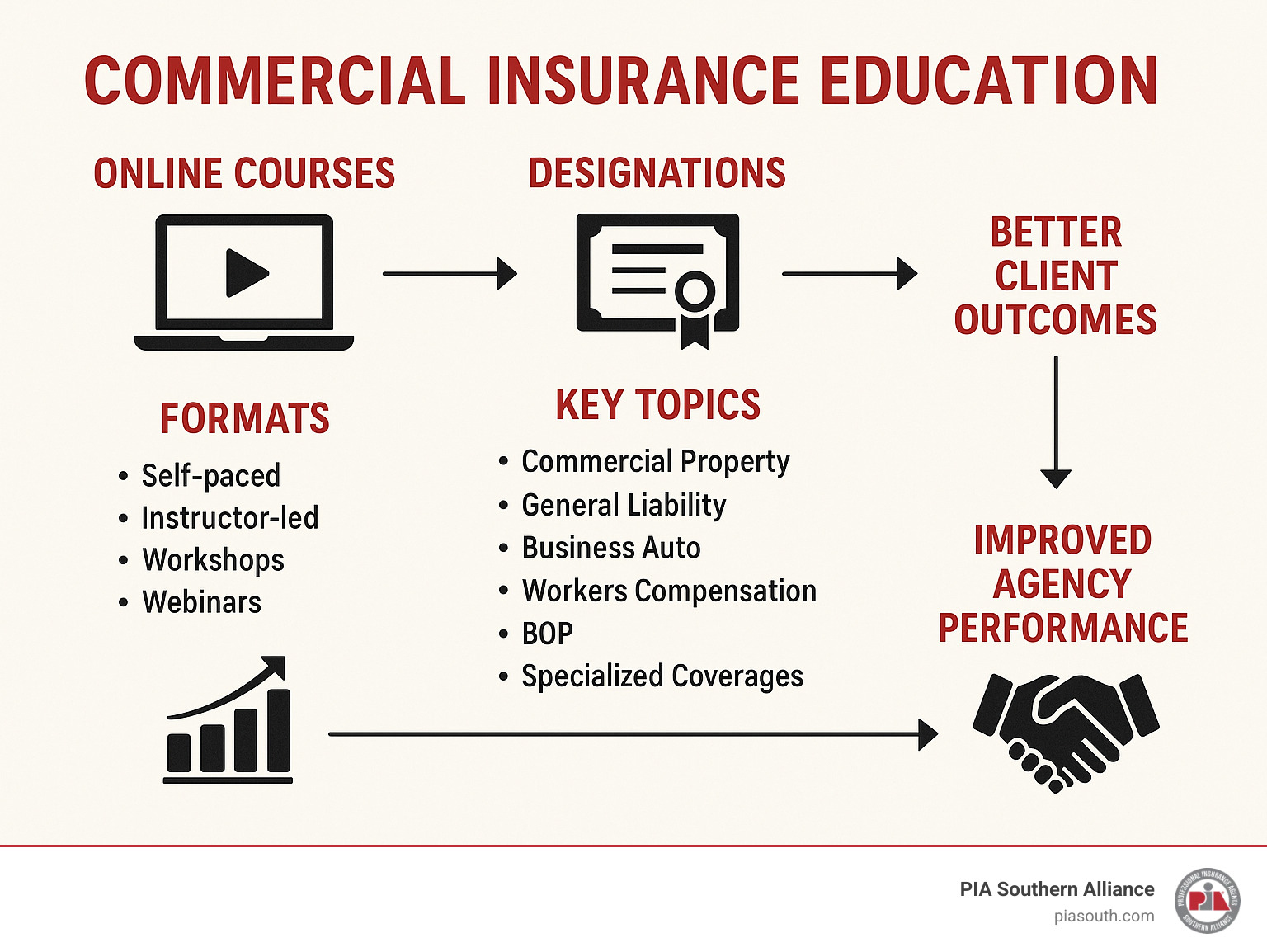
Commercial insurance education refers to specialized training and professional development focused on commercial lines coverages, risk management principles, and business insurance solutions. Here’s what you need to know:
- Definition: Structured learning programs that teach insurance professionals about business insurance policies, coverages, and risk assessment
- Formats: Self-paced online courses, instructor-led workshops, designation programs, and on-demand webinars
- Benefits: Improved client service, increased sales effectiveness, reduced E&O exposure, and career advancement
- Key topics: Commercial property, general liability, business auto, workers compensation, BOP, and specialized coverages
For independent agents in Georgia, Alabama, and Mississippi, commercial insurance education is not just about meeting CE requirements—it’s about building the expertise needed to protect businesses in today’s complex risk environment.
When your clients face a devastating property loss or a complex liability claim, your knowledge becomes their lifeline. That’s why investing in commercial insurance education is one of the most important decisions you can make for your agency’s future.
According to the research, 97% of participants in structured commercial insurance programs report improved job performance. Additionally, 94% recommend these courses to colleagues, highlighting the tangible benefits of specialized training.
The commercial insurance landscape has evolved dramatically over the past decade. From cyber threats to complex supply chain exposures, businesses face risks that didn’t exist a generation ago. Agencies that invest in ongoing commercial insurance education are better positioned to identify these emerging risks and recommend appropriate coverage solutions.
I’m a commercial lines specialist with PIA Southern Alliance, dedicated to helping independent agents across Georgia, Alabama, and Mississippi improve their commercial insurance education to better serve their business clients.
What Is Commercial Insurance and Why It’s Vital for Businesses

Picture this: A bakery owner arrives one morning to find water pouring through the ceiling, destroying equipment worth thousands of dollars. Without proper insurance, this could spell the end of a dream. This scenario illustrates why commercial insurance isn’t just a nice-to-have—it’s the backbone of business resilience.
Commercial insurance serves as a financial safety net designed specifically for the unique challenges businesses face. Unlike your personal auto or homeowners policy, commercial coverage addresses the complex world of business exposures. Think of it as the difference between insuring your family sedan versus a fleet of delivery trucks that travel across Georgia, Alabama, and Mississippi daily.
When we talk about why businesses need this protection, it boils down to four essential functions. Financial protection helps a business bounce back after property damage or equipment failures. Lawsuit defense provides both legal representation and settlement funds when a customer slips on a wet floor or claims your advice caused financial harm. Compliance ensures you’re meeting legal requirements like workers’ compensation coverage. And through risk transfer, potentially devastating financial burdens shift from your business to the insurance carrier.
According to the latest research on risk management, nearly 40% of small businesses will experience a property or liability loss within the next decade. For many of these businesses, proper coverage isn’t just about convenience—it’s about survival.
Understanding the distinction between first-party and third-party insurance forms the foundation of solid commercial insurance education. First-party coverage responds when your business suffers direct damage—like that bakery with water damage to equipment. Third-party coverage kicks in when your business is responsible for damage, injury, or financial harm to others—like if that leaking water ruined the inventory in the shop next door.
The Role of Risk Management
Risk management and commercial insurance go hand-in-hand like thunder and lightning. You can’t effectively address one without considering the other.
Good risk management starts with hazard identification—taking a magnifying glass to your business operations to spot potential trouble before it happens. For a restaurant in coastal Georgia, this might mean assessing hurricane risks. For a manufacturing plant in Alabama, it could involve machinery breakdown scenarios.
Once hazards are identified, loss control measures can be implemented. This might be as simple as installing better locks or as complex as redesigning an entire production process to reduce injury risks. The goal is preventing losses when possible and reducing their severity when prevention fails.
Finally, business continuity planning ensures your business can weather the storm—literally, in many cases across our southern states. How will you serve customers if your building is damaged? Where will employees work? How will you access critical data? These questions need answers before disaster strikes.
For independent agents serving businesses in Georgia, Alabama, and Mississippi, understanding regional hazards is particularly important. Our states face unique challenges from severe weather events like hurricanes and tornadoes, making property insurance and business interruption coverage especially critical components of any commercial insurance program.
By combining solid risk management practices with appropriate commercial coverages, businesses create a resilience strategy that helps them not just survive unexpected events, but often emerge stronger on the other side.
Core Commercial Lines Coverages Every Agent Must Master
Let’s face it – walking into a business and confidently discussing their insurance needs requires more than just basic knowledge. You need to master several fundamental commercial coverages that form the foundation of most business insurance programs. This expertise is where your commercial insurance education truly shines.
Commercial Property Insurance
Think about it – when a business owner looks at their building, equipment, and inventory, they’re seeing their livelihood. Commercial property insurance protects these vital assets against damage or destruction.
Most policies use the Building and Personal Property Coverage Form (BPP) as their foundation, paired with one of three Causes of Loss forms – Basic, Broad, or Special. The difference between these forms can mean everything to your client after a loss. Equipment Breakdown protection and Ordinance or Law coverage add crucial layers of protection many businesses don’t realize they need until it’s too late.
Did you know property losses make up about 30% of all commercial insurance claims? That’s why this coverage deserves special attention in your client conversations. Learn more about mastering this essential coverage through Commercial Property Insurance Courses.
Commercial General Liability (CGL)
When a customer slips on a wet floor or a product causes injury, CGL becomes your client’s financial shield. This coverage protects businesses from third-party claims of bodily injury, property damage, and those tricky personal and advertising injuries.
A solid CGL policy covers premises operations, products and completed operations, and includes defense costs – which can be substantial even when a business has done nothing wrong. Scientific research on CGL shows that for small businesses, general liability claims average $75,000. That’s enough to sink many operations without proper protection.
Commercial Auto Insurance
Whether it’s a fleet of delivery trucks or a single vehicle used for business purposes, commercial auto coverage is essential. The policy typically includes liability coverage, physical damage protection, and hired/non-owned auto liability for those occasions when employees use personal vehicles for business errands.
One aspect many agents overlook? The significant differences in commercial auto requirements across Georgia, Alabama, and Mississippi. Getting this wrong can leave your clients with costly compliance issues. Learn more about state-specific requirements from this scientific research on commercial auto requirements.
Workers Compensation
When employees get hurt on the job, workers comp provides the medical benefits, disability income, rehabilitation services, and death benefits needed to protect both the worker and the business. This coverage isn’t optional in most cases – it’s mandatory for most employers in Georgia, Alabama, and Mississippi.
Business Income Insurance
I’ve seen too many businesses survive the initial disaster only to close permanently during the recovery period. Business income coverage (sometimes called business interruption) replaces lost income and pays for ongoing expenses when a business can’t operate after a covered property loss. This often-overlooked coverage can mean the difference between reopening or closing forever.
Additional Essential Coverages
Rounding out your expertise should be knowledge of inland marine coverage for property in transit, crime insurance for employee dishonesty and theft, umbrella liability for additional protection above primary policies, cyber liability for increasingly common data breaches, and professional liability for service-based businesses.

Property vs Liability at a Glance
Understanding the fundamental differences between property and liability coverages helps you explain complex concepts to clients in simple terms:
| Aspect | Property Insurance | Liability Insurance |
|---|---|---|
| Coverage Trigger | Direct physical loss or damage | Legal liability for damages |
| Insured Interest | First-party (insured’s property) | Third-party (others’ damages) |
| Claim Timing | Usually immediate after loss | Often delayed (litigation) |
| Policy Limits | Based on property values | Based on exposure assessment |
| Typical Claims | Fire, theft, weather damage | Bodily injury, property damage |
State-Specific Auto Requirements in GA, AL & MS
When advising clients across our tri-state region, knowing the specific requirements for each state isn’t just helpful – it’s essential.
Georgia Requirements:
Georgia requires minimum liability limits of $25,000 per person/$50,000 per accident for bodily injury and $25,000 for property damage. Interstate carriers need MCS-90 filings, while intrastate carriers need Form E. Georgia also has specific safety requirements for certain commercial fleets.
Alabama Requirements:
Alabama matches Georgia’s minimum liability limits. Self-insurance options become available for fleets with 25 or more vehicles, which can be an interesting option for larger clients.
Mississippi Requirements:
Mississippi maintains the same minimum liability limits as its neighbors, with federal requirements applying for interstate carriers. Commercial vehicle registration requires proof of insurance – something your clients need to know before they get caught short.
These are just minimums. In today’s litigious environment, most businesses need substantially higher limits to adequately protect their assets and future.
Why Specialized Commercial Insurance Education Matters
Let’s face it – those basic insurance licensing courses barely scratch the surface when it comes to commercial coverages. If you’re serious about serving business clients in Georgia, Alabama, or Mississippi, you need commercial insurance education that dives deep into policy forms, exclusions, endorsements, and proper risk assessment.

The payoff for investing in specialized training is substantial. You’ll experience a reduced learning curve, accelerating your understanding of complex commercial concepts that might otherwise take years to master through experience alone. Your client service levels will soar as you develop the ability to spot exposures that business owners often miss.
Want to sleep better at night? Comprehensive commercial insurance education is your best defense against E&O claims, which often stem from knowledge gaps. Plus, in today’s competitive marketplace, genuine expertise helps your agency stand out in a sea of sameness. And let’s not forget the bottom line – commercial accounts typically generate higher premiums and better retention rates than personal lines.
The numbers don’t lie: an impressive 97% of agents who complete structured commercial insurance programs report meaningful improvements in job performance. That’s not just a statistic – it’s a clear signal that investing in education pays dividends for both you and your clients.
Commercial Insurance Education for New Hires
For those new to the industry, commercial insurance can feel like learning a foreign language. Effective education for newcomers should build a solid foundation of knowledge about basic principles and policy forms, while gradually introducing industry-specific coverages relevant to your local market.
Self-paced online modules work wonders for new team members, allowing them to absorb complex concepts while still handling their daily responsibilities. But don’t forget the human element – pairing newcomers with experienced mentors creates opportunities for questions, clarification, and real-world application that no course can provide on its own.
The right training approach transforms overwhelmed newcomers into confident professionals who can contribute meaningfully to your agency’s success. For more information about getting your new team members up to speed, check out our Commercial Insurance Agent Training resources.
Commercial Insurance Education for Agency Owners & Managers
If you’re leading an agency, your educational needs extend beyond technical knowledge. Yes, you need to understand coverages, but you also need expertise in workflow efficiency to maximize your team’s productivity and cross-selling strategies to expand client relationships beyond their initial policies.
Agency leaders in our tri-state region benefit enormously from understanding regional market conditions and carrier appetites. This knowledge proves invaluable when placing challenging accounts or navigating hard market conditions that affect your clients.
The most successful agency owners recognize that investing in their team’s commercial knowledge creates a multiplier effect – each educated agent becomes more productive, more confident, and more valuable to clients. Learn more about optimizing your agency’s performance through our Commercial Insurance Training Programs.
How Commercial Insurance Education Builds Client Confidence
The magic happens when you sit across from a business owner and can speak with authority about their industry’s unique exposures. Well-educated agents don’t just sell policies – they ask better questions that uncover risks clients haven’t considered. They provide clearer explanations that translate insurance jargon into plain English.

When claims happen (and they will), knowledgeable agents respond more effectively, guiding clients through the process with confidence. Over time, this expertise allows you to offer more strategic advice, elevating your role from transaction processor to trusted business advisor.
Research consistently shows that clients are far more likely to follow coverage recommendations when they come from agents who can clearly explain the reasoning behind their suggestions. This leads to better-protected clients who appreciate your expertise – and fewer E&O headaches for your agency.
Think about it this way: when your client faces that devastating property loss or complex liability claim, your knowledge becomes their lifeline. That’s why investing in commercial insurance education isn’t just about checking CE requirement boxes – it’s about building the expertise your clients deserve when they need you most.
Learning Paths, Designations & Continuing Education
The journey to mastering commercial insurance education isn’t one-size-fits-all. Whether you’re a visual learner who thrives in interactive settings or someone who prefers to dive deep into content at your own pace, there’s a learning format that fits your style and schedule.
Many agents find that mixing different learning approaches creates the richest educational experience. You might start with self-paced online modules to build foundational knowledge, then reinforce those concepts through live discussion with peers and instructors. This blended approach helps cement your understanding while accommodating your busy agency schedule.
“I tried for years to make sense of commercial coverages through random articles and carrier training,” shares one Georgia agent. “Taking a structured course finally made everything click – the concepts connected in ways they never had before.”
The most common learning formats include online self-study programs that let you progress at your own pace, live instructor-led training (both virtual and in-person) that offers real-time feedback, hybrid programs blending independent study with group sessions, on-demand webinars for convenient learning, and peer learning groups where you can discuss real-world scenarios with fellow professionals.

Key Professional Designations
Professional designations aren’t just letters after your name – they’re powerful signals to clients and carriers that you’ve invested in developing specialized expertise. For commercial lines agents across Georgia, Alabama, and Mississippi, two designations stand out for their practical value:
The Commercial Lines Coverage Specialist (CLCS) designation focuses exclusively on business insurance, making it particularly valuable for agents specializing in commercial lines. The program consists of five comprehensive modules covering essential commercial coverages, typically completed within 3-6 months. Beyond the knowledge gained, you’ll earn 9 CE hours upon completion – a nice bonus for meeting your licensing requirements.
The Associate in General Insurance (AINS) offers a broader insurance foundation with significant commercial components. This widely-recognized credential demonstrates your commitment to insurance professionalism through multiple courses with formal exams. Each course typically requires 6-9 hours of study, making this a more substantial but highly respected achievement.
“Adding my CLCS designation to my email signature and business cards has opened doors with larger commercial prospects,” notes an Alabama agent. “They immediately see I’ve gone beyond the basics and have specialized knowledge.”
Skills You’ll Gain Through Commercial Insurance Education
Quality commercial insurance education builds practical skills you’ll use daily with clients. You’ll develop the ability to analyze complex policy language, identifying exclusions and conditions that might affect coverage. Your risk assessment skills will sharpen as you learn systematic approaches to identifying business exposures that clients might overlook.
Claims insight becomes second nature as you explore how coverage applies in real-world loss scenarios. You’ll gain confidence in negotiating with underwriters, using your technical knowledge to advocate effectively for your clients. Many programs also build analytical skills, teaching you to leverage data when making coverage recommendations, and familiarize you with technology platforms that streamline commercial lines workflows.
These skills translate directly to better client outcomes. When a Mississippi contractor faces a complex liability claim, the agent who understands defense cost provisions and exclusionary language becomes an invaluable resource. More info about Commercial Claims Data Analysis can help you develop these critical skills.
Ongoing Development Best Practices
Commercial insurance education isn’t a destination – it’s a journey that spans your entire career. The most successful commercial agents approach their development strategically, creating annual CE plans that map out both required and elective courses for the year.
Regular participation in webinars keeps you current on emerging issues and market trends. Many agents find tremendous value in case study reviews, analyzing complex claims scenarios to deepen their understanding of how coverage responds in challenging situations. Peer networking – whether through formal groups or informal connections – provides opportunities to exchange knowledge with other commercial lines professionals. And consistent industry reading ensures you stay current with evolving risks and coverage solutions.
Consider structuring your development around quarterly milestones:
- Q1: Review core coverage updates and carrier changes
- Q2: Focus on industry-specific exposures relevant to your client base
- Q3: Study emerging risks and new endorsements
- Q4: Complete required CE and plan next year’s development
For agents across Georgia, Alabama, and Mississippi, PIA Southern Alliance offers specialized resources to support this ongoing growth, including state-specific webinars and regional market updates that address the unique challenges of our tri-state area. More info about Commercial Insurance Continuing Education can help you build a sustainable development plan.
In commercial insurance, your knowledge directly impacts your clients’ financial security. Every hour invested in deepening your expertise pays dividends in client trust, agency growth, and professional satisfaction.
Frequently Asked Questions about Commercial Insurance Education
What makes commercial insurance education different from basic licensing courses?
When you first get your insurance license, you’ve only scratched the surface of what you need to know. Basic licensing courses are like learning the alphabet before you can write poetry – they give you fundamentals but not mastery.
Commercial insurance education dives much deeper into the real-world knowledge you need to serve business clients effectively. While your licensing exam might have asked you to define “general liability,” comprehensive commercial training teaches you how to analyze a manufacturing client’s operations, identify their unique exposures, and craft coverage solutions that truly protect their business.
In Georgia, Alabama, and Mississippi, licensing requirements include surprisingly little commercial content – usually less than 20% of the curriculum. That leaves a significant knowledge gap that specialized training fills beautifully. Think of licensing as getting your driver’s permit, while commercial insurance education teaches you how to steer complex highways with confidence.
How do designations like CLCS or AINS accelerate my career?
Professional designations aren’t just letters after your name – they’re rocket fuel for your insurance career. When you earn credentials like the Commercial Lines Coverage Specialist (CLCS) or Associate in General Insurance (AINS), you’re making a statement about your commitment to excellence.
These designations boost your career in tangible ways. Clients immediately recognize you have expertise beyond the ordinary agent. Carriers take your submissions more seriously. Your agency leadership notices your commitment to professional growth. And perhaps most convincingly, the numbers don’t lie – insurance professionals with designations earn 20-25% higher salaries on average than their non-designated colleagues.
Beyond the financial benefits, the structured learning journey these programs provide ensures you build a solid foundation of knowledge. You’ll connect with other professionals pursuing the same path, creating valuable relationships that can last throughout your career. When it comes to return on investment, few professional development choices pay off as well as earning these respected credentials.
Can online courses meet Georgia, Alabama, and Mississippi CE requirements?
Yes! The good news is that approved online courses can absolutely satisfy your continuing education requirements across Georgia, Alabama, and Mississippi. This flexibility makes maintaining your license while building commercial insurance education much more convenient.
Each state has its own specific requirements you’ll need to follow:
In Georgia, you need 24 hours of CE every two years, including 3 hours of ethics. While online courses are welcome, keep in mind that self-study can only account for up to 50% of your required hours.
Alabama also requires 24 hours every two years with 3 hours of ethics, but offers more flexibility by allowing unlimited self-study hours as long as the courses are approved.
Mississippi mirrors Georgia’s requirements: 24 hours biannually, 3 hours of ethics, and a 50% cap on self-study.
The key to success with online CE is making sure your courses are state-approved and that completion is reported electronically. This saves you from paperwork headaches down the road. PIA Southern Alliance offers state-approved online courses specifically designed for agents in Georgia, Alabama, and Mississippi, making it easy to meet requirements while building valuable commercial lines expertise.

Conclusion
The journey through commercial insurance education isn’t just about checking boxes for licensing requirements—it’s about building a foundation that transforms agents into trusted business advisors. As risks facing businesses become increasingly complex, specialized knowledge becomes not just valuable but essential.
For independent agents across Georgia, Alabama, and Mississippi, investing in commercial lines expertise delivers meaningful returns that impact every aspect of your business:
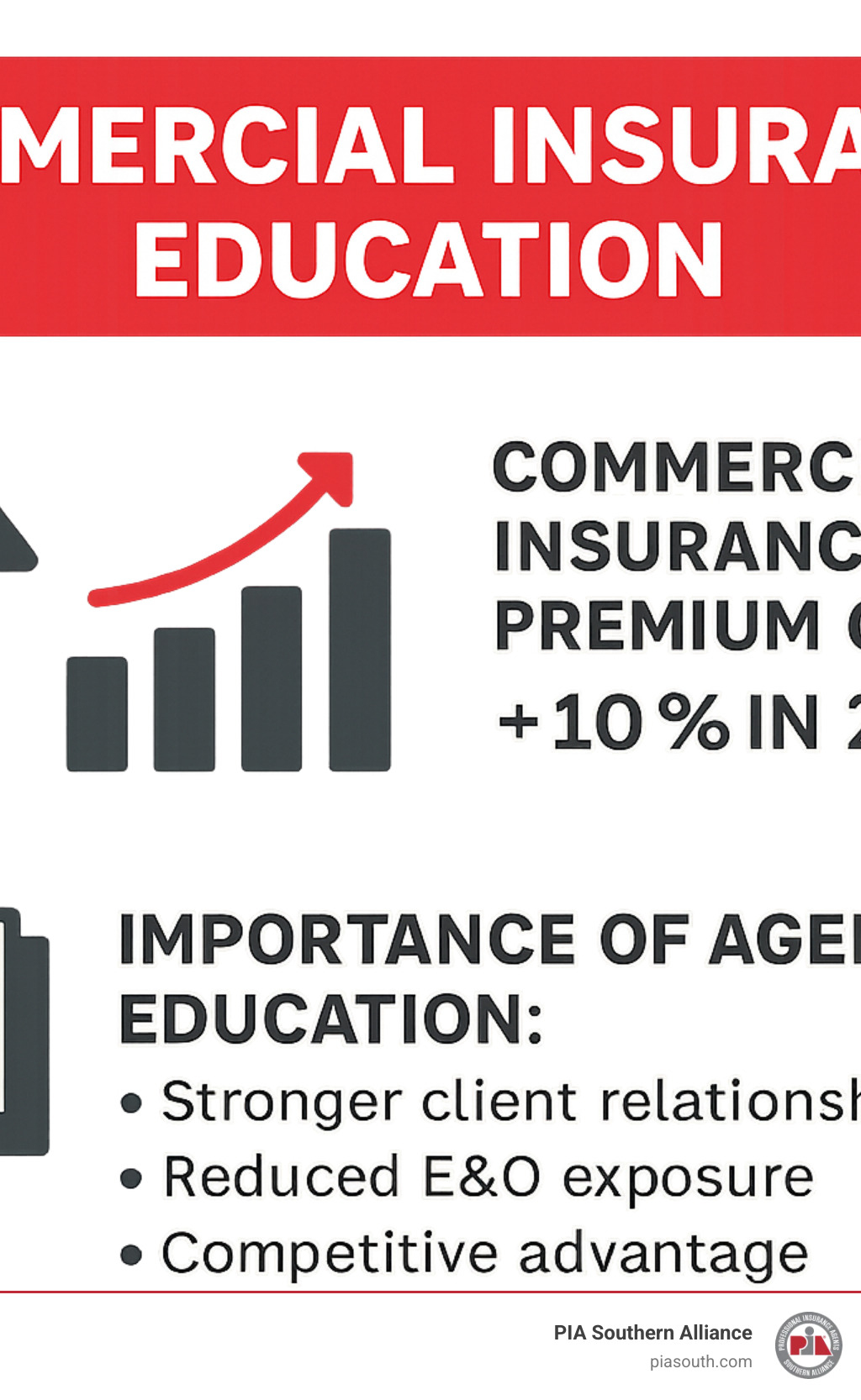
Stronger client relationships naturally develop when you can confidently analyze exposures and recommend custom solutions. Clients recognize and appreciate the difference between an order-taker and a knowledgeable advisor who truly understands their business challenges.
E&O exposure decreases significantly when you thoroughly understand policy language and coverage nuances. Many errors and omissions claims stem from knowledge gaps that could have been filled through proper education.
Your competitive advantage grows in a marketplace where many agents offer similar products. Your expertise becomes the differentiator that wins and retains valuable commercial accounts.
Revenue growth follows as commercial accounts typically generate higher premiums and better retention rates than personal lines. The investment in education pays dividends through a stronger book of business.
Perhaps most importantly, there’s genuine personal satisfaction in mastering complex concepts and using that knowledge to protect the businesses that form the backbone of your community.
Building commercial lines expertise isn’t a destination but an ongoing journey. By embracing lifelong learning and continuous professional development, you position yourself and your agency for lasting success in the commercial marketplace.
PIA Southern Alliance stands ready to support your growth with specialized resources designed specifically for agents in Georgia, Alabama, and Mississippi. From foundational courses to advanced webinars, our comprehensive training programs are crafted to help you build and maintain the expertise your commercial clients deserve and expect.
In commercial insurance, your knowledge truly is your most valuable asset. Invest in it wisely, nurture it consistently, and watch how the returns benefit both your clients and your agency for years to come.