
Navigating Your Professional Growth Journey
Commercial insurance continuing education is essential for insurance professionals who want to maintain their licenses and advance their careers. Here’s what you need to know:
| CE Requirements | Delivery Methods | Benefits |
|---|---|---|
| • Most states require 24 hours every 2 years | • Online self-study | • License maintenance |
| • Typically includes 3+ ethics hours | • Live webinars | • Professional advancement |
| • Georgia, Alabama, Mississippi have specific requirements | • In-person workshops | • Industry knowledge |
| • Deadlines align with license renewal | • Subscriptions | • Competitive edge |
The landscape of commercial insurance is constantly evolving, with new regulations, emerging risks, and changing client needs. Staying current through continuing education isn’t just about meeting state requirements—it’s about delivering the highest level of service to your clients and positioning yourself as a trusted advisor.
Why continuing education matters:
- Maintains your professional license
- Keeps you informed about industry changes
- Improves your expertise and credibility
- Provides opportunities for specialization
- Helps you better serve your clients’ complex needs
What happens if you don’t comply?
In states like Georgia, failing to complete required CE hours can result in fines (typically $50 per deficient hour) and eventually license inactivation. Most states provide a grace period after expiration, but catching up often comes with penalties.
As a member of the PIA Southern Alliance, we understand the challenges independent agents face in balancing daily operations with professional development requirements. Our organization specializes in providing relevant commercial insurance continuing education to help agents across Georgia, Alabama, and Mississippi stay compliant while gaining valuable knowledge to better serve their communities.
Commercial insurance continuing education word guide:
– Commercial insurance agent training
– Cross-selling insurance techniques
– ethics course for insurance agents
Understanding Commercial Insurance Continuing Education Requirements
For insurance professionals across Georgia, Alabama, and Mississippi, staying compliant with continuing education requirements is not optional—it’s mandatory for maintaining your license and serving your clients effectively. Commercial insurance continuing education requirements vary by state, but they all share the common goal of ensuring agents remain knowledgeable and ethical in their practice.
“Continuing education isn’t just a box to check—it’s an investment in your professional future and your clients’ security,” notes a veteran insurance educator with over 25 years of experience teaching commercial lines courses.
Let’s break down what you need to know about CE requirements in our southern states:
| State | Total Hours Required | Ethics Requirement | Renewal Period | Grace Period |
|---|---|---|---|---|
| Georgia | 24 hours | 3 hours minimum | Every 2 years | 90 days with penalties |
| Alabama | 24 hours | 3 hours minimum | Every 2 years | 30 days with penalties |
| Mississippi | 24 hours | 3 hours minimum | Every 2 years | 60 days with penalties |
State-Specific Commercial Insurance Continuing Education Requirements
Georgia Requirements
In Georgia, insurance agents need to complete 24 hours of continuing education every two years, with at least 3 hours focused on ethics. The Georgia Insurance Commissioner’s Office doesn’t mess around when it comes to CE compliance—missing your requirements can hit your wallet with a $50 fine per deficient hour.
Georgia gives you a 90-day grace period after your license expires, but here’s the catch—you technically can’t sell or service policies during this time. And if you let that grace period slip by? You’ll be starting the licensing process from scratch, which is about as fun as explaining to a client why their claim was denied.
Alabama Requirements
Alabama agents face similar requirements: 24 hours of CE every two years, including 3 ethics hours. What makes Alabama unique is their “classroom equivalent” rule—at least half of your CE hours need to be completed in a classroom setting or through interactive webinars with live instructors.
The grace period in Alabama is shorter—just 30 days. During this time, writing new business is a no-no, and the Department of Insurance takes violations seriously. Trust us, those penalties aren’t worth the risk!
Mississippi Requirements
Mississippi follows the same pattern of 24 total CE hours (3 for ethics) every two years. The Mississippi Insurance Department consistently emphasizes one thing: don’t wait until the last minute! Submit your CE completion records well before deadlines to avoid processing delays.
With a 60-day grace period, Mississippi sits between its neighboring states in terms of leniency. However, operating with an expired license can lead to some serious consequences that could affect your career for years to come.
For deeper insights into each state’s requirements, our Continuing Education for Insurance Agents resource page has you covered.
Ethical Standards and Regulatory Compliance
Ethics courses aren’t just a required box to check—they’re the backbone of commercial insurance continuing education across all three states. These courses tackle real-world situations you’ll face when advising clients on complex commercial coverage.
“The ethics requirement isn’t just regulatory red tape,” explains an industry compliance expert. “It’s about reinforcing the foundation of trust that the entire insurance industry is built upon.”
Ethics courses typically explore fiduciary responsibilities, proper disclosure practices, and ethical claims handling. They help you steer tricky situations like potential conflicts of interest in commercial sales and important privacy obligations. Knowing how to protect client data isn’t just ethical—it’s essential.
Regulatory compliance courses keep you current on the constantly evolving insurance laws. For commercial agents especially, these changes can significantly impact how you advise clients. Consider how recent cyber liability regulations have transformed commercial data breach coverage recommendations. Without staying current through commercial insurance continuing education, you risk providing outdated—or worse, incorrect—guidance to your clients.

Benefits of Commercial Insurance Continuing Education
Let’s face it – most of us initially pursue commercial insurance continuing education simply to keep our licenses active. But ask any seasoned agent, and they’ll tell you that quality CE delivers far more than just a renewed license. In today’s increasingly complex insurance landscape, ongoing education can be your secret weapon for professional success.
Staying Current with Industry Trends
Remember when cyber liability was barely on our radar? Or when pandemic-related business interruption wasn’t something we discussed with every commercial client? The commercial insurance world transforms rapidly, and yesterday’s knowledge quickly becomes outdated.
Through thoughtful commercial insurance continuing education, you gain valuable insights into emerging risks that your clients may not even know they face. From ransomware attacks targeting small businesses to supply chain vulnerabilities exposed by global disruptions, staying informed helps you protect your clients before problems arise.
Understanding market cycles becomes second nature when you regularly engage in quality CE. When you can confidently explain to clients why their premiums have increased during a hardening market – and what strategies might help mitigate those increases – you transform from “just an agent” into a trusted advisor.
One of our PIA Southern Alliance members in Alabama recently shared: “After completing a course on emerging cyber risks, I identified a significant coverage gap for my commercial client’s online retail operation. This findy not only protected them from a potentially devastating loss but also strengthened our relationship and led to referrals for three new commercial accounts in the same industry.”
The regulatory landscape shifts constantly too. Whether it’s changes to workers’ compensation in Mississippi or new data privacy regulations affecting Georgia businesses, your CE hours help you steer these changes with confidence and guide your clients accordingly.
Enhancing Professional Skills
Beyond technical knowledge, commercial insurance continuing education helps you develop crucial professional skills that make you more valuable to both clients and employers.

Quality CE programs strengthen your risk assessment abilities, helping you identify exposures that less-educated agents might miss. Your communication skills improve as you learn to translate complex insurance concepts into language clients can understand – a skill that’s particularly valuable when explaining complicated commercial coverages.
Your analytical thinking sharpens with each course, enhancing your ability to compare different coverage options and make sound recommendations custom to each client’s unique situation. Many agents also find the value of developing specialized expertise in specific industries like construction, manufacturing, or professional services.
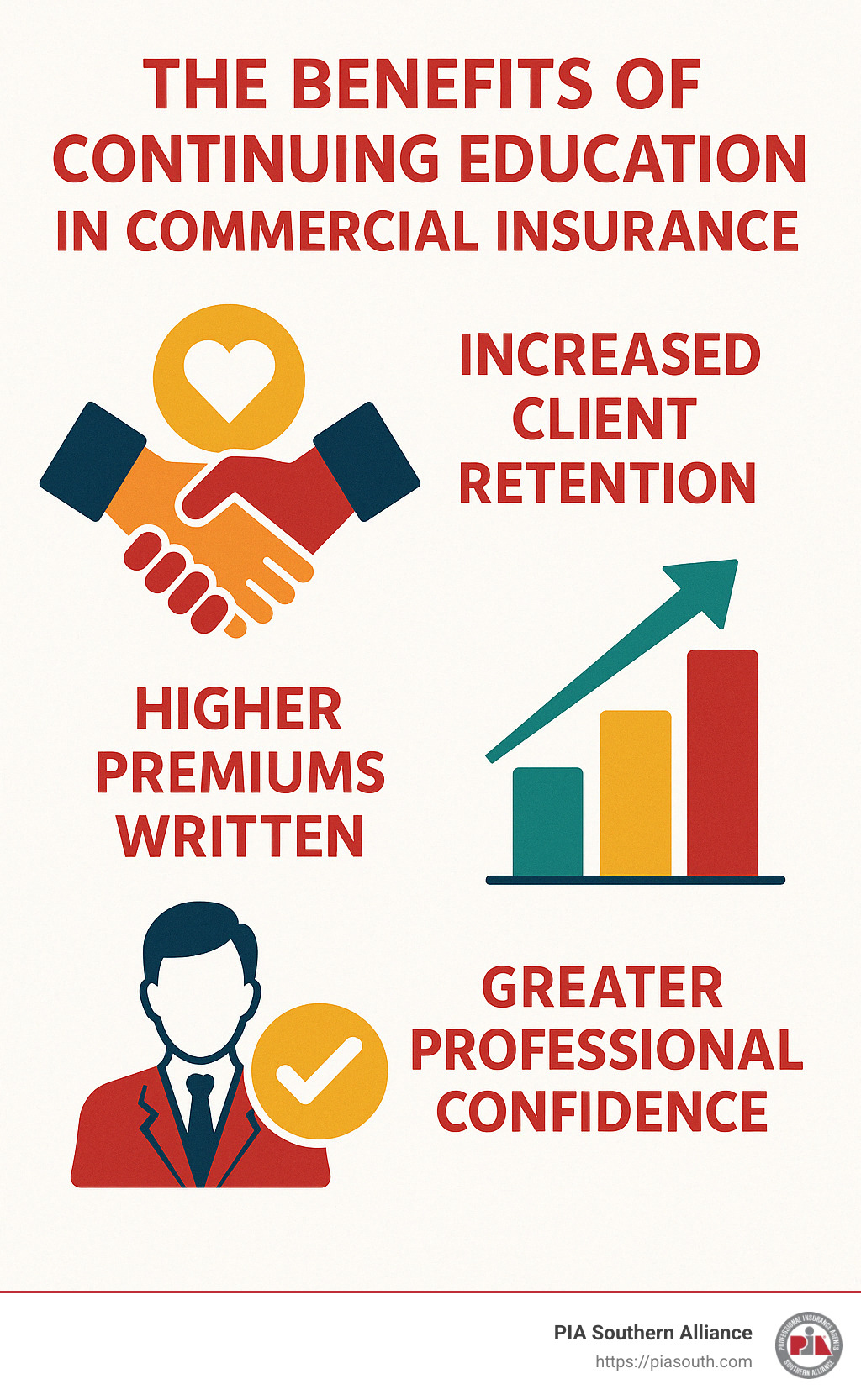
“Continuing education is essential for professionals to maintain their competitive edge,” notes a risk management professor at a leading southeastern university. “The agents who invest in ongoing learning consistently outperform their peers in client retention and new business development.”
The truth is simple: in commercial insurance, your knowledge directly correlates with your value. When you understand the nuances of various coverage forms, exclusions, and endorsements, you can craft solutions that truly protect your clients’ businesses. That expertise doesn’t just happen – it’s built one CE hour at a time.
And let’s not forget the confidence boost that comes from knowing your stuff. Walking into a meeting with a complex commercial client feels entirely different when you’ve recently completed relevant education. That confidence translates into trust, and trust translates into long-term client relationships and referrals.
For more insights on how continuing education impacts insurance professionals, check out the Insurance Information Institute’s resources on professional development.
Exploring CE Options: Online vs. In-Person Commercial Insurance Continuing Education

The world of commercial insurance continuing education has transformed dramatically in recent years. Gone are the days when your only option was sitting in a classroom for hours on end! Today’s insurance professionals can choose learning formats that match their personal style, schedule demands, and career goals.
Let’s take an honest look at how these options stack up:
| Online Learning | In-Person Learning |
|---|---|
| Self-paced flexibility | Structured environment |
| Learn anywhere, anytime | Face-to-face interaction |
| Often more affordable | Networking opportunities |
| Immediate access to materials | Hands-on learning activities |
| Can be completed in smaller time blocks | Fewer distractions |
| May include interactive elements | Direct Q&A with instructors |
Advantages of Online Commercial Insurance Continuing Education Courses
Remember the days of having to block off entire workdays for CE? For many agents across Georgia, Alabama, and Mississippi, online learning has been nothing short of revolutionary.
The beauty of digital courses lies in their flexibility. Had a crazy day with clients? No problem – you can tackle that cyber liability module after dinner. Unexpected meeting pop up? Simply pause your course and return when things settle down. This kind of adaptability is priceless for independent agents juggling multiple responsibilities.
“I used to dread CE season,” shares a veteran agent from rural Alabama. “Now I actually look forward to it. I can learn at my own pace, in my comfy chair, with my dog snoring next to me. And I’m absorbing more than I ever did in those marathon classroom sessions.”
Today’s online commercial insurance continuing education goes far beyond dry text on a screen. The best platforms offer engaging videos, interactive case studies, and even simulated client scenarios that test your knowledge in practical ways. Many include discussion forums where you can connect with other learners and instructors.
For agents in more remote areas of our three-state region, online learning eliminates long drives and overnight stays. One Mississippi agent told us she saves nearly $1,000 annually on travel expenses alone since switching to online CE.
The immediate verification is another plus – no more waiting weeks for your completion certificate to arrive in the mail. Most platforms now provide instant documentation you can submit to your state licensing authority.
Want to explore quality online options? Check out our Insurance Continuing Education Webinars for courses specifically designed for southern agents.
Benefits of In-Person Classes and Workshops
While online learning has clear advantages, there’s still something special about gathering with fellow insurance professionals in a physical classroom. Many agents find tremendous value in the connections and energy that come from face-to-face learning environments.
The networking aspect alone can be worth the extra effort. Think about it – where else can you spend a day surrounded by other insurance professionals facing the same challenges you are? These connections often lead to referral partnerships, mentoring relationships, and sometimes even friendships that last throughout your career.
“I met my best commercial lines placement connection at a CE workshop in Atlanta,” shares a Georgia agent. “We were paired up for a claims scenario exercise, hit it off, and now I have someone I can call when I’m struggling with hard-to-place manufacturing risks. That relationship has been worth tens of thousands in commission over the years.”
In-person settings also create a dedicated learning space free from the distractions of your office. No ringing phones, client emergencies, or administrative fires to put out – just focused time to improve your knowledge and skills.
The interactive elements of classroom learning can be particularly valuable for complex commercial topics. Role-playing exercises for client conversations about cyber liability, group discussions about contractors’ professional liability exposures, or hands-on policy form comparisons often stick better when experienced in person.
Many agents find they retain information better when they can raise their hand and ask questions in real time. That immediate clarification can make the difference between truly understanding a complex concept and just skimming the surface.
In-person learning shines brightest for nuanced topics like:
– Environmental liability exposures
– Complex business income calculations
– Construction defect coverage analysis
– Professional liability for specialized industries
– Multi-state workers’ compensation compliance challenges
Whether you prefer the convenience of online learning or the engagement of in-person workshops, the key is choosing options that fit your learning style and professional goals. Many of our most successful members actually mix both approaches – using online courses for basic requirements and attending in-person events for complex topics or networking opportunities.
At PIA Southern Alliance, we’re committed to providing quality education in whatever format works best for you. After all, the goal isn’t just checking the CE box – it’s becoming the kind of knowledgeable, confident agent that clients trust with their most valuable assets.
Selecting the Right Commercial Insurance Continuing Education Provider
With so many options available, choosing the right provider for your commercial insurance continuing education needs is a bit like finding the perfect pair of shoes – it needs to fit just right. The quality of your CE experience directly impacts not just your compliance status, but your professional growth as well.

Ensuring State-Specific Compliance
Let’s face it – the most crucial factor when selecting a CE provider isn’t the fancy website or the clever course titles. It’s making sure their courses are actually approved in your state. Each state’s insurance department maintains a list of approved providers and courses, and you don’t want to waste time on courses that won’t count.
I remember talking to an agent from Birmingham who learned this lesson the hard way: “I completed 24 hours with a provider only to find they weren’t approved in Alabama. Now I always verify state approval before enrolling.” Talk about a frustrating experience!
When evaluating a provider, always check their state approval status first. Legitimate providers will proudly display state-specific approval codes for each course – if you can’t find this information easily, that’s a red flag. Also pay attention to how they handle credit reporting. Some providers automatically report your completion to state authorities, while others leave you to submit documentation yourself. The automatic option saves you a headache (and potentially a missed deadline).
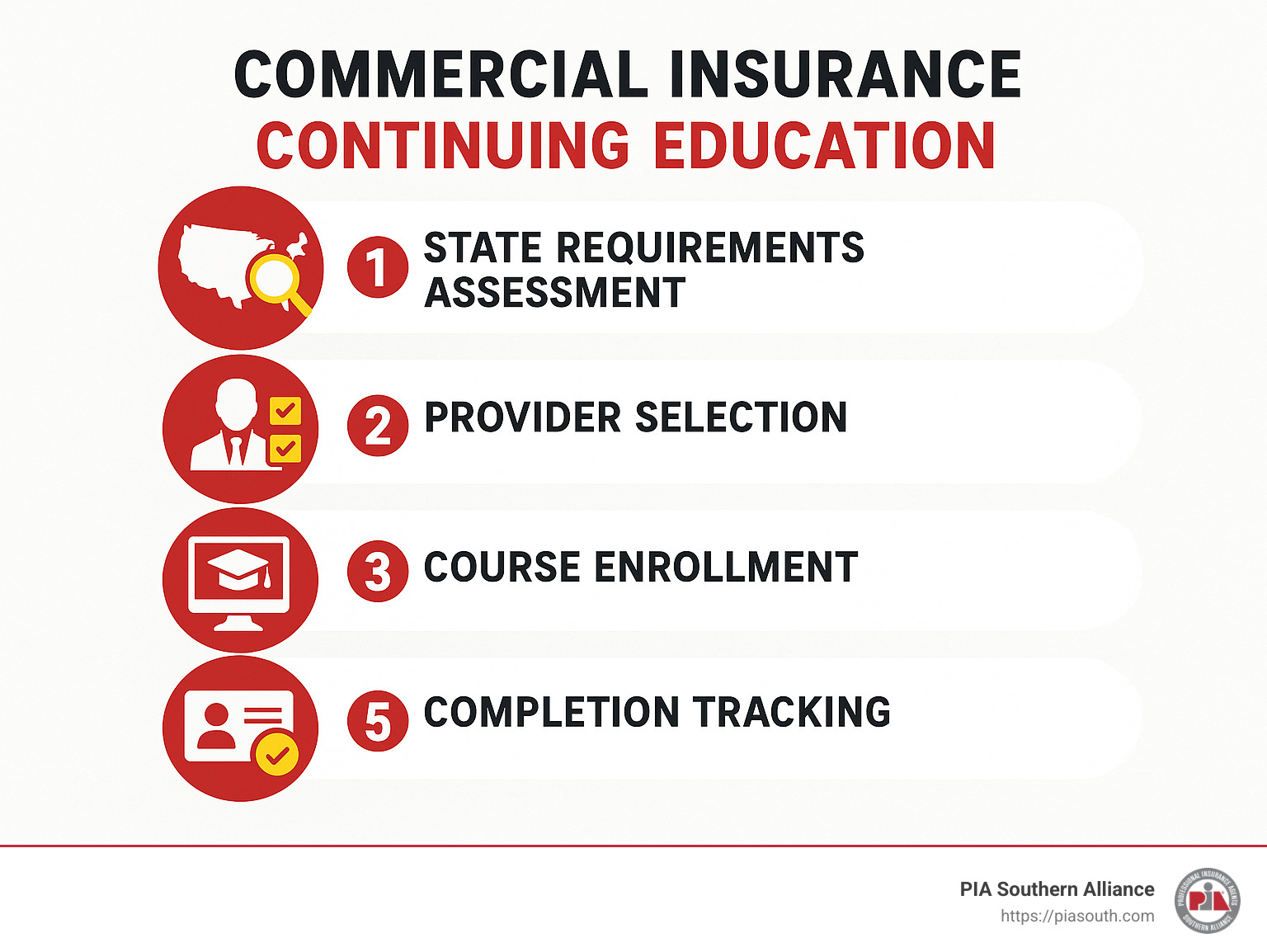
Another important factor is completion tracking. The best providers offer clear systems to track your progress toward meeting state requirements, so you’re never left wondering, “How many ethics hours do I still need?”
At PIA Southern Alliance, we understand these concerns. All our courses meet the specific requirements of Georgia, Alabama, and Mississippi, giving you confidence that your valuable time is spent on CE that actually counts toward your license requirements.
Evaluating Course Content and Quality
Beyond basic compliance, let’s talk about what really matters – the educational value of your CE experience. Not all courses are created equal, and the difference between checking a box and genuinely improving your professional skills can be enormous.
“The difference between mediocre and excellent CE is huge,” shared a commercial lines manager from Jackson. “I look for courses that challenge me to think differently about risks and coverage solutions, not just recite basic information I already know.”
When evaluating potential CE providers, instructor credentials should be at the top of your list. Courses taught by experienced industry professionals with relevant designations and practical experience will offer insights you can’t get from theoretical knowledge alone. These instructors can share real-world examples that help concepts stick.
Content relevance is equally important. The commercial insurance landscape is constantly evolving – from emerging cyber risks to changing climate concerns affecting property coverage. Choose courses that address current trends, challenges, and opportunities you’re actually seeing in your daily work with clients.
Your personal learning style matters too. Some of us learn best by reading, others through video instruction, and still others through interactive exercises. Select providers whose teaching methods align with how you learn best. And don’t forget to check course reviews from other insurance professionals who’ve taken the courses – they’ll give you the unvarnished truth about what to expect.
Finally, look at what supporting materials are offered. Quality providers go beyond the basic course to offer comprehensive handouts, reference guides, and additional resources you can use with clients long after the course is complete.
For more information about our commercial insurance training offerings, visit our Commercial Insurance Agent Training page.
Overcoming Challenges in Completing CE Requirements
Let’s face it – even with the best intentions, keeping up with commercial insurance continuing education requirements can be challenging. Between serving clients, managing day-to-day operations, and balancing personal commitments, finding time for CE often falls to the bottom of the priority list.
“I used to be a last-minute CE crammer,” admits a veteran commercial agent from Atlanta. “I’d realize my license renewal was weeks away and panic. Now I have a system that makes the whole process painless – and I actually learn more too.”
The good news? With some practical strategies and a bit of planning, you can transform CE from a dreaded obligation into a valuable part of your professional routine.
Tips for Successfully Completing CE Courses
The key to stress-free continuing education is treating it as an ongoing process rather than a periodic emergency. Think of it like maintaining your car – regular small investments prevent major breakdowns.
Start by creating a simple CE calendar that works backward from your license renewal date. If you need 24 hours every two years, that’s just one hour per month – completely manageable when spread out. Block this time on your calendar and protect it like you would an important client meeting.
Consider your learning style when selecting courses. Are you a morning person who thinks clearly at dawn? Schedule short study sessions before your workday begins. Night owl? Perhaps evening webinars work better. Align your CE with your natural energy patterns for maximum retention and minimum stress.
Many successful agents find ways to make CE more enjoyable. A commercial lines specialist from Birmingham shares: “I turn CE into a social activity by forming a study group with other local agents. We meet monthly to complete online modules together, discuss the content, and share how we’re applying it with clients. It’s become something I actually look forward to.”
Connecting CE topics to your business goals can transform it from a chore to an investment. If you’re looking to expand into cyber liability, courses on data breach coverage suddenly become more engaging. If construction risks dominate your book, advanced builders’ risk courses directly impact your daily work.
Don’t underestimate the power of a distraction-free environment. When it’s CE time, silence your phone, close unnecessary browser tabs, and communicate your unavailability to colleagues. These small boundaries can dramatically improve your efficiency and retention.
Leveraging Employer Support
Independent insurance agencies increasingly recognize that well-educated agents deliver better client outcomes and generate more premium. If you’re part of an agency rather than a sole proprietor, explore what support might be available to you.
Many agencies now view commercial insurance continuing education as a strategic investment rather than just a regulatory requirement. An agency owner from Jackson explains: “We budget for our commercial producers to complete at least 30 hours annually – beyond the state minimum. We’ve tracked the results for years and see a direct correlation between advanced education and premium growth.”
Look for agencies that offer paid time for CE completion during work hours. Some forward-thinking firms dedicate specific days each quarter to professional development, bringing in instructors for team learning that qualifies for CE credit while building agency-wide expertise.
Even if your agency doesn’t have a formal CE program, don’t hesitate to start the conversation. Present continuing education as a business investment with tangible returns – improved client retention, improved cross-selling capabilities, and reduced E&O exposure through more knowledgeable recommendations.
For independent agents without agency support, professional organizations like PIA Southern Alliance offer valuable resources. Our member community provides both formal educational opportunities and informal peer support to help you stay on track with your CE goals.
The ultimate beneficiaries of your continuing education are your clients. When you approach CE as a client service improvement rather than a regulatory burden, the motivation becomes intrinsic rather than forced. As one Mississippi agent put it: “When I reframed CE as something I do for my clients rather than for the state, my whole attitude changed.”
Maximizing Value from Commercial Insurance CE Courses
The true value of commercial insurance continuing education goes well beyond simply checking a box for license renewal. When approached strategically, CE can transform your professional capabilities and significantly boost your business success.
Cost-Effective Strategies for CE
Let’s face it – continuing education costs money, but there are smart ways to get the most bang for your buck without compromising quality.
Professional associations like PIA Southern Alliance often include CE credits as part of membership packages – essentially giving you “free” education that’s already bundled into your dues. This alone can save hundreds of dollars annually compared to purchasing courses individually.
Many agents I’ve spoken with have found significant savings through bundle discounts. Rather than buying courses one at a time, look for providers offering package deals that align with your renewal cycle. Some platforms even offer subscription models with unlimited access to courses for a fixed annual fee – particularly economical if you’re pursuing designations or specializations beyond minimum requirements.
“I used to shop exclusively based on price,” shares a commercial lines agent from Savannah. “Now I evaluate CE based on the potential business impact. A $200 course that helps me write just one additional commercial account is an incredible return on investment.”
For in-person workshops (which remain valuable for networking despite online options), coordinate with colleagues to share travel expenses. Carpooling to a CE event in Atlanta or Birmingham not only saves money but creates valuable time for professional discussion.
Don’t overlook early bird pricing either – many providers offer substantial discounts for planning ahead, which aligns perfectly with the proactive approach successful agents take toward their education requirements.
For more information about cost-effective training options that deliver real business value, visit our Commercial Insurance Sales Training page.
Integrating Essential Topics into Learning
The most successful insurance professionals approach commercial insurance continuing education with intention, creating a personal curriculum that builds complementary knowledge and skills rather than randomly selecting courses to meet hour requirements.
Ethics and professional responsibility courses deserve more than the minimum attention required by state regulations. Beyond compliance, these courses help you steer complex situations involving competing interests, disclosure requirements, and client advocacy – particularly valuable in commercial insurance where large sums and business viability often hang in the balance. A thoughtful approach to ethics can distinguish you from competitors who view these courses as mere obligations.
Risk management fundamentals form the backbone of truly consultative commercial insurance service. Understanding how to systematically identify, analyze, and treat risks helps you transition from policy salesperson to trusted risk advisor – a change commercial clients increasingly demand. Agents who can speak the language of risk management connect more effectively with risk managers and financial officers at prospective commercial accounts.
Courses addressing emerging risks and coverage innovations keep you ahead of the curve. From cyber liability to supply chain disruption to climate-related property exposures, the commercial risk landscape evolves constantly. One Mississippi agent told me, “I make sure at least 25% of my CE focuses on emerging risks. This forward-looking approach has helped me identify coverage gaps for clients before they become claims problems.”
Industry-specific knowledge can be a powerful differentiator. Rather than being a generalist, consider using CE to develop expertise in particular industries thriving in Georgia, Alabama, or Mississippi – whether that’s manufacturing, healthcare, construction, or agriculture. Clients value advisors who understand their business operations and industry-specific exposures.
Don’t overlook courses that improve your sales and communication skills. Technical insurance knowledge only creates value when effectively communicated to clients. Courses that improve your ability to explain complex coverage concepts, negotiate effectively, and build lasting relationships complement technical insurance topics beautifully.
The most successful commercial insurance professionals don’t view CE as a checkbox exercise but as a strategic investment in their professional toolkit. By thoughtfully selecting courses that build upon each other and address both current needs and future opportunities, you transform required hours into genuine competitive advantage.
At PIA Southern Alliance, we’re committed to helping agents across Georgia, Alabama, and Mississippi maximize the value of their continuing education investments through relevant, practical courses designed specifically for the challenges of today’s commercial insurance marketplace.
Frequently Asked Questions about Commercial Insurance Continuing Education
What are the CE requirements for commercial insurance agents in Georgia, Alabama, and Mississippi?
If you’re navigating commercial insurance continuing education across our southern states, you’ll find some consistent patterns with important nuances.
All three states—Georgia, Alabama, and Mississippi—require 24 hours of continuing education every two years for most license types, with at least 3 of those hours focused on ethics. Your specific deadline will align with your personal license renewal date, so marking this on your calendar is essential.
Georgia tends to be the strictest when it comes to enforcement, imposing a $50 fine per deficient hour if you miss your requirements. They do provide a 90-day grace period to catch up, but during this time, you technically shouldn’t be conducting insurance business. Alabama offers a shorter 30-day grace period, while Mississippi gives you a more generous 60 days to get back on track.
It’s worth noting that certain specialized licenses may have different requirements. For instance, Georgia’s limited lines agents need only 10 hours of CE rather than the standard 24. Since regulations can evolve, it’s always wise to verify current requirements directly with your state’s insurance department or through our resources at PIA Southern Alliance.
“I thought I was on top of my CE until my renewal notice showed I was short on ethics hours,” shares one Alabama agent. “Now I complete my ethics requirement first thing after renewal—peace of mind is worth it!”
How do online CE courses compare to in-person classes in terms of effectiveness?
The good news is that both learning formats can be equally effective when they’re well-designed and when you fully engage with the material. Your personal learning style and schedule will likely influence which option works best for you.
Online courses shine in the convenience department. The flexibility to complete modules during slow periods at the office or in the evening after your kids are asleep can be a game-changer for busy agents. Modern online courses have evolved beyond simple text and now include interactive elements like videos, simulations, and knowledge checks that can make learning more engaging. That said, they do require self-discipline—it’s easy to procrastinate when there’s no scheduled class time.
In-person classes offer unique benefits that many agents still value highly. The structured environment minimizes distractions, and having an instructor physically present means you can ask questions and get immediate clarification on complex commercial insurance concepts. Perhaps most valuable are the networking opportunities—many agents report forming valuable professional relationships during breaks or discussions at in-person CE events.
Many successful insurance professionals find that mixing both formats gives them the best results. One Georgia agent explains her approach: “I use online courses for most of my basic requirements, but I always attend in-person workshops for advanced commercial topics like cyber liability or construction defect coverage. The discussions that happen in those rooms are as valuable as the formal content.”
For more research on learning effectiveness in professional education, the Journal of Insurance Regulation regularly publishes studies comparing different educational approaches in the insurance industry.
How can I ensure that a CE provider’s courses meet my state’s requirements?
There’s nothing more frustrating than completing hours of education only to find they don’t count toward your license requirements. Here’s how to avoid that situation:
First, always check the state approval status of any provider you’re considering. Georgia, Alabama, and Mississippi each maintain searchable databases on their insurance department websites where you can verify approved providers and courses. This should be your first stop before registering for any course.
Look for specific course approval numbers—legitimate providers will prominently display these state-specific codes for each course they offer. These numbers are your assurance that the course has been reviewed and approved by your state’s regulatory authority.
Be careful to verify that the course offers the right type and amount of credit you need. For example, an ethics course approved in Georgia for 3 hours won’t help if you need general commercial lines credit in Alabama.
Understanding the reporting procedures is also critical. Some providers automatically report your completion to state authorities, while others may provide certificates that you must submit yourself. Knowing the process helps ensure your hours get properly credited.
When in doubt, don’t hesitate to request verification before payment. A reputable provider should be happy to confirm their approval status and provide documentation if needed.
At PIA Southern Alliance, we take the guesswork out of this process by maintaining current approvals across Georgia, Alabama, and Mississippi. Our team can help you verify that any course you’re considering will satisfy your specific license requirements—just one more way we support independent agents throughout their professional journeys.
“After learning my lesson the hard way with an unapproved provider,” shares a Mississippi agent, “I now only trust established organizations with proven track records in our region. The peace of mind is worth any small difference in price.”
Conclusion
Commercial insurance continuing education is more than just checking boxes for license renewal—it’s an investment in your professional growth and your ability to serve clients with excellence. In today’s rapidly changing insurance landscape, agents who accept ongoing education position themselves as trusted advisors rather than mere policy salespeople.
The journey of professional development in commercial insurance never truly ends. Each new course, webinar, or workshop adds another layer to your expertise, helping you steer the complex world of business risks and coverage solutions with greater confidence and skill.
When you approach your CE requirements strategically—understanding your state’s specific rules, choosing quality providers, and selecting courses that align with your career goals—you transform a regulatory obligation into a competitive advantage. Whether you thrive in the flexibility of online learning or prefer the dynamic interaction of in-person classes, the key is engaging consistently with relevant, challenging content.
At PIA Southern Alliance, we understand the unique challenges facing independent insurance agents across Georgia, Alabama, and Mississippi. That’s why we’ve developed educational resources specifically designed to improve your commercial insurance knowledge and practical skills. Our courses go beyond basic concepts to address the real-world scenarios you face when advising business clients.
The knowledge you gain through quality commercial insurance continuing education directly impacts your ability to protect your clients’ businesses and livelihoods. When you can confidently explain complex coverage options, identify potential gaps, and recommend appropriate solutions, you become an indispensable resource in your clients’ risk management strategy.
In commercial insurance, your expertise is your most valuable offering. Every hour spent expanding your knowledge isn’t just about maintaining a license—it’s about building a successful, sustainable career as a trusted insurance advisor who makes a real difference for business clients.
We’re proud to support your professional journey with comprehensive Commercial Insurance Training Programs designed specifically for independent agents in our southern states. We encourage you to view our Education Calendar for upcoming CE opportunities that will help you stay ahead in your career and better serve your commercial clients.
Your commitment to ongoing education doesn’t just benefit you—it strengthens the entire independent agency system and the businesses that rely on your expertise. Let’s continue growing together.