
Why Commercial Insurance Certificate Programs Are Your Fast Track to Success
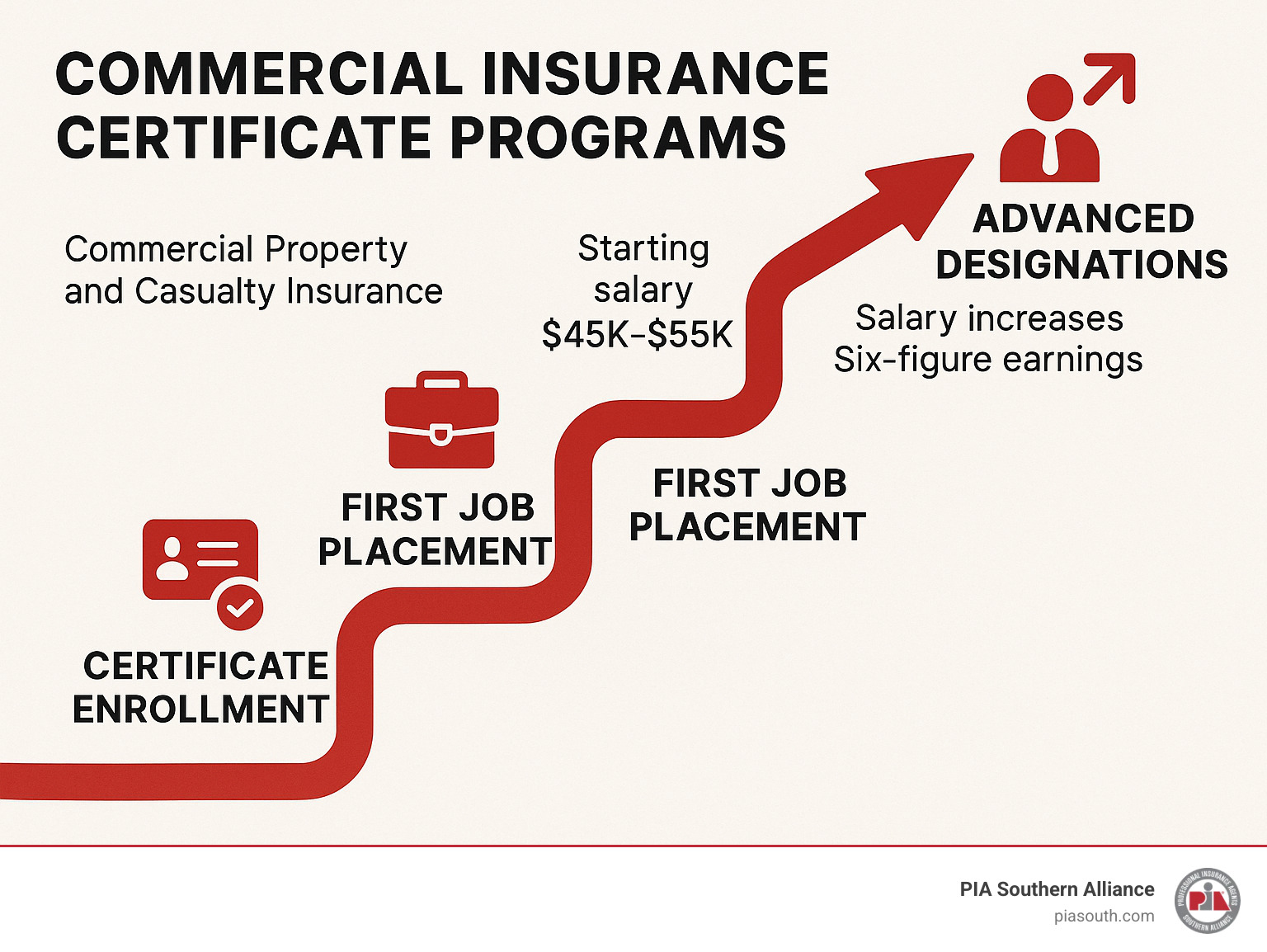
Commercial insurance certificate programs offer the quickest path to enter the lucrative property and casualty insurance industry, with starting salaries ranging from $45,000 to $55,000 and five-year earnings reaching six figures. These focused educational programs bridge the talent gap in an industry where 30% of the workforce is preparing to retire within the next five years.
Top Commercial Insurance Certificate Programs include:
- Ontario College Programs – 8-month certificates with 95% job placement rates
- Industry Association Certificates – IBAO, Insurance Institute programs (15-40 hours)
- Micro-Credentials – 3-month accelerated programs with RIBO licensing
- Hybrid Bootcamps – Virtual learning with hands-on mentorship
- Specialized Designations – AINS and CIP pathway programs
The insurance industry faces a critical talent shortage, making this an ideal time for career switchers, recent graduates, and personal lines agents looking to expand into commercial coverage. With 94% of industry professionals reporting pride in their work, commercial insurance offers both financial stability and personal fulfillment.
Most programs require only a high school diploma and basic math skills, though a risk management degree provides the strongest foundation for long-term success. Programs typically run 3-12 months and combine technical insurance knowledge with practical skills like underwriting, claims handling, and client relationship management.
As someone who has spent years promoting the highest standards of care for independent agents across Georgia, Alabama, and Mississippi, I’ve seen how commercial insurance certificate programs transform careers and strengthen agencies. The PIA Southern Alliance continues to champion professional development as the key to protecting both agents and their communities.
Commercial insurance certificate programs helpful reading:
– health insurance certification programs
– insurance agent license
– insurance certifications
Understanding Commercial Insurance Certificates
Commercial insurance certificate programs work like professional micro-credentials – they’re your proof that you understand commercial property and casualty insurance. For agents across Georgia, Alabama, and Mississippi, they’re becoming the go-to way to quickly build expertise needed to serve business clients confidently.
The Chartered Insurance Professional (CIP) designation is widely respected, and if you’re thinking about working in Canada, the Registered Insurance Brokers of Ontario (RIBO) Level 1 license is required for commercial brokers. Each state has its own licensing requirements, but the foundation knowledge remains remarkably similar.
Latest research on certificate completion rates shows that people who choose structured programs are much more likely to finish their training and land good jobs compared to those who try self-study.
Why “commercial insurance certificate programs” are booming
Right now, 30% of our industry’s workforce is planning to retire within the next five years – the biggest knowledge transfer challenge our industry has ever faced. This creates incredible opportunities for newcomers.
Commercial insurance certificate programs graduates typically start earning between $45,000 and $55,000, and within five years, most are making six-figure salaries. Plus, insurance is famously recession-proof, which means steady work even when other industries struggle.
Today’s commercial risks are more complex than ever. Cyber attacks, climate change, supply chain disruptions – these weren’t major concerns for the previous generation. Certificate programs focus on current, real-world challenges that agents face every day.
Who should explore commercial insurance certificate programs
Recent graduates often find these programs bridge the gap between classroom theory and real-world practice. If you have a risk management degree, you’re already ahead – that’s the most closely aligned educational background for insurance careers.
Personal lines agents make up a big chunk of certificate program students. You already understand insurance basics, but commercial coverage is different. These programs help you expand your services and significantly boost your earning potential.
Career switchers often surprise themselves with how well their previous experience applies. Whether you’ve worked in retail, manufacturing, or professional services, you already understand business risks from the inside.
Types of Credentials & Admission Essentials
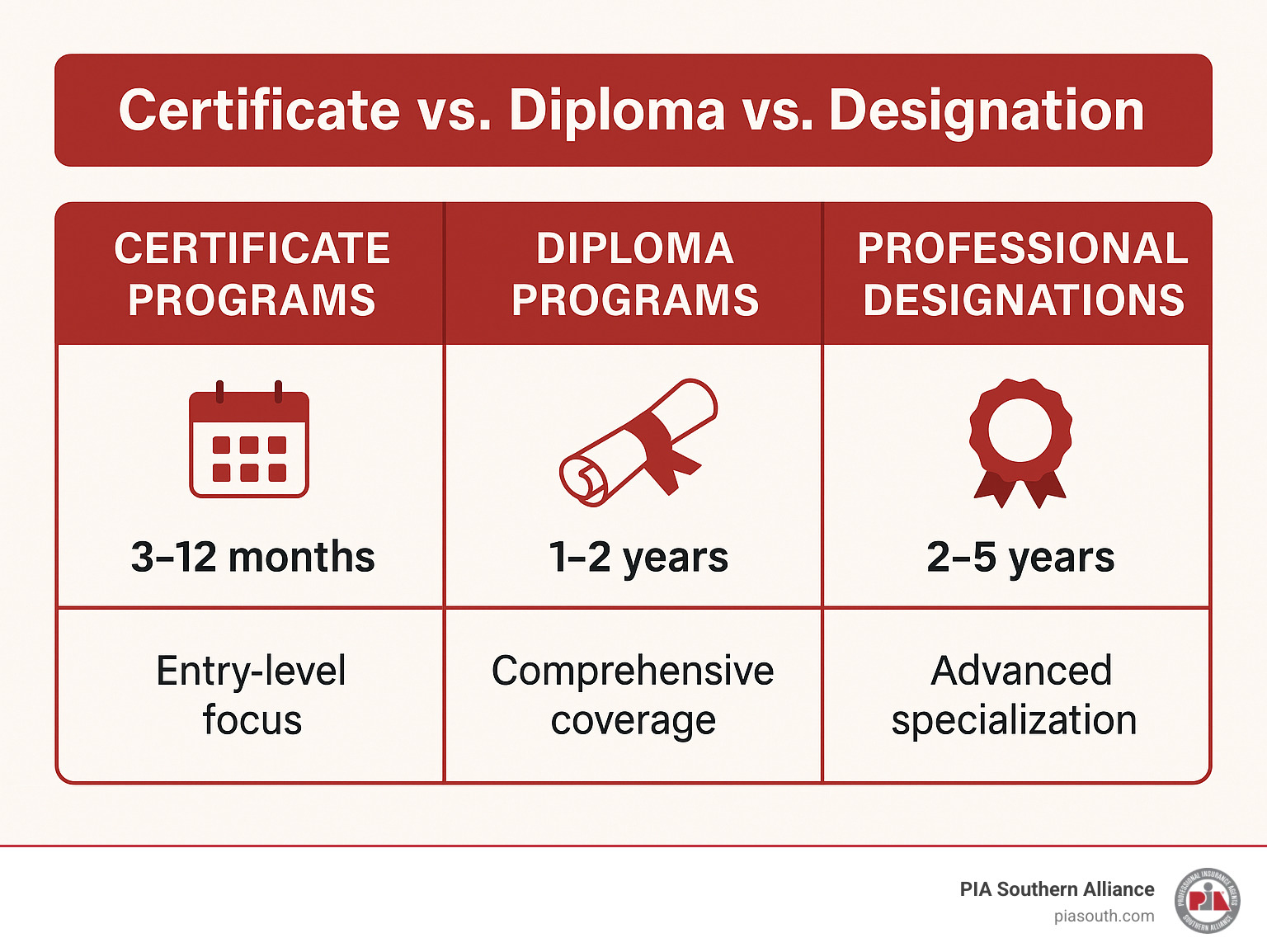
When you’re looking at commercial insurance certificate programs, it helps to understand where they fit in the bigger picture of insurance education. The insurance education world has three main levels: certificates, diplomas, and professional designations.
A risk management degree remains the gold standard for insurance careers, providing the deepest foundation in risk theory and regulatory frameworks. But certificate programs get you job-ready skills without the massive time commitment. Most programs expect you to have a high school diploma and solid English and math skills.
Certificate vs. Diploma vs. Designation: where “commercial insurance certificate programs” fit
Commercial insurance certificate programs are the sprint runners of insurance education – usually 3 to 12 months with just 15 to 40 hours of study time. They focus on immediate, practical skills you can use right away.
Diploma programs take 1 to 2 years and cover much broader territory, diving deeper into insurance operations and regulations. Many include credits toward professional designations.
Professional designations like AINS and CPCU take 2 to 5 years and require significant work experience. They’re worth pursuing once you’ve established yourself in the industry.
The beauty of starting with a certificate is that you can always build up. Many professionals begin with a certificate program, gain experience, then pursue diplomas or designations as their careers develop.
Admission checklist for Georgia-Alabama-Mississippi applicants
Educational background is usually simple – you need a high school diploma or equivalent. Some programs prefer candidates with post-secondary education or relevant work experience, but it’s not always required.
Professional requirements vary between programs. Some want you to already work in insurance or have an employer sponsor you. Others welcome career switchers. Background checks are common, especially for programs that prepare you for licensing exams.
State-specific considerations add another layer in Georgia, Alabama, and Mississippi. Alabama requires specific minimum classroom hours for prelicensing education, including at least five hours focused on state law. Georgia and Mississippi have similar requirements that change depending on which lines of authority you’re pursuing.
Choosing the Right Commercial Insurance Certificate Programs
Finding the perfect commercial insurance certificate programs becomes much clearer once you understand what to look for. You need to match the program to your specific needs, schedule, and goals.

Program length varies dramatically. You’ll find intensive 15-hour programs that wrap up in weeks, perfect for agents who need specific skills quickly. Comprehensive 6-month programs include mentorship and real-world field experience.
Delivery format makes a huge difference in your success. Online programs offer maximum flexibility. Hybrid programs blend online learning with live workshops. Traditional in-person programs offer intensive immersion experiences.
For agents across Georgia, Alabama, and Mississippi, More info about Commercial Insurance Training Programs provides detailed guidance on programs specifically designed for our regional market needs.
Key evaluation factors
Accreditation and industry recognition should top your evaluation list. Programs affiliated with established insurance institutes carry more weight with employers and clients. Even better are programs that provide continuing education credits or count toward professional designations.
Field experience components separate theoretical knowledge from practical skills. The most valuable programs include case studies, real-world simulations, or actual field placements. Some programs arrange field experiences with local agencies.
Instructor expertise makes or breaks any educational program. Look for instructors who are active industry professionals, not just academics. You want someone who’s dealt with complex commercial risks recently.
Fast-track and flexible commercial insurance certificate programs
Eight-week intensive courses have become the sweet spot for many working professionals. These programs typically require 6-8 hours of weekly study – manageable alongside a full-time job but intensive enough to build real competency.
Micro-credential approaches break complex commercial insurance topics into bite-sized modules. Instead of feeling overwhelmed, you master one area before moving to the next.
Self-paced modules provide ultimate flexibility for agents with unpredictable schedules. Client emergencies don’t follow a classroom timetable, so having the ability to study when time allows can make the difference between completing a program and dropping out.
Curriculum, Designations & Delivery Modes
The heart of any strong commercial insurance certificate programs lies in its curriculum. Most programs start with underwriting essentials because proper risk assessment is fundamental. You’ll learn how to read applications, spot red flags, and understand what makes one business a great risk while another keeps underwriters concerned.
Commercial auto coverage gets plenty of attention – it’s not just “car insurance for businesses.” Business interruption coverage has become crucial, especially after recent years showed how quickly operations can shut down. The COPE framework – Construction, Occupancy, Protection, and Exposure – becomes your systematic approach to property risk assessment.

Cyber risk education has moved from “nice to know” to “absolutely essential.” Modern programs don’t just teach cyber liability policies – they help you understand how cyber events can trigger traditional property and casualty coverage too.
More info about Insurance Certification Programs offers deeper insights into specific curriculum areas and how they align with industry needs.
Embedded designations you can earn while completing “commercial insurance certificate programs”
Many commercial insurance certificate programs let you work toward immediate practical skills and long-term professional credentials simultaneously.
The Associate in General Insurance (AINS) designation fits perfectly with certificate programs because it covers the same foundational knowledge you need for day-to-day work. Chartered Insurance Professional (CIP) credits through certificate programs represent serious value for Canadian professionals and those working with Canadian markets.
RIBO Level 1 licensing preparation gets embedded into many programs serving agents who work with commercial clients across borders. The genius of embedded designations is studying the same material once instead of twice.
Learning formats that work for busy agents
On-demand eLearning has become the backbone of modern certificate programs. You can pause when a client calls, rewind when something doesn’t click, and study when your brain works best.
Live webinars bring back the human element without the commute. You get real-time answers, hear what challenges other agents face, and benefit from group discussions. Most programs record these sessions too.
Hybrid bootcamps offer structure and interaction. You do knowledge-building online at your own pace, then join intensive workshops where you apply what you’ve learned.
Costs, Funding & Return on Investment
Program costs typically range from $500 for basic certificates to $3,200 for comprehensive programs that include licensing preparation. Most quality programs fall in the $1,200 to $2,000 range.
Beyond tuition, budget for textbooks and examination fees that can add $200 to $500. Many employers sponsor their agents through certificate programs. Smart agencies recognize that investing in their people’s education pays dividends.
For our friends in Canada, OSAP micro-credential funding has opened doors for many professionals. Similar grant programs exist throughout Georgia, Alabama, and Mississippi for qualifying individuals.
Financial-aid options for commercial insurance certificate programs
Scholarship opportunities exist through industry associations and educational institutions. Many go unclaimed simply because people don’t know they exist.
The Canada-Ontario Job Grant covers up to 83% of training costs for eligible employed individuals. Military veterans have excellent options through educational benefits and vocational rehabilitation programs.
Many programs offer payment plans that spread costs over several months, making the investment more manageable.
Calculating payback time
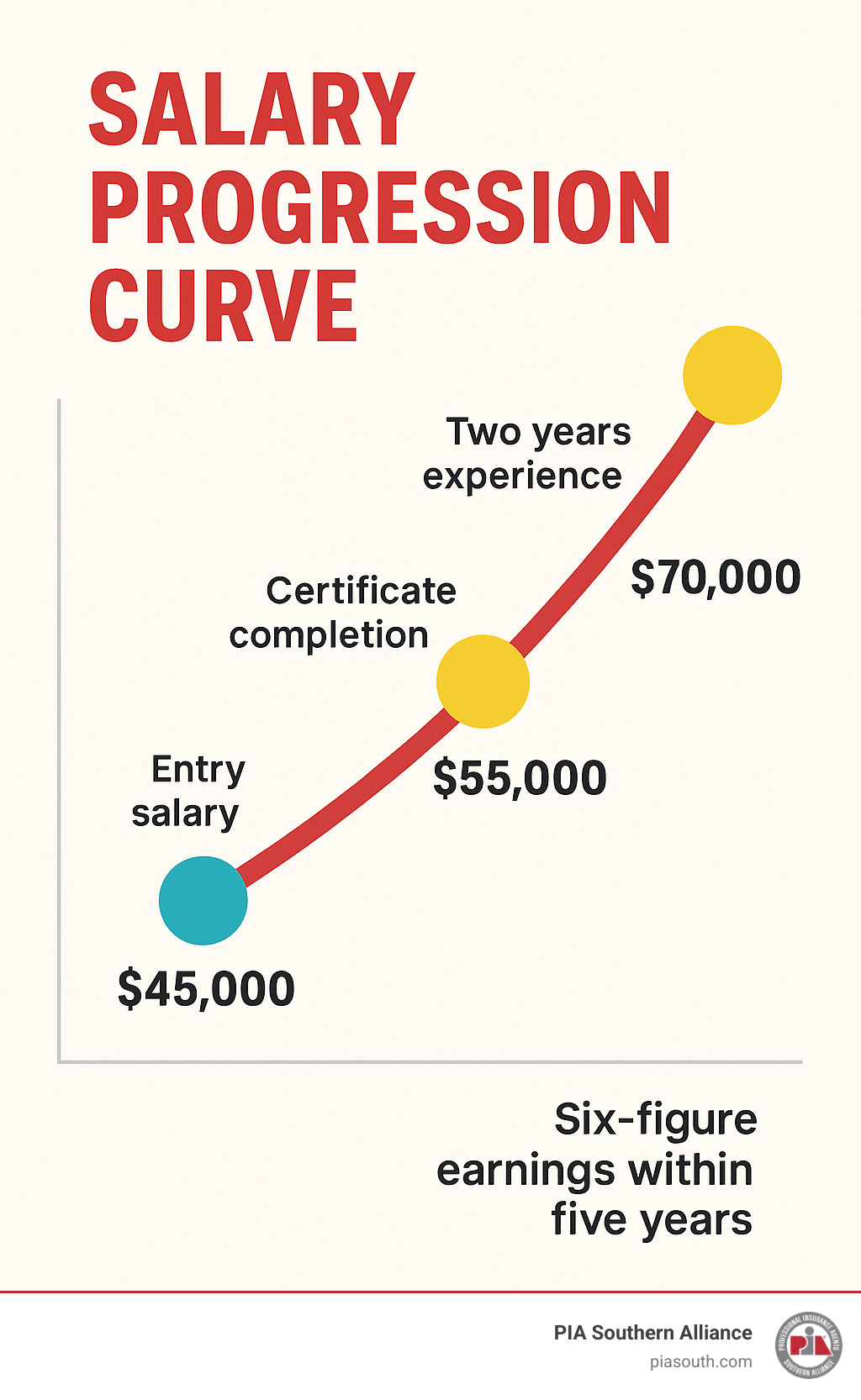
Starting salaries for certificate graduates typically hit $45,000 to $55,000 right out of the gate. Personal lines agents moving to commercial coverage frequently see instant bumps due to higher commission rates.
The five-year earning trajectory tells an even better story. Most certificate graduates reach six-figure incomes within five years. Consider this: a $2,000 program investment that leads to a $10,000 annual salary increase pays for itself in less than three months.
Career advancement opportunities multiply with certificate credentials. Employers value the demonstrated commitment to professional development, often translating to faster promotions and leadership opportunities.
Career Outcomes & Continuing Pathways
The moment you complete your commercial insurance certificate programs, you’ll step into a job market with a 95% job placement rate across leading programs. Graduates find themselves choosing from multiple opportunities rather than scrambling to find work.
Your first role might be as a commercial lines customer service representative or junior underwriter, diving into the analytical side by evaluating business risks. Claims adjusting offers variety and problem-solving for those who enjoy detective work. Commercial brokerage suits those drawn to relationship-building, designing insurance solutions for business clients.
Account management combines technical knowledge with people skills, making it perfect for professionals who want to stay close to clients while developing deep expertise.
More info about Commercial Insurance Sales Training provides additional insight into sales-focused career paths.
How certificate holders advance in commercial P&C
Commercial insurance certificate programs don’t just get you in the door – they set you up for long-term success. Most certificate holders advance through hands-on experience, strategic additional education, and smart professional designation choices.
Leadership opportunities typically emerge within 3-5 years for professionals who demonstrate both technical competence and business sense. Specialized designations like the Certified Risk Manager (CRM) or Chartered Property Casualty Underwriter (CPCU) represent the next level of professional achievement.
Agency ownership remains attractive for entrepreneurial professionals. Many successful agency owners in our region started with certificate programs, gained experience, built client relationships, and eventually launched their own practices.
Next steps after graduation
Completing your commercial insurance certificate programs is just the beginning. The immediate next step is tackling state licensing examinations, and your certificate training provides excellent preparation.
Licensing requirements vary slightly between Georgia, Alabama, and Mississippi, but your certificate program covers the core concepts tested in all three states. Advanced education opportunities become more accessible once you have your certificate. Many universities offer advanced standing in risk management degree programs for certificate holders.
Continuing education becomes part of your professional routine. The insurance industry evolves constantly, and staying current keeps your career moving forward. The PIA Southern Alliance continues to support professionals throughout their careers with specialized resources designed for independent agents in our region.
Frequently Asked Questions about Commercial Insurance Certificate Programs
What is the typical length of a certificate program?
Commercial insurance certificate programs offer flexibility with three main categories:
Quick-start programs run 15-40 hours and can be completed in 2-6 weeks with part-time study. Standard programs are the sweet spot – about 3-4 months with 6-8 hours of weekly commitment. Extended programs take 6-8 months but include field experience, mentorship, and licensing preparation.
Do online certificates meet state licensing requirements?
Online commercial insurance certificate programs absolutely can meet prelicensing education requirements across our region. Alabama requires minimum classroom hours with at least five hours focused on state law, but online delivery typically satisfies these requirements. Georgia and Mississippi have similar provisions that allow online education for prelicensing.
Before you enroll, always verify that your chosen program meets your state’s exact requirements. Quality programs will clearly spell out which licensing requirements they satisfy.
How much experience do I need before enrolling?
Commercial insurance certificate programs welcome everyone from complete newcomers to seasoned personal lines agents. The entry requirements are typically just a high school diploma and basic math skills.
Complete beginners shouldn’t feel intimidated. Personal lines agents often make the best commercial students because they already understand insurance fundamentals. Career switchers frequently bring valuable advantages – if you’ve worked in business, you already understand operations and client needs.
The most important qualification isn’t experience – it’s curiosity about how businesses work and a desire to help them succeed.
Conclusion
Starting a career in commercial insurance has never been more promising. Commercial insurance certificate programs open doors to an industry where talent is desperately needed and well-rewarded. With starting salaries between $45,000 and $55,000, and the realistic potential to earn six figures within five years, these programs deliver exceptional value.
The timing couldn’t be better. As 30% of current insurance professionals prepare to retire, you’re entering a field with guaranteed growth opportunities. Modern businesses face increasingly complex risks, creating steady demand for knowledgeable professionals.
What makes this career path appealing is the genuine satisfaction it provides. When 94% of insurance professionals report feeling proud of their work, you know you’re choosing more than just a job. You’re joining a profession that protects businesses and strengthens communities.
Whether you’re a recent graduate with a risk management degree, a personal lines agent ready to expand your expertise, or a career switcher seeking stability and growth, commercial insurance welcomes your unique background and skills.
At PIA Southern Alliance, we’ve watched countless professionals transform their careers through education and professional development. Our work with independent agents across Georgia, Alabama, and Mississippi has shown us how the right training improves not just individual success, but entire agency capabilities.
The path forward is clear and accessible. Commercial insurance certificate programs provide the knowledge foundation you need, while ongoing professional development keeps you current with industry changes. Most importantly, you’ll be joining a community of professionals committed to excellence and continuous learning.
Ready to take the next step? More info about insurance certification programs can help you begin your journey toward a rewarding career in commercial property and casualty insurance.