
Breaking into Commercial Claims Adjusting: Your Training Roadmap
Commercial claims adjuster training is the structured educational process that prepares insurance professionals to handle complex property and casualty claims for businesses. If you’re looking to enter this field or improve your existing skills, here’s what you need to know:
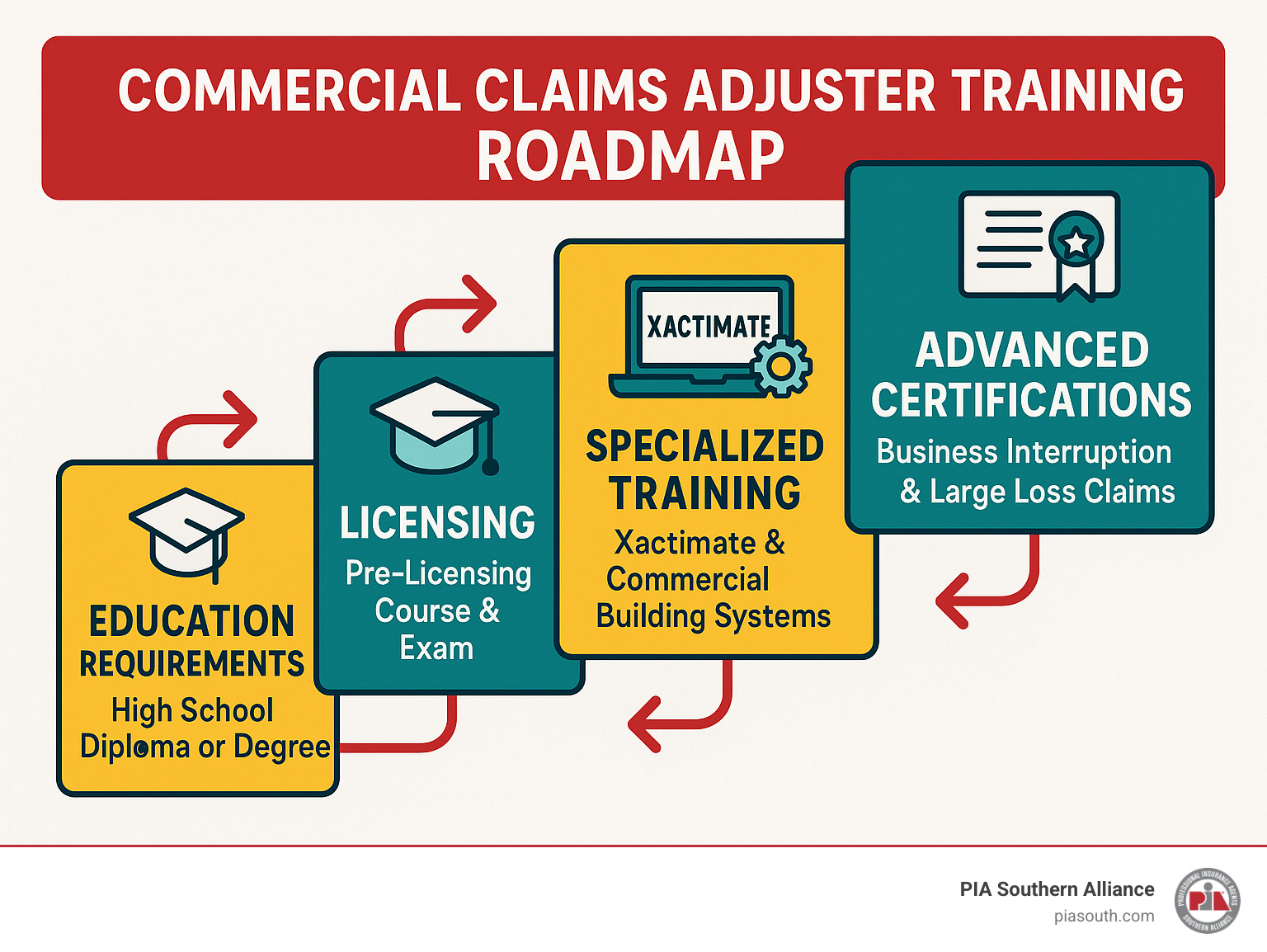
Quick Guide to Commercial Claims Adjuster Training:
1. Education Requirements: High school diploma minimum, risk management degree preferred
2. Licensing: State-specific exam and 24-52 hours of pre-licensing education
3. Core Training Components: Policy interpretation, building systems, Xactimate software, negotiation skills
4. Time Investment: 2-6 months for comprehensive training and licensing
5. Estimated Cost: $500-$1,500 for courses, exams, and licensing fees
Commercial claims adjusting offers a rewarding career path with median annual salaries of $75,020 according to recent Bureau of Labor Statistics data. The role requires specialized knowledge in commercial property valuation, business interruption calculations, and complex liability assessment—skills that go far beyond residential claims handling.
In Georgia, Alabama, and Mississippi, aspiring commercial adjusters must steer state-specific licensing requirements while developing technical expertise in estimation software and building systems. The comprehensive training programs available today combine classroom learning with hands-on experience in identifying damage, calculating settlements, and negotiating fair outcomes.
“The best training I have received in my insurance career has been focused on commercial claims adjusting,” notes one experienced adjuster who completed an intensive boot camp program. “This training has been an eye opener to the complexities of commercial property claims.”
As an organization dedicated to supporting independent insurance agents across Georgia, Alabama, and Mississippi, PIA Southern Alliance provides resources and guidance for those seeking to expand their expertise in commercial claims adjustment. Our focus remains on elevating the importance of property and casualty insurance while championing the personal and professional guidance that only independent agents provide.
Related content about commercial claims adjuster training:
– commercial insurance training
– commercial insurance underwriting training
Commercial Claims Adjuster Role & Responsibilities
When a business faces property damage or liability issues, the commercial claims adjuster steps in as the insurance company’s primary investigator and problem-solver. These professionals do much more than process paperwork—they’re skilled detectives, negotiators, and technical experts all rolled into one.
Investigation forms the cornerstone of a commercial adjuster’s work. You’ll find them climbing onto warehouse roofs after hailstorms, examining water damage in office buildings, or documenting inventory losses at manufacturing facilities. Their keen eyes catch details others might miss.
Coverage analysis requires deep knowledge of complex commercial policies. Unlike residential policies, commercial coverage often includes numerous endorsements, exclusions, and specialized language that demands expert interpretation. As one adjuster in Georgia put it, “Reading a commercial policy is like solving a puzzle where the pieces keep changing shape.”
Commercial adjusters also excel at damage assessment, applying their knowledge of building systems, equipment valuation, and local building codes across Alabama, Mississippi, and Georgia. They must understand everything from industrial HVAC systems to specialized manufacturing equipment.
Detailed documentation separates good adjusters from great ones. Every claim requires comprehensive reports, photographs, measurements, and written descriptions that could potentially stand up in court if challenged.
Negotiation skills prove essential when balancing the interests of policyholders, contractors, attorneys, and other stakeholders. The best commercial adjusters find fair solutions that satisfy all parties while protecting their company’s interests.
Risk assessment also falls under their purview, identifying potential subrogation opportunities or spotting the warning signs of fraudulent claims.
“Commercial claims adjusters don’t just settle claims—they solve complex business problems during some of the most challenging moments a company might face,” explains a veteran adjuster with over 15 years of experience in Mississippi’s commercial insurance market.
How Commercial Claims Differ From Residential
The jump from residential to commercial claims adjusting isn’t just a step up—it’s entering an entirely different world. Commercial claims adjuster training prepares professionals for these crucial differences:
The financial stakes reach dramatically higher levels in commercial claims, often involving hundreds of thousands or even millions of dollars. This heightened responsibility requires meticulous attention to detail and rock-solid justification for every decision.
Policy complexity increases exponentially with commercial coverage. While a homeowner’s policy might run 20-30 pages, commercial policies often exceed 100 pages with specialized endorsements, exclusions, and coverage extensions custom to specific business risks.
Multiple stakeholders complicate every claim. You’re not just working with a homeowner—you’re coordinating with business owners, property managers, tenants, contractors, and various third parties, each with their own priorities and concerns.
Business interruption calculations require specialized expertise. When a restaurant in Atlanta can’t operate for three months after a fire, calculating lost income involves complex formulas and business accounting principles that never appear in residential claims.
Commercial buildings contain sophisticated systems requiring specialized knowledge to assess properly. From industrial electrical systems in Alabama manufacturing plants to complex fire suppression systems in Mississippi retail centers, commercial adjusters need technical expertise far beyond residential requirements.
Code compliance issues add another layer of complexity. Commercial repairs must meet current building codes and Americans with Disabilities Act requirements, often adding significant costs to restoration projects.
A senior adjuster based in Alabama summed it up perfectly: “The difference between residential and commercial claims is like comparing a backyard garden to a commercial farm. The principles might be similar, but the scale, complexity, and specialized knowledge required are worlds apart.”
Day-to-Day Tasks That Build Expertise
The journey to mastery in commercial claims adjusting happens through daily practice. Each task builds crucial skills that transform novices into experts:
Site inspections sharpen your eye for detail. Whether examining storm damage to a Georgia shopping center or water intrusion at an Alabama office complex, each inspection builds your ability to identify structural issues, hidden damages, and potential repair challenges.
Policy review becomes second nature as you interpret complex commercial language daily. This repetition builds the mental muscle to quickly identify coverage nuances, exclusions, and special conditions that affect claim outcomes.
Damage valuation using specialized software like Xactimate becomes more intuitive with practice. Creating detailed estimates for commercial properties builds proficiency in construction costs and methods specific to business environments.
Reserve setting develops your business acumen. Establishing appropriate financial reserves for claims requires forecasting skills and financial judgment that improve with each case you handle.
Daily stakeholder communication transforms you into a skilled negotiator. Regular interactions with business owners, contractors, and experts across Georgia, Alabama, and Mississippi build professional communication abilities that prove invaluable throughout your career.
Meticulous documentation becomes habit-forming. Maintaining thorough claim files with photos, notes, and correspondence develops organizational skills that separate professional adjusters from the rest.
These daily activities gradually build the expertise that defines successful commercial claims adjusters. The most respected professionals in the field didn’t learn everything in a classroom—they developed their skills through years of hands-on experience handling increasingly complex commercial claims.
Licensing & Education Roadmap (GA, AL, MS Focus)

The path to becoming a licensed commercial claims adjuster in our tri-state region has its own unique twists and turns. While Georgia, Alabama, and Mississippi share similar fundamentals, each state adds its own special flavor to the licensing journey.
In Georgia, your journey begins with completing 40 hours of approved pre-licensing education. Once you’ve absorbed all that knowledge, you’ll face the state adjuster exam at one of the PSI testing centers. With exam conquered, you’ll submit your application through NIPR (National Insurance Producer Registry), complete a background check with fingerprinting, and pay a $100 initial license fee. Your license will need renewal every two years, along with 24 hours of continuing education to keep your skills sharp.
Alabama raises the educational bar slightly, requiring 52 hours of pre-licensing education, including 2 hours dedicated to ethics training. The Alabama exam comes with a $75 fee, and your application through NIPR will cost $110. One thing to watch for in Alabama: fingerprinting results are only valid for 30 days, and you’ll need to submit proof of citizenship within 10 days of application. For renewal, Alabama follows a biennial schedule based on your birth month/year, requiring 24 hours of CE with 3 hours specifically focused on ethics.
Mississippi follows a similar pattern with approved pre-licensing education, a state-specific exam, application through the Mississippi Insurance Department, and the standard background check with fingerprinting. Like its neighbors, Mississippi requires ongoing continuing education to maintain your license.
According to the Bureau of Labor Statistics, Claims Adjusters, Appraisers, Examiners, and Investigators can expect stable employment opportunities, with particular demand for those who specialize in commercial claims.
“I’ve seen many aspiring adjusters trip up by assuming requirements are identical across state lines,” shares one of our education specialists at PIA Southern Alliance. “What works in Georgia might leave you short in Alabama or Mississippi, so always double-check the specifics for your state.”
Fast-Track vs Traditional Paths
Not all roads to becoming a commercial claims adjuster look the same. The traditional path involves earning a risk management degree or related field, completing your state’s pre-licensing education, passing the exam, and starting as a trainee handling smaller claims before gradually moving up to complex commercial matters.
But what if you’re looking to accelerate your journey? Several fast-track options exist:
For hands-on learners, apprenticeship programs offer the chance to work under a licensed adjuster while completing your education requirements. Alabama specifically offers an apprentice adjuster license that allows on-the-job training for up to 12 months.
Military veterans often find their discipline, attention to detail, and experience with complex systems translate beautifully to adjusting. Some states offer expedited licensing paths to honor their service.
Those with backgrounds in construction, engineering, or law bring valuable expertise that can fast-track their transition into commercial claims adjusting.
Some even begin by working catastrophe response during major events, gaining intensive experience in a compressed timeframe – though this baptism by fire isn’t for everyone.
As one seasoned adjuster told us with a smile, “You can sprint to the finish line, but you might arrive too winded to do the actual job well. Building a solid foundation first pays dividends when you’re facing a complex commercial claim with multiple stakeholders and millions on the line.”
Maintaining Your License
Earning your license is just the beginning – keeping it current requires ongoing attention. All three states in our region require renewal every two years, with each having its own continuing education requirements.
In Georgia, you’ll need 24 hours of CE per renewal period. Alabama matches that 24-hour requirement but specifically mandates 3 hours of ethics training within that total. Mississippi also requires 24 hours, including ethics training.
The focus on ethics requirements continues to grow across all three states, reflecting the critical importance of ethical claims handling in maintaining public trust. As one adjuster put it, “Ethics isn’t just about following rules – it’s about sleeping well at night knowing you’ve treated everyone fairly.”
During declared emergencies, our states may implement special provisions for out-of-state adjusters to work temporarily, helping communities recover more quickly from disasters.
Throughout your career, maintain careful records of all CE credits and professional development activities. These documents are your proof of compliance should questions ever arise.
“I tell new adjusters to think of CE as an investment, not a burden,” notes one of our education specialists. “Every course you take makes you more valuable in this field. The adjusters who thrive are the ones who genuinely want to keep learning, not just check boxes for renewal.”
With the right education and licensing foundation, you’ll be well-positioned to build a rewarding career in commercial claims adjuster training and practice across Georgia, Alabama, and Mississippi.
Commercial Claims Adjuster Training Programs & Curriculum

When it comes to commercial claims adjuster training, there’s a world of difference between merely meeting licensing requirements and truly mastering the craft. The best training programs don’t just prepare you to pass an exam—they equip you to confidently handle the unique challenges of commercial claims from day one.
“I thought I knew insurance until I stepped into my first damaged warehouse,” shares one of our recently trained adjusters. “That’s when I realized why specialized commercial training matters so much.”
Quality commercial claims adjuster training programs blend theoretical knowledge with practical application. They typically begin with all-lines coverage instruction, ensuring you understand the intricate details of commercial property policies, liability protections, and the often-complicated business interruption calculations that can make or break a business after a loss.
The hands-on component is where many programs truly shine. Modern training facilities offer immersive learning environments—some featuring what trainees affectionately call “claim adjuster theme parks” spanning over 26,000 square feet. In these spaces, you’ll practice assessing damage on mock commercial structures, from retail storefronts to manufacturing facilities.
Xactimate training forms the backbone of most programs, with focused instruction on commercial applications of this industry-standard software. You’ll learn to create accurate scope of damages, steer commercial price lists, and generate the detailed reports that stakeholders expect.
Many programs offer specialized tracks for field versus desk adjusting, recognizing the different skill sets needed for on-site inspections versus remote claims handling. Field adjusters receive additional training in safety protocols and physical inspection techniques, while desk adjusters focus more on documentation and remote assessment skills.
For those who can’t commit to full-time classroom learning, self-paced online options provide flexibility. These programs allow you to develop commercial claims expertise while maintaining your current employment—an attractive option for career changers or those looking to specialize.
At PIA Southern Alliance, we understand the unique challenges faced by insurance professionals in Georgia, Alabama, and Mississippi. Our Commercial Insurance Training Programs are custom to the specific needs of adjusters working in these states, with attention to regional building codes, weather patterns, and state-specific regulations.
Core Modules in Commercial Claims Adjuster Training
Every comprehensive commercial claims adjuster training program builds expertise through several essential knowledge areas. Policy interpretation stands as perhaps the most fundamental skill—you’ll learn to steer the complex language of commercial property forms, understand business income calculations, identify coinsurance provisions, and recognize exclusions that could affect claim outcomes.
Building systems knowledge transforms good adjusters into great ones. You’ll develop expertise in evaluating commercial roofing types, assessing damage to complex HVAC systems, and identifying issues with electrical and plumbing infrastructures that often differ dramatically from residential settings. Understanding fire protection systems and building code compliance issues becomes second nature.
“The first time I had to evaluate a TPO roof system on a damaged strip mall, I was thankful for every minute of my commercial building systems training,” recalls one adjuster who completed our program.
Estimating software mastery receives significant attention, with hands-on practice creating accurate scopes, applying commercial pricing, and generating professional reports that stand up to scrutiny. The focus on Xactimate for commercial structures gives adjusters confidence when handling high-value claims.
Negotiation skills development prepares you for the human side of adjusting—working effectively with contractors, communicating clearly with anxious business owners, and documenting agreements properly. Many programs incorporate role-playing exercises to build these crucial soft skills.
Training in legal compliance rounds out the core curriculum, covering fair claims practices, documentation requirements, statutory obligations, and preparation for potential litigation. This knowledge helps protect both you and your company from unnecessary legal exposure.
Advanced Certifications & Continuing Education
Once you’ve mastered the fundamentals, specialized certifications can set you apart in the commercial claims field. Large loss specialization prepares you to handle claims exceeding $100,000, with advanced training in scope development and high-stakes negotiation techniques.
Catastrophe response certification equips you with the unique skills needed to handle commercial claims following hurricanes, floods, earthquakes, and other disasters. You’ll learn rapid assessment techniques, emergency mitigation strategies, and how to manage the logistics of catastrophe response.
Many adjusters pursue advanced study in business interruption calculations—a highly valued skill that involves determining lost income, extra expense coverage, and contingent business interruption. This expertise can save businesses from financial ruin following a covered loss.
Flood adjusting certification, focusing on National Flood Insurance Program requirements for commercial properties, opens doors to handling these specialized claims. Similarly, understanding workers’ compensation issues helps adjusters steer cases where property claims intersect with workplace injuries.
Finding quality continuing education is essential for maintaining your edge. Resources like the California Department of Insurance Education Provider and Course Search offer a model for identifying reputable education providers, though you’ll want to check with your specific state insurance department for approved courses in Georgia, Alabama, or Mississippi.
“The learning never stops in commercial claims,” notes one of our education specialists. “The most successful adjusters are those who view training not as a one-time requirement, but as an ongoing journey toward excellence.”
Essential Skills, Software, Ethics & Salary Outlook

Behind every successful commercial claims adjuster lies a well-rounded toolkit of skills, technical knowledge, and unwavering ethical standards. This isn’t just about checking boxes on a resume—it’s about developing the expertise that transforms an ordinary adjuster into an exceptional one.
When we talk with seasoned professionals about what makes them effective, they consistently highlight the blend of analytical thinking and people skills. “You need to be part detective, part engineer, part accountant, and part therapist,” laughs one veteran adjuster with over 20 years in commercial claims. “One day you’re crawling through a damaged warehouse, the next you’re explaining complex policy provisions to a business owner who just lost everything.”
Communication skills stand at the forefront of every successful adjuster’s arsenal. The ability to explain complicated coverage decisions with clarity and empathy can make all the difference during a business’s most challenging moments. This goes hand-in-hand with analytical thinking—parsing through dense policy language and applying it to unique, often complicated claim scenarios.
Equally important is a solid foundation of construction knowledge. Commercial adjusters must understand building systems, materials, and repair methods at a level that allows them to evaluate contractor estimates and identify potential issues. As one adjuster puts it, “You don’t need to be able to rebuild the building yourself, but you better know if someone’s trying to sell you a gold-plated solution to a brass problem.”
The modern adjuster must also accept technology. Xactimate proficiency isn’t optional—it’s essential. This industry-standard estimating software serves as the backbone for accurate commercial claims handling. Alongside Xactimate, adjusters increasingly work with Symbility for claims management, while newer technologies like drones revolutionize roof and exterior inspections of commercial properties. AI tools are also making inroads, helping adjusters assess damage patterns and streamline claims processing.
Documentation remains the unsung hero of claims adjusting. Creating thorough, defensible claim files requires discipline and attention to detail. “The claim file should tell a complete story,” advises one training specialist. “If someone picked it up five years later, they should understand exactly what happened and why decisions were made.”
The financial rewards of pursuing commercial claims adjuster training can be substantial. According to Bureau of Labor Statistics data, the median annual salary sits at approximately $75,000, with experienced commercial specialists often earning considerably more. During catastrophe events, adjusters may earn significant additional income through overtime and specialized assignments. Career advancement opportunities to senior adjuster, team leader, or claims manager positions can push earnings even higher.
Beyond the salary, there’s something deeply satisfying about helping businesses recover from disasters. “When you help a small business owner get back on their feet after a devastating fire, you realize you’re not just settling a claim—you’re saving jobs and livelihoods,” reflects one Georgia-based adjuster.
For those interested in exploring commercial claims trends in greater depth, our resource on Commercial Claims Data Analysis offers valuable insights.
Mastering Xactimate for Commercial Losses
When it comes to commercial claims adjuster training, few skills are as crucial as proficiency with Xactimate. This isn’t your basic residential estimating tool—commercial applications require a deeper understanding and specialized approach.
“The first time I tried to estimate a commercial warehouse in Xactimate, I nearly threw my computer out the window,” jokes one adjuster who now trains others. “The scale alone is intimidating, not to mention all the specialized materials and systems you need to account for.”
Effective Xactimate mastery for commercial claims involves several key components. First, adjusters must understand commercial line items and pricing, which differ significantly from residential materials. Macros and templates become essential time-savers when handling repetitive elements in commercial structures.
3D sketching takes on new importance with complex commercial buildings. Creating accurate digital representations of multi-story structures, unusual roof configurations, and specialized areas requires practice and spatial reasoning skills. Many adjusters find this the most challenging aspect to master.
Custom price lists also play a crucial role in commercial estimating. Regional variations in construction costs can significantly impact claim settlements, and savvy adjusters know how to develop and maintain price lists that accurately reflect local commercial construction realities.
Perhaps most importantly, commercial Xactimate estimates must be audit-ready. These documents will be scrutinized by supervisors, accountants, attorneys, and potentially expert witnesses. Attention to detail and thorough documentation of assumptions and calculations is non-negotiable.
The best commercial claims adjuster training programs offer hands-on practice with real-world commercial loss scenarios, feedback from experienced estimators, and regular updates on software changes. The investment in learning these skills pays dividends throughout an adjuster’s career.
Building an Ethical Mindset in Adjusting
Ethics isn’t just a checkbox on a licensing requirement—it’s the foundation of professional adjusting. In commercial claims, where financial stakes are high and multiple parties have interests in the outcome, ethical decision-making becomes even more critical.
Conflict of interest concerns arise frequently in commercial adjusting. The pressure to control claim costs must be balanced against the obligation to provide fair settlements based on policy provisions. As one ethics instructor puts it, “Your duty is to the integrity of the claims process, not to any particular outcome.”
Fair Claims practices are codified in most states, including provisions similar to California Insurance Code §14090.1, which establishes standards for equitable claims handling. These aren’t just legal requirements—they’re the guardrails that protect the reputation of the entire insurance industry.
Meeting statutory deadlines for claim acknowledgment, investigation, and settlement demonstrates respect for policyholders and compliance with regulations. In commercial claims, these timelines can be particularly challenging due to the complexity of losses, but ethical adjusters prioritize timely responses.
Transparency with policyholders builds trust during difficult circumstances. “I’ve never regretted being upfront with a policyholder, even when delivering unwelcome news,” shares one Mississippi adjuster. “People can accept a ‘no’ if they understand the why behind it.”
Maintaining rigorous documentation standards protects all parties involved. Complete, accurate records that support claim decisions provide a roadmap of the adjustment process and demonstrate good faith handling of the claim.
At PIA Southern Alliance, we believe ethical claims handling isn’t just about avoiding complaints or litigation—it’s about sleeping well at night knowing you’ve treated each claim with integrity and fairness. The best adjusters approach each file as if it were their own business at stake, recognizing that their decisions affect real people and real livelihoods.
The path to becoming an exceptional commercial claims adjuster isn’t easy, but for those willing to invest in developing these essential skills, master the necessary technology, and commit to ethical practice, few careers offer such a rewarding blend of intellectual challenge, financial stability, and meaningful impact.
FAQs & Conclusion
What are the prerequisites for commercial claims adjuster training?
Breaking into commercial claims adjuster training doesn’t require an advanced degree, but there are several important boxes you’ll need to check before getting started:
Most aspiring adjusters begin with at least a high school diploma, though a risk management degree can give you a significant competitive edge in this field. This specialized education provides a foundation in insurance principles that many employers value highly.
You’ll also need to clear a background check – Georgia, Alabama, and Mississippi all require fingerprinting to ensure you meet character and fitness standards. This reflects the position of trust that adjusters hold when handling significant financial decisions.
Age requirements are straightforward – you must be at least 18 years old in all three states we serve. You’ll also need to complete the state-required pre-licensing education, which varies from 24 to 52 hours depending on which state you’re pursuing licensure in.
Basic computer proficiency is essential as well. As one education specialist told us, “The days of clipboard-only adjusting are long gone. Today’s commercial adjuster spends as much time with software as they do inspecting properties.”
“While the barriers to entry are relatively low compared to other professions with similar earning potential,” notes one of our education specialists, “long-term success requires a genuine commitment to ongoing learning and professional development.”
How long does it take to become licensed in GA, AL, or MS?
The journey to becoming a licensed commercial claims adjuster varies somewhat between our three states, but generally follows a predictable timeline:
In Georgia, most candidates complete the process in 4-9 weeks. This includes 1-2 weeks for pre-licensing education, 1-3 weeks of exam preparation, 1-2 weeks for scheduling and completing the exam, and 1-2 weeks for application processing.
Alabama typically requires a bit longer, usually 5-10 weeks total. This is primarily because Alabama mandates 52 hours of pre-licensing education (compared to Georgia’s 40 hours), which usually takes 2-3 weeks to complete. The remaining steps – exam prep, testing, fingerprinting, and application processing – follow a similar timeline to Georgia.
Mississippi’s licensing process generally aligns with Georgia’s timeframe, averaging 4-9 weeks from start to finish.
“The process can definitely be expedited by focused study and prompt submission of all required documentation,” advises a licensing specialist we work with. “However, rushing through the educational components may leave gaps in your knowledge that become apparent when handling actual claims.”
We’ve seen motivated individuals complete the entire process in as little as one month when they dedicate themselves fully to the task. Others who are balancing full-time work or other responsibilities might take several months to complete all requirements.
Which tools should new commercial adjusters learn first?
Today’s commercial claims adjusters rely on a sophisticated toolkit that extends far beyond the clipboard and camera of yesteryear. New adjusters should prioritize mastering these essential tools:
Xactimate stands as the industry-standard estimating software and deserves your first attention. This powerful program enables you to create accurate damage assessments and repair estimates for commercial properties, and proficiency with it is often a job requirement.
Drone technology has revolutionized roof inspections, especially for large commercial properties. Learning to pilot these devices safely and in compliance with regulations provides a significant advantage in efficiency and safety.
Moisture meters and thermal imaging cameras have become indispensable for accurately assessing water damage in commercial structures, allowing adjusters to see beyond visible damage to identify potential problems lurking beneath surfaces.
Digital photography skills are crucial for proper documentation, while familiarity with claims management systems and basic office software (particularly Excel for calculations and Word for report writing) rounds out the essential technology toolkit.
“Technology is changing commercial claims adjusting at a remarkable pace,” explains one of our technology specialists. “Adjusters who accept these tools can work more efficiently and accurately, providing better service to policyholders while increasing their own productivity and value to employers.”

Conclusion & Next Steps
The journey to becoming a successful commercial claims adjuster isn’t a sprint – it’s a marathon that requires ongoing dedication to learning and professional growth. As we’ve explored throughout this guide, commercial claims adjuster training combines formal education, licensing requirements, technical skill development, and practical experience into a comprehensive career pathway.
For insurance professionals in Georgia, Alabama, and Mississippi, PIA Southern Alliance stands ready to support your journey, whether you’re just starting out or looking to improve your existing skills. Our commitment to the property and casualty insurance industry drives us to provide the educational resources adjusters need to excel in this challenging field.
If you’re considering this career path, we recommend taking these practical next steps:
First, honestly assess your current qualifications and determine which educational prerequisites you need to fulfill. Then research the specific licensing requirements for your state – each has its own nuances that can impact your preparation.
Consider enrolling in comprehensive training that goes beyond licensing basics to build commercial-specific expertise. The most successful adjusters we work with invest in developing proficiency with essential tools like Xactimate while simultaneously building a professional network through industry associations and mentorship relationships.
In this field, learning never stops. Commit to ongoing education to stay current with evolving building codes, policy forms, and claims practices. The insurance landscape changes constantly, and staying ahead of these changes is what separates average adjusters from exceptional ones.
“The best commercial claims adjusters I’ve worked with,” shares one of our education specialists, “combine technical knowledge with genuine people skills and ethical judgment. When these elements come together, you’re not just settling claims—you’re helping businesses recover and communities rebuild after loss.”
For more information about our commercial insurance training programs, visit Commercial Insurance Training Programs.