
Insurance agent classes are much more than a box to check.For insurance agents, education isn't a chore—it’s the cornerstone of a competitive, compliant, and profitable agency. Think of it as a critical tool for navigating a fast-moving industry.
Why Training Is a Strategic Asset for Insurance Agents

The insurance world doesn't stand still. New regulations pop up, client needs grow more complex, and innovative products hit the market constantly. The knowledge that served you well last year simply isn't enough for tomorrow's challenges. For today’s agents, continuous learning isn't just about compliance—it's a core business investment.
I like to think of high-quality education as an agency's GPS. It gives you clear, reliable directions in an increasingly tricky market, helping you sidestep risks and find the quickest routes to growth. Without it, you’re basically navigating blind.
More Than Just a Requirement
While many classes for insurance agents are mandatory for getting and renewing your license, their real value goes far beyond just meeting a requirement. A well-planned training program becomes a powerful strategic asset that fuels every single part of your agency.
For instance, getting a firm grasp on new products like Individual Coverage HRAs (ICHRAs) can unlock entirely new client segments you couldn't serve before, opening up fresh revenue streams.
This proactive mindset toward education delivers real, measurable returns:
- A Sharper Competitive Edge: Agents armed with the latest knowledge can offer more sophisticated and tailored solutions, which immediately sets them apart from the competition.
- Better Client Retention: When an agent truly understands a client's world, they build stronger relationships and earn lasting loyalty. In fact, with recent catastrophic events causing nearly $145 billion in economic losses, clients have complex questions and need expert answers now more than ever.
- Lower E&O Risk: Proper training in ethics and compliance directly reduces the odds of making a costly error or omission that could lead to a claim.
Viewing education as a strategic investment rather than an expense is the mindset that separates thriving agencies from those just getting by. It's the engine for sustainable growth and long-term relevance.
A Partnership in Professional Growth
For independent agencies in Georgia, Alabama, and Mississippi, this commitment to learning is even more crucial. You're dealing with local regulations and specific market dynamics that demand a focused educational strategy. That's where an organization like PIA Southern Alliance becomes a vital partner in your journey.
By providing curated educational resources, PIASA empowers agents like you to turn market challenges into genuine opportunities. Access to relevant courses, expert instructors, and a community of your peers transforms learning from an isolated task into a shared advantage. It ensures your team always has the skills needed to protect clients and build a resilient agency.
Understanding the Five Core Types of Insurance Classes

The world of classes for insurance agents can feel like a maze, with so many options vying for your attention. To make sense of it all, it helps to break your educational journey down into five core categories. Each one serves a different purpose, taking you from your very first day in the industry to becoming a seasoned expert.
Think of it like a mechanic's toolbox. You have basic wrenches for getting started, specialized tools for routine tune-ups, and high-tech diagnostic equipment for complex jobs. Knowing which tool to grab at each stage of your career is the key to working smarter, not harder.
1. Pre-Licensing Education
This is ground zero—your "learner's permit" for the insurance world. Before you can even think about selling a policy, every state requires you to pass a foundational pre-licensing course. These classes drill down on the absolute essentials: core insurance principles, key terminology, and the specific laws you'll need to follow.
The goal here isn't to turn you into a pro overnight. It's about giving you the baseline knowledge needed to pass your state licensing exam and ensuring every new agent starts with a solid understanding of the industry's rules and products.
2. Continuing Education
Once you’re licensed, the learning doesn't stop. In fact, it's just getting started. Continuing Education (CE) is the ongoing maintenance that keeps your license active and your skills from getting rusty. State insurance departments require you to complete a set number of CE credit hours each renewal period.
These classes make sure you’re up to speed on industry changes, new regulations, and evolving best practices. CE topics can range from ethics to new policy forms, making them a vital part of your professional growth.
Think of CE as your career's scheduled tune-up. It's not just about checking a box for compliance; it's about making sure your engine is running smoothly and you’re ready for whatever the road throws at you.
3. Product and Carrier-Specific Training
This is where you pop the hood and learn the ins and outs of a specific vehicle. When a carrier rolls out a new product or updates an old one, they often provide specialized training. These classes for insurance agents are deep dives into the nitty-gritty of policy language, underwriting rules, and ideal customer profiles.
A carrier might host a webinar, for instance, on a new Individual Coverage HRA (ICHRA) offering. This training gives you the confidence to explain its unique benefits to clients and pinpoint exactly who it's a good fit for. To get the most from these sessions and truly absorb the details, it helps to make study guides that reinforce what you've learned.
4. Sales and Marketing Skills
Having incredible product knowledge is one thing, but it won't grow your agency by itself. Sales and marketing training is like learning advanced driving techniques to leave the competition in the dust. These courses are all about practical, real-world skills that directly boost your bottom line.
This kind of training covers critical growth areas:
- Prospecting Strategies: Finding modern, effective ways to connect with potential clients.
- Consultative Selling: Moving from just selling a policy to becoming a trusted advisor who solves problems.
- Digital Marketing: Using social media, email, and your website to generate leads and build a strong brand presence.
Honing these skills helps you attract new business and strengthens your relationships with existing clients, which is a huge win for retention.
5. Compliance and Ethics Training
Finally, compliance and ethics training lays down the official rules of the road. These courses are often a mandatory part of your CE requirements and are designed to protect both your clients and your agency. They cover crucial topics like preventing errors and omissions (E&O) claims, handling client data securely, and navigating tricky ethical situations.
This is where you can find detailed information on key compliance areas, like the workers' comp specifics covered in our guide to https://piasouth.com/ncci-class-codes/. This training reinforces the professional standards that build client trust and ensure the long-term health of your business.
Navigating CE Requirements in Georgia, Alabama, and Mississippi
Continuing education isn't a one-size-fits-all deal. For agents across the Southeast, staying compliant is a local game, with each state setting its own unique rules for license renewal. Keeping these hyper-local requirements straight is critical to avoiding fines and ensuring your license—and your business—remains in good standing.
Think of state CE rules as different dialects of the same language. The core purpose is always the same: ensuring professional competence. But the specific vocabulary of credit hours, mandatory topics, and renewal deadlines varies quite a bit as you cross state lines from Georgia to Alabama to Mississippi.
Georgia CE Requirements
For agents in the Peach State, the rules are pretty clear and structured. Georgia mandates a specific number of hours every two years, with a non-negotiable focus on ethics to keep professional standards high.
- Total Hours: You'll need to complete 24 hours of continuing education every two-year renewal period.
- Ethics Requirement: Of those 24 hours, 3 hours must be dedicated to ethics. This is a mandatory piece of your CE puzzle.
- Renewal Cycle: Your license expires on the last day of your birth month every two years, tied to whether you were born in an odd or even year.
So, if you were born in May of an even-numbered year, your license will always be up for renewal by May 31st of the next even-numbered year. Missing these deadlines can lead to fines and a lapsed license, which is a major disruption no agency wants to deal with.
Alabama CE Requirements
Right next door in Alabama, the structure feels familiar but has its own unique quirks. The state also requires a 24-hour commitment over a two-year period, making sure agents are up-to-date on industry practices.
Maintaining compliance isn't just about checking a box; it's a fundamental part of risk management for your agency. A single lapsed license on your team can create a serious E&O exposure.
Alabama’s rules are straightforward:
- Total Hours: Agents need 24 hours of CE credits per two-year compliance period.
- Ethics Requirement: Just like in Georgia, Alabama requires 3 of these hours to be in ethics.
- Renewal Cycle: The renewal period is biennial, ending on the last day of the agent's birth month.
This consistency in total hours can make life a bit easier for agencies operating across state lines, but it's still absolutely crucial to track each agent's individual renewal date.
Mississippi CE Requirements
Mississippi also sticks to the 24-hour standard but throws in a key difference: it puts a heavy emphasis on courses related to an agent's specific lines of authority.
- Total Hours: A total of 24 hours is required every two years.
- Ethics Requirement: A minimum of 3 hours must cover ethics.
- Line of Authority Focus: At least 12 hours of your CE must be in courses directly related to the lines of insurance you're licensed to sell.
This means a Property & Casualty agent can't just fill their schedule with 24 hours of general courses. At least half of their training has to be on P&C-specific topics. This approach makes sure the education isn't just for compliance, but that it's actually practical and relevant to your day-to-day work. For a deeper look into these rules, our guide on state insurance education requirements explained offers even more detail.
Organizations like PIA Southern Alliance make this whole process a lot simpler. By offering a curated catalog of state-approved classes for insurance agents, we help our members in Georgia, Alabama, and Mississippi find the right courses without the headache. Members get access to tracking tools and exclusive discounts, making it easier and more affordable to stay compliant and focused on what really matters—serving your clients.
How to Choose the Right Insurance Classes for Your Team
Picking the right classes for insurance agents is a strategic move that goes far beyond just finding the cheapest option. Let's be honest, not all courses are created equal, and a bad choice wastes more than just money—it wastes your team’s valuable time. To make a smart educational investment, you need a solid framework for figuring out which training will actually sharpen your team's skills and help hit your agency's goals.
Think of it like hiring a new producer. You wouldn't just look at what they want for a salary. You’d dig into their experience, check their references, and see if their skills are what your agency truly needs. You should apply that same level of care when choosing your team's education. It's the only way to get a real return on your investment.
Look Beyond the Price Tag
The first step is a mental shift: stop focusing on cost and start focusing on value. An inexpensive but irrelevant course is a complete waste. It's far better to invest in a pricier class that directly boosts your team's sales ability or helps them get a handle on risk management.
To make sure your team enrolls in courses that tackle their actual professional development needs, a great starting point is using a practical skills gap analysis template. This will help you zero in on specific areas where a little training could go a long way.
From there, run potential classes through this simple checklist:
- State Accreditation: Is the course officially approved by the Department of Insurance in your state (Georgia, Alabama, or Mississippi)? This is the absolute first thing to check for any CE credit course. It's a non-negotiable.
- Delivery Format: Does the format work for your team? A live webinar is great for real-time questions and interaction, but on-demand courses offer the flexibility busy agents often need.
- Instructor Credibility: Who’s teaching the class? Look for instructors with years of real-world insurance experience, not just academic credentials. Their practical stories and insights are often the most valuable part of the training.
- Return on Investment (ROI): How will this course actually improve performance? A class on a new product like ICHRA should directly lead to new sales conversations. An E&O course should make your agency less risky.
The Power of a Vetted Partner
Let's face it, evaluating every single course provider against these standards is a huge time-sink. This is where having a trusted partner like PIA Southern Alliance gives you a massive advantage. We do the heavy lifting for you by thoroughly vetting our educational partners and every course they offer.
By partnering with an organization that pre-qualifies training, you gain instant access to a curated catalog of high-impact, relevant, and state-approved education. It’s a shortcut to quality.
For example, when PIA Southern Alliance puts a course on our calendar, you can feel confident that it already meets our strict criteria. We make sure every class is taught by a credible industry pro, is approved for CE credits in our member states, and delivers practical knowledge that agents can use the very next day.
This vetting process saves you the guesswork. It gives you peace of mind that your training budget is being spent wisely to equip your team with the skills they need to drive real, measurable results.
The PIASA Advantage for Agency Education and Growth

Choosing the right classes for insurance agents is a big job, but trying to navigate the educational landscape on your own can be a huge time-drain. That’s where partnering with an organization like PIA Southern Alliance really pays off. It turns what feels like a chore into a real strategic advantage, giving your agency a clear path to meaningful growth. It’s about more than just finding courses; it’s about joining a community built to help you win.
For independent agencies in Georgia, Alabama, and Mississippi, PIASA is a dedicated growth partner. We provide a framework of educational support that directly boosts your agency's performance, profitability, and your ability to bring in and keep top talent. It’s a partnership that equips you with hand-picked resources designed for the specific challenges and opportunities we face in the Southeast.
Member-Exclusive Educational Discounts
One of the first and most concrete benefits of membership is a major break on costs. We all know that managing an agency's training budget is a constant balancing act. Every dollar you save on essential education can be put right back into other growth areas. PIASA members get exclusive discounts on a huge range of courses, from mandatory CE to advanced professional development.
And these aren't just minor markdowns. The savings allow agencies to provide more training to more team members, building a stronger culture of learning without breaking the budget. This makes top-tier education more accessible, making sure your entire team—from producers to CSRs—has the skills they need to shine.
Localized Training and On-Demand Learning
Here at PIASA, we get that education has to be both relevant and convenient. That’s why we offer a blended approach that combines local, in-person events with a massive library of on-demand virtual classes. This flexibility means every agent can find training that fits their schedule and how they learn best.
- Local Events: Our in-person sessions are fantastic opportunities to network with other agents and learn from industry experts who truly understand the Southeastern market.
- Virtual Library: The on-demand catalog gives you 24/7 access to crucial training. It’s perfect for knocking out CE credits at your own pace or getting up to speed on a new topic fast.
This dual-format approach means you’re never without the training you need, whether you thrive in a collaborative classroom or prefer the flexibility of learning online.
A strong educational partner does more than just list available classes. It builds a community of learning, connecting you with regional experts and peers to solve real-world agency challenges together.
A Community Focused on Your Growth
Beyond the discounts and course catalogs, the real PIASA advantage is the community. Membership plugs you into a network of fellow independent agents who are tackling the same challenges and chasing the same goals. This collaborative environment is a powerful resource for swapping ideas and growing professionally. To see more on how this community focus helps agents thrive, you can explore the benefits of the PIA Southern Alliance.
This community creates connections that lead to shared insights on everything from mastering new products to improving agency operations. When you invest in a partnership with PIASA, you’re not just buying access to classes; you're gaining a true ally that's committed to your agency’s long-term success.
Building Your Agency's Annual Education Plan
Let's shift our thinking. Education shouldn't be a reactive expense you scramble to cover before a deadline. It's a proactive growth strategy. A well-built annual training roadmap aligns your team's development with your agency's biggest goals, turning continuous learning into the engine that drives long-term success.
Instead of frantically searching for last-minute classes for insurance agents to meet a renewal date, a yearly plan gives you control. You can budget with intention, pick courses that solve real business problems, and track progress across your entire team. This approach ensures your training dollars are invested wisely and generate a genuine return.
Step 1: Align Training with Business Goals
The best education plans I've seen are always tied directly to business objectives. Before you even glance at a course catalog, stop and ask: what do we want to accomplish this year? Your answers will be the North Star for your training choices.
- Launching a new product line? Your producers will need carrier-specific training and advanced sales classes tailored to that product's ideal client.
- Trying to improve client retention? Focus on customer service workshops, E&O risk management courses, and classes that deepen your team’s policy knowledge.
- Entering a new market? Your team might need courses on state-specific regulations or the unique risks facing clients in that new territory.
This goal-oriented approach gives every class a clear purpose. It moves your agency from random acts of education to a focused strategy where learning directly fuels growth.
Step 2: Budget for Education as an Investment
Once you have your goals, you can build a realistic budget. Think of this as an investment in your agency's talent and future profitability, not just another operational cost. A strong educational foundation is absolutely critical, especially in a market that's poised for growth.
Industry projections point to a resilient and expanding field, with an expected 6% employment growth for insurance sales agents by 2033. That means about 47,100 job openings will be created annually. To capture that opportunity, agencies in Georgia, Alabama, and Mississippi have to invest in their people's skills. Training in sales and client advisory are top priorities, helping agents boost their earning potential—where the median salary hit $60,370 in May 2024 and the top 10% earned over $135,660. To learn more about these workforce trends, you can explore the insights from the 2025 Shin Research Program.
Step 3: Create an Agency Training Map
Now it's time to map out the specific needs for different roles within your agency. A producer's educational journey will look completely different from a CSR's. A simple chart like the one below can help you organize the plan.
| Role | Primary Goal | Recommended Classes | Timeline |
|---|---|---|---|
| Producer | Increase new business sales by 15% | Advanced Sales Techniques, Product-Specific Training, Digital Marketing for Agents | Q1 & Q3 |
| CSR | Improve client retention by 5% | E&O Risk Management, Customer Service Excellence, Advanced Policy Knowledge | Q2 & Q4 |
| New Agent | Achieve license and start producing | Pre-Licensing Education, Foundational Sales Skills, Agency Systems Training | First 90 Days |
This kind of role-based plan makes sure everyone on your team gets relevant, high-impact training. It helps them excel in their position and, most importantly, contribute to the agency's overarching success.
FAQ About Classes for Insurance Agents
Working through your educational journey always brings up a few questions. Here are some practical, straightforward answers to the most common queries we hear from agents about training and staying compliant.
How Far in Advance Should I Complete My CE Credits?
As a best practice, aim to finish your continuing education credits at least 30-60 days before your license is up for renewal. Why so early? This window gives both the course provider and the state plenty of time to process everything. Cutting it too close risks a license lapse just because of a processing delay.
Can I Use CE Credits from Another State?
Often, yes, but it really boils down to your home state's reciprocity agreements. Many states will happily accept credits from courses approved elsewhere, though they might have specific rules about the topic or who provided the class. Your best bet is to always confirm with your state's department of insurance first before you sign up.
A live webinar is all about real-time interaction—you can ask the instructor questions on the spot. An on-demand course, on the other hand, offers total flexibility to learn at your own pace. For most busy agents, a healthy mix of both formats works wonders.
Can I Get an E&O Discount for Taking Certain Classes?
Absolutely. Many Errors & Omissions (E&O) carriers offer some nice premium discounts if you complete specific ethics or risk management courses. Associations like PIA Southern Alliance often facilitate these approved classes, giving you a great way to lower your insurance costs while knocking out your CE requirements at the same time.
The diagram below breaks down the simple process for mapping out your annual education plan.
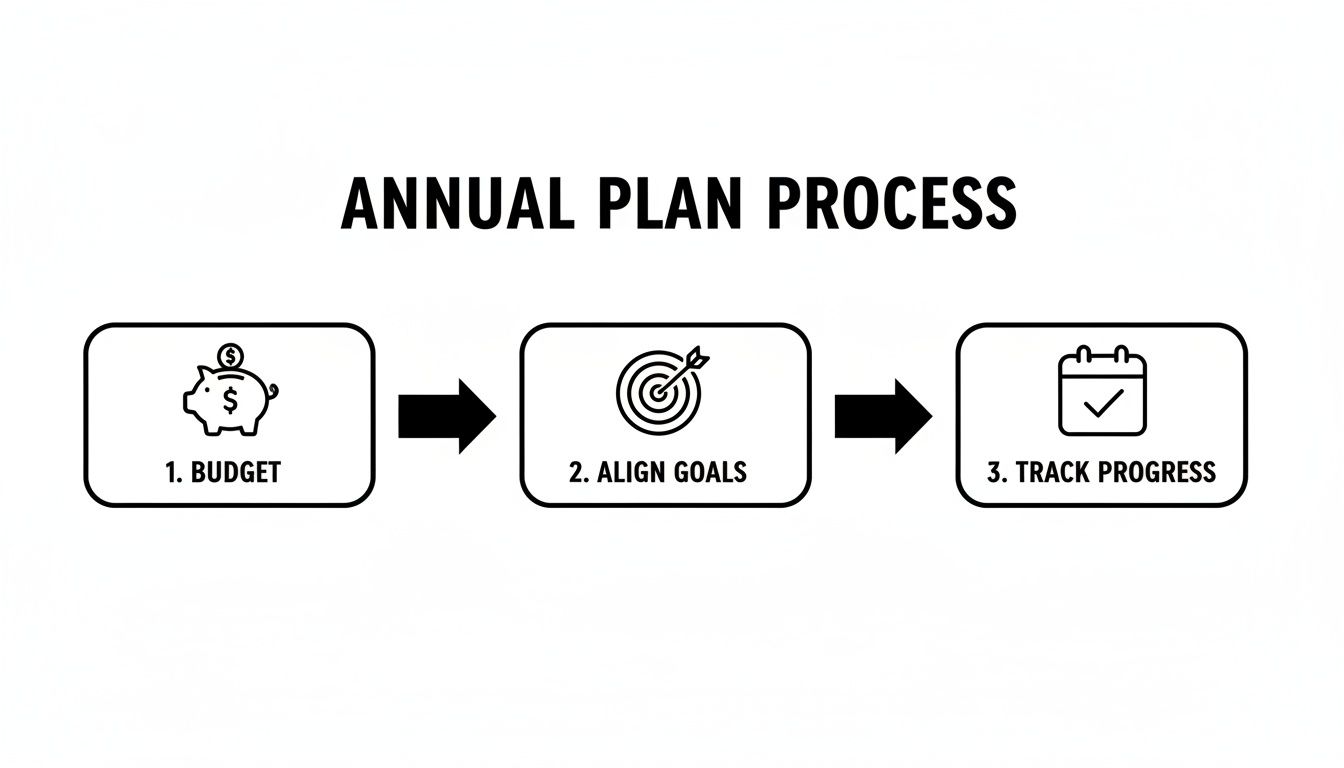
This visual highlights the three core steps to proactively managing your training: budgeting for it, aligning your education with your agency's goals, and tracking your progress along the way.
The PIA Southern Alliance is your partner in building a successful agency through strategic education. Discover how our member-exclusive resources, curated courses, and community support can help your team thrive. Learn more and join our network at piasouth.com.