
Finding affordable Errors and Omissions (E&O) insurance isn't about chasing the absolute lowest price—it's about building a smart, strategic plan. For independent agents in Georgia, Alabama, and Mississippi, landing cheap E&O insurance for insurance agents really means creating a risk profile that carriers want to reward. It all starts with a clear roadmap to lower premiums without giving up the protection your agency needs to thrive.
Your Roadmap to Affordable E&O Coverage
Think of finding cost-effective E&O coverage as a core business function, not just another bill to pay. This guide is designed to cut through the noise and give you a direct path to a policy that actually fits your budget. Instead of just shopping on price, the real goal is to make your agency a more attractive risk in the eyes of an underwriter. This mindset shift can turn a simple line-item expense into a strategic advantage for your agency.
The market for professional liability is massive. The global Insurance Agents Errors and Omissions Insurance market is projected to hit USD 4.1 billion in 2024, which just shows how essential this coverage is for agents everywhere. As the market grows, it's clear that more and more agencies see E&O as a non-negotiable part of their long-term stability.
The process for getting better rates can be boiled down to three key phases. This simple roadmap shows how a proactive approach works.
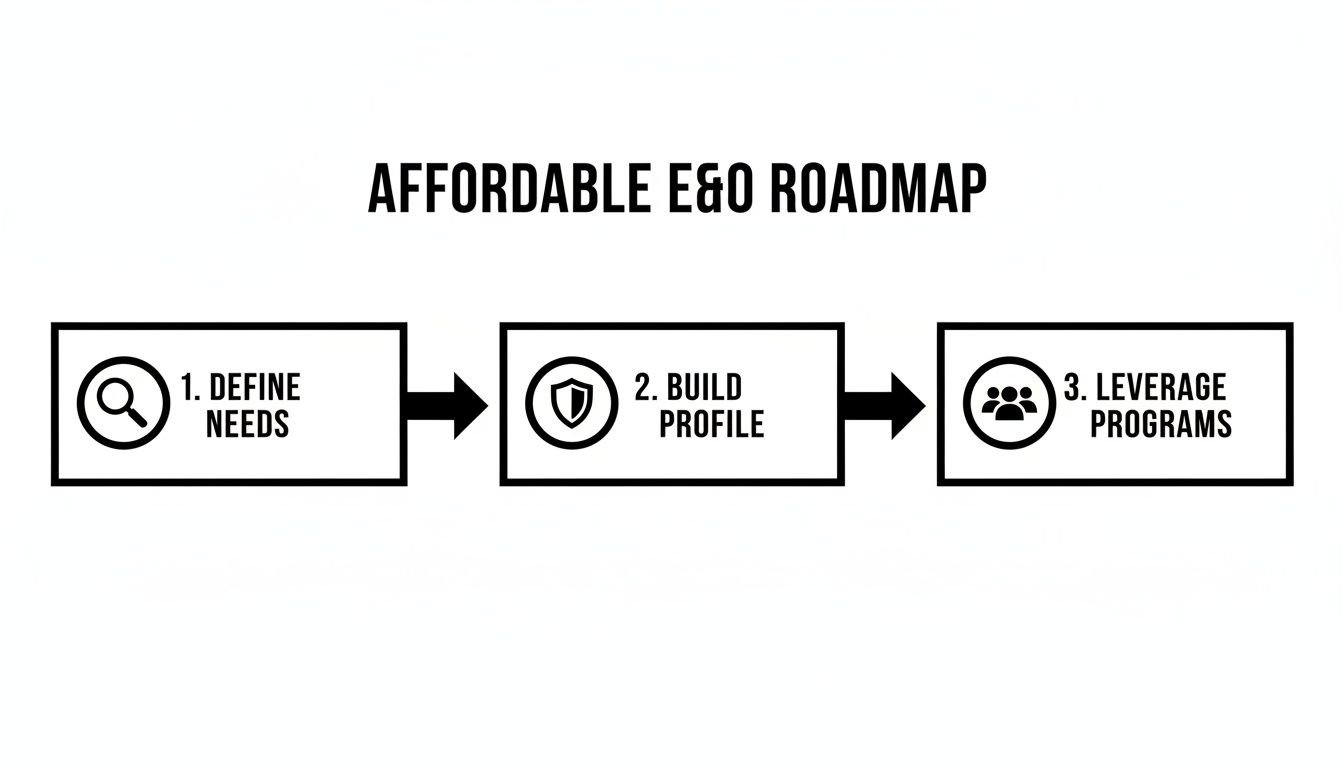
As you can see, a proactive strategy—defining your needs, building a strong risk profile, and using group programs—is the most reliable way to get a handle on your insurance costs.
Strengthen Your Agency's Risk Profile
Your journey to lower premiums starts by taking a hard look at your own internal operations. Underwriters reward agencies that can show they have strong risk management practices in place. Think of it as getting your agency ready for a favorable review.
You'll want to focus on a few key areas that underwriters scrutinize. These are the factors that directly influence what you pay.
Primary E&O Insurance Cost Drivers
Underwriters don't pull premium numbers out of thin air. They evaluate specific aspects of your agency to predict your potential for a claim. Here’s a breakdown of what they’re looking for.
| Cost Factor | What Underwriters Look For | Impact on Premium |
|---|---|---|
| Lines of Business | The types of policies you sell (e.g., complex commercial lines vs. simple personal auto). | Higher-risk lines like benefits or financial products increase premiums. |
| Agency Procedures | Documented, consistent workflows for quoting, binding, and client communication. | Standardized procedures demonstrate control and lower your premium. |
| Claims History | The frequency and severity of past E&O claims against your agency. | A clean loss run is your best asset for securing lower rates. |
| Staffing & Training | The number of agents, their experience levels, and your training programs. | Regular E&O training and experienced staff signal a lower-risk operation. |
| Technology Use | How effectively you use your Agency Management System (AMS) for documentation. | Consistent documentation and internal audits show you're proactive. |
| Revenue & Growth | The size of your agency and how quickly it's growing. | Rapid growth without proper controls can be seen as a higher risk. |
By improving in these areas, you give underwriters concrete reasons to offer you a better rate. It's about showing, not just telling, them that you're a good risk.
Here are a few practical steps you can take right now:
- Standardize Your Workflows: Get your procedures for quoting, binding, and client communication down on paper. Consistency is key to preventing common, and costly, errors.
- Invest in Staff Training: Hold regular training sessions on E&O avoidance and compliance. It proves your commitment to minimizing risk before it happens.
- Audit Your Own Files: Use your agency management system to its full potential. Conduct regular internal file audits to catch inconsistencies before an underwriter does.
Building a strong operational foundation creates tangible proof for underwriters that your agency is a lower-than-average risk. This gives you powerful leverage during rate negotiations. For instance, the strategic outsourcing of insurance processes can lead to significant cost savings and reduced error rates, making your agency a much more appealing risk to carriers.
By taking these steps, you’re not just buying insurance; you're building a case for why your agency deserves a better premium. This sets the stage for long-term savings and a stronger, more resilient business.
Figuring Out What Your Agency Really Needs
The first step toward finding cheap E&O insurance for insurance agents isn't scrolling through quotes. It's figuring out exactly what you need to buy in the first place. I’ve seen so many agents overspend on coverage they’ll never use, which just inflates their premium for no good reason. On the flip side, being underinsured to save a few bucks is a gamble that could put your entire agency on the line.
This is where you build your "shopping list." It's about getting past the generic advice and down to the nitty-gritty of your agency. The goal here is to create a detailed blueprint of your needs so you can request accurate, competitive quotes that actually match your risk profile.
Aligning Liability Limits with Your Agency’s Reality
Setting your liability limits can feel like a guessing game, but it doesn't have to be. Start by thinking through your worst-case scenario. What’s the single biggest claim that could realistically hit your agency?
If you run an agency in rural Mississippi focused on personal auto and home, that number is probably tied to the value of a high-end home and everything inside it. But for a mid-sized commercial agency in metro Atlanta handling big accounts, the potential claim could be exponentially higher, involving things like business interruption or complex liability.
To right-size your limits, think about these key factors:
- Annual Revenue: More revenue usually means more transactions. More transactions mean a higher chance of an error slipping through. Carriers see a direct line connecting revenue and risk.
- Client Concentration: Do you have one or two massive clients making up a huge chunk of your revenue? A single mistake on one of those accounts could be devastating, which points toward needing higher limits.
- Product Complexity: Selling standard personal lines is generally seen as lower risk than placing complex Directors & Officers (D&O) or cyber liability policies. That said, even with personal lines, the exposure can be higher than many agents think. You can learn more about how personal lines present more E&O exposure than you might realize in our detailed article.
- State and Local Jurisdictions: Jury awards and legal climates are not the same everywhere. An agency in a more litigious part of town might need higher limits just to sleep at night.
Walking through these points helps you land on a limit—like $1 million per occurrence / $2 million aggregate—that’s based on your specific risk, not just an industry default.
Choosing a Deductible You Can Actually Afford
Your deductible is one of the most direct ways to control your premium. A higher deductible will almost always mean a lower premium, but those savings are worthless if you can't comfortably write a check for that amount when a claim happens.
Choosing a deductible isn't just a financial decision; it's a cash-flow decision. Ask yourself: Can my agency write a check for this amount tomorrow without disrupting operations? If the answer is no, the deductible is too high.
Let's say you're looking at two options:
- A $5,000 deductible with a $4,500 annual premium.
- A $10,000 deductible with a $3,800 annual premium.
That $700 in premium savings with the higher deductible looks pretty good on paper. But if a claim comes in, finding $10,000 on short notice could put a major strain on your agency's finances. The smarter move is often the lower deductible that fits your agency’s cash reserves, even if it costs a bit more in premium.
Your E&O policy should be a safety net, not a source of financial stress. By nailing down these details first, you're ready to shop the market with a clear, defensible list of what you need.
Building a Risk Management Program Carriers Love

Let's be blunt: E&O carriers reward proactive risk management with lower premiums. It really is that simple. When an underwriter sees an agency with documented, consistent loss-control habits, they see a lower-than-average risk.
This is your chance to stand out. You can transform your agency from just another application in the pile into a best-in-class risk that carriers actively want to insure. It’s not about theory; it’s about putting practical systems in place that directly translate into premium credits and negotiating from a position of strength for cheap E&O insurance for insurance agents.
Develop and Document Your Loss-Control Procedures
The first thing you need is a formal "E&O procedures manual." This isn’t just paperwork—it’s tangible proof of your agency's commitment to getting things right. It doesn't need to be a hundred pages long, but it must be clear, consistent, and—most importantly—followed by everyone on your team.
Think of this manual as your agency's playbook. It should outline the non-negotiable steps your team takes to prevent the common mistakes that lead to claims.
Here are some of the most impactful procedures you can implement today:
- Standardized Coverage Checklists: Create and use a consistent checklist for every single client interaction. This goes for new policies and renewal reviews. It ensures you always offer key coverages and, crucially, document the client's decision to accept or decline.
- A Dual-Signature Process: For high-value or complex commercial policies, require a second set of eyes on the final proposal and binding documents. A simple peer review can catch a costly mistake before it ever leaves the office.
- Consistent Client Communication Logs: This one is huge. Mandate that every substantive client conversation—phone call, email, or in-person meeting—is documented in your agency management system (AMS). This creates an unshakeable record of what was discussed, what was promised, and when.
- Formal Renewal Review Process: Never assume a client's needs are the same year after year. Implement a mandatory process for reviewing coverages with every client at renewal time. Don’t just send the invoice.
By documenting these habits, you’re not just building a defense against potential claims. You’re giving underwriters a concrete, undeniable reason to offer you a better rate.
An underwriter’s job is to predict risk. A well-documented procedures manual removes the guesswork. It proves your agency operates with a level of diligence that significantly reduces the likelihood of a future claim.
Even if your agency doesn't focus on tech clients, you're still affected by broader market trends. For instance, the United States commands a massive 36% global market share in Technology E&O insurance, driven by the sheer number of SaaS companies and strict vendor liability standards. For us agents in Georgia, Alabama, and Mississippi, this means the pricing and policy structures we see are often shaped by what's happening in larger tech hubs. You can learn more from the full technology E&O insurance market report-insurance-market).
Prioritize Ongoing Staff Training
That procedures manual? It’s only as effective as the team putting it into practice. This is why regular, focused staff training is the second pillar of a strong risk management program. Carriers love to see agencies that invest in their people, because educated teams make fewer errors.
You don't need a huge budget for this. Effective training can be as simple as a 30-minute huddle once a month dedicated to E&O avoidance.
Here are a few high-impact training topics to get you started:
- Real-World Claim Scenarios: Find some anonymized E&O claims from industry reports and talk them through as a team. What went wrong? How would our agency’s procedures have prevented that error?
- "Hard" vs. "Soft" Market Education: Train your staff on how market conditions affect coverage availability and pricing. This helps them set realistic expectations with clients and avoid promising something the market simply can't deliver.
- Documentation Best Practices: Continually reinforce the "if it's not in the AMS, it didn't happen" rule. Show concrete examples of good and bad file notes to illustrate exactly what you expect.
Make sure you document every training session—the date, the topic, and who was there. This training log becomes another piece of evidence for your underwriter, proving your agency’s proactive stance on risk. This commitment, combined with a strong procedures manual, makes a compelling case for the best possible E&O premium.
How to Shop the Market for the Best E&O Quotes
With your agency's needs defined and your risk controls documented, it's time to shop smart. The good news? The E&O market for independent agents has stabilized in a big way. After years of a tough market and climbing rates, a buyer-friendly environment finally emerged in 2023.
This shift happened because new carriers jumped into the market, bringing fresh capital with them. That sparked more competition and put the brakes on runaway premium hikes. For agents in Georgia, Alabama, and Mississippi looking for affordable coverage, this is a very favorable window. You can take a closer look at these market dynamics in this full analysis of the agent E&O market.
This climate gives you more power as a buyer—but only if you know how to work the quoting process. The goal is to get multiple, truly comparable quotes to find the best value, not just the lowest price on paper.
Partner with a Specialist Broker
Your first and most important move is to find the right partner. You wouldn't send a client with a complex manufacturing risk to a generalist who only writes personal auto, right? The same logic applies here. You need a broker who lives and breathes E&O for insurance agents.
A specialist broker brings some serious advantages to the table:
- Deeper Market Access: They have real relationships with the key carriers in the professional liability space, including those niche players a generalist has never even heard of.
- Coverage Expertise: They understand the subtle—but critical—differences in policy language from one carrier to the next. They know which exclusions are red flags and which endorsements are non-negotiable for your agency.
- Negotiation Leverage: Because they bring a ton of premium volume to E&O carriers, specialist brokers often have more clout to negotiate better terms and pricing for you.
Working with a generalist might seem easy, but they often lack the focused expertise to spot a policy that looks cheap on the surface but is riddled with dangerous coverage gaps.
Ask the Right Questions Before You Commit
Once you've found a potential broker, it's interview time. Don't be shy about asking tough questions. How they answer will tell you everything you need to know about their depth of knowledge and whether they're the right fit.
Your broker is your first line of defense. Vet them as carefully as you would a new producer. Their expertise—or lack thereof—will directly impact your agency's financial security.
Here are a few essential questions to ask any potential broker before they start shopping for your quotes:
- Which carriers will you approach for my E&O coverage? A good broker should be able to name their primary markets off the top of their head and explain why they are a good fit for an agency like yours.
- What is the A.M. Best rating for each of those carriers? You want to be certain you're only getting quotes from financially stable, A-rated or better carriers.
- How do these carriers handle claims? Are they known for being fair and responsive? A low premium is worthless if the carrier has a reputation for fighting legitimate claims tooth and nail.
- What are the most common or concerning exclusions I should watch for in policies for agents in my state? This question tests their specific knowledge of risks in the GA, AL, and MS markets.
The quality of their answers will reveal their competence and whether they can actually find you cheap E&O insurance for insurance agents without sacrificing crucial protection.
Compare Quotes Like an Underwriter
Once the quotes start rolling in, resist the impulse to just glance at the premium. A true apples-to-apples comparison means you have to dig into the policy details. I recommend creating a simple spreadsheet to line up the key features side-by-side.
Your comparison should force you to look past the price tag. The best option is often not the cheapest one, but the one offering the most comprehensive protection for a fair premium. You can also explore our overview of the top E&O insurance companies to see how leading carriers stack up. This methodical approach ensures you're making an informed decision based on value, not just cost.
Unlock Exclusive Savings with PIA Southern Alliance

While shopping the open market is always a smart move, one of the most powerful ways to find cheap E&O insurance for insurance agents is often right under your nose: your professional association. For independent agents in Georgia, Alabama, and Mississippi, your membership with the Professional Insurance Agents (PIA) Southern Alliance is a direct line to lower costs and top-tier coverage.
This isn't just about a small discount, either. PIA’s endorsed E&O programs are specifically vetted and negotiated for our members. The result is access to rates and policies designed for the real world of running an agency in the Southeast—a level of relevance you just can't get from a generic, one-size-fits-all policy.
Gain Access to PIA Endorsed E&O Programs
The biggest perk of your membership is getting into exclusive E&O programs. These aren't just any plans off the street. PIA’s own insurance committee puts carrier partners through a tough evaluation, looking for deep expertise in agent professional liability, rock-solid financials (A-rated or better), and a reputation for fair claims handling.
This vetting process saves you a ton of time. Instead of you spending hours researching dozens of carriers, the Alliance has already done the heavy lifting. You get a shortlist of high-quality, stable partners, giving you peace of mind that you're getting more than just a low price.
The benefits you'll often see include:
- Access to A-Rated Carriers: Many of these top-tier carriers prefer working through established association programs and might not even be available on the open market, especially for smaller or newer agencies.
- Negotiated Policy Forms: The policy language is often negotiated by PIA to be more favorable for independent agents, closing gaps you might find in standard forms.
- Stable, Competitive Pricing: PIA works with its carrier partners to keep pricing stable and competitive for members year after year, shielding you from the wild rate swings of the broader market.
Turn Your Professional Development into Premium Credits
Here’s where your PIA membership really starts paying you back in cash. Your commitment to being a better, more knowledgeable agent can directly lower your E&O premium through member-only credits.
PIA-endorsed carriers know that agents who actively pursue continuing education and loss-control training are better risks. So, they offer real premium credits for participating in specific PIA-sponsored programs.
It's a true win-win. Take a PIA CE course on E&O risk management, and you not only make your agency safer but also get an immediate discount on your policy. It’s that simple.
Think about these common premium credits available only to members:
- PIA E&O Loss-Control Credit: Complete a qualifying PIA E&O seminar and you can earn a credit of up to 10% on your premium for two straight policy periods. That one action could save you hundreds or even thousands of dollars.
- PIA Certified Professional Insurance Agent (CPIA) Credit: Earning your CPIA designation is a huge professional achievement, and endorsed carriers reward that hard work with another premium credit.
Of course, these credits aren't automatic—you have to take the courses and show proof of completion to your broker. But it's one of the easiest and most effective ways to drive down your premium while making your agency a stronger, better-defended business. There's a wealth of information out there on how an active membership pays off, and you can learn more about how the PIA Southern Alliance helps its members grow.
Think of it as a loyalty program for good risk management. The more you invest in your expertise through PIA, the more you save. This gives underwriters a clear, financial reason to offer you their best rate—an inside track to savings that non-members simply don't have.
Answering Your Top E&O Insurance Questions
When you're shopping for E&O, a lot of questions pop up. It’s totally normal. You’re trying to find affordable coverage that actually protects your agency, and the details can get confusing fast.
Let's cut through the noise. Here are some straightforward answers to the most common concerns we hear from independent agents across Georgia, Alabama, and Mississippi.
What Does E&O Insurance Actually Cover, Anyway?
At its heart, Errors and Omissions (E&O) insurance is a very specific type of professional liability coverage. It’s built to financially protect insurance agents if they're accused of dropping the ball while doing their job.
Think of it as your agency’s own safety net. It’s there to help cover the costs if a client alleges:
- Errors: You accidentally write a policy with the wrong coverage amount.
- Negligence: You failed to recommend a crucial coverage that a client clearly needed.
- Omissions: You forgot to add that brand-new truck to a client's commercial auto policy.
- Insufficient Work: You misquoted a premium or didn't get coverage bound in time, leading to a gap.
A good E&O policy will typically cover court costs, attorney fees, and settlements up to your policy limit, whether the claim gets resolved in court or not. It’s the one thing standing between your agency and the financial fallout of human error.
Do I Legally Have to Carry E&O Insurance?
This is a huge point of confusion for a lot of agents. In Georgia, Alabama, and Mississippi, there’s no specific state law that forces an independent agent to have an E&O policy. But that’s not the whole story.
While the state might not mandate it, the insurance carriers you want to get appointed with absolutely will. It is standard practice for carriers to require any agency selling their products to maintain an active E&O policy. Plain and simple, they won’t appoint you without it.
You can think of it this way: while not always a legal requirement, E&O coverage is a practical necessity to do business as an independent agent. Without it, your access to carriers and markets will be severely limited, if not nonexistent.
What's This Going to Cost Me? Unpacking E&O Premiums
There’s no single price tag for E&O insurance. The cost varies widely, much like the policies you sell your own clients. Underwriters look at a pretty consistent set of factors to figure out what your premium will be.
Here are the key drivers that influence your premium:
- Your Lines of Business: Selling complex commercial or benefits policies is seen as higher risk than standard personal lines.
- Agency Size and Revenue: A larger agency with more staff and higher revenue naturally has more exposure.
- Claims History: A clean loss run is your single best tool for getting a lower premium.
- Coverage Limits and Deductible: Higher limits and lower deductibles mean higher costs.
- State of Operation: Legal climates and jury award trends can differ by state, which impacts rates.
While prices vary, some data suggests E&O premiums for life and health agents can start as low as $26 per month. For P&C agents, especially those with commercial books, the cost is usually higher. The real takeaway, though, is that this premium is a tiny fraction of what a lawsuit could cost—which can run from $3,000 to over $150,000, even for a minor claim.
Can a Small Mistake Really Turn into a Big Claim?
Yes. One hundred percent, yes. This is one of the most underestimated risks in our industry. Even the most careful, detail-oriented agent can make one small oversight that snowballs into a massive financial headache.
Just think about this real-world scenario. An agent forgets to add a newly licensed teenage driver to a family's auto policy. A week later, that teen causes a serious at-fault accident. The claim is denied.
Now the client is facing huge bills for property damage, medical costs, and potential legal action. You can bet they'll be looking to the agency to make them whole, arguing the agent was negligent. That single omission could easily trigger a six-figure claim.
This is exactly why finding cheap E&O insurance for insurance agents is about getting the best value, not just the lowest price. Your policy is there to protect you when these seemingly small mistakes spiral out of control.
What’s the Difference Between "Claims-Made" and "Occurrence" Policies?
This is a critical distinction every agent needs to get right. The vast majority of E&O policies you'll find are written on a claims-made basis.
- Claims-Made Policy: This policy covers claims that are made and reported during the policy period. For coverage to kick in, your policy must be active when the claim is filed, no matter when the mistake actually happened. This is why maintaining continuous coverage and understanding your "retroactive date" (the date from which your policy will cover past acts) is so important.
- Occurrence Policy: This policy covers incidents that occurred during the policy period, regardless of when the claim is eventually filed. These are extremely rare in the professional liability world because of the long-tail risk they create for insurers.
Since your E&O is claims-made, letting your policy lapse is a huge gamble. It can create a dangerous gap in your protection, leaving you completely uninsured for mistakes made in the past.
Ready to find high-quality, affordable E&O coverage that’s built for your agency? At PIA Southern Alliance, we connect members in Georgia, Alabama, and Mississippi with exclusive, vetted E&O programs that offer competitive rates and superior protection. Explore our member-exclusive E&O options and other benefits today.