
The Financial Impact of Insurance Certification on Your Career
Earning a professional designation almost always translates into a larger paycheck. Certified property-and-casualty specialists command 18–25 % higher pay than their non-certified peers. Typical ranges look like this:
Average Certified Insurance Professional Salaries:
- AINS (Associate in General Insurance): $72,000/year
- CIP (Chartered Insurance Professional): C$64,000/year (Canada)
- CISR (Certified Insurance Service Representative): $63,000/year
- Licensed Property & Casualty Agent: $59,000/year
- Insurance License 440: $45,000/year
Key Salary Factors:
- Experience: $44,000 entry-level to $97,000+ senior
- Location: Metro areas usually pay more
- Gender Gap: 5-10 % in most markets
- Job Satisfaction: 4/5 across credentials
For independent agencies in Georgia, Alabama, and Mississippi, the takeaway is simple: certification isn’t an expense—it’s an investment. PIA Southern Alliance sees certified producers earn more and retain clients longer while tackling cyber and climate-driven risks. Agents who upskill now position themselves for emerging high-value accounts and stronger, more resilient careers.
What Does It Mean to Be a Certified Insurance Professional?

Think of being a certified insurance professional like being a master craftsman instead of just someone who owns a hammer. You can get your basic property and casualty license and start selling insurance – that’s your hammer. But certification? That’s your entire toolbox, complete with specialized instruments that most agents never learn to use.
In Georgia, Alabama, and Mississippi, we see agents every day who wonder if investing time and money in certification is worth it. The certified insurance professional salary data speaks for itself, but there’s more to it than just the paycheck boost.
When you pursue certification beyond your basic Insurance License 440, you’re telling the world that you take this profession seriously. You’re not just someone who stumbled into insurance – you’re a professional who understands the complexities of risk management, the nuances of coverage analysis, and the art of matching clients with the right protection.
The process isn’t exactly a walk in the park. You’ll complete rigorous coursework, pass comprehensive exams, and commit to ongoing education. But here’s what makes it worthwhile: you’ll start thinking differently about insurance. Instead of just selling policies, you’ll become someone who truly understands risk.
Most-Recognized Credentials in P&C
When it comes to property and casualty certifications, some credentials carry more weight than others – both in terms of respect and salary potential.
The Associate in General Insurance (AINS) sits at the top of the earnings ladder, with professionals averaging $72,000 annually. This certification covers everything from fundamental insurance principles to advanced underwriting concepts.
The Chartered Insurance Professional (CIP) designation is particularly strong in Canada, where holders earn around C$64,000 per year. While more common north of the border, this certification demonstrates expertise in insurance law, claims handling, and sophisticated risk management strategies.
For agents who excel at client relationships, the Certified Insurance Service Representative (CISR) credential opens doors to $63,000 average annual earnings. This certification focuses on the service side of insurance – turning you into someone clients actually want to work with.
Your basic Licensed Property & Casualty Agent credential gets you in the door at around $59,000 annually, but it’s really just the foundation. Most successful agents we work with in our three-state region use this as their launching pad, not their destination.
Why Risk-Management Degrees Lead the Pack
Here’s something interesting we’ve noticed: agents with risk management degrees consistently outperform their peers, regardless of which certifications they add later.
A risk management major teaches you to think like an underwriter from day one. Instead of learning to sell insurance and then figuring out how it works, you understand the “why” behind coverage decisions. You can look at a manufacturing facility and immediately spot the exposures that keep underwriters awake at night.
This background gives you real-world underwriting knowledge that makes client conversations completely different. When a business owner describes their operations, you’re not just nodding along – you’re already thinking about their loss control opportunities and coverage gaps.
The client-analysis skills that come with risk management education are pure gold in commercial lines. You can walk into a prospect meeting and demonstrate value before you even talk about price. That’s the difference between being a vendor and being a trusted advisor.
In our experience across Georgia, Alabama, and Mississippi, agents with this educational foundation tend to gravitate toward commercial property and casualty lines, where the earning potential typically exceeds personal lines. They also advance into agency ownership roles more quickly because they understand insurance as a business, not just a product.
Certified Insurance Professional Salary Overview in the U.S. & Canada
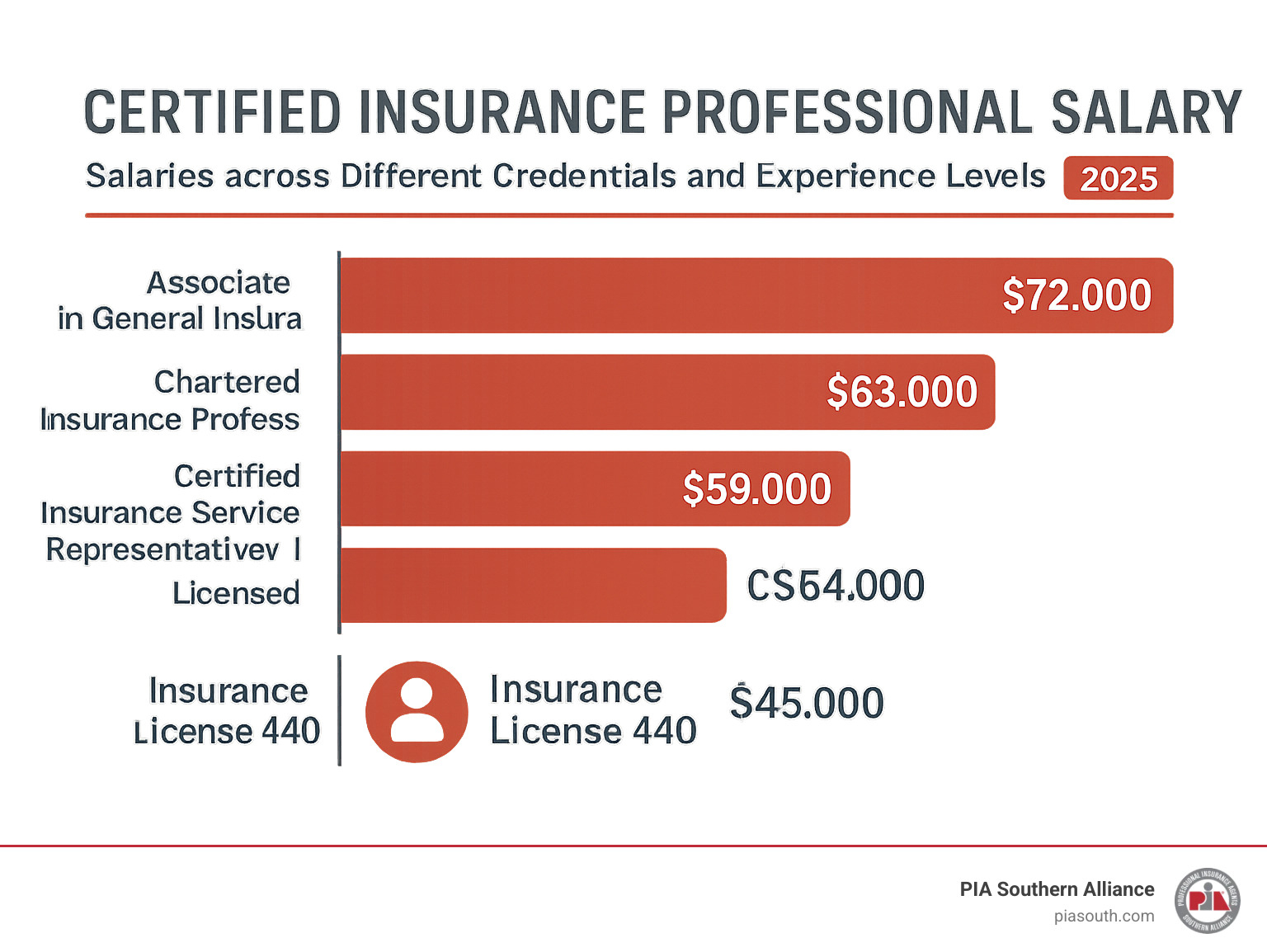
When you’re deciding which certification path to pursue, understanding the certified insurance professional salary differences between the U.S. and Canada can help you make the smartest investment in your future. The numbers tell a compelling story about the value of professional credentials in property and casualty insurance.
Across both countries, certified professionals consistently out-earn their non-certified peers. In the United States, insurance specialists with certifications average $65,704 annually, with most professionals earning between $56,488 and $73,801. But specific certifications often push you well above these baseline numbers.
Our neighbors to the north show similar patterns. Canadian professionals holding the Chartered Insurance Professional (CIP) designation earn an average of C$64,000 per year, which breaks down to about C$27.50 per hour. What makes this particularly attractive is the flexibility it offers for professionals who prefer varied work arrangements.
The latest research on Canadian CIP earnings reveals something else worth noting: job satisfaction among certified professionals runs high, with 4 out of 5 rating their career satisfaction positively. That’s the kind of work-life balance that makes the certification investment worthwhile.
Average Certified Insurance Professional Salary by Certification
Let’s get specific about what each certification can mean for your paycheck. The certified insurance professional salary varies considerably based on which credential you choose to pursue.
AINS holders command the highest average at $72,000 annually. This Associate in General Insurance certification opens doors to commercial lines work, where complex risk analysis translates to higher compensation. Nearly a quarter of AINS professionals are in their early careers, yet they’re already earning competitive salaries.
CIP professionals in Canada average C$64,000 per year. What’s fascinating about this certification is the demographic breakdown: 75% of holders are women earning between C$46,000 and C$95,000, while their male counterparts earn between C$48,000 and C$109,000. The hourly rate of C$27.50 makes this particularly appealing for professionals seeking flexible schedules.
CISR certification delivers solid returns at $63,000 annually. The Certified Insurance Service Representative credential attracts professionals who excel at customer relationships and technical knowledge. With nearly 35% of CISR holders in late-career stages, this certification shows excellent retention.
Licensed Property & Casualty Agents earn a foundational $59,000 per year. Based on reports from over 7,400 professionals, this represents your starting point. The experience levels are evenly distributed across career stages, showing steady progression opportunities.
Insurance License 440 starts at $45,000 annually. While this represents the entry level of certified professional salaries, it’s often your first step toward more advanced credentials. Nearly 80% of holders are women, with equal representation in early and mid-career stages.
How Certified Pay Stacks Up to Non-Certified P&C Roles
The salary premium for certification becomes crystal clear when you compare certified professionals to general insurance roles. More info about base agent pay shows that agents without certifications typically earn 15-25% less than their certified counterparts – and that gap widens over time.
Licensed insurance producers without additional certifications average $66,026 annually, with earnings ranging from $44,000 to $97,000. While there’s some overlap with certified roles, the career progression and long-term earning potential tell different stories entirely.
Insurance advisors without certifications average just $49,645 annually. That’s a substantial gap compared to certified professionals, and it becomes even more pronounced when you factor in total compensation packages, including bonuses and benefits that certified professionals typically command.
Here in Georgia, Alabama, and Mississippi, we see this premium play out consistently across our markets. Certified professionals not only earn more initially, but they also advance faster and build stronger client relationships that translate to long-term success.
What Really Drives Your Paycheck?

Certification sets the floor, but several other variables decide where you’ll land inside each pay band.
Experience is the biggest lever. Certified newcomers usually start around $44k–$48k. Ten years in, many top $97k because credentials speed up promotions.
Location inside Georgia, Alabama, or Mississippi matters too. Atlanta, Birmingham, and Jackson post the highest averages, though smaller towns sometimes offset lower bases with better work-life balance.
Agency size can change the math. Large regionals pay higher salaries and benefits; lean independents may trade lower bases for stronger commission splits and faster advancement.
A 5–10 % gender gap still persists, so negotiating well remains important.
Skills that add dollars:
- Cross-selling and new-business production
- Deep risk analysis, especially in commercial P&C
- Comfort with agency-management technology
- Confident negotiation
Insurance Specialist benchmarks show bonuses can add another 10-15 % for high achievers.
Entry, Mid, and Senior-Level Pay Progression
- Entry (0-2 yrs): $44k–$52k
- Mid (3-7 yrs): $55k–$75k
- Senior (8+ yrs): $75k–$97k+
Job Titles That Command Top Dollar
Insurance Specialist, Licensed Producer, Commercial Account Manager, and Advisory roles consistently sit at the upper end of the ranges above.
Career Paths & Long-Term Earning Potential

Your first certification is a starting line, not a finish. Most professionals follow one of two paths:
Traditional ladder
Licensed Agent → Senior Account Manager → Agency Management → Agency Owner/Principal
Each rung raises both base pay and control over your income.Specialist track
Certified producer → Niche consultant, corporate risk manager, or insurtech leader. Focused expertise often commands premium fees without the overhead of ownership.
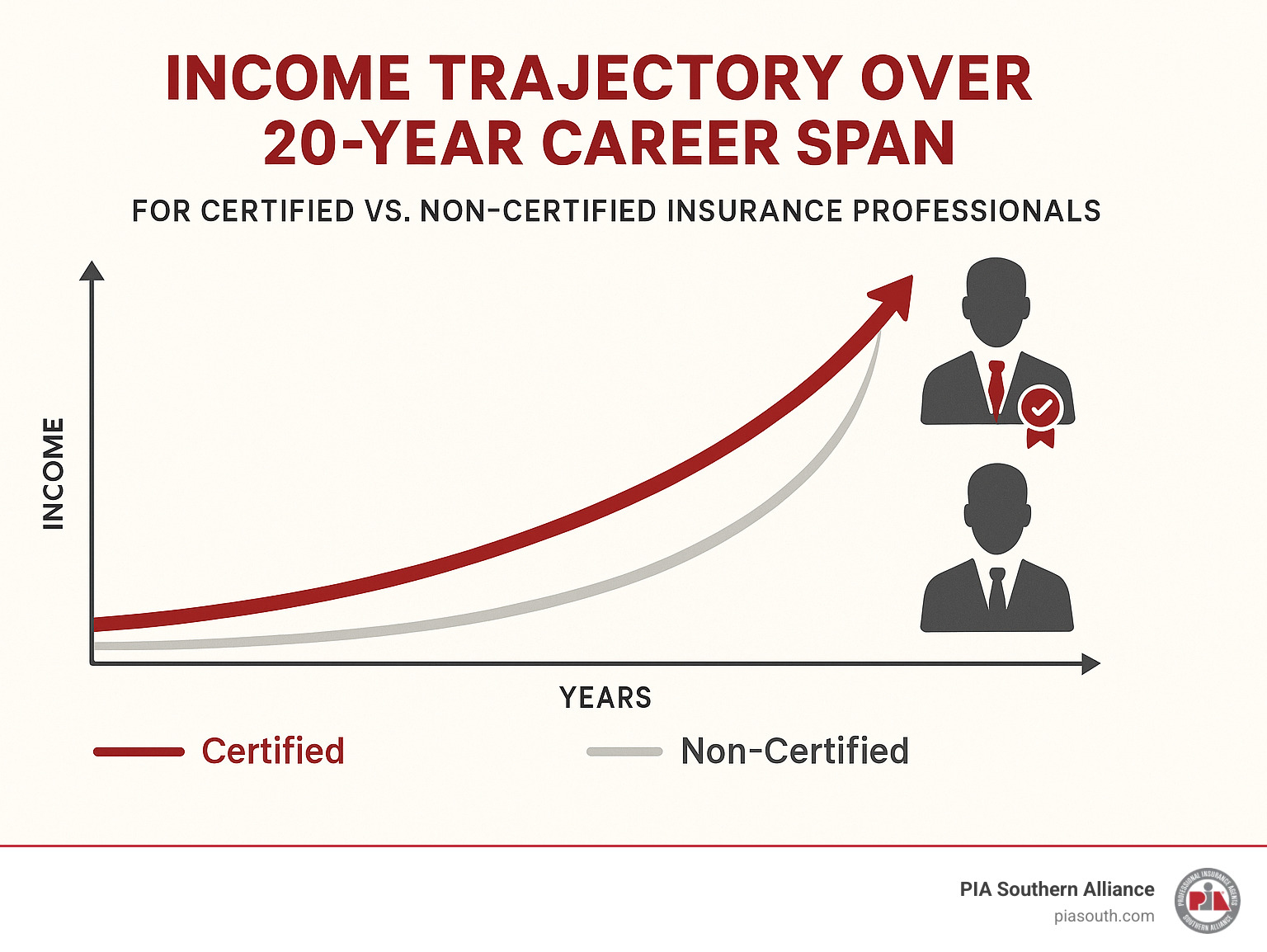
Transitioning from Producer to Agency Owner
More info about owning an agency
Certification eases that leap. Carriers offer appointments more readily, clients follow trusted advisors, and lenders view credentials as proof of competence—three ingredients for building long-term equity and residual income.
Emerging Opportunities in P&C
Cyber liability, climate-driven property risks, and data-driven analytics all favor certified agents who can translate complex exposures into coverage solutions.
Frequently Asked Questions about Certified Insurance Professional Salary
How much more can certification add in Georgia, Alabama, and Mississippi?
The salary boost from certification in our three-state region is impressive, but it varies depending on where you work and what you do. Certified insurance professional salary increases typically range from 15-25% over non-certified roles, though we’ve seen some professionals experience even greater jumps.
Atlanta’s busy insurance market tends to reward certification most generously. We’ve tracked certified professionals there earning 30-35% more than their non-certified colleagues. The competition is fierce, but the rewards match the intensity.
Alabama and Mississippi present a different picture. While base salaries might be lower than Georgia’s urban centers, the commission structures often favor certified professionals more heavily. Rural markets in these states offer something urban markets can’t – the chance to build deep, lasting client relationships that translate into substantial long-term earning potential.
The real magic happens when you look beyond base salary. Certified professionals consistently receive better commission splits, more desirable accounts, and faster advancement opportunities. That 15-25% increase in base pay often doubles when you factor in total compensation.
Which certification pays quickest dividends in property & casualty?
If you’re looking for the fastest return on your certification investment, the answer depends on where you’re starting from. AINS (Associate in General Insurance) holders command the highest average salary at $72,000 annually, making it attractive for those ready to tackle commercial lines.
But “quickest dividends” isn’t always about the highest number. Customer service representatives often see the most dramatic career change with CISR certification. The program teaches practical skills you can use immediately, and many professionals report salary increases within 6-12 months of completion.
For producers already working in commercial property and casualty, AINS provides the strongest foundation. The knowledge directly translates to better client conversations, more confident presentations, and ultimately, higher sales. We’ve watched agents leverage their AINS designation to move into specialized niches that command premium compensation.
The key is matching your certification choice to your career goals. A personal lines agent might see faster results with CISR, while someone eyeing commercial accounts should consider AINS. Either way, the investment typically pays for itself within the first year through increased earning potential.
Do certified professionals report higher job satisfaction?
Absolutely. Across every certification we analyzed, professionals consistently rate their job satisfaction at 4 out of 5 – significantly higher than non-certified colleagues. This isn’t just about the money, though the improved certified insurance professional salary certainly helps.
Certification transforms how you feel about your work. You approach client meetings with confidence because you truly understand the coverage you’re discussing. Complex claims become puzzles to solve rather than problems to avoid. Professional relationships deepen because clients recognize your expertise.
The continuous learning aspect keeps careers fresh and engaging. While some might worry about ongoing education requirements, certified professionals tell us it’s one of their favorite aspects. The industry evolves constantly, and staying current through certification programs ensures you’re always growing.
Career advancement opportunities multiply with certification. We’ve observed certified professionals moving into leadership roles, starting their own agencies, and transitioning into specialized consulting more frequently than their non-certified peers. This variety of options contributes significantly to long-term career satisfaction.
The combination of higher compensation, increased confidence, better client relationships, and expanded career options creates a positive cycle. Certified professionals earn more, enjoy their work more, and build more successful careers – which is why job satisfaction ratings remain consistently high across all certification types.
Conclusion
The evidence speaks for itself: investing in certification as an insurance professional delivers real financial results. The certified insurance professional salary data shows earnings ranging from $45,000 to $72,000 annually, with the specific credential you choose making a significant difference in your paycheck.
But here’s what makes certification truly valuable – it’s not just about that initial 18-25% salary boost. It’s about opening doors you didn’t even know existed. We’ve watched countless agents transform their careers after earning their credentials, moving from struggling to make ends meet to confidently building thriving practices.
The property and casualty landscape across Georgia, Alabama, and Mississippi is changing rapidly. Cyber risks that didn’t exist a decade ago are now essential coverage for every business. Climate-related claims are reshaping how we think about property insurance. Technology is revolutionizing how we serve clients and manage risk.
Certified professionals aren’t just keeping up with these changes – they’re leading them. They’re the ones clients turn to when facing complex exposures. They’re the ones agencies promote to management roles. They’re the ones who successfully transition to agency ownership and build lasting wealth.
The path from where you are now to where you want to be isn’t always clear. But certification provides a roadmap. Whether you’re aiming for that senior account manager position, planning to open your own agency, or simply want to sleep better knowing you can provide genuine value to your clients, professional credentials give you the foundation to succeed.
Your clients deserve an expert, not just someone who can fill out applications. Your family deserves the financial security that comes with being a sought-after professional. You deserve the confidence that comes from truly understanding your craft.
The insurance industry will keep evolving, creating new opportunities for those prepared to seize them. The question isn’t whether change is coming – it’s whether you’ll be ready when it arrives.
Ready to take that next step? Explore the various certification pathways available to property and casualty professionals. Your future self will thank you for the investment you make today.
In an industry built on relationships and trust, certification isn’t just another line on your resume. It’s proof that you’re serious about your profession – and serious about serving your clients at the highest level.